Mathematics II
 Call Kai
 Learn
Learn Practice Test
 Spaced Repetition
 Match
Match Flashcards
 Knowt Play
1/49

There's no tags or description
Looks like no tags are added yet.
Name | Mastery | Learn | Test | Matching | Spaced | Call with Kai |
|---|
No analytics yet
Send a link to your students to track their progress
50 Terms
What is the formula for the limit of a composite function?
lim (x -> a) f(g(x)) = f(lim (x -> a) g(x))
When is a function continuous?
lim (x -> a-) f(x) = lim (x -> a+) f(x) = f(a)
When does a limit exist?
lim (x -> a-) f(x) = lim (x -> a+) f(x)
What is the formula for the ceiling function?
⌈x⌉ = the smallest integer greater than or equal to x
What is the formula for the floor function?
⌊x⌋ = the greatest integer less than or equal to x
What is the formula for L'Hôpital's Rule?
If lim (x -> c) f(x)/g(x) is indeterminate, then lim (x -> c) f(x)/g(x) = lim (x -> c) f'(x)/g'(x)
If f(x) is differentiable at c, f is [?] at c?
continuous
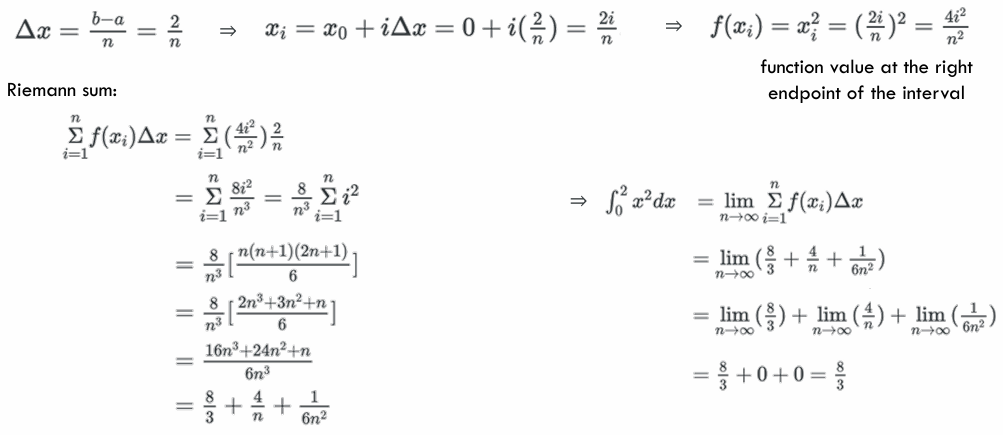
What is the formula for the Riemann Sum?
Σ f(xi*) Δx

What is the process when solving a Riemann Sum problem?
1. Calculate Δx
2. xi = a + iΔx
3. plug xi into f(xi*)
4. isolate i sum and replace with n
5. Simplify n expression
6. Calculate answer when n -> infinity
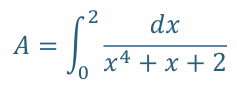
Determine an appropriate inequality that bounds A using the Comparison Theorem and write a general Min-Max Bounding Method
Min-Max Bounding Method:
S = ∫[a to b] f(x) dx with f(x) contiunous on [a,b]
Identify the integrand i.e. f(x) = (the integrand)
Find where f(x) is largest and smallest on the interval
Check if f(x) increasing or decreasing
OR evaluate f(a) and f(b) if monotonic (always increasing/decreasing)
Use the bounding inequality
min f(x) (b - a) ≤ ∫[a to b] f(x) dx ≤ max f(x) (b - a)Substitute in the values for min/max f(x) - compute the bounds
![<p>Min-Max Bounding Method:</p><p>S = ∫[a to b] f(x) dx with f(x) contiunous on [a,b]</p><ol><li><p>Identify the integrand i.e. f(x) = (the integrand)</p></li><li><p>Find where f(x) is largest and smallest on the interval</p><ul><li><p>Check if f(x) increasing or decreasing</p></li><li><p>OR evaluate f(a) and f(b) if monotonic (always increasing/decreasing)</p></li></ul></li><li><p>Use the bounding inequality<br>min f(x) (b - a) ≤ ∫[a to b] f(x) dx ≤ max f(x) (b - a)</p></li><li><p>Substitute in the values for min/max f(x) - compute the bounds</p></li></ol><p></p>](https://assets.knowt.com/user-attachments/426bff44-3e3d-4880-a7d7-2fa5d7e5659e.png)
What is the formula for the average value of a function?
Average = (1/(b-a)) ∫[a to b] f(x) dx
What is the formula for the area between two curves?
Area = ∫[a to b] |top curve - bottom curve| dx
Area = ∫[a to b] |right curve - left curve| dy
How to differentiate partial derivates?
Differentiate as usual but pretend y is a constant for ∂f/∂x and vice versa for ∂f/∂y
∂2f/∂x∂y
Read R -> L
ie ∂f/∂y first
then ∂f/∂x
What is Newton-Raphson Method?
xn+1 = xn - f(xn)/f′(xn)
Critical Points
a point on a graph where the derivative is either zero or undefined.
What is the formula for the instantaneous rate of change?
f'(x) = lim (h -> 0) [f(x + h) - f(x)] / h
f'(x) < 0 = f(x) ?
f'(x) > 0 = f(x) ?
f'(x) < 0 = f(x) decreasing
f'(x) > 0 = f(x) increasing
f'(x) = 0, f''(x) < 0 = ?
f'(x) = 0, f''(x) > 0 = ?
f'(x) = 0, f''(x) < 0 = maximum
f'(x) = 0, f''(x) > 0 = minimum
When is there a:
Vertical asymptote?
Horizontal asymptote?
Vertical asymptote = lim (x -> a+) f(x) or lim (x -> a-) = +/- infinity
Horizontal asymptote = y = L if lim (x -> +/- infinity) f(x) = L
Σr
Σr2
Σr3
between r =1 to n
Σr = n(n+1)/2
Σr2=(n(n+1)(2n+1))/6
Σr3=(n2(n+1)2)/4
What is the formula for the Fundamental Theorem of Calculus?
If F is an antiderivative of f on [a, b], then ∫[a to b] f(x) dx = F(b) - F(a)
What is the formula for the [?] of a function?
1. gradient
2. magnitude?
3. direction?
1. ∇f = (∂f/∂x, ∂f/∂y)
2. |∇f| = √((∂f/∂x)^2 + (∂f/∂y)^2)
3. ∇f/ |∇f|
1. Product rule
2. Quotient rule
3. integration by parts
1. uv' + vu'
2. (vu' - uv')/v^2
3. ∫uv' dx = uv - ∫vu' dx
a.b = ?
alternative notation (2 forms) = ?
a.b = |a| |b| cosθ
alternative = <a,b> or (a^T)b
What is the:
Cauchy-Schwarz Inequality?
Triangle inequality
|<x,y>| ≤ | x | | y|
| x + y | ≤ | x | + | y |
v1→ = (2, 1)T
v2→ = (4, 1)T
How do you show span(v₁, v₂) long and short method?
Long Method:
v→= (x,y)T=α1v1→+α2v2→
Split into x and y
x = 2α₁ + 4α₂
y = α₁ + α₂Solve for α₁ and α₂
α₁ = 2y - x/2
α₂ = x/2 - y
Short Method: There are 2 vectors of dimension 2 ∴ span R²
<a, b> = ? for x in [0, 1]
∫(1 to 0) a(x)b(x) dx
What is the formula for the determinant of a [?] matrix?
1. 2x2
2. 3x3
3. 4x4
1. det(A) = ad - bc
2. det(A) = a(ei - fh) - b(di - fg) + c(dh - eg)
3. Turn matrix into upper triangular form
det(A) = (product of diagonal entries) x (correction factors)
Correction factors:
- swap 2 rows = x -1
- multiply a row by k = x k
- adding a multiple of one row to another = no change
Linear Map = ?
T(ax + by) = aT(x) + bT(y)
What is the formula for the [?] of a matrix?
1. eigenvalues?
2. eigenvectors?
1. eigenvalues = Solve det(A - λI) = 0
2. eigenvectors = Solve (A - λI)v = 0 where v is the eigenvector
What is the formula for the sum of an
1. arithmetic series?
2. geometric series?
1. S_n = n/2 * (a + l) where l is the last term
2. S_n = a(1 - r^n) / (1 - r) for r ≠ 1
How do you find:
PDF (if you have e.g. f(x) = {a if 0 ≤ x < 0.5, a/3 if 0.5 ≤ x ≤ 1})
CDF from PDF
PDF from CDF
Probability
Using PDF
Using CDF
∫[a to b] f(x) dx + ∫[c to d] g(x) dx +… = 1 (solve sum of integrals = 1)
F(x) = ∫[-∞ to x] f(t) dt - piecewise i.e. based on bounds (might not be -∞)
differentiate - d/dx F(x)
Probability:
PDF: ∫[a to b] f(x) dx + ∫[c to d] g(x) dx using bounds from PDF
CDF: P(a < X < b) = F(b) - F(a)
PDF = ?
CDF = ?
PDF = P(a <= X <= b) = ∫(b to a) f(x) dx where f(x) = PDF
CDF = F_x(x) = F(x) = P(X <= x) =
∫(x to - infinity) f(x) dx
How to convert to standard z?
z = (x - μ)/σ
1. E[aX + bY] = ?
2. V[aX + bY] if X and Y independent = ?
3. V[aX + bY + c] = ?
1. E[aX + bY] = aE[X] + bE[Y]
2. V[aX + bY] if X and Y independent =
a^2V[X] + b^2V[Y]
3. V[aX + bY + c] = a^2V[X] + b^2V[Y] + 2ab*cov(X)
What is the formula for the expected value of a random variable?
E[X] = Σ [x P(X=x)] for discrete variables or E[X] = ∫ x f(x) dx for continuous variables
What is the formula for variance?
Var(X) = E[X^2] - (E[X])^2
E[X_sm] = ?
V[X_sm] = ?
What is V_sm and how does it differ from s2?
E[X_sm] = E[X]
V[X_sm] = V[X]/n
V_sm = characterise the variance of a given distribution
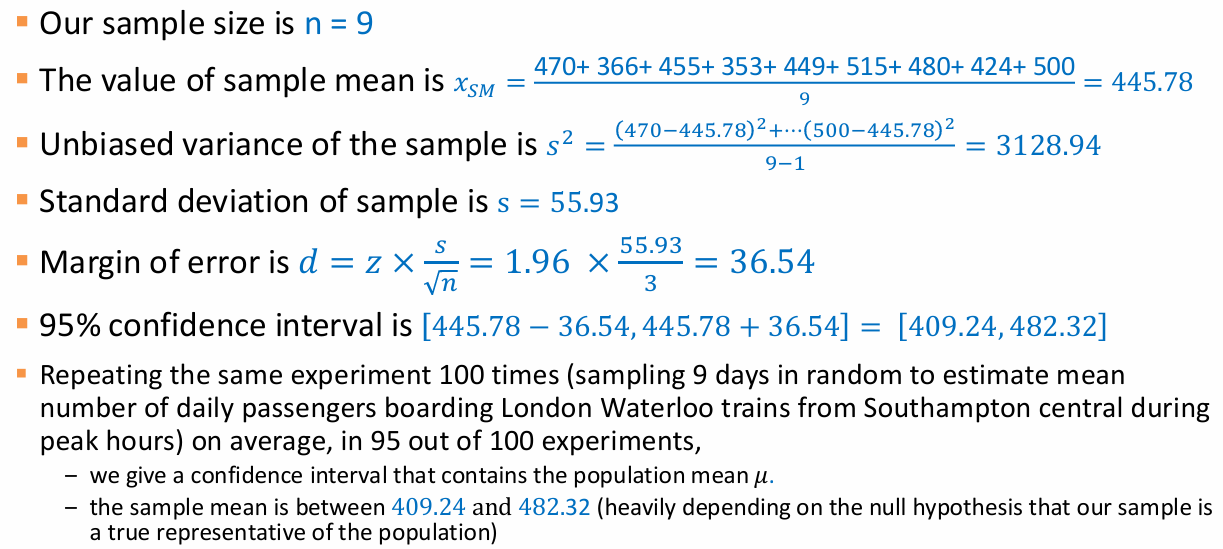
s2 = specific sample variance (estimate = /n - 1) - only use if not given true variance
std error = ?
σ[X_sm] ∝ 1/√n
therefore
σ[X_sm] = σ[X]/√n
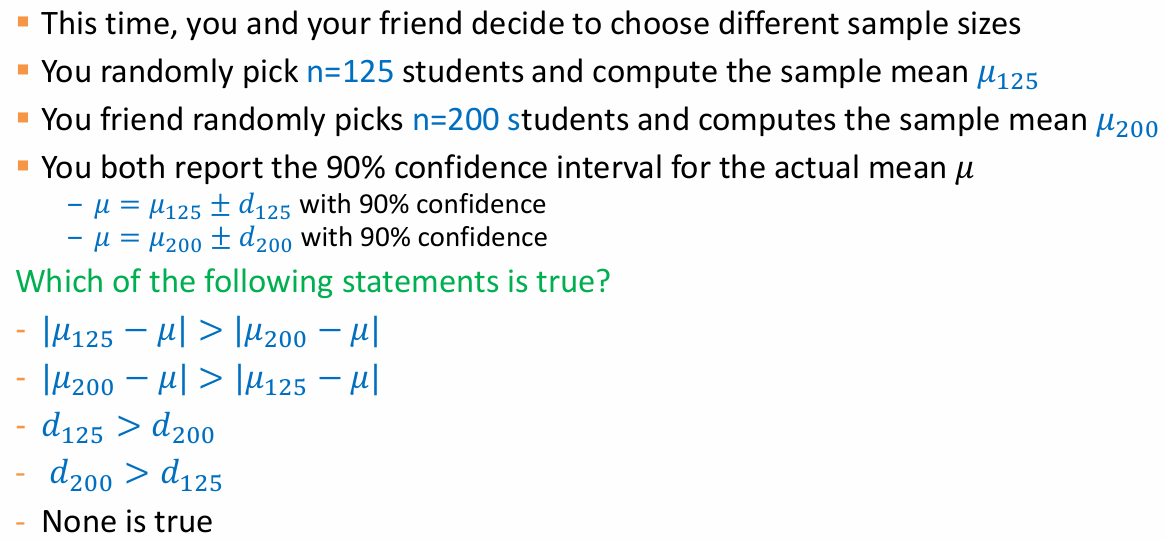
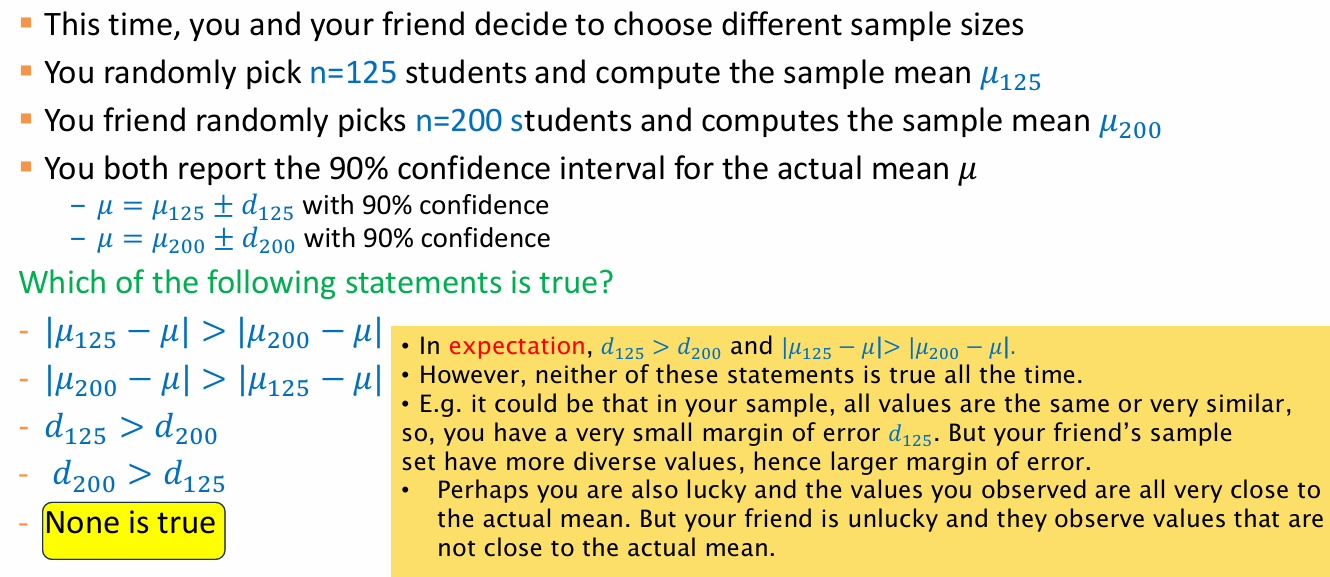
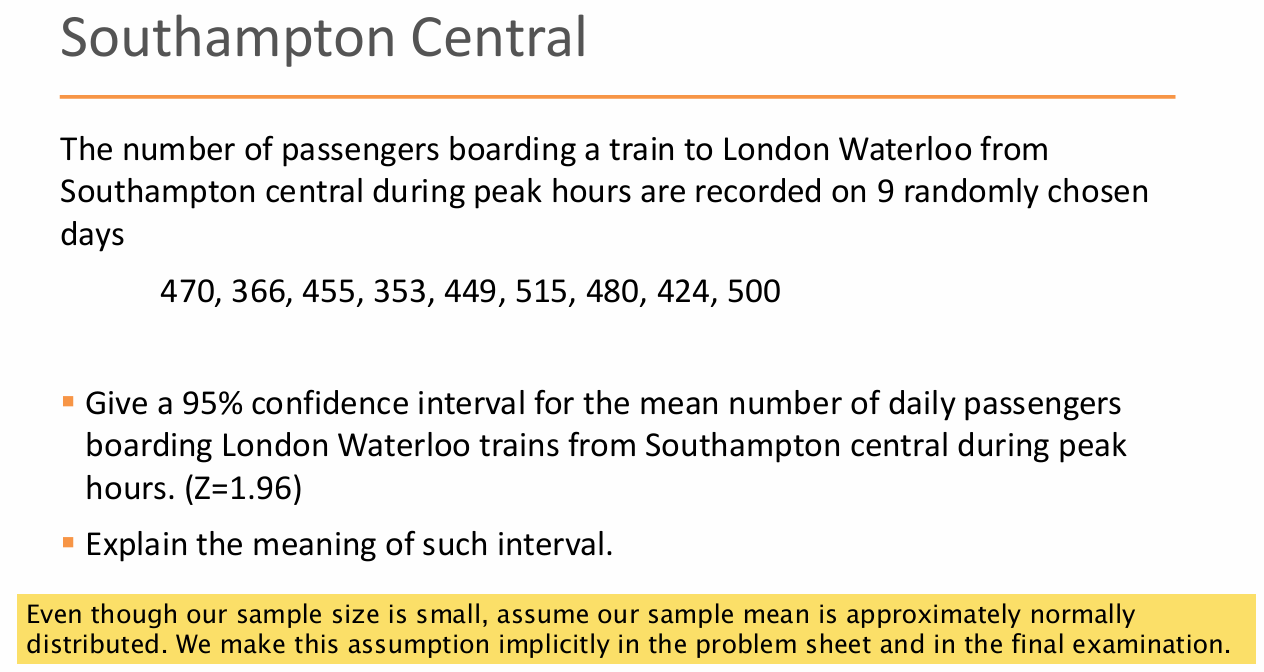
What is the formula for the margin of error?
margin of error = z-score * σ[X_sm]
where z-score is for the specific confidence interval and takes into account the extra left tail
e.g. 95% confidence interval → z = 0.975 as 5% left over / 2 (as two tailed) = 2.5%
∴ z-score = P(Z ≤ z₂) where z₂ = 0.95 + 0.025
Is:
d₉₅ > d₉₀ or d₉₀ > d₉₅ and why?
d₉₅ > d₉₀ as greater confidence requires larger interval
μ = ? in regards to margin of error
μ = μ_sm +/- d where d = margin of error
s2 = ?
s2=∑n−1(xi−μsm)2
Normal ↔ Binomial
µ = ?
σ = ?
µ = np
σ = √(np(1-p))
What are the 2 ways to write a confidence interval of 95%
P(Xsm−d ≤ µ ≤ Xsm+d ) = P(µ - d ≤ Xsm ≤ µ + d) = 0.95
What is the chain rule (conditional probability)?
P(A ∩ B) = P(A | B) x P(B)
What is Bayes’ Theorem?
P(B | A) = P(A)P(A∣B)P(B)