Information Processing Approaches to Development
 Call Kai
 Learn
Learn Practice Test
 Spaced Repetition
 Match
Match Flashcards
 Knowt Play
1/39

Earn XP
Description and Tags
Marr's levels of explanation, developments in the mind (memory, control, strategies, causal reasoning), induction in development (core knowledge theories, zone of proximal development, intuitive theory of biology and essentialism)
Name | Mastery | Learn | Test | Matching | Spaced | Call with Kai |
|---|
No analytics yet
Send a link to your students to track their progress
40 Terms
What is the mind?
A system that processes information + transformed it into something else that can direct your behaviour
Capture this by performing mathematical operations on an input
Outline Marr’s levels of explanation
Computational
Math treatment of what we think the information processing system is doing (e.g. calculator → arithmetic)
Algorithmic
In depth explanation of how the treatments are achieved (e.g. calculator → binary system)
Implementational
How this is actioned (e.g. calculator → wires, buttons etc)
How does information processing apply to development?
System changes by adding new ways of representing or processing information (discontinuous change) → adding new info to a system (continuous change)
How does the mind change during development (generally)?
Changes in well-specified reps + processes
Representational change → new way of making sense of an input (being able to hold that input in mind in a new way)
Processing change → adding new ways that you can manipulate that info, adding new operations on representations
How can striking changes in children’s behaviour be explained?
Through continuous changes to cognitive systems like memory and control
OR
Gradual emergence of new strategies
Outline which information processing systems change during development
Executive functions
Memory (domain general factors)
Control (behaviours)
Strategies (to solve a task)
Causal reasoning
What are executive functions?
Mental operations that enable us to coordinate our thoughts + behaviours using the processes of planning, working memory + response inhibition
What are executive functions supported by?
Circuitry in the prefrontal cortex → brain/area matures → ability to solve tasks improves (Baird et al., 2002)
Lesions of the frontal cortex are accompanied by executive dysfunction so that the ability to solve tasks deteriorates (Diamond and Goldman-Rakic, 1989)
In which areas have executive function been shown to predict?
Mathematical reasoning (Bull et al., 2008)
Analytical reasoning (Richland and Burchinal, 2013)
Fluid intelligence -> processing capacity to think + reason (Duncan, 2005)
Increases with age, plateaus in early adulthood and then shows significant decline in older age – particularly after age 55 (Nettelbeck and Burns, 2009)
What is working memory?
Temporary buffer store used to keep a representation in mind when we need it to solve a problem
How does working memory relate to development?
Willatts (1997) → children must plan their actions + remember to execute them in the correct order
BUT planning + memory alone aren't enough → distractions must be ignored (inhibition)
Diamond (1991) → planning, working memory and response inhibition are a powerful combination that enables us to solve tasks
What evidence is there qualitative difference about memory in young children?
Childhood amnesia
Foetus learns in womb → can form memories BUT we retain very few autobiographical memories from this period
What explanations are there for childhood amnesia?
Memories carried into adulthood are linked to our ability to speak + use language
Change in child’s ability to understand events + encode them in a meaningful way
How does the link between memories and language ability explain childhood amnesia?
Infants who can't speak can't encode memories in a way that enables them to be retained LT (Simcock and Hayne, 2002)
1-3 → language dramatically improves
Language supports schemas that help the child to remember events (Bauer, 1995)
Nelson (1986) + Nelson and Fivush (2004)
BUT these memories are relatively limited + don't survive until adulthood → language can't be the only explanation
How do changes in ability to understand and encode events explain childhood amnesia?
Children forget because they lack the frameworks for recounting + storing events → memories are fragmented + piecemeal (Fivush + Hammond, 1990)
May influence source monitoring (accurately attributing memories to the correct origin) → Drummey and Newcombe (2002)
How does early learning depend on one’s ability to form a LTM?
3-month-old infants can learn to recognise a particular mobile hung over their cot using operant conditioning where a ribbon is tied from the mobile to their leg (Rovee + Rovee, 1969 and Rovee-Collier, 1999)
BUT may be limited to procedural/implicit knowledge → infant doesn't need to consciously reflect on their experiences
Deferred imitation paradigm → infant imitates an event demonstrated some time earlier
E.g. the infant observes an adult doing something unusual, remembers this event and then repeats the action a week later (Meltzoff, 1988a and b)
How does memory change during development?
Working memory → ability to actively keep (short-term) goals in mind + manipulate those representations (to meet behavioural goals)
Diamond (1985) → hiding objects in the same position + then switching this → A-not-B error depends on the time you make the child wait before searching
What are types of memories potentially dependent on? What does this suggest?
Different neural circuits → mature at different rates (Nelson, 2002)
Explains why implicit + procedural knowledge (less dependent on frontal cortical structures) appear earlier than autobiographical, explicit and source memory (requires these structures) → Squire + Knowlton (2000)
BUT this only addresses one part of childhood amnesia
Why might children have better early childhood memories as adolescents?
Carers talk to them more frequently about the past → help to organise the early memories into meaningful events (Jack, 2009)
How does control over behaviours change during development?
Inhibitory control → ability to suppress/override prepotent responses or undesired thoughts/behaviours
Butterworth (1977) → A not B error sometimes still occurs when objects are hidden in transparent boxes -> more about control over behaviour than object knowledge
What is causal reasoning?
Inference that events happening close together in time + space are linked in some causal way
What evidence is there of changes in causal reasoning during development?
Leslie and Keeble (1987) → visual habituation to red ball launching white ball
Gopnik and Sobel (2000) → by 16-24 months, infants quickly learn the causal properties of particular objects in the blicket detector paradigm (novel object placed on a machine activates an interesting noise that they find rewarding)
Walker and Gopnick (2014) → also become sensitive to the causal relationship between objects to produce outcomes
What did Goswami (1998) argue about casual reasoning in development?
Continues to operate throughout development as children use their experience of events to infer unobservable sequences + predict future outcomes
E.g. 3-year-old children who see a jumbled sequence of pictures of apple segments, a whole apple + knife cutting an apple can reorder them so that they follow a logical causal sequence (Gelman et al., 1980)
Older children are more sophisticated in the types of knowledge + experience they draw on to decide causality (e.g. Goswami, 2008)
When judging causality, older children give greater consideration to the similarity of preceding events and outcomes than to their timing (Shultz and Ravinsky, 1977)
How do strategies evolve during development?
Developmental changes to these factors interact with the child’s current knowledge to explain their behaviour
Increases + changes in the strategies that are able to solve a task
Children are able to use more efficient strategies, increased capacity to process + store information + faster mental operations to solve ever more complicated problems
Algorithmic explanation
Siegler → micro-genetic analysis method + overlapping waves model
Weighted by how useful the strategies are + the practice that children have had with these strategies
Over periods of development you see reorganisations of which strategies of preferred → learn new strategies + start to disprefer old ones
What is Siegler’s (1996) overlapping wave theory?
Children have the ability to approach a single problem in different ways → develop new strategies to tackle new situations
Children learn through experience that applying only 1 strategy is ineffectual → different strategies must be considered
Adopt variable strategies → learn to modify strategies to deal with general classes of problems + identify selective strategies for specific problems
E.g. counting forwards vs backwords to tell the time (new time-telling strategy) (Siegler and McGilly, 1989)
What problem does learning pose?
Problem of induction (e.g. inferences about grammar + physical objects, determining causation) → constraints on how children learn may solve this
What is core knowledge?
Children can innately organise the sensory stimuli + impressions in order to make sense of the world around them
Born with a certain hardwired understanding about the world (not just the general tools to acquire that understanding)
Evolved system/solutions → no need to iteratively solve the same problem each generation
There are core principles that guide learning in a variety of different domains besides language
Our brains are equipped to solve specific, recurrent problems through conceptual reasoning (Carey, 2009)
E.g. object permanence → brain expects object to exist
Allows for more rapid learning
What are core knowledge theories based on?
Brain evolved as a system of mechanisms to solve the same recurrent problems that would have faced our ancestors
Innate theories that have evolved as a product of natural selection + enable us to develop some of the most complex/uniquely human skills (e.g. speech + language)
Children enter the world with both these general learning mechanisms (strategy formation, executive functions, inhibitory control +
Some skills (e.g. language learning) can’t be achieved using general learning mechanisms alone
Require built-in, domain-specific mechanisms → what enables any child in any culture to learn a language at roughly the same time + with little instruction from parents memory) + specialised mechanisms for solving specific problems (e.g. how to acquire language)
Describe core principles
Universal, don’t change over a lifetime of experience + don’t have to be learned (Spelke, 2000) → fundamental properties or principles remain relatively unchanged (although there is some variation)
E.g. a CKP = ‘all objects have a degree of solidity, meaning that they will stop the movement of another object when they collide’ BUT varying degrees of solidity among objects → have to be discovered through experience, leading to an increasingly sophisticated understanding of the differences between objects and nonobjects (Baillargeon, 1994)
What are some examples of core domains?
Estimating small numbers (Carey, 2009)
Appreciation of the spatial layout and navigation of the environment (Wang and Spelke, 2002)
What is a weakness of core knowledge theories?
Core knowledge alone doesn't explain how development occurs
Initial ideas (e.g. about objecthood, animacy) are fleshed out with increased amounts of knowledge in the form of the theory (theory building) -»allow us to interact in the world in successful ways
Children learn to explain the world through deeper properties + don't just attend to physical appearance
Theory = schema
Core knowledge = accurate but impoverished theory
What is the zone of proximal development?
At any age, a child in capable of acquiring wide (but bounded) range of skills
What is some evidence for the zone of proximal development?
Children who interacted with adults or more knowledgeable peers tended to acquire skills towards the top of this range (BUT children who didn’t tended to acquire skills towards the bottom)
Parents + carers seem to have a natural understanding of this zone → tend to direct instruction towards upper end of child's range of skills → more competent → encouraged to think at higher levels
What is the intuitive theory of biology (domain specific factors)?
Young children quickly move beyond thinking about the world in superficial ways → abstracting away from physical appearance
Learn that change in appearance doesn’t change what something actually is
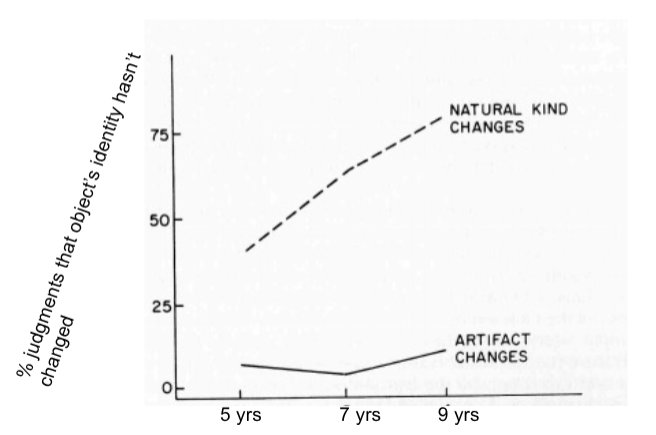
What evidence is there for the intuitive theory of biology
Evidence from stories of transformations
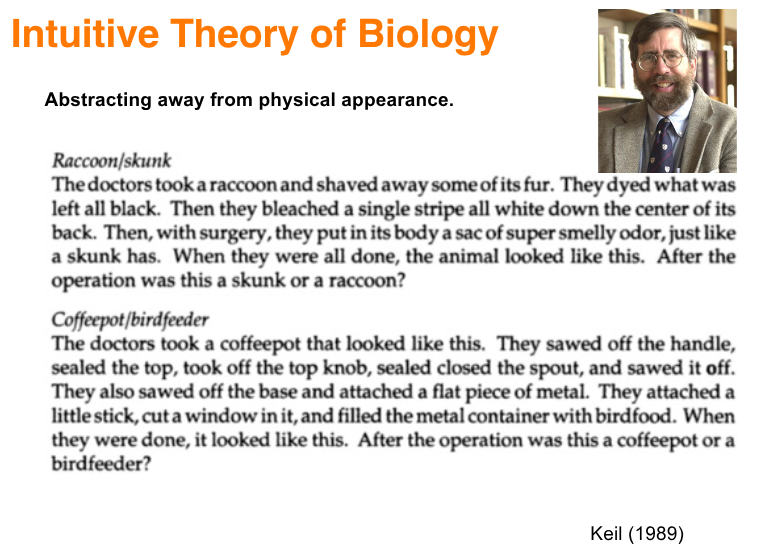
What other categories do children essentialise?
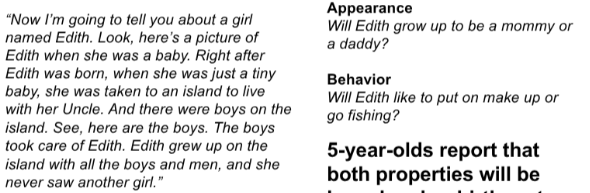
Taylor, Rhodes + Gelman (2009) → switched at birth paradigm
5yos report that both appearance + behaviour will be based on her birth, not her environment
Implications for how adults reason
What did Locke say about essentialism?
"[Essence is] the very being of anything, whereby it is what it is. And thus the real internal, but generally . . . unknown constitution of things, whereon their discoverable qualities depend, may be called their essence"
What does Susan Gelmon argue about Locke’s essentialism?
Locke's argument is a predictive description of how people think about categories
People think there is a deep, meaningful (maybe unknowable) constitution of things which causes external properties of things -> guides how we learn about categories around us
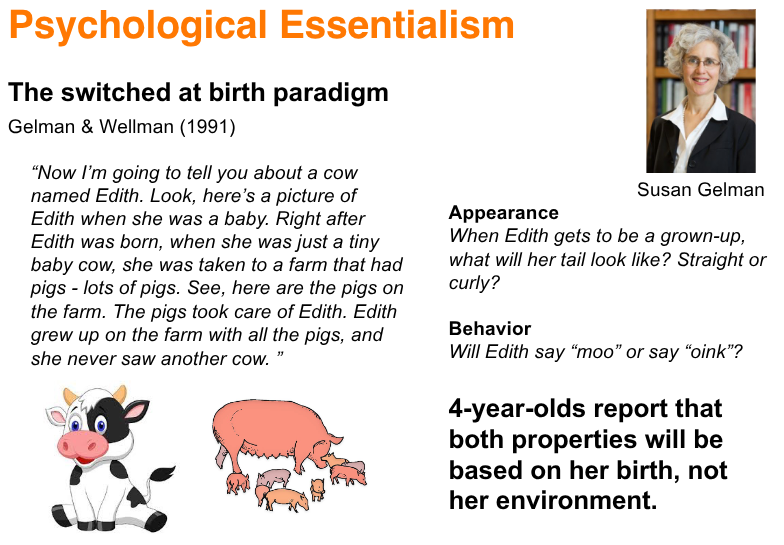
What is psychological essentialism?
An intuitive belief that Locke's claim is correct which guides subsequent learning about categories (particularly applies to bio categories)