LAST BIO 1 Exam - Names and Expirements section
 Call Kai
 Learn
Learn Practice Test
 Spaced Repetition
 Match
Match Flashcards
 Knowt Play
1/41

There's no tags or description
Looks like no tags are added yet.
Name | Mastery | Learn | Test | Matching | Spaced | Call with Kai |
|---|
No analytics yet
Send a link to your students to track their progress
42 Terms
In Frederick Griffith's 1928 experiments, what was the specific observation that led to the conclusion that a 'transforming principle' existed?
B. Heat-killed S cells mixed with living R cells resulted in the recovery of living S cells from dead mice.
Alfred Hershey and Martha Chase used radioactive isotopes to label bacteriophages. Why was radioactive phosphorus (32P) specifically chosen to track the genetic material?
DNA contains phosphorus in its sugar-phosphate backbone, while proteins generally do not.
What structural feature of DNA, deduced from Rosalind Franklin's X-ray crystallography, allows the molecule to maintain a uniform width of 2 nm?
The pairing of a purine with a pyrimidine.
Define purine
larger nitrogenous bases; double ring (A and G), must be paired with a pyrimidine.
Define pyrimidine
smaller nitrogenous bases; single ring (C, T, and U in RNA), must be paired with purine.
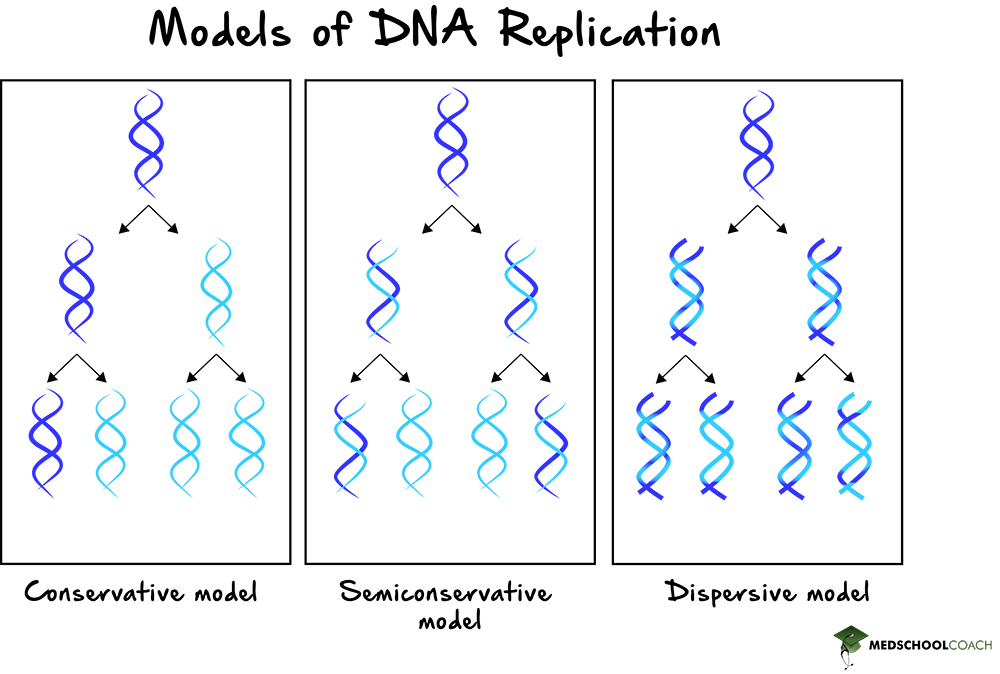
Define the semiconservative model
process of DNA replication where one DNA molecule is old (exact copy of the parent), and the other is newly made.
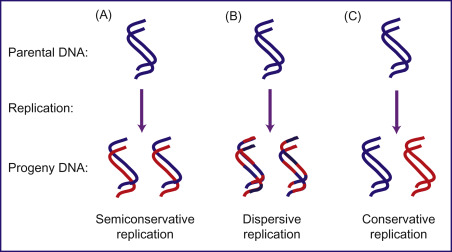
Define conservative model
two parent dna molecules create their exact identical, with one parent dominating.
Define Dispersive model
contains a mix of old parent DNA and newly synthesized DNA.
In eukaryotes, DNA replication is accelerated by which of the following mechanisms?
The presence of multiple replication bubbles that eventually fuse. Starting replication at many sites simultaneously allows large chromosomes to be copied quickly.
Define the central dogma
cells are governed by a "cellular chain of command" that dictates the directional flow of genetic information.
Define transcription
synthesis of RNA using information stored in the DNA. During this stage, a specific type of RNA called messenger RNA (mRNA) is produced to carry the genetic message from the DNA to the protein-synthesizing machiner
Define translation
synthesis of a polypeptide (a chain of amino acids) using the information encoded in the mRNA. This process takes place at the ribosomes, which serve as the sites of translation
The 'Central Dogma' of molecular biology describes the flow of genetic information. Which molecule acts as the intermediate between DNA and protein synthesis?
mRNA (messenger RNA carries the transcribed code from the DNA in the nucleus to the ribosomes for translation).
What is the primary function of the triplet code in gene expression?
To provide enough unique combinations of nucleotides to specify 20 different amino acids. Three-nucleotide words (43=64) provide sufficient diversity, whereas doublets (42=16) would not.
The genetic code is described as 'nearly universal.' What is the evolutionary significance of this observation?
It suggests that all living organisms share a common ancestor. Because the same code is used across almost all life forms, it likely originated in an early common ancestor.
In the bacterial operon model, what is the function of the 'operator'?
It serves as an 'on-off switch' where a repressor protein can bind to block transcription. The operator is a DNA segment within or near the promoter that controls the access of RNA polymerase to genes.
How does histone acetylation affect eukaryotic gene expression?
It promotes a more open chromatin structure (euchromatin), making DNA more accessible for transcription. Acetylation neutralizes positive charges on histones, loosening their grip on DNA.
Define epigenetic inheritance
inheritance of traits transmitted by mechanisms that do not directly involve the nucleotide sequence of DNA. epigenetic changes involve modifications to chromatin (the complex of DNA and protein) that can be passed to future generations of cells.
DNA methylation
Histone Acetylation
Define Horizontal gene transfer (PROKARYOTES ONLY)
bacteria can acquire new heritable traits through:
Transformation: The assimilation of foreign DNA from the surrounding environment.
Transduction: The transfer of DNA from one host cell to another by a virus (bacteriophage).
Define polyploidy
the inheritance of extra sets of chromosomes due to accidents during meiosis
Which of the following is an example of epigenetic inheritance?
The inheritance of a specific pattern of DNA methylation that affects gene expression. Methylation patterns can be passed to daughter cells, influencing traits without altering the underlying nucleotides.
In eukaryotes, 'alternative RNA splicing' is a mechanism that allows for:
The production of multiple different proteins from a single gene. By treating different segments as exons or introns, a cell can generate varied mRNA transcripts from one gene.
Retrotransposons are unique among transposable elements because they:
Move via an RNA intermediate and leave a copy at the original site. They use reverse transcriptase to turn RNA back into DNA for insertion elsewhere, increasing genome size
Define Transposable elements
“jumping genes” moving through a cut and paste method
Define Retrotransposons
jumping genes that move via an RNA intermediate, leaving a copy of itself behind
Barbara McClintock's work with maize provided the first evidence for:
transposable elements
The field of genomics that involves collecting and sequencing DNA from an environmental sample of multiple species is called:
metagenomics
Which of the following is the most likely cause of the evolution of larger genome sizes over time?
errors during meiotic recombination leading to duplication
Which mechanism of evolution consistently leads to adaptive evolution?
Natural selection
In humans, simple sequence DNA often consists of many copies of tandemly repeated short sequences. Where is this DNA most likely to be found?
at the centromeres and telomeres
What is 'proteomics'?
The study of the full set of proteins encoded by a genome. Proteomics looks at when and where proteins are produced and how they interact.
What happens during 'nucleotide excision repair'?
A nuclease cuts out a damaged segment of DNA, and the gap is filled by DNA polymerase and ligase.
The comparison of the human genome to the chimpanzee genome has revealed that:
Small genetic differences in regulatory sequences can lead to significant phenotypic differences. Much of the difference between these species lies in how genes are expressed rather than just the protein sequences.
In eukaryotic regulation, what is the role of 'mediator proteins'?
They act as an interface between specific transcription factors (activators) and the general transcription machinery. Mediators help relay signals from enhancers to the promoter area.
Which type of mutation is most likely to be passed on to the next generation?
A mutation in a germ-line cell (gamete). Only mutations occurring in cells that produce eggs or sperm can be passed to the next generation.
What is the function of the 5′ cap on eukaryotic mRNA?
It promotes the binding of the mRNA to the small subunit of the ribosomes. The cap is essential for ribosome recognition and initiation of translation.
In the context of evolution, what is 'microevolution'?
A change in allele frequencies in a population over generations.This represents the smallest unit of evolution within a single gene pool.
According to the central dogma, 'translation' is the process of:
synthesizing a polypeptide using the info in mRNA.
What is the significance of the fact that eukaryotes have many more 'noncoding' sequences than prokaryotes?
It allows for more complex regulation of gene expression and higher genetic diversity.
The DNA between functional genes often includes 'pseudogenes.' What are these?
former genes that have accumulated mutations and can no longer function to produce proteins.
Leading strand synthesizes….
TOWARD THE REPLICATION FORK
Lagging strand synthesizes….
AWAY FROM THE REPLICATION FORK