Modelling Atmospheric Pollution Revision Notes (Week 5)
 Call Kai
 Learn
Learn Practice Test
 Spaced Repetition
 Match
Match Flashcards
 Knowt Play
1/41

Earn XP
Description and Tags
Comprehensive practice questions covering wind meteorology, Pasquill stability, Gaussian dispersion equations, and advanced air quality modeling techniques.
Name | Mastery | Learn | Test | Matching | Spaced | Call with Kai |
|---|
No analytics yet
Send a link to your students to track their progress
42 Terms
What is the primary driver of pollutant transport and dilution in the atmosphere?
Wind.
According to the dilution effect, how does doubling the wind speed affect the concentration of a pollutant in a plume?
It halves the pollutant concentration.
In what type of geographic setting does the worst air pollution typically occur?
Where strong winds are scarce, such as in an enclosed valley (e.g., Mexico City).
What are the three distinct effects of wind speed on pollutant dispersion?
- Dilution: emission diluted proportionally to speed; 2. Mechanical turbulence: greater speed leads to greater mixing; 3. Plume bending: buoyant sources are pushed down at higher speeds.
What is the Power Law formula used to calculate wind speed (u(z)) at a specific height (z)?
u(z)=u0(z/z0)p where u0 is speed at anemometer height z0, and p is the stability exponent (0.1–0.4).
How is wind direction reported in meteorology?
It is reported as the direction FROM which the wind blows, measured in compass points or degrees clockwise from north.
Which specific local wind patterns are created by temperature differences between land and water?
Sea breezes (during the day) and land breezes (at night).
Contrast mechanical turbulence and buoyant turbulence.
Mechanical turbulence is caused by wind flowing over uneven surfaces (trees, buildings), while buoyant turbulence is caused by solar heating of the Earth’s surface creating upward thermals.
What is 'mixing height' in the context of atmospheric dispersion?
The height to which pollutants are vertically dispersed, determined by the balance of mechanical and buoyant turbulence.
How many Pasquill Stability Classes are there, and what determines them?
There are 6 categories (A–F) based on wind speed and insolation (solar radiation/cloud cover).
In the Pasquill scheme, which class represents 'Strongly unstable' conditions and which represents 'Moderately stable' conditions?
Class A is strongly unstable (strong sun, light wind); Class F is moderately stable (clear night, light wind).
What is the stability classification for overcast or very windy conditions, regardless of whether it is day or night?
Class D (Neutral).
Define a Receptor Model.
A model that works backwards from measured concentrations at a receptor to identify source contributions, often used for source attribution.
What is the difference between Eulerian and Lagrangian dispersion model sub-types?
Eulerian models use a fixed reference frame (air flows past a fixed point); Lagrangian models use a moving reference frame (travels with the air mass).
Distinguish between Macro, Meso, and Micro spatial scales in air quality modeling.
Macro: ~1000 km (synoptic systems); Meso: 10s-100s km (local modifications); Micro: <1 km (local features like street canyons).
In the Gaussian Dispersion Model coordinate system, what do the x, y, and z axes represent?
x-axis: downwind direction; y-axis: crosswind (horizontal); z-axis: vertical.
What does the symbol Q represent in the Gaussian dispersion equation?
The pollutant emission rate, typically measured in gs−1.
What are σy and σz in the Gaussian equation?
They are the horizontal (crosswind) and vertical dispersion standard deviations (measured in meters), which determine the spread of the plume.
What is the simplified Gaussian equation (Eq. 5-5) for a ground-level release (H=0) directly downwind (y=0,z=0)?
χ=πuσyσzQ
How does stable condition (Class F) affect the physical appearance of a plume compared to unstable conditions (Class A)?
Stable conditions (F) result in narrow plumes (smaller σ), while unstable conditions (A) result in wider plumes (larger σ).
What is a 'wind rose'?
A diagram showing the proportion of time the wind blows from each compass direction.
How do night-time valley inversions impact air quality?
Cool air drains to the valley floor and traps pollutants from roads, factories, and towns near the ground.
In indoor air pollution modeling, what is the formula for steady-state concentration (C) assuming complete mixing?
C=m/Q where m is the source term mass/time and Q is the ventilation rate volume/time.
What is the CURED model (2016) specifically used for?
It uses calibrated real-drive diesel emission functions for Euro 6 vehicles.
Which substance is used as a passive tracer for model validation because it has no ambient background and is stable?
SF6 (Sulfur hexafluoride).
What are the strengths and weaknesses of air quality monitoring
Air quality monitoring offers an impartial and reliable information about ambient air quality. It is expensive and creates incomplete image due to spatial limitations
What are the 4 types of AP models?
Dispersion, receptor, stochastic and box/compartment
Describe a dispersion model.
The model is based on a detailed understanding of the fluid dynamics of the atmosphere and physical chemical processes. Predict concentrations at specific times when the emissions and conditions are known.
Describe a receptor model.
Based on the relationship between a dataset of measurements at the receptor and the emissions dataset that may influence the receptor readings.
Describe a stochastic model.
Semi empirical relationship between the pollutant, concentrations and various factors ignoring atmospheric conditions.
Describe a box/compartment model.
A model that calculates the mean concentration in a defined volume of atmosphere by looking at the flow of inputs and outputs from that volume
What direction do cyclones rotate in the northern hemisphere
Clockwise
What direction do anticyclones rotate in the northern hemisphere
Anticlockwise
Explain the basic principles behind the formation of wind.
Wind is formed by the uneven heating of the earths surface by the sun, which creates an uneven pressure gradient causing the air to move.
Explain pressure gradient force
A difference in air pressure over a distance which causes a net force movement from high to low pressure
Define Coriolis Force.
An apparent deflection caused by the rotation of the Earth. Northern hemisphere is right and southern is to the left, 0 at the equator and increasing with latitude
How much is a knot in mph?
Roughly 1.15
What are deterministic models used for?
Used for long-term planning based on emission registers and meteorological variables.
What is a K-model
A complex model that treats turbulence as analogous to molecular diffusion
What does a pollutant rose do?
Shows the angular distributions of pollutant concentrations in relation to wind directions
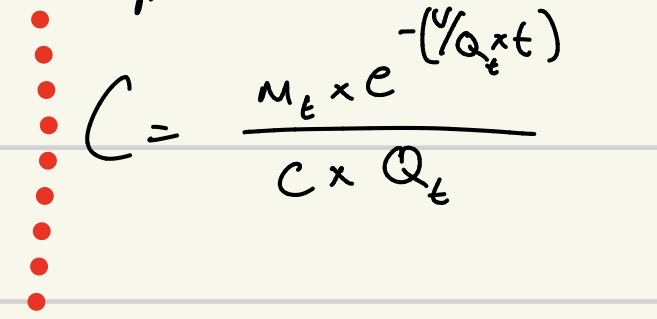
How to calculate the indoor concentration at time t of a pollutant?