Personal Identity
 Call Kai
 Learn
Learn Practice Test
 Spaced Repetition
 Match
Match Flashcards
 Knowt Play
1/46

There's no tags or description
Looks like no tags are added yet.
Name | Mastery | Learn | Test | Matching | Spaced | Call with Kai |
|---|
No analytics yet
Send a link to your students to track their progress
47 Terms
What is the core question regarding personal identity?
Under what conditions is a person P1 at time t1 numerically identical to a person P2 at time t2?
What does the Indiscernibility of Identicals state?
If a is numerically identical to b, then a is qualitatively identical to b.
How does one reconcile numerical identity with qualitative change over time?
Numerical identity allows for the same entity to possess different, compatible properties at different times.
Why is it better to ask 'Is P1 at t1 identical to P2 at t2?' instead of 'Are two people identical?'
It avoids confusion between numerical identity and qualitative similarity.
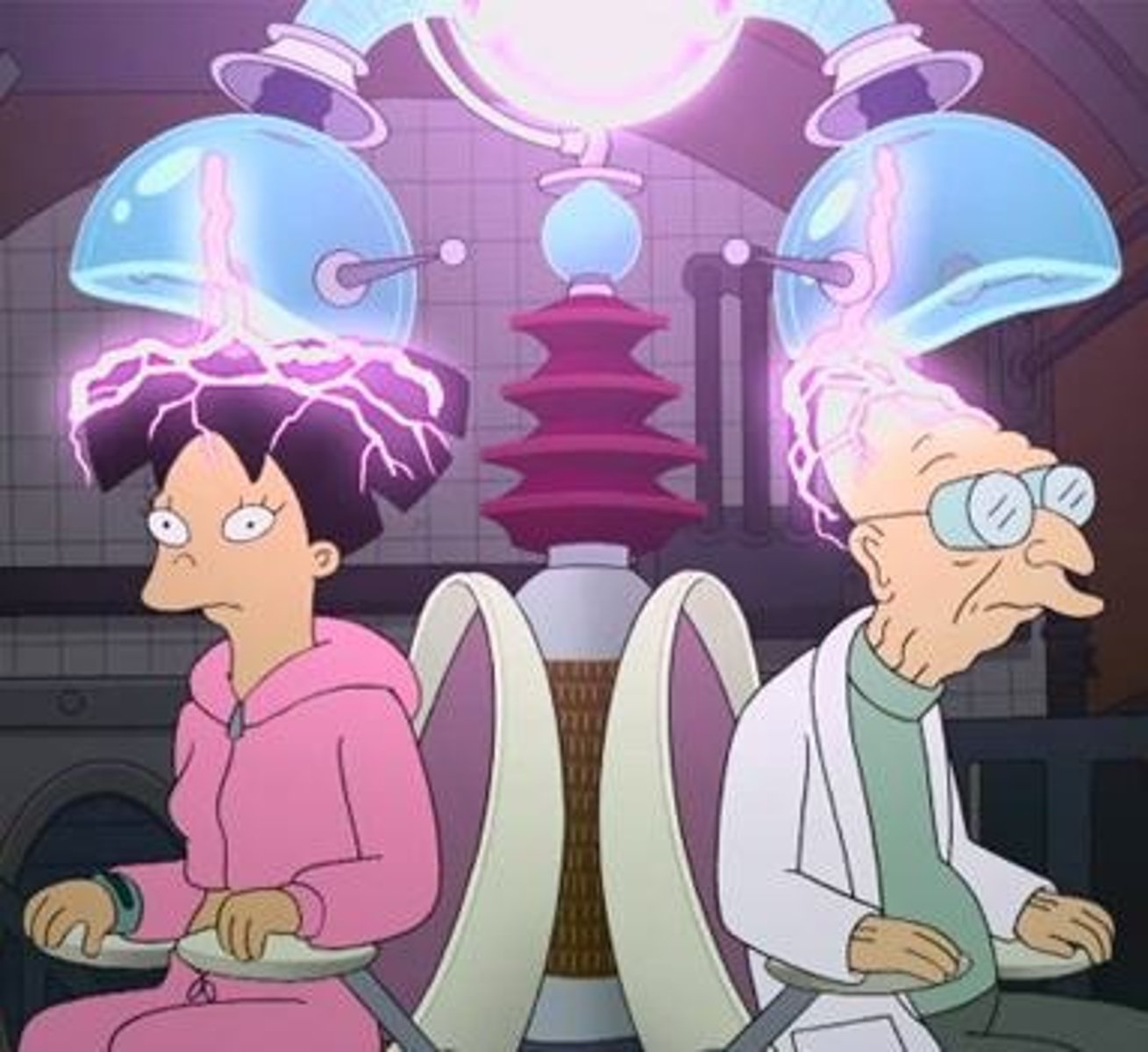
What is the significance of the Professor Farnsworth brain-copying thought experiment?
It suggests that personal identity is a psychological relation rather than a physical one.
What is the memory criterion for personal identity?
P1 at t1 is identical to P2 at t2 if and only if P2 remembers experiences had by P1.
What is the primary objection to the original memory criterion?
It is trivial because, by definition, one can only remember one's own experiences.
What is a quasi-memory?
A state where one seems to remember an experience that someone actually had, and the memory is causally dependent on that experience.
What is the revised memory criterion?
P1 at t1 is identical to P2 at t2 if and only if P2 quasi-remembers experiences had by P1.
What is a potential objection to the quasi-memory criterion?
It struggles to distinguish between genuine quasi-memories and apparent memories caused by external sources like diaries.
What is the main problem with relying solely on memory for personal identity?
It fails to account for the possibility of surviving temporary amnesia.
What is the psychological criterion for personal identity?
P1 at t1 is identical to P2 at t2 if and only if P2 is psychologically connected to P1.
What types of connections are included in psychological connectedness?
Similarities in beliefs, desires, personality traits, and causal explanations of actions.
Why is psychological connectedness not a sufficient criterion for identity?
It is not transitive, whereas numerical identity must be transitive.
What is the definition of psychological continuity?
A chain of relations of psychological connectedness leading from one person at one time to another at a different time.
What is the revised psychological criterion for identity?
P1 at t1 is identical to P2 at t2 if and only if P1 is psychologically continuous with P2.
How does the 'Transporter' thought experiment challenge our understanding of identity?
It questions whether a person who is destroyed and recreated elsewhere is the same individual.
According to the psychological criterion, does a person survive the 'Transporter' process?
Yes, because the person at the other end is psychologically continuous with the person who entered.
What is the 'Transporter' machine described as by critics?
An expensive killing and cloning machine.
Is numerical identity a transitive relation?
Yes, if A=B and B=C, then A=C.
What is the difference between numerical and qualitative identity?
Numerical identity refers to being the exact same entity, while qualitative identity refers to sharing the same properties.
What does it mean to say a person ceases to exist?
The point at which the entity P1 is no longer numerically identical to any future entity.
Can a person survive if every part of their body is replaced by an inorganic replica?
The psychological criterion suggests they could, provided psychological continuity is maintained.
Why is the 'transitivity' of identity a problem for the psychological connectedness theory?
Because connectedness can exist between A and B, and B and C, without existing between A and C.
Why is the psychological criterion considered non-transitive?
Because one person can be psychologically continuous with two different people who are not identical to each other.
What is the 'fission' problem for the psychological criterion?
If one person splits into two psychologically continuous people, the criterion implies you are identical to both, which is a logical contradiction.
What is Parfit's view on personal identity and survival?
Identity is not what matters; survival is defined by psychological continuity, regardless of numerical identity.
According to Parfit, what is the 'Naïve View' of survival?
To survive is to be numerically identical to someone in the future.
How does Parfit apply his view to moral responsibility?
Responsibility for a past action depends on psychological continuity with the person who performed it, not strict identity.
How does Parfit define the requirement to keep a promise?
You are required to keep a promise only if you are psychologically continuous with the person who made it.
What is the 4-dimensional view of people according to Lewis?
People are entities that persist through time by having 'person-stages' at different times, similar to how objects extend through space.
What is a 'person-stage' in Lewis's philosophy?
A temporal part of a person existing at a specific time.
How does Lewis define the 'R-relation'?
The relation of psychological continuity between person-stages.
How does Lewis define a 'continuant person'?
A maximal R-interrelated aggregate of person-stages.
How does Lewis resolve the fission contradiction?
He argues that two distinct continuant people overlap by sharing the same person-stages before the fission event.
What analogy does Lewis use to explain overlapping people?
The analogy of a road segment that is part of two different roads that fork.
According to Lewis, how many people enter a transporter before a fission event?
In one sense, one person-stage enters; in another sense, two people are present because that stage is part of two distinct continuant people.
What is Lewis's response to the objection that his view makes the number of people dependent on future events?
He compares it to how the number of roads one crosses depends on whether there is a fork ahead.
What is the primary difference between Parfit's and Lewis's view on identity?
Parfit argues identity doesn't matter for survival, while Lewis argues that identity and psychological continuity are compatible and both matter.
What does it mean for a relation to be 'transitive'?
If the relation holds between A and B, and B and C, it must hold between A and C.
How does Lewis define the condition for two person-stages to be part of the same person?
They are parts of the same person if and only if they are psychologically continuous with one another.
What is the 'Naïve View' regarding selfishness?
It is only rational to prefer the future wellbeing of someone if that person is numerically identical to you.
How does Parfit's view change the perspective on selfishness?
It is rational to prefer the future wellbeing of someone if you are psychologically continuous with that future person.
What is the core of the 'transporter' thought experiment?
It challenges the psychological criterion by creating a scenario where one person becomes two.
Why does Lewis reject the idea that fission creates a contradiction?
Because he denies that the two resulting people must be identical to the original person in a way that creates a logical conflict.
What does 'maximal R-interrelated aggregate' mean?
A collection of person-stages that are all psychologically connected to each other and cannot be extended further.
What is the main takeaway of Lewis's 4-dimensionalism regarding identity?
Objects and people are extended in time, and identity is a matter of being parts of the same 4-dimensional whole.