460 Parasitology Mid term 2
 Call Kai
 Learn
Learn Practice Test
 Spaced Repetition
 Match
Match Flashcards
 Knowt Play
1/25

There's no tags or description
Looks like no tags are added yet.
Name | Mastery | Learn | Test | Matching | Spaced | Call with Kai |
|---|
No analytics yet
Send a link to your students to track their progress
26 Terms
Cyst and trophozoites
Cyst - dormant, thick walled cell (infectious stage)
Trophozoite - active, feeding and multiplying form
Entamoeba histolytica (protozoa)
Causes invasive intestinal amebiasis
Intestinal ulcers, dysentery, ulcerous colitis, Mega colon
Causes invasive extraintestinal amebiasis
liver abscess, cutaneous and genital amebic lesions, brian hemorrhages
Diagnosis
3x stool exam, stool wet mount, fecal EIA, PCR
Entamoeba histolytica prevention and treatment
Prevention
wash hands, boil water, chlorination does not help
Treatment
Asymptomatic: Iodoquinol
Symptomatic: Metronidazole
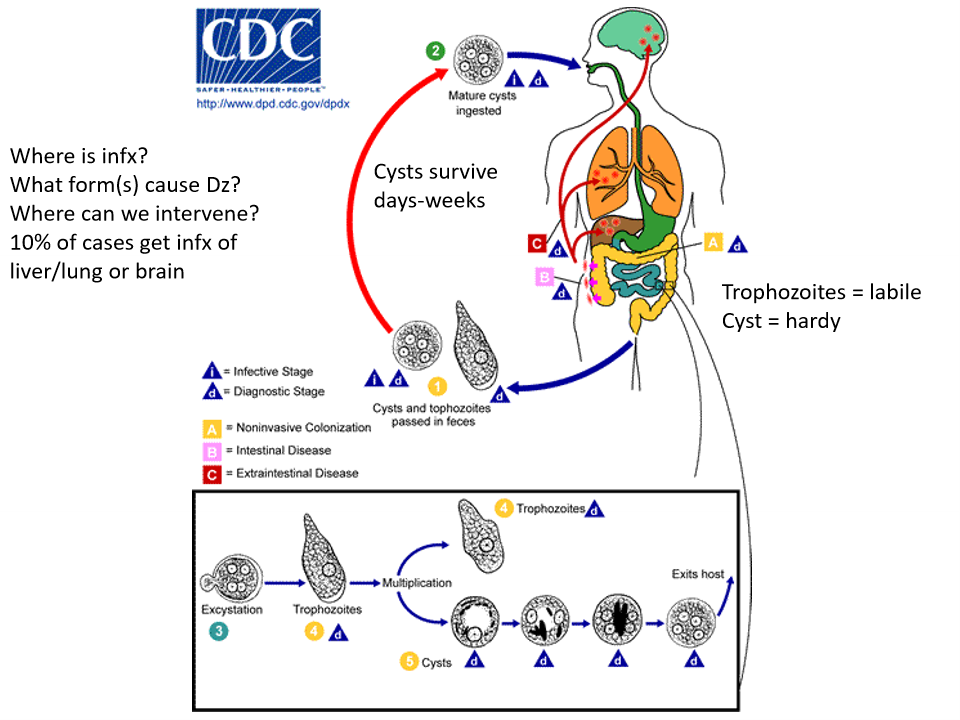
Entamoeba histolytica life cycle
Eat dirt with cysts
Cysts mature in environment
Cysts infect lungs, liver and GI as trophozoites
Excrete out cysts
Entamoeba histolytica morphology
Trophozoite
15-20uM in size, single nucleus
Cyst
Four nuclei
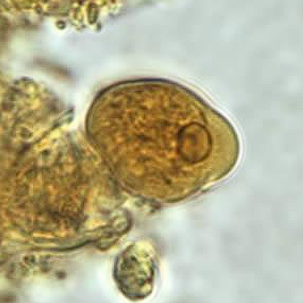
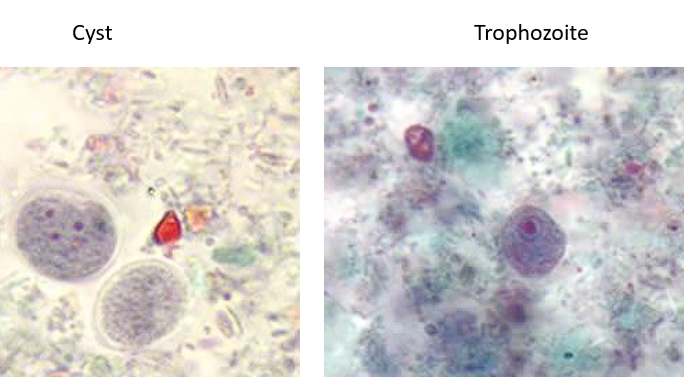
Entamoaeba coli (protozoa)
Cyst: 8+ nuclei
Tropozoite: 1 nucleus with large/dirty cytoplasm
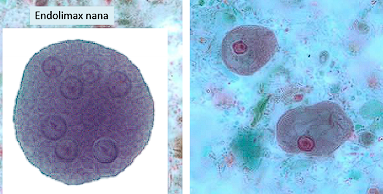
Endolimax nana
Cyst: 4 nuclei; lacks peripheral chromatin
Trophozoite: Irregular blot-like karyosome
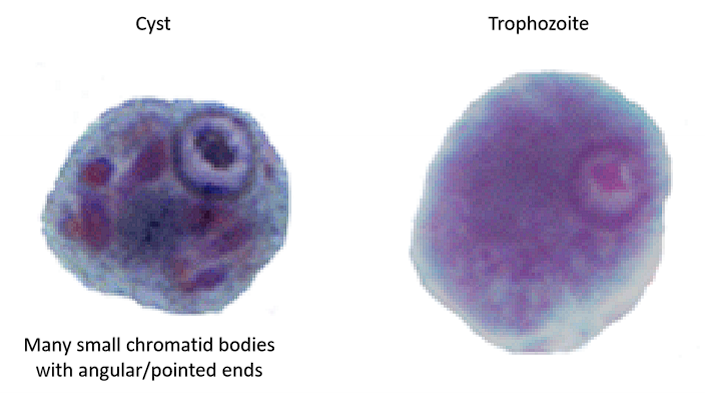
Entamoeba polecki
Cysts: many small chromatid bodies with angular pointed ends
Trophozoite: empty looking
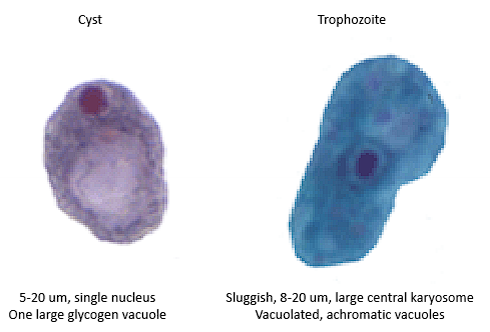
Iodamoeba buetschlii (protozoa)
Cyst: Single nuclei, large vacuole
Trophozoite: tall (wide) cell, 1 nuclei, vacuolated
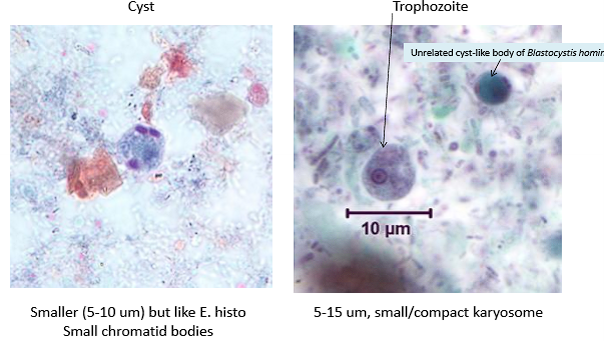
Entamoaeba hartmanni (protozoa)
Cyst: small chromatid bodies
Trophozoite: Small, compact karyosome
Dientamoeba fragilis (protozoa)
Flagellated protozoa
Trophozoite stage only, no cysts
Causes symptomatic and asymptomatic infections
2 nuclei inclusions possible in trophozoite form
Dientamoeba fragilis life cycle
Ingestion of trophozoites
Binary fission of trophozoites in GI
Trophozoites secreted in feces
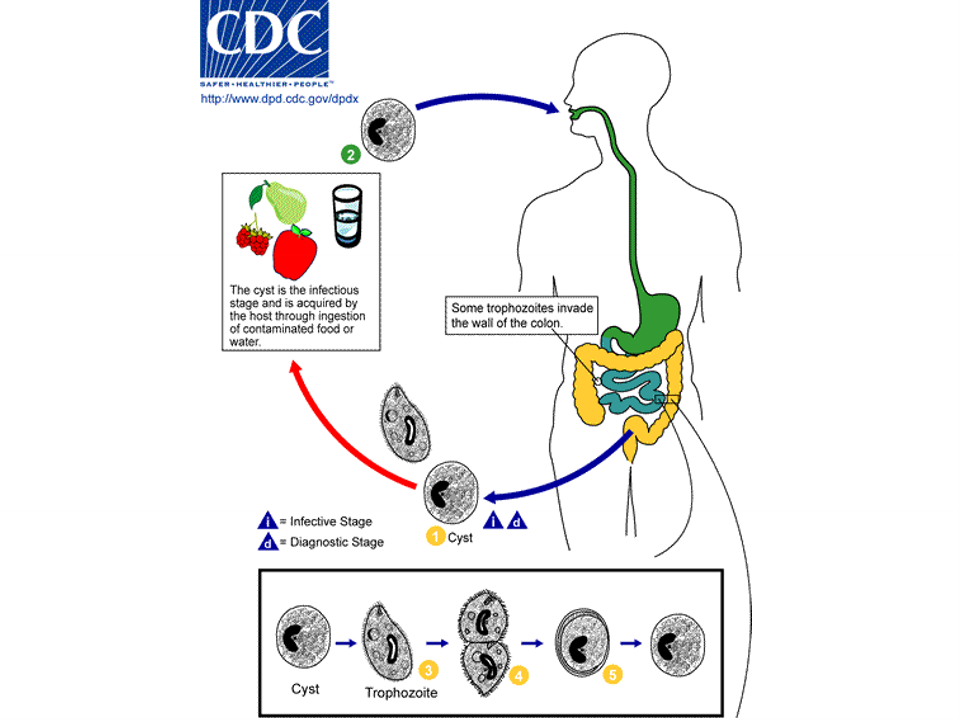
Balantidum coli (protozoa)
Ciliated parasite
Parasite of pigs; not common in humans (but we can get infected)
Treatment: Tetracycline
Fecal-oral transmission
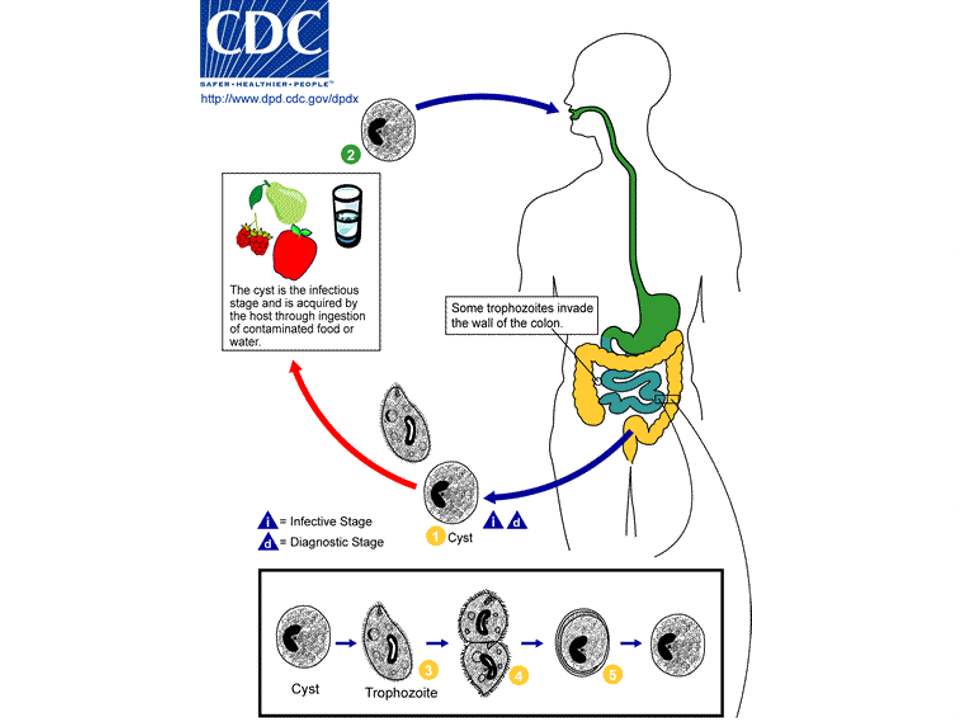
Balantidum coli life cycle
Consumption of contaminated produce (probable fecal contamination)
Cyst develops into trophozoite in GI
Trophozoite experiences binary fission and switched back into cyst
Cyst is excreted
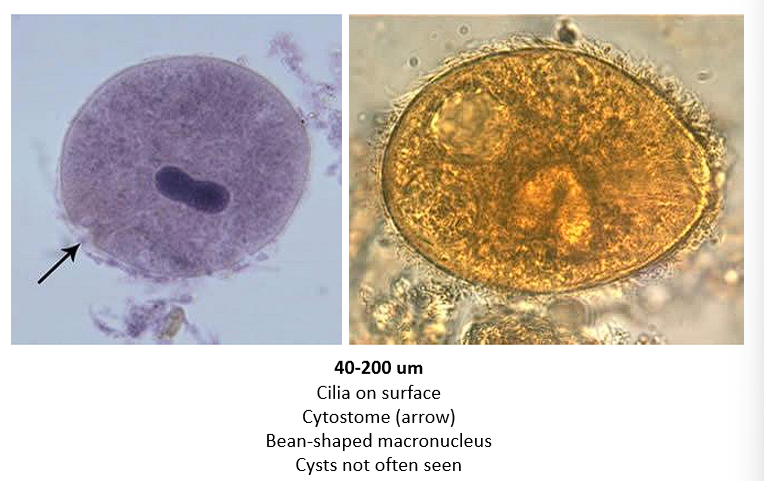
Balantidum coli morphology
Cilia on trophozoite surface
Bean shaped macronucleus
Cysts not often seen
Giardia duodenalis
Intestinal flagellate
Has ventral suction disk that allows for attachment to GI tract
Causes
inflammation of the jejunum, watery stools, steatorrhea (as vilia go flat, leading to malabsoprtion)
Diagnosis (up to 3 stool samples observed)
Antigen assay
Fluorescent antigen test kits
Multiplex PCR
Giardia duodenalis prevention and treatment
Chlorination is not effective
Boiling water is ok
Iodination is the best method of cleaning
Wash hands, eat clean, cooked food
Giardia duodenalis morphology
Trophozoite: Pear shaped organism with tail
Cyst: 2 nuclei (immature)'; 4 nuclei (mature)
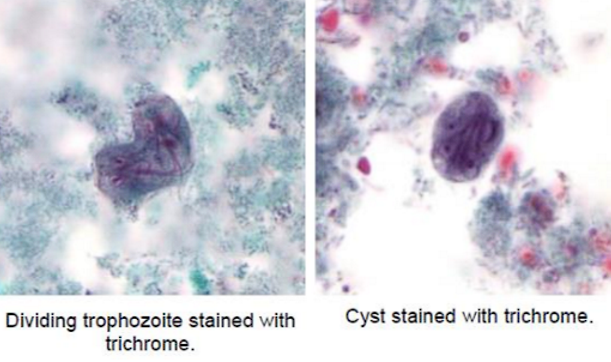
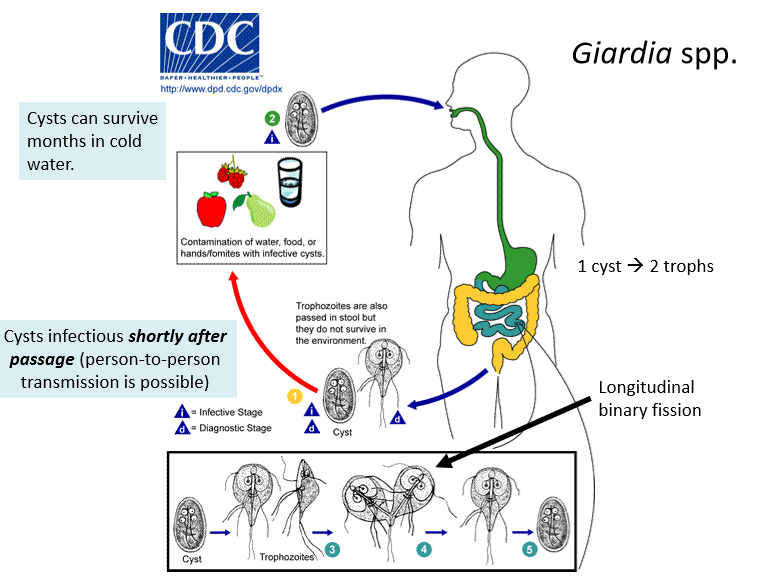
Giardia duodenalis life cycle
Ingestion of cysts
Cycst develop into trophozoite
Trophozoite experience longitudinal binary fission
Trophozoite becomes cyst
Cyst excreted in waste products
Trichomonas vaginalis
Flagellated protozoan
No cyst stage, only trophozoites
Sexually transmitted infection; most common nonviral STD
Men symptoms
Asymptomatic, rarely urethritis
Women symptoms
Vaginitis, discharge, PID
Neonates
Congenital transmission, preterm delivery, low-birthrates
Diagnosis
wet mounts and viewing motility
Anaerobic culture (GOLD STANDARD)
PCR (Preferred method)
Trichomonas prevention and treatment
Safe sex
Metronidazole and trinidazole
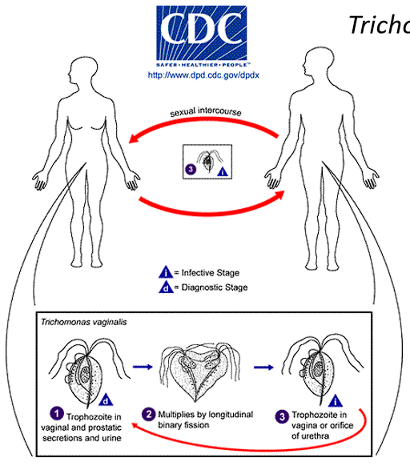
Trichomonas vaginalis life cycle
Sexual intercourse leads to the swapping of trophozoites
Multiplication in the sexual tract via longitudinal binary fission
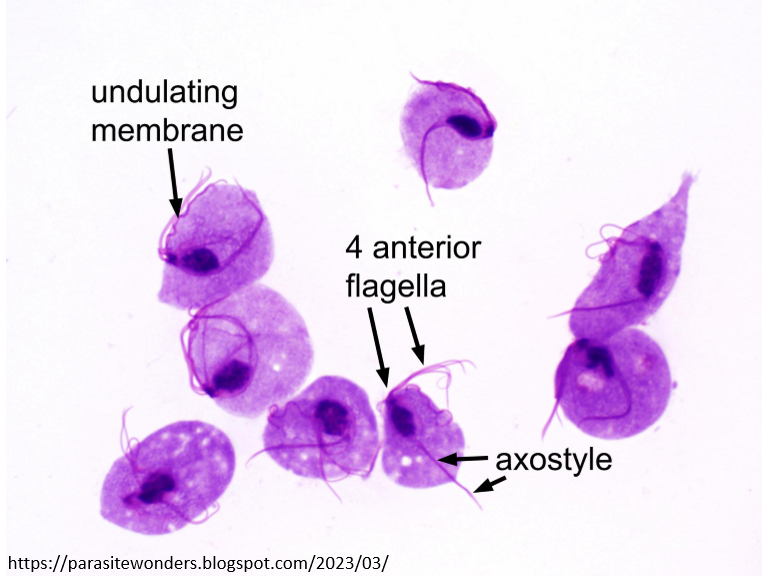
Trichomonas vaginalis morphology
Trophozoite: undulating membrane, 4 anterior flagella
Koch’s postulate (in the context of this lecture)
Clinical data can be non-specific; PCR diagnosis alone sometimes is not enough to confirm the identity of an organism
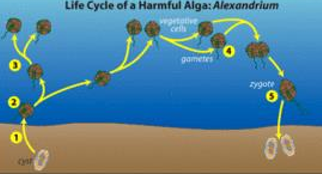
Dinoflagellates (Alexandrium Spp) and its life cycle
Produces saxitoin concentrate in mollusks
Causes
Nerve damage, some cases paralysis