U4 Adaptations, Natural Selection & Speciation
 Call Kai
 Learn
Learn Practice Test
 Spaced Repetition
 Match
Match Flashcards
 Knowt Play
1/32

There's no tags or description
Looks like no tags are added yet.
Name | Mastery | Learn | Test | Matching | Spaced | Call with Kai |
|---|
No analytics yet
Send a link to your students to track their progress
33 Terms
Gene pools
The sum of the alleles of all the members of a population (members that can readily interbreed)
Described by frequency of alleles of each of the genes present
Allele frequency
Calculated as the presence of a certain allele within a population
large gene pools have a higher allele variation and are able to cope with environmental changes → HIGH ADAPTIVE POTENTIAL
small gene pools have low allele variation and little ability to cope with change → LOW ADAPTIVE POTENTIAL
Calculation of total # alleles & alleles frequency
Total Alleles = 2 x Number of Individuals
Allele frequency = (# specific allele / total alleles) * 100
Describe characteristics of large gene pools and small gene pools
Large gene pools have higher allele variation and are able to cope with environmental changes → high adaptive potential
Small gene pools have low allele variation have little ability to cope with change → low adaptive potential
List 4 factors that changes allele frequencies within gene pools
Mutation
Gene flow
Genetic drift
Natural Selection
Define mutation and list the three types
= Change in the nucleotide sequence of a section of DNA encoding for a specific trait (responsible for introducing new alleles into a population via changes to DNA)
Mutations may be advantageous or deleterious depending on their reproductive success in their specific environment.
3 main types of mutations: point, frameshift or block mutations.
Point Mutations
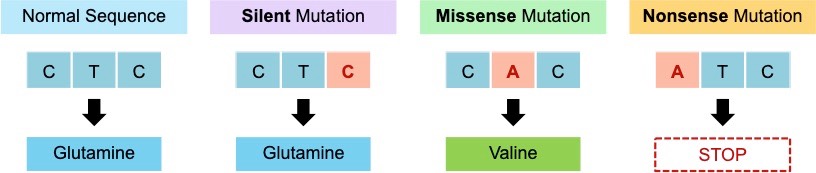
Point mutations involve the substitution of a single base of DNA, which may alter the phenotype by changing the protein sequence
Silent mutations: DNA change does not alter the amino acid sequence (due to degeneracy of the genetic code)
Missense mutations: DNA change alters a single amino acid in the polypeptide chain (can create new alleles)
Nonsense mutations: DNA change creates a premature STOP codon which truncates the polypeptide
Frameshift Mutations
= involve either the addition (insertion) or removal (deletion) of a single base of DNA, changing the reading frame
This change will affect every codon beyond the point of mutation and thus may dramatically change the amino acid sequence
Block Mutations
Changes to segments of a chromosome, resulting in large scale changes in the DNA of an organism
Block mutations are commonly caused by transposons (mobile genetic elements that can change positions within the genome)
Duplications – a part of the chromosome is copied, resulting in duplicate segments (potentially increasing gene expression)
Deletions – a portion of a chromosome is lost (along with any genes contained within this segment)
Inversions – a segment of a chromosome is removed and then replaced in reverse order
Translocations – segments of two chromosomes are exchanged (may interrupt gene sequences)
Gene Flow
The movement of alleles between interbreeding populations (as a result of migration and sexual reproduction) → influences allele frequency for given traits
Gene flow maintains the genetic compatibility between two separate populations and hence functions to prevent speciation
What does genetic variation do?
Genetic variation creates differences in the characteristics an organism possesses that enable it to interact with the environment
Define adaptation
Characteristic of an organism that can improve their fitness in its specific environment - these arise due to mutations
Organisms evolve to better cope w/ abiotic and biotic factors in their environment
Outline the types of adaptations
Structural: Physical differences in biological structure (e.g. neck length of a giraffe)
Behavioural: Differences in patterns of activity (e.g. opossums feigning death when threatened)
innate: inherited from ancestors (low variation within pop.)
learned: developed through experiences (high levels of variation within pop.)
Physiological: modification to internal functioning or metabolic processes (e.g. homeothermy, colour perception)
Biochemical: Differences in molecular composition of cells and enzyme functions (e.g. blood groups, lactose tolerance)
Developmental: Variable changes that occur across the life span of an organism (e.g. patterns of ageing / senescence)
Outline selection pressures
External factors which affect the ability of an organism to survive and reproduce
reduces variation within a population’s gene pool to create a change in allele frequency (I.e. evolution)
selection is driven by random processes (genetic drift), the environment (natural selection) or human intervention (artificial selection)
Outline genetic drift and its impact on different population sizes.
Change in composition of a gene pool as a result of random or chance events
It will occur faster and be more significant in smaller populations, where chance events have a bigger impact on a gene pool
Larger populations will be less affected by random events and maintain more stable allele frequencies with low genetic drift
Allele frequencies will change significantly when a large population is reduced to a small population
Two mechanisms causing population change = bottleneck event & the founder effect
Bottleneck event
Rapid reduction (~>50%) in population size due to environmental changes that are either natural (fires, floods) / human-made (overhunting)
The surviving population has less genetic variability than before and will be subject to a higher level of genetic drift
As surviving members begin to repopulate, the newly developing gene pool will be different to the original
ex) northern elephant seals have reduced genetic diversity compared to southern seals due to overhunting
Founder Effect
Occurs when a small group breaks away from a larger population to colonise a new territory
This population subset does not have the same degree of diversity as a larger population → it is subject to more genetic drift
As this new colony increases in size, its gene pool will no longer be representative of the original gene pool
ex) Certain Amish communities have higher incidence of polydactyly because of inter-marriage within the community
Compare and contrast the founder effect to population bottleneck
Both results in:
inbreeding → greater chance of inheriting deleterious alleles
lower adaptive potential → pop. becomes vulnerable to new selection pressures that could challenge & potentially wipe out the entire population ∵ absense of advantageous alleles
Contrast:
Founder effect, the original population remains largely intact
Define natural selection
Change in the composition of a gene pool as a result of the presence of selective environmental agents
Survival of the fittest → the process where organisms better adapted to their environment tend to survive, reproduce more, and pass on their advantageous traits to offspring
The four conditions of natural selection are:
Variation: there are genetic and phenotypic differences within a population.
Selection Pressure: a factor in the environment impacts the survivability of organisms.
Selective Advantage: Fitter (more advantageous) phenotypes are able to survive and reproduce more successfully.
Inheritance: surviving individuals reproduce and pass on advantageous traits
Effects of natural selection on population diversity
Genetic diversity in a gene pool decreases with natural selection as the alleles for advantageous phenotype is passed onto the next generation more successfully
Therefore, the population becomes better suited for their specific environment.
But, if their environment changes, they may be at higher risk for extinction since population has low genetic diversity
Speciation
Definition: Process in which populations genetically diverge until they become distinct from each other
distinct = they cannot interbreed to produce viable and fertile offspring
Why it occurs: when reproductive barriers prevent two populations from interbreeding – there is no gene flow between gene pools
Consequently, the two pops. begin to evolve separately as a result of cumulative mutation, genetic drift and natural selection
Eventually the two pops. reach a degree of genetic divergence whereby they can no longer interbreed (speciation)
= isolating mechanisms
Outline types of reproductive isolating mechanisms
Pre-zygotic/reproductive barriers
Temporal: different breeding seasons/feeding times
Behavioural: different courtship displays / different niches /habitats / feeding areas
Mechanical: mismatch in reproductive parts (damselfly)
Post-zygotic/reproductive barriers
Zygote mortality: fertilisation may occur however the zygote will not survive
Hybrid sterility: a viable offspring may form but it will not be fertile
Key difference between the two types of speciation
Allopatric speciation involves the geographic separation of a population, while sympatric speciation does not involve physical separation
Allopatric Speciation
Occurs when a geographical barrier physically isolates pops. of an ancestral species → pops. will be exposed to different selection pressures & evolve along divergent pathways
Keypoints:
Geographic barrier: Populations are isolated from one another by a physical barrier, restricting gene flow.
Selection pressure: Populations are subjected to different selection pressures, resulting in the accumulation of genetic differences.
Speciation: Populations can no longer interbreed to form viable and fertile offspring due to genetic differences.
Examples of geographical barriers
Large expanse of ocean (relative to organism)
Large expanse of land (relative to organism)
Mountain range/canyon
Example of allopatric speciation
Example: Galapagos Finch (separated by distance and have different food source)
These finches have specialised beak shapes depending on their primary source of nutrition (e.g. seeds, insects, nuts, nectar)
The finches occupied a variety of distinct ecological niches (different islands) with no gene flow between populations
Over time, this leads to the rapid evolutionary diversification of a single ancestral line (adaptive radiation)
Markscheme Answer:
Allopatric speciation was caused by the geographical separation of groups of finches
This prevented gene flow between the finches
Due to the difference in diet/habitat (selection pressure) on different islands, some finches beak or body type produced a selective advantage
This allowed them to survive, reproduce, and pass on favourable alleles to offspring
Overtime, genetic mutations also accumulated in each population
Explain = cause & effect → x leads to y
Sympatric Speciation
Sympatric speciation occurs when a population becomes reproductively isolated without being physically separated
In other words, it involves the divergence of species within a shared geographical location (i.e. no physical separation)
The reproductive isolation can be caused by temporal or behavioural factors, or caused by chromosomal abnormalities (polyploidy)
Example of Sympatric Speciation
Different species of Howea palms on Lord Howe Island
Howea palms are endemic to Lord Howe island (single location), but may be exposed to different soil conditions (volcanic vs calcareous)
Palms growing in nutrient-rich volcanic soil (more acidic) tend to flower earlier than palms growing in calcareous soil (more basic)
Because the palms were flowering at different times, reproduction ceased to be random (assortative mating began to occur)
This temporal isolation between the two populations of palms caused them to evolve along different pathways (i.e. disruptive selection)
Over time, the gradual accumulation of genetic differences caused the populations of Howea palms to form separate species
Define extinction
Organisms that no longer live or exist on planet earth
Fossil records indicates that over geological history, many kinds of organism have become extinct
Outline reasons why the rate of extinction has increased
excessive clearing of native grasslands
unsustainable loss of old growth forests
overgrazing
changed frequency of fire
degradation of water quality in rivers, lakes and estuarites
introduction of exotic plants, predators and diseases
unregulated exploitation of terrestrial and marine wildlife
population growth of humans and increased urbanization
increased levels of pollution
Outline polygeny
= study of relationships among different groups of organisms and their evolutionary development
these relationships are hypothesized by phylogenetic inference methods that evaluate observed heritable traits e.g. DNA sequences
Phylogenetic Trees
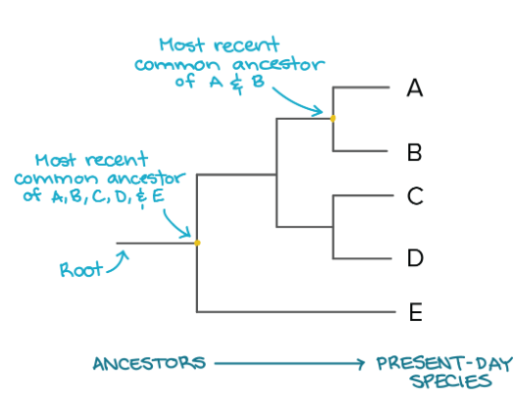
Pattern of branching reflects how species or other groups evolved from a series of common ancestors