structure-3
 Call Kai
 Learn
Learn Practice Test
 Spaced Repetition
 Match
Match Flashcards
 Knowt Play
1/21

There's no tags or description
Looks like no tags are added yet.
Name | Mastery | Learn | Test | Matching | Spaced | Call with Kai |
|---|
No analytics yet
Send a link to your students to track their progress
22 Terms

giant ionic lattice
physical properties of ionic compounds
high melting and boiling points (takes a lot of energy to break the ionic bonds)
soluble in water (aqueous solutions)
don’t conduct electricity in solid form (ions held tightly and cannot move to carry the charge)
conduct electricity when molten or aq( ions can now move)
what structures can covalently bonded substances have
molecular covalent
giant covalent
what is between covalent molecules
weak intermolecular forces (van der Waal’s forces)
properties of molecular covalent molecules
low melting and boiling points (little energy need to break the VDW forces) solid at room temperature
do not conduct electricity (no charged particles to move)
insoluble in water
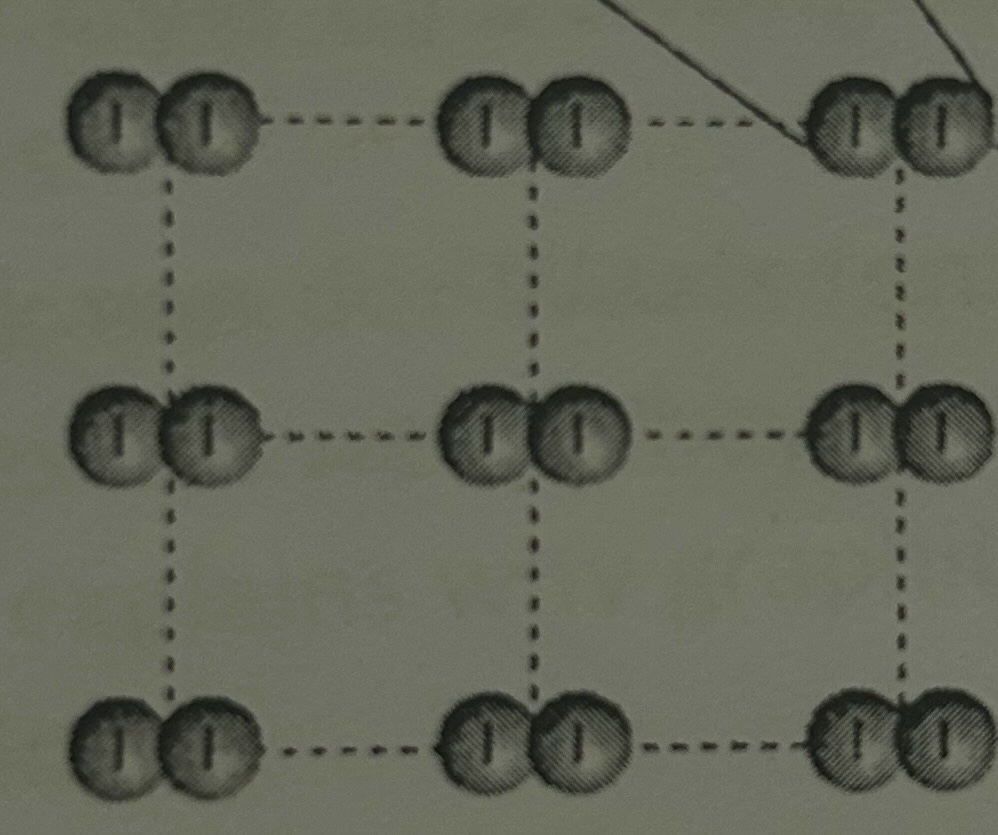
molecular covalent substance
allotrope definition
alternative forms of the same element in the same physical state

diamond
giant covalent molecule (macromolecule)
diamond facts
hardest know substances
high melting point
poor conductor of heat and electricity (no delocalised electrons to move)

graphite
graphite facts
layered structure
lubricant
high melting point
good conductor of heat and electricity (1 electron per carbon atom is not involved in bonding)
soft and flaky (layers slide over one another)

graphene
graphene facts
graphene is 1 single atom thick of graphite
good conductor of heat and electricity
used in batteries and solar cells
what is the structure of metals
giant metallic lattice
properties of metals
good conductors (delocalised electrons move)
malleable and ductile (one layer of met ions can slide over another layer without disrupting the bond)
usually high melting and boiling points (forces of attraction is very strong)

alloy
alloy definition
a mixture of 2 or more elements at least one of which is a metal- has metallic properties
metallic bonding definition
the attraction between delocalised electrons and positive ions in a regular lattice
what is a nanoparticle
nanoparticles use structures that are 1-100 nm and contain a few hundred atoms
nanoparticle size
1×10(-9) m
nanoparticle advantages in suncream
don’t leave a white residue
better skin coverage
more effective protection
risks of nanoparticles
could be absorbed through the skin
breathing then in mag cause inflammation of the lungs
may be absorbed into the bloodstream
we don’t know the long term effects