Particle model of matter
 Call Kai
 Learn
Learn Practice Test
 Spaced Repetition
 Match
Match Flashcards
 Knowt Play
1/24

There's no tags or description
Looks like no tags are added yet.
Name | Mastery | Learn | Test | Matching | Spaced | Call with Kai |
|---|
No analytics yet
Send a link to your students to track their progress
25 Terms
how are particles arranged in a solid?
-regular arrangement
-vibrating in a fixed position
-can’t be compressed or flow
-particles bonded together
how are particles arranged in a liquid?
-random arrangement
-moving randomly
-fills a container from the bottom
-can’t be compressed
-can flow
how are particles arranged in a gas?
-wide spaces between particles
-moving at high speeds
-can be compressed
-can flow
-will fill a container
what is density?
a measure of the ‘compactness’ of a substance - how much mass it has per unit volume
what is the particle model of matter?
a model that says that all matter consists of many very small particles that are constantly moving
what are the 3 assumptions of particle theory?
All particles are:
-small
-inelastic
-spheres
what is internal energy?
-also called thermal energy
-total kinetic and potential energy of all the particles that make up a system
how does heating effect the energy store of a system?
-by increasing the energy of the particles that make up to system
-this either raises the temperature (kinetic energy increases) or produces a change of state (potential energy increases)
how does melting occur?
-In solids, strong attractive forces hold the particles in place, so they can only vibrate in position
-As the substance is heated, the particles gain energy and vibrate more quickly
-Eventually, the particles have so much energy that they overcome the forces holding them together, and the substance melts into a liquid
how does boiling occur?
-As heat is applied to a liquid, the particles gain kinetic energy and move faster
-With enough energy, the forces of attraction between the molecules will break
-At this point, the liquid boils into a gas
what will happen if you heat a gas in a fixed, closed container?
Increases the pressure because:
-particles gain kinetic energy
-average speed increases
-collisions with the walls of the container are more frequent
-and each collision exerts more force
-this means the force per unit area is increased
-so the pressure increases
how does condensation occur?
-In gases, the particles have enough energy to overcome the attractive forces between them and so spread out randomly
-If the temperature is lowered, they will no longer have enough energy to overcome these attractive forces, so the particles will move closer together and condense into a liquid
what are the units for density?
kg/m3
how can you calculate the density of an irregularly shaped object?
-Measure the object’s mass using a balance
-Use a Eureka can to measure the object’s volume
-Use the mass and volume to calculate the density
What is specific heat capacity?
The amount of energy required to cause a temperature change of 10C per kilogram
What is specific latent heat?
-The amount of energy required to change the state of 1 kilogram of the substance with no change in temperature
-From solid to liquid - specific latent heat of fusion
-From liquid to gas - specific latent heat of vaporisation
what happens to the temperature of a substance whilst it changes state?
remains constant
why does the temperature of a substance remain constant while it is melting or boiling?
The temperature remains constant because the energy is used to break the forces holding the particles together rather than being transferred to the particle’s kinetic energy stores
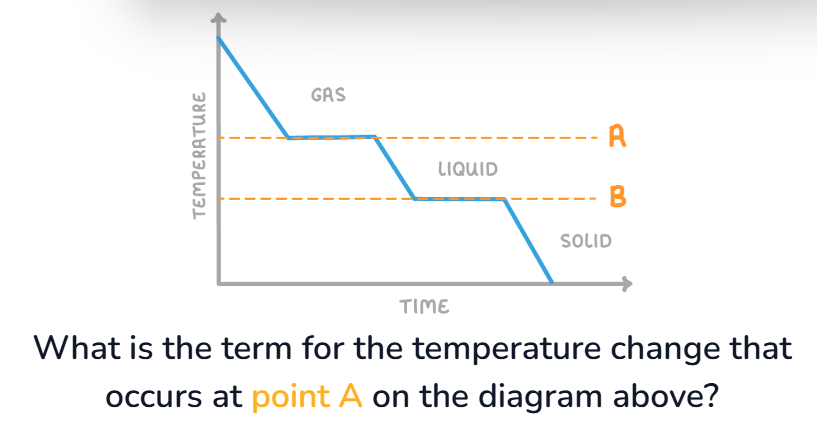
-The boiling point or sometimes called the condensing point
-The substance changes from a gas to a liquid or vice versa
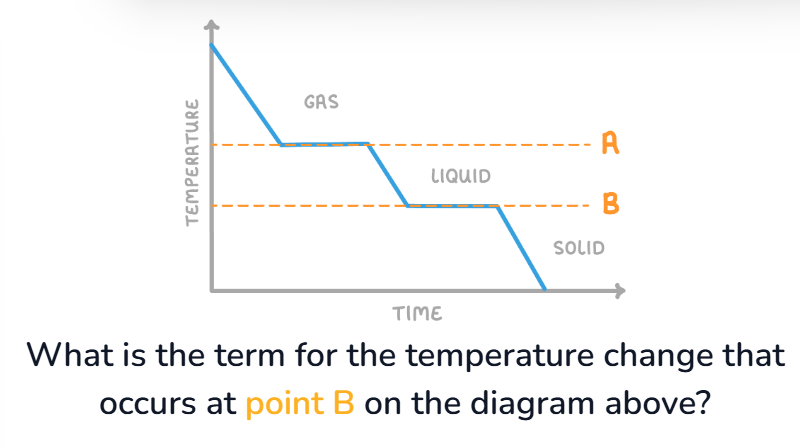
-The melting point sometimes called the freezing point
-The substance changes from a liquid to a solid
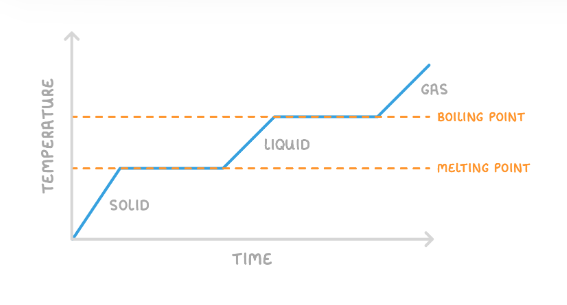
What will a temperature-time graph look like for a solid being heated until it turns into a gas?
How do gas particles trapped in a container behave?
-are in constant random motion
-the particles collide with the walls of the container
-each collision exerts a small force
-this leads to pressure on the walls of the container
-they move in a straight line until they hit the wall of the container or another particle
-they fill the space that they are in
How does decreasing the volume of a container affects the pressure of a gas?
-Increase the pressure
-Decreasing the volume of the container, whilst keeping the number of gas particles the same, will increase the concentration
-There will also be a smaller distance between the walls
-These two points mean that collisions between the gas particles and the walls of the container will be more frequent
-This means that more force will be exerted over a smaller area of the container, and so the pressure will be higher
How does increasing the concentration of a gas in a flexible container affect the volume?
-A higher concentration of particles means more particles in the same volume
-These extra particles will collide with the walls of the container and so push the container walls outwards, increasing the volume
-This is only possible if the container is flexible
How does increasing the number of gas particles in a non flexible container affect pressure?
-Collisions with the walls of the container are more frequent
-This means that the force per unit area increases
-So the pressure increases