ch 5 macromolecules

0.0(0)
Studied by 0 people
call kaiCall Kai
learnLearn
examPractice Test
spaced repetitionSpaced Repetition
heart puzzleMatch
flashcardsFlashcards
GameKnowt Play
Card Sorting

1/48

encourage image

There's no tags or description

Looks like no tags are added yet.

Last updated 7:31 PM on 6/1/26
Name
Mastery
Learn
Test
Matching
Spaced
Call with Kai

No analytics yet

Send a link to your students to track their progress

49 Terms

1
New cards

polymer

large molecule made of many identical or similar subunits connected together

2
New cards

monomer

subunit of a polymer

3
New cards

macromolecules

large organic polymers made from smaller building blocks to form a new level of organization

  • carbohydrates, lipids, proteins, amino acids

assembled through dehydration reactions and broken down by hydrolysis

4
New cards

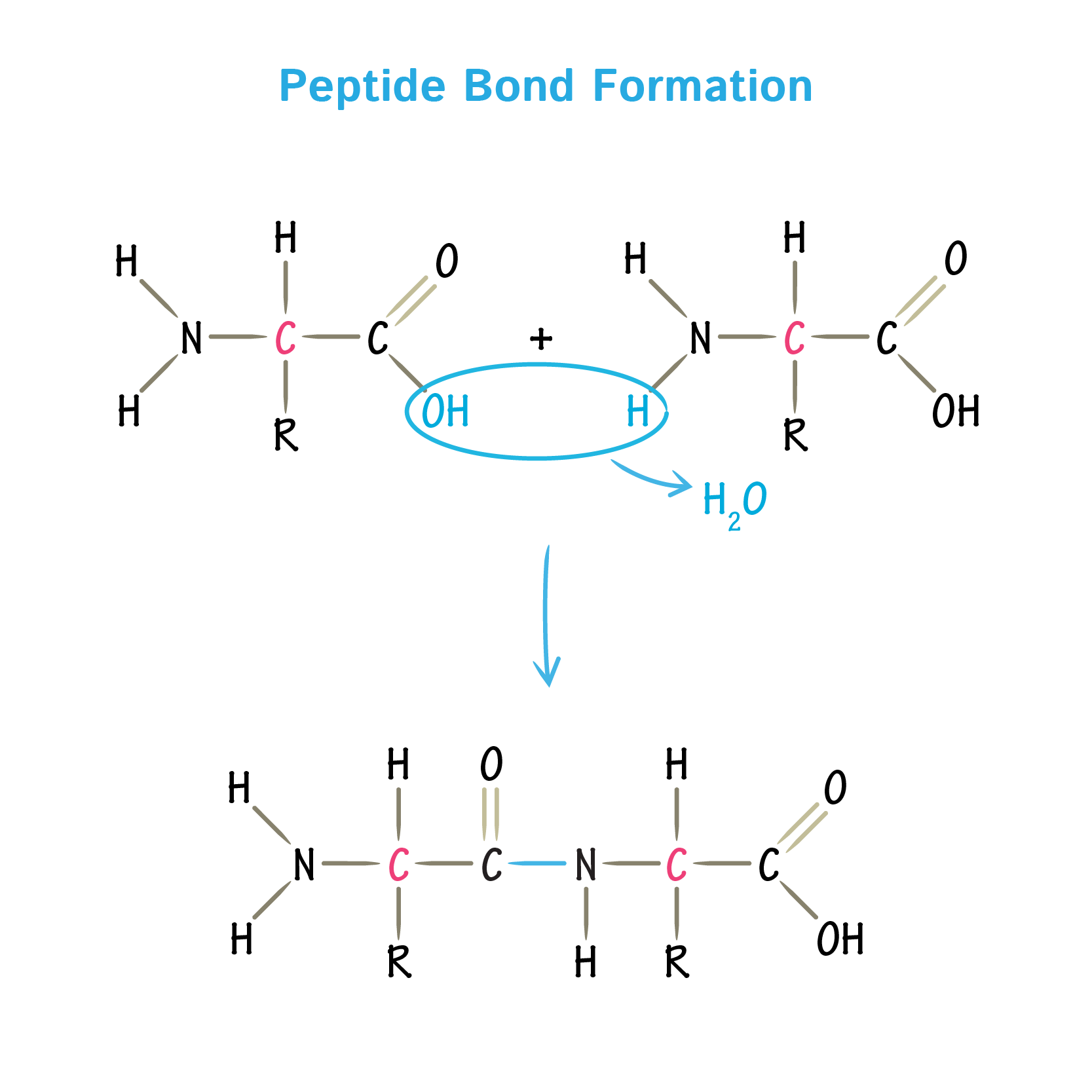
dehydration reaction

reaction links 2 monomers by removing water from the 2 monomers and creating a covalent bond connecting them

  • requires energy input and catalytic activity of enzymes
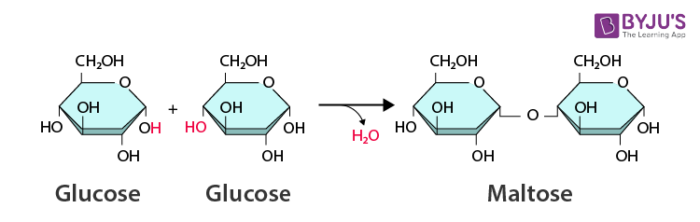
<p>reaction links 2 monomers by removing water from the 2 monomers and creating a covalent bond connecting them</p><ul><li><p>requires energy input and catalytic activity of enzymes</p></li></ul><p></p>
5
New cards

hydrolysis

reaction that breaks down macromolecules by adding water
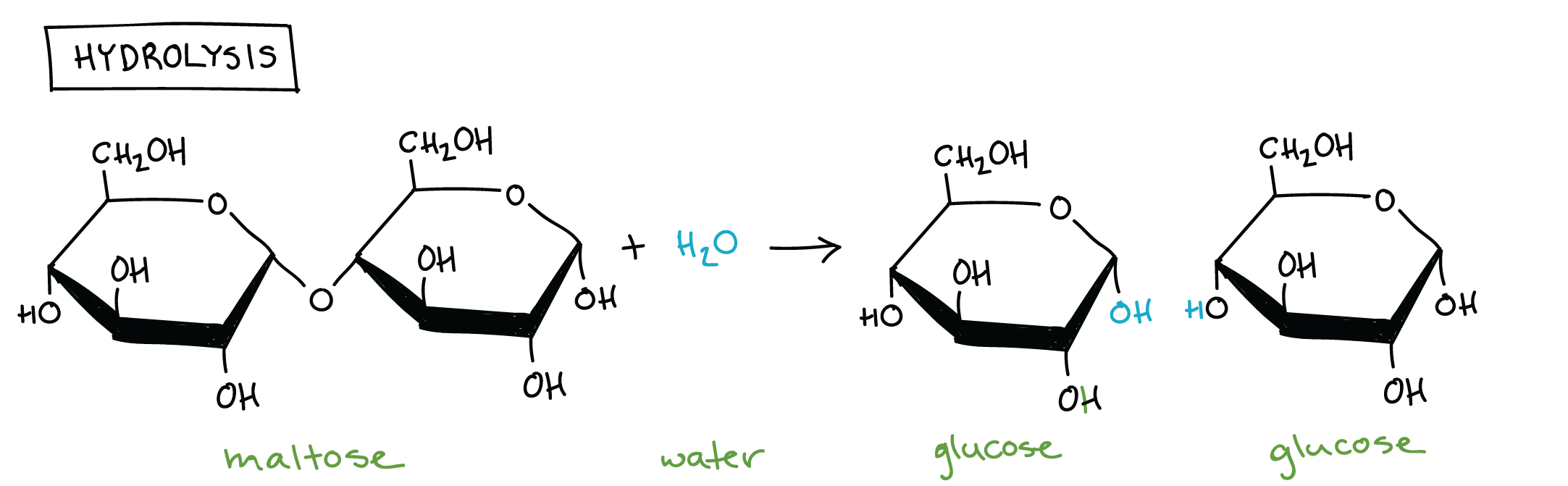
<p>reaction that breaks down macromolecules by adding water</p>
6
New cards

carbohydrates

organic (carbon + hydrogen) polymers made of sugars and their polymers

  • monosaccharides → disaccharrides → polysaccharrides

  • each has specialized function, overall for energy storage and structural support

7
New cards

monosaccharides

simple sugars, monomer of carbohydrates

C, H, O in the ratio of Ch2O

  • or a multiple: C6 H12 C6, glucose

  • triose: C3

  • pentose: C5

  • hexose: C6

function: nutrients for cells (glucose), store energy in bonds, raw material for other organic molecules, to be polymerized into di and poly saccharides

  • aldose or ketose sugars

  • enantiomer: different sugar, forms ring structure in solution
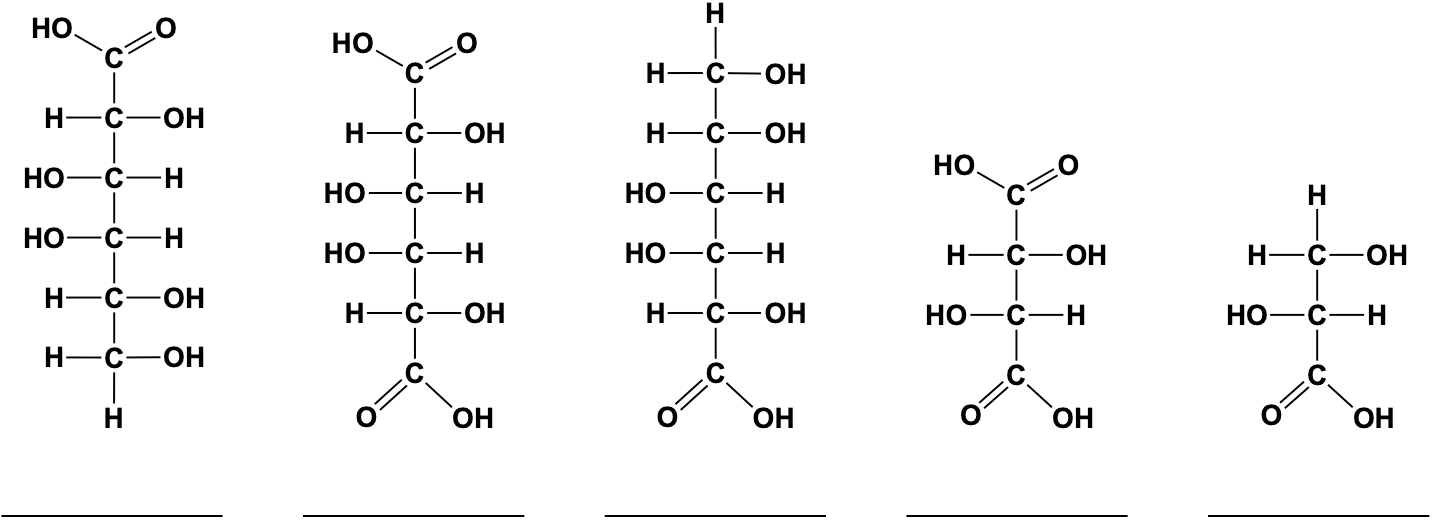
<p>simple sugars, monomer of carbohydrates</p><p>C, H, O in the ratio of Ch2O</p><ul><li><p>or a multiple: C6 H12 C6, glucose</p></li><li><p>triose: C3</p></li><li><p>pentose: C5</p></li><li><p>hexose: C6</p></li></ul><p>function: nutrients for cells (glucose), store energy in bonds, raw material for other organic molecules, to be polymerized into di and poly saccharides </p><ul><li><p>aldose or ketose sugars</p></li><li><p>enantiomer: different sugar, forms ring structure in solution</p></li></ul><p></p>
8
New cards

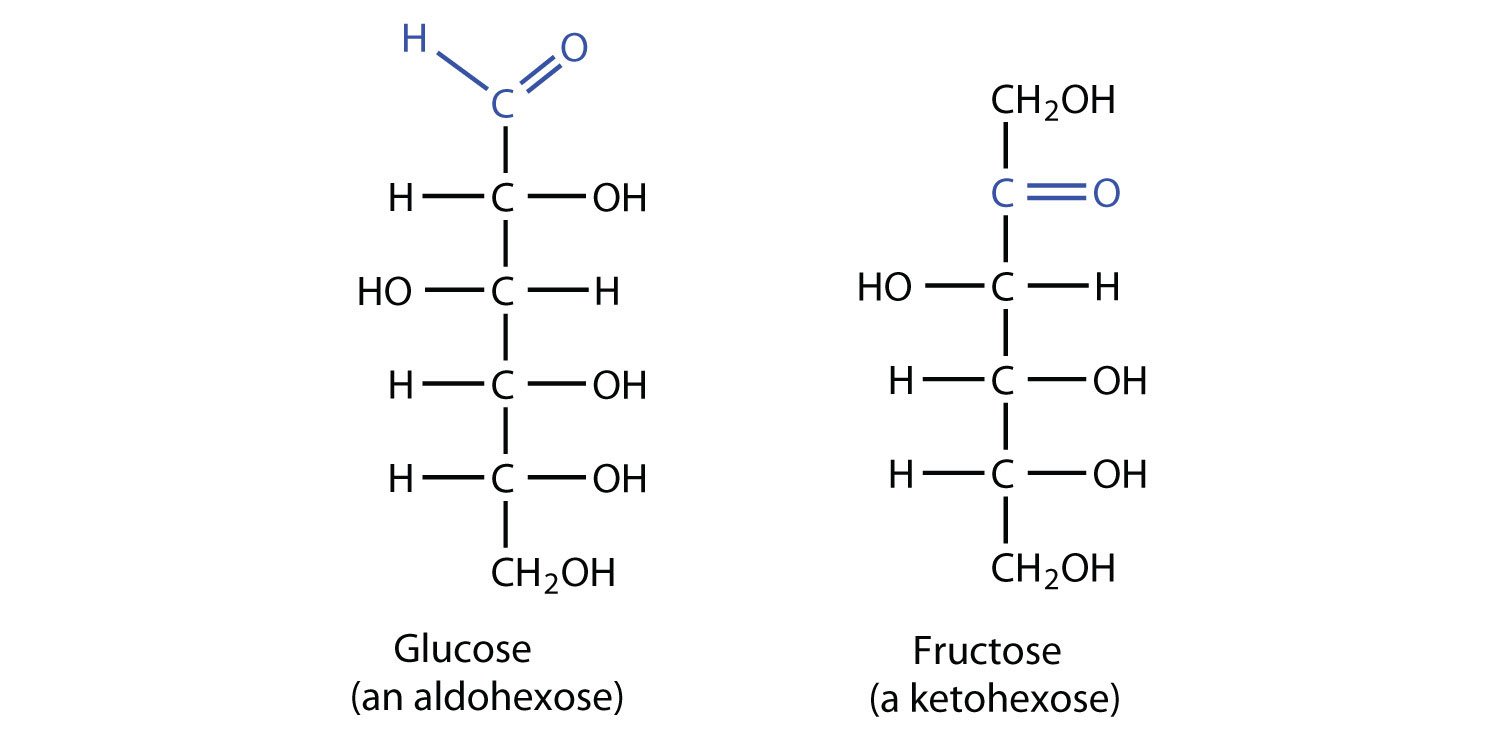
aldose sugar

monosaccharride with carbonyl (C=O) at end of carbon skeleton
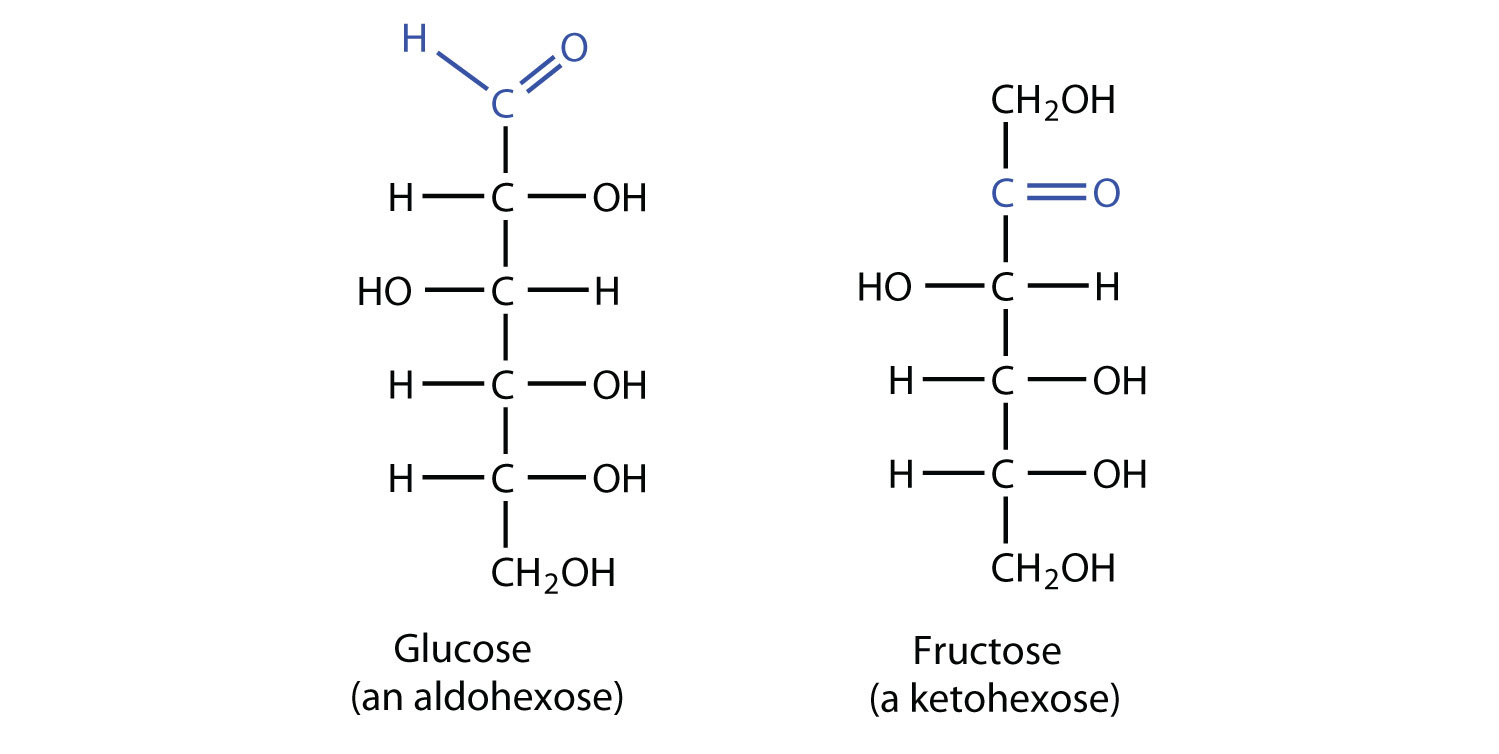
<p>monosaccharride with carbonyl (C=O) at end of carbon skeleton</p>
9
New cards

ketose sugar

monosaccharride with carbonyl (C=O) in middle of carbons skeleton
<p>monosaccharride with carbonyl (C=O) in middle of carbons skeleton</p>
10
New cards

disaccharide

two monosaccharides joined by glycosidic linkage via dehydration reaction

-ex: maltose (beer), lactose (milk), sucrose (table sugar)

<p>two monosaccharides joined by glycosidic linkage via dehydration reaction</p><p>-ex: maltose (beer), lactose (milk), sucrose (table sugar)</p>
11
New cards

glycosidic linkage

bonds between monomers (monosaccharides) of carbohydrates

covalent bonds from dehydration reaction

12
New cards

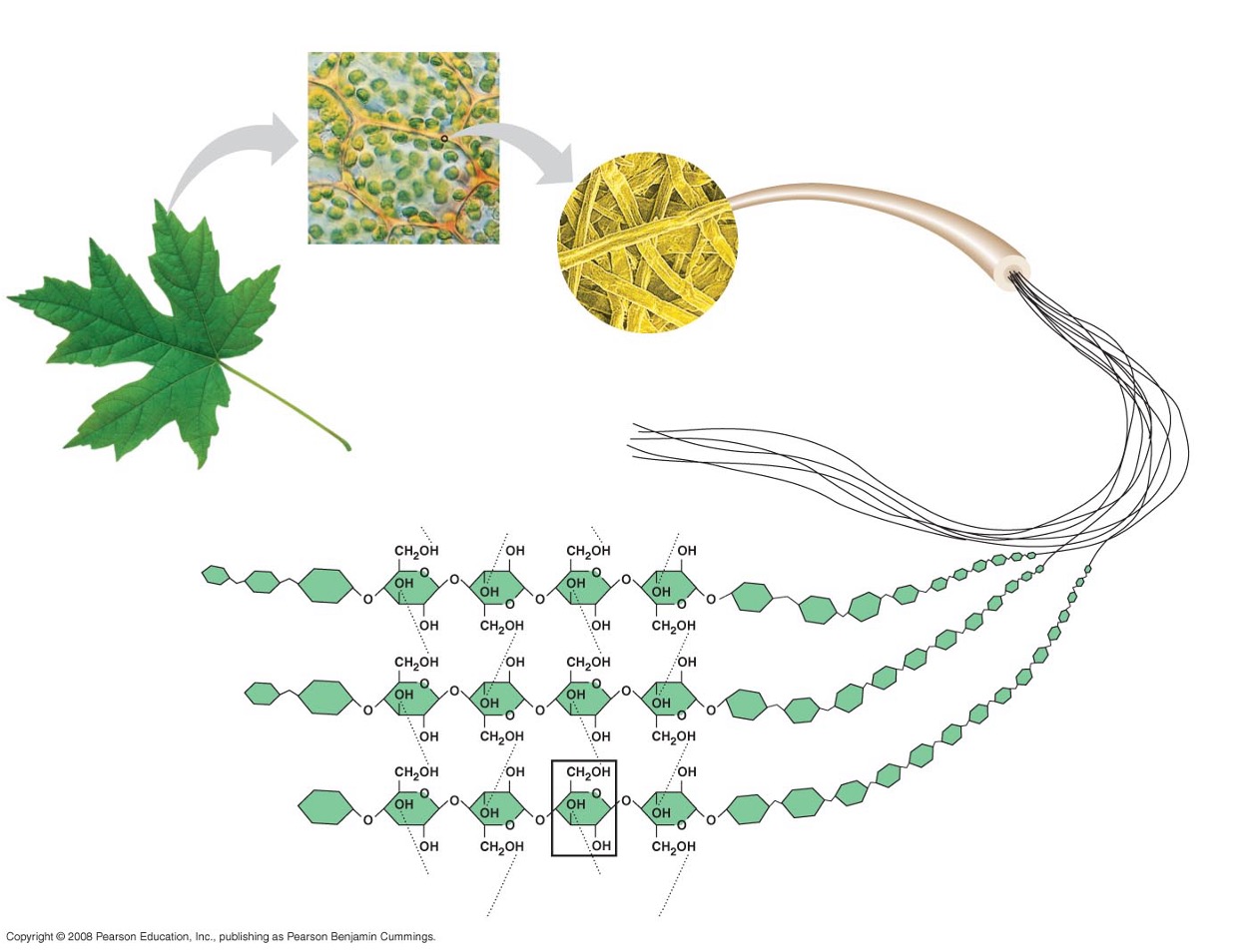
polysaccharide

polymers composed of monosaccharides linked by dehydration reactions and glycocetic bonds

  • polymers of carbohydrates

  • function: energy storage (starch and glycogen) and structural support (cellulose and chitin)
<p>polymers composed of monosaccharides linked by dehydration reactions and glycocetic bonds</p><ul><li><p>polymers of carbohydrates</p></li><li><p>function: energy storage (starch and glycogen) and structural support (cellulose and chitin)</p></li></ul><p></p>
13
New cards

polysaccharide function in storage

hydrolyzed into simple sugars as needed

  • starch: glucose polymer in plants with 1-4 linkages in alpha config

    • stored energy, released y hydrolysis in form of glucose

    • animals have enzymes to hydrolyze starch

  • glycogen: glucose plolyer in animals, highly branched

    • liver and muscle cells

    • hydrolysis used to release energy in form of glucose for the body

14
New cards

polysaccharide function in structure

cellulose: plant cell walls, glucose in beta 1-4 linkages, most abundant monomer b/c in all plants

chitin: amino sugar, arthropod exoskeleton

15
New cards

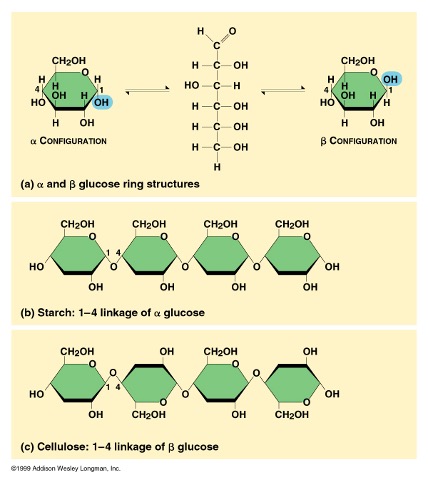
beta configuration

chemical structure is configured to show certain molecules, above plane of molecule

  • ex: humans are unable to digest cellulose very well, need an enzyme to hydrolyze + release energy/sugar in animals, only because of configuration… STRUCTURE=FUNCTION
<p>chemical structure is configured to show certain molecules, above plane of molecule</p><ul><li><p>ex: humans are unable to digest cellulose very well, need an enzyme to hydrolyze + release energy/sugar in animals, only because of configuration… STRUCTURE=FUNCTION</p></li></ul><p></p>
16
New cards

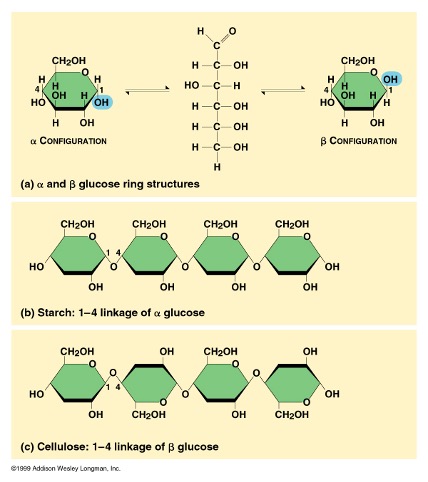
alpha configuration

chemical configuration shows certain molecules below plane of molecule

  • ex: starch is a glucose polymer in plants that is able to be digested by humans, whereas cellulose is not
<p>chemical configuration shows certain molecules below plane of molecule</p><ul><li><p>ex: starch is a glucose polymer in plants that is able to be digested by humans, whereas cellulose is not</p></li></ul><p></p>
17
New cards

lipids

water insoluable (hydrophobic) compounts

  • not true macromolecules, not quite big enough

  • functions: primary component of cell membrane, energy storage, signaling molecules, insulation

  • fatty acids + glycerol → fats, triglycerides, phospholipids, steroids

18
New cards

fats

type of lipid macromolecule made from:

  • glycerol: 3-carbon alcohol

  • fatty acids: hydrocarbon chain 16-18C with carboxyl group on one end

nonpolar b/c no oxygen on ends

dehydration reactions for ester linkages → triglycerides
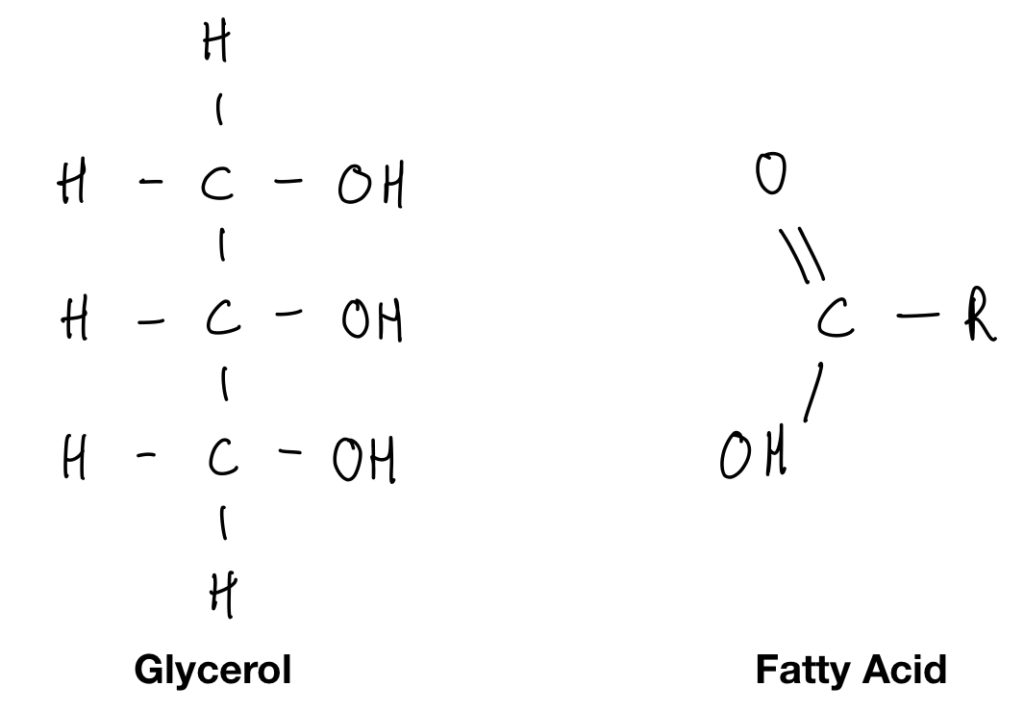
<p>type of lipid macromolecule made from: </p><ul><li><p>glycerol: 3-carbon alcohol</p></li><li><p>fatty acids: hydrocarbon chain 16-18C with carboxyl group on one end</p></li></ul><p>nonpolar b/c no oxygen on ends</p><p>dehydration reactions for <mark data-color="yellow" style="background-color: yellow; color: inherit;">ester linkages</mark> → triglycerides</p><p></p>
19
New cards

ester linkages

bonds that form fats and lipids

→ triglyceride, phospholipid, steroid, etc

20
New cards

triglyceride

fatty acids and 3 molecules of glycerol linked by dehydration reactions to form ester linkages

  • function as fat storage in adipose tissue

  • hydrophobic

  • can differ in saturation of fatty acid composition
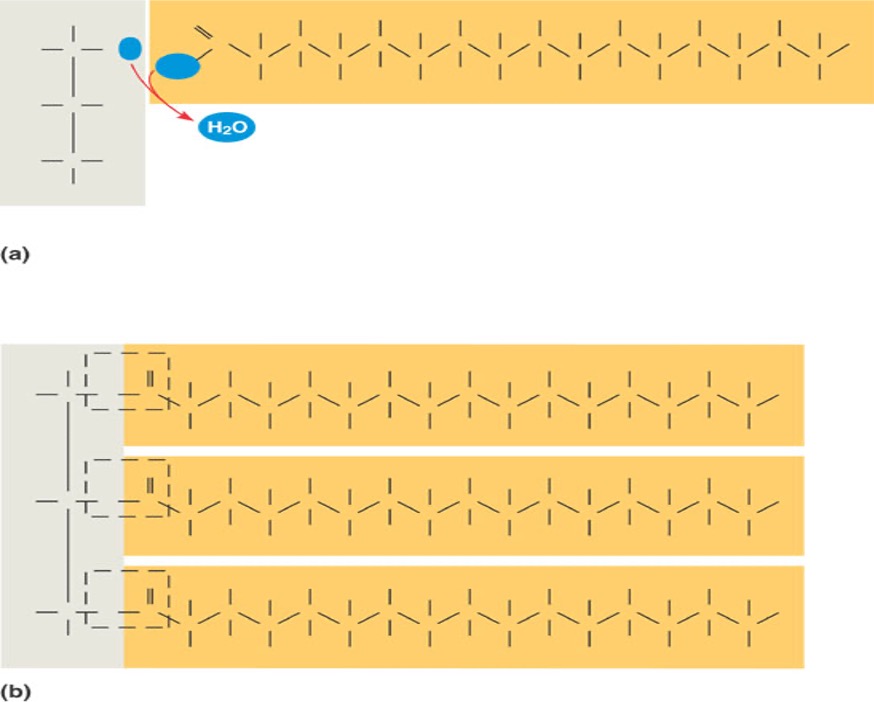
<p>fatty acids and <mark data-color="yellow" style="background-color: yellow; color: inherit;">3 molecules</mark> of glycerol linked by dehydration reactions to form ester linkages</p><ul><li><p>function as fat storage in adipose tissue</p></li><li><p>hydrophobic</p></li><li><p>can differ in saturation of fatty acid composition</p></li></ul><p></p>
21
New cards

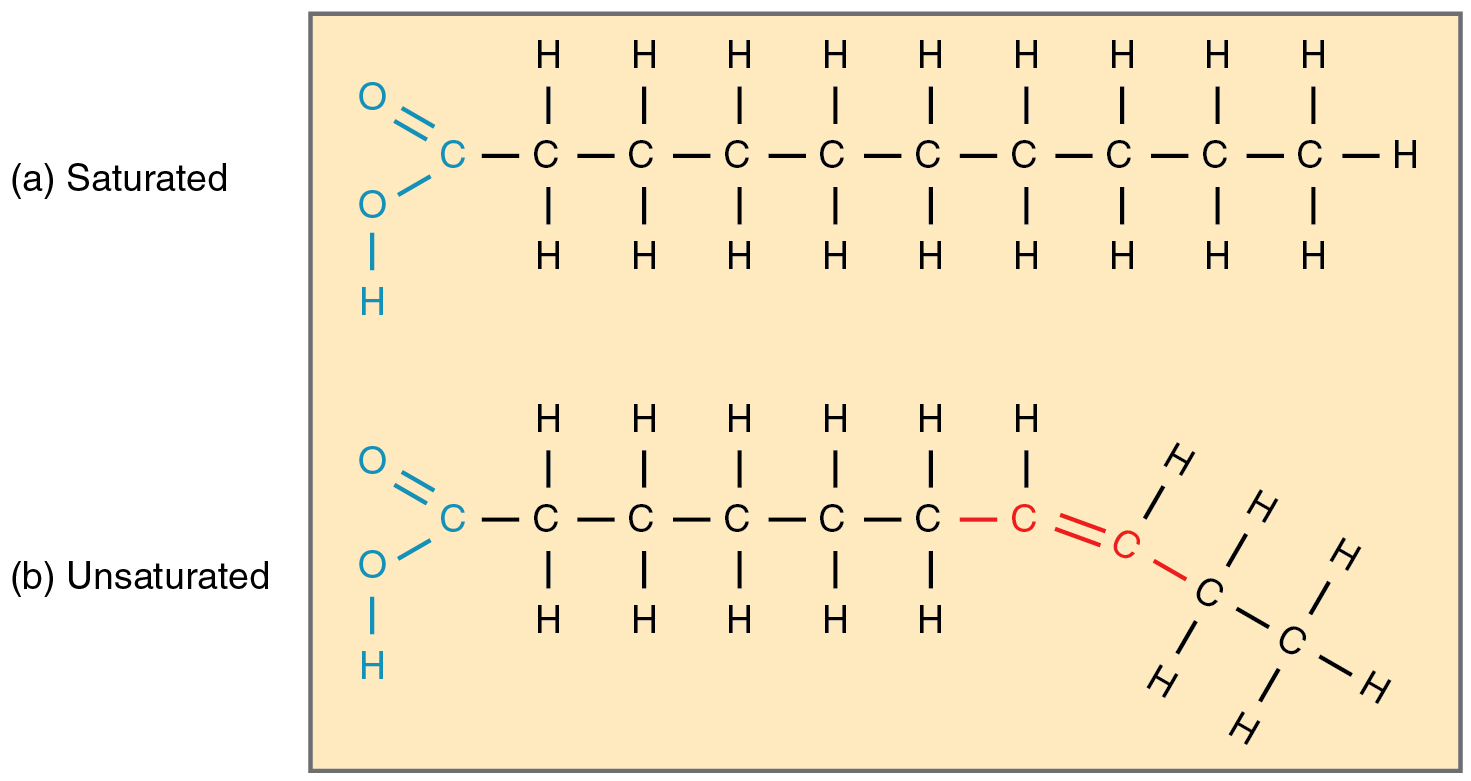
saturation of a fatty acid

number of double bonds in hydrocarbon chain of a lipid/fat/triclyceride

22
New cards

saturated fat

no double bonds in hydrocarbon chain (fatty acid chain) of triglyceride, solid at room temp

bad fat

  • animal fat

  • ex: stearic acid, butter

  • contribute to more cardiovascular diseases: raise cholesterol levels

  • often hydrogenated (saturated in hydrogen) for preservation
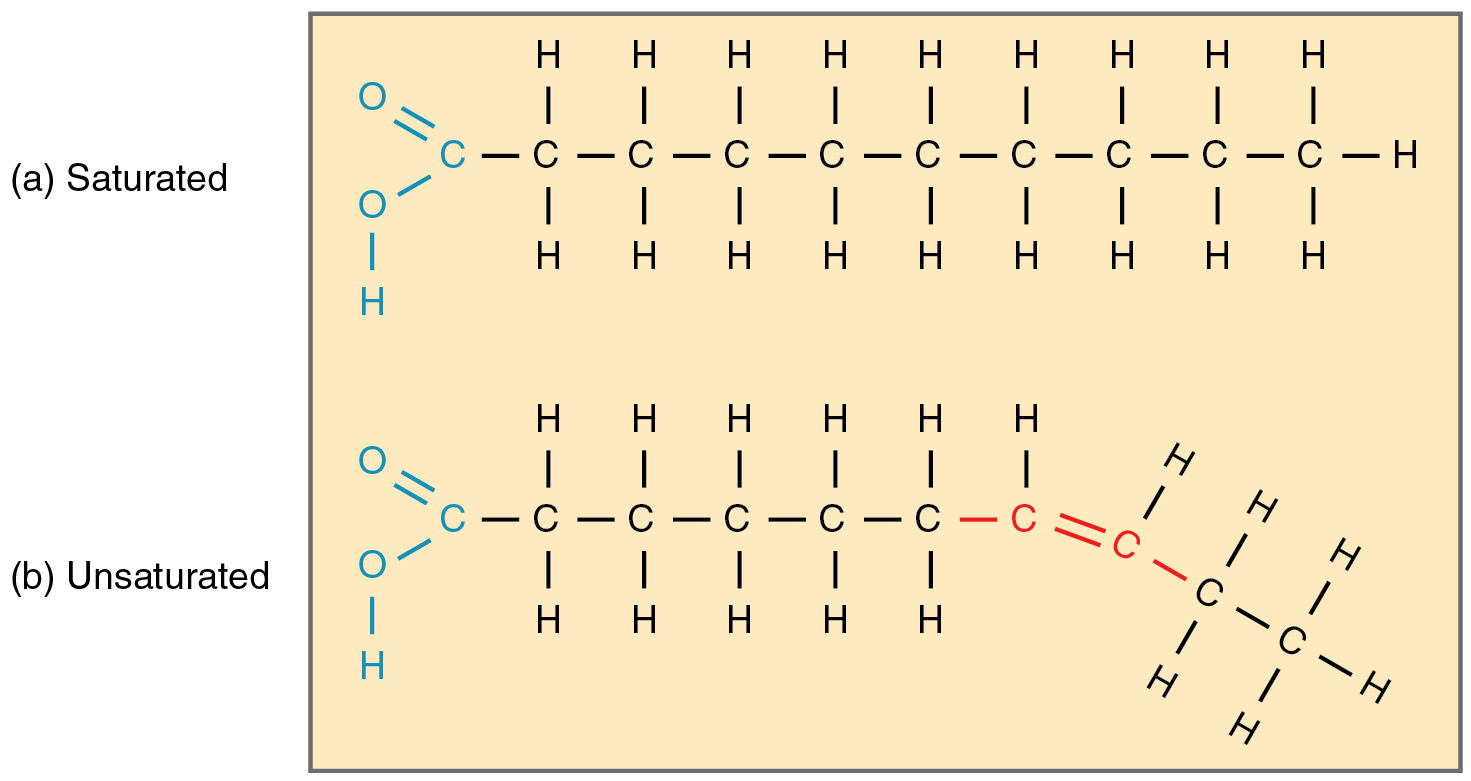
<p>no double bonds in hydrocarbon chain (fatty acid chain) of triglyceride, solid at room temp</p><p>bad fat</p><ul><li><p>animal fat</p></li><li><p>ex: stearic acid, butter</p></li><li><p>contribute to more cardiovascular diseases: <mark data-color="yellow" style="background-color: yellow; color: inherit;">raise cholesterol levels</mark></p></li><li><p>often hydrogenated (saturated in hydrogen) for preservation</p></li></ul><p></p>
23
New cards

unsaturated fat

one or more double bonds in hydrocarbon chain (fatty acid) of a triglyceride, liquid at room temp

good fat

  • have a kink in the hydrocarbon chain because of double bond → molecules can’t pack tight together

  • plant oil

  • ex: oleic acid

  • not saturated in hydrogen

<p>one or more double bonds in hydrocarbon chain (fatty acid) of a triglyceride, liquid at room temp</p><p>good fat</p><ul><li><p>have a <mark data-color="yellow" style="background-color: yellow; color: inherit;">kink</mark> in the hydrocarbon chain <mark data-color="yellow" style="background-color: yellow; color: inherit;">because of double bond</mark> → molecules can’t pack tight together</p></li></ul><ul><li><p>plant oil</p></li><li><p>ex: oleic acid</p></li><li><p>not saturated in hydrogen </p></li></ul><p></p>
24
New cards

phospholipids

Amphiphilic lipid composed of a

  • phosphate group head: hydrophilic

  • a glycerol as a link

  • 2 fatty acids tails: one saturated and one unsaturated (w/ kink b/c of double bond)

    • hydrophobic

→ third fatty acid of triglyceride becomes phosphate group here

form biological membranes: phospholipid bilayer of cell membranes!!!
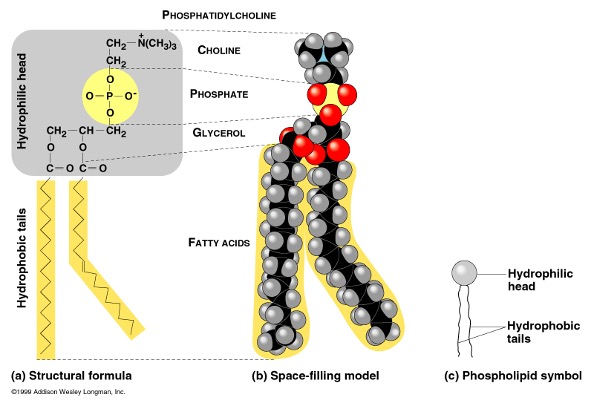
<p>Amphiphilic lipid composed of a</p><ul><li><p>phosphate group head: hydrophilic</p></li><li><p>a glycerol as a link</p></li><li><p>2 fatty acids tails: one saturated and one unsaturated (w/ kink b/c of double bond)</p><ul><li><p>hydrophobic</p></li></ul></li></ul><p>→ third fatty acid of triglyceride becomes phosphate group here</p><p>form biological membranes: phospholipid bilayer of cell membranes!!!</p><p></p>
25
New cards

phospholipids in cell membranes

hydrophobic tails of each layer point towards each other, away from the surrounding water

hydrophilic heads form outside boundary

room for protein passageways and valves make it semipermiable
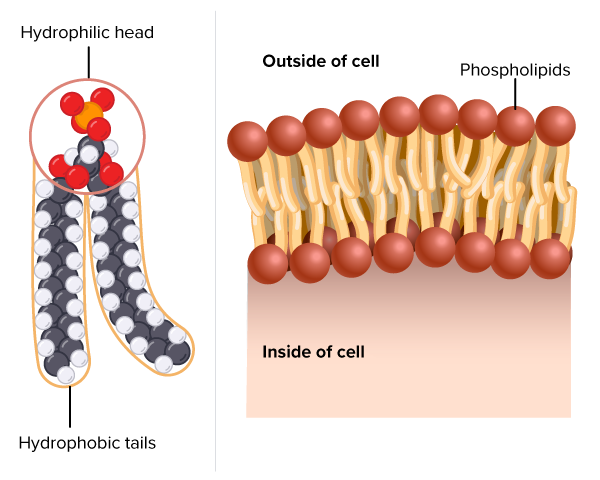
<p>hydrophobic tails of each layer point towards each other, away from the surrounding water</p><p>hydrophilic heads form outside boundary</p><p>room for protein passageways and valves make it semipermiable </p>
26
New cards

steroids

lipids with 4 fused carbon rings and functional groups

→ cholesterol (pre-cursor to hormones), estrogen, testosterone

  • part of cell membranes and signaling mechanisms

  • only 15% of cholesterol needed from outside, 85% made in liver - too many saturated fats that increase cholesterol are BAD
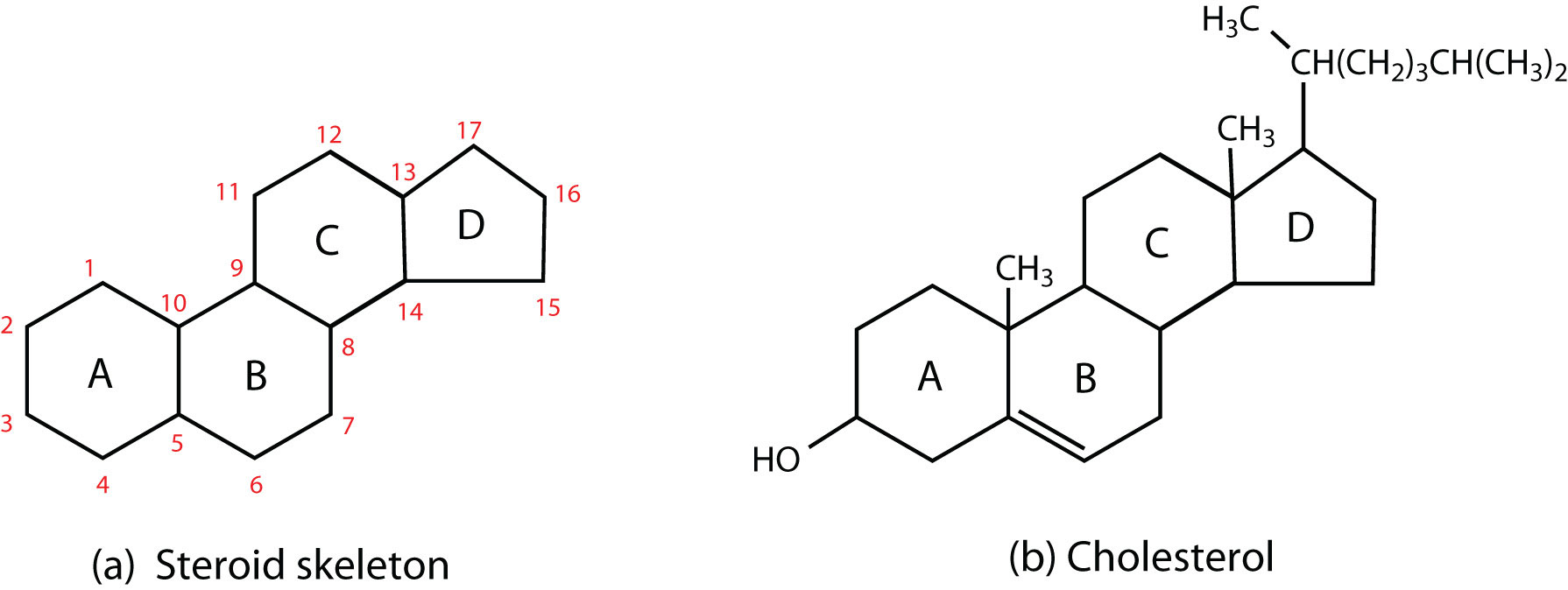
<p>lipids with 4 fused carbon rings and functional groups</p><p>→ cholesterol (pre-cursor to hormones), estrogen, testosterone</p><ul><li><p>part of cell membranes and signaling mechanisms</p></li><li><p>only 15% of cholesterol needed from outside, 85% made in liver - too many saturated fats that increase cholesterol are BAD</p></li></ul><p></p>
27
New cards

proteins

macromolecule composed of one or more polypeptide chains folded into specific conformation

  • polypeptide =/ protein, specific folding and twisting is needed

amino group + carbonyl group → amino acids + peptide bonds → polypeptide x1000 → proteins

wide variety of functions → wide variety of structures:

  • structure, trasport, storage, signaling, movement, making enzymes, etc

  • made from combining 20 amino acids in a particular sequence that determine the function

  • ex: lysozyme has a curled and curved structure needed to aggresively break down food in saliva
<p>macromolecule composed of one or more polypeptide chains folded into specific conformation</p><ul><li><p>polypeptide =/ protein, specific folding and twisting is needed</p></li></ul><p>amino group + carbonyl group → amino acids + peptide bonds → polypeptide x1000 → proteins</p><p>wide variety of functions → wide variety of structures:</p><ul><li><p>structure, trasport, storage, signaling, movement, making enzymes, etc</p></li><li><p>made from combining 20 amino acids in a particular sequence that determine the function  </p></li><li><p>ex: lysozyme has a curled and curved structure needed to aggresively break down food in saliva </p></li></ul><p></p>
28
New cards

polypeptides

polymers made of amino acids (monomer) in a particular sequence, linked by peptide bonds

  • range from a few to thousands of amino acids in one

  • 20 kinds of amino acids

<p>polymers made of amino acids (monomer) in a particular sequence, linked by peptide bonds</p><ul><li><p>range from a few to thousands of amino acids in one</p></li><li><p>20 kinds of amino acids </p></li></ul><p></p>
29
New cards

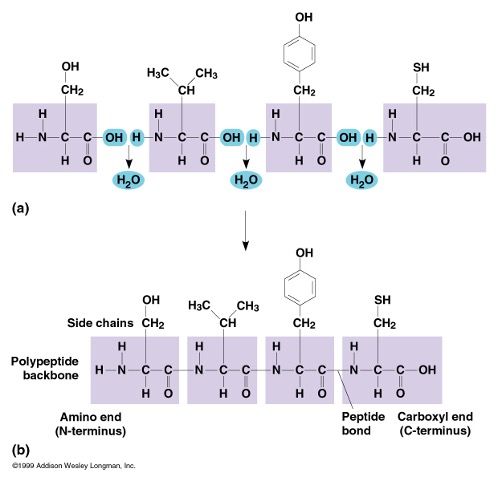
peptide bond

links the carboxyl group in one amino acid to the amino group of another

bonds that form polypeptides → proteins

30
New cards

amino acids

central carbon bound to an amino group, a carboxyl group, a hydrogen, and a variable R- group (radical group)

  • r-group determines characteristics of the amino acid: nonpolar, polar, acidic, basic

  • linked together by dehydration synthesis forming a peptide bond

  • ex: glycine (r-group is an H, nonpolar), cystenine (r-group is SH-CH2, polar)
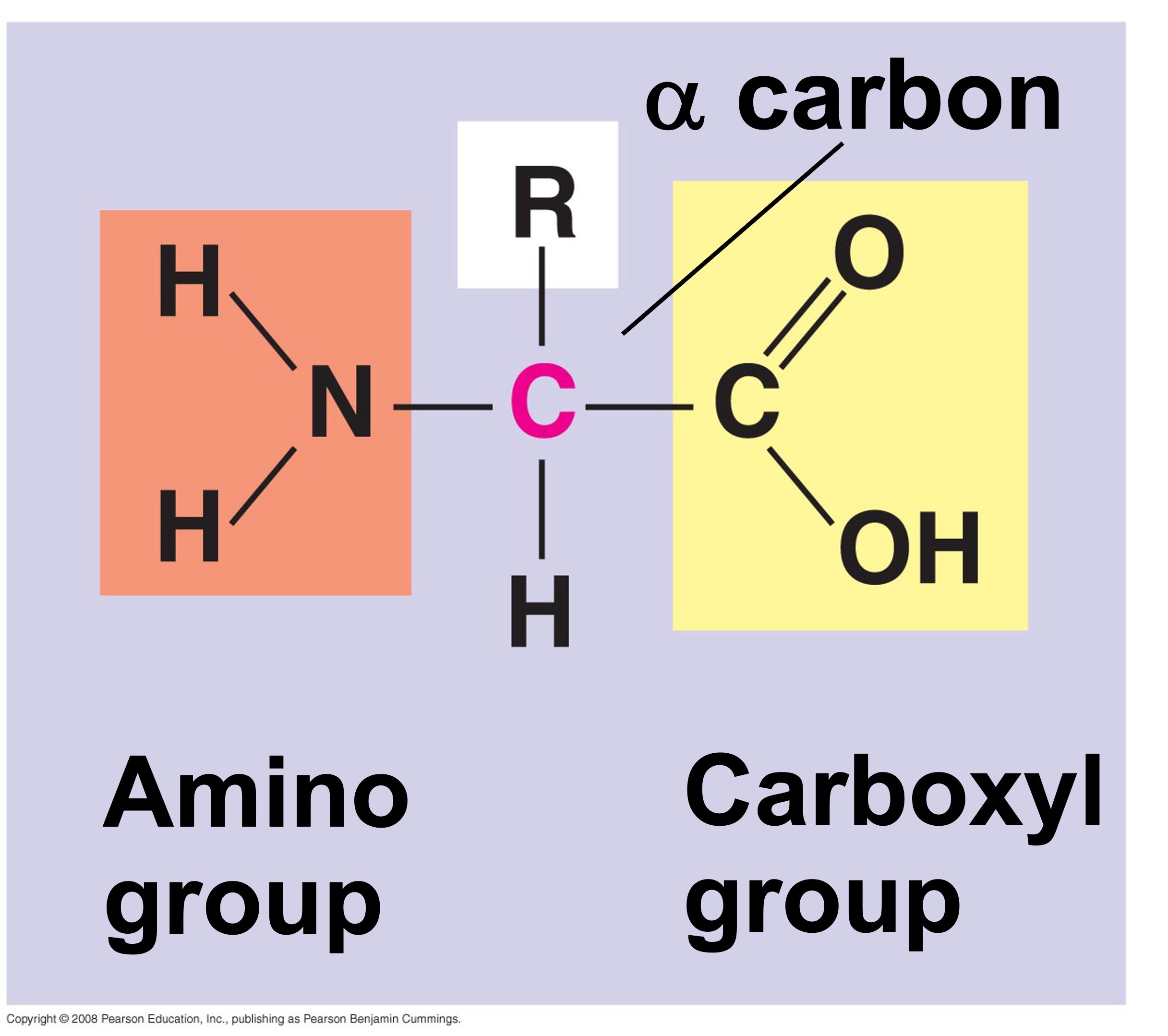
<p>central carbon bound to an amino group, a carboxyl group, a hydrogen, and a variable R- group (radical group)</p><ul><li><p>r-group determines characteristics of the amino acid: nonpolar, polar, acidic, basic</p></li><li><p>linked together by dehydration synthesis forming a peptide bond</p></li><li><p>ex: glycine (r-group is an H, nonpolar), cystenine (r-group is SH-CH2, polar)</p></li></ul><p></p>
31
New cards

function, structure, amino acid

a protein’s _______ is dependent on it’s _______ which is determined by the ______ ______ sequence.

32
New cards

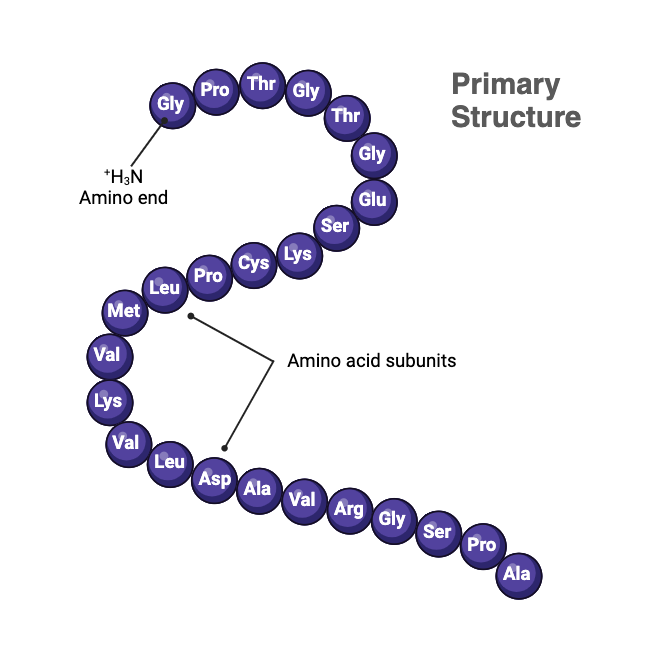
primary protein structure

unique amino acid sequence of a protein (dictated by genes)

  • singal sequence of amino acids

<p>unique amino acid sequence of a protein (dictated by genes)</p><ul><li><p>singal sequence of amino acids </p></li></ul><p></p>
33
New cards

secondary protein structure

regular coiling and folding of a peptide chain

  1. alpha helix

  2. beta pleated sheet

→ can co-exist in same protein

→ formed by H-bonds between one group of amino acids (H+) and carboxyl group (O-)

  • interactions between “backbone” amino acids, NOT r-group
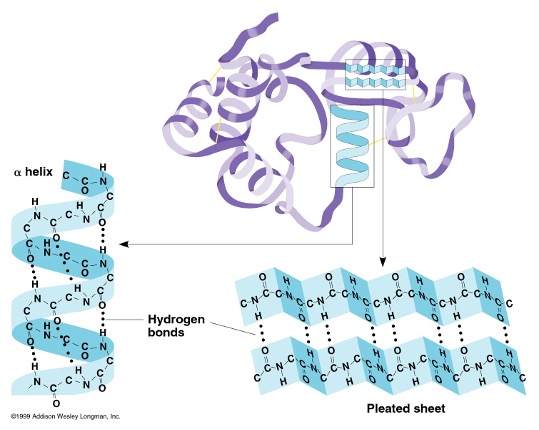
<p>regular coiling and folding of a peptide chain</p><ol><li><p>alpha helix</p></li><li><p>beta pleated sheet</p></li></ol><p>→ can co-exist in same protein</p><p>→ formed by H-bonds between one group of amino acids (H+) and carboxyl group (O-)</p><ul><li><p>interactions between “backbone” amino acids,<mark data-color="yellow" style="background-color: yellow; color: inherit;"> NOT r-group</mark></p></li></ul><p></p>
34
New cards

alpha helix

helical coiling stablized by hydrogen bonding

type of secondary structure of a protein

  • H-bonds between amino group and carboxyl group on opposite molecules of amino acids (backbone of amino acids, not R-group)
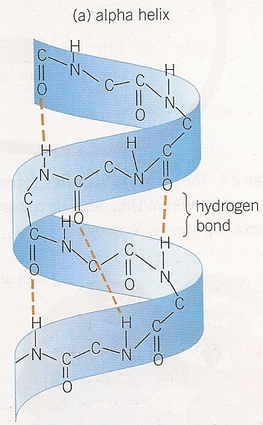
<p>helical coiling stablized by hydrogen bonding</p><p>type of secondary structure of a protein </p><ul><li><p>H-bonds between amino group and carboxyl group on opposite molecules of amino acids (backbone of amino acids, <mark data-color="yellow" style="background-color: yellow; color: inherit;">not R-group</mark>)</p></li></ul><p></p>
35
New cards

beta pleated sheet

antiparallel chains in pleats

type of secondary protein structure

  • formed by H-bonds between amino group and carboxyl group on opposite molecules of amino acids (backbone of amino acids, not R-group)
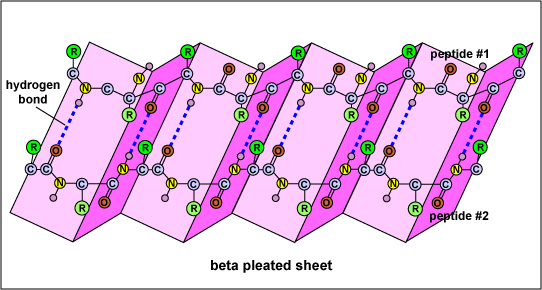
<p>antiparallel chains in pleats</p><p>type of secondary protein structure</p><ul><li><p>formed by H-bonds between amino group and carboxyl group on opposite molecules of amino acids (backbone of amino acids, <mark data-color="yellow" style="background-color: yellow; color: inherit;">not R-group</mark>)</p></li></ul><p></p>
36
New cards

tertiary protein structure

3D shape of polypeptide chain

  • determined by weak forces (H-bonding, iconic attraction, and hydrophobic interaction) and covalent linkages

  • from R-GROUPS, not backbone of amino acid
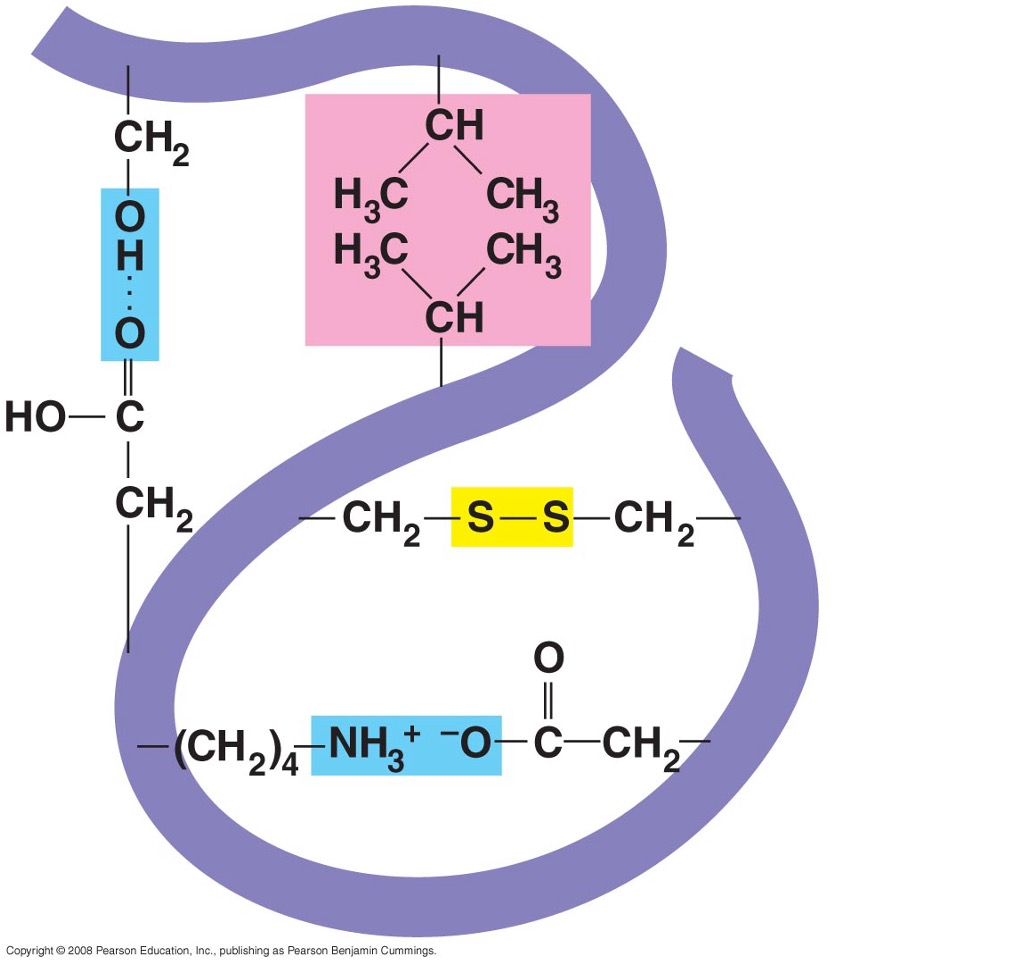
<p>3D shape of polypeptide chain</p><ul><li><p>determined by weak forces (H-bonding, iconic attraction, and hydrophobic interaction) and covalent linkages </p></li><li><p>from <mark data-color="yellow" style="background-color: yellow; color: inherit;">R-GROUPS</mark>, not backbone of amino acid</p></li></ul><p></p>
37
New cards

quaternary protein structure

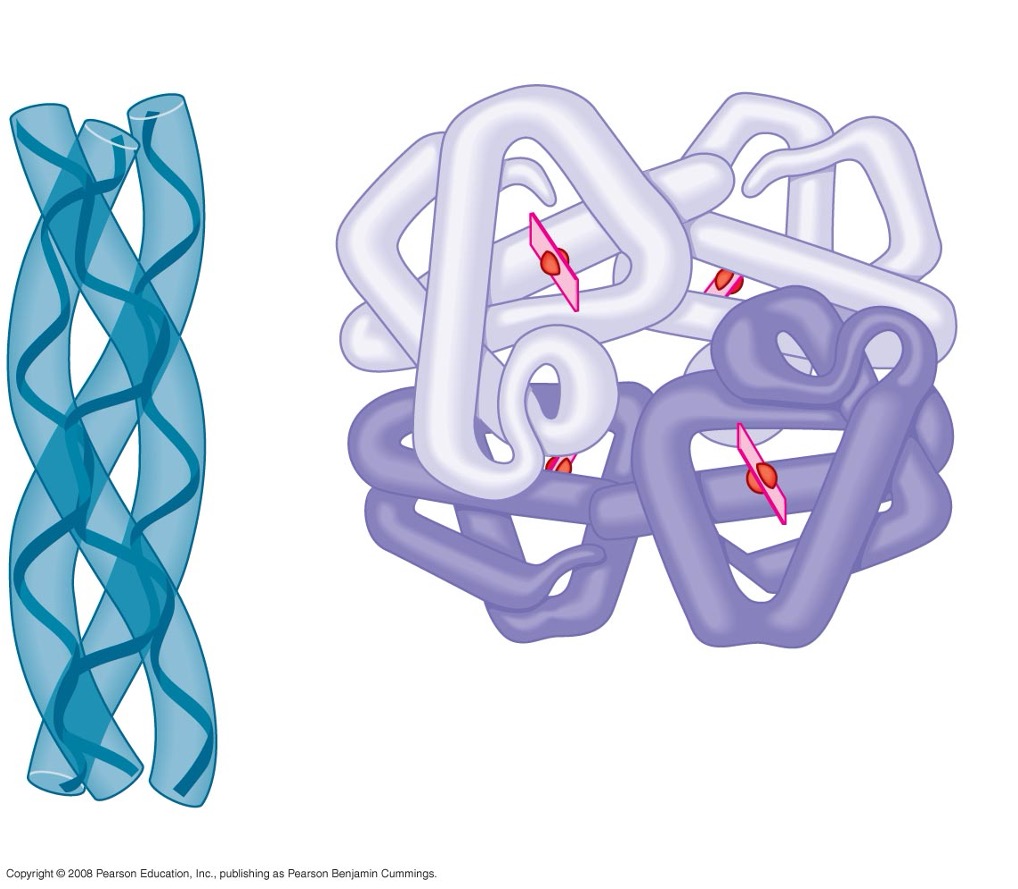
interactions of several peptide chains to make a single protein

  • forms overall structure

  • aggregation of polypeptide chains together

  • ex: 3 collagen polypeptide chains wound together in a rope shape, bound by the quaternary structure of polypeptide chains

  • influence on function: healthy hemoglobin vs sickle cell hemoglobin = one molecular substitution effects ability to form quaternary protein structure and leads to clumping instead of twisting and curling around each other
<p>interactions of several peptide chains to make a single protein</p><ul><li><p>forms overall structure</p></li><li><p>aggregation of polypeptide chains together</p></li><li><p>ex: 3 collagen polypeptide chains wound together in a rope shape, bound by the quaternary structure of polypeptide chains</p></li><li><p>influence on function: healthy hemoglobin vs sickle cell hemoglobin = one molecular substitution effects ability to form quaternary protein structure and leads to clumping instead of twisting and curling around each other </p></li></ul><p></p>
38
New cards

denaturation of proteins

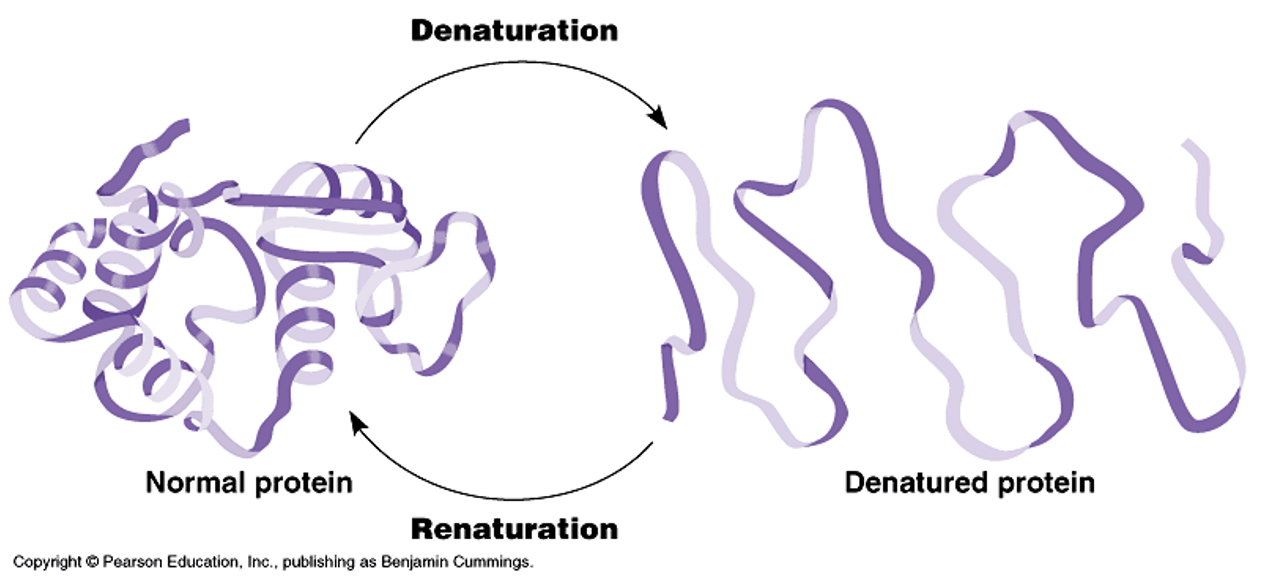
harsh or unsual envrionmental conditions can cause the protein to change its shape and lose biological activity

  • pH, salt concentration, temperature, solvent (aqueous vs organic)

<p>harsh or unsual envrionmental conditions can cause the protein to change its shape and lose biological activity </p><ul><li><p>pH, salt concentration, temperature, solvent (aqueous vs organic)</p></li></ul><p></p>
39
New cards

renaturation of proteins

process when a protein structure is altered and damaged due to environment, chaperone proteins repair denatured proteins and restore structure and function
<p>process when a protein structure is altered and damaged due to environment, chaperone proteins repair denatured proteins and restore structure and function</p>
40
New cards

nucleic acids

polymer that stores genetic information and controls protein synthesis

  • monomer: nucleotides linked by dehydration reactions

DNA and RNA

41
New cards

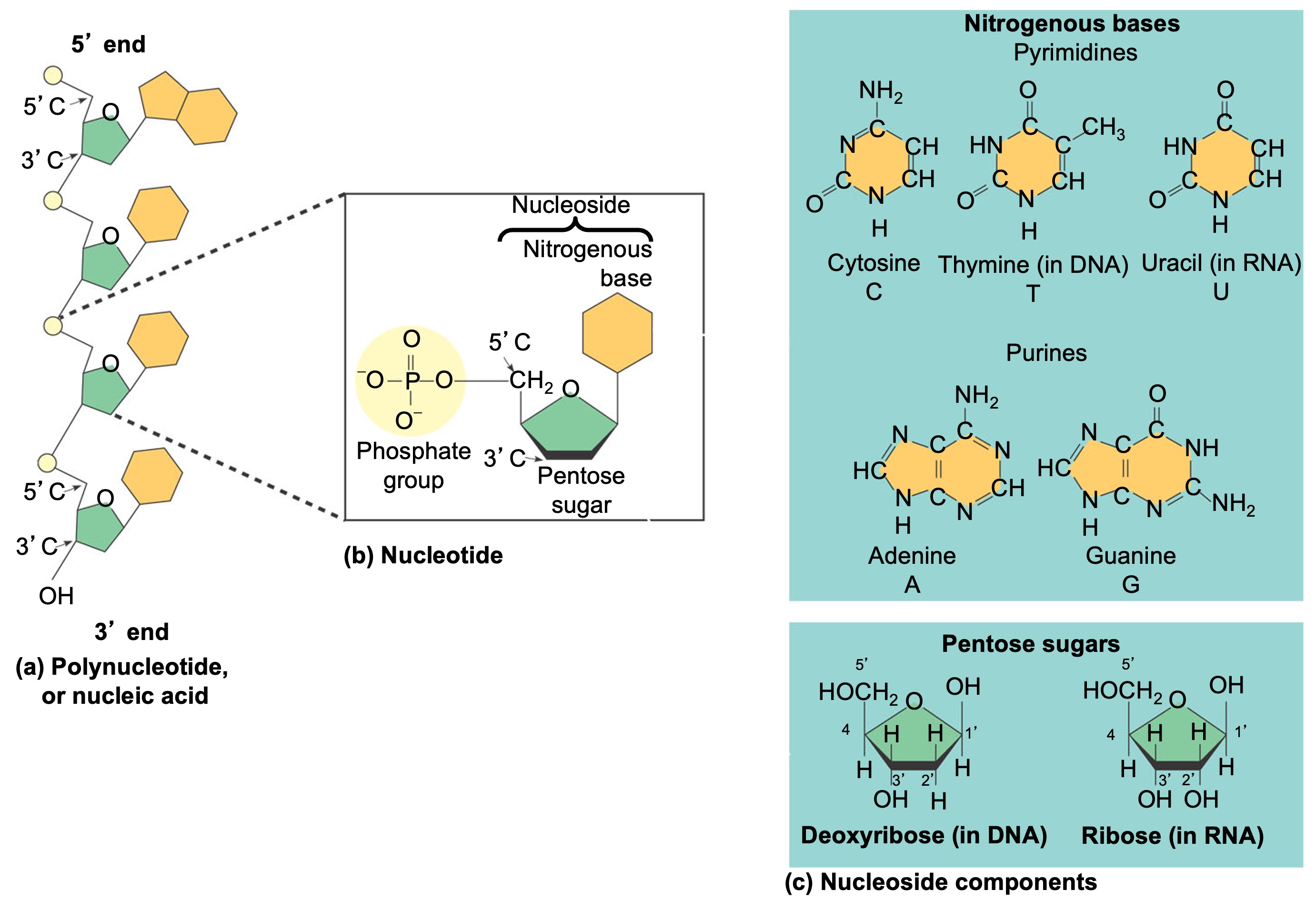
nucleotides

forms nucleic acids (DNA and RNA)

made of:

  • 5-carbon sugar “pentose:” ribose or deoxyribose

  • phosphate group

  • nitrogenous base: purines or pyrimidines

function as:

  • monomers for nucleic acids energy

  • transfer molecules (ATP) electrons

  • acceptors (NAD)

<p>forms nucleic acids (DNA and RNA)</p><p>made of:</p><ul><li><p>5-carbon sugar “pentose:” ribose or deoxyribose</p></li><li><p>phosphate group</p></li><li><p>nitrogenous base: purines or pyrimidines</p></li></ul><p>function as:</p><ul><li><p>monomers for nucleic acids energy</p></li><li><p>transfer molecules (ATP) electrons</p></li><li><p>acceptors (NAD)</p></li></ul><p></p>
42
New cards

ribose

5-carbon sugar in RNA

43
New cards

deoxyribose

5-carbon sugar in DNA

44
New cards

purines

type of nitrogenous base composed of 2 ring structure

  • adenine and guanine

45
New cards

pyrimidines

nitrogenous bases composed of a single ring

cytosine, thymine (DNA), uracil (RNA)

46
New cards

DNA

genetic information

type of nucleic acid, made of nucleotides

set of coded instructions that tells a cell how to make proteins

replicated and passed from one generation to the next

regulator information for when, where, and how genes are expressed

double helix structure because of structure of nucleotides (monomer)

47
New cards

RNA

messenger molecule that directs and instructs protein synthesis

nucleic acid made of nucleotides

carries info from nucleus to sites of protein synthesis (rough ER, ribosomes, mitochondria, etc)

DNA → RNA → proteins

48
New cards

DNA double helix

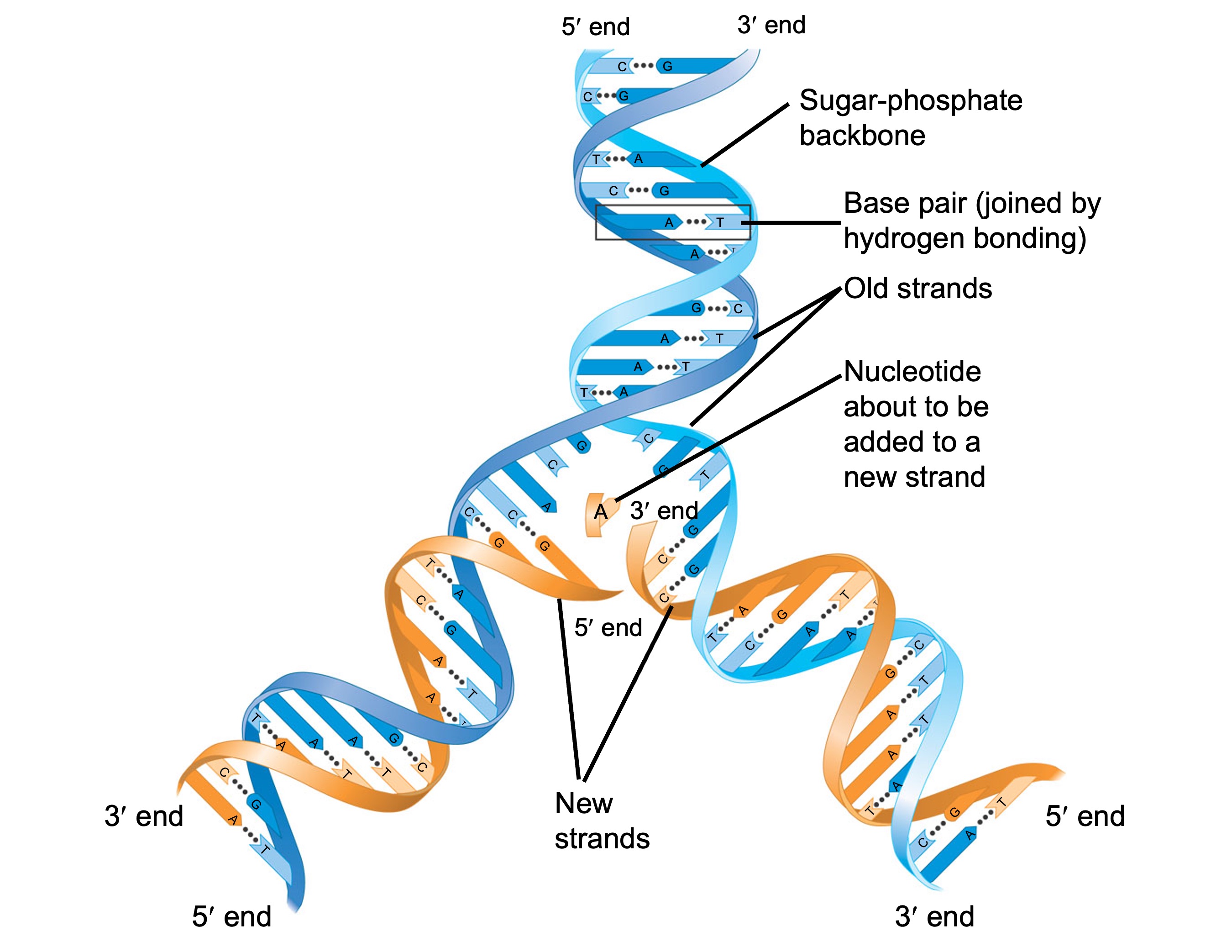
2 polynucleotides spiral around each other

  • sugar + phosphate backbone forms helix ribbon

  • H-bonds form between nitrogenous bases (A-T, C-G) to form the rungs

→ replication: identical nitrogenous base sequence used, H-bonds break + reform, RNA produces second strand for new DNA strand

  • discovered by Watson and Crick, Rosalinda Franklin
<p>2 polynucleotides spiral around each other</p><ul><li><p>sugar + phosphate backbone forms helix ribbon</p></li><li><p><mark data-color="yellow" style="background-color: yellow; color: inherit;">H-bonds</mark> form between nitrogenous bases (A-T, C-G) to form the rungs</p></li></ul><p>→ replication: identical nitrogenous base sequence used, H-bonds break + reform, RNA produces second strand for new DNA strand</p><ul><li><p>discovered by Watson and Crick, Rosalinda Franklin</p></li></ul><p></p>
49
New cards

protein synthesis

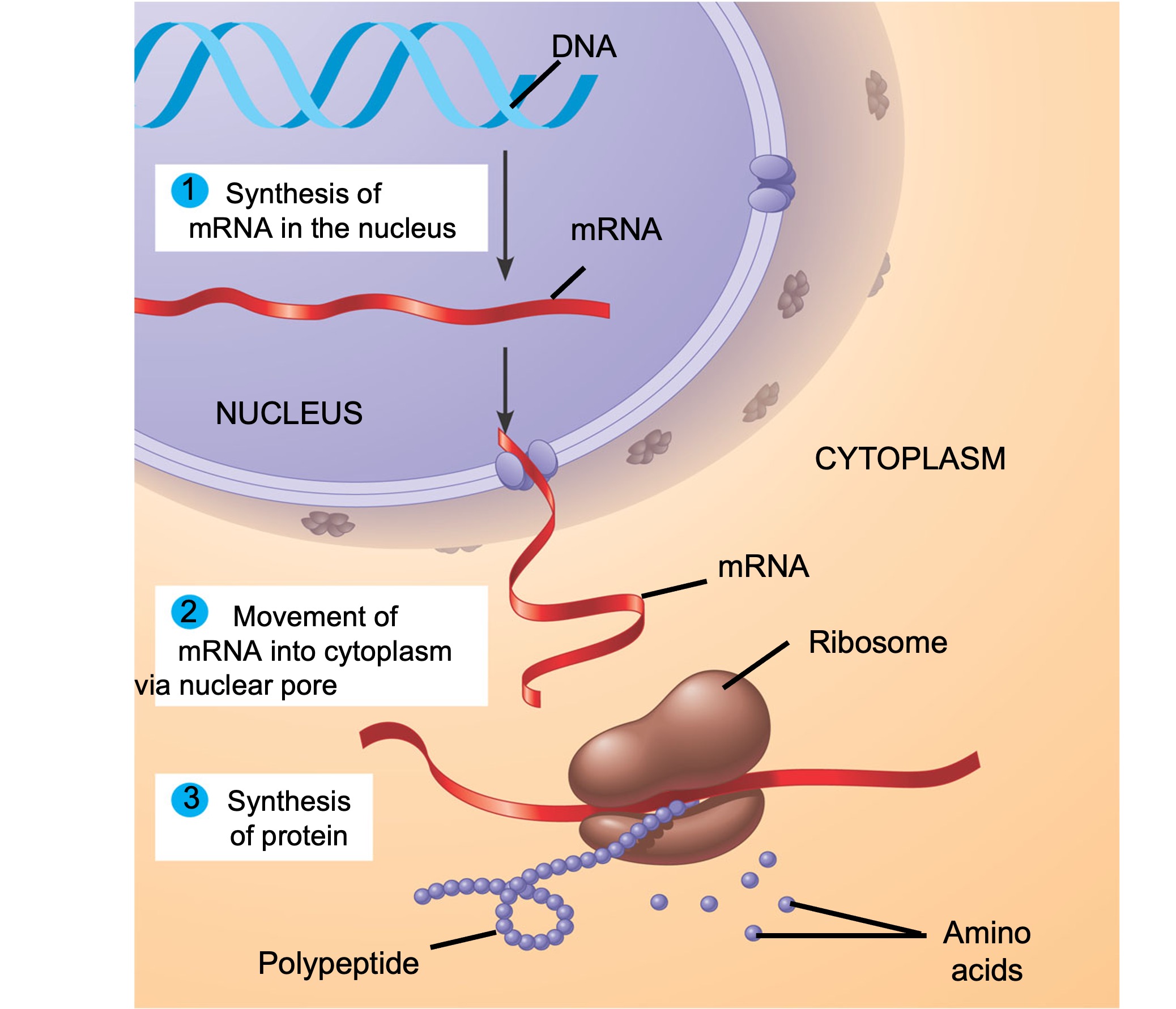
DNA → RNA → proteins

  • mRNA, synthesized from DNA code in nuecleus

  • mRNA used to construct amino acid sequence (proteins)

  • single strand, synthesized to know the amino acid sequence from DNA code → go to ribosome and collects amino acids → polypeptide
<p>DNA → RNA → proteins</p><ul><li><p>mRNA, synthesized from DNA code in nuecleus </p></li><li><p>mRNA used to construct amino acid sequence (proteins)</p></li><li><p>single strand, synthesized to know the amino acid sequence from DNA code → go to ribosome and collects amino acids → polypeptide </p></li></ul><p></p>