FP 11 - Color and Shade Matching (Dr. Muftu)
 Call Kai
 Learn
Learn Practice Test
 Spaced Repetition
 Match
Match Flashcards
 Knowt Play
1/109

There's no tags or description
Looks like no tags are added yet.
Name | Mastery | Learn | Test | Matching | Spaced | Call with Kai |
|---|
No analytics yet
Send a link to your students to track their progress
110 Terms
- Esthetics
- Comfort
- Function
- Biologic health
What are the parameters under which we should enhance or maintain quality of life for craniofacial function?
- Color
- Translucency
- Texture
What are the three main features in a natural tooth that must be produced in dental porcelain or an esthetic restorative material are?
- Light source
- Object (Interaction of light and matter)
- Observer
The mechanism of visual color perception relies on (3)
around 400-700 nm
What is the visible light wavelength?
Color rending index (CRI)
Define the following:
Ability of a light source to reveal colors accurately compared to ideal or reference light source (i.e. N. daylight)
0-100
What is the scale for CRI?
FALSE
Higher CRI = better coloring rendering ability; 100 = perfect match
T/F: Lower CRI = better coloring rendering ability
They have the same color temperature
CRI measures for a pair of light sources can only be compared if __________
color temperature
What has the following characteristics?
- Refers to appearance of light emitted by a light source
- Helps define whether light looks warm (yellowish), neutral, or cool (bluish)
- Related to the color standard black body radiation
- Reported in degrees Kelvin
Black body radiation
Color temperature is related to the color standard ___________
6500ºK (northern daylight)
What is the color temperature for northern daylight?
Incandescent light
What type of light?
- Emits a high concentration of yellow waves
- Not suitable for shade matching
- Low CRI
Fluorescent light
What type of light?
- Emits a high concentration of blue waves
- Not suitable for shade matching
- CRI of 50-80
northern daylight considered best as it is closest to emitting the full spectrum of white light
- specifically hours around noon, where full spectrum of colors visible
What is the ideal light?
Close to 100
what is the CRI of natural daylight?
Yellow/orange, blue/green
Morning and evening daylight is rich in __________ and lacks _________
shorter wavelengths scatter before penetrating the atmosphere
Why do morning/evening daylight lack blue/green?
Hours around noon
What is the most ideal time of daylight for CRI?
incident daylight most visible light spectrum, full spectrum of colors visible
Why are hours around noon the most ideal time of daylight for CRI?
Washington DC, June, 12-1pm, with a slight overcast, color temp of 5,500K and CRI 90
Standard illuminant for dentistry, D55, is defined as what?
5,500K and CRI 90
Standard illumniant for dentistry has a color temperature of ____K and CRI of _____
TRUE
T/F: When light strikes an object, the color that we see is what is left of the spectrum after part of it is absorbed by the object. So for example, a red object looks red bc it reflects red more than green or blue
a) opaque
If all the light reflects back, then it is considered:
a) opaque
b) translucent
c) transparent
c) transparent
If all the light passes through, then it is considered:
a) opaque
b) translucent
c) transparent
b) translucent
If some of the light is refracted at different angles, including bouncing back, then it is considered:
a) opaque
b) translucent
c) transparent
TRUE
T/F: The more glass you have the more translucent the material is. The more crystals, the stronger but more opaque it is
Material thickness
For each preparation, we must determine the required amount of tooth reduction and carefully select the restorative material, as translucency is also influenced by ___________
Specular reflection
Define the following:
- A reflection produced by a smooth surface in which parallel light rays are reflected in parallel
- Creates a shiny appearance
Diffuse reflection
Define the following:
- Reflection that occurs when parallel rays of light hit a rough surface and all reflect at different angles
- Creates a matte appearance
Gloss
Define the following:
- "A view of material appearance"
- An optical property based on the interaction of light with physical characteristics of a surface
- Ability of a surface to reflect light in a specular direction
Gloss
All of the following are factors that affect _____:
- Refractive index of material
- Angle of incident light
- Surface topography
- Rods
- Cones
The retina is made up of what two types of photoreceptor cells?
Rods
What part of the eye?
- Peak sensitivity (490- 495nm)
- black /white
Cones
What part of the eye?
- Short, 420-440 nm
- Medium, 530-540 nm
- Long, 560-580nm
- blue-, green-, red- sensitive
True
T/F: Rods are monochromatic, cones are trichromatic
males 8% (females 0.5%)
A defect in color vision is more common in what gender?
Colorimeters
ID THE DEVICE:
- Analyze the values for red, green, and blue reflected through filters that simulate sensing photoreceptor cells of the human eye
- "Reliable enough"
- The tristimulus X, Y and Z coordinates are automatically converted to L*, a*, b* value
- Less expensive
- Easy to use chairside
spectrophotometers
ID the device:
- Measure and record the amount of light reflected or transmitted from the object through its wavelength
- High precision, sensitivity to measure absolute colors and are equipped with spectral distributions of various illuminants
- Complex and expensive
- Hard to measure vital teeth
- Hue
- Value
- Chroma
Color space specifies colors based on 3 color dimensions. What are they?
Munsell color system
(CIE 1976 color space)
What color system do we use to communicate and compare color?
hue
Define the following:
- Variety of color
5 principal: Red, Yellow, Green, Blue, Purple
5 intermediate:
- each of these are then broken into 10 substeps totaling 100 hues, each given integer values
There are a total of 10 hue gradations
In the munsell system, how many hues are there?
hue
What has the following characteristics according to the munsell color theory?
- Determined by reflected wavelength of observed light within the visual light spectrum (VLS)
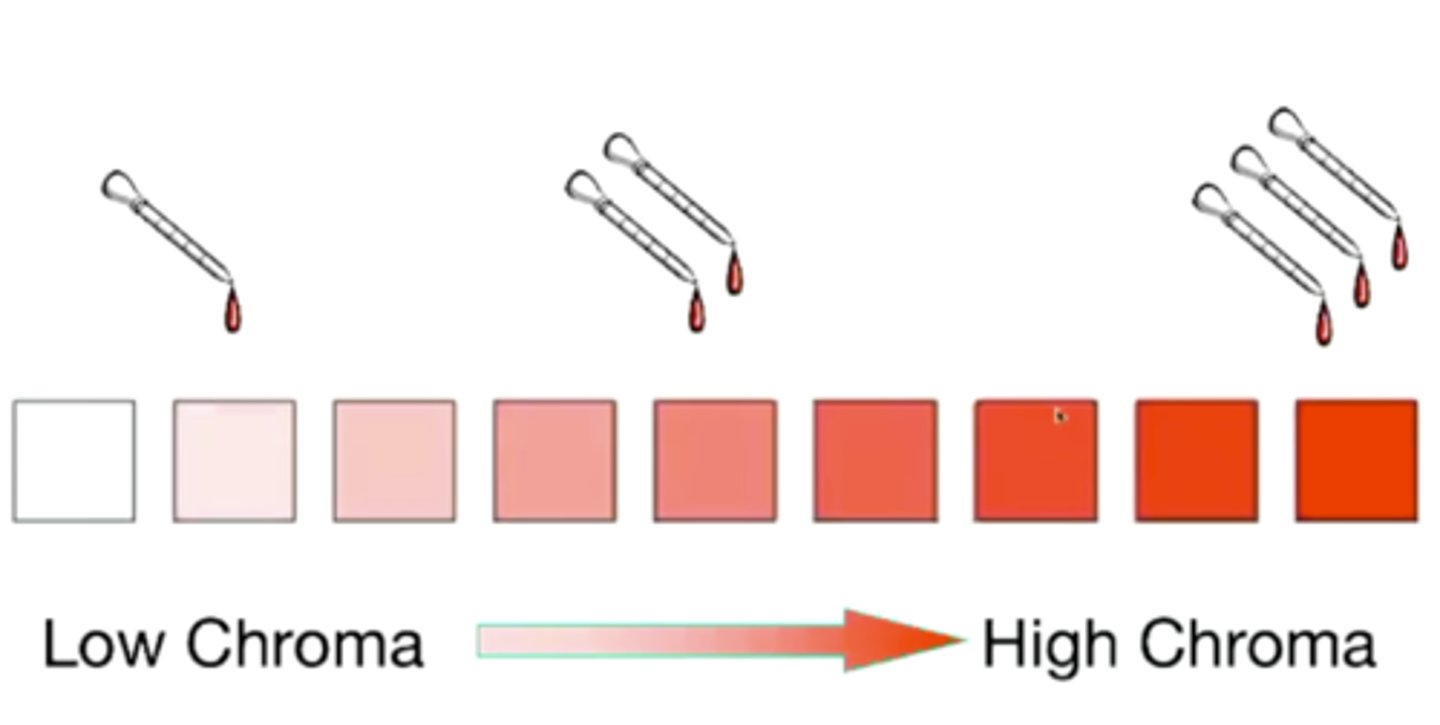
chroma
Define the following:
Intensity or saturation of a hue
Less
low chroma = more or less color?
a) Very intense color
A high chroma is...
a) Very intense color
b) Very pale color
FALSE
T/F objects of different chroma and value can be of identical hue
value
What has the following characteristics?
- Relative darkness/lightness of a color aka brightness of object
- Amount of light energy an object reflect or transmits
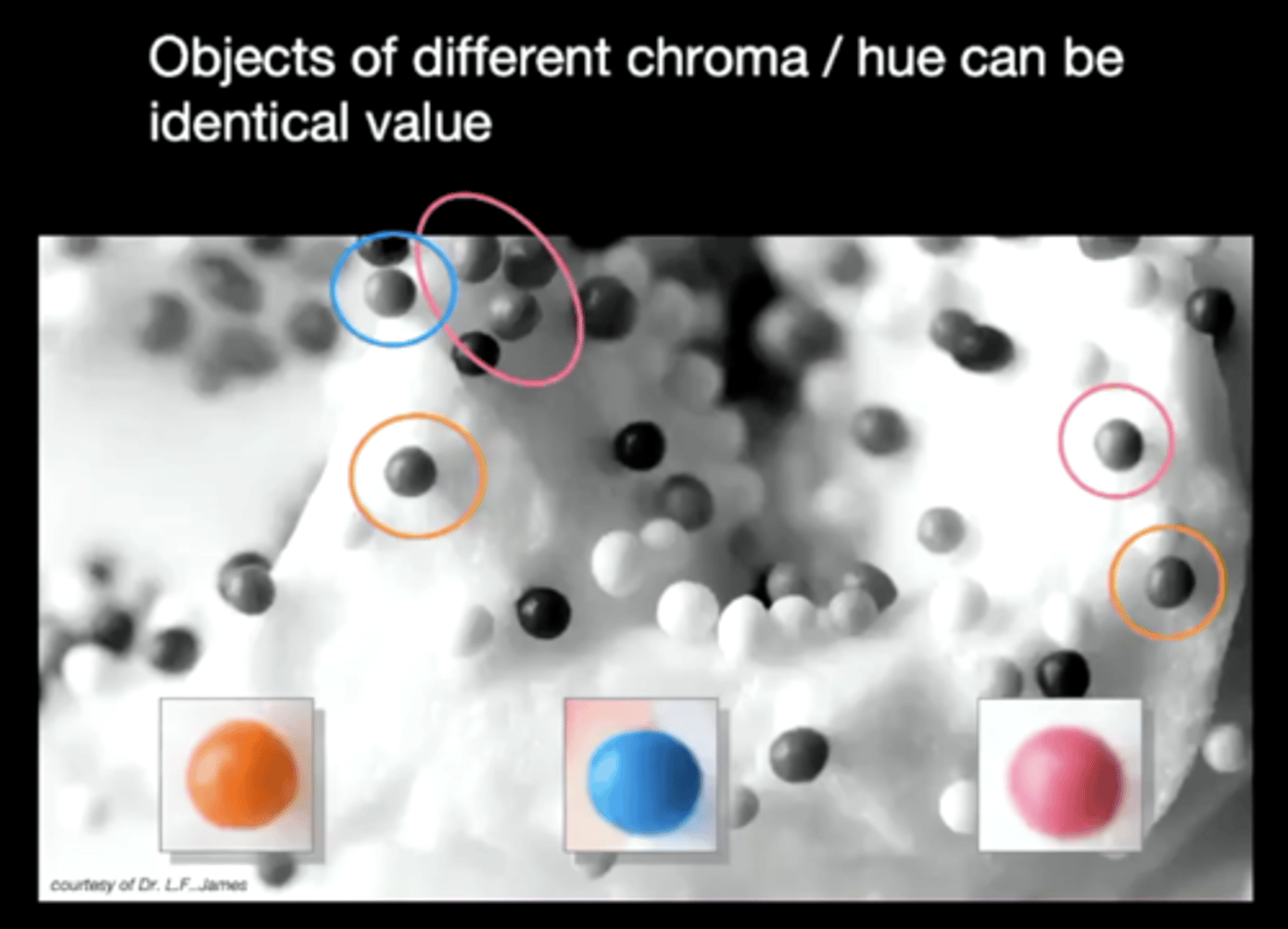
value
What has the following characteristics?
- Amount of light energy an object reflects/transmits
- Objects of different hues/chroma can be identical value
Ranges from 5.5-8.5
What is the value for natural teeth?
true
T/F: Restorations too high in value are easily detected
TRUE
T/F: Objects of different chroma and hue can be of identical value
lightness
CIE color space expresses what with L*?
black
L* = zero, what color?
white
L* = 100, what color?
redness
CIE color space expresses what with positive a*?
greenness
CIE color space expresses what with negative a*?
-90 to 70 Δa*
a* has what numerical range?
yellowness
CIE color space expresses what with positive b*?
blueness
CIE color space expresses what with negative b*?
-80 to 100 Δb*
b* has what numerical range?
color difference
This is the equation for what?

b. does NOT consider color modifiers
Which of the following is false regarding shortcomings of CIE?
a. mathematically accurate but not practical for dentistry
b. considers color modifiers
c. does not consider optical phenomena
Fluorescence
Define the following:
Absorption of light by a material and the spontaneous emission of light in a longer wavelength
FALSE - should say VITAL
T/F: Non-vital teeth look brighter and alive because higher amount of organic material is present
b) dentin
The fluorescent effect of teeth come from __________
a) enamel
b) dentin
c) pulp
Dentin
______ contains a greater amount of UV photosensitive organic pigment than enamel and is 3x more fluorescent
b) the more dentin fluoresces, the lower the chroma
Which of the following is true?
a) the more dentin fluoresces, the higher the chroma
b) the more dentin fluoresces, the lower the chroma
c) the more dentin fluoresces, the higher the value
d) the more dentin fluoresces, the lower the value
TRUE
T/F: Ceramics that lack a fluorescent agent appear as missing teeth when viewed in the dark
Check optical interaction with black light
How do you check for fluorescence of teeth or restorations?
Opalescence
Define the following:
Property of transparent or translucent materials which gives those materials a milky appearance, with iridescent reflections that resemble opal stone
a) enamel
the opalescence of teeth can be attributed to which layer of the tooth?
a) enamel
b) dentin
c) pulp
a) enamel selectively forwards long waves, and reflects short waves
- this is why the enamel can be viewed as having a blue-ish white color
which of the following statements is true?
a) enamel acts as a filter & selectively forwards long waves, and reflects short waves
b) enamel acts as a filter & selectively forwards short waves, and reflects long waves
c) enamel does not forward/reflect waves, dentin does
blue ish white
incisal enamel can be viewed as having a ____ color
counter opalescence
dentin will reflect long waves too, giving enamel an orange glaze. what is this effect known as?
Metamerism
Define the following:
The color of a pair of specimens having different spectral reflectance functions matches under one set of illuminant and observer conditions but mismatches under another set of conditions
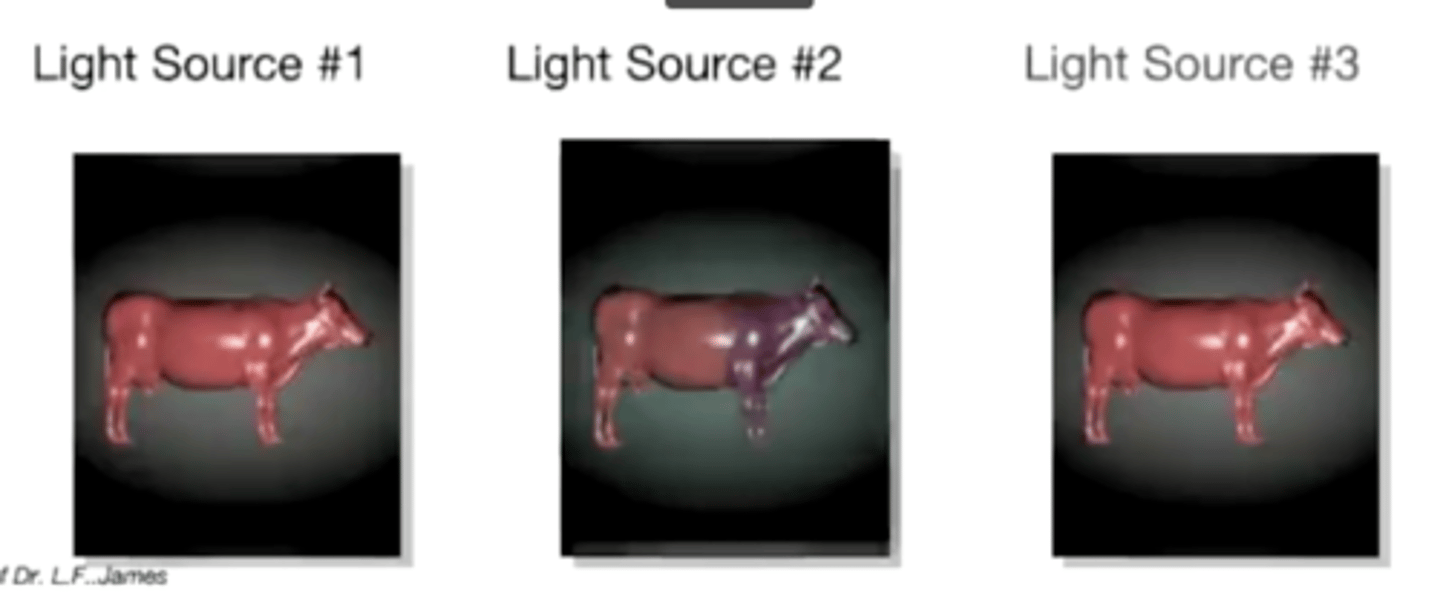
Metamerism
Two colors that appear to be a match under a given lighting condition but have different spectral reflectance = metamers. The phenomenon is _________
intrinsic and extrinsic colorimetric effects
the color of a tooth is determined by a combination of __________ and __________ effects
reflection, absorption
Intrinsic colorimetric effects is associated with ___________ and ___________ of light
coloring materials interacting with enamel, such as coffee, tea, tobacco
What are extrinsic colorimetric effects associated with?
Bluish
Enamel plays a minor role scattering at wavelengths at the _________ range
b) dentin
Tooth color is mainly determined by the color of __________
a) enamel
b) dentin
c) pulp
70% light
Enamel transmits about ______% light through a 1mm thick section
not much more than 30%
Dentin transmits _____% light through a 1mm thick section
True
T/F: Color transitions from cervical to incisal, mesial to distal, labial to lingual. they vary in thickness of enamel/dentin and in translucency/opacity of enamel/dentin
Yellow
Maxillary anterior teeth are slightly more ________ than mandibular anterior teeth
all of the above are true
All of the following are true except?
a) Maxillary central incisors are higher in value than maxillary lateral incisors and canines
b) No significant difference between color of male and female teeth
c) With age, teeth have lower value (darker) and get more yellow
Shade selection
__________ is a subjective evaluation with considerable variation. Subtle variations can exist without causing disharmony in smile
Vita
What is the shade guide we use at tufts?
C, B, A, D
What is the order of recommended sequence for the Vita classical shade guide?
A) Value selection
B) Chroma selection
C) Hue selection
D) Final Check/Revision
hue-oriented
Is this hue-oriented or value-oriented?
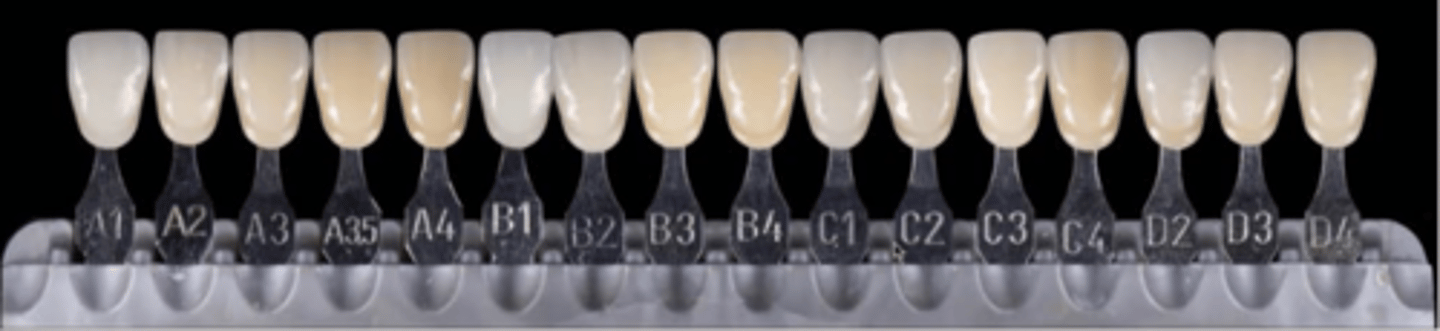
value-oriented
Is this hue-oriented or value-oriented?
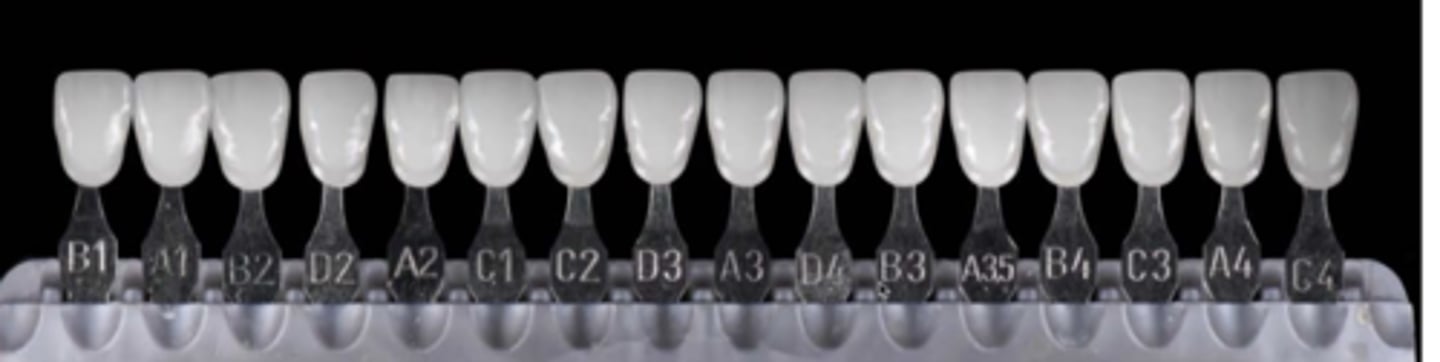
value-oriented
What type of shade guide is recommended: Hue-oriented or value-oriented?
A) Beginning of appointment
When should the shade comparisons be performed?
A) Beginning of appointment
B) End of appointment
C) Immediately after prep is done
d - evaluate shade under multiple lights
principles of shade selection include all the following except:
a) teeth must be clean
b) remove bright colors from FOV
c) view pt at eye level
d) evaluate shade under the brightest light
e) make shade comparisons at the beginning of appt
f) shade comparisons should be made quickly to avoid eye fatigue
g) select before dehydration (before prep and rubber dam placement)
25-35cm
What is the ideal distance for shade selection?
Commercial Shade Guides
What has the following characteristics?
- Most convenient and common method of making shade selections
- Guides consist of shade tabs
- - Metal backing
- - Opaque porcelain
- Neck, body, and incisal color
- Select tab with the most natural intraoral appearance
Whitish-yellowish and slightly reddish, and light
Teeth are predominantly what colors?
Extended range shade guides
What has the following characteristics?
- Most shade guides do not cover all the colors in the natural dentition
- Some porcelain systems extend the typical range
- - Bleached shades
- - Dentin shades
- - Custom shade guides
Material specific shade guides
What has the following characteristics?
i.e. for e.max (lithium disilicate)
- High translucency
- Low translucency
- Medium translucency
- Medium opacity