MENT EXAM 2
 Call Kai
 Learn
Learn Practice Test
 Spaced Repetition
 Match
Match Flashcards
 Knowt Play
1/157

Earn XP
Description and Tags
LOCK IN PT 2
Name | Mastery | Learn | Test | Matching | Spaced | Call with Kai |
|---|
No analytics yet
Send a link to your students to track their progress
158 Terms
Group
two or more people, interacting and interdependent, who come together to achieve particular objectives
Formal Groups - Types of Groups
defined by an organizational structure with designated work assignments and behaviors are stipulated by and directed towards organizational goals
Informal Groups - Types of Groups
alliances that are neither formally structured or organizationally determined
Natural formations in work environment due to need for social contact
Why do people join groups?
security, self esteem, status, affiliation, power, goal achievement
Stages of Group Development(Stage Model)
1. Forming(period of uncertainty)
2. Storming(period of intragroup conflict, jockey for roles)
3. Norming(cohesiveness, differences are resolved and expectations align)
4. Performing(fully functional, focus on task at hand)
5. Adjourning(optional: disbandment)
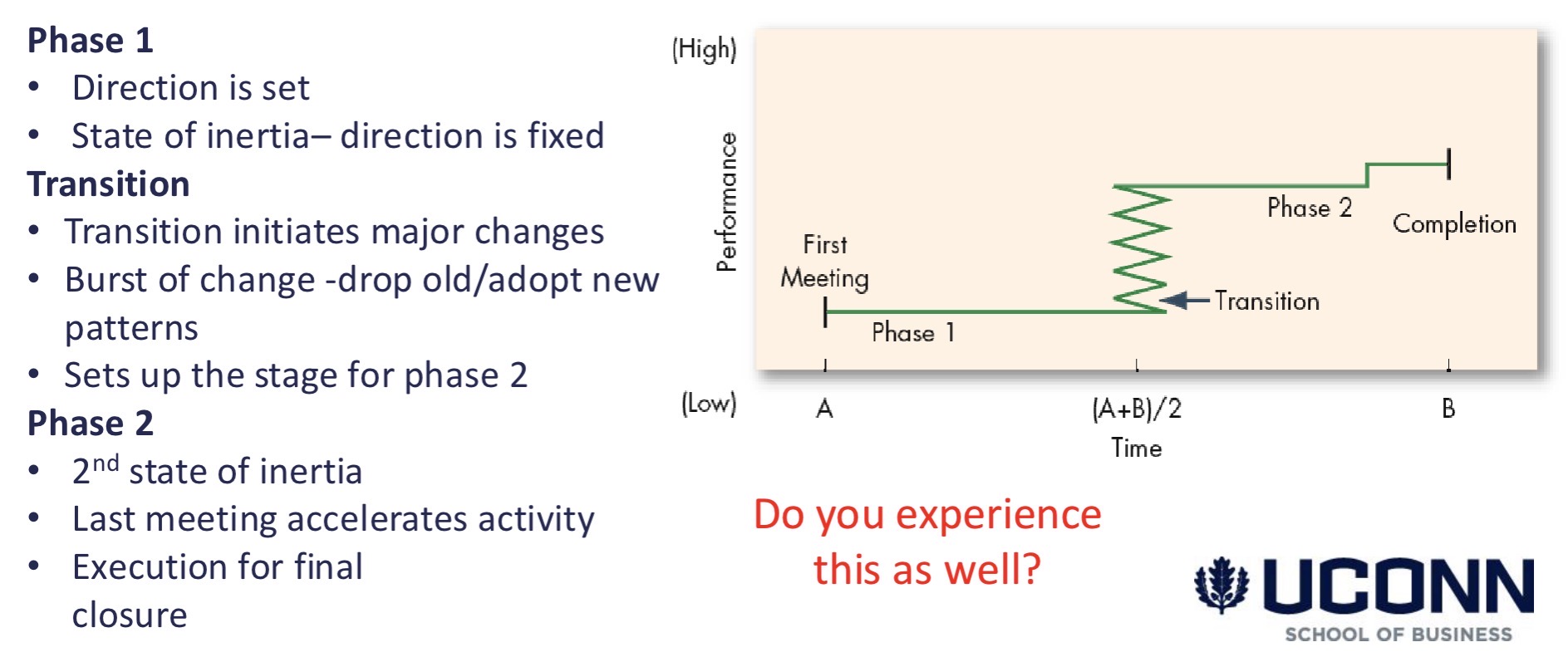
Punctuated-Equilibrium Model
Characterizes groups as exhibiting long periods of inertia interspersed with brief revolutionary changes triggered primarily by their members’ awareness of time and deadlines
Teams develop through the sudden formation, maintenance, and sudden revision of a “Framework for Performance”
Common for temporary groups with a deadline
Difference between PEM and Stage Model
PEM focuses on how a team works on a specific task, stages models focus on overall development of the team
Role Perception - Group Roles
individual view of how to act in a given situation(how we perceive)
Role Expectation - Group Roles
how others believe one should act in a given situation(how others perceive)
Role Conflict - Group Roles
when an individual in confronted with divergent role expectations
Group Norms
acceptable standards of behavior within a group that is shared by group members
Norms can influence individual behavior by providing explicit cues about the group’s expectations
How hard members should work
How to do the job
What level of tardiness is appropriate
Reference Group
for conformity
One where the person is aware of the others
The person defines himself or herself as a member, or would like to be a member
And the person feels that the group members are significant to him/her
Group Status
socially defined position or rank given to groups or group members
Status Characteristics Theory
status derived from one of three sources
Power a person wields over others
Person’s ability to contribute to a group’s goals
Individual’s person characteristics
Dark Side of Status
high status people are more abusive and critical
Status differences may inhibit diversity of ideas and creativity
Lower status individuals are less active participants
Group Size
number of people in the group
Depends on what the group is trying to accomplish
Small - completing tasks
Large - solving problems
Dark Side of Group Size
social loafing - Max Ringlemann Tug of War
Group Cohesiveness
degree to which members are attracted to each other
If performance norms are high, cohesive groups are more productive
If performance norms are low, cohesive groups are less productive
How to increase cohesiveness
Make the group smaller
Encourage agreement with group goals
Increase time members spend together
Increase group status and barriers to entry
Stimulate intergroup competition
Give group, rather than, individual rewards
Physically isolate the group
Group Decision Making
multiple members gather and consider ideas relevant to their specializations, then make recommendations to the final decision maker(usually team leader)
Pros - Decision Making in Groups
More complete information and knowledge
Increased diversity of views
Increased acceptance of solutions
Cons - Decision Making in Groups
Time-consuming
Conformity pressures
Domination by small numbers
Ambiguous responsibility
What is better for Decision Making?
Accuracy - groups(however accuracy performance worse than most accurate member)
Creativity - groups
Acceptance - groups
Speed - individuals
Potential Dark Side of Group Decision Making
Groupthink - a situation where group pressures for conformity deter the group from critically appraising unusual, minority, or unpopular views
Members of a group make decisions based on the pressure they get from the group
Symptoms of groupthink
Members rationalize any resistance to the assumptions they have made
Members apply direct pressure on those who express doubts about shared views or who question the alternative favored by the majority
Members have doubts or differing points of view keep silent about misgivings
There appears to be an illusion of unanimity
Groupthink is not about suppressing dissenters, it’s about maintaining a positive image of the group
Reducing Groupthink
Monitor group size
Encourage leaders to be impartial
Actively seek input from all members
Appoint a devil’s advocate
Someone who, given a certain argument, takes a position they do not necessarily agree with(alternative position from the accepted norm), for the sake of debate or to explore a thought further
Focus on negative aspects of options
Teams
consists of two or more people who work interdependently over some time period to accomplish common goals related to some task-oriented purpose.
How do teams differ from groups?
Interdependently
Common goals
Task-oriented purpose
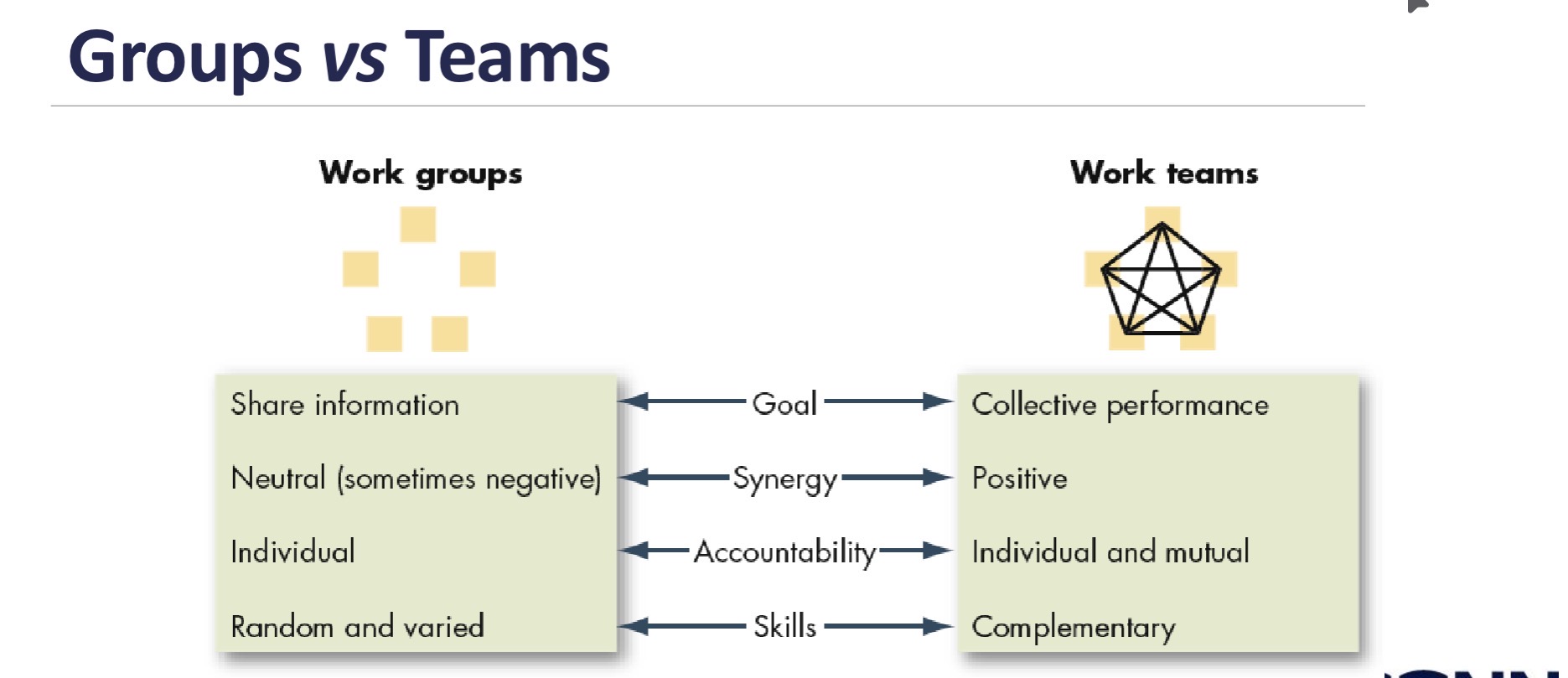
Work Groups
a group that interacts primarily to share information and to make decisions to help each group member perform within his or her area of responsibility
Work Teams
a group whose individual efforts result in a performance that is greater than the sum of the individual inputs.
Groups vs. Teams
Why have teams become so popular?
Teams typically outperform individuals
Teams better utilize employee talents
Teams are more flexible and responsive to changes in the environment
Teams facilitate employee involvement
Teams are an effective way to democratize an org. and increase motivation
Problem-Solving Teams - Types of Teams
groups of employees meeting to address particular issues
Self-Managed Work Teams - Types of Teams
groups of employees performing highly interdependent jobs and take on responsibilities that are traditionally performed by supervisors
Cross-Functional Teams - Types of Teams
employees from different work areas who come together to accomplish a task
Virtual Teams - Types of Teams
teams that use tech. to connect physically dispersed members in order to achieve a common goal
Team Effectiveness
Context
Composition
Work Design
Process
Context - Team Effectiveness
Adequate resources
Appropriate leadership and structure
Climate of trust
Evaluation and reward systems
Composition - Team Effectiveness
Abilities of members - need technical expertise problem-solving, decision making, and good interpersonal skills
Personality - conscientiousness, openness to experience, and agreeableness all relate to team performance
Allocating roles - putting most able, experienced, and conscientious worker into central roles
Diversity - diversity can lead to lower performance at first
Size of teams - 5-9
Member flexibility
Member preferences - not everyone is a team player
Work Design - Team Effectiveness
Skill variety - requirements for different tasks in the job
Task identity - completion of a whole piece of work
Task significance - the job’s impact on others
Autonomy - level of discretion in decision making
Feedback - amount of direct and clear information on performance
Process - Team Effectiveness
Common plan and purpose - developing goals and creating strategies to achieve the overall goal
Specific goals - transfer common purpose into specific goals, specific goals facilitates clear communication
Team efficacy - teams that have confidence will believe that they can succeed → motivates members to work harder
Conflict levels
Task conflict → stimulates discussion for better decision
Relational conflict → hinders team performance
Social loafing - clear communication about individual versus joint responsibility
Three tests to see if a team fits the situation:
Is the work complex and is there a need for different perspectives?
Does the work create a common purpose or set of goals for the group that is larger than the aggregate of the goals for individuals?
Are the members of the group involved in interdependent tasks?
Diversity
the differences between individuals on any attribute that may lead to the perception that another persona is different from the self
Recognizing and accepting individual uniqueness and differences
Dimensions of Diversity
race, ethnicity, gender, socioeconomic status, physical abilities, and political/religious beliefs
Benefits of Diversity
contributes to the availability of a richer pool of information
Heterogeneous teams can be characterised by having more different perspectives, information, and ideas than homogeneous teams
Can outperform homogeneous teams, as long as members engage in information and cognitive processes are shared among team members
Harms of Diversity
Diversity within groups can create subgroups and intergroup biases
Subgroups → ingroup and outgroup categorization
This facilitates ingroup biases
Favoritism - people favor ingroup over outgroup members
Negative intrateam interactions
Conflict, distrust, disliking, limited communication between members
Trust
the willingness to be vulnerable to a trustee based on positive expectations about the trustee’s actions and intentions
Intangible asset and takes a long time to build
Affects both customers and employees
Dispositional Trust - Personality
a general expectation that the words, promises, and statements of individuals and groups can be relied upon
High trust propensity(too much trust, can trust the wrong people) vs. low trust propensity(not enough trust, can keep them from trusting the right people)
Cognitive Trust(Trustworthiness)
defined as characteristics or attributes of a trustee that inspire trust
Ability - the skills, competencies and areas of expertise that enable an authority to be successful in a specific area
Benevolence - the belief that the authority wants to do good for the trustor, apart from any selfish or profit centered motives
Integrity - the perception that the authority adheres to a set of values and principles that the trustor finds acceptable
Affective trust(Feelings toward Trustees)
trust that depends on feelings towards the authority that go beyond any rational assessment
Based on emotions rather than reason, we trust because we like them rather than them proving themselves to be trustworthy
Organizational Justice
the perceived fairness of an authority’s decision making
key factor in managing a diverse team
Distributive Justice
the allocation of goods
Should everyone receive the exact same amount?
Equality is treating everyone the same
Equity is giving everyone what they need to be successful(not giving everyone the same amount)
Procedural Justice
Voice - giving employees the chance to express their opinions and views
Correctability - provides employees with the chance to request an appeal when a procedure seem to have worked ineffectively
Consistency - procedures should be consistent across time and people
Bias suppression - procedures should not be affected by personal self-interest or blind allegiance to existing perceptions
Representativeness - procedures should reflect the basic concerns, values and outlooks of the individuals who are affected by them
Accuracy - procedures should be based on completely accurate and valid information
Distributive vs. Procedural Justice
Distributive and procedural justice combine to influence employee reactions
When outcomes are undesirable, procedural justice becomes enormously important
Procedural justice tends to be a stronger driver of reactions to authorities than distributive justice
Interpersonal Justice
the perceived fairness of the treatment received by employees from authorities
Occurs when authorities are rude or disrespectful to employees, or when they refer to them with inappropriate labels
Extreme forms of interpersonal justice occurs when there is abusive supervision(the display of hostile verbal and nonverbal behavior, excluding physical contact)
Angry outbursts
Public ridiculing to be used as scapegoats for negative events
The Respect Rule - Interpersonal Justice
whether authorities treat employees in a dignified and sincere manner
The Propriety Rule - Interpersonal Justice
whether authorities refrain from making improper or offensive remarks
Informational Justice
the perceived fairness of the communication provided to employees from authorities
Justification Rule - Informational Justice
authorities should explain decision making procedures and outcomes in a comprehensive and reasonable manner
Truthfulness Rule - Informational Justice
communications should be honest and candid
Reputation
Why do organizations care about ethics?
Some Ethical Considerations
Important to both report ethical behavior to supervision and the person the unethical behavior is towards
Spin - if there is a scandal - should the public be told honestly about what is happening or should there be a spin to make it sound better - what works better
If a friend is fired, do not cut ties with them - spend time with them outside of work while still maintaining your job
Important for supervisors to let their employees know they are required to report before they divulge information
Seemingly small unethical behavior snowball and lead to larger unethical situations
Corporate Social Responsibility
a perspective that acknowledges that the responsibilities of a business encompass the economic, legal, ethical, and citizenship expectations of society
More obligations than just profit maximization
Understanding ethical rights and wrongs, and following them
Legal component
Ethical component
Citizenship component
Management
use of authority inherent in designated formal rank to obtain compliance from organizational members
Leadership
the ability to influence a group toward the achievement of collective goals
The Trait Theory of Leadership(1900s - 1950s) - Classical Theories of Leadership
“the great man theory”, which assumes that the leader’s personal traits are the key to leadership success. It considers personality, social, and physical, or intellectual traits to differentiate leaders from non-leaders.
This theory focused on identifying the innate qualities and characteristics possessed by great social, political, and military leaders - people were BORN with these traits
Assumes leaders are born, leaders differ from others in a small number of key traits, these traits do not change over time, these individuals have the potential to be great leaders at any point in time and in any society
Conscientiousness(leader effectiveness), openness(leader effectiveness), and extraversion(leader emergence)
Personal characteristics can predict leadership - however traits are more predictive of leader emergence(who becomes a leader in the first place) than leader effectiveness(how well a person actually leads)
Power
a capacity that A has to influence the behavior B so that B acts in accordance with A’s wishes
Dependency
B’s relationship to A when A possesses something that B requires
Dependency is the key to power
The General Dependency Postulate
the greater B’s dependency on A, the greater the power of A over B
People are more or less dependent due to access to resources that are scarce, important, and non-substitutable
Leadership
Focuses on goal achievement of group goals
Requires goal compatibility with followers
Used for downward influence
Research focus - leadership styles and relationships with followers
Power
Used as a means for achieving individual goals
Requires dependency
Used for lateral, upward, and downward influence
Research focus - power tactics for gaining compliance
Leadership As Power - Classical Theories of Leadership
Formal/Organizational Power
established an individual’s position in an organization
Coercive power
Reward power
Legitimate power
Person Power
comes from an individual’s unique characteristics
Expert Power
Referent Power
Coercive Power - Formal/Organizational Power
This is derived from having the perceived capacity to penalize or punish for non-compliance
A power base exercised via fear
This is subject to abuse and is often associated with legitimate power
The use of this power will inevitably damage any relationship with the subordinate
Reward Power - Formal/Organizational Power
compliance achieved based on the availability to distribute rewards that others view as valuable
The power to give or withhold rewards such as salary increases, bonuses, promotions, recommendations
Legitimate Power - Formal/Organizational Power
the power a person receives as a result of his or her position in the formal hierarchy of an organization(acceptance of authority)
Associated with having status or formal job authority
The person has the right to make demands, and expect obedience from others
Example: project director, CEO, politician
Expert Power - Person Power
power that accrues to someone based on the information or expertise they possess
Example: doctors, tax accountants
Referent Power - Person Power
influence based on followers personally identifying with the leader. Followers tend to like, admire, and want to emulate their leader
Leaders who have admirable personal characteristics, charisma, and an excellent reputation often possess referent power.
Referent power sometimes used by people with no positional power in organizations - using requests rather an orders
Can be gained by developing interpersonal skills and confidence others have in you
Behavioral Theory - Classical Theories of Leadership
The relationship between a leader’s actions and the follower’s satisfaction and productivity
Leadership = leader’s certain actions(behaviors)
Trait theories of leadership → focus: leader selection
Behavioral studies of leadership → leader training
Ohio State Studies of Leadership - Behavioral Theory
key assumption
Leaders are made not born
Focuses on two types of leader behaviors described by employees - initiating structure and consideration
Initiating Structure - Behavioral Theory
The extent in which leaders organize and define the roles of individuals in the pursuit of goal attainment
Initiation: creating, facilitating and sometimes resisting new ideas or practices
Organization: defining and structuring work, clarifying roles and coordinating employees
Production: setting goals and providing incentives to meet those goals and providing incentives to meet those goals
Consideration - Behavioral Theory
The extent to which leaders actively create job relationships based on mutual trust, respect for employees, and consideration of co-worker’s feelings
Membership: mixing with employees, informal interactions
Integration: encouraging a pleasant atmosphere, reducing conflict
Communication: providing information to employees, seeking information for them
Recognition: expressing approval or disapproval of the behaviors of employees
Representation: acting on behalf of the group
Situational Theory - Classical Theories of Leadership
Leaders did more than simply “act” - they often had to “react” to specific situations
Situational model of leadership
Aka life cycle theory
Optimal combination of initiating structure and consideration is reliant on the readiness of the employees within the work unit
Readiness - Situational Theory
R1 - Telling: leader focuses on providing structure(specific instructions) to establish clear goals for the team. Leader also closely monitors teams performance
R2 - Selling: Employees find tasks more difficult than expected resulting in dissatisfaction. Leader provides support and encouragement to protect employee confidence levels
R3 - Participating: Employees gain more ability so guidance and direction become less necessary. Leaders provide support to help members adjust their more self-managed state of affairs
R4 - Delegating: Leader delegates responsibility for key behaviors to employees. Minimal observation and monitoring is required to make sure the group’s efforts stay on track/
Conflict
the perception that one party has negatively affected(or is about to negatively affect) something the first party cares about
Examples of why conflict occurs
Incompatibility of goals
Differences over interpretations of facts
Disagreements based on behavioral expectations
Functional Conflict (Positive)
Conflict that supports the goals of the group and improves its performance
Increased group performance
Improved quality of decisions
Stimulation of creativity and innovation
Encouragement of interest and curiosity
Provision of a medium for problem solving
Creation of an environment for self-evaluation and change
Groupthink prevention
Dysfunctional Conflict (Negative)
Conflict that hinders group performance
Development of discontent
Reduced groupthink effectiveness
Retarded communication
Reduced group cohesiveness
Infighting among group members overcomes group goals
Thomas/Kilmann Model - Conflict Resolution Styles
Assertiveness - concerned about your outcomes
Cooperativeness - concerned about other’s outcomes
Competing - Conflict Resolution Styles
High assertive, low cooperation, Quick decisive action
When does it occur?
Often high power distance
Important but unpopular issues
Vital issues (know you’re right)
Against people who will take advantage of you
Results
Win - lose
Good short term
Bad long term
Avoiding - Conflict Resolution Styles
Low assertiveness, low cooperation
When does it occur?
Trivial Issues, with more pressing issues present
When issues are tangential/symptomatic
No chance of satisfying your concerns
When others can resolve better
Results
Lose - lose
Bad short term
Bad long term
Does not resolve conflict
Good strategy to let people cool down and then use a different conflict resolution strategy
Accomodating - Conflict Resolution Styles
Low assertiveness, high cooperativeness
When does it occur?
Useful when issue not important to you, very important to others
Important in low power situations
Results
Lose - win
Maintain cooperation
Build up social capital
Minimize loss when outmatched
Harmony/stability matter
Collaborating - Conflict Resolution Styles
high assertiveness, high cooperativeness
Why does it occur
Task-oriented > personal conflict
Issues are too important to compromise
Objective is to learn
Results
Win - win
Non-zero-sum game
Generally best, most difficult
Full information sharing
Discussion of concerns
Relatively equal power
Lots of time
Merge insights and perspectives
Gain commitment through consensus
Compromising - Conflict Resolution Styles
medium assertiveness, medium cooperativeness
When does it occur
Most common, easiest
Give-and-take
Not worth the disruption
Temporary settlements
Results
Maintains relationships - both parties win and lose
Favorable evaluations
Opponent committed to mutually exclusive goal
Expedient under time pressure
Backup after collaboration/competition fails
Negotiations
A process in which two or more interdependent individuals discuss and attempt to come to an agreement about their different preferences
Distributive Bargaining - Negotiation Strategies
Win-lose negotiating over a “fixed pie” of resources
Either fixed sum or zero sum
Example: purchasing a car
Integrative Bargaining - Negotiation Strategies
Use of problem solving and mutual respect to achieve to a satisfying outcome for both parties
Example: deciding on a honeymoon location
Consensus - Negotiation Strategies
When both parties agree
What’s good for one party is sometimes good for the other party as well
Preparation - Negotiation Stages
each party determines its goals and whether or not the other party has anything to offer
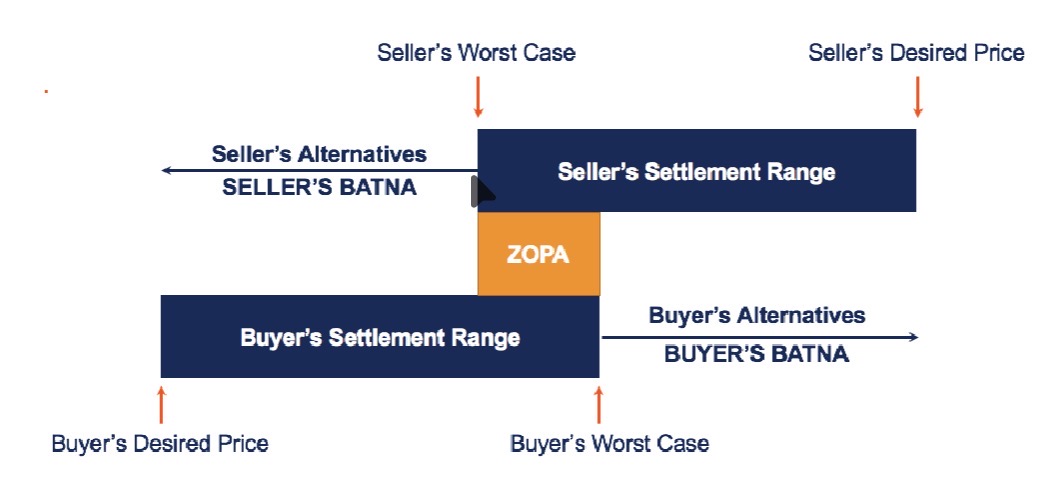
BATNA(Best Alternative To a Negotiated Agreement)
Next best offer you have received
If you’re interviewing jobs , BATNA is the best offer you have received so far
Describes a negotiators bottom line or walk away point
Exchanging Info - Bargaining Stages
Each party makes a case for its position and attempts to put all favorable information on the table
Each party also informs the other party how it arrived at the conclusions it has and which issues it believes are important
Studies show that successful negotiators ask many questions and gather much information at this stage
Bargaining - Bargaining Stages
Both parties likely make concessions and give up something to gain something in return
The goal is for each party to walk away feeling like it has gained something of value (regardless of the actual bargaining strategy)