Ring Silicates (Disilicates, Ring Silicates, Orthosilicates)
 Call Kai
 Learn
Learn Practice Test
 Spaced Repetition
 Match
Match Flashcards
 Knowt Play
1/14

Earn XP
Description and Tags
Lab 9! :)
Name | Mastery | Learn | Test | Matching | Spaced | Call with Kai | Chat |
|---|
No analytics yet
Send a link to your students to track their progress
15 Terms
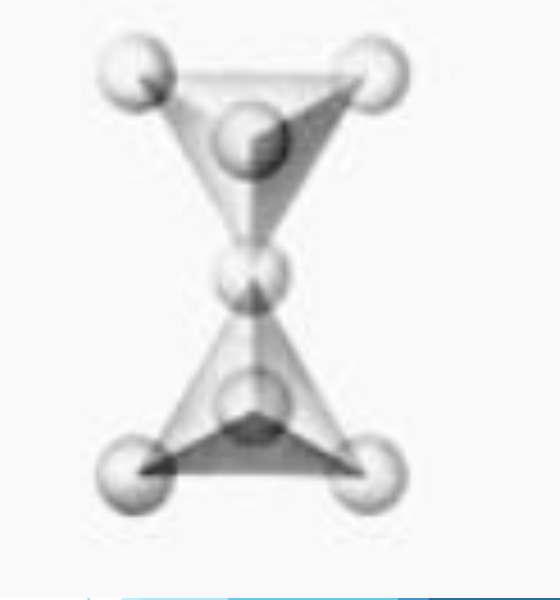
Disilicates (sorosilicates)
Isolated double tetrahedra
-Si/Al:O ratio of 2:7
-Epidote group of minerals
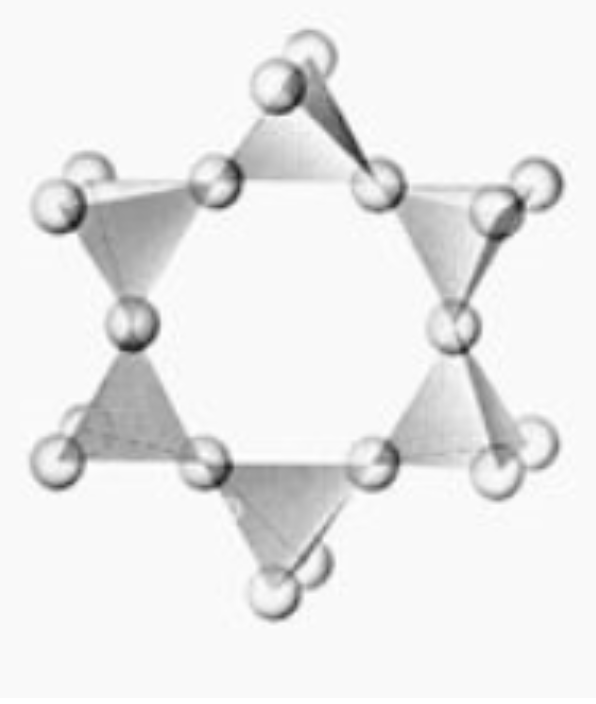
Ring Silicates (Cyclosilicates)
-Tetrahedra linked into rings
-Si/Al ratio of 1:3
-3-member rings and 6-remember rings varieties
-Large gaps in crystal structure enable incompatible elements to fit into these crystals in some cases
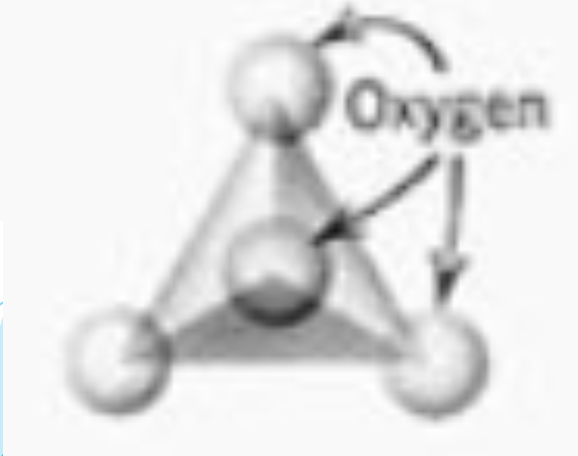
Orthosilicates (Nesosilicates)
“island” silicates
Isolated tetrahedra connected only by interstitial cations
-Al₂SiO₅ group of minerals
-Garnet group of minerals
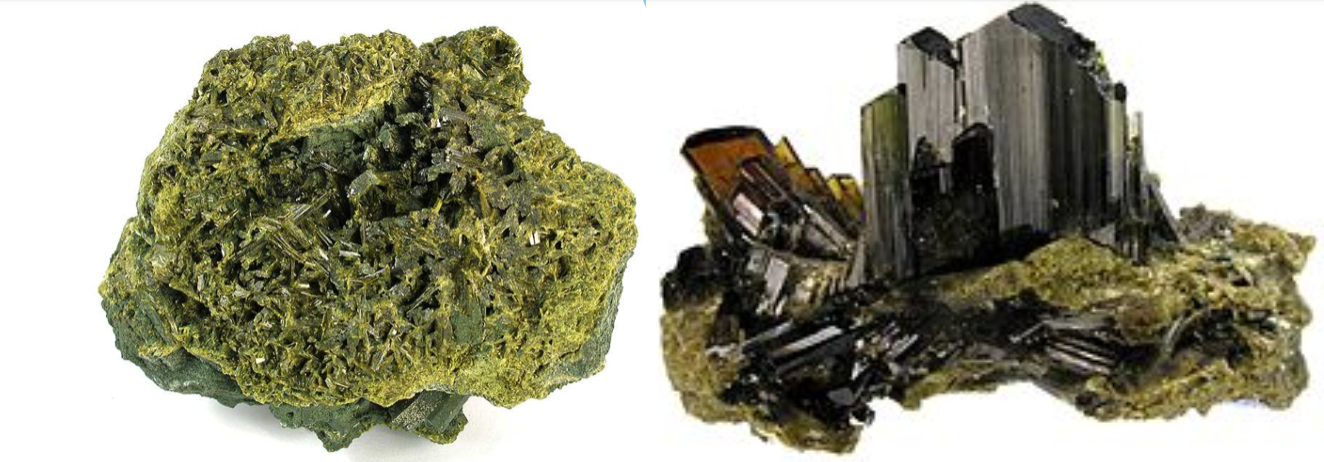
Epidote (clinozoisite)- monoclinic
Ca2Al2 (Al, Fe)[Si2 O7][SiO4]O(OH)
Disilicate (Sorosilicate)
Hand Sample
Pistachio-green color typically but also yellowish or black
H ~6 to 7
Massive to grainy aggregate typical
1 plane perfect cleavage {001}
Fine grain nature may make this difficult to observe
Minor uneven fracture & and brittle tenacity
PPL
Strong pale green/yellow pleochroism, grainy crystal habit, 1-D @ 90 cleavage sometimes visible, & low relief
XPL
2nd to 3rd to order birefringence & variable extinction
![<p><mark data-color="#c2f3be" style="background-color: #c2f3be; color: inherit">Ca2Al2 (Al, Fe)[Si2 O7][SiO4]O(OH)</mark></p><p><strong><mark data-color="#f5f5f5" style="background-color: #f5f5f5; color: inherit">Disilicate (Sorosilicate)</mark></strong></p><p><strong>Hand Sample </strong></p><ul><li><p>Pistachio-green color typically but also yellowish or black</p></li><li><p>H ~6 to 7 </p></li><li><p>Massive to grainy aggregate typical </p></li><li><p>1 plane perfect cleavage {001}</p><ul><li><p>Fine grain nature may make this difficult to observe</p></li><li><p>Minor uneven fracture & and brittle tenacity</p></li></ul></li></ul><p><strong>PPL </strong></p><ul><li><p>Strong pale green/yellow pleochroism, grainy crystal habit, 1-D @ 90 cleavage sometimes visible, & low relief</p></li></ul><p><strong>XPL </strong></p><ul><li><p>2<sup>nd</sup> to 3<sup>rd</sup> to order birefringence & variable extinction</p></li></ul><p></p>](https://knowt-user-attachments.s3.amazonaws.com/0241d0aa-7c92-4eea-b810-744f2d7afdd6.png)
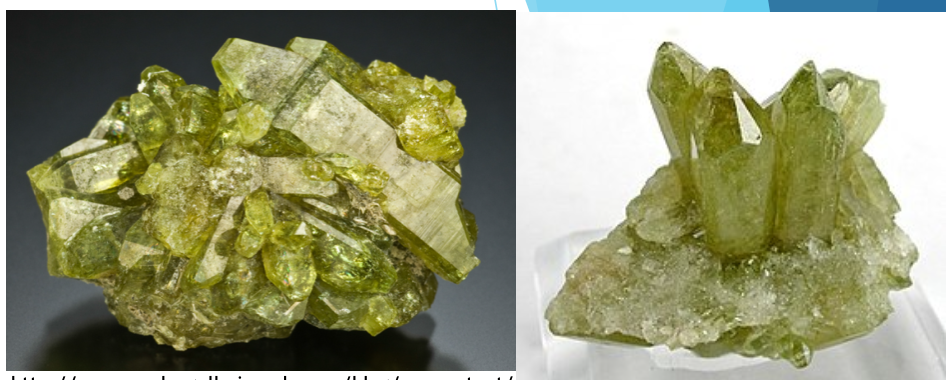
Vesuvianite-Tetragonal
Ca19(Al,Mg)13B0-5Si18O68(OH,O,F)10
Disilicate (Sorosilicates)
Hand Sample
Yellow to greenish brown color typical
Stubby tetragonal prisms
H ~6 to 7
Most commonly conchoidal fracture
Cleavage on {110} but very poor
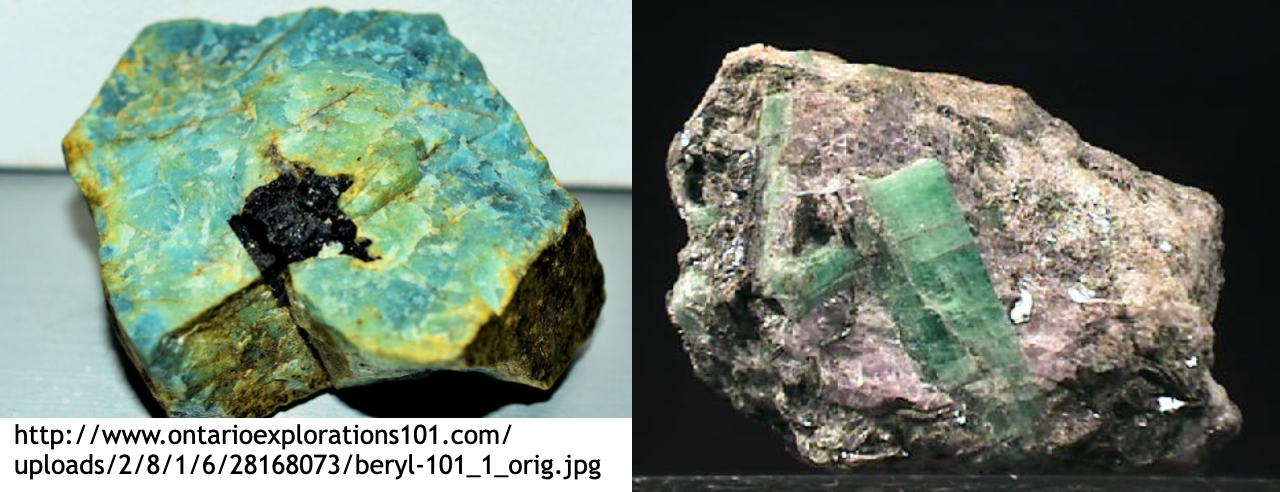
Beryl-Hexagonal
Al2Be3Si6O18
Ring Silicates (Cyclosilicates)
Hand Sample
Can be any colors but typically some shade of green, blue, yellow, or white
Aquamarine is blue
Emerald is green
Hexagonal prisms (harder than Apatite)
H ~7.5 to 8
1-D basal {001} cleavage
Minor conchoidal to uneven fracture & brittle tenacity
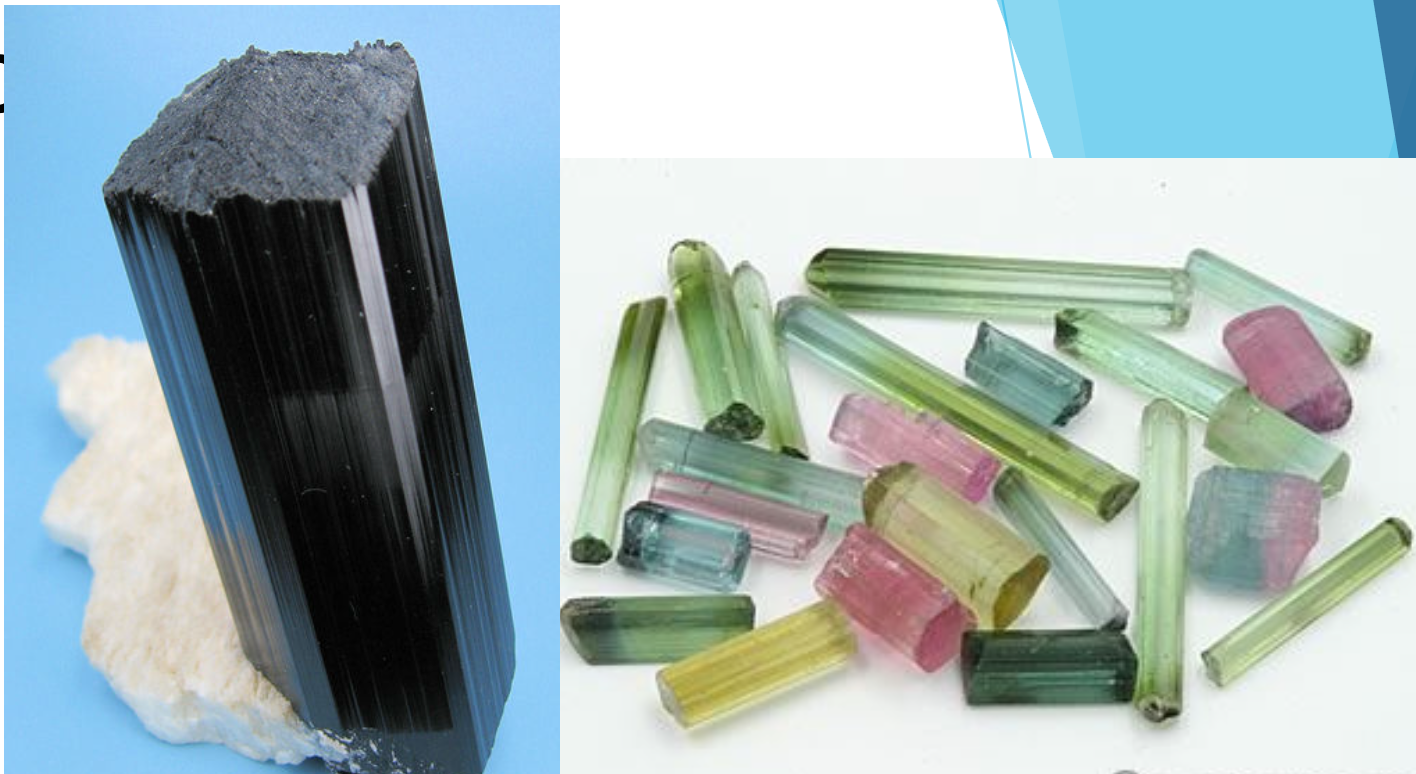
Tourmaline-Trigonal
Ring silicate (Cycosilicate)
WX3Y6 [Si6O18](BO3)3 (O,OH,F)4
Class of minerals
Schorl
Dravite
Elbaite
Hand Sample
Most commonly black color but can be any color of the rainbow based on impurities
H ~ 7
Rounded trigonal prisms w/ striated faces
Very poor cleavage & some conchoidal/uneven fracture
Often found in granitic pegmatites
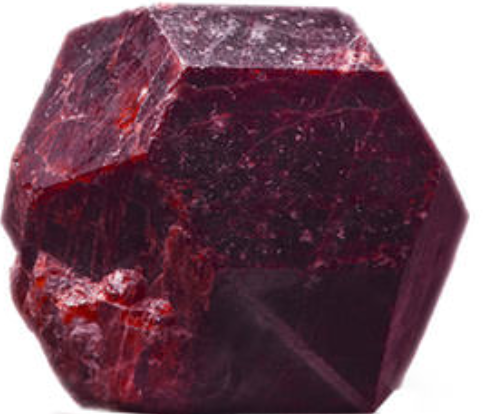
Garnet- Isometric
Solid solution series mineral
Orthosilicates (nesosilicates)
X3Y2(SiO4)3
X can be Ca, Mg, Fe, Mn, or other divalent cations
Y can be Al, Fe, Cr, or other trivalent cations
Pyralspite Group
Almandine
Pyrope
Spessartine
Grandite Group
Andradite
Grossular
Hydrogrossular
Hand Sample
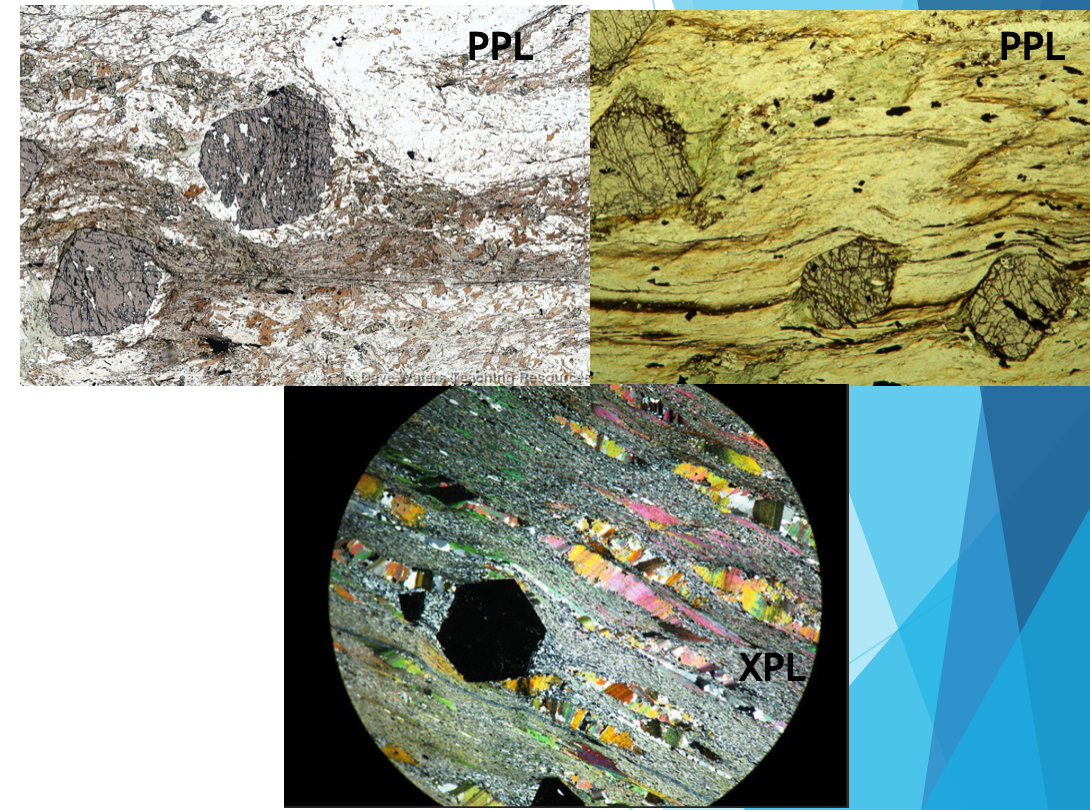
H ~6.5 to 7, typically dark red in color but can be pretty much any color, dodecahedral crystal habit, minor conchoidal fracture
PPL
Round habit, high relief, no cleavage, high relief fractured, no pleochroism, often inclusion-rich
XPL
Isotropic (extinct in 360 )
Kyanite (aluminosilicate)- Triclinic
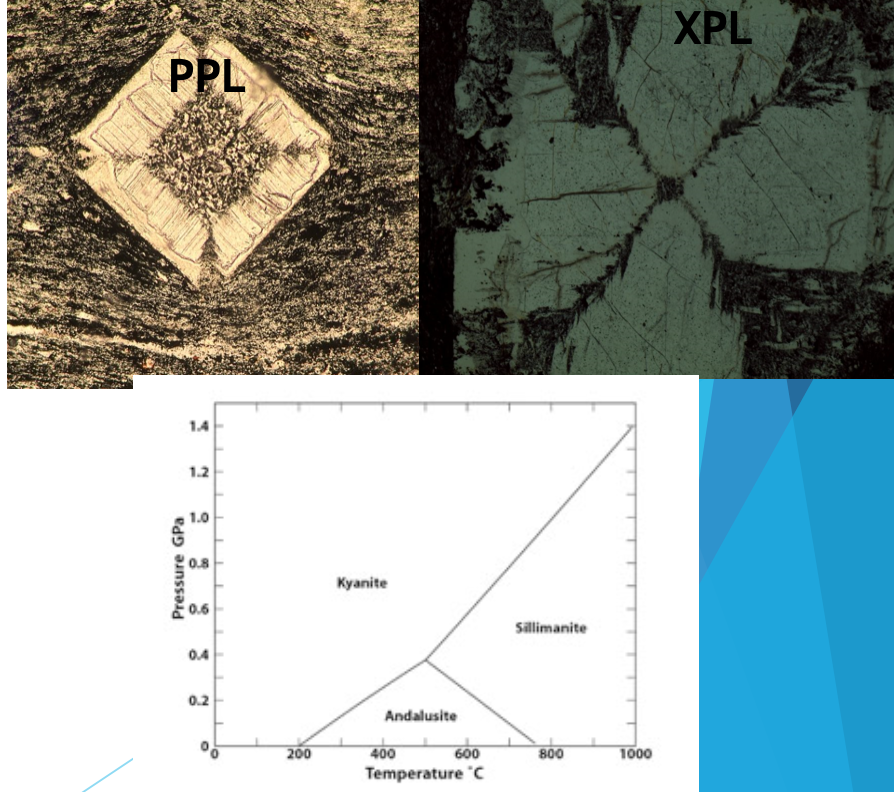
Al2SiO5
Orthosilicates (nesosilicates)
Hand Sample
Blue color most common but it can be white or rarely red
metamorphic rock associate
splintery cleavage w/two planes parting @~ 90°
elongate bladed crystals
H ranging from 5 to 7 depending on orientation of crystal
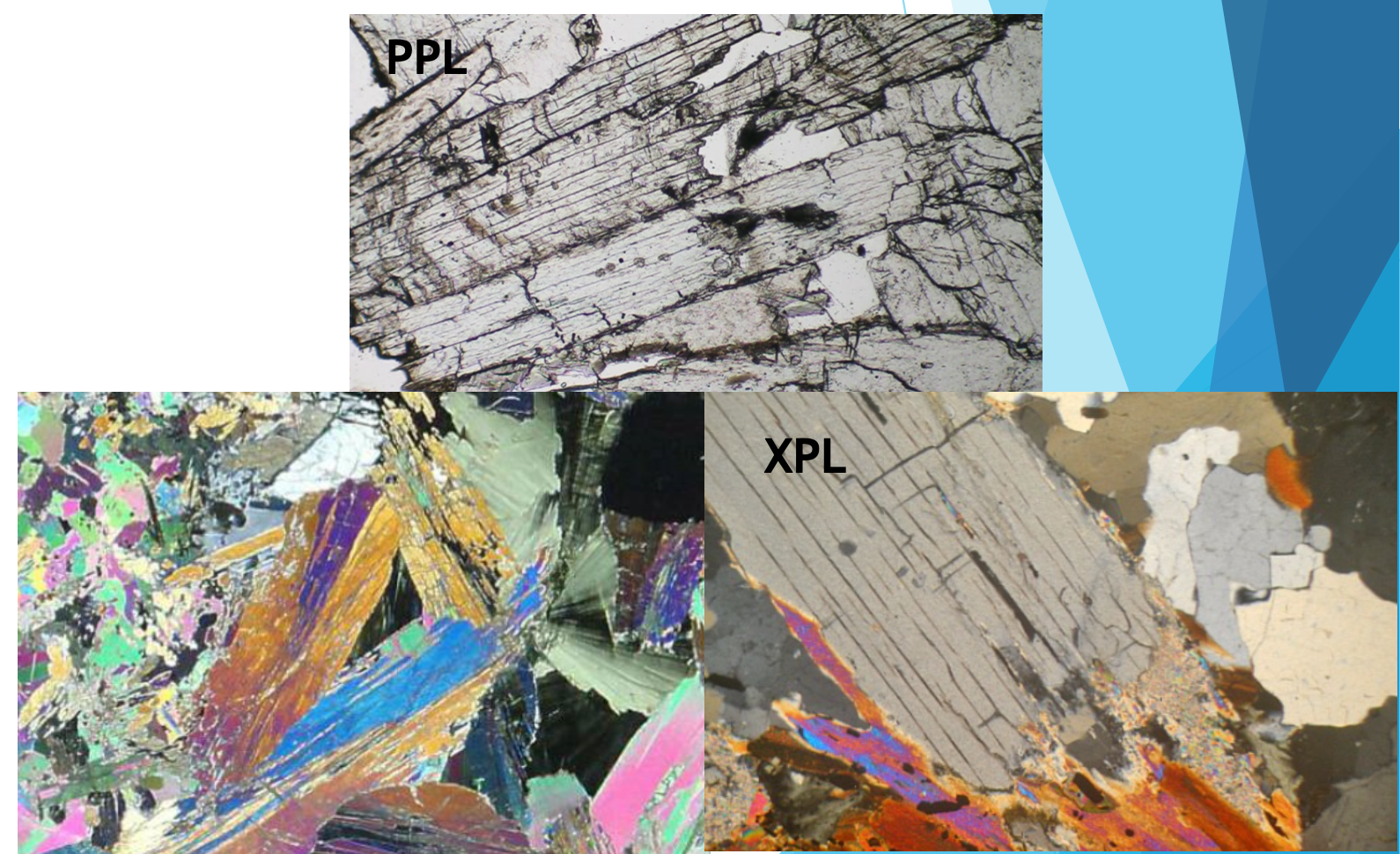
PPL
high relief, tabular grains with strong cleavage, kink banding common, found in metamorphic rocks, ~ 90° parting.
XPL
1st to low 2nd order birefringence, often twinned, inclined extinction
Andalusite (aluminosilicate)- Orthorhombic
Al2SiO5
Orthosilicates (nesosilicates)
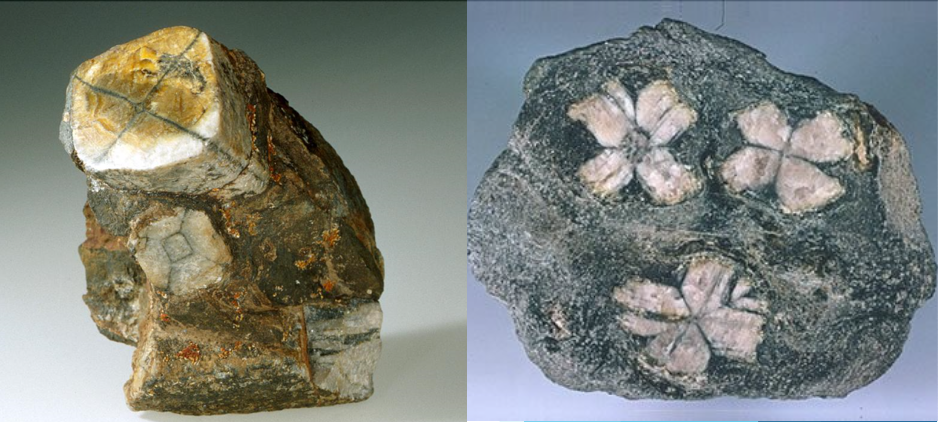
Hand Sample
Typically yellowish green to gray in color
Good cleavage parallel to prism faces
H ~6.5 to 7.5
Euhedral grains
Often exhibits dark carbonaceous cross-shaped inclusions (chiastolite variety)
Medium-grade metamorphic rocks association
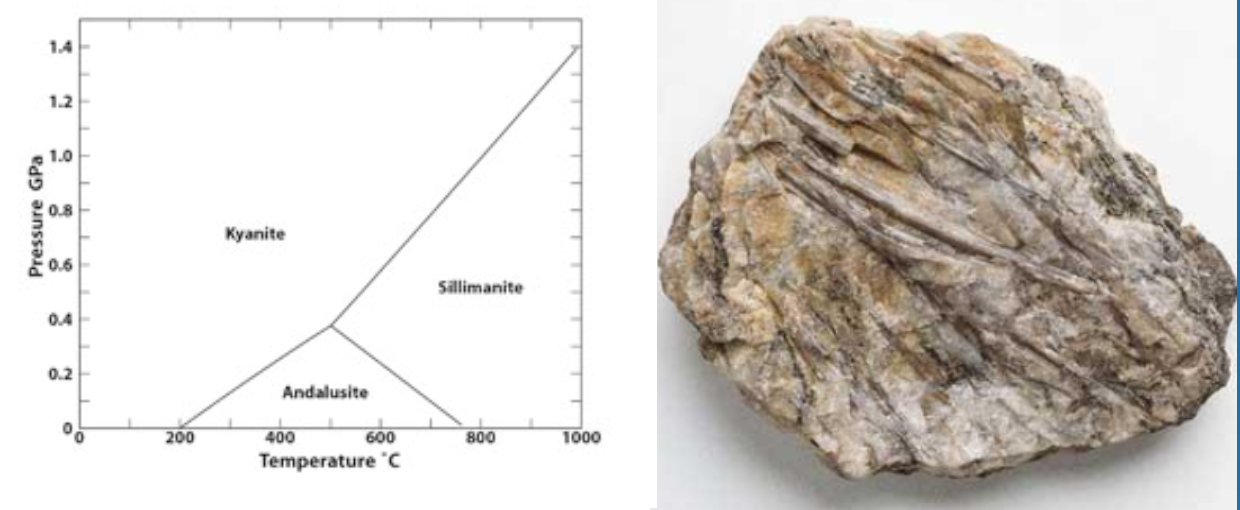
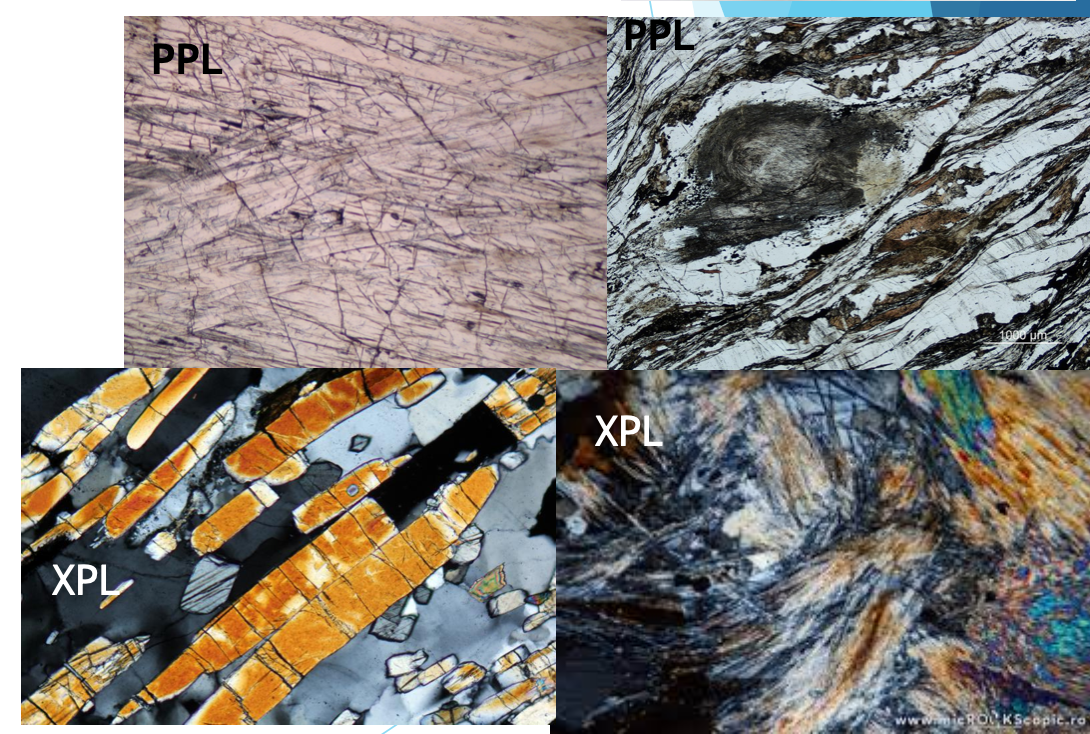
Sillimanite (aluminosilicate)- Orthorhombic
Al2SiO5
Orthosilicates (nesosilicates)
Hand Sample
Typically white to off-white to tan in color but can be a variety of colors,
H between ~5 & 7 due to orientation
Slender to fibrous crystals
Associated w/ high T metamorphic rocks
PPL
High relief & slender prismatic crystals typical
XPL
1st order birefringence (pale yellow) & parallel extinction
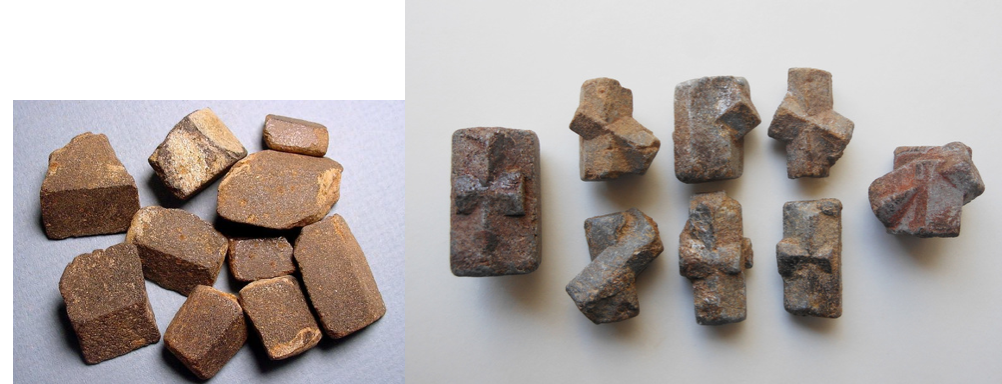
Staurolite- Monoclinic
Al9Fe2 [(Si,Al)O4]4O6 (O,OH)2
Orthosilicates (nesosilicates)
Hand Sample
Typically red-brown to black
metamorphic rocks associated
H ~7 to 7.5
Cross shaped penetration twins
PPL
pleochroic brown-yellow, inclusions rich, tabular to wedge shaped habit if euhedral
XPL
1st order (yellow to bluish) birefringence
![<p><span><mark data-color="#c2f3be" style="background-color: #c2f3be; color: inherit">Al<sub>9</sub>Fe<sub>2</sub> [(Si,Al)O<sub>4</sub>]<sub>4</sub>O<sub>6 </sub>(O,OH)<sub>2</sub></mark></span></p><p><strong>Orthosilicates (nesosilicates) </strong></p><p><span><strong>Hand Sample </strong></span></p><ul><li><p><span>Typically red-brown to black</span></p></li><li><p><span>metamorphic rocks associated </span></p></li><li><p><span>H ~7 to 7.5</span></p></li><li><p><span><em>Cross shaped penetration twins</em></span></p><p></p></li></ul><p><span><strong>PPL </strong></span></p><ul><li><p><span>pleochroic brown-yellow, inclusions rich, tabular to wedge shaped habit if euhedral</span></p></li></ul><p><span><strong>XPL </strong></span></p><ul><li><p><span>1<sup>st</sup> order (yellow to bluish) birefringence</span></p></li></ul><p></p>](https://knowt-user-attachments.s3.amazonaws.com/6063e040-6d58-4631-bcc3-844c8da7be4c.png)
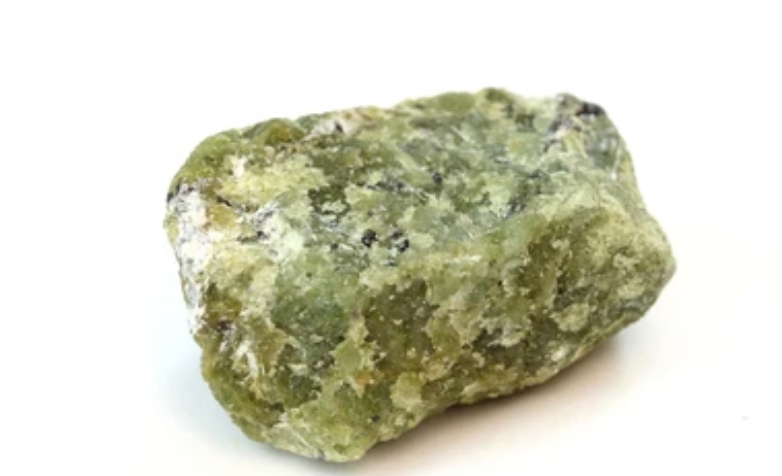
Olivine- Orthorhombic
(Mg,Fe)2SiO4
Orthosilicates (nesosilicates)
Hand Sample
Most often green in color but can be brownish
Grainy aggregate masses
Mantle xenoliths & phenocrysts in basalt association
H of 6.5-7
Conchoidal fracture
very poor cleavage
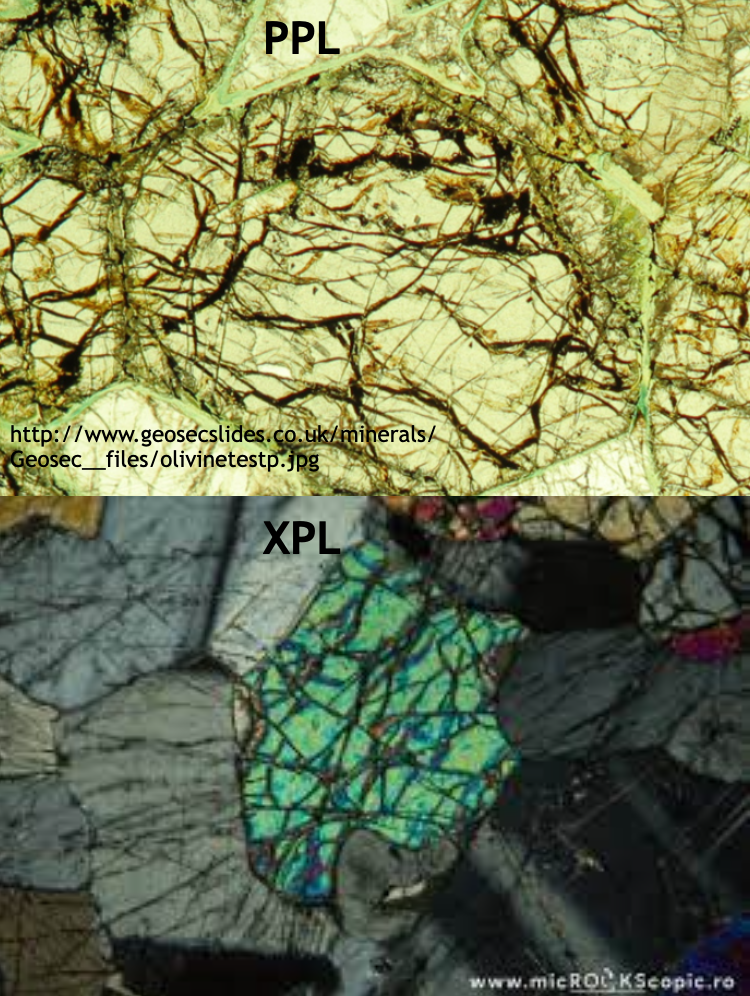
PPL
High relief, rounded habit, no pleochroism, no cleavage
XPL
2nd to 3rd order birefringence, often found in aggregate masses most easily visible in CPL
Zircon-Tetragonal
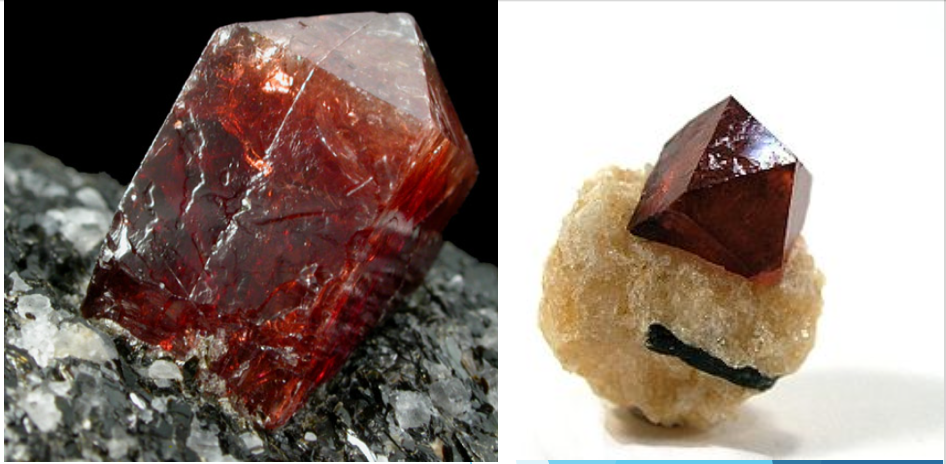
ZrSiO4
Orthosilicates (nesosilicates)
Hand Sample
Typically far too small to see – 100 micron-sized
Typically yellow to reddish brown
H ~7.5
Very poor cleavage
Conchoidal fracture and brittle tenacity
Vitreous to adamantine luster
Hf isotopes make zircon highly useful in age dating
Topaz- Orthorhombic
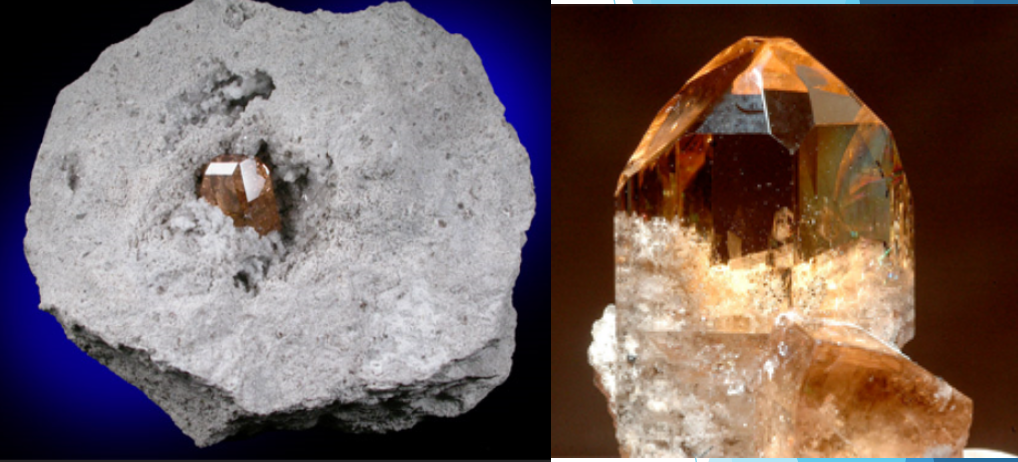
Al2SiO4(F,OH)2
Orthosilicates (nesosilicates)
Associated with rhyolites
Clear to yellow in color
H ~ 8
1-D Basal {001} cleavage (1 plane)
Minor subconchoidal to uneven fracture & brittle tenacity
Cleavage & crystal system makes it distinguishable from quartz