Bio
 Call Kai
 Learn
Learn Practice Test
 Spaced Repetition
 Match
Match Flashcards
 Knowt Play
1/194

There's no tags or description
Looks like no tags are added yet.
Name | Mastery | Learn | Test | Matching | Spaced | Call with Kai |
|---|
No analytics yet
Send a link to your students to track their progress
195 Terms
4 Postulates of Cell Theory
all living things are composed of cells
The cell is the basic functional unit of life
cells arise only from preexisting cells
Cell carry genetic info in the form of DNA, which is passed down generations
Nucleolus
a subsection of the nucleus in which ribosomal RNA (rRNA) is synthesized
Nucleoid
What prokaryotes have instead of a true nucleus
Rough ER (RER)
Studdeed with ribosomes, which permit translation of proteins destined for secretion
Smooth ER (SER)
Used for lipid synthesis and detoxification
Golgi Apparatus
consists of stacked membrane-bound sacs in which cellular products can be modified, packaged, and directed to specific cellular locations.
Actin microfilaments
composed of actin. They provide structural protection for the cell and can cause muscle contraction through interactions with myosin. They also help form the cleavage furrow during cytokinesis in mitosis.

Intermediate Filaments
are involved in cell-cell adhesion and maintenance of the integrity of the cytoskeleton; they help anchor organelles. Common examples include keratin and desmin.

Microtubules
composed of tubulin. They create pathways for motor proteins like kinesin and dynein to carry vesicles. They also contribute to the structure of cilia and flagella, where they are organized into nine pairs of microtubules in a ring with two microtubules at the center (9 + 2 structure). Centrioles are found in centrosomes and are involved in microtubule organization in the mitotic spindle.

Parenchyma
the functional parts of the organ
Connective Tissue types
bone, cartilage, tendons, ligaments, adipose tissue, and blood
Prokaryotes
no membrane-bound organelles
have a nucleoid
perform the ETC using their cell membrane
have small ribosomes (30S and 50S)
multiply thru binary fission
Plasmids
extrachromosomal material, which can be incorporated into prokaryote DNA (if so, becomes an episome). Can increase bacterial genetic recombination.
Archaea
extremophiles, divide by binary fission
Bacteria
can be mutualistic or parasitic to humans. They can have one or multiple flagella, and use chemotaxis to find stuff.
Obligate aerobes vs. obligate anaerobes
aerobes need oxygen, while anaerobes die in the presence of oxygen
Facultative anaerobes vs. aerotolerant anaerobes
Facultative don’t care at all about oxygen, while aerotolerant can surive in oxygen, but cannot use it for metabolism
What controls the movement of solutes into and out of bacteria?
The cell wall and cell membrane, which form the envelope
Gram-positive bacteria
bacteria have a thick cell wall composed of peptidoglycan and lipoteichoic acid. The purple ones
Gram-negative bacteria
have a thin cell wall composed of peptidoglycan and an outer membrane containing phospholipids and lipopolysaccharides. The pink ones.
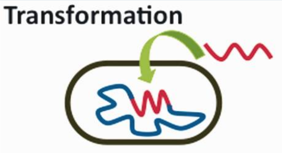
Transformation
Outside materials comes into cell and incorporates
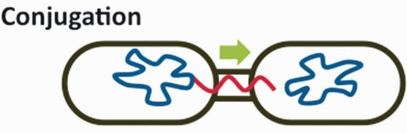
Conjugation
transfer between bacteria, almost like sex, but using a conjugation bridge
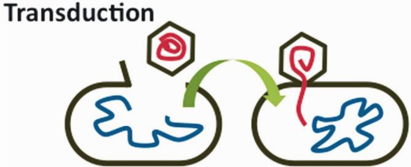
Transduction
a virus infects the cell and adds DNA
Transposons
can go anywhere on the genome, move around, and delete themselves
The Bacterial Growth Pattern
1. The bacteria adapt to new local conditions during the lag phase.
2. Growth then increases exponentially during the exponential (log) phase.
3. As resources are reduced, growth levels off during the stationary phase.
4. As resources are depleted, bacteria undergo a death phase.
What do bacteriophages use their tail sheath and fibers for?
tail fiber to attach to bacteria, and sheath to inject their genetic material
Retroviruses
contain a single-stranded RNA genome, from which a complementary DNA strand is made using reverse transcriptase. The DNA strand can then be integrated into the genome.
*are the chronic infections viruses*
Positive vs. negative sense
Single-stranded RNA viruses may be positive sense (that can be translated by the host cell) or negative sense (which requires a complementary strand to be synthesized by RNA replicase before translation).
Positive: infect right away
Negative: requires a viral enzyme to make an RNA strand that the host ribosome can read and create viral proteins
Lytic vs. Lysogenic Cycle
Lytic: virus produces massive numbers of new virions, until the cell lyses (virulent)
Lysogenic: the provirus can remain in the genome indefinetly or may leave the genome in response to a stimulus
Prions vs. Viroids
Prions: infectious proteins that trigger misfolding of other proteins (typically convert α-helix into ß-pleated sheets)
Viroids: a plant pathogen that inactivates their genes.
Peroxisomes
contain hydrogen peroxide and can break down very long chain fatty acids via ß-oxidation. They also participate in phospholipid synthesis and the pentose phosphate pathway.
What produces the Myelin on neurons in the CNS and PNS
CNS: oligodendrocytes
PNS: Schwann Cells
Astrocytes
take part in the blood-brain barrier
Ependymal Cells
line the ventricles and produce cerebrospinal fluid
Absolute Refractory Period
no amount of stimulation will trigger another AP
Relative Refractory Period
a really greater than normal amount of stimulation could cause an AP
Sensory Neurons
afferent (ascend towards the brain)
Motor Neurons
efferent (exit the spinal cord towards the body)
Monosynaptic Reflex
a sensory (afferent, presynaptic) neuron fired directly onto a motor (efferent, postsynaptic neuron) … (knee-jerk)
Polysynaptic Reflex
a sensory neuron may fire directly onto a motor neuron, but interneurons are used as well … (stepping on a nail)
Fertilization (5 terms)
occurs in the ampulla of the fallopian tube, where the sperm penetrates the corona radiata and zona pellucida by secreting acrosomal enzymes. Once it passes through and injects its nucleus, it causes the cell to have a cortical reaction, in where a release of calcium occurs which depolarizes the cell, this prevents fertilization by other sperms and increases metabolic rate for the zygote
Zygote
the fertilized egg before dividing
Embryo
the zygote after dividing
Blastocyst
the clump of cells that implants in the endometrium
Embryonic Development Sequence
Fertilization → cleavage (division) → morula → blastulation → gastrulation
Blastulation
Going form a solid clump of cells (morula) into a blastula. The embryo now has a fluid-filled space which creates space for cell movement and separates self from support cells.
Blastocoel
The fluid-filled space of a blastula
Trophoblast
The layer of cells in the blastula that will form the plancetal structures
Chorion
Contains chorionic villi, which penetrates the endometrium and creates the interface between maternal and fetal blood
Allantois
involved in early fluid exchange between the embryo and the yolk sac
Amnion
lies just inside the chorion and produces amniotic fluid (really the most inner layer of the placenta)
What is Grastulation
happens after blastulation, and is the process of making 3 layers of cells (the ectoderm, mesoderm, and endoderm) … It also establishes the cranial and caudal ends, as well as left to right
Ectoderm
becomes epidermis, hair, nails, and the epithelia of the nouse, mouth, and anal canal, as well as the nervous system (including adrenal medulla) and lens of the eye
Mesoderm
becomes much of the musculoskeletal, circulatory, and excretory systems. It also gives rise to the gonads and the muscular and connective tissue layers of the digestive and respiratory systems, as well as the adrenal cortex
Endoderm
becomes much of the epithelial linings of the respiratory digestive tracts and parts of the pancreas, thyroid, bladder, and distal urinary tracts
Neurulation
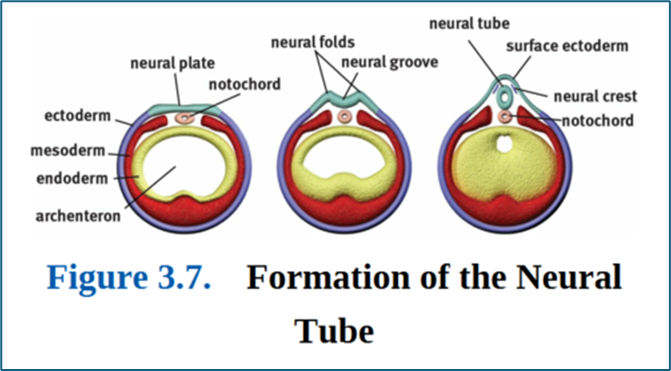
Formation of the neural tube (by giving rise to 3 germ layers)
Notochord
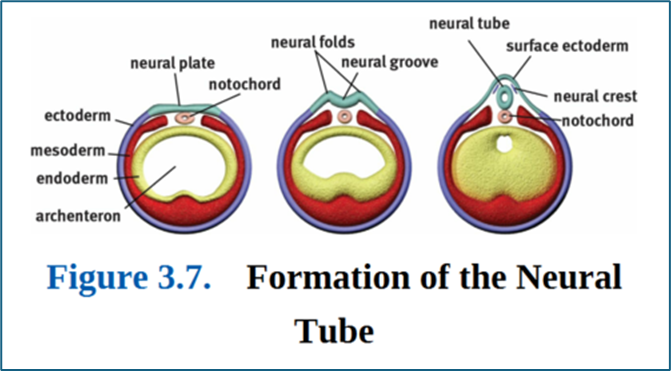
induces a group of overlying ectodermal cells to form neural folds surrounding a neural groove
Nueral Folds
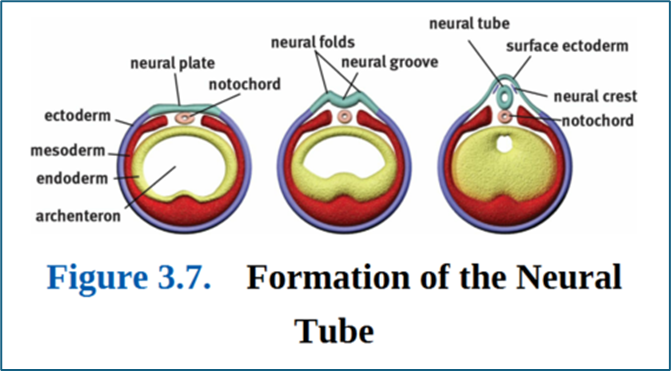
fuse to form the neural tubes, which becomes the central nervous system … the tip of each neural fold contains neural crest cells
Neural Crest Cells
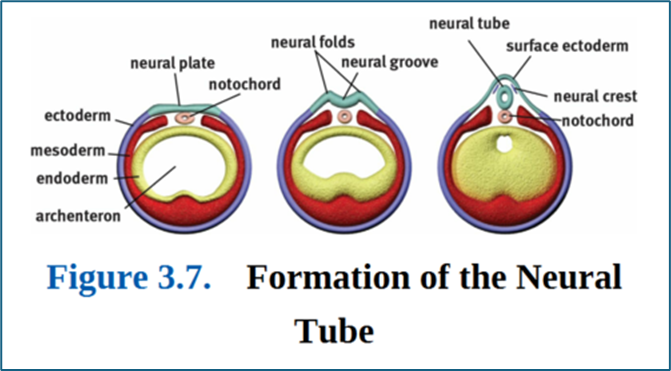
become the peripheral nervous system (sensory ganglia, autonomic ganglia, adrenal medulla, and Schwann cells), as well as specific cell types in other tissues (calcitonin-producing cells of the thyroid, melanocytes in the skin, and others)
Teratogens
substances that interfere with fetal development
Specification
the process is still reversible
Determination
complete commitment
Differentiation
process of becoming the next cell
specification → determination → differentiation
Totipotency
(can become ANY cell) Any cell type in the developing embryo or in extraembryonic tissues (amnion, chorion, placenta)
Pluripotency
(can become any of the cells derived from the primordial endo, ecto, and mesoderm) Any cell type in the developing embryo
Multipotency
(stem cell that can become a specialized cell type within a specific tissue or organ lineage) Any cell type within a particular lineage (ex. the hematopoietic stem cells)
Fetal Circulation
Fetal blood is not in contact with the mom’s bc of a multitude of risks. It carries fetal hemoglobin (HbF), which has higher affinity for oxygen, making diffusion on capillaries located in the planceta to occur. They also have shunts, which are like blockades so that a lot of blood doesn’t enter and damage tissues that are not “ready” yet.
What are the 3 shunts in fetuses, what vessels/chambers are connected, and what organs are bypassed?
Foramen Ovale: right atrium to left atrium (lungs)
Ductus Arteriosus: pulmonary artery to aorta (lungs)
Ductus Venosus: Umbilical vein to inferior vena cava (liver)
What happens during the first trimester
Organogenesis (development of the major organs)
What happens during the second trimester?
Lots of rapid growth, begins to move, face developsW
What happens during the third trimester?
More growth and transfer of antibodies from mom
What happens in G1 phase of Mitosis
cell creates organelles for energy (more mitochondria), and increases cell size
Chromatin vs. Chromatids vs. sister chromatids vs. chromosome
Chromatin: loose DNA + proteins
Chromatid: one condensed unit of DNA (essentially an L-shaped chromosome
Chromosome: can look like a chromatid (l) or an (x), but it just has to have a centromere to be a chromosome
Sister chromatids: a chromatid and its attached clone from after DNA replication, when it’s x-shaped
Briefly explain mitosis
We start with chromatin, then replicate them during S phase, and condense it into chromosomes (gives us 46 chromosomes, each attached to their identical clone, hence 92 chromatids … the # of chromosomes is always the # of centromeres) ... they then align on the mitotic plate and get separated (PMAT), meaning each cell now has 46 chromosomes and 46 chromatids
Briefly explain Meiosis
We start with chromatin, during S phase we duplicate it, after it condenses and forms chromosomes (46 chromosomes, and 92 chromatids), but during Porphase 1 the maternal and paternal chromosomes form a tetrad (23 tetrads if you will), they cross over and form novel chromosomes. They then align on the mitotic plate and the tetrads get broken up and carried to different cells. We now have 2 cells with each 23 new chromosomes and 46 chromatids. We then align them again in the mitotic plate and separate the sister chromatids. Given rise to 4 cells, each with 23 chromosomes, and 23 chromatids
Sertoli cells vs. Leydig cells
Sertoli cells nourish sperm
Leydig cells secrete testosterone
Describe Spermatogenesis
Remember, we start with our diploid stem cell, spermatogonia (the OG that’ll be used to create the sperms). After they replicate their DNA (S stage), they develop into diploid primary spermatocytes. The first meiotic division occurs, producing haploid secondary spermatocytes. Then they undergo meiosis II to generate haploid spermatids. Once these mature, they become mature spermatozoa
Spermatogonia → primary spermatocytes → secondary spermatocyes → spermatids → spermatozoa
o -onia: the OG stem cells
o Primary: still diploid, hasn’t gone or finished meiosis
o Secondary: haploid
o -tids: almost ready
o -ozoa: mature gametes
Define Oogenesis
Here the diploid stems cells are all gone by the time the baby is born, aka no more oogonia once born. Meaning all girls are born with their primary oocytes (they are still diploid but arrested at prophase 1). Later in life, every menstrual period will “select” one primary oocyte, and have it continue to down meiosis to form a secondary oocyte (haploid) which will get arrested at metaphase 2, and it won’t complete the remainder of meiosis 2 until its fertilized.
Effects of LH (luteinizing hormone) in males vs. females
Males: LH causes interstitial cells to produce testosterone
Females: LH causes the corpus luteum (the remains of the previous ovulation), to secrete progesterone
→ helps with hormone secretion ←
Effects of FSH (follicle stimulating hormone) on males vs. females
Males: FSH stimulates Sertoli cells and triggers sperm maturation
Females: FSH allows for estrogen to be secreted, which aids in the development and maintenance of the female reproductive system and female secondary sexual characteristics
Estrogen vs. Progesterone in terms of the menstrual cycle
Estrogen: causes the regrowth of the endometrium
Progesterone: maintains it for implantation
Follicular Phase
During this phase the ovum is maturing and the endometrium is finishing shedding / just began to regrow
Ovulation occurs bc of what?
LH surge
Luteal Phase
LH causes the formation of the corpous lutem, while the endometrium finishes growing
Menstruation
The shedding part. Caused by the decrease in estrogen and progesterone … which had build up bc of LH and FSH but once there’s too much it causes a negative feedback loop.
Purpose of human chorionic gonadotropin (hCG)
Hormone secreted by the developing fetus into the endometrium to ensure progesterone and estrogen keep being made.
Hormonal outcomes of menopause
ovaries become desensitized to LH and FSH, leading to a drop off of estrogen and progesterone, meaning no more menses. No more estrogen/progesterone removes the negative feedback loop on LH and FSH, so levels rise.
Peptide Hormones
They are made up of amino acids. They are packaged into vesicles and later released via exocytosis.
Made of aa, nonpolar, can’t cross membrane, extracellular receptors … fast onset but short acting
Steroid Hormones
Derived from cholesterol, not water-soluble (nonpolar), can cross the membrane, intracellular/nuclear receptors … slow onset but longer acting
Amino Acid-Derivative Hormones
like the name says, they are made of aa, usually one to two, with a few modifications. They are less predictable. For example, epinephrine and norepinephrine bind to GPCR, while thyroid hormones bind intracellularly.
Direct vs. Tropic Hormones
Direct hormones act directly on their target, while tropic hormones bind to some endocrine tissue that will then secrete another hormone
Thyroid and Parathyroid effect on Calcium
So, the thyroid secretes Calcitonin, which causes calcium to be stored in the bones (essentially it removes calcium from the blood), while the parathyroid secretes PTH (parathyroid hormone), which causes the release of calcium from the bone (adds calcium back into the blood).
Corticosteroids
hormones produces by the adrenal gland
Glucocorticoids
as the name suggests, these guys are involved with glucose. They are cortisol and cortisone (popularly known as the stress hormone). So, during stress your body wants to be awake, so we will increase gluconeogenesis, but we will stop protein synthesis. (make sugar, halt protein production)
Mineralocorticoids
Remember, if Vasopressin causes water reabsorption, then aldosterone causes sodium reabsorption. … This is how: low BP causes the juxtaglomerular cells to secrete renin, which cleaves angiotensinogen to its active form, angiotensin I. It then gets converted to angiotensin II by ACE in the lungs
Renin-angiotensin-aldosterone system: increases sodium and water reabsorption in the distal convoluted tubule (DCT) and collecting ducts
Cortical Sex Hormones
the adrenal cortex also releases androgens and estrogens, which help the different sexes physiologically and phenotypically. However, this is more important in females as they rely more heavily on the adrenal cortex for androgens, since males already produce testosterone in the testes
Adrenal Medulla
responsible for releasing epinephrine and norepinephrine
Glucagon
made in alpha cells of pancreas, when you have hypoglycemia, this causes gluconeogenesis and glycogenolysis
Insulin
made in the beta cells of pancreas, when you have hyperglycemia, this causes glycogenesis, and fat and protein synthesis
Somatostatin
made in the delta cells of pancreas; inhibitor of both insulin and glucagon … released when we have high blood glucose and amino acids