Accounting for managers equations
 Call Kai
 Learn
Learn Practice Test
 Spaced Repetition
 Match
Match Flashcards
 Knowt Play
1/27

There's no tags or description
Looks like no tags are added yet.
Name | Mastery | Learn | Test | Matching | Spaced | Call with Kai |
|---|
No analytics yet
Send a link to your students to track their progress
28 Terms
High low method for calculating variable costing Cost volume per unit
Change in cost / change in units
high low method calculating fixed cost
Fixed cost = total cost - variable cost (variable cost per unit * number of units)
Contribution margin
Total sales revenue - variable costs
(So what is left to contribute to covering fixed costs)
How to decide whether a change in fixed costs bring greater sales volume is worth it?
INCREASED UNITS: (Increase in units * contribution margin) - (increase in costs)
INCREASED REVENUE: (Increase in revenue * CS RATIO!) - (increase in costs
if positive it’s worth it, if negative it’s not
what is break even point? Calculate it in units and sales:
Break even point is when fixed costs = contribution margin (so 0 profit is made as all contribution goes to fixed costs)
Break even units:
Fixed costs / unit contribution
Break even sales:
Fixed costs / CM ratio
How to find units needed for a target profit
Fixed costs + target profit / contribution margin
(Like break even equation which technically adds 0 to the numerator as the target profit)
What is margin of safety? calculate
in number of units: Excess sales over break even point
Total sales - break even sales
in £’s: Express as percentage: Margin of safety sales /total sales
Purpose of knowing direct and indirect costs
For traceability to trace costs to specific cost objects (aka a single product)
Purpose of knowing product and period costs
Needed for financial reporting so product costs are included within inventory? (CHECK THIS) and period costs are considered general expense
Purpose of knowing fixed and variable costs
Necessary to predict cost behaviour when activity changes (how will costs respond to increase activity, variable costs will rise with it but fixed costs remain the same)
Purpose of knowing controllable and uncontrollable costs
To assess performance
Purpose of knowing differential, sunk and opportunity costs
Aids decision making process
Calculation for costs of goods sold in income statement
Beginning inventory + addition to inventory (aka production of more goods or buying more goods) - ending inventory (what is left over )
price variance equation
AQ(AP-SP)
Quantity variance equation
SP(AQ-SQ)
pre-determined overhead rate
estimated overhead costs / estimated productive capacity/total units in allocation base for period e.g. direct labour hours, machine hours, direct labour costs
overhead applied
pre-determined rate * actual activity
present value
future value * discount factor (find in table using discount rate)
net present value and how to determine investment?
present value of cash outflow (cost —> the present value is the SAME as bought in present so say discount factor = 1 and * by 1) - (SUBRACT) present value of cash outflows
if NPV is POSITIVE make investment
if NEGATIVE don’t make investment
if NPV = 0 do invest and this means the present value of the return is the same as the initial cost (expected rate of return matches the discount rate)
Internal rate of return, meaning and equations
meaning: the discount rate where net present value = 0, is the actual rate of return the project delivers
a discount rate GREATER than the IRR means NPV will be lower and should not do investment
a discount rate LOWER than the IRR means NPV will be higher and should invest
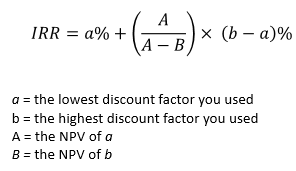
equation 1: investment required/net annual cash flows
equation 2: (see pic) lowest discount factor gives the positive NPV and highest discount factor gives NGEATIVE NPV
but NPV preferred to IRR when making investment decisions
Payback period
the length of time it takes to recover its initial cost
= investment required/net annual cash flow (assuming cash flows are equal yearly)
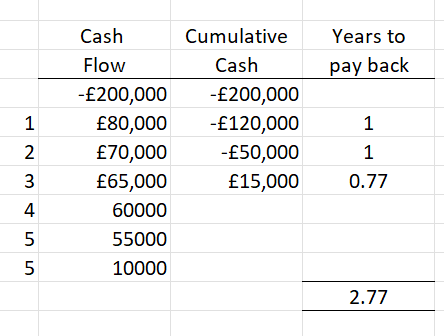
if cash flows not equal work from top and work out cumulative cash - see in image (start from negative cost and add inflows till you get to positive number, figure out how many years to get to 0 - so if a positive number over 0 divide to find out how much into the year it is to get to 0)
DOESN’T CONSIDER TIME VALUE OF MONEY (doesn’t kook at present values)
Accounting rate of return
average profit / initial investment
for average profit work out yearly inflows - yearly expenses including depreciation and divide by number of years
What is a balanced scorecard?
its a strategic planning and management system used to align business incentives to the business strategy by monitoring performance against STRATEGIC goals (not just financial) —> so is specific to the firm and its long-term strategy
Components of Balanced Scorecard
4 PERSPECTIVES/performance measures:
Customer —> critical success factors of increased customer satisfaction, retention etc.
Financial —> net profit, sales growth, shareholders
Internal business —> improved operations, increased efficiency, delivery performance
Learning & growth —> improving employees via training etc. motivate and empower employees
critical success factors VS KPIs
CSF - Factors critical/vital to the success of the business, different for different businesses, if not met = failure, met directly leads to success or competitive advantage eg. customer satisfaction, Amazon speedy delivery
KPIs = key performance indicators. MEASUREMENTS that indicate how well critical success factors have been met e.g. Amazon average delivery time, average ratings from customer surveys (NEEDS TO BE ACTUALLY AND SPECIFICALLY MEASURABLE, may compare to a target KPI e.g. cant just be employee training but total hours on training)
Balanced scorecard benefits
clarifies vision and overall strategy
aligns daily operations with longer-term strategy
improves organisational performance by measuring what matters
increased focus on strategy
greater focus on the factors which are key to future performance
Balanced scorecard drawbacks
complex and time consuming to prepare
RELIES on a well defined strategy (small firms don’t have) - leads to poor implementation
focus on lagging measures
use of generic metrics (the 4 key things) instead firms should identify which are most relevant
self serving managers - may set easy goals to obtain rewards or look good
Management vs financial accounting
STAKEHOLDERS: management gives info to internal managers to help them direct and control operations, financial for EXTERNAL shareholders and creditors (giving loans)
TIME: Management forward looking —> helps inform for future, gives important data for daily operations, Financial backward looking to record and judge past financial performance,
legislation - Management doesnt have a prescribed format just ethical code of conduct, Financial follow a prescribed format e.g. IFRS reporting standards
Management emphasis on relevance for planning, timely data provided quickly, Financial emphasis on verifiable precise figures
management can focus on specific segments, financial focuses on the whole organisation