AS LAW C1 SB
 Call Kai
 Learn
Learn Practice Test
 Spaced Repetition
 Match
Match Flashcards
 Knowt Play
1/24

Earn XP
Description and Tags
civil process, civil courts, tribunals, ADR,
Name | Mastery | Learn | Test | Matching | Spaced | Call with Kai |
|---|
No analytics yet
Send a link to your students to track their progress
25 Terms
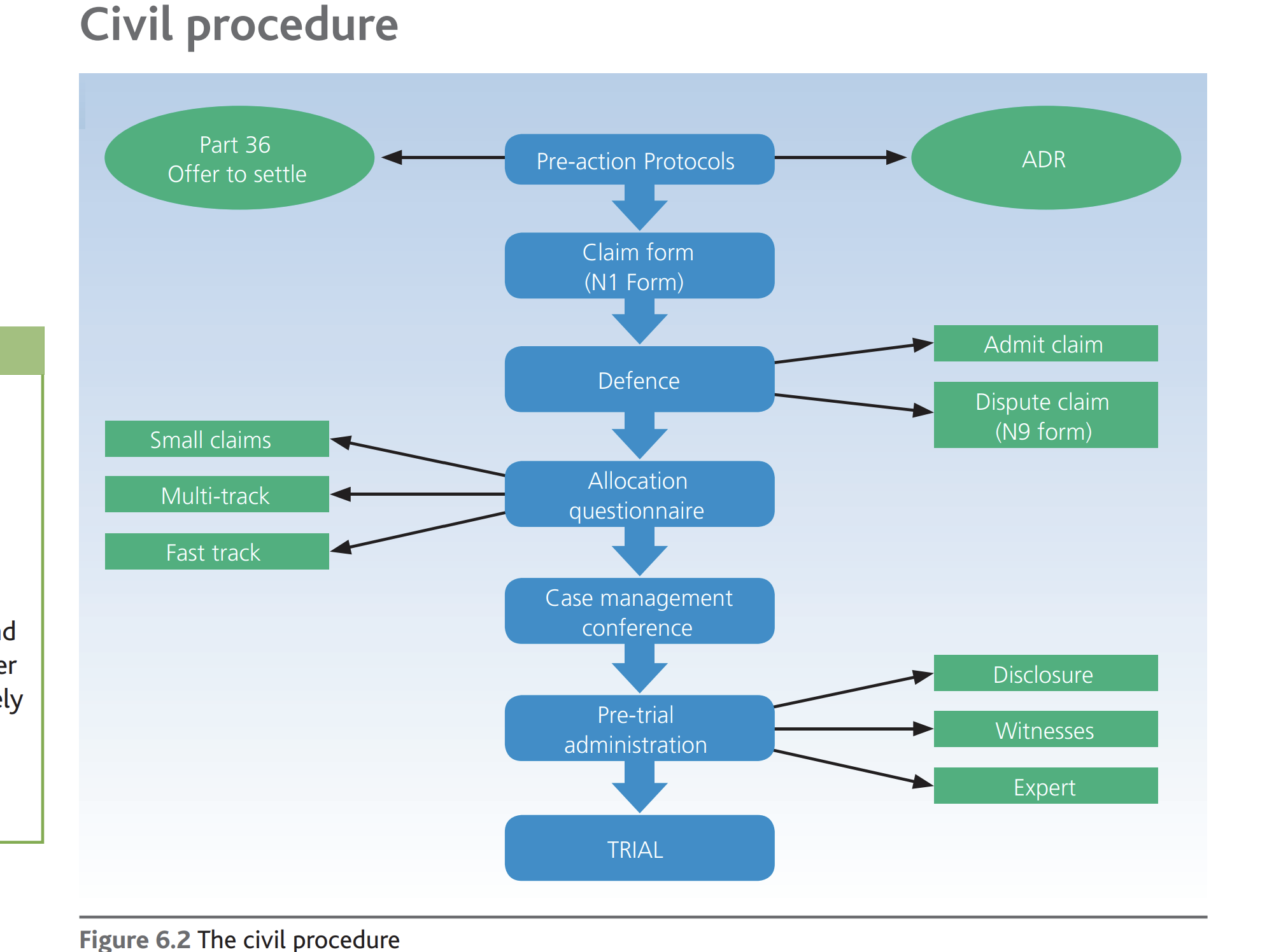
CP. what are the pre-action protocols taken before your proceedings?
Before proceedings tasks must be carried out by both parties
The aim is to provide info to both parties and to reach an agreement, to avoid going to court. if a party fails to comply with the proceedings they may be ordered to pay the costs of the proceedings.
Protocols include:
the claimant writes a letter outlining the claim, who is at fault, and the damage/ injury suffered
defendant then has up to 3 months to investigate claim and respond - admitting or denying
the Claimant and defendant must agree on an expert to use who provides a neutral report, eg medical experts for personal injury claims
CP. what are the court fees and what courts are claims held in?
If negotiation fails courts are the next step
There is a court fee to pay to start a claim, and parties may have to pay the other sides costs if they loose
if claiming less than £100,000 (or less than £50,000 for a personal injury claim) the case must start in the county court
if claiming more than £100,000 (or more then £50,000 for personal injury) the claimant can choose whether to start the claim in the county court or the high court
CP. what is the court paperwork for the Claimant and Defendant?
Issuing a court claim:
C must complete Form N1-the claim form
filed at court office
a fee is paid- amount varies depending on how much the claim is worth, the fee is worth £35 if claiming £300, rising to £10,000 if claiming £200,000 or more
Defending a court claim:
D can admit the claim and pay the full amount
D can dispute the claim, acknowledging it with form N9, or a full defense submitted to court within 14 days
if D ignores it, C can ask the court to order in their favor
CP. what is the track system?
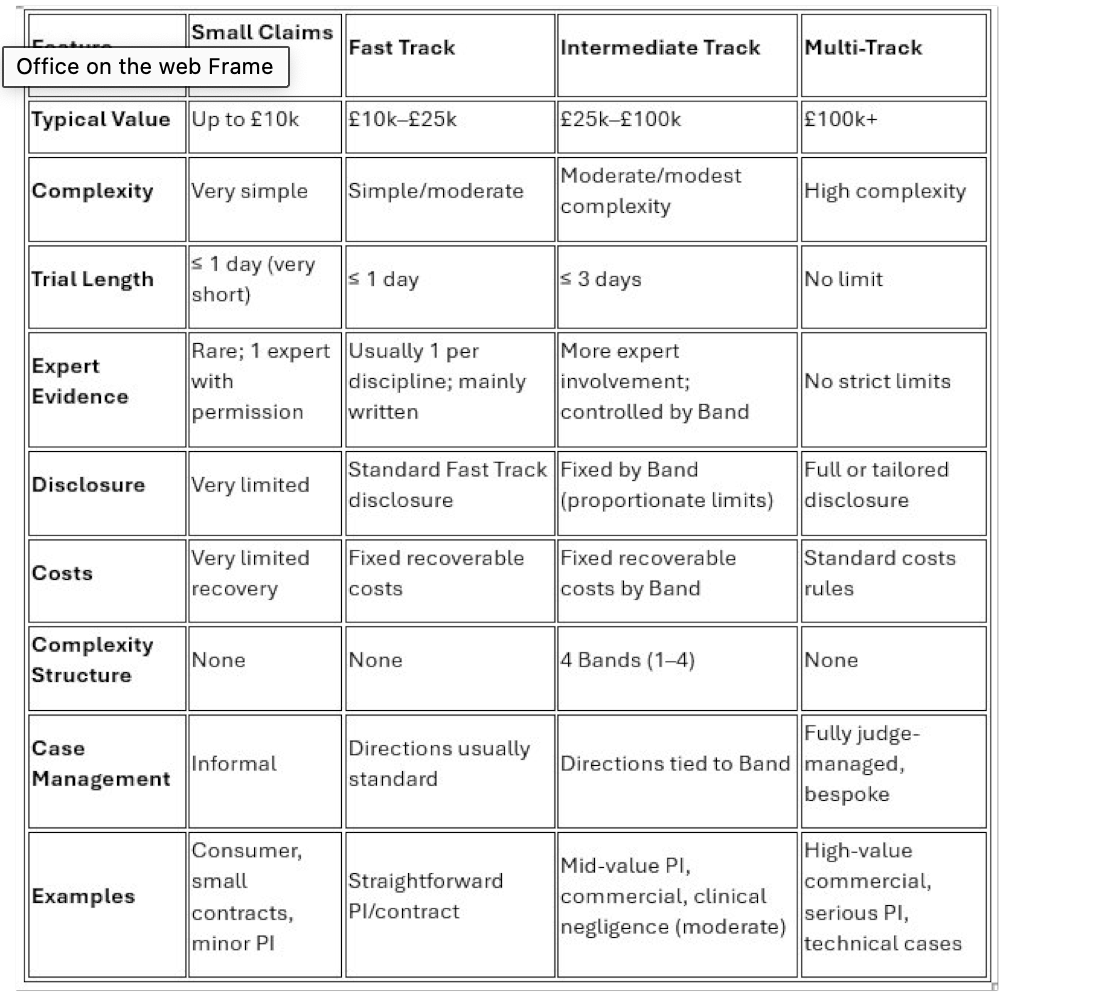
the track system is used to allocate civil disputes to specific procedural routes based on financial value, complexity, and trail length.
4 tracks:
small claims track
fast track
multi-track
intermediate track
CP. What is the small claims track used for?
used for disputes under £10,000
except for personal injury claims - limit of £1,500, and £5000 for road traffic accidents
parties usually represent themselves
district judges help parties explain
district judges can be more flexible with procedure
usually heard in private
CP. What is the fast track used for?
used for straightforward cases worth between £10,000 and £25,000
aim to hear cases in 30 weeks
court sets a strict timetable so that time and costs aren’t wasted
heard by district or circuit judge in open court
usually only one expert allowed
case heard in one day
CP. What is the multi-track used for?
used for cases worth over £25,000 and/or complex cases
heard by circuit judge who also manages the case
high court judge will hear case if its worth over £100,000 and high court is chosen
managing includes identifying issues, encouraging ADR, dealing with procedures, and creating a timetable - all aimed to keep costs lower
CP. What is the intermediate track used for?
the intermediate track was introduced in October 2023 and is a litigation track used for claims valued between £25,000 and £100,000 that involve modest complexity and can be tried in no more than 3 days
its designed to streamline mid-value civil cases by setting fixed case-management steps, and 4 complexity bands that determine the level of work and recoverable costs
CP. draw out the table for the different tracks showing: the value, complexity, trail length, expert evidence, disclosure, costs, complexity, case management, and examples
CC. what is the court hierarchy?
Supreme Court
court of appeal (civil division)
high court (kings bench division, chancery, and family)
county court
CC. what is the first appeal from the county court?
If a District judge hears the case at first instance:
the appeal is heard in the same county court by a Circuit Judge
If a circuit judge hears the case at first instance:
the appeal is heard by a High Court Judge
CC. What is the second appeal from the County court?
If a circuit judge heard the first appeal:
the second appeal is heard by the Court of Appeal (civil division)
If a High Court judge heard the first appeal:
the second appeal is heard by the court of appeal (civil division)
Permission is needed to appeal to the CoA and can only happen in exceptional circumstances set out in S55 of the Access to Justice Act 1999, namely where the case raises an important point of principle or practice.
CC. How is a case appealed in from the High court?
If the High Court hears the case at first instance:
the appeal is heard in the Court of appeal (Civil Division)
or, rarely, cases can “leapfrog” past the CoA and go straight to the Supreme Court - this procedure can only happen where the case involves an issue of national importance, SC must give permission or ‘leave’ to allow this kind of appeal
CC. How can a case be appealed further from the Court of appeal?
After the CoA makes an appeal decision:
the case can be appealed again to the Supreme Court
permission or ‘leave’ must be granted by either the CoA or SC
CC. What did the Access to justice act 1999 do?
in normal circumstances there would only be one level of appeal to the courts
where a court has already made a decision brought on by appeal, there is generally no other opportunity to appeal unless special circumstances
this means that second appeals are rare
appeals are a review of the hearing, they are only a real trial if it is in the interest of justice
a retail is only allowed if the decision is wrong or unjust due to procedure
(so this act made second appeals much more difficult to get)
CC. what is the structure of the Court of Appeal (civil division)?
located at the Royal Courts of Justice in London
there are judges known as: “lord justices of appeal”
presided over by the “master of the Rolls”
full appeals are heard by 2-3 Lord justices of appeal
CC. what is the structure of the Supreme Court?
located in Middlesex guildhall, London
Judges are known as : “Lord justices of the Supreme Court”
presided over by the President of the Supreme Court
there are 12 lord justices of the Supreme Court
most cases have 5 justices, more important ones will have 9
CC. what flaws did lord Woolf find in the civil justice system in 1996?
expensive: his report found that costs often exceed the amount in dispute
delays: cases took an average of 3-5 yrs to reach the trial stage
complex: with differing procedures for the county and high courts, parties found the system complex, as a result more layers were hired, increasing cost for plaintiffs
adversarial: there was an emphasis on exploiting the system rather then cooperation between parties
unjust: there was an imbalance of power between the wealthy represented party and the underrepresented party. this was particularly a problem with out-of-court settlements- one party more under pressure to settle
emphasis on oral evidence: most evidence did not need to be presented orally and could have been pre assessed by the judge. This made trails slow and inefficient and led to an increase in costs, with expert witnesses charging high fees
CC. What changes were made as a result of the Woolf report?
As a result of the findings of the Woolf report, the main recommendations were put into effect in the civil procedure rules 1998
The Woolf reforms include:
Simplified procedure:
the overriding aim of this reform was to provide a common procedural code for the county and high courts. some terminology was changed to make it more accessible to claimants (prev known as plaintiffs)
Pre- action protocols:
one of the biggest themes of the reform was to encourage parties to cooperate. Pre- action protocols are designed to encourage parties to exchange information as early as possible, be in contact with each other and cooperate over the exchange of info. The overall aim to encourage parties to settle out of court, reducing cost and delay.
Case management:
one of the most important reforms has been judges becoming the managers of cases with proactive powers to set timetables and sanction parties that do not cooperate. the overall aim of this reform was to pass management of the case to the court and not the parties, to improve efficiency and reduce costs
Alternative dispute resolution:
parties can postpone proceedings for 1 month to attempt to settle the case using ADR. courts should also actively promote its use. However, in Hasley V Milton Keynes general NHS trust (2004), the court of appeal said the courts cannot force parties to ADR as it might be against Article 6 European Convention of human rights - the right to a fair trial.
CC. What sanctions did the Civil procedure rules act 1998?
The main aim of the reforms were to ensure that cases where as time and cost effective as they could be, with judges taking on the role of case managers, they have been given the powers to issue sanctions on parties that do not follow timetables or delay unnecessarily.
Two main sanctions:
adverse award of costs - court order that requires a party to pay the legal fees and expenses of the opposing party
order for a case to be struck out (in part or in full)
In Biguzzi V Rank leisure plc (1999) it was held that striking out a case would only happen if it was proportional and there were other options to deal with delay (last resort)
However, in UCB V Halifax Ltd (1999) it was stressed that a lax approach should not be used for serious cases and courts should use the new powers available to them.
CC. What weaknesses of the civil courts did the Briggs review find?
The latest review of the civil courts was undertaken by lord briggs in 2016, he outlined 5 main weaknesses afflicting the civil courts:
a lack of adequate accesses to justice for ordinary individuals and small businesses. this is due to excessive costs associated with taking a civil case to court along with the risk that losing the party pays some or all of the winner’s costs. In addition, civil courts can be intimidating for litigants in person, therefore necessitating the use of expensive legal representation.
Inefficiencies arising from excessive paperwork and outdated IT facilities
Unacceptable delays in the Court of Appeal, caused by its excessive workload
serious underinvestment in provision for civil justice outside of London.
widespread weakness in the processes for the enforcement of judgements and orders.
CC. What proposals did Lord Briggs put forward?
Flexible opening hours of court:
his majesties courts and tribunal service have piloted flexible opening hours - between 8:30am and 8:30pm - in some civil courts to see I this will provide greater flexibility and accessibility for litigants and other court users
Civil Courts and the Covid-19 pandemic:
to help ensure the court service continued during the pandemic, his majesties courts and tribunals service (HMCTS) permitted hearings to be conducted via phone and video. Digitization of the courts and online hearings have developed rapidly since March 2020
law society reported in 2021 that due to its success this should remain a permanent feature of the justice system.
CC. draw out a representation of the civil procedure
ADR. what is alternate dispute resolution?
ADR is a method of resolving issues out of court. Litigation is not always the most appropriate method of resolving a dispute due to:
complexity of legal procedures
delay it causes in resolution
cost of court action
intimidating atmosphere of the courts
public nature of court action
adversarial nature of court action, which can result in a deterioration of the relationship between parties
ADR is encouraged by Part 1 of the Civil Procedure Rules 1998 (CPR), where it is part of the judges role in active case management to encourage ADR where appropriate.
-ADR is only used in civil cases, in criminal cases there is too much of a risk to justify an alternate to the CJS
-under rule 44.5 of CPR, if a court believes that a case could have been more effectively settled via ADR it can punish the party who insisted on a court hearing by penalizing them in costs, e.g. even in a C wins they may not have their costs paid by the legal party. the application of this rule is demonstraighted in Dunnett v rail track (2002)
ADR. ARBITRATION
Type of ADR: arbitration - commonly used in commercial and contract cases, and notably in high profile sort cases.
Description:
this is the most formal method and is adjudicative (disputes are resolved through a neutral third party who has the authority to bind the parties to the terms of the decision)
the parties agree to let an independent arbitrator make a binding decision. many contracts include a Scott V Avery clause to agree pre-contactually to arbitrate in the even of a dispute
there can be a hearing but many cases are conducted using paper arbitration- when parties submit their arguments and evidence in writing to the arbitrator as opposed to making oral submissions at a hearing
an award (decision of the arbitrator) can be appealed only on the basis of serious irregularity in the proceedings or on a point of law - under S65 Arbitration act 1996
European Directive on ADR (2015) requires ask EU countries to have ADR available for consumer disputes, and requires ADR providers to meet certain standards
Legal Authority/ example: