Test Three
 Call Kai
 Learn
Learn Practice Test
 Spaced Repetition
 Match
Match Flashcards
 Knowt Play
1/96

There's no tags or description
Looks like no tags are added yet.
Name | Mastery | Learn | Test | Matching | Spaced | Call with Kai |
|---|
No analytics yet
Send a link to your students to track their progress
97 Terms
Personality
A set of behavioural and emotional tendencies that people display. It distinguishes individuals from one another.
Trait theory
A psychological approach focused on identifying characteristics that shape how individuals behave in situations.
Openness
O in OCEAN, measures a person’s creativity and willingness to explore new ideas
Concientiousness
C in OCEAN, measures self-control, dilligence, and attention to detail.
Extraversion
E in OCEAN, measures sociability and energy
Agreeableness
A in OCEAN, measure kindness and helpfulness
Neuroticism
N in OCEAN, measures depression, being prone to anxiety, and irritability.
Trait theory
Idea that we behave consistently accross situations.
Situationism
Our thoughts and behaviors are governed by and change with the situations that we are put in.
It also recognises that individual characteristics (age, sex, gender) can influence the situations people are in, and therefore their behaviour.
Mischel and Peake (1982)
Authors of this study observed university students’ exhibitition of conscientious behaviour. They found that the students were likely to be consistent in similar situations, but not in different types of situations.
Interractionism
The idea that both traits and situations combine to affect our thoughts and behaviours.
Eysenck’s Three-Factor Model
A model of personality which suggests that personality is heavily influenced by biology and three factors (PEN) — psychoticism, extroversion, and neuroticism.
Psychometrics
A system of measuring the mind that quantifies psychological attributes to see how people differ from and compare with each other.
Interactionism
A micro-sociological perspective which views behaviour as a product of both the individual and the situation. (ex: someone’s personality might interact with how they encounter a positive/negative situation).
Mental age/chronological age x 100
How IQ is calculated in children
William Stern
A 20th century German psychologist who created one of the first ideas of an IQ calculation.
Catell & Horn’s fluid and crystalised intelligence
Two different domains of Spearman’s “g” found by Catell & Horn.
The ability to use general intelligence to learn new things, solve new problems and deal with novel situations.
The ability to apply general intelligence to new situations.
Gardner’s multiple intelligences
The idea that humans hold multiple types of intelligence rather than a general one.
Linguistic intelligence
Knowledge of spoken and written languages
Visual-spatial intelligence
Excellence in visiospatial abilities, including pattern recognition skills and spatial awareness
Musical intelligence
Good at thinking in sounds and rhythms. Often excel in musical areas.
Logical-mathematical intelligence
Having good problem-solving and mathematics skills.
Bodily-kinesthetic intelligence
Excellence in fitness, performing actions, and bodily movement.
Intrapersonal intelligence
Excellence in being aware of one’s metacognition and emotional needs.
Interpersonal intelligence
Excellence at communication and empathy, and attunement to someone’s emotions, wants and needs.
Naturalist intelligence
Strengths in finding connection in nature and the environment.
Existential intelligence
Ability to dive into deeper thinking about life and intelligence.
Honesty-humility
H in the HEXACO model, which the Mini-IPIP6 is based on. Measures modesty, greed-avoidance, sincerity, and fairness.
Spearman’s general factor “g”
The idea that there is a single influencing factor on cognitive performances across various tests.
Charles Spearman represented this with the general variable “g”.
How well a person does on a particular test will reflect not just their specific aptitude on that test, but also how much general ability they have.
Analytic intelligence
Part of Robert Steinberg’s 3 forms of intelligence. A type of intelligence which focuses on an individual’s ability to solve complex problems by encoding and processing information.
Practical intelligence
Part of Robert Sternberg’s 3 forms of intelligence. “Street smarts”/”common sense” — success with solving real-world and practical problems
Creative intelligence
Part of Robert Sternberg’s 3 forms of intelligence. The ability to invent solutions to new problems.
Mischel and Peake (1982)
These researchers observed conscientous behaviour in university students in a longitudinal study. Whenever they observed a conscientous behaviour, they would write it down.
During the first week of university, when there was less academic pressure, students displayed more conscientous behaviours (ex: taking notes).
However, as the weeks went on, conscientous behaviour declined, likely due to compounding factors (ex: increased academic pressure and extracurriculars).
Mini-IPIP 6
An open-source personality test which uses the HEXACO model to measure personality traits at a population level.
Participants are asked to answer a mix of positively and negatively worded questions on a scale of 1-7, 1 being “very inaccurate” and "7 being “very accurate”.
HEXACO model
The “Big 6” personality traits, more commonly used than the OCEAN model to measure traits. Includes honesty-humillity.
Gardner’s multiple intelligences
A contradictory theory to traditional intelligence and IQ which suggests that intelligence is made up of eight distinct skills.
Sternberg’s three forms of intelligence
A theory which proposes that intelligence has three domains, not just academic intelligence but also creative intelligence (innovation skills) and practical intelligence (street smarts).
Psychoticism
Dimension of personality linked to antisocial behaviour and nonconformity.
People who score high in this division are thought to reduce a person’s responsiveness to conditioning, causing them to neglect social norms and instead engage in criminal/nonconformist behaviour.
Extraversion
Dimension of personality linked to outgoingness and sociability.
People who score high in this division are thought to have lower levels of cortical activity, and seek external stimuli to increase it.
Neuroticism
Dimension of personality linked to emotional instability and being prone to anxiety.
People who score high in this division catastrophize and experience anxiety more frequently.
Psychometrics
Tests which are used to quantify an indivdual or population’s psychological characteristics
Reliability
Measure of whether test results are consistent and repeatable
Validity
Measure of whether test results are accurate to the variable they’re supposed to assess
Fluid intelligence
Ability to think of novel ideas and solutions to new problems. This tends to decrease in middle-aged adults, attributed to a loss of frontal grey matter in adults aged 65+.
Crystalised intelligence
Fixed knowledge gained from lived experience. Usually this type of intelligence increases with age, as the older one gets, the more experience and knowledge they gain.
Standardisation
Measure used in IQ testing to ensure that the test results are consistent accross the population. This is often done by keeping test conditions and content the same for each member.
Norming
The process of giving a test to the population to recieve a population norm by comparing test results. This norm can be used to interpret test scores.
Verbal
One subtest in David Wechsler’s IQ testing — involves comprehension and language-related questions ex: defining words and concepts.
Assesses crystalised intelligence
Visual
One subtest in David Wechsler’s IQ testing — involves abstract thinking, such as pattern recognition and arranging pictures in the right order.
Assesses fluid intelligence.
David Wechsler (1958)
Psychologist who developed IQ testing further by creating the WAIS-III (Wechsler Adult Intelligence Scale) and the WISC-III (Wechsler Intelligence Score for Children), and established verbal and visual questions in IQ tests.
True
True or false:
For adults, IQ can deteriorate later in life, and the mental/chronological age ratio calculation will become less accurate over time. This can be due to physical and mental deterioration from illness or injury.
Comparing individual IQ to standardised sample
Method of calculating adult IQ
Clinical psychology
An applied branch of psychology that focuses on treating mental health problems in a clinical space.
It looks at thoughts and behaviours using talk therapy. People working in this field work collaboratively with individuals accross the lifespan to help them understand their cognition.
Scientist-practitioner model
A training model in psychology which suggests that psychologists must apply evidence-based treatments during their evaluations of patients. This means that they are expected to keep up with research in their field and use research methods to determine the effect of their treatments.
Psychological disorder
A clinically significant disturbance in an individual’s cognition, emotion, or behaviour that reflects disfunction in an individual’s underlying mental functioning. These disorders are usually associated with distress or impairment in important areas of functioning.
For example, OCD may impair everyday functioning through urging the patient to reinforce the obsessive-compulsive cycle.
Distress
Emotional suffering that exceeds the everyday stress levels, impacting everyday functioning in areas such as work or relationships.
Impairments in functioning
A mental disorder’s interference with areas of everyday life, such as self-care.
Atypicality
For something to be considered a mental disorder, it must be unexpected within the sociocultural context it is observed in.
The sociocultural context is important, because some behaviours that appear “disordered” in some cultures may be perfectly normal.
DSM-5
Diagnostic and Statistic Manual of Mental Disorders — one of the diagnostic manuals which psychological disorders are diagnosed through.
Psychologists use the manual to understand and classify behaviours as mental disorders.
ICD-10
International Classification of Diseases. A similar diagnostic manual to the DSM-5 more commonly used in Europe and other countries.
Pros of diagnosis
Diagnosis normalises and validates the problems which individuals go through, and provides them with treatment options.
It informs clinical psychologists on how they can treat patients, for example, they can administer scientifically-backed treatments to diagnoses, resulting in effective recovery
It helps individuals access services that can benefit their mental health.
Cons of diagnosis
Diagnosis can lead to stigma against mental disorders, which creates negative schemas against mental disorders from society and the patient, hindering recovery.
Centers the problem around the individual without taking into account interpersonal/social/cultural factors
Risk of misdiagnosis — as doctors diagnose differently, and symptoms may overlap with one another
Some disorders may be comorbid from others, a single diagnosis may not be representative of the big picture
Lowering diagnostic thresholds
The DSM-5 has come under controversy for this — critics say that it gives mental health diagnoses to people who may simply be experiencing normal problems with living.
Biological model
The idea that mental disorders are influenced by biological abnormalites.
For example, genetic predispositions are risk factors — people with a family history of bipolar disorder are more likely to inherit it, and people with immediate family who have OCD are more likely to develop it.
Low serotonin
Linked to depression
High dopamine
Linked to psychosis
Overactive amygdala (fear center)
Imbalance in FMRI scans present in people with Anxiety/PTSD.
Shows an imbalance in emotional regulation/generation, leading to problems with mood and impulses.
Underactive prefrontal cortex (control and regulation area)
Imbalance in FMRI scans present in people with depression/ADHD
Shows an imbalance in emotional regulation/generation, leading to problems with mood and impulses.
Psychodynamic model
Developed by Sigmund Freud, proposes that mental disorders are the result of unconscious instincts and past experiences. For example, depression may have been the result of grief experienced in the past.
Behavioural model
Distress is conditioned through classical/operant conditioning. For example, phobias are reinforced by constant exposure or association with an unconditioned stimulus. This model also posits that it can be unlearned through conditioning.
Cognitive model
How someone interprets the situation can influence behaviours/mental disorders. For example, people with depression may hold the belief that “I am worthless”. These beliefs can be altered.
Humanistic model
The idea that mental health/disorders is influenced by conditions of worth/needs not being met.
For example, someone may experience depression and anxiety because their safety and love+belonging needs are not being met because they are in an abusive situation.
Cultural model
How cultural factors influence various beliefs around mental health. For example, one’s connection to their culture and identity can disconnect someone with their identity, resulting in poor mental health.
Socioenvironmental factors
How different environments shape mental health. For example, people who experience poverty may experience mental disorders due to increased exposure to adversity and unstable lifestyles.
Adverse Childhood Experiences (ACE) study
A large study conducted by Kaiser Permamente. A survey was given to 17000 people who sought their health services.
This survey observed individuals’ adverse childhood experiences, including whether they experienced abuse, neglect, or household dysfunction (factors such as abusive, bereaved or mentally ill family members).
The score on the survey reflects risk of future adverse experiences (ex: addiction, intimate partner violence), unless protective measures intervene.
Diathesis-stress model
This model suggests that mental disorders come from the interraction of underlying biological/psychological vulnerabilities (diathesis) and external stressors.
Diathesis can be traumatic events or destructive environments.
DSM-5 criteria for depression
Depressed mood most of the day, nearly every day
Markedly diminished interest or pleasure in most activities
Significant weight loss or gain, or appetite disturbance
Insomnia or hypersomnia
Psychomotor agitation or retardation
Fatigue or loss of energy
Feelings of worthlessness or excessive/inappropriate guilt
Diminished ability to think or concentrate; indecisiveness
Recurrent thoughts of death, suicidal ideation, or suicide attempt
According to the DSM-5, five or more of these symptoms being present in the same 2-week period is part of the criteria for …
Depressed mood nearly every day
Depressed
Markedly diminished interest in most activities
Man
Significant weight loss or gain
Smokes
Insomnia or hypersomnia
In
Psychomotor retardation or agitation
Pee
Fatigue or loss of energy
Factory
Feelings of worthlessness and guilt
For
Diminished cognitive ability
Delicious
Reccurrent suicidal ideation
Rabbits
Cognitive model
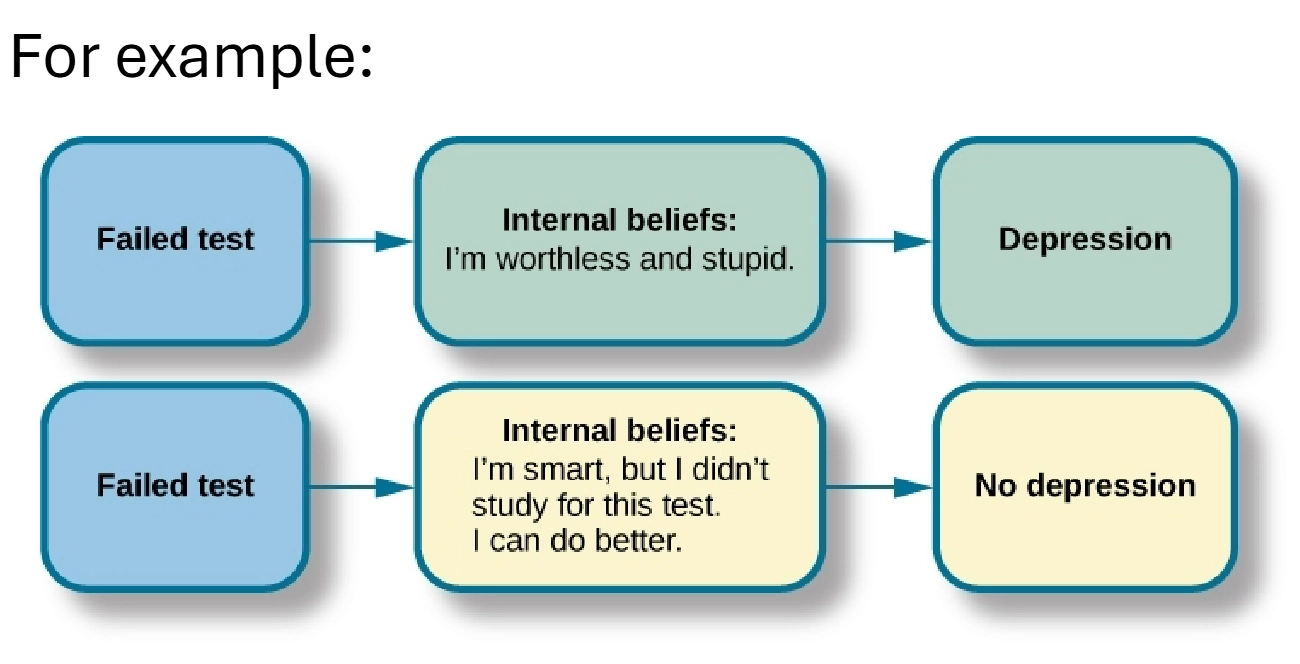
A belief system where someone’s perception of an event influences how they feel about it. Changing your perception can impact your emotions.
Core beliefs
Deeply ingrained beliefs rooted in early experiences, which influence our intermediate thinking. For example, perfectionism at an early age can make someone believe that they must not fail at anything.
Intermediate beliefs
Expectations people set for themselves which are influenced by core beliefs. For example, someone with the core belief that they can not fail at anything would establish that they must perform perfectly at everything, or fail.
Automatic thoughts
Quick thoughts one may have when responding to a situation, influenced by core beliefs and intermediate beliefs. For example, someone who believes that they can not fail at anything and sets expectations around that would think “I must succeed right now”.
Beck’s cognitive triad
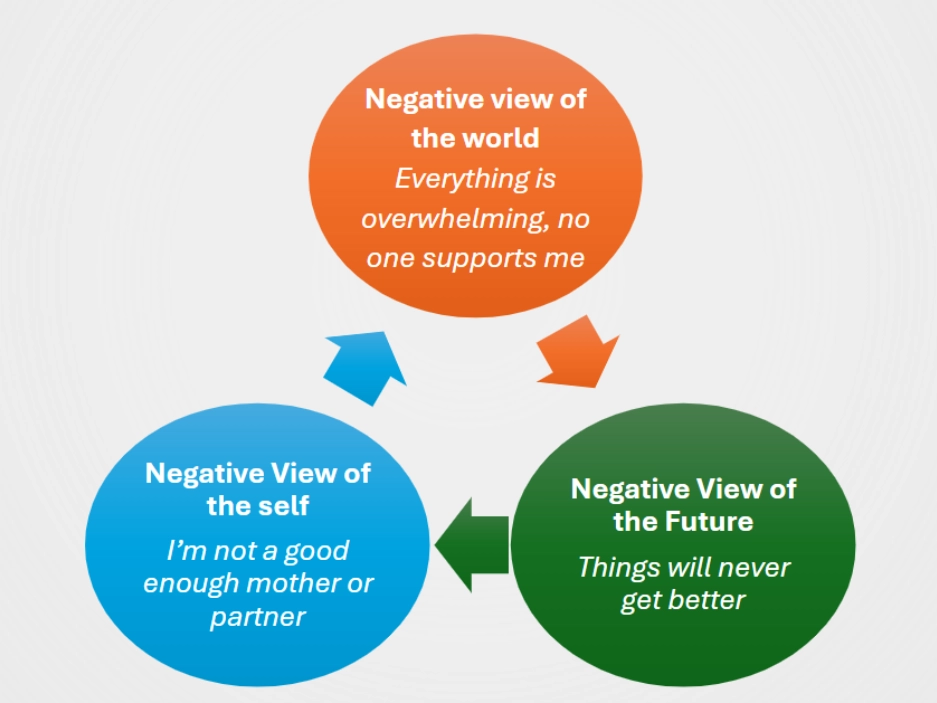
A cognitive model which proposes that depression arises from negative thoughts about the self, negative thoughts about the world and others, and negative beliefs about the future.
CBT Five-Part model
A framework which allows people to observe how different areas of their life are impacted by depression/mental health problems.
These areas include situations, thoughts, physical sensations, emotions and behaviour.
Situation
The external event which triggers the behavior in the CBT Five-Part model.
(For example, a friend walks past without saying “hi”)
Thoughts
The mental intepretation of the behaviour in the CBT Five-Part Model.
(For example, thinking a friend hates you after they walk past without saying “hi”).
Reaction
What you do as a result of the factors impacting you in the CBT Five-Part Model
(For example, not saying “hi” to a friend who walked past without saying “hi”)
Physical sensation
What you feel in your body as a result of the factors impacting you in the CBT Five-Part Model
(For example, you may begin to have a stomachache bc you feel anxious that your friend isn’t saying “hi”)
Emotions
How you feel as a result of the compounding factors in the CBT Five-Part model
(For example, you might feel sad or lonely if your friend doesn’t say “hi”)