L44 - Non-ruminant Digestive Physiology
 Call Kai
 Learn
Learn Practice Test
 Spaced Repetition
 Match
Match Flashcards
 Knowt Play
1/32

There's no tags or description
Looks like no tags are added yet.
Name | Mastery | Learn | Test | Matching | Spaced | Call with Kai |
|---|
No analytics yet
Send a link to your students to track their progress
33 Terms
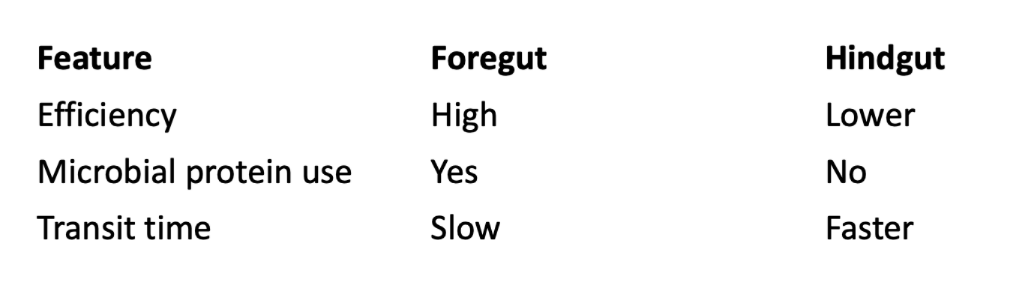
What’s the difference between foregut and hindgut fermentors? Why is this significant?
Foregut → ferment prior to gastric stomach and SI
VFAs and microbial proteins can be absorbed better in SI
Hindgut → ferment after SI
VFAs mostly absorbd, but microbial proteins are lost
Where fermentation occurs determines how efficiently nutrients are used
What needs to occur for microbial fermentation?
Retention of digesta and microbes
Suitable Environment → pH and anaerobic
Volume for fermentation
Rention Time → longer retained, more able to digest
Microbial Population
What’s a key difference between ruminants and hind gut fermentors?
Rention time → less time in hindgut than in ruminants
Faster in horses than cows
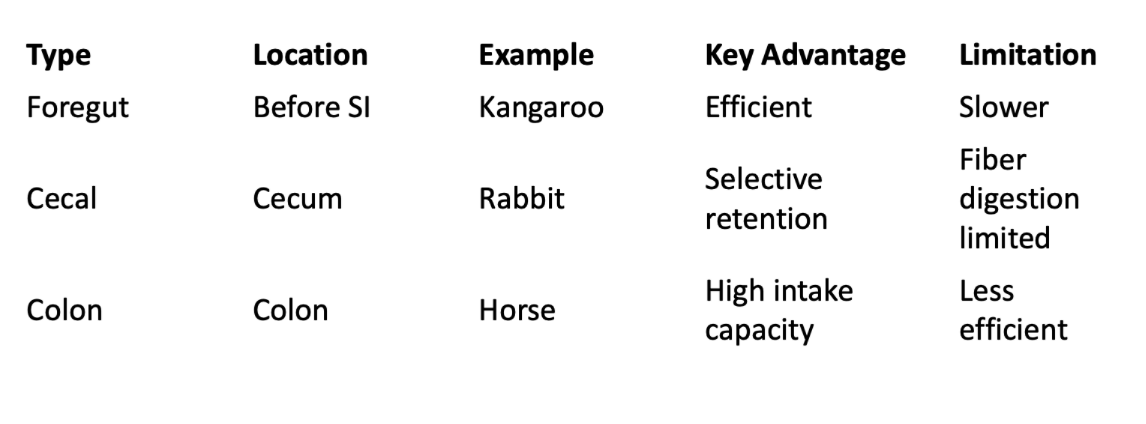
What are foregut formentors? Species?
Stomach compartments sort and retain fibrous materials → 2-4 pouches that are separate from gastric region for “pre-gastric” fermentation
Expanded cardiac region → microbial fermentation
Hippos → bulk roughage feeder
Kangaroo and Sloth → browsers
What are cecal fermentors? Species?
Larger cecum
Rabbit, guinea pig, rodents
What are colon fermentors? Species?
Large colon
Horse, elephant, koala
What are the key advantages and limitations of foregut, cecal and colon fermentors?
What domestic species are foregut fermentors?
There are no domestic foregut fermentors (just sloth, kangaroos, wallabies, hippos)
What type of fermentation is useful for degrading plant toxins?
Foregut Fermentor
How many pouches does the stomach of sloth, kangaroos and colobus monkey have?
Sloth: 3 chambers
Kangaroos: Long and tubular with 3 sections (sacciform, tubiform for fiber digestion, and gastric section)
Colobus Monkey: 4 pouches
Why is the cecum considered a blind sac?
Digesta enters and exits through the same opening (approx. 1-2 times a day)
Separates and excret indigestible fiber based on fiber density in the colon
Less dense (larger fiber particles) → stay in colon lumen and moves through it
Denser material (small protein and easily digestible fiber) → collects in colon perimeter → moves back to cecum with fluid for fermentation
Digestible components are retained
What are the type of feces from a cecal fermenter?
Hard
mostly indigestible fiber
Soft → “cecotrophs/night feces”
mucus-coated by goblet cells
comprised of cecal contents
recovers B-vitamins and microbial proteins
How do cecal fermentors recovery nutrients?
Coprophagy → eat feces
Why is hindgut fermentation less efficient?
Fermentation occurs after SI → Microbial protein is lost so can’t be absorbed
Limited absorption time, but recover most VFAs
What are the functional roles of cecum, haustra and colon?
Cecum → mixes, transports ingesta between haustra
Haustra → sac-like invaginations in cecum and ventral colon
Keeps digesta homogenous
Colon → fermentation, mixing, bicarbonate secretion, absorption of VFAs and water/electrolytes
What promotes fermentation in the cecum and colon?
Mixing
When do solids vs. soluable digest reach cecum?
Solids → more than 2 hours after ingestion (depends on particle size)
Soluble Digesta → around 2 hours after ingestion
What allows the movement of digesta from cecum to right ventral colon?
Cecocolic orifice
Is there retrograde flow from colon to cecum?
No! Once it leaves, it keeps going!
What are the ventral colon motility types?
Haustral Segmentation (mixing) → fermentation and VFA absorption, retention which allows microbes to digest and prevents microbe washout
Peristalsis (forward movement) → propels digesta from cecum to left ventral colon
Retropulsion → left ventral colon and resists it from moving forward, allows for retention and mixing
What are the dorsal colon motility types?
Segmentation
Peristaltic
BUT diameter decreases at large and small colon junction → impedes digesta flow → Retropulsion for further mixing
Where is the pelvic flexure?
Left ventral and left dorsal colon
Why is the pelvic flexure clinically relevant?
Smaller diameter and where antiperistaltic contraction originate → large particles are retained for fermentation → can commonly cause impaction due to flow restriction
What contractions in the small colon allow for the formation of fecal balls?
Segmentation contractions
What is the function of the small colon? Why is this clinically significant?
Make fecal balls
Recovers water, electrolytes and VFAs
Fluxations in water and electrolytes in large/small colon can increase susceptibility to colonic disease in horses
Why are VFAs important?
Provide energy
Ex. Acetate, Butyrate, Propionate
What are the typical substrates for fermentation and VFA production?
Structural carbohydrates → lots of cell walls → high in cellulose and lignin → high amounts reaches hindgut
Non-structural carbohydrates (starch, soluble sugars, ressistant starches, fructans) → load reaching hindgut varies
High NSC can contribute to GI upset (colic or laminitis)
What maintains pH in the colon?
Bicarbonate and phosphate buffers
What is secreted when there’s high VFA production in the colon?W
Water
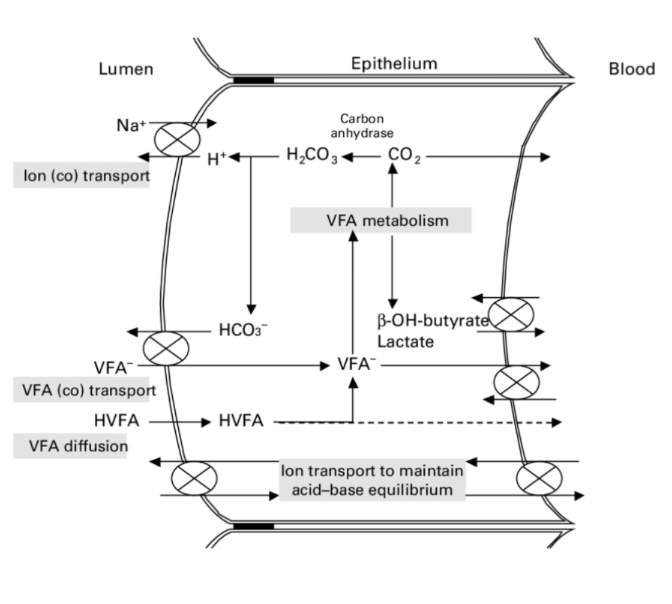
How are VFAs absorbed? Why is this important?
Sodium co-transport → water follows → bicarb is generated
Critical for maintaining a stable pH
What’s the transit time of hindgut fermentation?
2-3 days → faster than ruminants
How do foregut and hindgut fermentors compare in regards to efficiency, microbial protein use and transit time?