Principles of Managment w Gaylor
 Call Kai
 Learn
Learn Practice Test
 Spaced Repetition
 Match
Match Flashcards
 Knowt Play
1/46

Earn XP
Name | Mastery | Learn | Test | Matching | Spaced | Call with Kai |
|---|
No analytics yet
Send a link to your students to track their progress
47 Terms
Organization
deliberate collection of people brought together to accomplish some specific purpose
Organization Characteristics
goals
people
structure
Management
the process of getting things done effectively and efficiently, with and through people
Efficiency
doing things right
Effectiveness
doing the right things
The Levels of Management
Top Managers > Middle Managers > First Line Managers > Team Leaders
Functions of Management
Planning Organizing, Leading, Controlling
Employable Skills for a Manager
critical thinking, communication, collaboration, knowledge application and analysis, social responsibility
Good Boss Characteristics
someone who listens and allows for employees to be put in situations that best fit their skills set, clear outlines of expectations
Bad Boss Characteristics
micromanagement, bad at scheduling times that fit the employees schedule, arrogant
Approaches to Management
Classical Approach: rules and principles were developed that could be taught and used in a variety of settings.
Behavioral Approach: focused on the actions of workers
Quantitative Approach: statistics, optimization models, information models, computer simulations, and other techniques and activities
Contemporary Approach: managers’ concerns inside the organization
Key Contributors to Management
Intentionality
Trust
Autonomy
Connection
Accountability
Characteristics of External Environment
Political/legal
Demographics
Economic
Sociocultural
Technological
Global
Sharing Economy
Asset owners share with other individual through peer to peer service, for a set fee, their underutilized physical assets or their knowledge, expertise, skills, or time
Economic Inequality
the unequal distribution of income and opportunity between different groups in society
Demographics
Demography is destiny
Age cohorts
Age Cohorts
baby boomers, Gen X, Gen Y, Gen Z
Share Holders
an owner of shares in a company
Stake Holders
Any constituencies in an organization's environment that are affected by that organizations decisions and actions
Organizational Culture
Shared values, principles, traditions, and ways of doing things that influence the way organizations members act
Characteristics of a strong culture
Substitute for formal rules and regulations
Create predictability, orderliness, and consistency.
4 types Of Organizational Culture
innovative culture
Sustainability culture
Ethical Culture
Learning Culture
Globalization
A boundaryless world where goods and services are produced and marketed worldwide
Ways To Go Global
Multi domestic corporations
Transnational organizations
Global corporations
Hofstedes Framework
Assertiveness
Future Orientation
Uncertainty avoidance
Power distance
Individualism/ collectivism
Corporate Social Responsibility
Social obligations
Social responsiveness
Ex. Magazines in Barbershop
Views of Ethical Behavior
Utilitarian view of ethics
Rights view of ethics
Theory of Justice view of ethics
How Should managers create an ethical environment?
Be a good role model by being ethical and honest.
Tell the truth always.
Don’t hide or manipulate information.
Be willing to admit your failures.
Share your personal values by regularly communicating them to employees.
Stress the organization’s or team’s important shared values.
Use the reward system to hold everyone accountable to the values.
The Three Ethical View Points
Utilitarianism - provides the greatest good for greatest number of people
Rights view - respect and protect greatest number of people
Justice view - expect to b treated fairly and impartial decision making
Steps Of The Decision Making Process
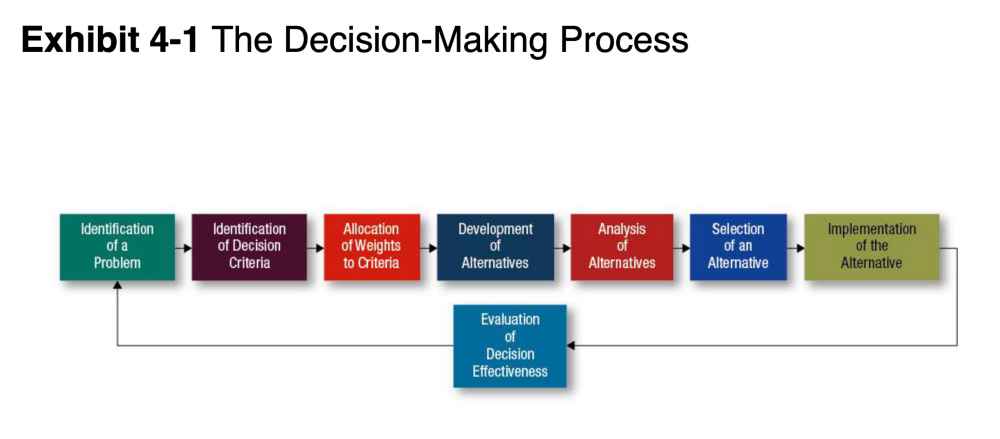
Common Errors in Decisions Making Process
overconfidence, hindsight, randomness, representation, avaliablity, revison, framing, confirmation, selective perception, anchoring effect, immidiate gradification
Rational Decision Making
choices that are consistent and value maximizing within specified constraints. Usual not a very realistic approach
Bounded Rationality
a concept in decision-making theory that suggests individuals make decisions by selecting the best available option given their cognitive limitations, time constraints, and the complexity of the decision-making environment.
Satisfice
a practical approach to decision-making, particularly in situations where the decision-maker faces constraints such as limited time, cognitive resources, or access to information.
Escalation Of Commitment
refers to the phenomenon where individuals or groups continue to invest more resources, such as time, money, or effort, into a failing course of action despite evidence that suggests it is unlikely to succeed or is no longer the best option.
Intuition
involves making decisions on the basis of experience, feelings, and accumulated judgment, which can complement both rational and bounded rational decision making. (more than half of managers use this approach.)
Types of Problems Managers Make
Structured problem - straightforward, familiar, easily defined
Unstructured problem - new or unusual for which information is ambiguous or incomplete
Programmed - repetitive decision that can be handled using a routine approach
Nonprogrammed - a unique and non recurring that requires a custom made solution
How Managers Make Decision
Managers must account for certainty, risk, uncertainty
Difference between Procedures, Problems, and Rules
Procedures refer to a series of steps or actions that are followed to accomplish a specific task or objective within the organization.
Problems represent challenges or obstacles that arise within the organization that hinder productivity, performance, or goal achievement.
Rules are established guidelines, policies, or standards that govern behavior, conduct, or operations within the organization.
Pros of Group Decision Making
Diversity of experiences
More alternatives
more legitimacy
Cons of Group Decision Making
time-consuming
Minority domination
ambiguous responsibility
Pressures to conform
Ways to Improve Group Decision Making
Brainstorming
The nominal group technique
Electronic Meetings
Why Ethical People Make Unethical Choices
excessive pressure to reach an unrealistic target, conflicting goals, no positive example,
Classical Approach
rules and principles were developed that could be taught and used in a variety of settings.
Behavioral Approach
focused on the actions of workers
Quantitative Approach
statistics, optimization models, information models, computer simulations, and other techniques and activities
Contemporary Approach
managers’ concerns inside the organization