Cellular transportation
 Call Kai
 Learn
Learn Practice Test
 Spaced Repetition
 Match
Match Flashcards
 Knowt Play
1/77

There's no tags or description
Looks like no tags are added yet.
Name | Mastery | Learn | Test | Matching | Spaced | Call with Kai |
|---|
No analytics yet
Send a link to your students to track their progress
78 Terms
simple diffusion definition
diffusion across a phospholipid bilayer
diffusion
tendency of molecule to disperse until they are venly distributed in the available space.
concentration gradient
the difference in concentration on two sides of a membrane/ meaning if the concentration difference is high, the solution would diffuse quick
osmosis
passive net movement of free water molecules through a partially permeable(selective) membrane, form a place of low solute concentration to a place of high solute concentration.
semipermeable membrane
membrane that act as a filter which only allows water to cross.
solute
molecule dissolved in a solvent/ liquid
osmolarity
total concentration of solutes in a solution
isotonic solution
solution that have the same pressure as the cytoplasm
hypertonic solution
solution that have a high osmolarity than the cytoplasm.
hypotonic solution
solution that have a lower osmolarity than the cytoplasm
facilitated diffusion
the passive movement of molecules across a biological membrane via specific transmembrane integral proteins
channel protein/protein channel
filtering the molecules that to through the cell membrane
passive movement
movement that does not require any energy
polar
non-polar
molecule that
channel protein in the plasma membrane
allow the passive movement of ions and small polar movements
diffusion of small and non-polar molecules move down a concentration gradient across a membrane
simple diffusion
condition of molecule passing through the cell membrane through simple diffusion
small and non-polar
for a large, polar, charged particles to cross a membrane
transmembrane protein
for larger molecules to diffuse via cell membrane
carrier protein
water is able to cross the membrane straight away without osmosis T/F
T
for small polar molecules and ion to diffuse
channel protein
the difference between the molecules that diffuse through channel protein and carrier protein
molecules diffuse via channel protein are small and polar while the molecule diffusing through carrier protein are large
movement of molecules across a membrane down their concentration gradient
passive transport tr
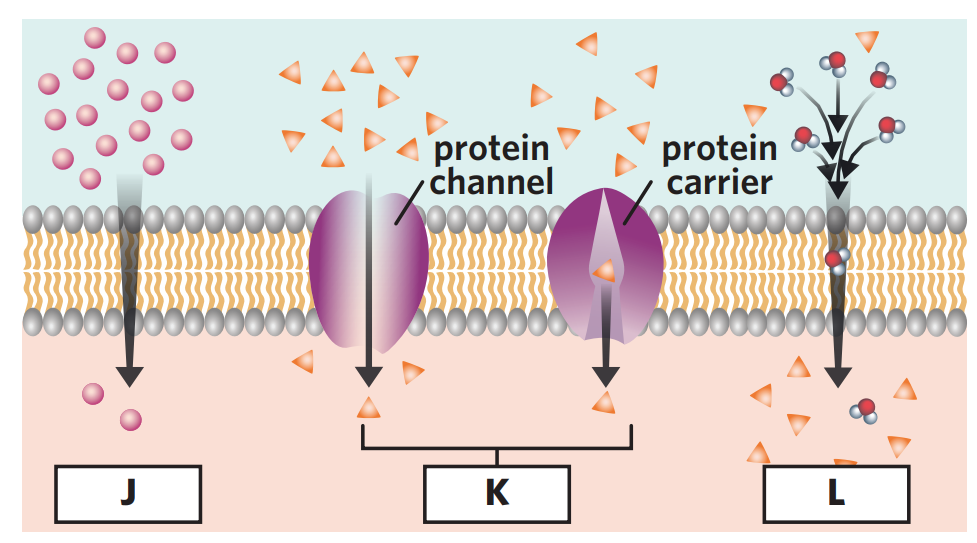
identify letter J
simple diffusion
identify letter K
facilitated diffusion
identify letter L
osmosis
hydrophobic /non-polar
water-scared / resisting water
hydrophilic /polar
like water/ having the tendency to mix with water
Water moves from areas of low solute concentration to high solute concentration
osmosis
Water moves from hypotonic regions to hypertonic regions.
osmosis
cytoskeleton function
The cytoskeleton gives shape and support to the cell and transports molecules around the cell.
carbohydrate
Its function may be involved in receiving or sending signals and cell to cell adhesion.
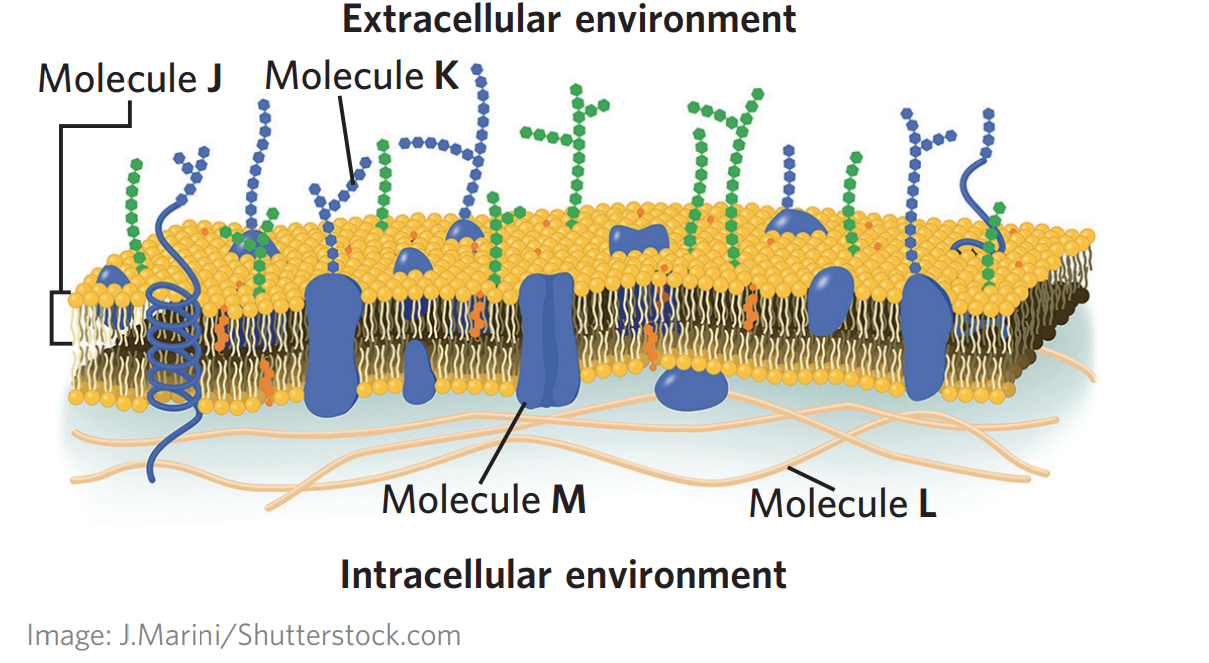
identify molecule K
carbohydrate
identify molecule L
cytoskeleton
ATP/function
adenosine triphosphate/ the phosphate group composed ATP could easily be broken of from the other phosphate groups in order to release the energy that can be used to drive other active processes.
ADP
adenosine diphosphate
Pi
inorganic phosphate
how is ATP produced
ATP is produced in the mitochondria by cellular respiration
cycle of ATP
produced in the mitochondria; diffuse to places in the cell where active processes are taking place; broken into ADP and Pi then diffuse back to the mitochondria.
how does ATP knows where to diffuse to
ATP automatically diffuse to the place where there is a lower concentration
active transport
active movement of molecule against their concentration gradient, across a membrane via specific transmembrane integral membrane
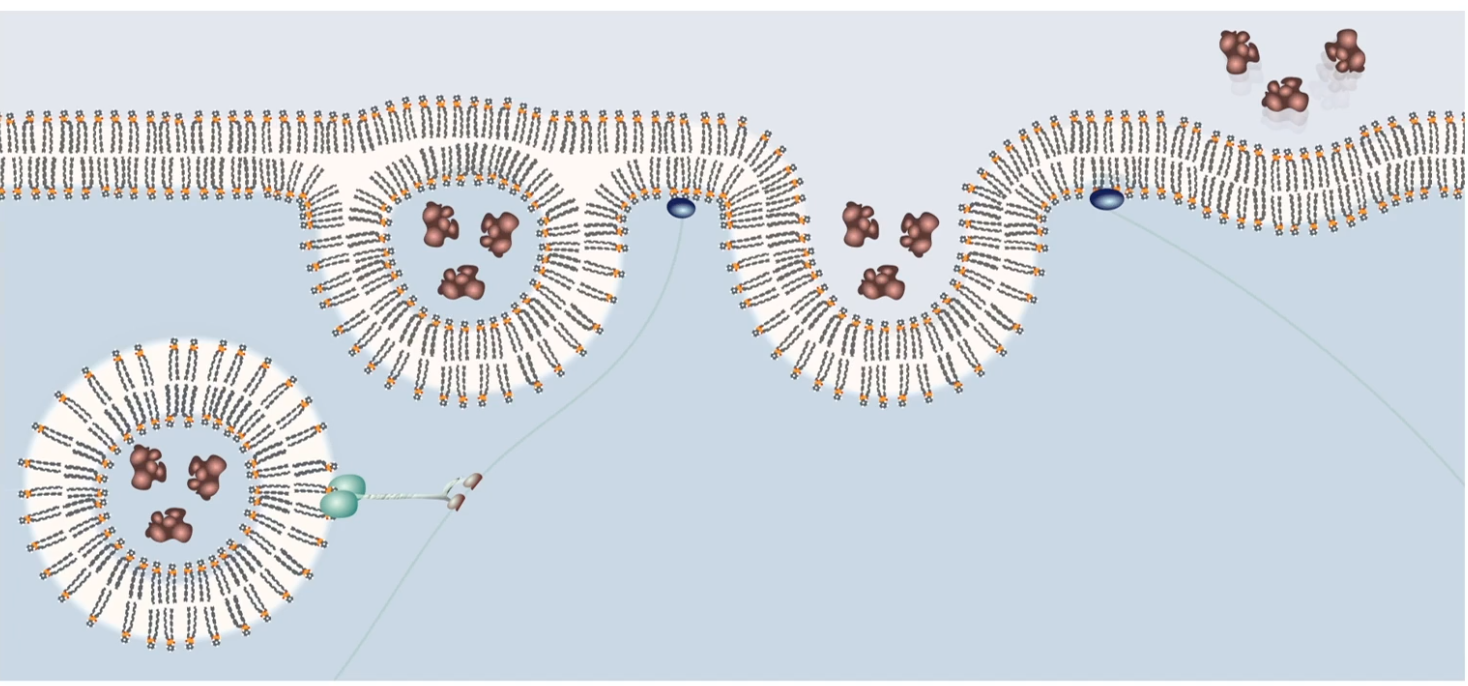
identify the process
Exocytosis
Exocytosis
process of bilk transport/ large molecules(protein) are secreted from a cell by the fusion of a vesicle of the plasma membrane
bulk transport
active movement of a large molecule into or out of a cell, bu enclosing it in a membrane sac
identify the process
exocytosis
endocytosis
reverse of exocytosis/ where the membrane furrows to surround a particle and engulfs it within a vacuole/ taking molecules into a cell
Phagocytosis
endocytosis of solid material, such as bacteria
pinocytosis
endocytosis of fluid material, such as lipids
how could a molecule to be moved when its to big to move through a carrier protein
by bulk transport
is phagocytosis and pinocytosis related to endocytosis or exocytosis
endocytosis
pump protein are also known as
transmembrane protein
conformation
the shape or structure of sth.
hypertonic
A solution is hypertonic if it has a higher concentration of dissolved substances (solutes) than the solution it's being compared to
high water concentration = ? solute
low solute concentration
why does low solute generally means high water concentration
if there is less solute, then there is more space taken up by water. So the proportion of water is higher, making the environment high water concentration compare to the other environment
substance(s) that can be transported by exocytosis.
I proteins
II large molecules
III secretory products
IV groups of molecules
NOT small, nonpolar molecules/ in this case, why can't the small and nonpolar molecules be transported by exocytosis
because nonpolar molecules as lipid -soluble molecules cuold cross the lipid membrane directly, especially when its small.
whearea exocytosis specifically means transportation of large molecules that is too big to be transported by the carrier membrane
why is nonpolar molecules lipid soluble/ and therefore able to pass through lipid membrane directly
Nonpolar molecules are also mostly hydrocarbon / no charge
Lipids (cell membranes) are made of long nonpolar hydrocarbon tail
resting membrane potential
where the inside of a neuron is negatively charged during resting state
what does it means moving down the concentration gradient
moving down the concentration=
High concentration → lots of particles crowded together
To Low concentration → fewer particles
So moving down the gradient means:
from crowded → less crowded
The resting membrane potential is mainly maintained by active transport, where the sodium–potassium pump uses ATP to move Na⁺ out and K⁺ into the neuron, creating ion gradients.
the resting potential is maintained by
the action potential is maintained by active transport because the sodium–potassium pump uses ATP to move ions against their concentration gradients.
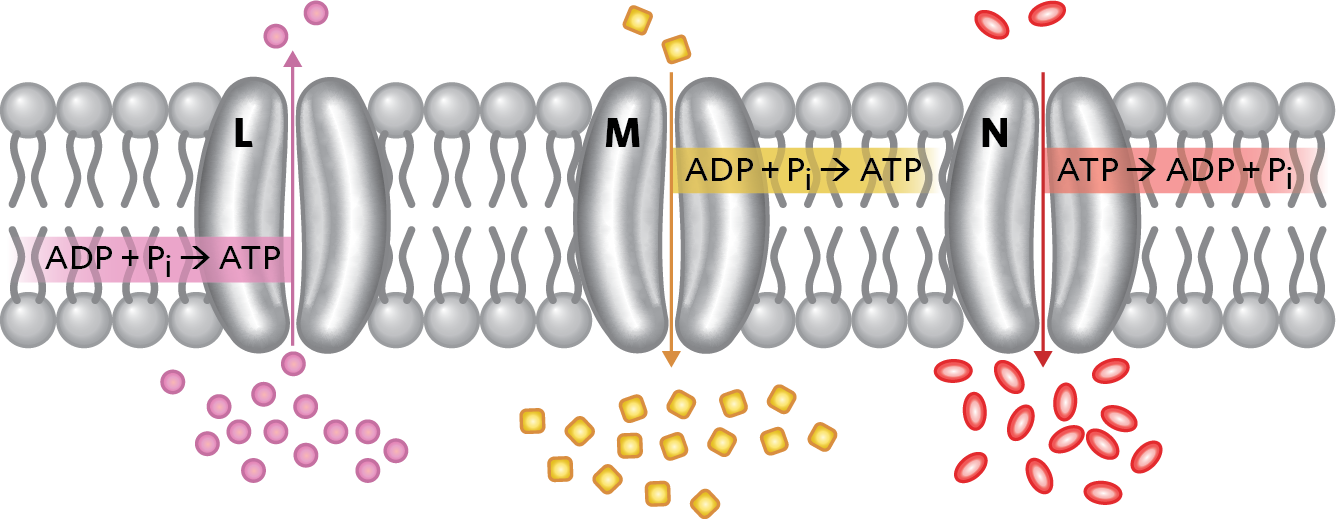
which of the transport are undertaking active transport
N/ as ATP(brakes into)→ ADP+Pi (to release energy required for the transportation
process after endocytosis
After endocytosis, the molecule is enclosed inside a vesicle called an endosome. This vesicle can then fuse with a lysosome, an organelle containing digestive enzymes. These enzymes break down large molecules into smaller components.
when the molecules breakes down, they produce:
amino acids
fatty acids
simple sugars
nucleotides
These can be:
✔ reused to build new molecules
✔ recycled for cell repair and growth
what is the function of ion in relation to cellular transportation
Ions are crucial in cellular transport because they help cells move substances, generate signals, and maintain balance inside and outside the cell.
definition of ion
molecule/atom that has a electrical charge
Charged ions cannot freely cross cell membranes, why
because the membrane’s hydrophobic interior repels charged, water-coated particles(ion), so they need channels or pumps to get through.
ion channel
Passive transport
Ions move down their concentration gradient (high → low)
No energy (ATP) required
Like an open tunnel or gate
ion pump
Active transport
Move ions against their concentration gradient (low → high)
Requires energy (ATP)
Like a machine that pushes ions across
difference between ion channel and pump
ion channel is a opened gate which requires no energy(passive transport), whereas the ion pump is the ticket machine that requires energy (active transport) in order to push the molecule to pass
pneumonia
lung inflammation/肺炎
lipophobic /Lipophobicity/lipophobia
Lipophobicity, also sometimes called lipophobia, is a chemical property of chemical compounds which means "fat rejection", literally "fear of fat".
Lipophobic compounds are those not soluble in lipids or other non-polar solvents.
hydrophilic
“Hydro” = water
“philic” = loving
👉 So hydrophilic substances mix well with water and are usually polar or charged.
hydrophobic
“Hydro” = water
“phobic” = afraid of
👉 So hydrophobic substances repel water and are usually non-polar or neutral.
phospholipid bilayer structure
The lipid is considered of:
Hydrophilic (polar) heads → face the water
on the outside of the cell
and on the inside (cytoplasm side)
Hydrophobic (nonpolar) tails → inside /in between the membrane
Liposome /definition /role
Liposomes are tiny spherical vesicles made of a phospholipid bilayer (basically a mini artificial cell membrane).
Role to send drug into the cell while preventing it from getting breakdown by the enzymes.