Populations and evolution
 Call Kai
 Learn
Learn Practice Test
 Spaced Repetition
 Match
Match Flashcards
 Knowt Play
1/24

Earn XP
Description and Tags
Name | Mastery | Learn | Test | Matching | Spaced | Call with Kai |
|---|
No analytics yet
Send a link to your students to track their progress
25 Terms
Define gene pool.
All the alleles of all the genes within a population at a particular time.
Define population.
All the individuals of one species in a particular area at a particular time that can interbreed to produce fertile offspring.
Define allele frequency.
The proportion of a specific allele within a gene pool.
Give the more simple Hardy-Weinberg equation.
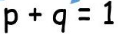
(p = dominant allele frequency
q = recessive allele frequency)
Give the more complex Hardy-Weinberg equation.
(p2 = frequency of homozygous dominant genotype
2pq = frequency of heterozygous genotype
q2 = frequency of homozygous recessive genotype)

Give two factors that cause variation between the phenotypes within a population.
Genetics.
The environment.
What is the primary source of genetic variation?
Mutation.
Give three types of selection.
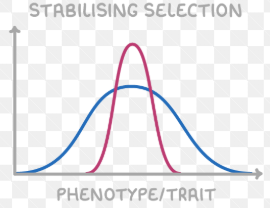
Stabilising selection.
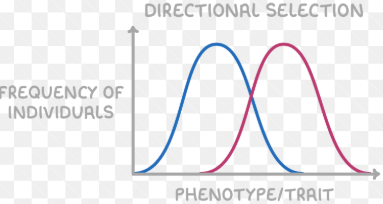
Directional selection.
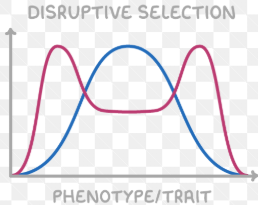
Disruptive selection.
Sketch a graph that shows stabilising selection.
Sketch a graph showing directional selection.
Sketch a graph showing disruptive selection.
Define evolution.
A change in allele frequencies within a population over many generations.
Give four things that drive evolution.
Natural selection.
Genetic mutation.
Gene flow (migration).
Genetic drift.
Define speciation.
The process that results in the creation of a new species.
What always causes speciation?
Reproductive isolation.
How does reproductive isolation cause speciation?
Over time, differences in gene pools of the populations accumulate (due to random mutation) until they are so genetically different that they cannot breed to produce fertile offspring.
What is allopatric speciation?
When populations become reproductively isolated due to geographical separation.
Talk me through the process of allopatric speciation.
1) Something occurs forming a geographical barrier in between the two populations.
2) These two populations are unable to reproduce together (become reproductively isolated) due to the physical geographical barrier.
3) Separate populations accumulate random, beneficial mutations over many generations.
4) This accumulation of mutations leads to the two populations being unable to reproduce to produce fertile offspring, therefore speciation has taken place.
What is sympatric speciation?
When populations become reproductively isolated due to differences in their behaviour.
Give two more specific changes that can lead to reproductive isolation in sympatric speciation.
Different courtship rituals.
Fertility at different times in the year.
Talk me through how sympatric speciation occurs.
1) Due to changes in behaviour individuals within a population do not reproduce together.
2) This means there is no gene flow between the two groups within the population.
3) Over time, different mutations are accumulated in these two groups so much so they can no longer breed to produce fertile offspring.
What is genetic drift?
The change in the allele frequency within a population between generations.
True or false? Genetic drift is rare.
False. GENETIC DRIFT HAPPENS BETWEEN EVERY GENERATION WITHIN A POPULATION.
Why does evolution often occur more rapidly in smaller populations?
Changes in allele frequencies have a bigger impact on smaller populations.
Give five conditions that are required for the Hardy-Weinberg principle to be accurate.
Large population size.
Random mating.
No natural selection.
No mutation.
No gene flow (migration, death, birth).