Lithium Disilicate
 Call Kai
 Learn
Learn Practice Test
 Spaced Repetition
 Match
Match Flashcards
 Knowt Play
1/36

There's no tags or description
Looks like no tags are added yet.
Name | Mastery | Learn | Test | Matching | Spaced | Call with Kai | Chat |
|---|
No analytics yet
Send a link to your students to track their progress
37 Terms
lithium disilicate
type of glass ceramic that can be layered or monolithic
- can be milled or pressed
- flexural strength of 360-400 MPa
- esthetics (light reflection + scattering)
- composition = quartz, lithium dioxide, phosphor oxide, alumina, potassium oxide
360-400 MPa
what is the flexural strength of lithium disilcate
aluminum oxide
what minimizes chemically solubility in lithium disilicate
potassium oxide
what lowers the viscosity in lithium disilicate
phosphorous pentoxide
what is the nucleating agent and helps in bulk crystallization process in lithium disilicate
zinc oxide
what improve chemical stability + optical translucency in lithium disilicate
magnesium oxide
what increase the viscosity of glass matrix in lithium disilicate
ingots
round cylinders of lithium disilicate
pressed lithium disilicate
produced according to a unique bulk casting production process to create the ignots
microstructure consists of ~70% needle like lithium disilicate crystals embedded in a glass matrix, 3-6 microns in length
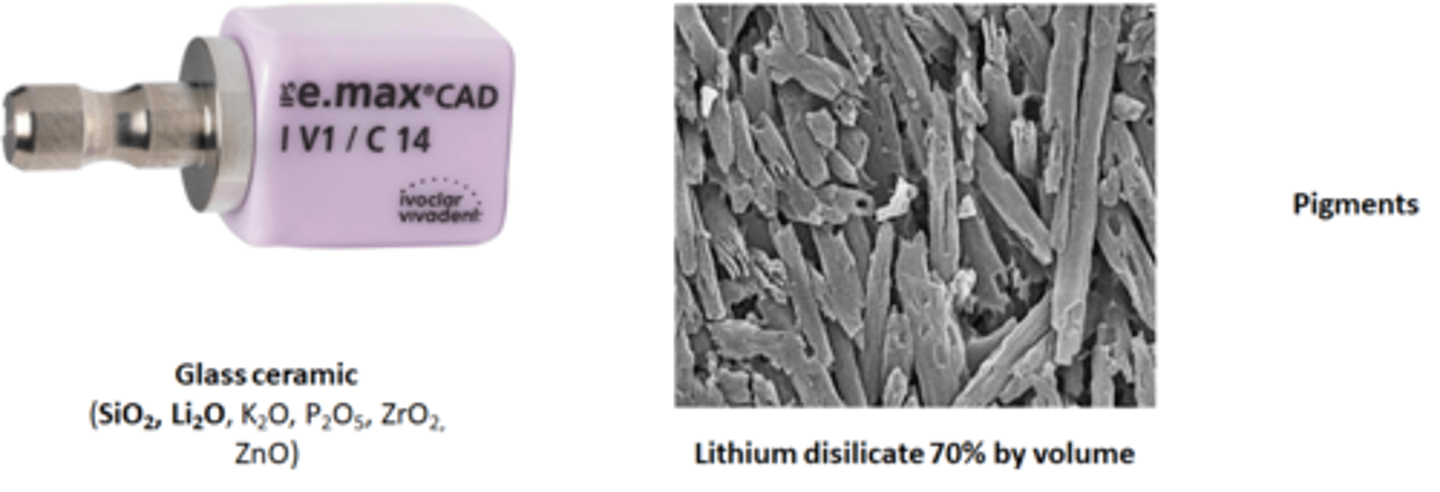
pressed technique (ignots)
utilizes in lost-wax hot-pressing technique in which lithium metasilicate in ingots are converted to lithium disilicate
ingot pressed into mold at 850C for 20-25 minutes to form 70% volume of crystalline lithium disilicate
heat-pressed technique must be done in a lab (> manufacturing time + technical skills)
press furnace
machine where you insert the ingot and plunger in into investment after preheating it
computer-aided design + computer-assisted manufacturing
what does CAD-CAM stand for
milling
fabrication process that used CAD-CAM technology charge-coupled camera device to make a 3D impression of the tooth + crown is designed --> block altered based on digital info
40%
what volume % of crystals are embedded in a glass matrix (mostly lithium metasilicate, small amount of lithium orthophosphate and lithium disilicate) of a non-fired blue block
milled LD
require intermediate crystallization to ensure blocks can be milled efficiently in an intermediate bleu phase
intermediate process leads to formation of lithium metasilicate crystals --> 40% embedded in glass, 0.2-1 microns, flexural strength 130 MPa
130 MPa
what is the flexural strength of milled LD
70%
what is the crystal microstructure percentage of fine grained lithium disilicate in milled LD after crystallization (after firing)
blue
what is the color of the intermediate crystalline stage of a lithium disilicate block
pressed
what produces larger, stronger crystals for LD
milled
what produces shorter, weaker crystals for LD
veneers
inlays, onlays, overlays
single crowns in anterior + posterior areas
3 unit bridges in anterior + premolar areas
what are some indications for LD
very deep subgingival preparation
4 units or multiple unit bridges
patients with severely reduced residual dentition
parafuncction (bruxism)
what are some contraindications for LD
conventional + digital impression techniques
adhesive, self-adhesive, or conventional cementation options
high esthetics (mimic shade of natural tooth)
wide range of indications
biocompatiblity, less plaque accumulation
can be intraorally repaired in case of chipping
what are some advantages of LD
most difficult to machine among glass ceramics for intra-oral adjustments
thermal processing can influence strength of LD
intrinsic brittle behavior
superficial wear of LD sensitive to environmental pH
lack of literature discussing long-term survival + outcomes
what are some disadvantages of LD
2mm
what is the incisal reduction for #9 LD prep
1.0-1.2mm
what is the lingual fossa reduction for #9 LD prep
1.0mm
what is the lingual cervical reduction for #9 LD prep
1.0mm
what is the facial cervical reduction for #9 LD prep
1.0-1.5 mm
what is the incisal facial reduction for #9 LD prep
856-016 + football bur
what burs do you use for the #9 LD prep
3-5 degree taper
what is the taper of the axial walls of a #9 LD prep
2-3mm
what height should you maintain on the lingual cervical wall of your #9 LD prep
Ferrule effect
1.5 - 2 mm of tooth structure is sufficient to ensure the transmission of the forces of mastication to both post and tooth.
ferrule
a metal cap or band placed on a wooden pole to prevent splitting or wearing
dental ferrule
a band that encircles the external dimension of tooth structure
1.0mm
how wide should your uniform rounded shoulder be for your #9 LD prep
zirconium oxide
nucleating agents and helps promote surface crystallization in LD