Week 1B Tissues, Cytoskeleton, and Extracellular Matrix
 Call Kai
 Learn
Learn Practice Test
 Spaced Repetition
 Match
Match Flashcards
 Knowt Play
1/10

Earn XP
Description and Tags
Appreciate cellular diversity, the role of the cytoskeleton, and the ways that individual cells to come together to form a multicellular organism
Name | Mastery | Learn | Test | Matching | Spaced | Call with Kai |
|---|
No analytics yet
Send a link to your students to track their progress
11 Terms
cytoskeleton
a dynamic, interlinking network of protein fibers—microtubules, microfilaments, and intermediate filaments
determines the shape of the cell
“the cell’s internal skeleton + transport system”
Extracellular Matrix (ECM)
A network of proteins and molecules outside the cell that provides support, structure, and signaling.
“the environment or scaffold around cells”
What is the basic tissue types in animals
epithelial, connective, nervous, muscle
Microfilaments
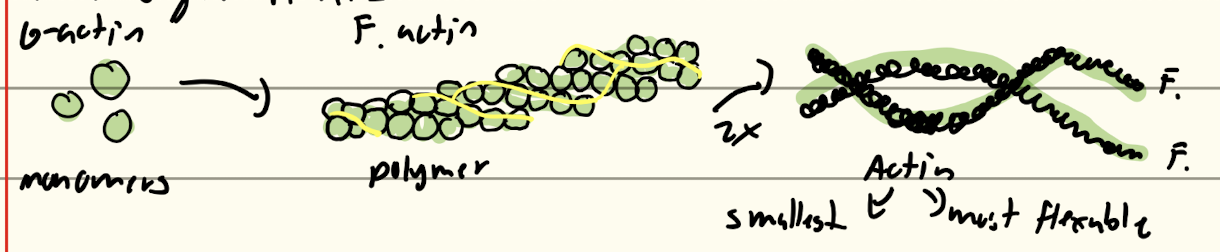
Smallest most flexible made up of g-actin forming f-actin that makes a polymer 2 polyers make a double helix of your microfilament
Involved in…
Cell Migration: can change shape of cell to fit between things (ex diapedesis)
Cell Division: pinches 1 cell into 2 during cytokiesis
Cell Extensions: tiny finger-like on cells, makes up microvilli (for GIT) and stereocilia (ear)
Cell Junctions: helps make up adhernis and tight junctions
Muscle contraction: sticks to myosin to create a contraction
Membrane Transport: allow for things that are outside of the cell to come into the cell; helps with endocytosis (bring in) and exocytosis (things out)
Intermediate Filaments
Middle size but the toughest and the most resilient
can maintain the shape of the cell despite compressive forces
prevent cells like cardiac tissue and epithelial tissue from separating apart (cell junctions)
prevent the separation of the epithelium from the dermis
Microtubules
made up of Tubulin dimers
Hollow, “rail-road of the cell”
Function…
Cell shape and support
Cell movement - by cilia (the hair-like shits on eukaryotic cells move fluids (mucus), flagella (tails on the sperm)
Cell division (chromosome segregation) - they are the spindles
Vesicle transport (in neuron)- Kinesin → - to + (heading towards axon terminal) Dynein → − (heading toward nucleus)
Organelle arrangement

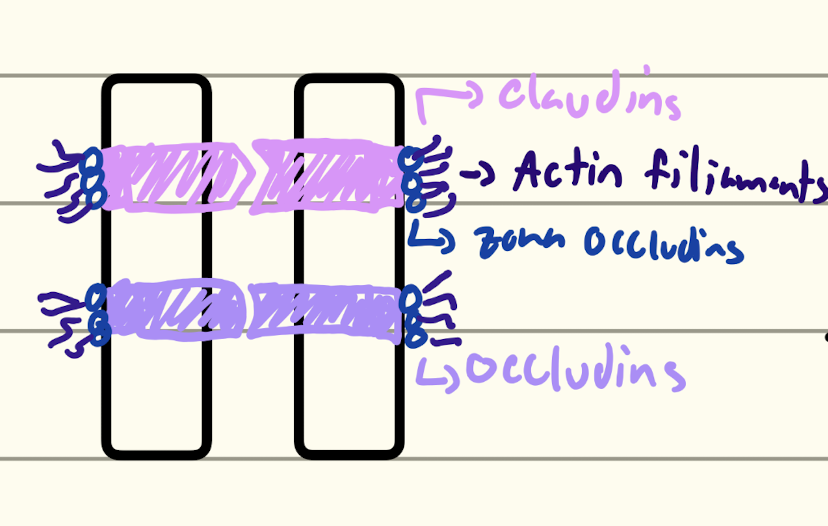
Cell Junction: Tight Junction
tightly hold the cells together
acts as a diffusion barrier
@ the apical surface of the cell
Major component: Claudins, occludins
Cytoskeletal attachment: Intermediate filament
Cell Junction: Adherens junction
Resting shearing/abrasive forces
more basial compared to tight
Major component: Cadherins
Cytoskeletal attachment: Actin filiments (Microfilaments)
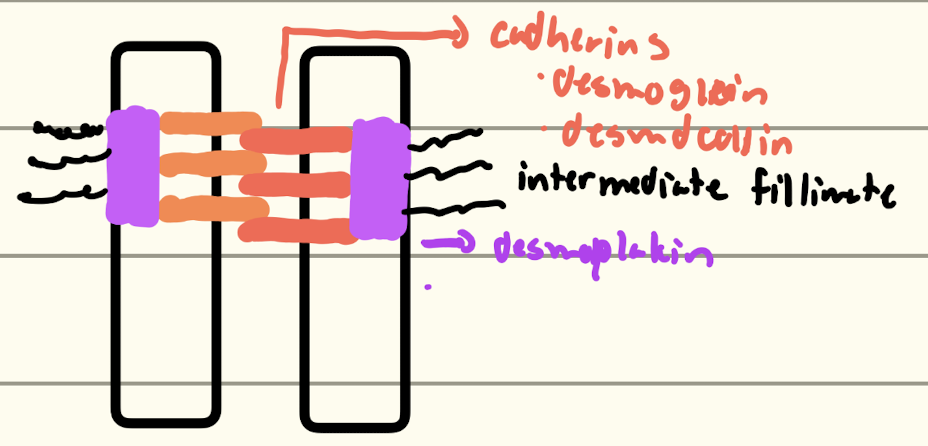
Cell Junction: Desmosomes
More tensile strength then Adherens
Major component: Cadherins
Cytoskeletal attachment: Intermediate filament
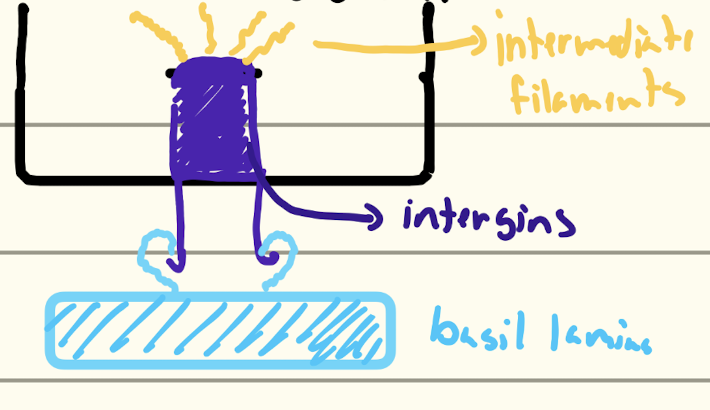
Cell Junction: Hemidesmosome
Major component: Integrins
Cytoskeletal attachment: Intermediate filaments
Cell–extracellular matrix adhesion
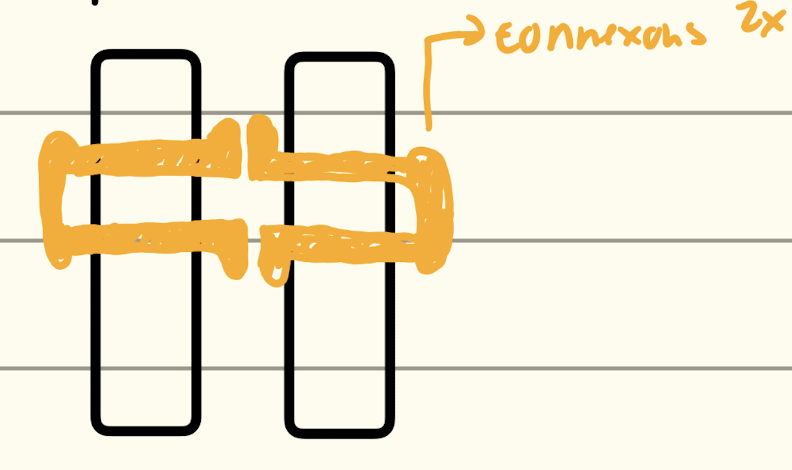
Cell Junction: Gap Junctions
Major component: Connexins
Communication between animal cells