sterilisation and disinfection
 Call Kai
 Learn
Learn Practice Test
 Spaced Repetition
 Match
Match Flashcards
 Knowt Play
1/14

There's no tags or description
Looks like no tags are added yet.
Name | Mastery | Learn | Test | Matching | Spaced | Call with Kai |
|---|
No analytics yet
Send a link to your students to track their progress
15 Terms
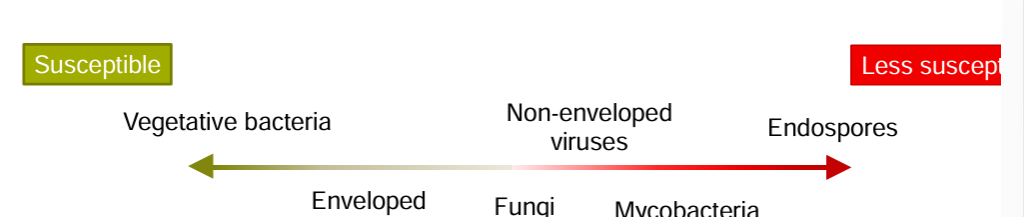
susceptibility
varies with killing agent
vegetative bacteria are killed at 60-70 for 5 min by denaturation of proteins and disruption of lipi membrane
some baceria are adpatd for survival
prions can survive dry heat at 200 for 1-2 hours
why
medicine
intrument
dressing
clothing
inject
microbiology
protection of personnel
purity of cultures
food
canning and bottling
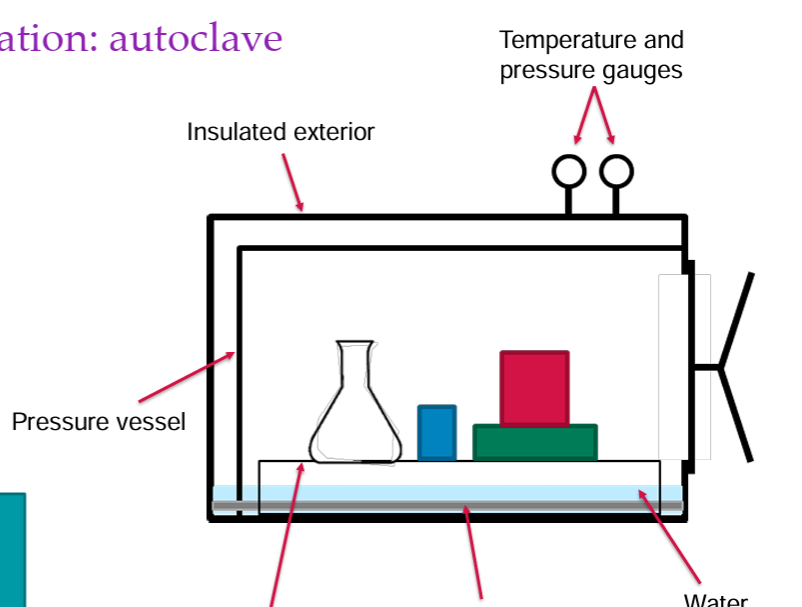
physical sterilisation- autoclave
moist heat
15 min 121 degrees
only way to get rid of endospores effectively
how can you test if the autoclave worked
autoclave tape- line turns black. this detects steam
brownes tubes are glass tubes containing red heat sensitive dye. changes colour to green after a defind period of time at a certain temp. and indicator strips- detecting heat and time
detecting sterilisation- spore strips contain non pathogenic spore which are transferred asepticaly to culture medium to germinate
factors affecting autoclaving
steam penetrating- moist heat required
time to reach temp- large vol of liquid
physical sterilosayion- dry heat
hot air oven- 45 min at 160degrees
glass, metal istrumentcotnainers
bunsen flame- microbiological loop
physical tyndallisation
heat to boiling point and hold 15 min, 3 days in succession
rest in between in a moist warm env
allow any surviving spores to germinate then be killed
day 1- vegetative organissm killed, spores activated
day 2- germinated spors killed
day 3- just to be sure
not reliable- some endospores may survive
things that cannot withstand pressurised heating eg plant seed
other heat method
boiling at 100
pasteurisation
slow 63-66 × 30 min
rapid 73 × 15min
kills m bovis and b abortus and many other zoonotic pathogens
endospores not killed
acts as amean of disinfection/ decontaminaiton
physical- radiation
uv
poor penetration
small scale
clean surface
gamma
good penetration
industrial scale
60 Co
wont ermove endospore
physical- filtration
membrane filter- not sterilising
often used for drug for injection
pore size determines what passses through- 0.22 um viruses pass through
chemical
10 percent formalin
formaldehyde solution HCHO 43 percent w/v
tissue fixation- spores killed
20ppm hydrochlorite- bleach
undissociated hypochlorous acid is powerufl oxidising agent
10 percent ethyleen oxide gas , liquid boils at 10 degrees
CH2.O.CH2
industrial sterilisation of plastic disposables
explosive, carcinogenic, requires special apparatus
disinfection
removes most infective organisms
endospores and some virses may survive
disinfectant destroys or inhiits growht of microorganism on inanimate
antiseptic- on living tissue
what is needed for effective disinfection
organic material will inactivate many disinfectants
so cleaning needed
how do disinfectants work
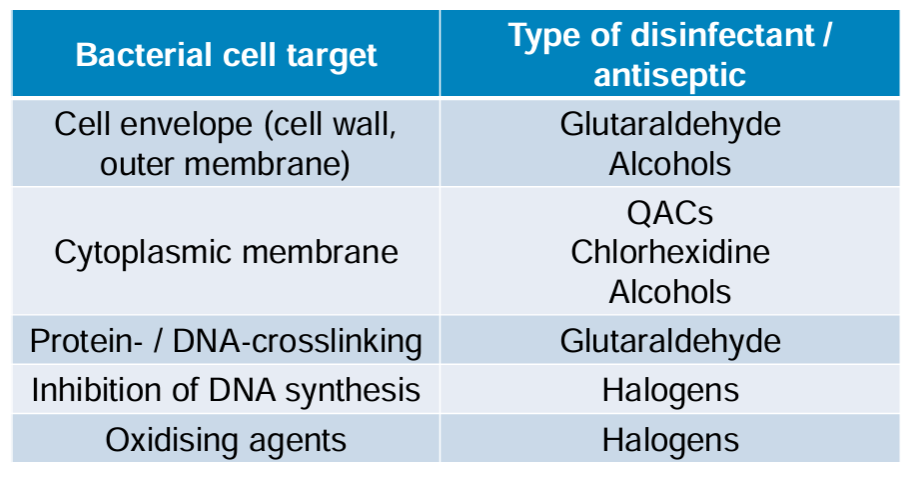
examples of harsh
hypochlorous acid eg domestos
phenols eg dettol