PE Study
 Call Kai
 Learn
Learn Practice Test
 Spaced Repetition
 Match
Match Flashcards
 Knowt Play
1/44

There's no tags or description
Looks like no tags are added yet.
Name | Mastery | Learn | Test | Matching | Spaced | Call with Kai |
|---|
No analytics yet
Send a link to your students to track their progress
45 Terms
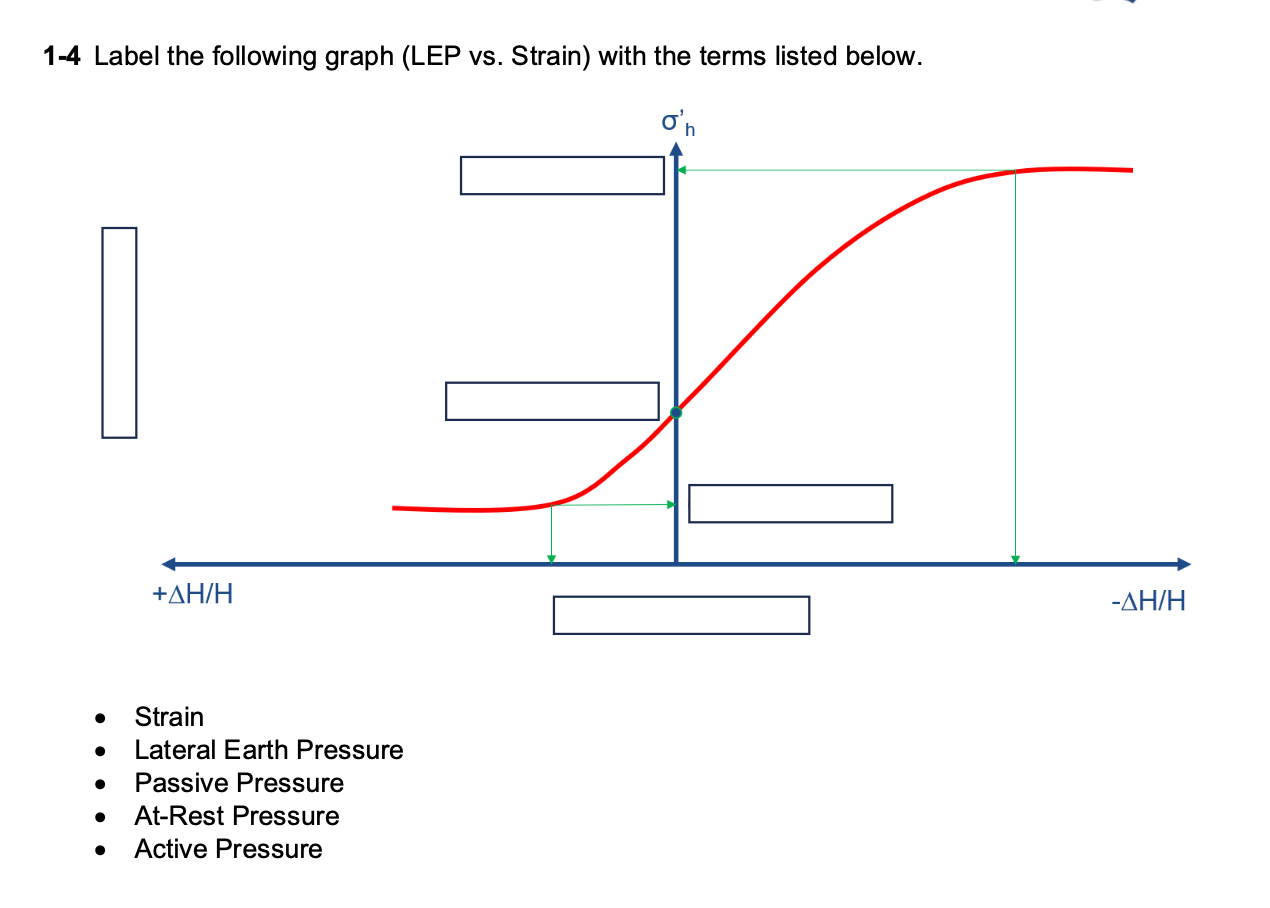
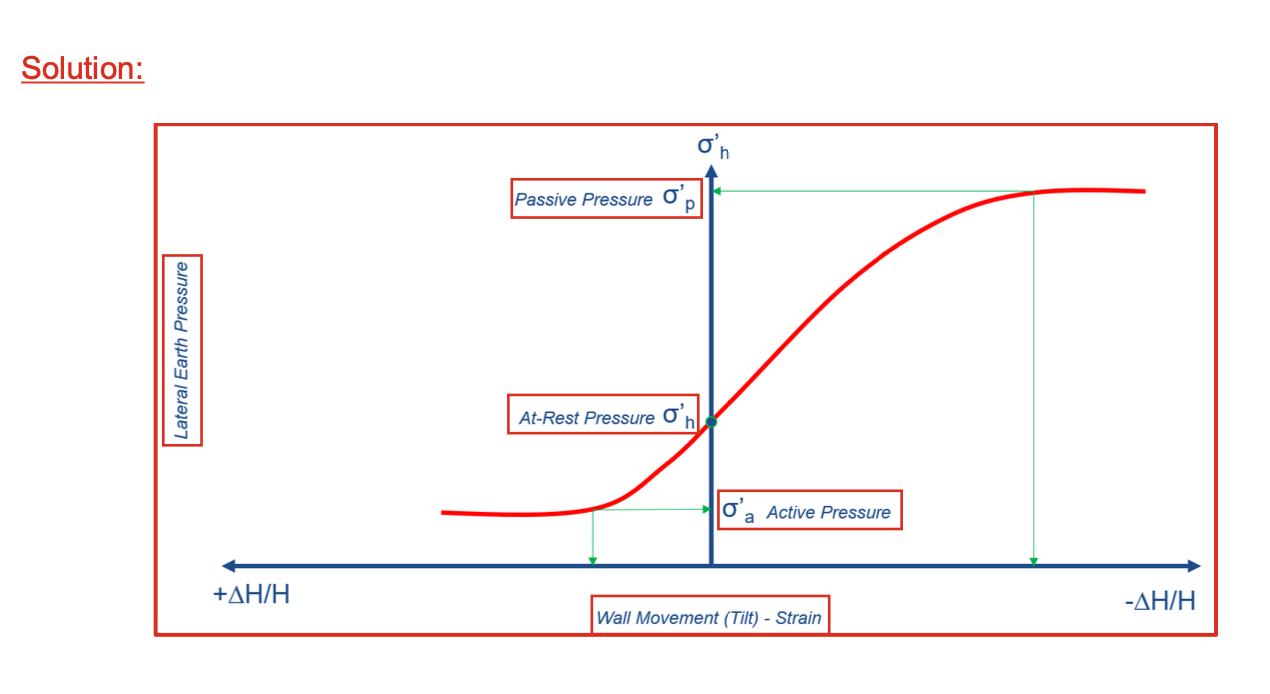
True or False regarding lateral earth pressure - With an ability for the wall to tilt away from the soil, the condition for lateral pressure is referred to as active
True
True or False regarding lateral earth pressure - Wall tilt toward the soil can only occur as a result loss of bearing capacity of soil beneath the wall.
False
True or False regarding lateral earth pressure - Wall pressures increase relative to depth
True
True or false regarding lateral earth pressure - Thrust generated from Lateral earth pressure is dependent on the unit weight of the soil (among other factors)
True
True or false regarding lateral earth pressure on retaining structures - Active earth pressure occurs when the wall moves away from the retained soil, allowing the soil mass to expand and mobilize minimum lateral stress
True
True or false regarding lateral earth pressure on retaining structures - At-rest pressure represents the condition where the wall does not move, and lateral strain in the soil mass is essentially zero
True
True or False regarding lateral earth pressure on retaining structures - passive earth pressure develops when the wall moves toward the soil, mobilizing maximum lateral resistance.
True
True or False regarding lateral earth pressure on retaining structures For a given soil, the magnitude of lateral earth pressure coefficients follows the relationship
Kp<K0<Ka
False, For a given soil, the active pressure coefficient Ka is the smallest (least lateral stress), the at-rest coefficient K0 is intermediate, and the passive pressure coefficient Kp is the largest (greatest lateral resistance).
True or False regarding lateral earth pressure on retaining structures increasing the angle of internal friction (phi) of the soil tends to decrease the active earth pressure acting on the wall.
True
True or False regarding lateral earth pressure on retaining structures the total thrust due to lateral pressure acts at approximately H/3 above the base for a triangular pressure distribution
True
True or false about long term (post construction) settlement when Two identical footings carry the same load. Case I is founded on medium-dense sand; Case II on lightly overconsolidated lean clay of comparable thickness. Assume no bearing failure.
Most of Case I’s settlement occurs during or immediately after construction; long-term settlement is typically small.
True Sands drain quickly → settlement is mostly immediate/elastic; little long-term consolidation.
True or false about long term (post construction) settlement when Two identical footings carry the same load. Case I is founded on medium-dense sand; Case II on lightly overconsolidated lean clay of comparable thickness. Assume no bearing failure.
For Case II, long-term settlement can be significant because excess pore pressures must dissipate; the rate depends strongly on drainage path length.
True Clays consolidate over time; drainage path (layer thickness to a drain boundary) controls rate.
True or false about long term (post construction) settlement when Two identical footings carry the same load. Case I is founded on medium-dense sand; Case II on lightly overconsolidated lean clay of comparable thickness. Assume no bearing failure.
Increasing the OCR (overconsolidation ratio) of the clay generally reduces long-term consolidation settlement.
True: Higher OCR means the soil has been preloaded; under the same added stress it compresses less.
True or false about long term (post construction) settlement when Two identical footings carry the same load. Case I is founded on medium-dense sand; Case II on lightly overconsolidated lean clay of comparable thickness. Assume no bearing failure.
Installing vertical drains in Case II can reduce the magnitude of ultimate consolidation settlement.
False: Vertical drains shorten drainage path → speed up consolidation, but do not change the ultimate magnitude (controlled by compressibility and stress change).
True or false about long term (post construction) settlement when Two identical footings carry the same load. Case I is founded on medium-dense sand; Case II on lightly overconsolidated lean clay of comparable thickness. Assume no bearing failure.
For equal applied contact stress, the larger the footing width, the greater the immediate elastic settlement in sand.
True: For the same contact stress, a wider footing induces a deeper influence zone and higher elastic settlement in sand.
True or false about long term (post construction) settlement when Two identical footings carry the same load. Case I is founded on medium-dense sand; Case II on lightly overconsolidated lean clay of comparable thickness. Assume no bearing failure.
Secondary compression (creep) is usually more pronounced in clays than in sands and contributes to long-term settlement.
True: Secondary compression is small in sands but notable in clays, adding to long-term settlement.
True or false about long term (post construction) settlement when Two identical footings carry the same load. Case I is founded on medium-dense sand; Case II on lightly overconsolidated lean clay of comparable thickness. Assume no bearing failure.
Lowering the groundwater table beneath a sand foundation increases effective stress and can cause additional long-term settlement
True: Lowering GWT increases effective stress in sands → additional volume change/settlement over time.
Depending on the relationship between the existing effective overburden pressure (po) and the maximum past effective pressure (pc), a clay’s stress history can be described using the
Overconsolidation Ratio (OCR = pc/po). Which of the following statements about soil behavior and OCR is not true?
a. A clay with OCR=1 is normally consolidated and will undergo virgin compression if additional load is applied.
b. A clay with OCR>1 is overconsolidated, indicating that it was previously loaded and unloaded; future settlements are typically small and mostly elastic.
c. A normally consolidated clay will not undergo any additional settlement if loaded further because it has already fully consolidated under the existing pressure.
d. A clay with OCR<1 is underconsolidated, meaning primary consolidation under the existing load is still occurring even without new loads.
e. The greater the OCR value, the stiffer and less compressible the clay tends to be.
a – True: OCR=1 → the clay is at its preconsolidation stress; additional load pushes it into the virgin compression range (significant new settlement).
• b – True: OCR>1 → soil has been preloaded; subsequent loads mostly cause small recompression.
• c – False: Even normally consolidated clays do compress further when new load is added—this is the virgin compression range.
• d – True: OCR<1 → soil is underconsolidated, still experiencing ongoing primary consolidation even without new loads.
• e – True: Higher OCR corresponds to stiffer, less compressible soil (steeper recompression line).
A 3-story building is constructed on two soil sites: one underlain by medium-dense sand, and another by normally consolidated clay of similar thickness. Which of the following statements
most correctly describes their settlement behavior? Select all that apply.
a. Immediate settlement will be greater in the sand due to its higher stiffness.
b. The clay site will experience time-dependent primary consolidation settlement, whereas the sand site will not.
c. Secondary compression (creep) is more significant in sand because of particle rearrangement.
d. Long-term settlement for the clay site is expected to exceed that of the sand site.
a. False – Sand’s higher stiffness causes smaller immediate settlement.
• b. True – Primary consolidation dominates in clays as pore pressures dissipate.
• c. False – Secondary creep is negligible in sands.
• d. True – Long-term settlement is greater in clays.
The principle of effective stress is fundamental to soil mechanics and governs many aspects of soil behavior. According to Terzaghi’s relationship 𝜎𝜎′=σ−u, which of the following statements is most correct? Select all that apply.
a. The effective stress represents the portion of total stress carried by the soil solids.
b. When the pore water pressure (u) increases, the effective stress in the soil also increases.
c. The total stress (σ) in a soil mass always equals the effective stress (σ′).
d. A rise in the groundwater table causes a decrease in effective stress within the soil.
• a – True: Effective stress is the stress transmitted through the soil skeleton (particle contact).
• b – False: Increasing pore water pressure reduces effective stress (since σ′ = σ − u).
• c – False: Effective and total stress are equal only if pore pressure is zero (dry conditions).
• d – True: A higher water table increases pore pressure (u), lowering effective stress in the saturated zone.
A footing constructed on dense sand experiences a well-defined failure surface extending from the footing to the ground surface, accompanied by distinct heaving of the surrounding soil and
a sharp peak load followed by a sudden drop on the load–settlement curve. Which type of bearing capacity failure is this behavior most characteristic of?
a. Local shear failure
b. General shear failure
c. Punching shear failure
d. Elastic settlement
General Shear Failure
-General shear failure occurs in dense sands and stiff clays that are low in compressibility and high in strength.
-The failure is sudden and well-defined, producing a distinct bulging or heave at the ground surface and a sharp peak load–settlement response.
-Local shear failure shows a gradual transition and no sharp peak, while punching shear occurs in very soft or loose soils with large settlements and no surface heave.
A contractor is excavating a temporary slope to install a utility line. The slope will remain open for only a few weeks during construction and will not support any permanent structures. The site is located in a nonseismic region. The minimum factor of safety (FS) that should be used for this temporary condition is most nearly:
a. 1.00
b. 1.10
c. 1.25
d. 1.50
1.25
• FS = 1.25 → Appropriate for short-term or temporary construction slopes where the
duration is brief and the consequence of failure is limited.
• FS = 1.3–1.5 → Used for long-term or permanent slopes, depending on whether they
support structures.
• FS = 1.1 → Typically used for seismic conditions or special cases.
• FS = 1.0 → Indicates failure is imminent (unacceptable).
The AASHTO soil classification system primarily differentiates between granular and silt-clay materials based on:
a. Liquid Limit value
b. Percentage passing the No. 200 sieve
c. Plasticity Index value
d. Coefficient of uniformity
b. Percentage passing the No. 200 sieve
Under the USCS (Unified Soil Classification System), the classification of coarse-grained soils is based on which of the following parameters? Select all that apply.
a. Percent passing the No. 200 sieve
b. Coefficients of uniformity and curvature
c. Atterberg limits of the fines fraction
d. Optimum moisture content
a. Percentage passing the No. 200 sieve
b. Coefficients of uniformity and curvature
c. Atterberg limits of the fines fraction
(USCS classifies coarse-grained soils first by the fraction passing No. 200, then uses Cu and Cc for gradation, and the Atterberg limits of the fines (if >5%) for dual symbols.)
Which of the following statements correctly describe the behavior of cohesive and cohesionless soils with respect to strength and compressibility? Select all that apply.
a. Cohesionless soils derive shear strength primarily from internal friction and particle interlocking.
b. The undrained shear strength of cohesive soils increases with water content.
c. The compressibility of clayey soils generally increases as plasticity index increases.
d. Dense sands exhibit lower compressibility and higher shear strength compared to loose sands.
e. The presence of organic matter typically reduces the compressibility of fine-grained soils.
(a) True — granular soils rely on friction and interparticle contact for strength.
(b) False — increasing water content reduces effective stress and lowers undrained strength.
(c) True — higher PI means greater capacity for volume change under load.
(d) True — denser packing resists deformation, reducing compressibility and raising strength.
(e) False — organics increase compressibility due to lower stiffness and bonding.
Which of the following correctly relate permeability characteristics to soil and rock types?
Select all that apply.
a. Permeability of coarse-grained soils primarily depends on particle size and gradation.
b. Clays exhibit very low permeability due to electrochemical attraction between particles.
c. Well-graded gravels have higher permeability than uniformly graded gravels.
d. Fractured rock masses can exhibit higher permeability than the intact rock.
e. Cementation and compaction both tend to decrease permeability in aggregates and rocks.
(a) True — larger, well-connected pores allow easier water flow.
(b) True — small pore sizes and double-layer effects restrict flow in clays.
(c) False — well-graded gravels are less permeable than uniform gravels, because finer
particles fill voids
(d) True — fractures dominate flow pathways in rocks, greatly increasing effective
permeability.
(e) True — both cementation and compaction reduce pore connectivity
Which of the following materials can be used to supplement or replace Portland cement as ‘cementitious material’ in a concrete mix design? Select all that apply.
a. Fly Ash
b. Silica Fume
c. Calcium Chloride
d. Slag
a. Fly Ash
b. Silica Fume
d. Slag
*calcium chloride is a set accelerator not a cementitious material*
The property of concrete that allows for protection against the freeze and thaw cycle is:
a. Strength
b. Durability
c. Air entrainment
d. Workability
air entrainment
Which of the following statements about aggregates in Portland cement concrete are true?
Select all that apply.
a. The quality and gradation of aggregates significantly affect concrete performance
b. Coarse aggregates provide volume and strength to the concrete mix
c. Fine aggregates (sand) fill voids between coarse aggregates
d. Aggregates should be porous to absorb more water for better hydration
True:
a. The quality and gradation of aggregates significantly affect concrete performance
b. Coarse aggregates provide volume and strength to the concrete mix
c. Fine aggregates (sand) fill voids between coarse aggregates
False:
d. Aggregates should be porous to absorb more water for better hydration. (this is because Excessive porosity in aggregates leads to high water absorption, which can negatively impact mix consistency and durability.)
What is the primary role of cement in a concrete mixture?
a. It controls the slump of fresh concrete
b. It reduces the overall cost of the mixture
c. It binds the aggregates together by forming a paste
d. It increases the flexibility of concrete
c. It binds the aggregates together by forming a paste
What is the primary function of water in a concrete mix?
a. It acts as a lubricant to help mix ingredients together
b. It initiates the hydration reaction with cement
c. It provides long-term strength to hardened concrete
d. It reduces the aggregate content in the mix
b. It initiates the hydration reaction with cement
In concrete mix design, what is the primary reason for controlling the water-cement (w/c) ratio?
a. To control the workability and strength of concrete
b. To reduce shrinkage cracks
c. To minimize the amount of cement used
d. To increase the aggregate content
a. To control the workability and strength of concrete
Which of the following factors can help achieve a higher compressive strength? Select all that apply.
a. Increasing the cement content
b. Adding more water for better workability
c. Reducing the water-cement ratio
d. Using well-graded aggregates
a. Increasing the cement content
c. Reducing the water-cement ratio
d. Using well-graded aggregates
(b. adding more water for better workability lowers the strength)
Which of the following statements about the SSD condition of aggregates and its effect on water absorption in a concrete batch mix are true? Select all that apply.
a. If aggregates are wetter than SSD, they will release excess water into the mix, increasing the effective water-cement ratio.
b. SSD is an irrelevant concept in concrete mix design since moisture content does not affect the final mix performance.
c. SSD aggregates have their internal pores fully saturated, but their surface is dry.
d. If aggregates are drier than SSD, they will absorb water from the mix, reducing effective water content.
True: a. If aggregates are wetter than SSD, they will release excess water into the mix, increasing the effective water-cement ratio.
c. SSD aggregates have their internal pores fully saturated, but their surface is dry.
d. If aggregates are drier than SSD, they will absorb water from the mix, reducing effective water content.
Explanation: SSD = Saturated Surface Dry is the condition of an aggregate when its internal pores are fully
saturated with water, but its surface is dry.
In this state, the aggregate neither absorbs nor releases water into the concrete mix, making it the
reference condition for mix design calculations.
• If aggregates are wetter than SSD, they contribute extra free water, increasing the water-
cement ratio, which may lead to lower strength and increased shrinkage.
• SSD is a critical concept in mix design, as incorrect moisture adjustments can significantly
impact workability, strength, and durability.
• SSD condition means the aggregate's internal pores are fully saturated, but the surface is
dry, preventing it from absorbing or releasing water.
• If aggregates are drier than SSD, they will absorb water from the mix, reducing the effective
water-cement ratio, which may lead to reduced workability and strength issues.
What is Hooke’s Law
Defines the linear elastic relationship where stress is proportional to
strain. It is only valid in the elastic region of the stress-strain curve.
Modulus of Elasticity (E)
Also called Young’s Modulus, quantifies a material’s
stiffness (resistance to deformation under stress).
What is Ductility
Measures how much a material can deform plastically before breaking, observed in the later stages of the stress-strain curve.
What is stress strain relationship
describes how a material deforms under applied stress. It provides insight into the material's mechanical behavior, including elasticity, plasticity, and failure.
What is the difference between erosion and sediment control
Erosion control prevents erosion, sediment control prevents sediment from entering navigable waters