bio 2 lab final
 Call Kai
 Learn
Learn Practice Test
 Spaced Repetition
 Match
Match Flashcards
 Knowt Play
1/85

There's no tags or description
Looks like no tags are added yet.
Name | Mastery | Learn | Test | Matching | Spaced | Call with Kai |
|---|
No analytics yet
Send a link to your students to track their progress
86 Terms
opisthokonta
Consists of animals, fungi and some closely related protist groups e.g. choanoflagelllates and nucleariidds.
Choanoflagellates
aquatic, single-celled or colonial protists that represent the closest living single-celled relatives of animals (metazoans)
They have collar cells (Choanocytes) which are similar to those found in sponges, cnidarians and echinoderms.
fungi
-eukaryotic, multicellular absorptive heterotrophs (obtain energy from organic carbon by absorption)
-Fungal body
Mostly hidden underground or inside host
Consists of network of threads called hyphae
Complete feeding network of hyphae network called mycelium
- includes zygomycota, ascomycota, basidiomycota, chytridiomyocta, mucoromycota, lichens, and mycorrhizae.
fruiting bodies
sexual reproductive structures of fungi and are usually the only part of the fungus that emerges from the substrate.
chytrids
thought to be the first fungi to evolve on earth
important for understanding evolutionary relationships
have flagellated gametes meaning their reproductive cells have a flagellum
have chitin in their cell walls, an important defining feature of the fungi
stolon hyphae
cover the horizontal surface of the host
rhizoid hyphae
penetrate the bread to absorb the nutrients
sporangiophores
sgtand upright to hold a sporangium at their tips
zygomycota
Reproductive structure: Zygosporangia → zygotes
• Example in class:
• Rhizopus stolonifera (bread molds)
ascomycota
• Reproductive structure: Asci → ascospores
Examples in class:
• Saccharomyces cervisiae (yeast used for baking and alcohol)
• Peziza sp.
• Sordaria fimicola
basidiomycota
• Reproductive structure: Basidia → basidispores
• Examples in class:
• Mushrooms
• Coprinus sp.
• Bracket/shelf fungus
basidia
gills of mushroom bear basidia, the sexual reproductive structures of the mushroom
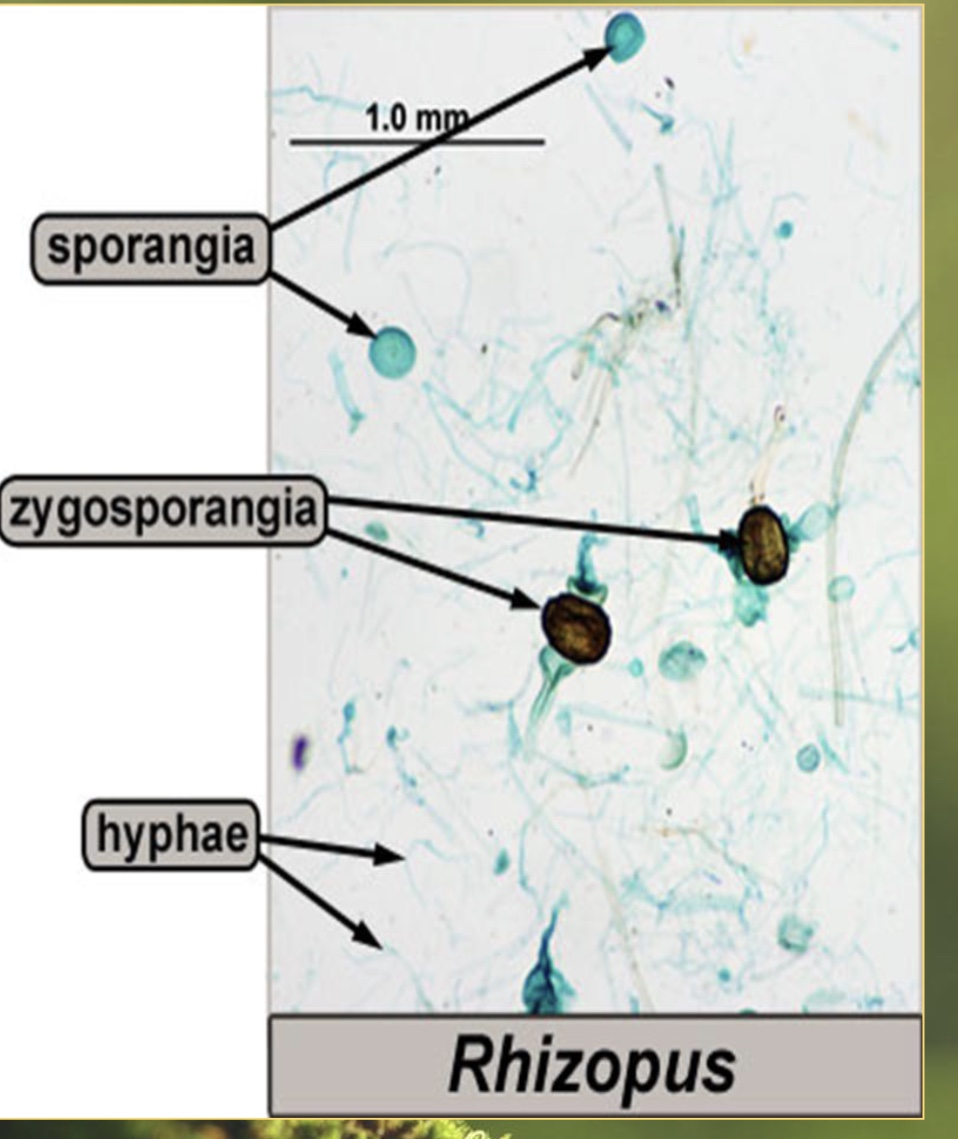
rhizopus sexual and aseuxual structures
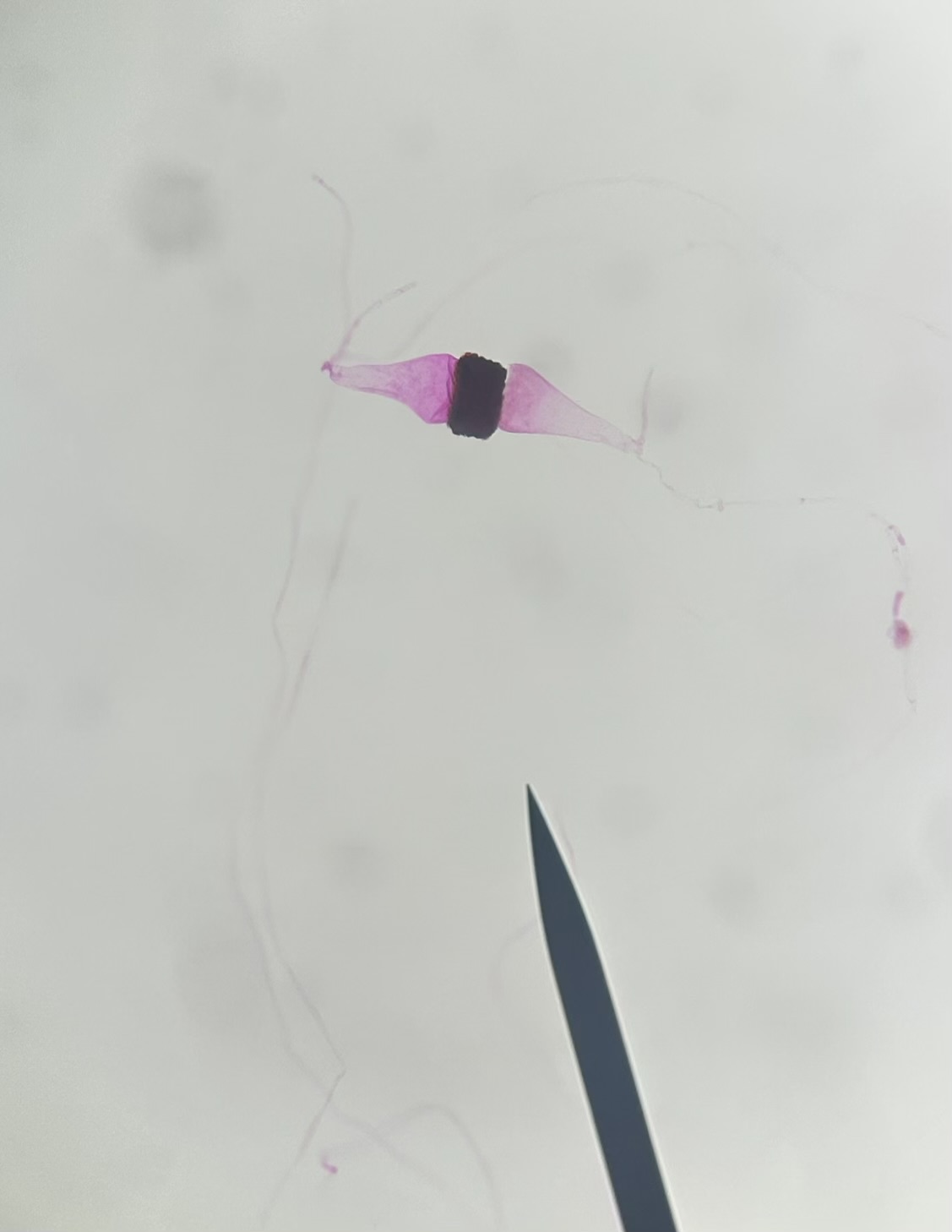
sexual = zygosporangium
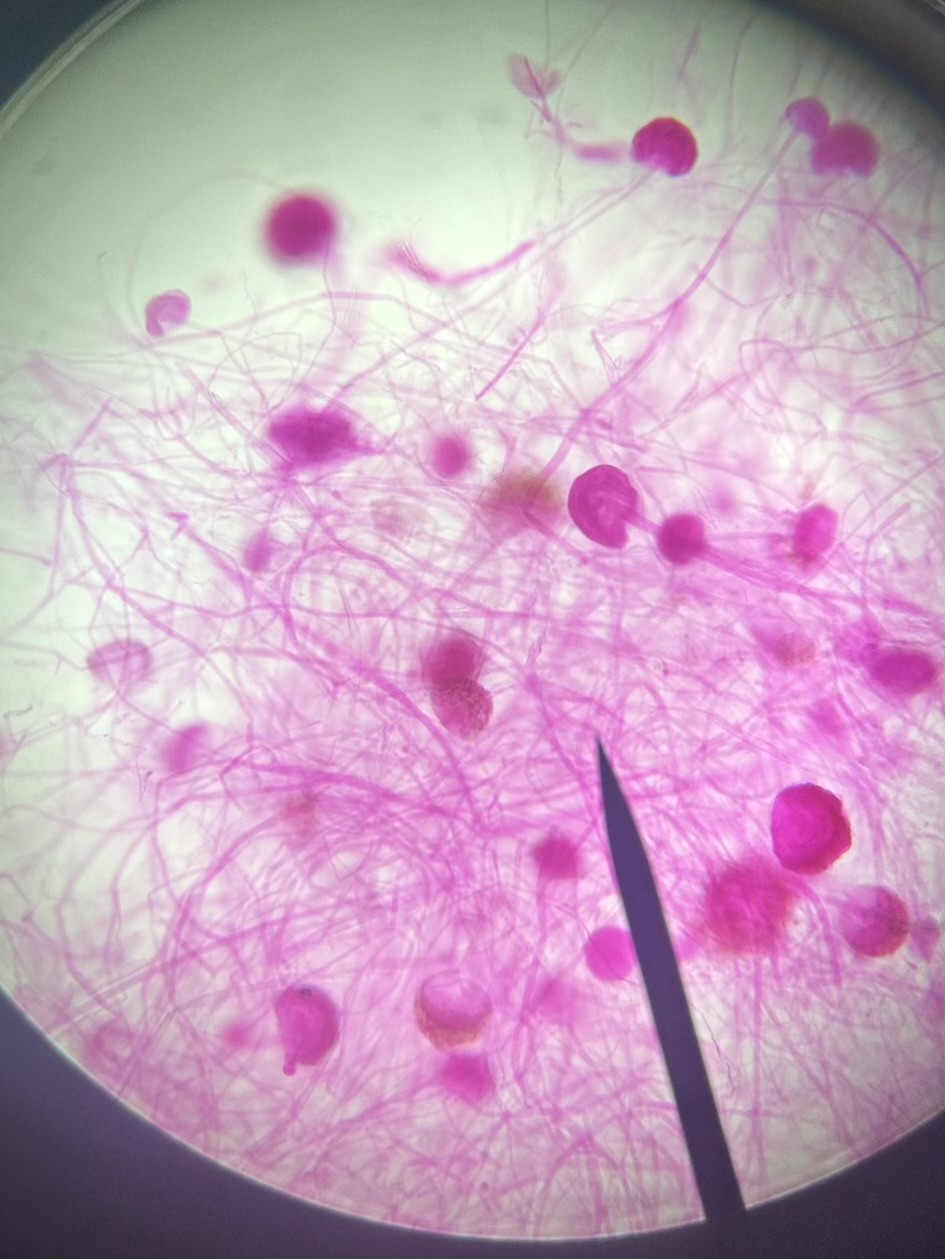
asexual = sporangia
rhizopus sexual structure
rhizopus asexual structure
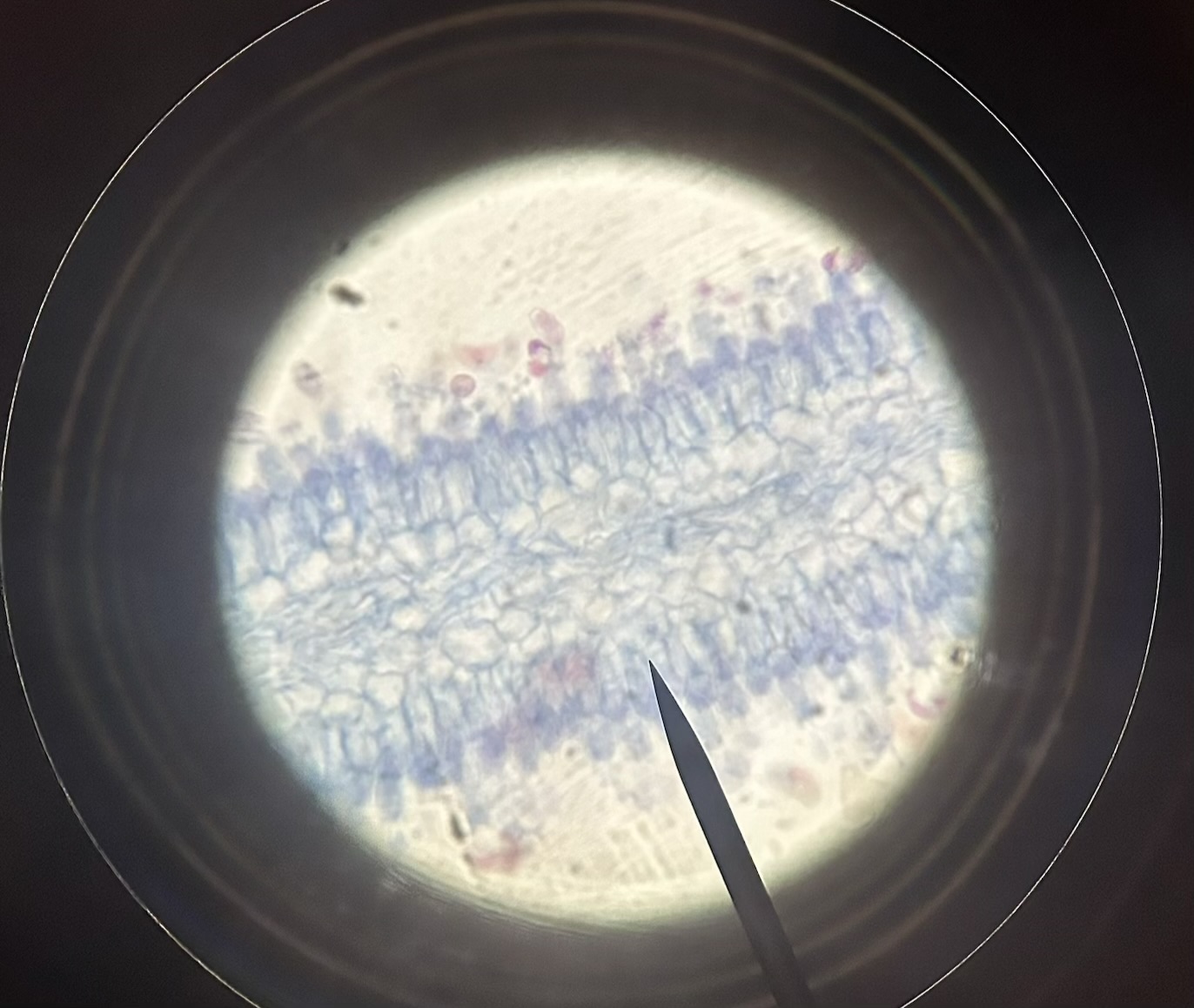
peziza fungus
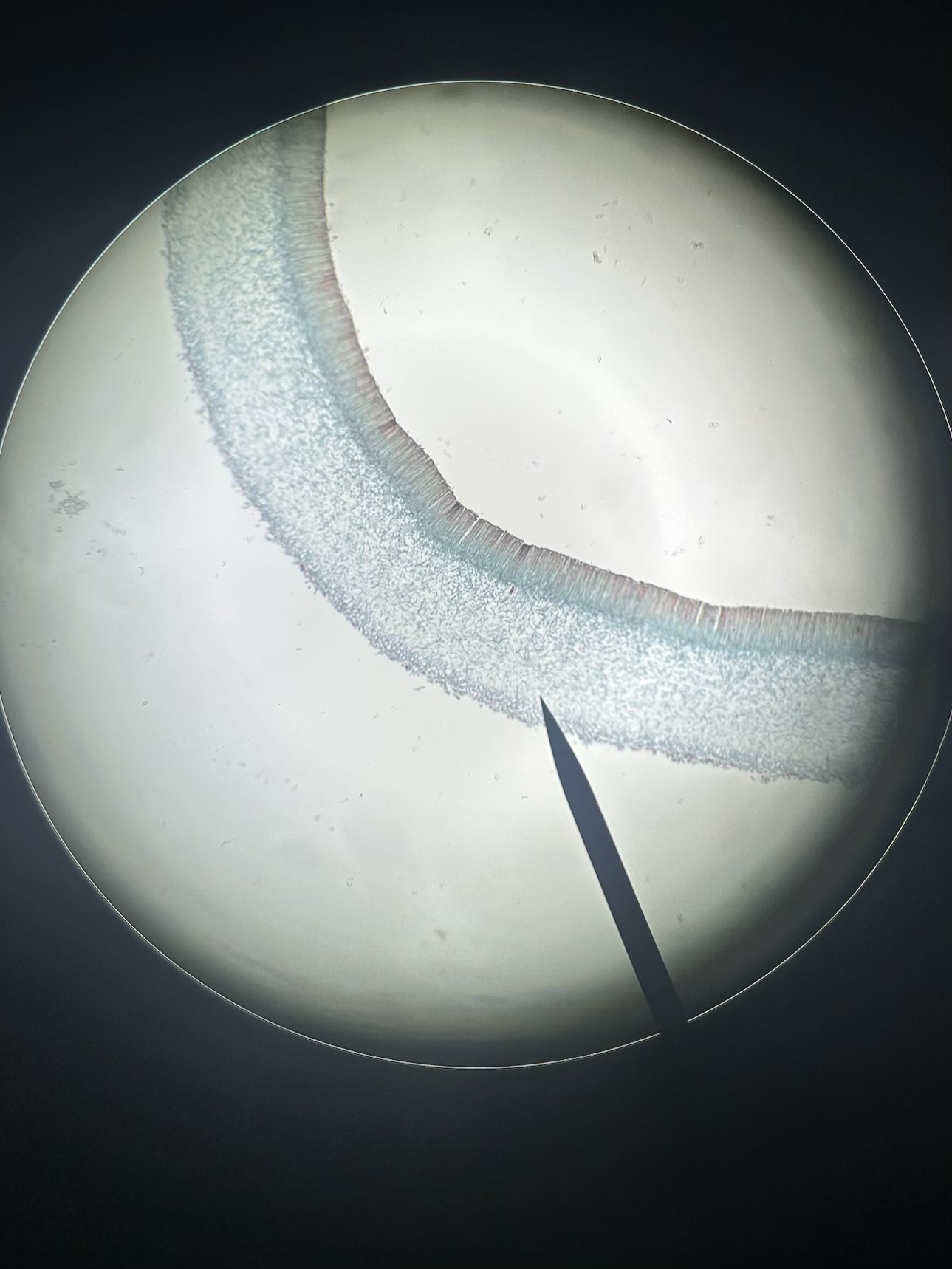
basidiocarps
reproductive bodies of an extensive underground system of mycelia
includes the stipe, cap, annulus, and gills
gills bear the basidia, the sexual reproductive structures of the mushroom
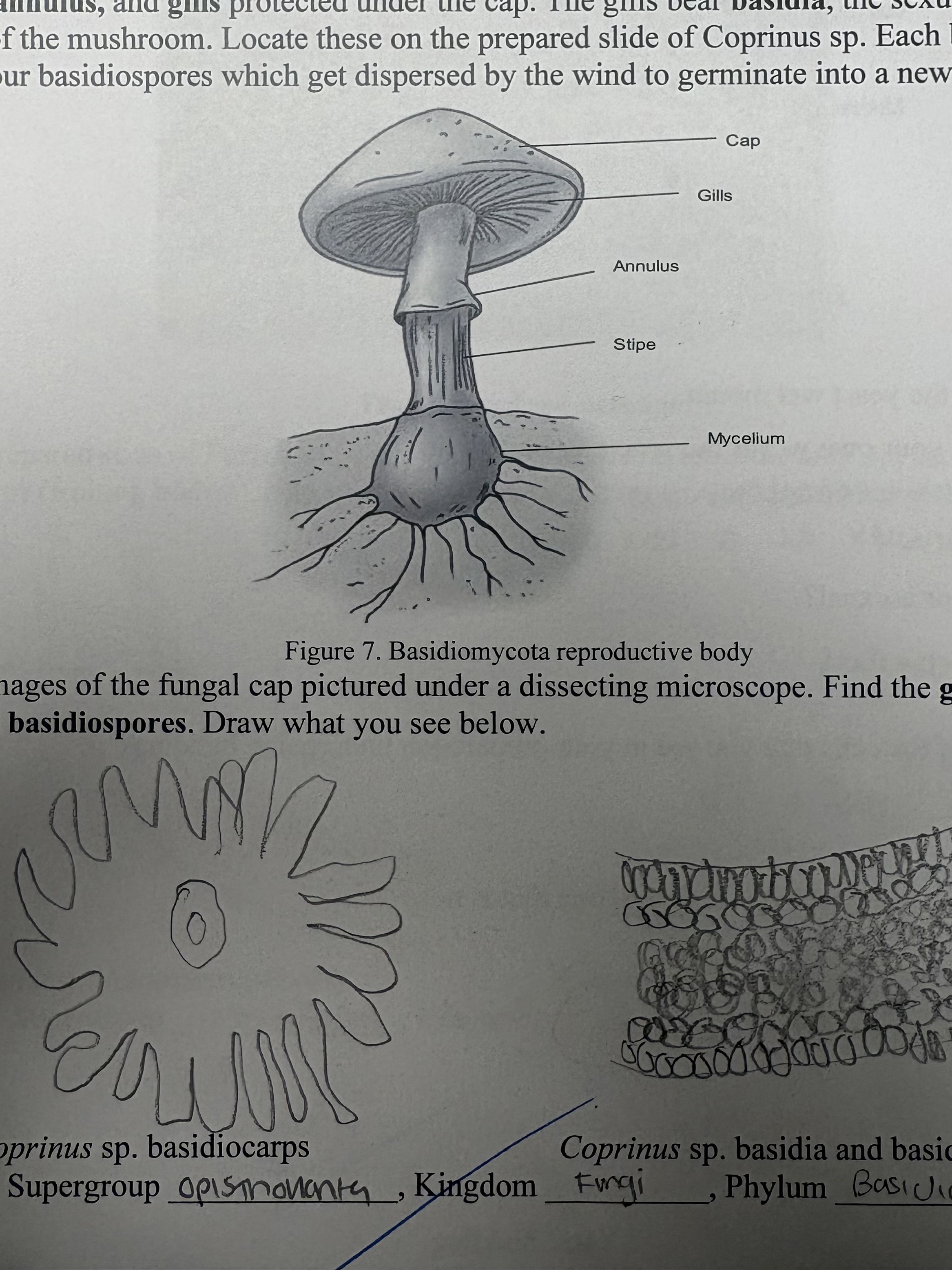
Mycorrhizae
symbiotic relationship between a fungus and a plant
• The plant give the fungus carbohydrates
• The fungus helps increase mineral and water absorption for the plant.
• About 90% of land plants have mycorrhizal fungi.
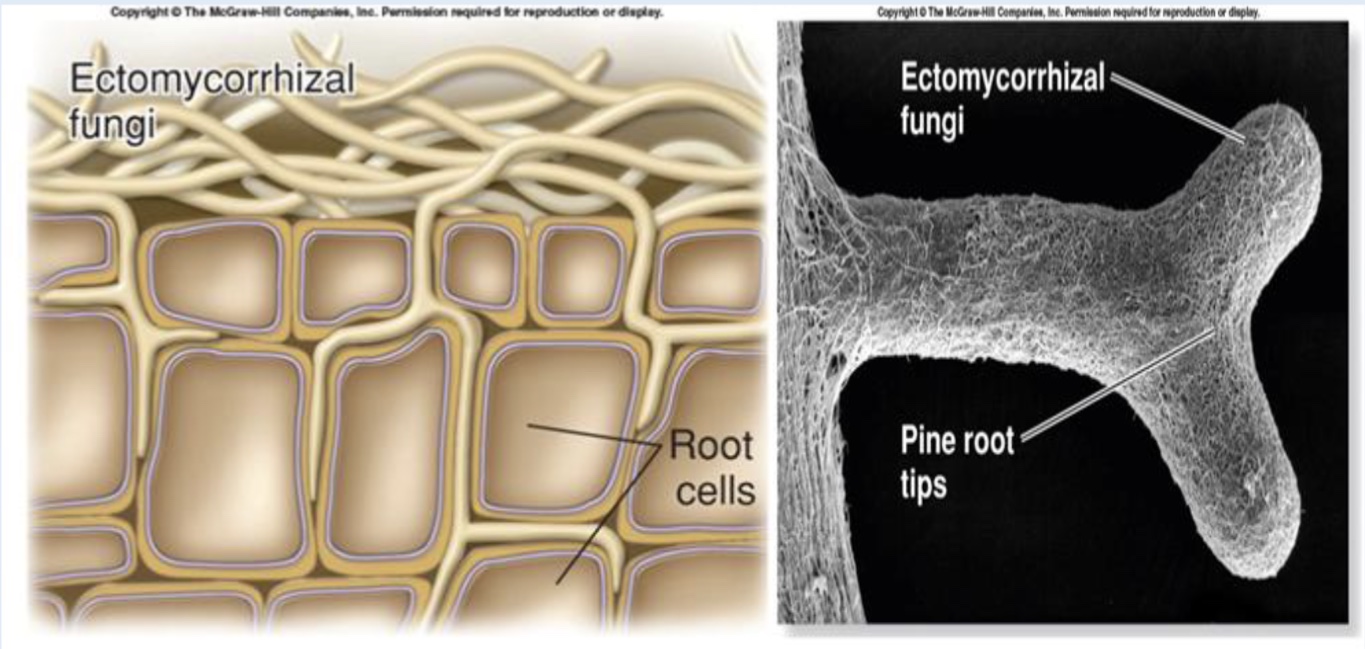
lichens
• Lichens: symbiotic relationship between multiple fungi, cyanobacteria or
green algae.
• The cortex and medulla layers are made of fungus.
• A layer of cyanobacteria or algae is encased by the fungal layers.
• Lichens are not moss!
Crustose lichens
flat and adhere tightly to the surface of rocks or tree bark.
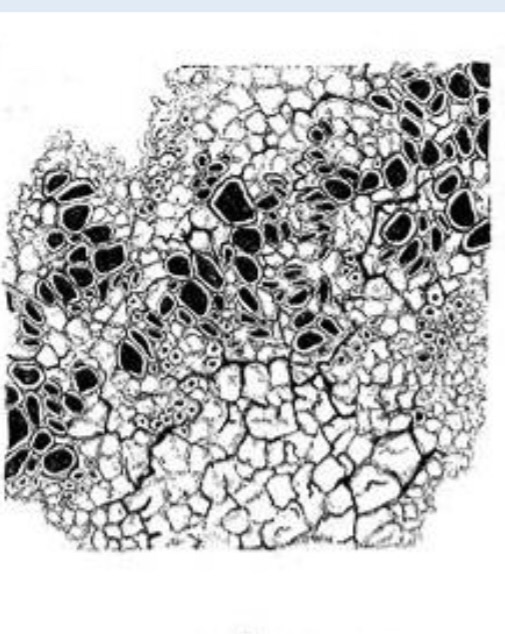
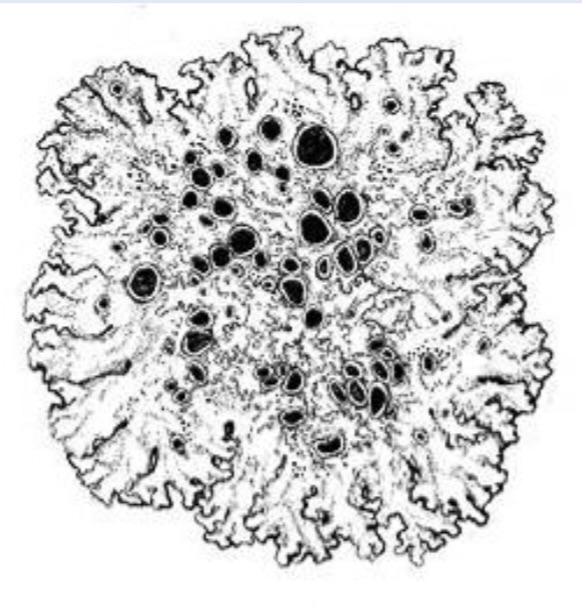
Foliose lichens
more leaf-like, and their edges generally curl away from the substrate.
They are typically found growing on the trunks or branches of trees.
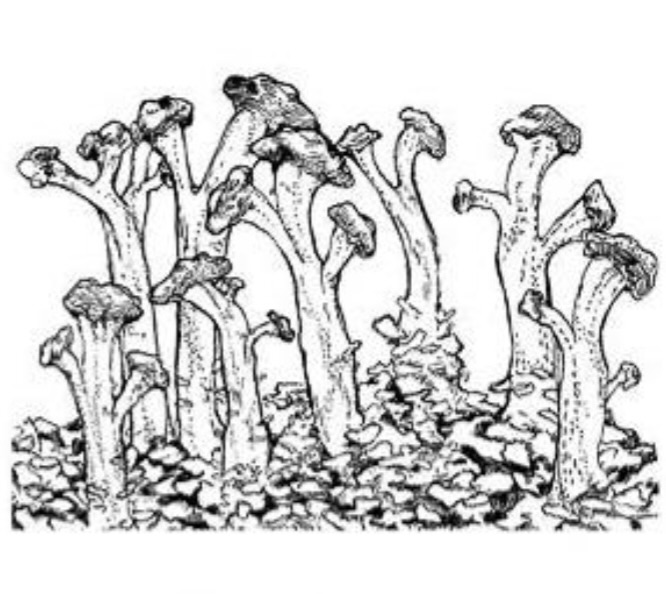
Fruticose lichens
have a more 3-dimensional, shrubby growth
Metazoa
Kingdom Anamalia
Eumetazoa
true tissues
Parazoa
no true tissues
sponges (porifera)
• Assymetrical and lack true tissues
• Have some specialized cells
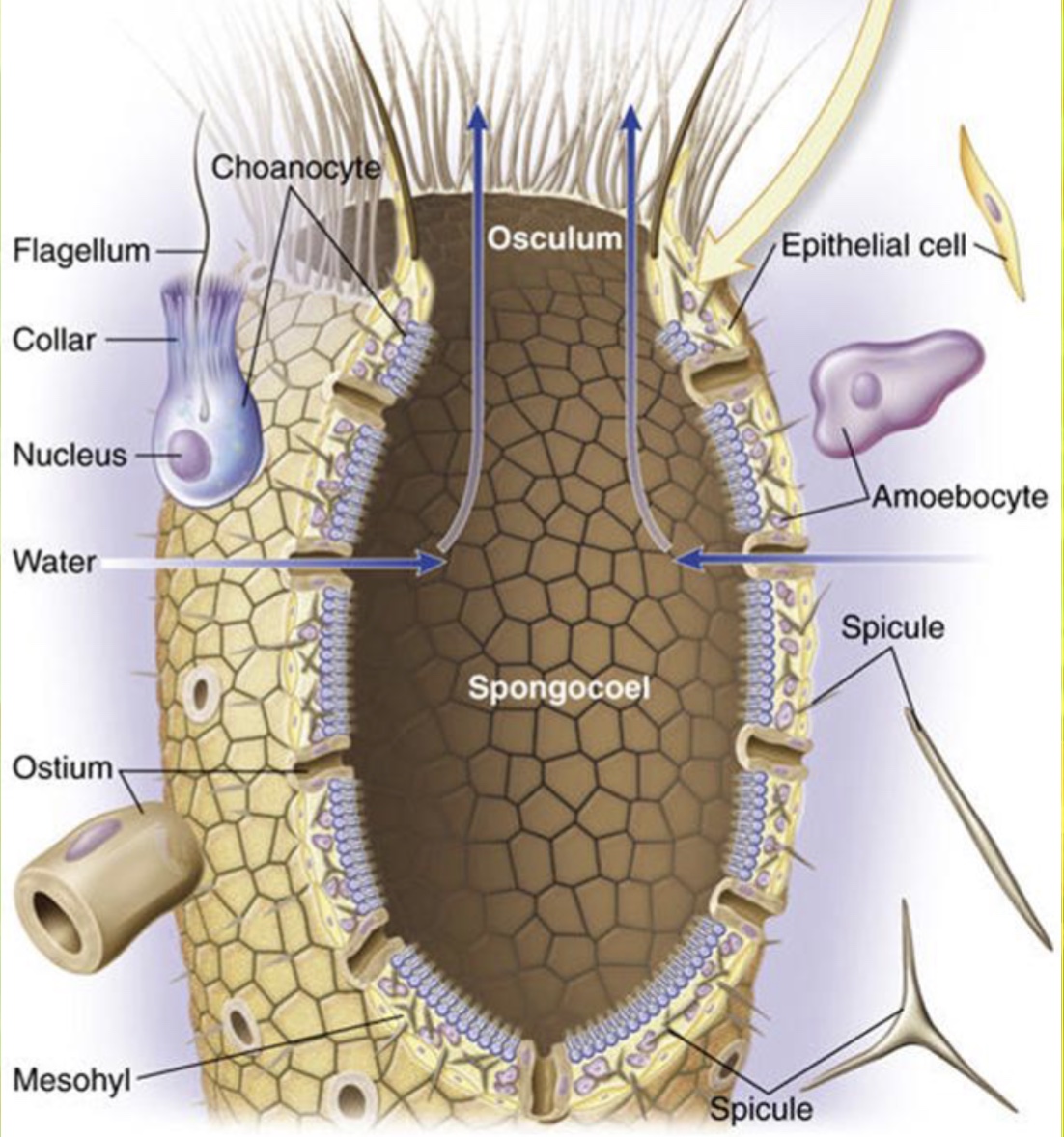
sponge anatomy
Choanocytes in the body wall to draw water through the Ostia.
Food particles are trapped microvilli collars and picked up by Amoebocytes.
Amoebocytes digest food and deliver nutrients to sponge.
Water exits though the Osculum
Cnidarians and Ctenophora (formerly Radiata)
• Two germ layers (Ectoderm and Endoderm)
• Between the two layers is mesoglea
Cnidarians
• Radial Symmetry
• Nematocysts (stinging cells)
• Either a polyp or medusa life stage.
• Some go through both forms at different life stages.
-hydra, jellyfish, box jellies, coral, sea anemones
• Clade Hydrozoa
Hydra, Obelia and Physalia sp.
• Clade Anthozoa
Sea anemones and corals
• Clade Scyphozoa
Preserved Cassiopeia sp
Ctenophorans
• Biradial Symmetry
• No nematocysts
• No life stage metamorphosis
- comb jellies
Lophotrochozoans and Ecdysozoans
are protostomes.
• When an embryo develops, the first opening that forms is called the blastopore.
• The blastopore will eventually develop into the digestive track.
• In Protostomes, the blastopore becomes the mouth
Know the anatomical structures used to classify Lophotrochozoans
Lophotrochozoans have either a:
- lophophore
feeding apparatus
Made of ciliated tentacles that surround a mouth
- trochophore
larval stage
determinate cleavage
the type of tissue a cell will become is set early in development
indeterminate cleavage
early development cells can become many different types of tissues
Phylum Platyhelminthes (flatworms)
• Bilaterally symmetrical organisms
• Possess a head region with sense organs (Cephalization)
• Incomplete gastrovascular cavity
• Only has one opening
• Basic central nervous system
• Hermaphroditic
• Possess both male and female reproductive organs
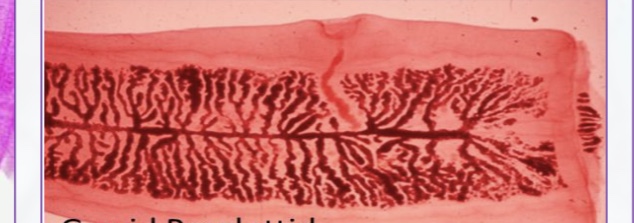
Immature proglottids
are closest to the scolex (head region).

Mature proglottids
contain male and female sex organs and are in the “middle” of the worm.
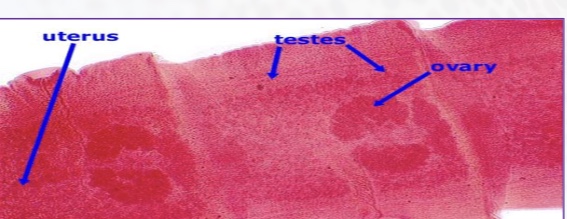
Gravid proglottids
are at the posterior end of the worm. They are filled with eggs and will eventually break off the worm so that embryos can be transferred to the host.
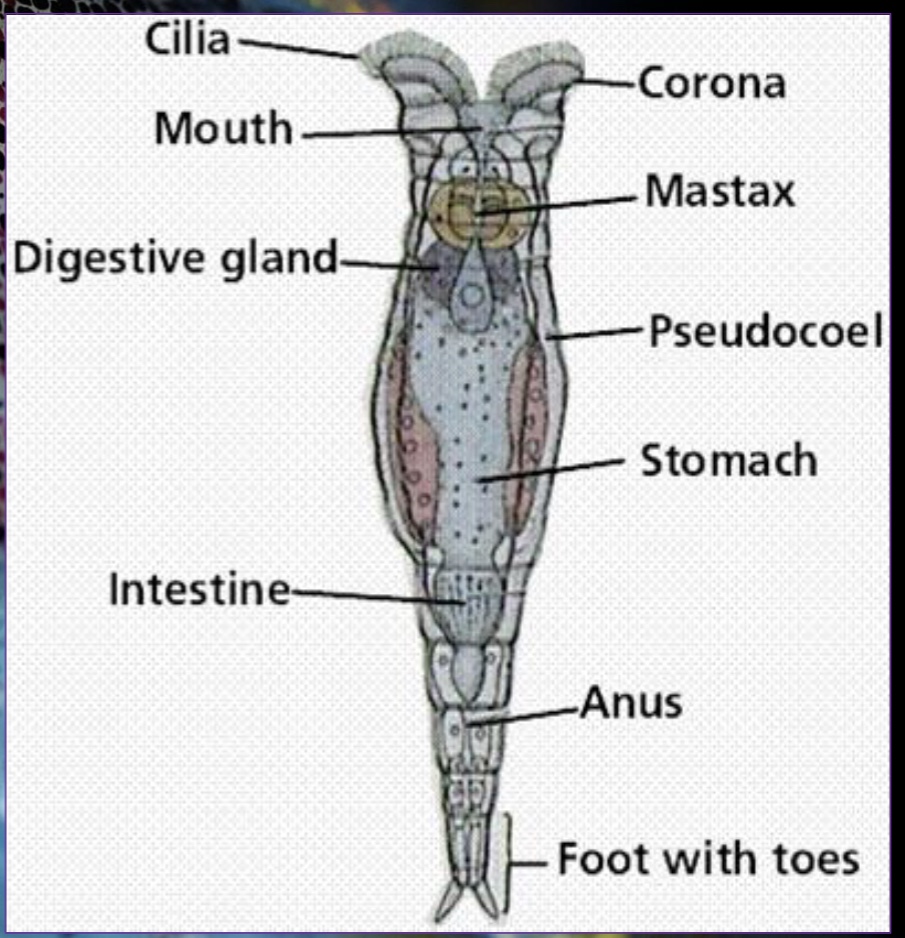
Syndermata-Formerly Phylum Rotifera (Rotifers)
Coronoa
Ciliated structure that looks like a rotating wheel
Used for movement and feeding
Mastax
Muscular pharynx and jaws for chewing food particles
Have a complete digestive system.
Phylum Brachiopoda
• Have true body cavity
• Possess lophophores
• Used for feeding and respiration
• Resemble clams
• Clams do not have a lophophore
Phylum Annelida
• Characterized by a body form made of many segments.
Errantia – free living predators
Sub-class of polychaete worms
Sedentaria – sedentary or slow-moving
includes Tube worms, earthworms, leeches
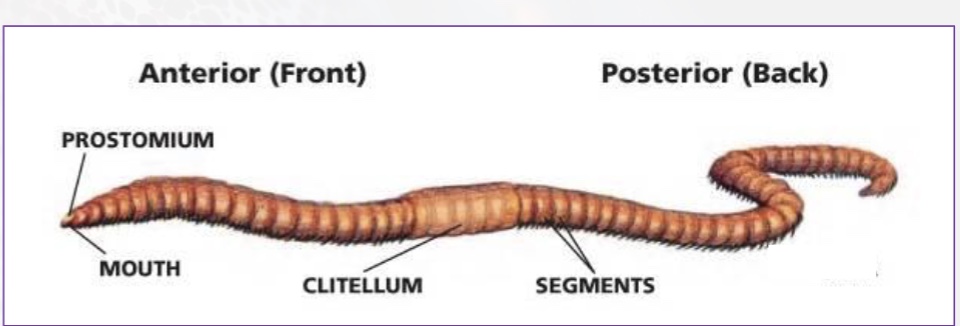
earthworm external anatomy
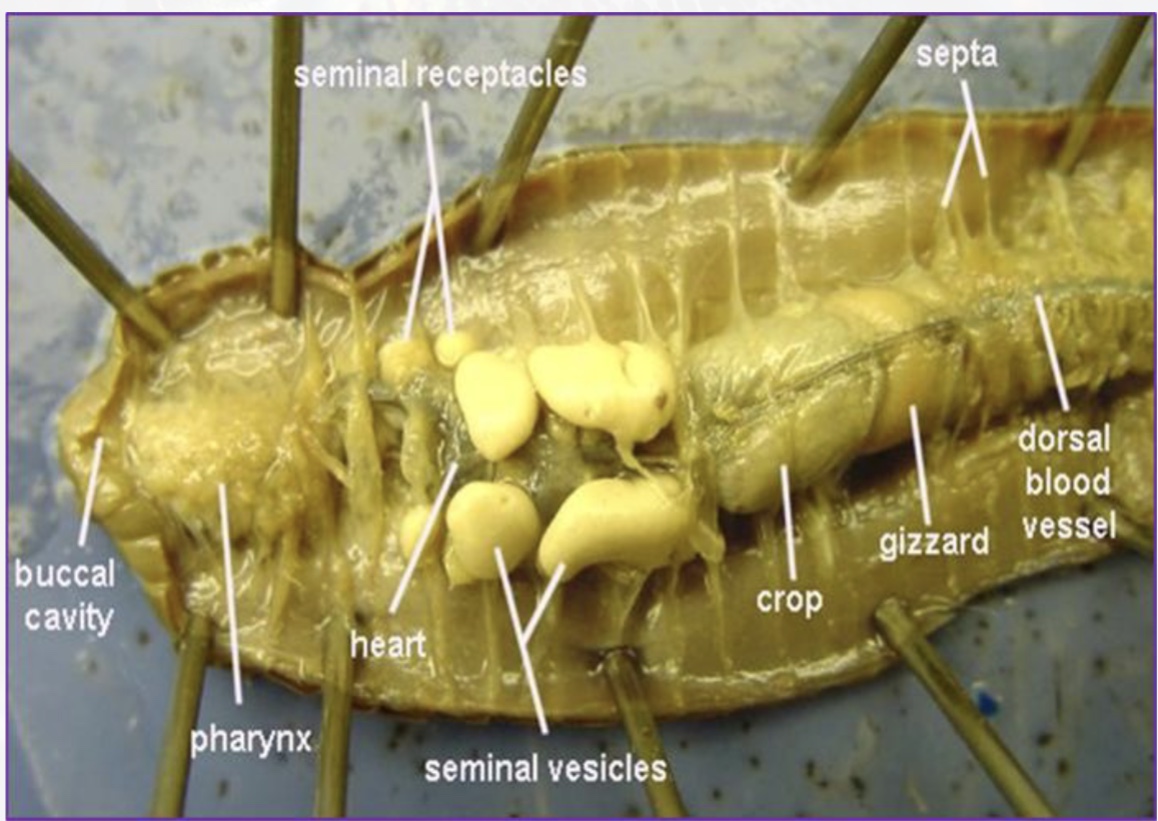
earthworm internal anatomy
Phylum Mollusca (snails, slugs, oysters, clams, octopuses, and squids)
• Body plan 3 main parts:
• Muscular foot: usually used for movement
• Visceral mass: contains most of the internal organs
• Mantle: drapes the visceral mass and secretes the shell (if one is present).
Phylum Mollusca - Class Polyplacophora
• Chitons
• Reduced head
• Dispersed sensory organs
• Strong foot, attaches them to rocks
Phylum Mollusca-Class Gastropoda
• Snails, slugs
• Very diverse!
• Marine, Freshwater and terrestrial forms
• Many have shells
• Exhibit torsion –the twisting of organs within a shell
Phylum Mollusca-Class Cephalopoda
• Active predators - Some members have demonstrated high levels of intelligence
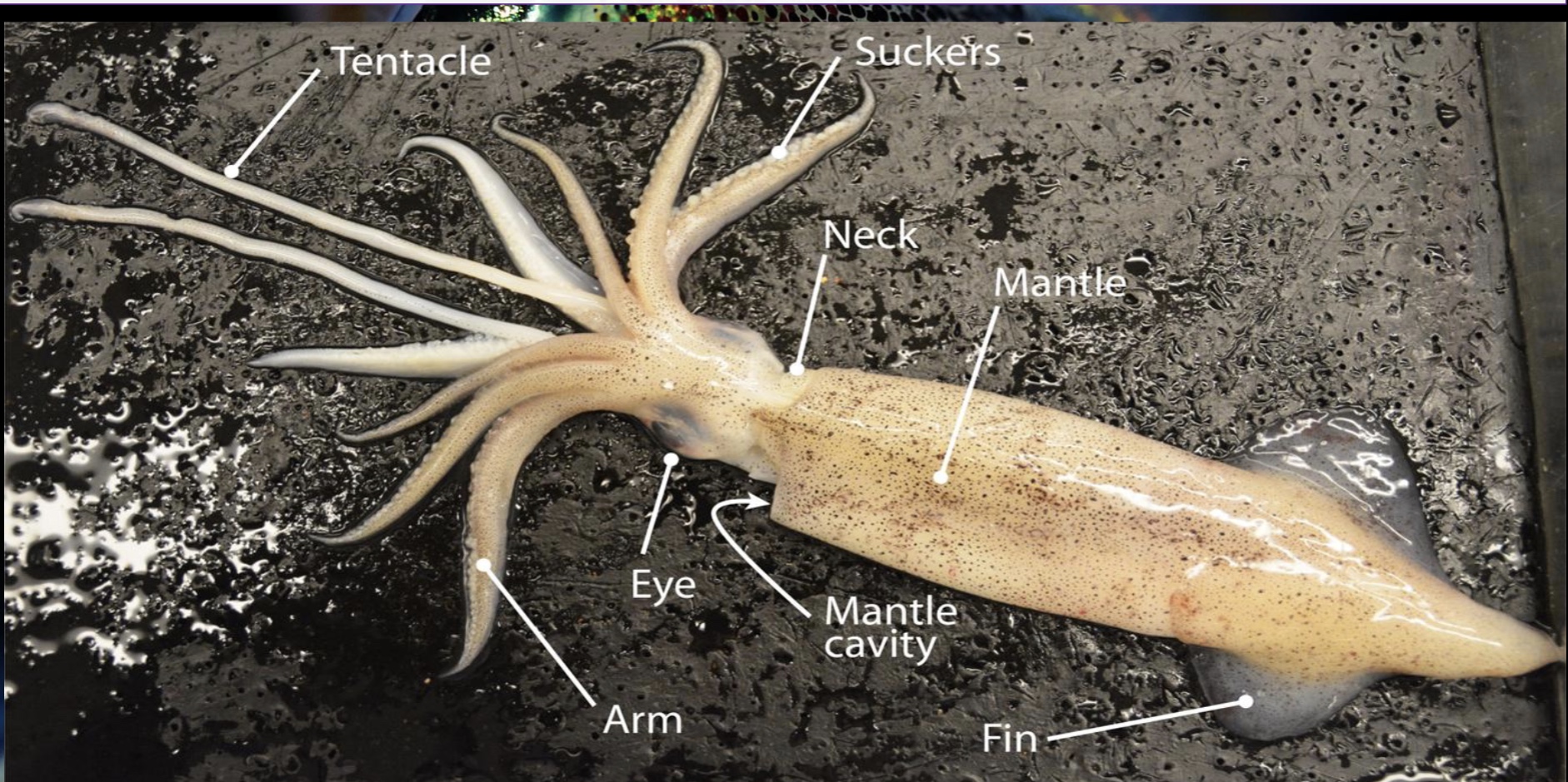
• Head surrounded by tentacles that are a modification of the foot.
squid, octopus, etc
squid external anatomy
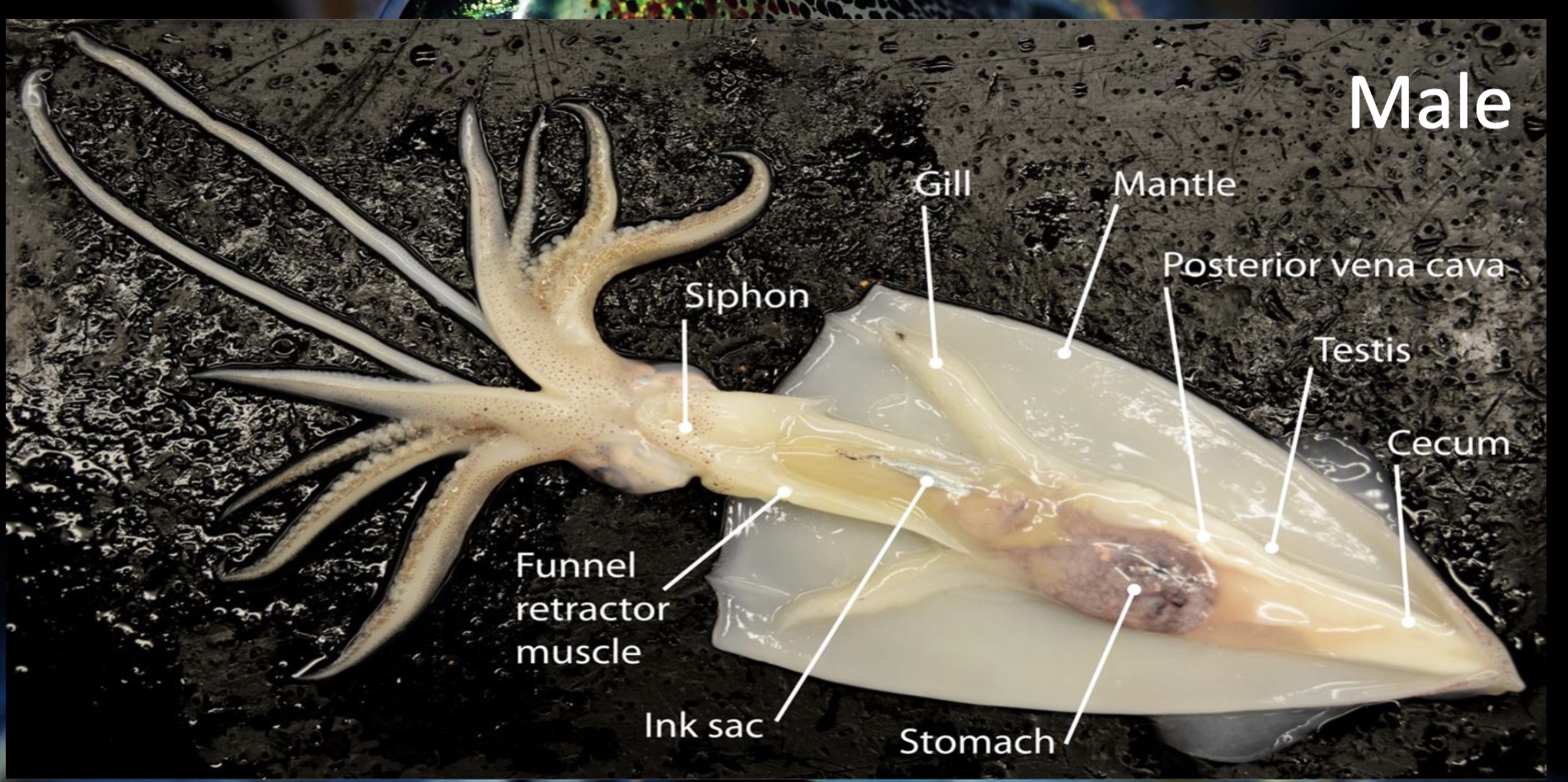
male squid internal anatomy
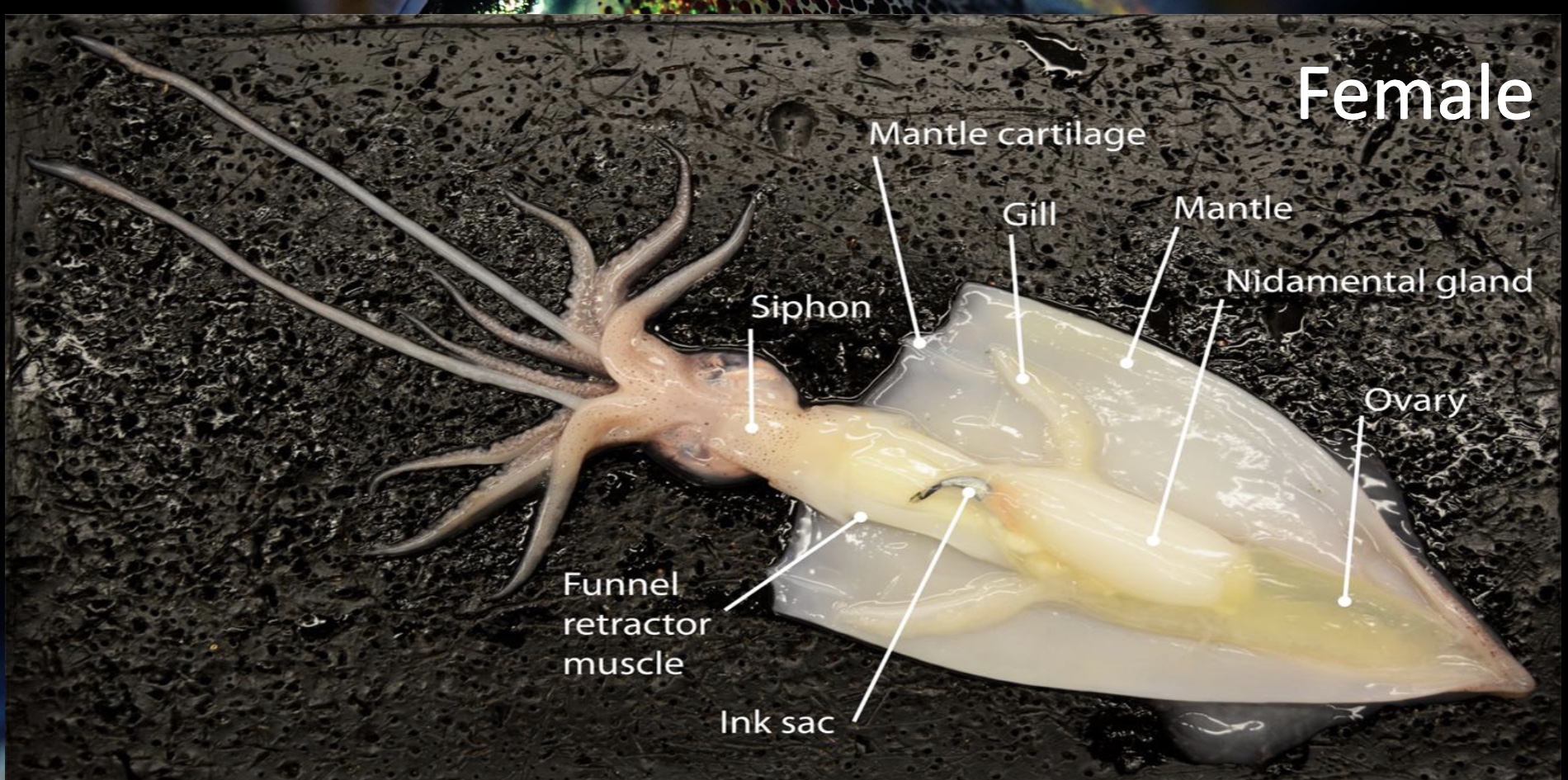
female squid internal anatomy
Siphon
The squid uses this structure to help push water over the gills, propel itself through the water, expel waste products and push ink out of the body.
Chromatophores
Specialized cells that allow the squid to change colors.
Ink Sac
Expels ink through the siphon
to deter predators
Pen
Vestigial internal shell made of chitin. It helps hold the squid's organs in place.
Class Bivalvia
•Clams, oysters, scallops
•Ecologically and commercially important
•Filter the water by capturing particles from water column and ingesting sediment
Ecdysozoans
Many perform ecdysis, which is the shedding or molting of skin.
shed their exoskeletons in order to grow.
• This process can also allow them to repair or regenerate damaged limbs.
Phylum Arthropoda (Insects, arachnids, crustaceans)
• Highly successful (3/4 of all described species fall into this group)
• Terrestrial and Aquatic species
• Ecologically and economically important.
includes Subphylum Trilobita, Subphylum Chelicerata, Subphylum Crustacea, Subphylum Hexapoda, Subphylum Myriapoda
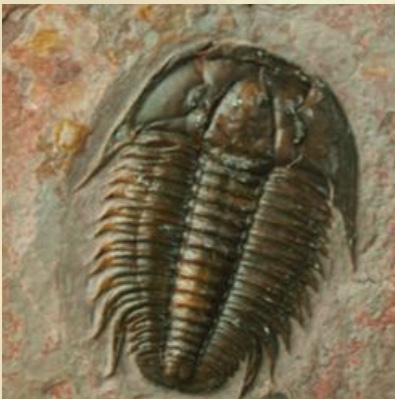
Subphylum Trilobita
• Ancient arthropods that dominated the oceans over 500 million years ago.
• They are now extinct
• May have given rise to modern day chelicerates such as horseshoe crabs and arachnids.
Subphylum Chelicerata
• Chelicerates- Horseshoe crabs, arachnids, and pycnogonids (sea spiders)
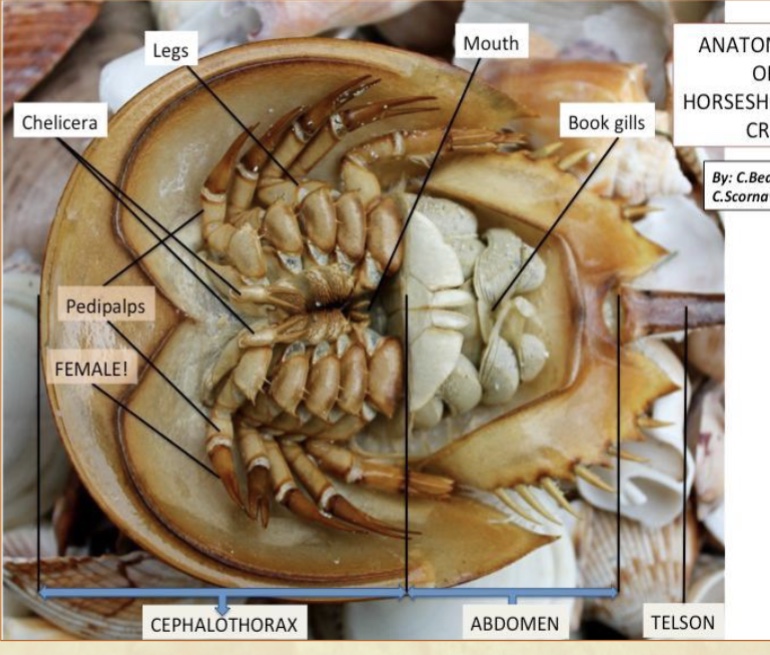
• Chelicerae, a specialized pair of appendages used for feeding
• Their bodies consist of a cephlathorax and an abdomen
• A tail-like Telson may also be present (to steer or to flip over)
horseshoe crab
• Females are usually larger.
• In males, the first pair of walking legs is modified with little hooks that are used during
mating. The walking legs in the female all look the same.
Class Arachnida (Spiders, ticks, mites)
• Over 60,000 species of arachnids
• Have two body regions
• Cephalothorax, abdomen
• Eight legs
Subphylum Crustacea
• Shrimps, lobsters, crayfish, crabs, barnacles, isopods
• Two body segments
• Cephalothorax (often covered in a carapace)
• Abdomen
• Biramous Appendages
• Each leg has two joints
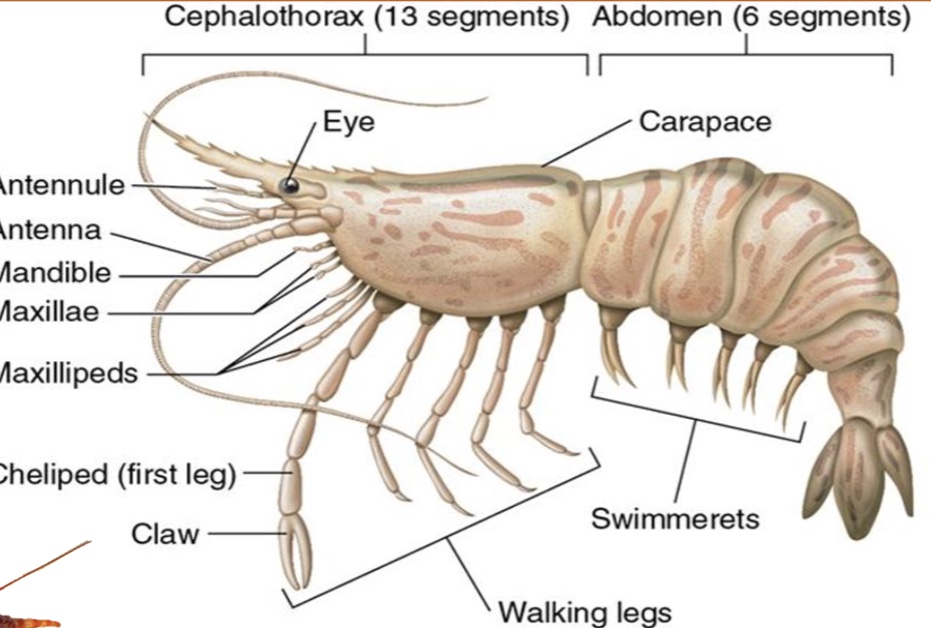
crayfish external anatomy
antennae used for touch and taste
mandibles are opposable mouth parts used for biting and chewing
first and second maxillae used for sorting and handling food
• Males usually have larger claws.
• Males are often brighter in color.
• Males have a pair of enlarged swimmerets.
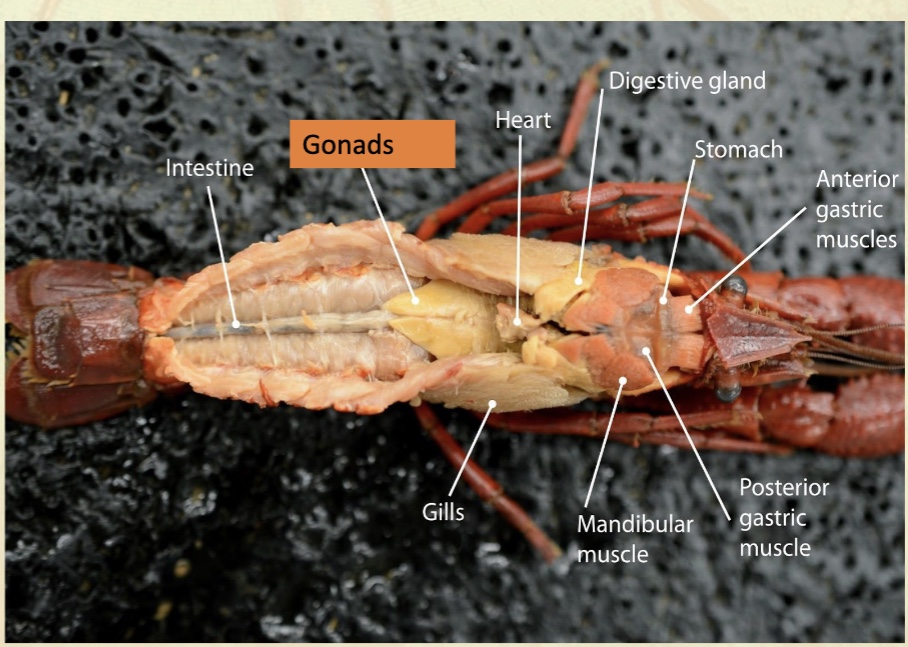
crayfish internal anatomy
Gastric Mill
• Found inside the stomach
• Look like teeth
• Are used to grind food
Subphylum Hexapoda
• Numerous species, ecologically dominant
• Successful due to:
• Small size
• Ability to fly
• Protective exoskeleton
• Reproductive fecundity
• Metamorphic life stage development
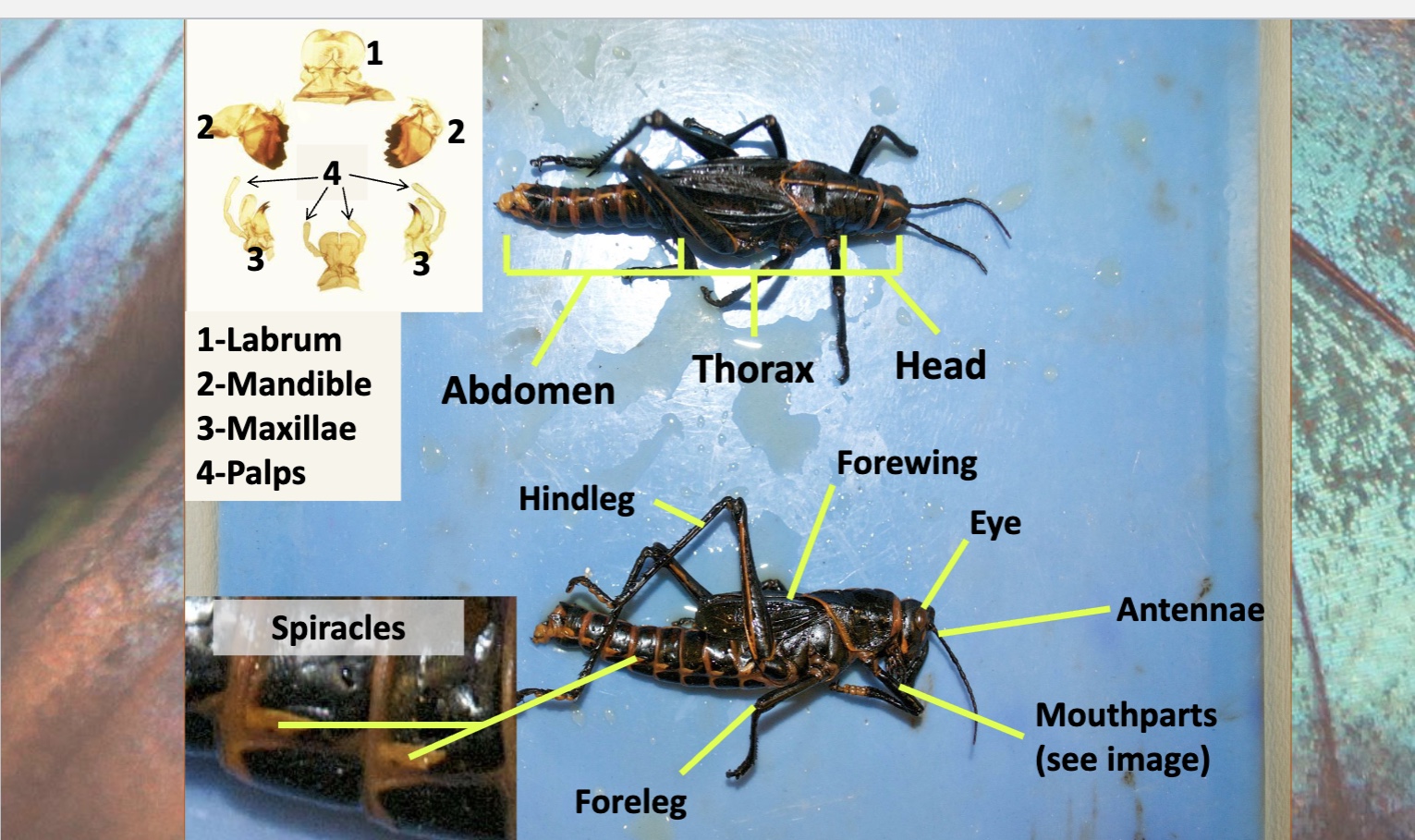
includes Grasshoppers, Mosquitos, Horsefly, Butterfly
grasshopper anatomy
Class Chilopoda : Centipedes
• Active predators
• Kill prey by injecting them with venom
• Flattened body
• Single pair of legs per body segment
Class Diplopoda : Millipedes
• Detritivores – feed on rotting plant material
• Rounded body
• Two pairs of legs per body segment.
Phylum Nematoda
round worms
found in almost all habitats
Some round worms such as Ascaris lumbricoides are parasites that infect the intestinal tract of humans and other vertebrates.
Deuterostomes
Defined by:
• Embryological development
Blastopore becomes anus in deuterostomes
Blastopore becomes mouth in protostomes
• Bilateral Symmetry
• Endoskeleton
• Two major Phyla:
Echinodermata
Chordata
• Know the four characteristics that all chordates share
notochord- felxible cartilaginous rods that acts as a support structure
hollow dorsal nerve cord- always located on the dorsal side of the notochord
pharyngeal arches
muscular postanal tail
Know the four characteristics that all mammals share
mammary glands- milk producing glands found in females
hair
specialized teeth
enlarged skulls
Phylum Echinodermata
• Spiny skinned animals
• All echinoderms have complex water vascular systems which they use for locomotion and breathing
sea star, sea urchin, brittle star, sea cucumbers etc
• Know the generalized anatomy of the sea star
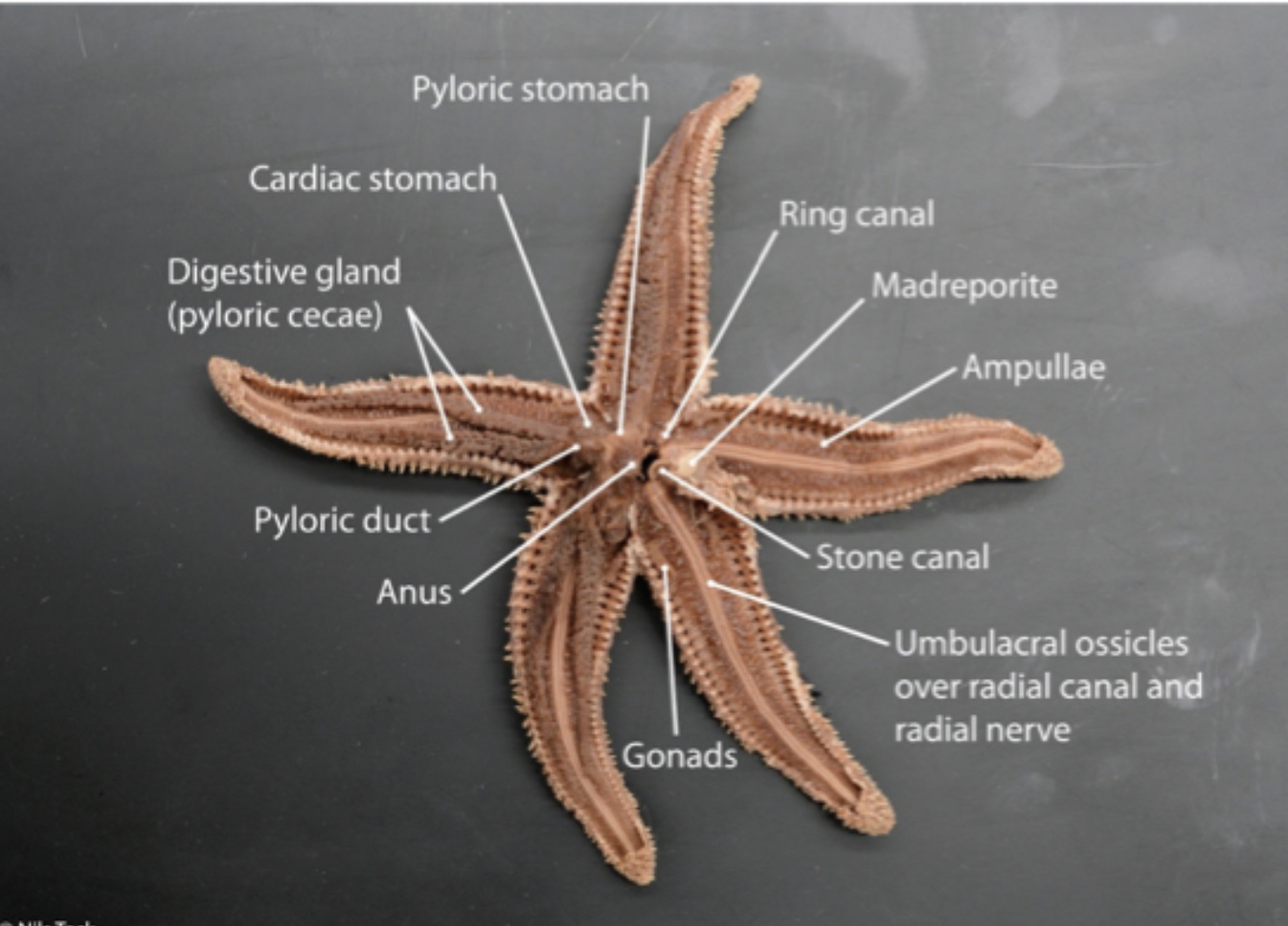
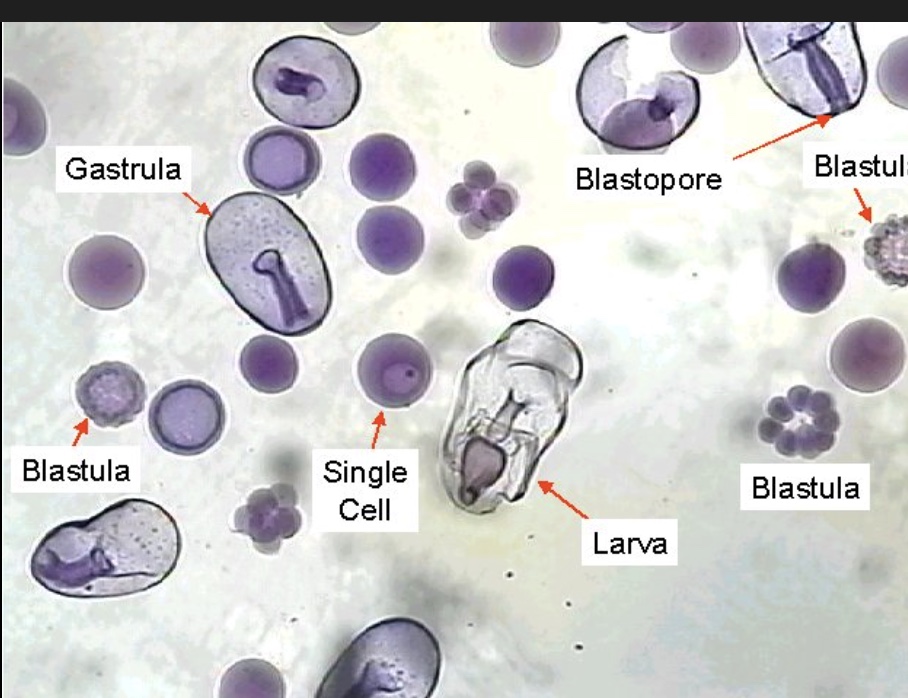
Be familiar with sea star cellular development
Sea star cellular development begins with fertilized eggs undergoing rapid cleavage to form a blastula, which then gastrulates to establish three germ layers (ectoderm, endoderm, mesoderm)
Phylum Chordata
Three groups
Urochordata (tunicates)
Cephalochordata (lancelets)
Vertebrata (vertebrates)
Remember: All vertebrates are chordates but not all chordates are vertebrates!
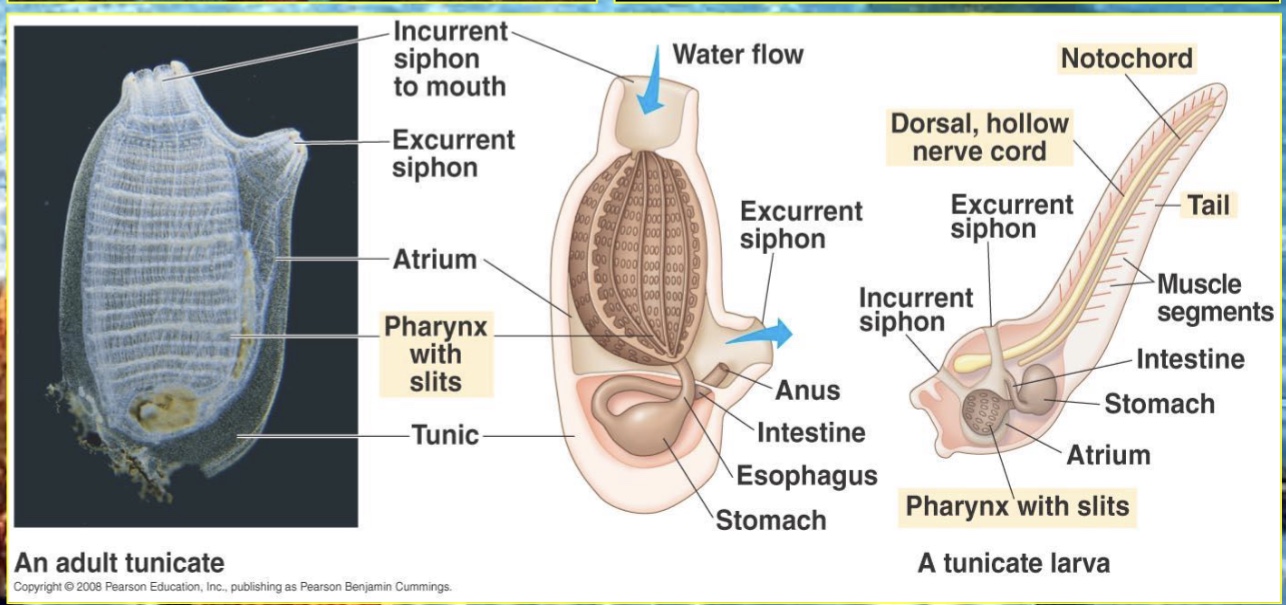
Subphylum Urochordata
• Sea Squirts/ tunicates
• Larvae are free swimming
• Adult-asymetrical
• Have protective sheath called tunic
Subphylum Cephalocordata
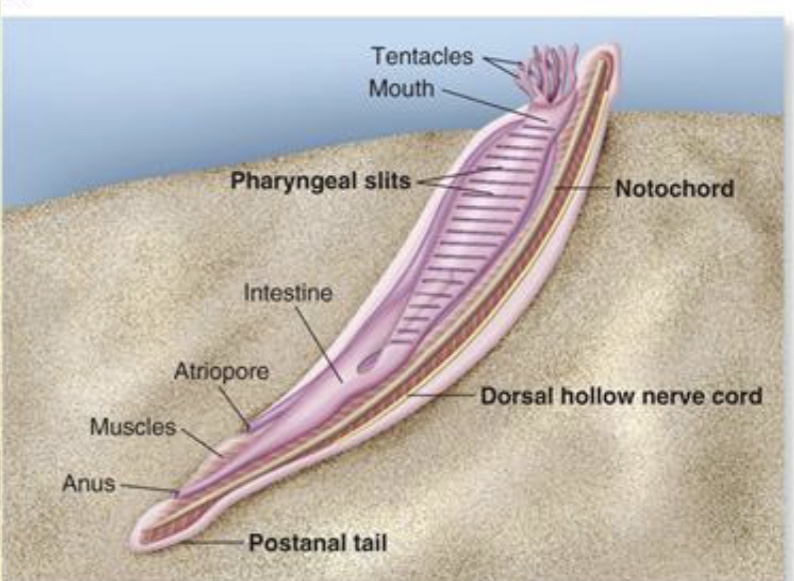
• Lancelets
• Have a dorsal nerve cord, notochord, gill slits,
tail.
• Do not have jaws, sense organs, paired fins, a heart, or well developed brain.
• Can swim but prefer to stay buried in the sand.
Subphylum Vertebrata (craniata)
• Have all the features of Chordates plus:
• Cranium
• Vertebral Column
Class Cyclostomata
lampreys and hagfish
without jaws
Class Chondrichthyes
• Sharks, Skates, Rays, Chimaeras
• Endoskeleton made of cartilage
• Some can detect changes in electrical fields and water pressure
Class Actinopterygii
• Ray-finned fishes
• Endoskeleton of ossified bone
Class Sarcopterygii
Lobe-finned fishes
Class Amphibia
• Frogs, Salamanders, toads, caecilians
• Live on land but are dependent on water for reproduction
Clade Sauropsida/Reptilia
• Turtles, snakes, lizards, crocodilians, and birds
• Use an amniotic egg for reproduction.
• Protects embryo from drying out.
• Allows for reproduction away from water
• All reptiles except birds are ectotherms
Birds must be able to regulate heat internally to fly without overheating.
Mammal Dentition
Carnivore Skulls with large canines and carnassial molars for piercing flesh. Note the ridge on the back of the skull for jaw muscle attachment.
Herbivore with large incisors for nipping and broad flat molars for shredding vegetation
omnivores have large canines and flat molars for chewing
piscivore: homodont teeth with all their teeth appearing similar