Energy Expenditure
 Call Kai
 Learn
Learn Practice Test
 Spaced Repetition
 Match
Match Flashcards
 Knowt Play
1/18

There's no tags or description
Looks like no tags are added yet.
Name | Mastery | Learn | Test | Matching | Spaced | Call with Kai |
|---|
No analytics yet
Send a link to your students to track their progress
19 Terms
Why is energy expenditure measured?
Assess metabolic needs of a task or person
Fuel utilisation
Thermic effects of food
Nutritional interventions for performance and recovery
Assessment of energy economy
Information on demands of exercise
What is a calorie?
The amount of energy required to raise the temperature of 1g of water by 1°C
What 2 ways can energy expenditure be measured?
Direct and indirect calorimetry
What is the process of direct calorimetry?
Direct calorimetry measures energy expenditure by recording the heat produced by the body during exercise.
The athlete performs exercise inside a thermally insulated chamber surrounded by a water jacket.
Heat produced by the body warms the water, and the change in water temperature is used to calculate total energy expenditure.
What are the pros and cons of direct calorimetry?
Pros:
Accurate for steady state measures
Direct measures of heat
Cons:
Expensive
Takes time to generate results
Equipment is scarce
Not as accurate for exercise
What is the process of indirect calorimetry?
Collecting samples of expired volumes of oxygen and CO2 during rest and exercise, which can then be used to determine the energy expenditure
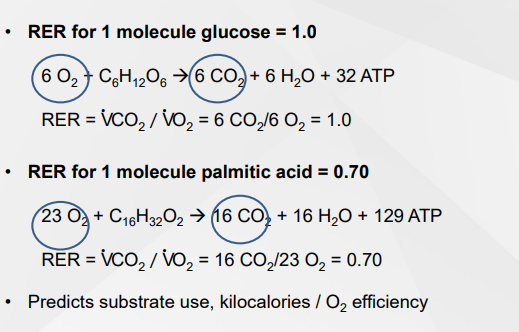
What is the RER of carbs and fat during exercise, and explain it?
Carbs = The amount of oxygen used and CO2 produced when breaking down a carbohydrate is equal. Works out to be a 1.0 ratio (6:6)
Fat = The amount of oxygen used compared to the amount of CO2 when breaking down a fatty acid works out to be a 0.7 ratio (23:16)
What are the pros indirect calorimetry?
Pros
Can detect changes during exercise with breath by breath analysis
Not as invasive equipment as direct calorimetry
Accurate for aerobic measures
Provides direct assessment of ags exchange
What are the cons of direct calorimetry?
Cons:
It assumes body O2 content is constant,
Assumes lung CO2 removal is proportional to cell production due to aerobic production
Ignores the contribution of protein to energy source (around 5%)
What is Basal metabolic rate (BMR)?
The number of calories a person needs to perform basic functions (e.g. breathing, blood circulation)
How does age affect metabolic rates?
2-3% decrease in metabolic rate per decade of age
Decrease in fat-free mass as age increases
Decrease in metabolic activity of the lean tissue as age increases
However exercise can slow down these deteriorating effects
What is resting metabolic rate (RMR)?
Similar to BMR, but measures the energy used to rest including minor activity (e.g. sitting)
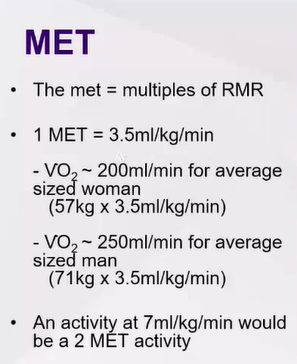
What is metabolic equivalent of task (MET)
Method of describing the intensity of an activity
1 MET = 3.5mL/kg/min
What is Fat max?
The exercise intensity at which maximal fat oxidation is observed
What are the 2 causes of fat max?
Blood shifts towards the working muscles, reducing the release of FFA’s from fat stores into the bloodstream
A reduced entry of fatty acids into the mitochondria due to a reduction of the carnitine shuttle which usually transports them
What is the equation for mechanicaly efficiency?
ME = external work accomplished / energy expenditure
What is oxygen deficit?
The lag in oxygen uptake during exercise until steady state occurs
What occurs during the fast portion of EPOC?
ATP and PCr levels are synthesised
Oxygen levels in myoglobin and haemoglobin are restored
Thermogenic effects of hormones occur, such as adrenaline
Lasts 2-3 mins after exercise
What occurs during the slow portion of EPOC?
HR and minute ventilation remain elevated
Lactate is resynthesised and converted to oxygen
The athlete’s elevated core temperature requires more oxygen
Lasts upto 1 hour after exercise