Bio Key Concepts Review
 Call Kai
 Learn
Learn Practice Test
 Spaced Repetition
 Match
Match Flashcards
 Knowt Play
1/132

There's no tags or description
Looks like no tags are added yet.
Name | Mastery | Learn | Test | Matching | Spaced | Call with Kai |
|---|
No analytics yet
Send a link to your students to track their progress
133 Terms
Endocrine organs
make and release hormones, chemical messengers that travel throughout the body using the flow of blood through blood vessels.
scattered throughout the human body.
Nervous System
Cells are neurons.
Signaling is a combination of electrical signaling and chemical signaling.
Neurotransmitters provide targeted, short distance messaging to target cells.
Target cells quickly respond to chemical signaling.
Endocrine System
Cells are glandular cells.
Electrical signaling is not used to spread messages.
Hormones are chemical messengers that travel in blood.
Target cells may be far away from endocrine gland.
Hormones may cause rapid responses, or promote long-term physiological processes.
Small amino acid derivatives
are amino acids that have undergone small chemical modifications.
Peptide hormones
made of chains of amino acids
Lipid hormones
commonly called steroid hormone, are made in some endocrine organs by making modifications to the lipid molecule cholesterol
Hydrophilic Hormone Signaling
All amino acid and peptide hormones are hydrophilic meaning they have many partial charges that allow them to dissolve easily in plasma, the fluid portion of blood.
extracellular protein receptors
transmit a signal into the target cell. Allows amino-acid based hormones to pass through plasma membrane of the cell
cholesterol
complex molecule with four fused carbon rings that is mostly made of carbon and hydrogen
All steroid hormones are hydrophobic, meaning?
they are fatty molecules that do not dissolve easily in bodily fluids.
steps involved when an steroid hormone communicates with a target cell through an intracellular receptor.
a lipid hormone crossing the cellular membrane and attaching to the NR/HSP complex.
The complex dissociates, releasing the heat shock protein and a NR/hormone complex.
The complex dimerizes, enters the nucleus, and attaches to an HRE element on DNA, triggering transcription of certain genes.
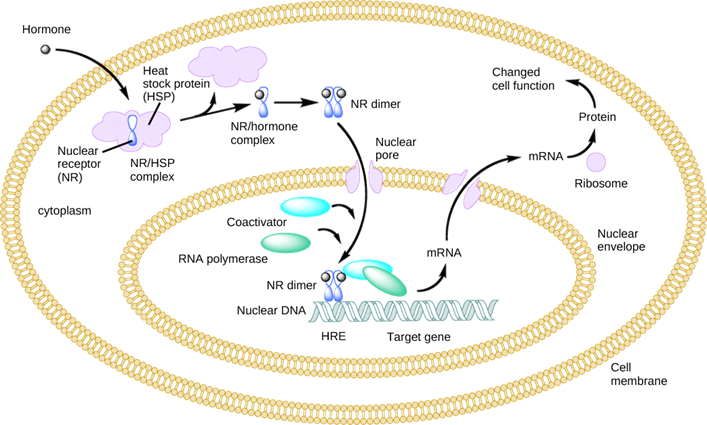
Steroid-based hormones can pass through plasma membrane of a cell to activate
intracellular receptors
hypothalamus
region of the brain has three important roles related to the endocrine system
Some of the hormones that are produced from the hypothalamus enter the ——, a short set of blood vessels that takes those hormones to the anterior pituitary gland.
hypophyseal portal system
RH
releasing hormone - cause the anterior pituitary to release a hormone into the blood
IH
inhibiting hormone - stop release of an anterior pituitary hormone
TRH (thyrotropin release hormone)
travels to the anterior pituitary to cause release of thyroid stimulating hormone (TSH).
anterior pituitary
contains mostly glandular cells
What are two anterior pituitary hormones?
Growth hormone (GH)
Thyroid stimulating hormone (TSH)
posterior pituitary
mostly made of axons derived from cells in the hypothalamus
Antidiuretic Hormone (ADH)
prevents the process of diuresis, release of urine with water-soluble wastes
oxytocin most well-known roles?
stimulating contractions of the smooth muscle in the uterus that expel a fetus during child labor.
where is the thyroid located?
anterior side of the neck just below the laryngeal prominence
what are the two major hormones secreted by the thyroid and their alternative name?
T4 or thyroxine or tetraiodothyronine
T3 or triiodothyronine
Thyroid Hormones
We must eat small amounts of ______in our diets to ensure we can produce enough thyroid hormone.
iodine
What causes a negative feedback loop in the endocrine system?
When one hormone slows its own release by turning off a gland upstream in the endocrine pathway
what does renal refer to?
kidneys
where are the adrenal glands located?
along superior border of kidney
what are the two distinct layers of endocrine tissue in the adrenal glands?
adrenal medulla
adrenal cortex
what is the adrenal medulla?
the deep endocrine layer that secretes epinephrine and norepinephrine. These molecules are essential for the sympathetic response or short-term response.
adrenal cortex
the superficial endocrine layer that secretes hormones aldosterone and cortisol in response to long-term stress.
what is aldosterone?
Most important mineralocorticoid. This hormone is essential for retaining water and maintaining blood pressure.
What is cortisol?
Most important glucocorticoid. Has the effect of slowing production of cells involved in defense and immunity.
Pancreas
an essential organ in both the digestive system and the endocrine system.
What is the pancreas mostly composed of?
Exocrine glands that release a variety of enzymes that digest food molecules within the small intestine
What are endocrine tissues/pancreatic islets (Islets of Langerhans)?
small clusters of hormone secreting cells embedded within the exocrine tissue.
what are the two important cell types in pancreatic islets?
Alpha cells
Beta Cells
what do alpha cells produce?
Glucagon, a hormone that raises blood glucose levels
What do beta cells produce?
Insulin, a hormone that lowers blood glucose levels. Insulin tells body cells to take up glucose from the blood.
Insulin and glucagon represent an important pair of
antagonistic hormones
Antagonistic hormones are
two hormones that have opposite physiological functions
What type of skeleton do annelids and echinoderms have?
A hydrostatic skeleton.
How do annelids and echinoderms generate movement?
By utilizing the pressure from water moving through the coelom, an internal body cavity.
What is the composition of the exoskeleton of arthropods?
Arthropods have an exoskeleton mostly composed of the carbohydrate chitin.
what type of skeleton does arthropods have?
exoskeleton
What type of skeleton do Chondrichthyes have?
Chondrichthyes have an endoskeleton, which is an internal skeleton made of cartilage.
What type of skeleton do humans have?
Humans have an endoskeleton of bone.
What is bone composed of?
Bone is composed of collagen protein and mineralized with hydroxyapatite, a hard, calcium-rich substance.
How many bones are in a complete human skeleton?
There are 206 bones in a complete human skeleton.
What are the different shapes of bones in the human skeleton?
The human skeleton has a variety of shapes of bones including long, short, sesamoid, and irregular.
What do the long bones include?
humerus of the upper limb and femur of the lower limb
What are the epiphyses and what do they contain?
ends of a long bone & contain spongy bone
What do the pores of the spongy bone contain?
red bone marrow which is used to generate blood cells.
What is the diaphysis and what does it contain?
The shaft of a long bone & contains yellow bone marrow
what is yellow bone marrow?
fat tissue that is encased in dense layer of compact bone
The cells of all types of muscle tissue are called
muscle fibers
What composes the large muscles that can be controlled voluntarily?
skeletal muscles
what are tendons?
the connective tissue structures that connect muscles to bones
Skeletal muscles often work in antagonistic pairs. What are antagonistic pairs?
there are two muscles that pull in opposite directions to create movement.
What does the biceps brachii muscles produce?
flexion at the elbow, a movement that brings the hand toward the shoulder.
What does the triceps brachii muscles produce?
extension, the opposite of flexion, at the elbow to straighten the upper limb.
What are the parts of a skeletal muscle fiber?
Sarcoplasm
Sarcolemma
Transverse tubules
Sarcoplasmic reticulum
Myofibril
Thin filaments
Thick filaments
Sarcomere
What is sarcoplasm?
cytoplasm of a muscle fiber
What is sarcolemma?
the plasma membrane of a muscle fiber
What are transverse tubules?
folds of the plasma membrane that penetrate into a muscle fiber. These are important for spreading electrical excitation into a muscle that causes contraction.
What is sarcoplasmic reticulum?
membranous organelle with structure like endoplasmic reticulum in a muscle fiber used to store calcium ions (Ca+2). Compartments associated with sarcoplasmic reticulum are close to the sarcolemma associated with T-tubules.
What is myofibril?
cylinder of contractile proteins within a skeletal muscle fiber composed of two types of overlapping filaments:
thin filaments
thick filaments
What are thick filaments?
protein strands composed of actin, troponin, and tropomyosin
What are thin filaments?
protein strands composed of myosin
What is sarcomere?
repeated microscopic unit of contraction in a muscle fiber observed in a myofibril composed of overlapping thin filaments and thick filaments
What the process of electrical excitation required for muscle contraction?
A somatic neuron sends an action potential toward a muscle fiber.
The neuron releases the neurotransmitter acetylcholine (ACh) onto a muscle fiber.
ACh binds to receptors on the surface of the muscle fiber and opens sodium ion channels.
Na+ enters the muscle fiber.
An action potential starts at the sarcolemma and spreads through the T-tubules.
Ca+2 is released from the sarcoplasmic reticulum of the muscle fiber into the sarcoplasm.
What are the interactions of myosin and actin after excitation?
Ca+2 binds to troponin in the thin filaments.
Troponin moves tropomyosin to reveal the active site on actin.
Myosin binds to actin to form a cross bridge.
Myosin performs a power stroke as it pulls the thin filament toward the center of a sarcomere.
ATP binds to myosin to break the cross bridge.
ATP breaks down to release energy that returns myosin to a high energy “cocked” state.
what events must take place for muscle to go to a relaxed state after contraction?
Immediately after being released at the synaptic cleft, acetylcholine is broken down by the enzyme acetylcholinesterase. This reduces the electrical excitation of the muscle fiber.
Calcium ions are actively pumped back into the sarcoplasmic reticulum.
As calcium ions disappear from the sarcoplasm, most will separate from troponin. This will allow tropomyosin to change position, blocking additional cross bridge formation.
why is the circulatory system essential?
The distribution of essential gases, nutrients, and ions throughout the animal body.
In order to make the essential energy molecule ATP, animals must
gain oxygen from the atmospheric air or water.
Instead of a circulatory system what do sponges, jellies, and flatworms use?
They participate in direct gas exchange with the external environment.
What does gas exchange involve?
oxygen absorption from water or atmospheric air, and release of carbon dioxide.
What do organisms with thicker tissues have to carry gases and circulatory fluid?
circulatory and a muscular pump.
Insects, crustaceans, and mollusks have an
Open circulatory system. In this type of a system, hemolymph is the circulatory fluid. A heart pumps the hemolymph through vessels. The vessels have open ends such that the hemolymph falls directly onto tissues. Fluid re-enters the heart through openings called ostia.
Annelids and all types of vertebrates have a
Closed circulatory system. This means that blood, the main circulatory fluid, stays at all times within the heart and blood vessels. Interstitial fluid is the fluid outside of the blood vessels that directly contacts the body cells. The blood participates in gas exchange with interstitial fluid at capillaries, this vessels that permit exchange between blood and other tissues.
What are the structures of closed circulatory systems?
Atrium
Ventricle
Arteries
Capillaries
Veins
What is the atrium?
a superior (top) chamber in bipedal organisms, or the cranial chamber (closer to the head) chamber in quadrupedal organisms.
What is a ventricle?
an inferior (bottom) chamber in bipedal organisms, or the caudal chamber (closer to the tail) chamber in quadrupedal organisms
What are arteries?
Carry blood away from the heart. Composed of an endothelium that contacts blood, a middle layer smooth muscle that can control blood pressure, and an outer layer of collagen.
What are capillaries?
Thin vessels composed of an endothelium, a single layer of flat cells. Are located between arteries and veins where gas exchange occurs between the blood and the interstitial fluid.
What are veins?
Carry blood back to the heart. Have the same basic tissue layers as arteries, but with less smooth muscle and elastic tissue
What type of heart do boney fishes have?
two-chambered heart with one atrium and one ventricle
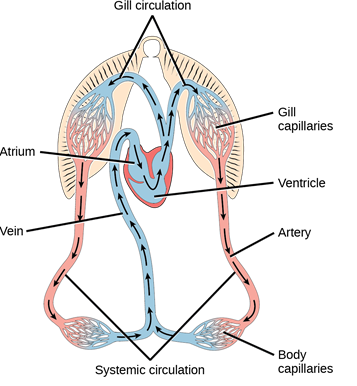
What is the blood circulation pattern of boney fishes?
atrium, ventricle, arteries to gills (gill circulation), gill capillaries, aorta, arteries, systemic capillaries, veins, atrium.
What type of heart do amphibians have?
three-chambered heart with two atria and a single ventricle
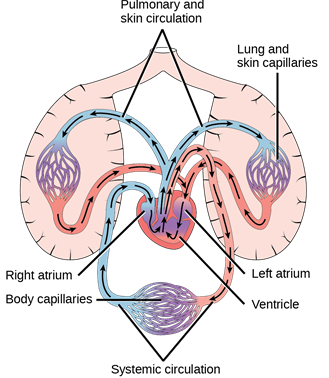
What is the blood circulation pattern of amphibians?
right atrium, ventricle (mixed oxygenated blood), pulmonary arteries, pulmonary capillaries, pulmonary veins, left atrium, ventricle (mixed oxygenated blood), aorta, systemic arteries, systemic capillaries, systemic veins, right atrium.
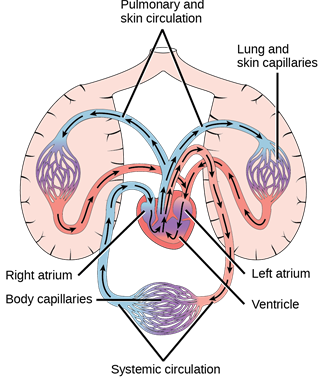
What type of heart do reptiles have?
three-chambered heart with two atria and a single ventricle and a double circulation pattern
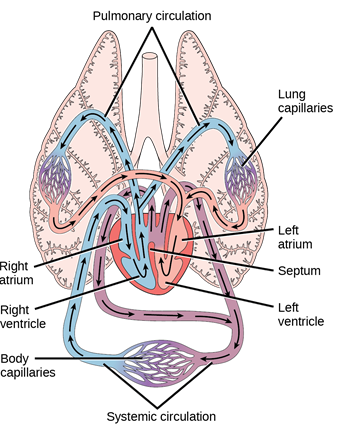
What is the blood circulation pattern of reptiles?
right atrium, right ventricle, pulmonary arteries, pulmonary capillaries, pulmonary veins, left atrium, left ventricle (mixed oxygenated blood), aorta, systemic arteries, systemic capillaries, systemic veins, right atrium
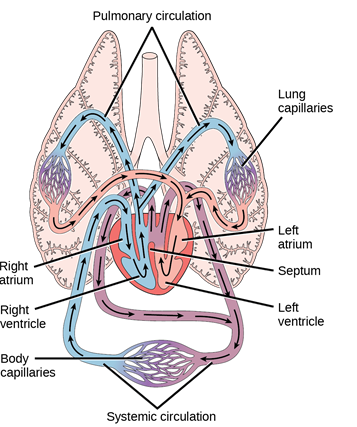
What type do birds and mammals have?
four-chambered heart with two atria and two ventricles
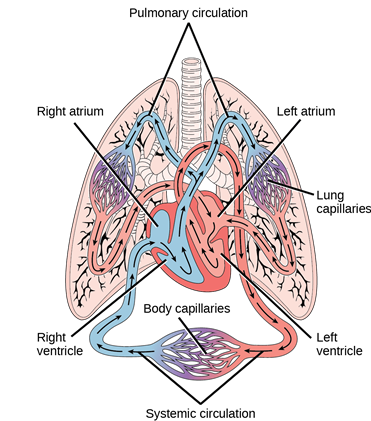
What is the blood circulation pattern of birds and mammals?
right atrium, right ventricle (only deoxygenated blood), pulmonary arteries, pulmonary capillaries, pulmonary veins, left atrium, left ventricle (only oxygenated blood), aorta, systemic arteries, systemic capillaries, systemic veins, right atrium.
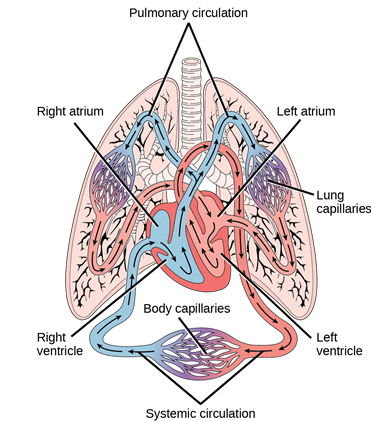
What are valves?
structures used to ensure that blood only flows in one direction through the heart and blood vessels
where are atrioventricular (AV) valves are located?
between the atria and the ventricles
what are chordae tendineae (heart strings)?
connect the valves to the ventricular wall
What are chordae tendineae connected to?
papillary muscles that can control the tension in the strings and the position of the valve.
What is the right AV valve considered?
a tricuspid valve because three flaps of connective tissue form the valve.
What is the left AV valve/mitral valve considered?
a bicuspid valve because it has two flaps.