Sliding Filament Theory - fr
 Call Kai
 Learn
Learn Practice Test
 Spaced Repetition
 Match
Match Flashcards
 Knowt Play
1/16

There's no tags or description
Looks like no tags are added yet.
Name | Mastery | Learn | Test | Matching | Spaced | Call with Kai |
|---|
No analytics yet
Send a link to your students to track their progress
17 Terms
What is the sliding filament theory?
An explanation of how the muscle contracts, by the sliding past each other of proteins in the muscle, pulling the sarcomere/contracting
What is the Endomysium?
Delicate sheath surrounding individual muscle fibre (cell)
Connective tissue
Its the end bro just at the smallest point, no more ygm
What is the Epimysium?
Outer layer of dense connective tissue surrounding entire muscle
Think epic #sobig its the outside
What is the perimysium?
Thick layer of connective tissue surrounding groups of muscle fibres
Think piri seasoning needs to go deeper than just sit on tip
What is a fascicle?
Bundles of muscle fibres
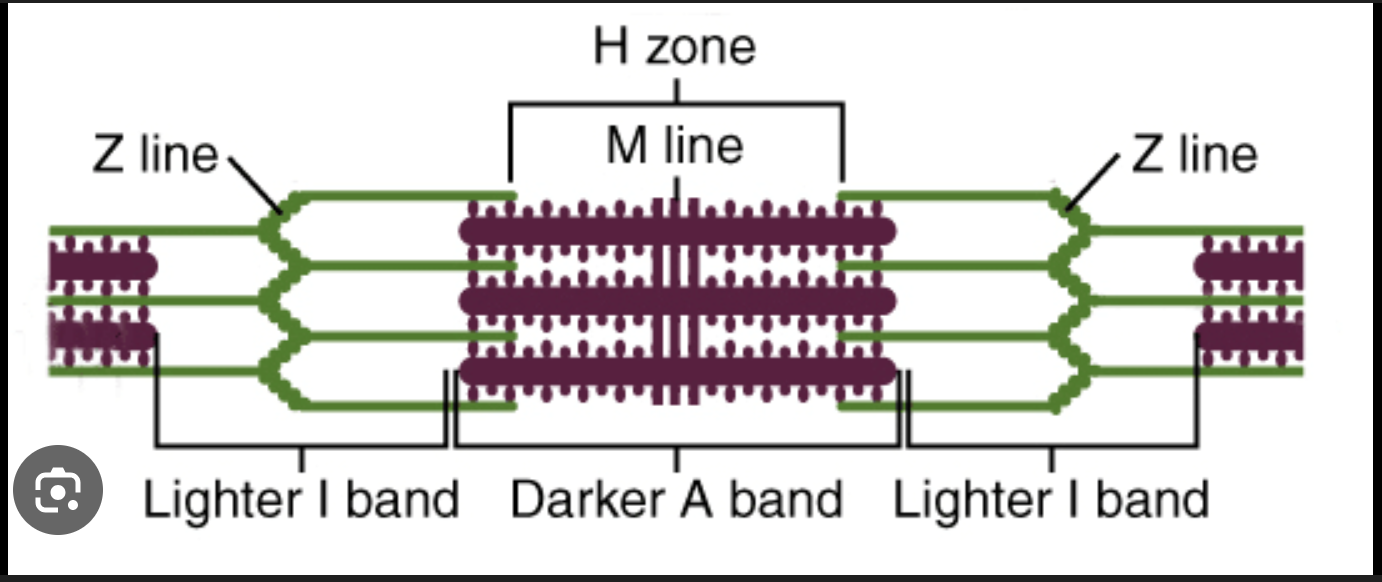
What terms do we use to describe sarcomeres in more detail?
Bands, discs and lines
When looking at muscle underr a microscope what do we see?
Mainly myosin (thickest) and actin
What proteins do we find in the sarcomere?
Myosin
Actin
Troponin
Tropomyosin
Myosin role
Creates movement
Mysoin structure
2 Heads - contain ATP enzyme, ATP attaches to head, breaks down into ADP
Hinge Region
2 Tails
Troponin and Tropomysin
Sit between actin, decide whether ectin will contract
What causes muscle contraction
At the sarcomeres: The heads of mysoin attach to actin filaments, form cross bridges and walk down the filament, forming Z
Neural stimulus: Somatic nervous system releases acetyl colene to stimulate muscle fibres and create action potential, this triggers calcium release in muscle cells
ATP must be available for energy, to make myosin move
Neuromucular junction - the end of a peripheral motor neuron meets a muscle fibre
Describe the process of excitation step - by - step
Neuron Signal is sent by the brain through the spinal chord through to the nerve endings
1 - An action potential rises at the Axon Terminal
2 - This causes the Na+ channels to open, Na+ enters through Na+ channels
3 - This causes Ca2+ channels to open, Ca2+ enters Ca2+ channels
4 - The Ca2+ allows the vesicles to move (vesicles contain neurotransmitter acetylcholene)
5 - Via exocytosis, neurotransmitters released across synaptic cleft
6 - Acetylcholene binds to ligand gated receptors on post-synaptic cell
7 - this causes Na+ to enter myofibril which increses the positive charge AKA excitation AKA depolarisation
8 - this excitation travels across sarcolemma (muscle membrane) into T-tubule
9 -
Describe the sliding filament theory step-by-step
1 - The depolarisation goes into T-tubule, into the sarcoplasmic reticulum
2 - this triggers the release of Ca2+
3 - The calcium binds to the troponin, causing it to change shape and move the tropomyosin off the binding site
4 - this allows the binding heads on myosin to bind to the binding sites on actin
5 - ATP allows the binding heads to relax, bind, pull (pulling it closer)
What is it called when the binding heads of myosin are attached to the binding sites of actin?
Cross - bridge
What is the z-line? M line? A band? I band?