Human Reasoning & Complex Cognition
 Call Kai
 Learn
Learn Practice Test
 Spaced Repetition
 Match
Match Flashcards
 Knowt Play
1/65

There's no tags or description
Looks like no tags are added yet.
Name | Mastery | Learn | Test | Matching | Spaced | Call with Kai |
|---|
No analytics yet
Send a link to your students to track their progress
66 Terms
Reasoning
A combination of intuitive and analytic thinking.
What are the two types of reasoning systems in dual process theory?
System 1 (implicit, automatic) and System 2 (explicit, effortful).
What is the singularity principle in reasoning?
People consider a single hypothetical possibility or mental model at one time.
What does the relevance principle state?
People consider the model that is most relevant to the current context.
What is the satisficing principle?
Models are accepted if they are satisfactory based on the current goal.
What is the difference between deduction and induction?
Deduction is general to specific (if true in all models), while induction is specific to general (not guaranteed).
What is abduction in reasoning?
Creating a new possible cause or explanation based on observations.
How does cognitive capacity limit reasoning?
Working memory limits individuals to considering only one model at a time.
What is belief bias?
The tendency to accept believable conclusions over logical ones.
What are mental models?
Possibilities imagined to simulate the world and draw conclusions.
What is the difference between necessary and possible consequences?
Necessary consequences will happen if a condition is met; possible consequences could happen but are not guaranteed.
What is the significance of the dual process perspective?
It highlights the interplay between intuitive (fast) and deliberate (slow) reasoning.
What are the four methods of fixing belief?
Tenacity, Authority, A priori, and Science.
What is the limitation of reasoning based on formal rules?
It does not explain everyday reasoning well.
What is the implication of computational complexity in reasoning?
Real-world problems are too complex to optimize, making full rational reasoning impossible.
What does it mean to evaluate a model in reasoning?
To check if the scenario makes sense and fits the goal.
What is a counterexample in reasoning?
An example that fits the premises but leads to a different conclusion.
What is modulation in reasoning?
Considering additional clauses or conditions that can affect outcomes.
What is the role of intuition in reasoning?
It allows for quick scenario generation based on experiences and beliefs.
What is unified theory of reasoning
Putting together different types of reasoning into one model
What is the impact of satisficing on decision-making?
It leads to accepting solutions that are good enough rather than optimal.
How do errors and biases occur in reasoning?
Through the interplay of relevance filtering and cognitive limitations.
Types of reasoning
relational, propositional, model, causal, quantificational
Relational reasoning
reasoning involving premises that express the relations between items
Propositional reasoning
?????
Casual reasoning
Identifying cause and effect
Quantificational reasoning
?????
a priori
what feels reasonable, personal preference
what is scientific reasoning
believing based on external reality, scientific conclusions, data
what is authority reasoning
believing what institutions tell you
tenacity reasoning
reiterating beliefs over and over and ignoring what challenges them
modulation
adds background knowledge and removes unrealistic possibilities
deduction
General to specific
true in all models
induction
Specific to general
can be multiple premises/possibilities
abduction
best guess based on data
probability
likelyhood of models
belief bias
people accept what is easiest to believe over logic
To say it is ____ is harder than saying _____
necessary, not necessary
disjunction
OR statement (A or B)
Conjunction
AND statement (A AND B)
Conditional
If A then B
Iconicity
mental models resemble what they represent
Social contract
perceived benefit to perceived cost of social interaction that people must fufill
social contract cheating
Cheating is failure to pay obligation to get benefit
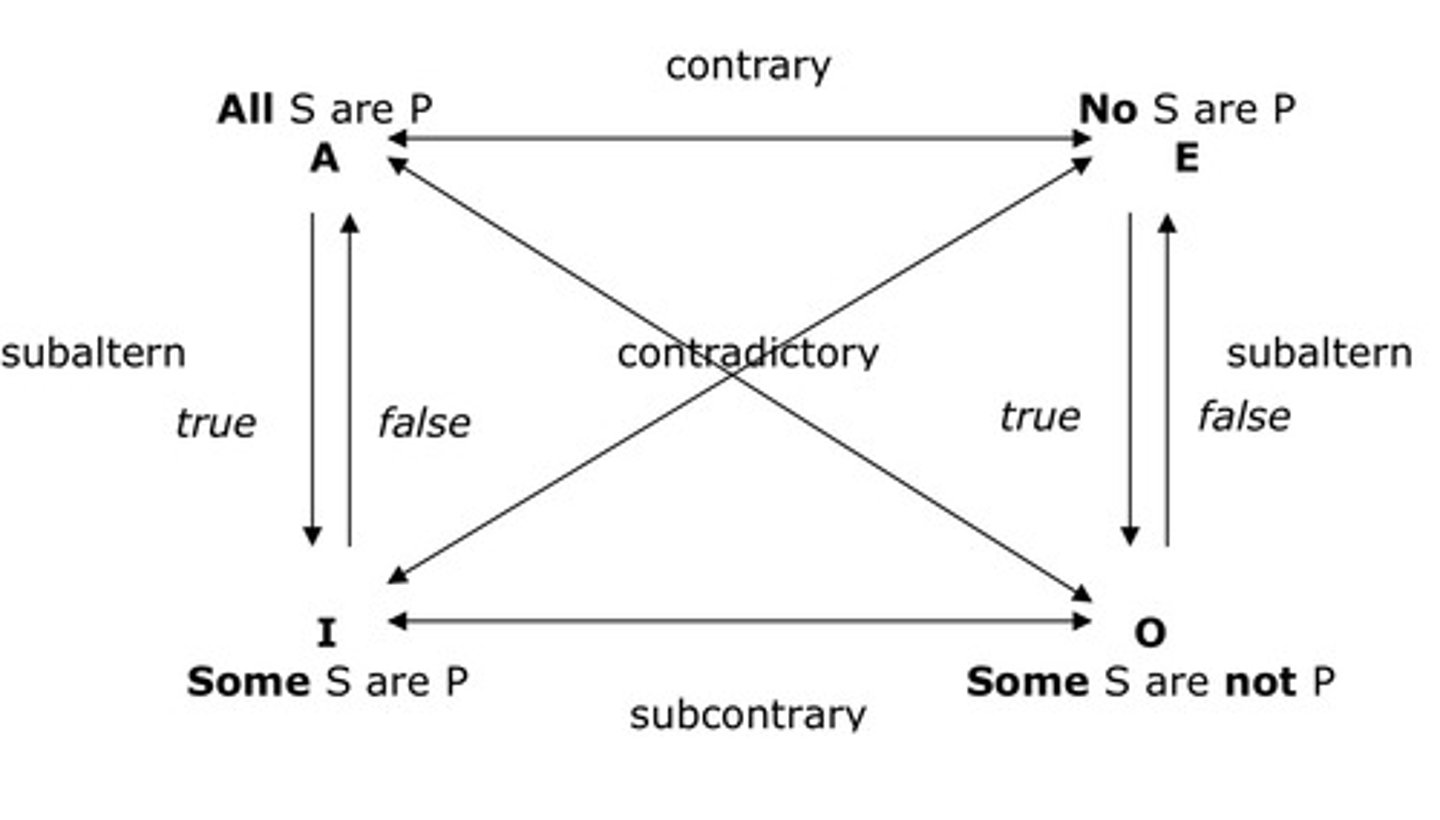
Universal positive (A) rule
ALL s are p
Partial positive (I) rule
SOME s are p
universal negative (E) rule
NO s are p
Partial negative (O) rule
SOME s are not p
Truth only goes from (subaltern)
Universal to partial
False only goes from (subaltern)
Partial to universal
Partial Affirmative label
I
Universal positive label
A
Universal negative label
E
Partial negative label
O
Existential import (x) (venn diagram)
There must be at least one S????
Contrary (A and E)
Can never be both true, may be both false
Subcontrary (I and O)
Must be both false, may be both true
A true I statement
means O does not matter, it is automatically invalid as there is more than one option
silogisms form
1. Major premise (P + Middle term)
2. minor premise (S + Middle Term)
3. conclusion (S+P)
Term S in logic
subject, can not be in first line, if so switch line 1 and 2
Term P in logic
preterate
Why we reason
To argue
Neccessity vs sufficiency conditions
1. P and Q
2. P and not-Q
3. Not
Try to make logic square
Conditional Logic
Solving problems based on "if p, then q" structures, including abstract versions and those framed through "permission schemas
Permission schema
Rule that relates action to precondition
If X then Y must happen first
If not-X then it does not matter
If Y then X may happen
If not-Y then action must not be taken