ap hug semester 2 final exam
 Call Kai
 Learn
Learn Practice Test
 Spaced Repetition
 Match
Match Flashcards
 Knowt Play
1/76

There's no tags or description
Looks like no tags are added yet.
Name | Mastery | Learn | Test | Matching | Spaced | Call with Kai |
|---|
No analytics yet
Send a link to your students to track their progress
77 Terms
Unit 4: nation
A group of people with shared culture, language, history, or identity
Unit 4: state
A political unit with defined borders, government, and sovereignty.
Unit 4: nation-state
When a nation and a state mostly overlap (ex: Japan)
Unit 4: Nation-less states (stateless nations)
Groups of people with a shared identity but no country of their own
Examples: Kurds, Palestinians, Chechens, Basques
Unit 4: Significance of the Berlin Conference of 1884–1885
European powers divided Africa without considering ethnic groups
Created artificial borders → leads to conflict still today
Unit 4: Legacy of colonialism
Language: European languages still spoken (English, French)
Religion: Spread of Christianity
Dependent Economy: Many countries depend on exporting raw materials (dependent economies)
Unit 4: boundary types→ superimposed, geometric, natural.
drawn over existing groups (Africa)
straight lines (U.S.–Canada border)
physical features (rivers, mountains)
👉 In Africa, many borders cause conflict because they split ethnic groups
Unit 4: Ratzel vs Mackinder vs Spykman
(Organic Theory): States grow like living organisms
(Heartland Theory): Control Eastern Europe = control world
(Rimland Theory): Control coastal areas = control world
Unit4: what was the apartheid in South Africa?
A system of racial segregation where nonwhite people had fewer rights in South Africa after white people colonized the area, settling there. (1948–1990s)
Unit4: wallerstein’s world systems theory
Core: rich, developed countries
Periphery: poor, less developed countries
Semi-periphery: in between
👉 Core exploits periphery for resources and labor
Unit 4: Centripetal vs Centrifugal forces
unite people (strong education, shared culture)
divide people (inequality, language differences)
Unit 4: Devolution & Balkanization
power moves from central government to regions
a state breaks into smaller, often hostile states
Unit 4: Shapes of states Compact, Elongated, Prorupted
Compact and easy to govern (Poland)
long and stretched shape (Chile)
Compact with a extension for resources (Thailand)
Unit 4: shapes of states Fragmented, Perforated, Landlocked,
separated pieces (Indonesia)
one state surrounds another (South Africa/Lesotho)
no ocean access (Bolivia)
unit 4: Unitary vs Federal states
power at central government (France)
power shared with regions/states (U.S.)
Unit 4: Reapportionment & Gerrymandering
(redistricting): redrawing voting districts after census
manipulating boundaries to benefit a group/party
Unit 4: Supranational organizations
NATO: military cooperation
European Union: economic/political cooperation
United Nations: global peace and cooperation
Unit 5: Intensive vs Extensive Agriculture
small land, lots of labor (rice farming in Asia)
large land, less labor (wheat farms, ranching in U.S.)
Unit 5: shifting agriculture
farmers move fields after soil loses nutrients (tropics: Africa, South America)
Unit 5: von Thünen Model (Bid-Rent Theory)
Land use depends on distance to market (transport cost vs profit), the farther you go from the CBD the land cost decreases, but the closer you get to the CBD the more expensive land gets.
Unit 5:Rings (from city outward):
1. Dairy & perishables
2. Forest (wood)
3. Grains
4. Livestock ranching
Unit 5: Malthus vs Boserup & Carrying Capacity
Thomas : population grows faster than food → crisis
Ester : technology increases food supply when needed
max population an area can support
Unit 5: agricultural revolutions
1st: Neolithic (10,000 yrs ago) → hunting and gathering to subsistence farming, farming begins (permanent settlements)
2nd: Industrial (1700-1800 Britain) → subsistence farming to commercial, (increased peoples wealth) ,machines, better tools (more efficiency)
3rd (Green Revolution) (1940s Mexico): new seeds, fertilizers → big increase in food, but environmental issues
Unit 5: LDCs exploited by MDCs (Cash Crops)
___ grow cash crops (coffee, cotton) for export
Less focus on staple crops → can cause food shortages
Unit 5: agribusiness
Large, corporate, commercial farming focused on profit (common in MDCs)
Unit 5: Sustainable Agriculture & Organics
Focus on protecting environment and long-term farming for future Generations to come.
Organic farming avoids chemicals but not zero.
Reaction against industrial farming problems
Unit 5: Climate & Crops
Luxury (cash) crops: tropical climates (coffee, sugar, bananas)
Staple crops: vary by region
Rice → warm/wet Asia
Wheat → drier climates (U.S., Europe)
Corn → temperate climates
Unit 5: moar globally consumed staple crop
Rice.
Unit 7: Brandt Line (MDCs vs LDCs)
The Brandt Line is an imaginary line that divides the world into:
(More Developed Countries) → wealthier, industrialized (U.S., Europe, Japan)
(Less Developed Countries) → poorer, less industrialized (Africa, parts of Asia, Latin America)
Unit 7: Primary, Secondary, Tertiary Activities
→ get raw materials (farming, mining) → common in LDCs
→ manufacturing goods (factories) → growing in developing countries
→ services (teachers, doctors, retail) → dominant in MDCs
Unit 7: Gap Between Core & Periphery
rich, powerful
poor, less developed
The gap is increasing because core countries control trade, technology, and wealth.
Unit 7: HDI (Human Development Index)
Life expectancy (health)
Education
Income (GNI per capita)
High → North America, Europe
Low → Sub-Saharan Africa
Unit 7: Economic, Social, Demographic Indicators
income, jobs, GDP
education, healthcare, literacy
population growth, birth/death rates
Unit 7: Approaches to Development - Self- sufficiency & Rostows Stages of Economic Growth)
build your own economy (limit imports)
countries go through stages from traditional → modern
Unit 7: Approaches to Development - dependency theory, sustainable development
→ poor countries depend on rich ones
→ grow without → poor countries depend on rich ones
Unit 7: Commodity Chain & New International Division of Labor
-LA commodity chain shows how a product is made across different countries. Example: a T-shirt may be designed in the U.S., made in Asia, sold worldwide.
-New International Division of Labor = companies move jobs to cheaper countries (outsourcing).
Unit 7: neocolonialism
MDCs still control LDC economies through business and trade, even without political control.
Unit 7: islands of development
Small areas of wealth (like big cities) in poorer countries that grow rapidly into megacities.
Unit 7: Cottage Industries → Mass Manufacturing
handmade goods at home
large-scale factory production
Unit 7: Break-of-Bulk Points
is where goods are transferred (ship → truck), often increasing cost.
Unit 7: Bulk-Gaining vs Bulk-Reducing
→ product loses weight (mining) → near raw materials
→ product gains weight (bottling soda) → near market
Unit 7: site factors
Costs inside the factory:
Land
Labor
Capital (money)
Unit 7: situation factors
Location-related:
Near raw materials
Near markets
Transportation access
Unit 7:Deindustrialization → Gentrification
factories close in MDCs and move elsewhere
Leads to urban decline, then____ (wealthy people move in, area improves, prices rise)
Unit 7: Labor-Intensive Industries (Textiles)
Need lots of workers → located in LDCs where labor is cheap.
Unit 7: maquiladoras
Factories in Mexico near the U.S. border that import materials, assemble goods cheaply, and export them.
Unit 7: Outsourcing (T-shirt example)
Companies send production to other countries to reduce costs.
Unit 7: just in time delivery
Companies receive materials only when needed to reduce storage costs.
Unit 7: Fordist vs Post-Fordist Production
mass production, standardized goods
flexible, customized products
Unit 7: Basic industries
export goods from foreign suppliers (bring money in through tourism ect)
Unit 7: non basic industries
Domestic local services bring in money to country (restaurants, shops)
Unit 7: christallens central place theory
Cities are formed by hexagonal shapes to maximize equal distance, explains how businesses and services are spread around in the area.
Unit 7: range & threshold
how far people are willing to travel
The minimum amount of customers needed to support a job.
Unit. 7: Market Areas = ___
=functional regions where ideas/people/ products go in and out, Areas served by a business (like a shopping mall’s customers).
Unit7: gateway cities
Cities that connect regions (major ports, airports).
Unit. 7: Bid-Rent Theory (Retail Location)
land cost is highest near the city center → businesses that can pay the most locate there.
Unit 6: Highest Urbanization in LDCs
Latin America has very high urbanization due to migration to cities.
Unit 6: Blockbusting, Filtering, Redlining
agents scare white homeowners to sell cheaply
= homes decline over time and become affordable
= banks refuse loans in minority areas
Unit 6: Where Are Poor People Located?
MDCs → inner-city ghettos
LDCs → outskirts (squatter settlements)
Unit 6: Rising Middle Class (India & China)
Growing economies = more jobs, better income, more consumers.
Unit 6: Rank-Size Rule
Cities follow a pattern:
2nd largest = 1/2 size of largest
3rd = 1/3 size, etc.
Unit 6: primate cities
A city that is double the size of the second largest city, controlling the cities cultural, political and societal aspects.
Unit 6: Islands of Development → Megacities
Wealthy urban centers grow into huge cities in LDCs.
Unit 6: MDC & LDC Urban Models
→ organized, zoning, suburbs
→ rapid growth, informal settlements
Unit 6: New Urbanism
Planning cities to be:
Walkable
Mixed-use
Environmentally friendly
Unit 6: pros of gentrification
Safer neighborhoods
Better buildings
More businesses
Unit 6: cons of gentrification
Higher rent
Poor residents forced out
Loss of culture
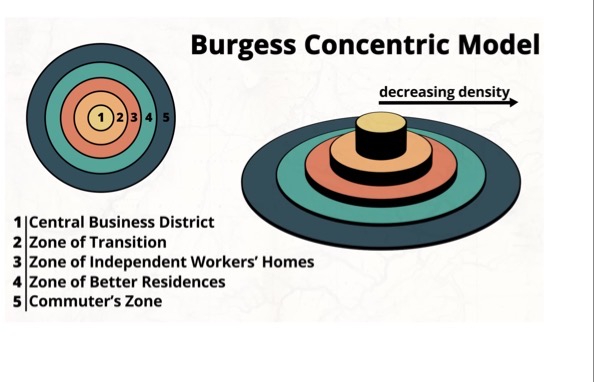
Unit 6: North American City models → concentric zone model
Has circular rings that sprout outward from the CBD. It goes out from working class industries middle class and commuters. The farther you get the less density there is of people.
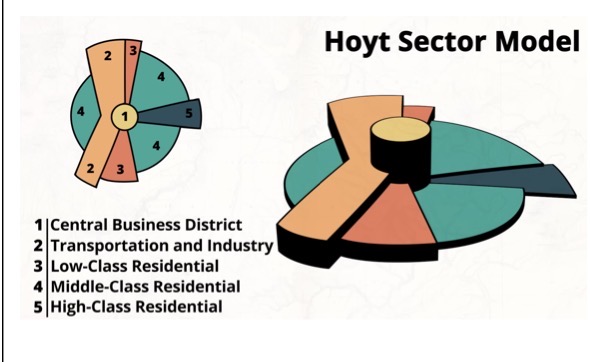
Unit 6: North American City models → Hoytt sector model
Wedge shaped sectors CBD, less dominant low income resident's, always near factories and transportation
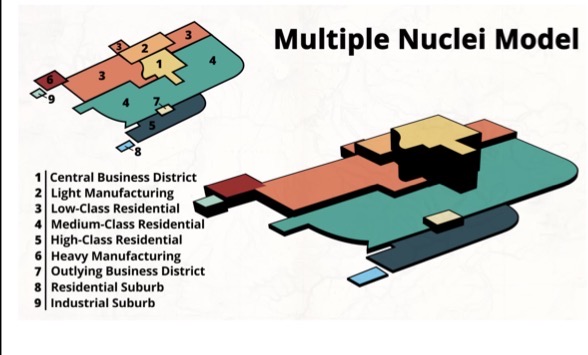
Unit 6: North American City models → Harris and Ullman Multiple nuclei model
Multiple centers (nodes) developed because the importance of CBD's is decreasing, lots of business districts in high consumption areas in each node.
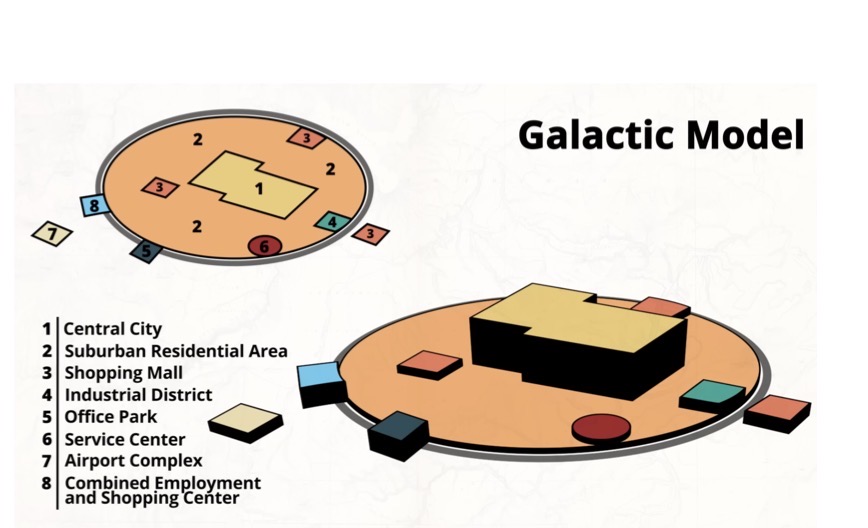
Unit 6: North American City models → Galactic model
Cities are spread outward (urban sprawl). It creates multi cities and the growth of edge cities surrounding the CBD in a ring (suburbs), highly dependent on transportation and cars.
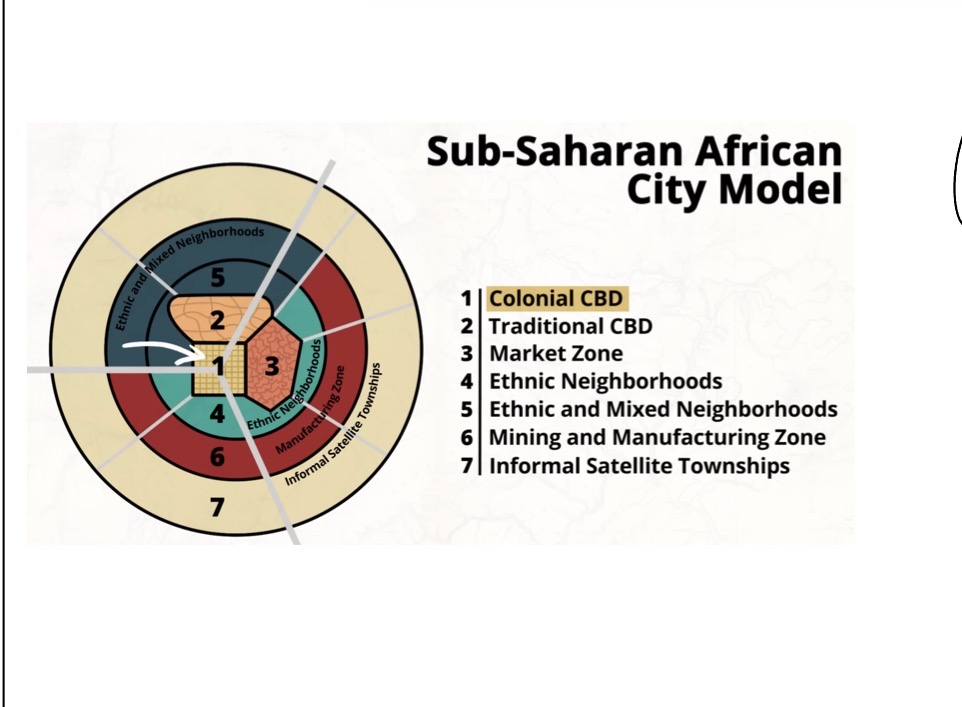
Unit 6: LDC City model→ Sub-Saharan African model
CBD consists of a market and a traditional CBD (2 CBDs), influenced by colonization. Ethnic and mixed and industries surround the CBD while the squatter settlements circle around everything.
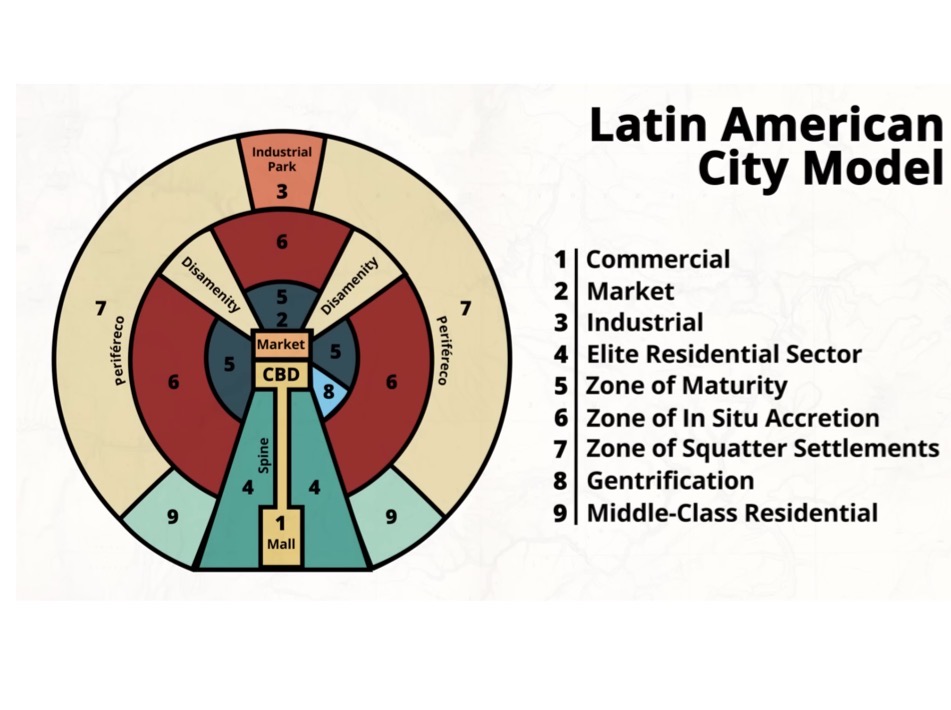
Unit 6: LDC City model→ Latin American model
The CBD consists of a plaza and a religious building. The elite are in the center and the poor are on the outskirts lots of Favela's (squatter settlements).
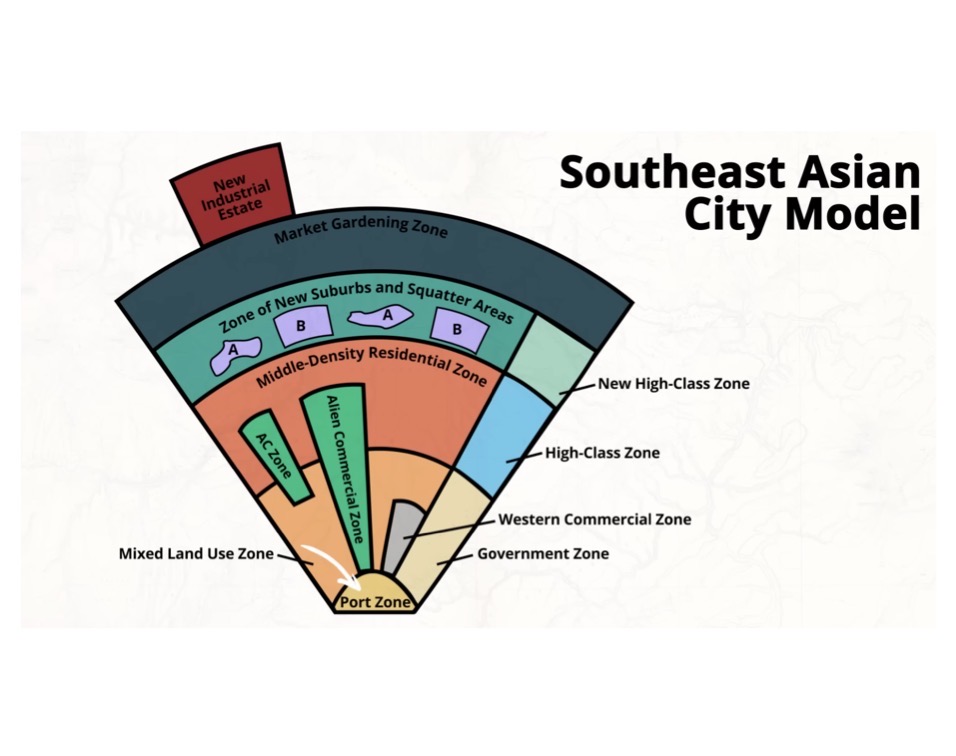
Unit 6: LDC City model→ southEast Asian model
The CBD focuses on a port for exporting manufactured goods. It comes from colonial needs. Special economic zones sprout from the port towards all the sectors. New industries are at the edge. Poor and well off residence live clustered together. New housing and government buildings are on the side.