4 Dynamics of Microbial Growth
 Call Kai
 Learn
Learn Practice Test
 Spaced Repetition
 Match
Match Flashcards
 Knowt Play
1/25

There's no tags or description
Looks like no tags are added yet.
Name | Mastery | Learn | Test | Matching | Spaced | Call with Kai |
|---|
No analytics yet
Send a link to your students to track their progress
26 Terms
binary fission
Bacteria growth is measured by the number of cells.
Done through __: asexual reproduction in which one cell divides to form two identical daughter cells
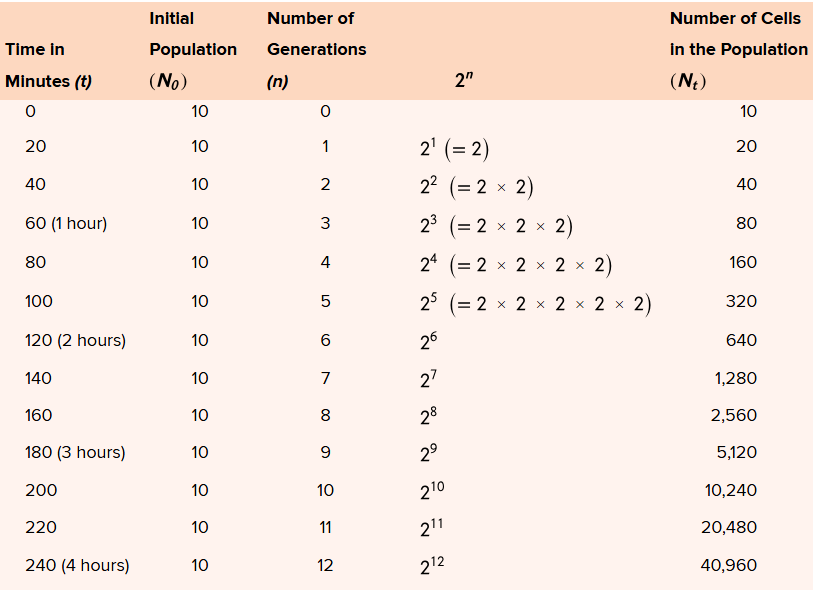
Growth is exponential → population doubles with each division
Nt = N0 × 2n ,
wherein
Nt = number of cells at a given time (t)
N0 = initial amount of cells
n = number of generations at that point in time*
(*) must account for Generation time
Generation time
Speed of bacterial growth depends on
__: time taken for a cell to divide or population to double
varies from species to species
also dependent on environmental conditions
nutrient-rich mediums = faster time
ideal temperature of growth affects speed
eg. E. coli normally grows at 37 degrees Celsius
10 days
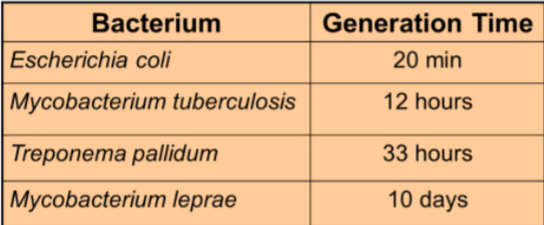
Mycobacterium leprae has a generation time of __
Treponema pallidum
Organism that causes syphilis. Has a generation time of 33 hours
33 hours
Treponema pallidum (causes syphilis) has a generation time of __
12 hours
Mycobacterium tuberculosis has a generation time of __
chronic
Since Mycobacterium tuberculosis has a generation time of 12 hours,
TB (the disease it causes) is considered a __ disease, as it takes a long time to develop
20 minutes
Escherichia Coli has a generation time of __.
Pure culture
Population of cells derived from a single cell.
Clones; genetically identical
aseptic technique
How pure culture is maintained; set of procedures used to minimize potential contamination
Culture medium
Where bacteria is grown in or on
Contains nutrients dissolved in water
can be:
broth: liquid media
solid gel: broth media with the addition of agar
Agar
Marine gel extract that is added to broth to turn it into solid media
liquefies/melts at >95 degrees Celsius
boil to revert back to broth
solidifies at 45 degrees Celsius
solid at room temperature and body temperature
remains solid over entire temp. range most microbes grow
Petri dish
Two ways to grow bacteria on solid agar
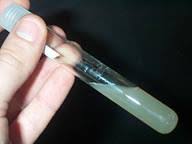
slant: agar in a tube solidified at an angle → angle gives more SA for bacteria to grow
__: agar plate → ideal amount of large SA where bacteria can grow into colonies: distinct masses of cells
note: ~1 million bacteria already grown if it’s macroscopic to the eye
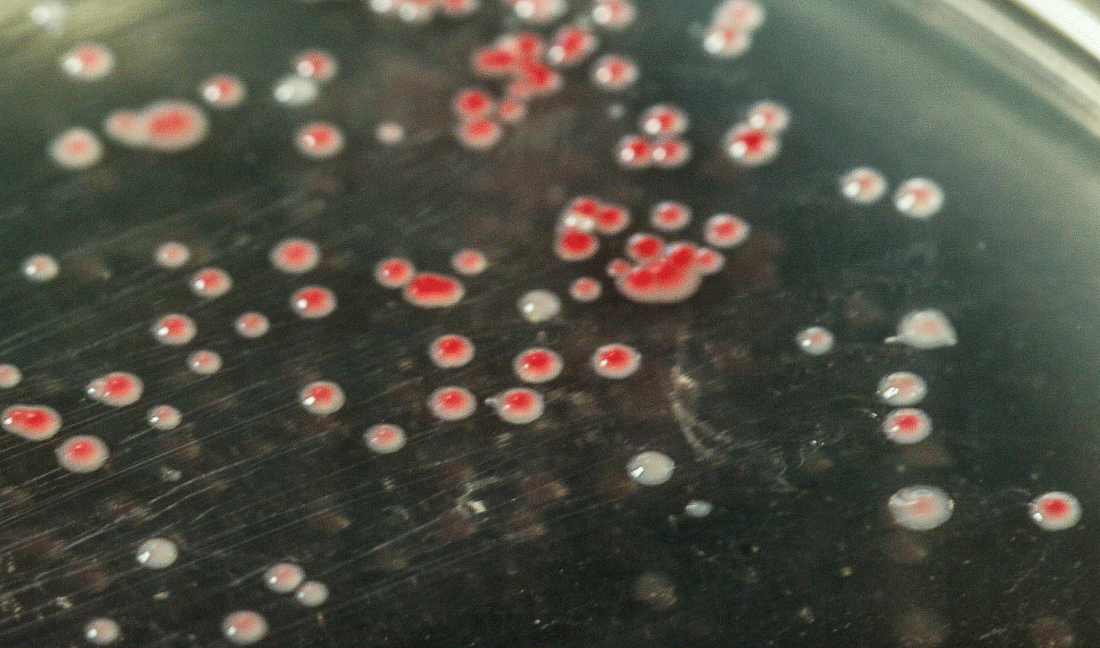
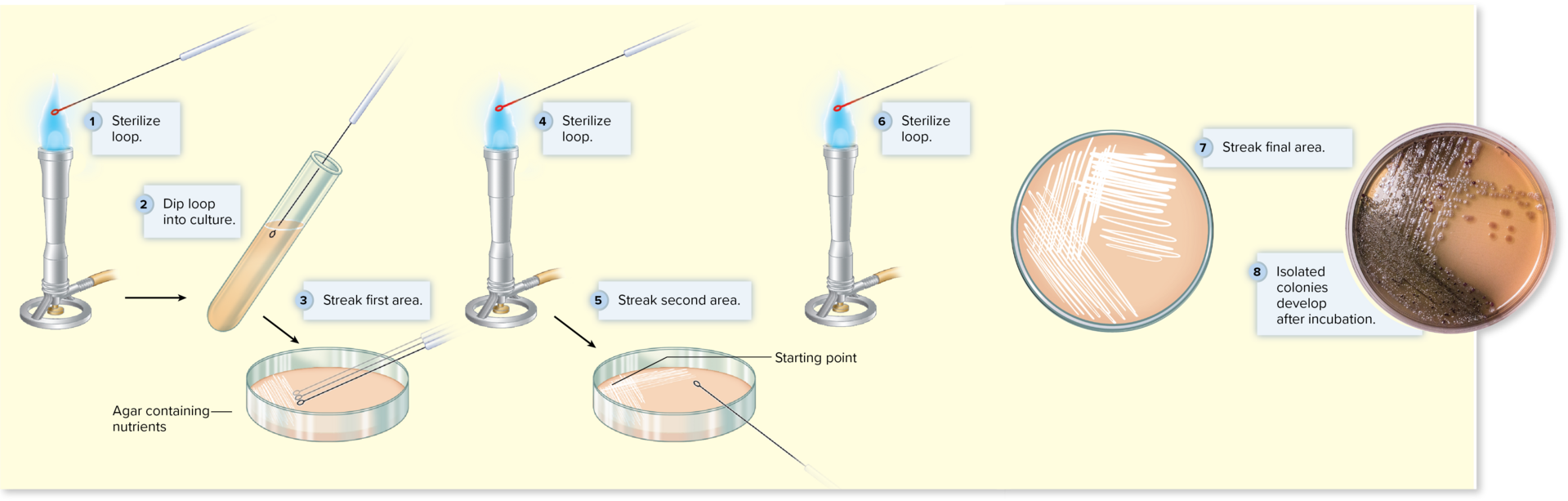
Streak-plate method
Simplest and most commonly used technique for isolating bacteria
Successive streak patterns used to sequentially dilute an inoculum on the surface of an agar plate
→ spreads out cells into isolated colonies
w/ goal: retrieving a pure culture
closed system
Bacteria grown on agar plates / tubes / flasks of broth are __(s)
i.e, batch cultures
what is inside stays inside
nutrients not renewed; wastes not removed. hence it is a __!
running low on nutrients / inc. waste → stops growth on own
Growth Curve
Batch cultures demonstrate this characteristic pattern of bacterial growth and decline due to its limited resources
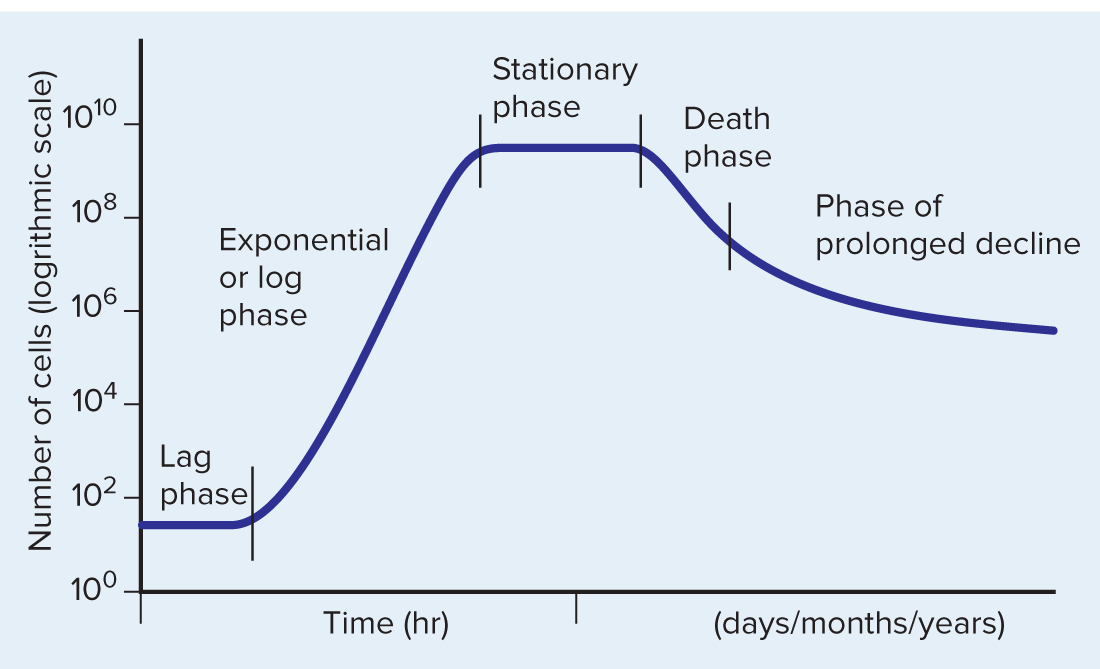
lag phase: cell number doesn’t increase. bacteria preparing for growth
log / exponential phase: where cells grow as quickly as possible
most sensitive to antibiotics in this phase (penicillin!)
energy is spent on growing rather than surviving
stationary phase: number of cells produced = cells dying (equilibrium). overall population stabilizes
happens from exhausted nutrients or waste build up
death phase: total number of viable cells decreases. death is exponential
phase of prolonged decline: 99% of cells are dead
gradual decrease in viable cell population
most adapted cells survive
lag phase
1/5 distinct stages in the Growth Curve
Cell number doesn’t increase. Bacteria preparing for growth
exponential phase
2/5 distinct stages in the Growth Curve
When cells grow as quick as possible. Also known as log phase.
sensitive to antibiotics as energy redirected to growth, not survival
penicillin especially effective → targets peptidoglycan synthesis
3/5 distinct stages in the Growth Curve
4/5 distinct stages in the Growth Curve
5/5 distinct stages in the Growth Curve
extremophiles
Prokaryotes that live harsh environments
primarily of Archaea domain
Temperature
¼ environmental factors that influence growth
This is because each species has a well defined __ range » optimum growth [_]
Prokaryotes divided into 5 categories by these ranges:
Psychrophiles (-5 to 15 C)
Psychrotrophs (20 to 30 C)
Mesophiles (25 to 45 C)
Thermophiles (45 to 70 C)
Hyperthermophiles
Oxygen
2/4 environmental factors that influence growth
pH
¾ environmental factors that influence growth
water availability
4/4 environmental factors that influence growth