chemistry
 View linked note
 Call Kai
 Learn
Learn Practice Test
 Spaced Repetition
 Match
Match Flashcards
 Knowt Play
1/90

There's no tags or description
Looks like no tags are added yet.
Name | Mastery | Learn | Test | Matching | Spaced | Call with Kai |
|---|
No analytics yet
Send a link to your students to track their progress
91 Terms
Relative atomic mass
The average mass of an atom of an element relative to 1/12 the mass of a carbon-12 atom.
Isotope
Atoms of the same element with the same number of protons but different numbers of neutrons.
Atomic number
the number of protons in the nucleus of an atom. Mass number is the sum of protons and neutrons in the nucleus.
Elements, compounds, mixtures
An element is a substance made up of only one atom.
Compounds are joined by 2 or more atoms by any type of chemical bond
Mixtures are made from 2 ions, compounds, mixed together but not chemically bonded
Mole
A different way to count the particles within a substance
Solution, solute and solvent
Components of a solution where solute is dissolved in a solvent to form a homogeneous mixture.
Empirical formula
The simplest whole number ratio of atoms of each element present in a compound.
Molecular formula
A chemical formula indicating the actual number of atoms of each element in a molecule.
Skeletal formula
A simplified organic formula showing atom arrangement without all bonds.
Displayed formula
A molecular formula showing all atoms and bonds in a molecule.
Homologous series
Organic compounds with the same functional group and similar properties.
Structural isomer
Isomers with the same molecular formula but different structures.
Stereoisomer
Isomers with the same molecular and structural formula but different has spatial arrangements.
Optical isomer
Non-superimposable mirror image stereoisomers.
Chiral centre
An atom in a molecule bonded to four different groups.
Complete and incomplete combustion
Complete combustion produces CO2 and H2O
Incomplete combustion produces CO or C.
Molecular ion peak
Peak in a mass spectrum corresponding to the molecular ion.
Fragment
A smaller molecule formed during mass spectrometry.
Isotopic abundance
Relative amount of each isotope of an element in a sample.
SN1 reaction
A two-step reaction forming a carbocation intermediate.
SN2 reaction
A one-step reaction with simultaneous nucleophile attack and leaving group departure.
SEAR reactions
Single electron transfer-aromatic substitution reactions.
Essential amino acid
Amino acid essential from the diet, not synthesized by the body.
Buffer
A solution resisting pH changes with acid or base addition.
Optimum temperature/pH
The most efficient temperature or pH for a reaction.
Dynamic equilibrium
State with constant reactant/product concentrations due to equal forward and reverse reaction rates.
Closed system
A system where neither matter nor energy can enter or leave.
Position of equilibrium
Relative reactant/product concentrations at equilibrium.
Le Chatelier's principle
System at equilibrium shifts to counteract changes in temperature, pressure, or concentration.
Catalyst
Substance increasing reaction rate without being consumed.
When a substance is used to quicken up the rate of a reaction without being used up itself
Equilibrium constant
Ratio of product to reactant concentrations at equilibrium.
Common ion effect
Suppression of weak electrolyte ionization by a strong electrolyte with a common ion.
Partial pressure
Pressure from one gas component in a mixture.
Mole fraction
Ratio of moles of a component to total moles in a mixture.
Rate of reaction
Change in concentration per unit time.
Collision theory
Reactions occur when particles collide with sufficient energy and orientation.
Activation energy
Minimum energy for a reaction to occur.
Maxwell-Boltzmann distribution
Distribution of molecule speeds in a gas at a given temperature.
Rate equation
Relates reaction rate to reactant concentrations.
Rate constant
Proportionality constant in the rate equation.
Order of reaction
Exponent of the concentration term in the rate equation.
Strong acid/base
Acid/base fully dissociating in solution.
Weak acid/base
Acid/base ions partially dissociating in solution.
pH scale
Scale indicating solution acidity or basicity between 1-14.
pKa
Negative logarithm of the acid dissociation constant (Ka).
Kw – self ionisation of water
Equilibrium constant for water autoionization.
Spectroscopy
Study of matter-electromagnetic radiation interaction.
Fingerprint region
Infrared spectrum region with unique absorption bands.
it is a region between o-1500
Carbon environment
Local chemical environment influencing NMR chemical shift.
Chemical shift
Peak displacement in NMR spectrum, measured in ppm.
Integral
Area under an NMR peak, proportional to contributing protons.
Enthalpy of combustion
this is when heat energy is given out when one mole of a substance burns completely in oxygem
Standard enthalpy
the change under standard conditions
Enthalpy
it is the total energy associated with a system at constant pressure
oxidation
loss of electrons
reduction
gain in electrons
redox
combination of reduction and oxidation
hybridisation
combination of S-orbitals and P-orbitals to form new atomic orbitals from the originals
electronegativity
power of an atom to attract electron density from inside of a covalent bond
Types of intermoleculer forces
hydrogen bonding
dipole-dipole (temporary)
london forces
Collision theory
A reaction can only take place if:
particles collide
collide with sufficient energy
collides at the correct orientation
Increasing rate of reaction
add catalyst
increase temperature
increase pressure
increase surface area
stir solution (particles with collide with each other)
ionic bonding
it is an electrostatic attraction between oppotively charged ions
hydrogen bonding
it is a weak electrostatic attraction between electrons due to an uneven distribution of electrons in some atoms
Test for alcohols
white misty fumes of HCI will be released
the fumes will become acidic and turn the universal indicator paper red
Test for haloalkanes
coloured precipitate
exited state
When an electron is given energy to move up in higher energy levels
sometimes the electron can be exited so far it can leave the atom leaving a positively charged ion
Relaxation state
when energy is released from an electron making it move in lower energy levels
Atom
the smallest particle made up on protons, electrons and neutrons
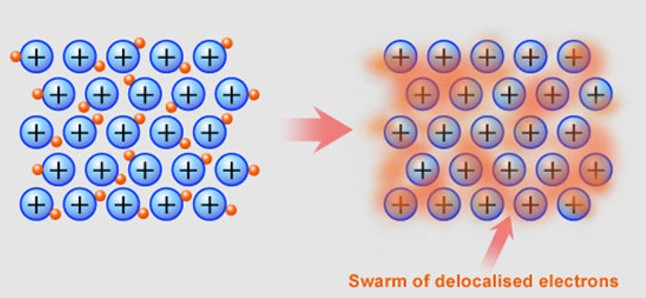
metallic bonding
A metallic bond is the electrostatic attraction between the sea of delocalsed electrons and lattice of positive ions
Equilibrium constant Kc
It is a constant which describes the ratio of products and reactants in a given equilibrium at a given temperature
Ionisation energy down a group
Atomic radius increases down a group
outer electrons are further from the nucleous
electrostatic attraction is decreased
less energy is needed to remove outer electrons
Shielding increases down a group
more repulsion between inner and outer electrons
less energy needed to remove outer electrons
Ionisation across a period
Atomic radius decreases
outer electrons are held more strongly by nucleus
needs more energy to remove outer electrons from the atom
shielding fills same outer energy level across a period
S-Orbitals
s-orbitals are like electron shells
There is only one s-orbital in each sublevel
They increase in size as they move up the energy levels
They fit around each other, with the nucleus in the middle
P-Orbitals
p-orbitals have a “dumbbell” or “figure of 8” shape
There are three p-orbitals in each p-sublevel
Each p-orbital points in a different direction
They fit together to make the p-sublevel
3 pieces of evidence to disprove kekule structure of benzene
Does not react with bromine water due to a lack of discreet C=C bonds
Reduced energy of hydrogenation
all bond lenghts are the same
How to identify peaks in chemical analysis
Anything between 0-1500 is a fingerprint region which can be ignored
Polar bonds
A significant difference in electronegativity values
Lattice enthalpy
When one mole of an ionic solid is formed in its standard state from the corresponding gaseous ions
Enthalpy of atomisation
when one mole of a gaseous atom is formed from its elements under standard conditions.
Electron affinity
When one mole of a gaseous atom gains one mole of electron to form one mole of a gaseous anion
spontaneous reaction
Depends on the entropy change of its surroundings which change as energy is released or absorbed
Enthalpy
Amount of energy lost or gained by a system but does not tell you whether a reaction will occur or not
Primary in haloalkane functional groups
When a haloalkane is attached to a carbon which is attached to the end of the carbon chain
secondary in functional group
When a functional group is attached to a carbon which is attached to 2 other carbons
tertiary
When a functional group is attached to a carbon attached to 3 other carbons
Electrophile
Takes H+ ion pair
nucleophile
Donates H+ ions
2nd laws of thermodynamics
Energy is neither lost nor gained but can only be transferred to another energy source
Entropy can increase constantly inside of a closed system
how does Entropy change in different processes
Entropy increases from solid to liquid to gas
The entropy change can be predicted whether if it is positive or negative by looking at the phases of the reactants and products
Formation of a covalent bond when orbitals overlap
When 2 atoms come close together the atomic orbitals overlap. The overlap allows electrons from each atom to be shared between them. The sharing of electrons creates a bond between the atoms.