contact lens designs
 Call Kai
 Learn
Learn Practice Test
 Spaced Repetition
 Match
Match Flashcards
 Knowt Play
1/20

There's no tags or description
Looks like no tags are added yet.
Name | Mastery | Learn | Test | Matching | Spaced | Call with Kai |
|---|
No analytics yet
Send a link to your students to track their progress
21 Terms
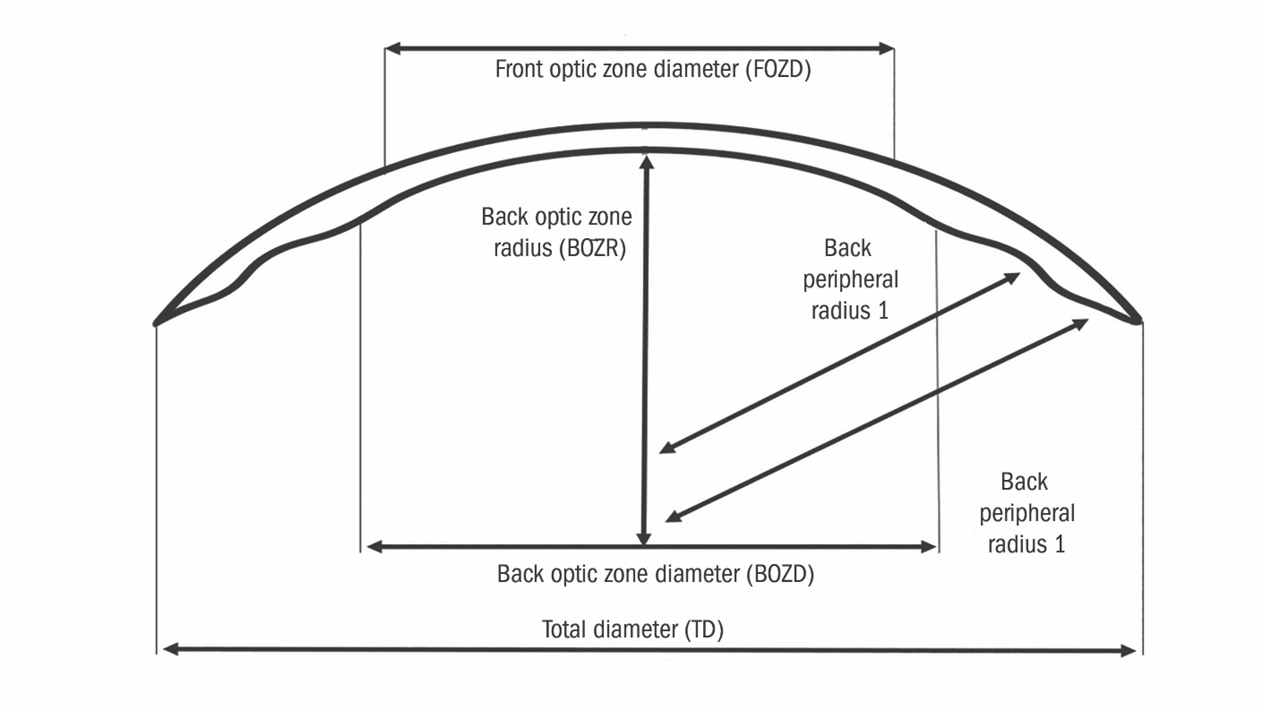
what is the main anatomy of a contact lens (5)
known as parameters:
front optic zone diameter - FOZD
back optic zone diameter - BOZD
total diameter - TD
back peripheral radius 1 + 2
back optic zone radius - Base curve - BC
what parameters are commonly found on the blister pack (3)
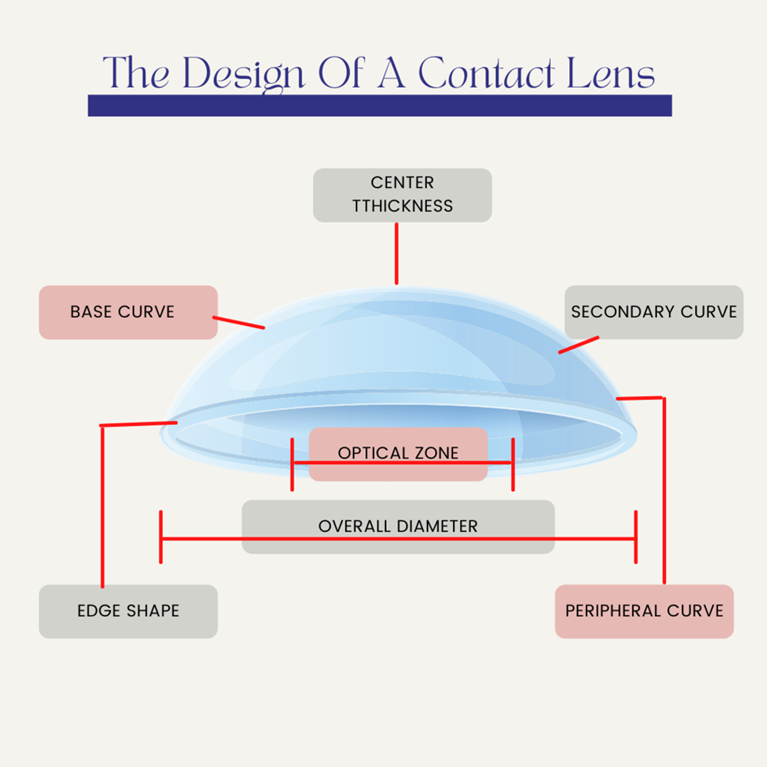
base curve - curvature measured in mm
TD - width of lens in mm
power - sphere/cyl - measured in diopters
describe lens diameter of a soft contact lens (2)
Total contact lens diameter – greater than HVID
lens is usually much bigger by a couple mm – drapes over cornea and rests on conjunctiva
describe thickness of soft contact lenses (3)
prescription determines thickness
mid periphery and peripheral curves fixed in design
interested in central thickness, mid periphery and overall
describe curvature of soft contact lenses (2)
front and back optical radii will determine optical value; the power difference between the 2 determines the optical value - the power of the lens
other radii (peripheral) on contact lens determine physical design - the fit of the lens - ensure lens is smooth on edges and don’t irritate eye or bulge into conjunctiva
describe design of soft contact lenses (2)
further design of lens radii of peripheral curves; their widths, number and junctional curves
junctional curves - blended curves – from OZ to mid periphery – more to do with hard contact lenses – if hold up to light may see shadow which represents junctional
describe the ideal relationship of soft contact lenses with the eye (2)
parameters of the contact lens should closely meet the dimensions of the ocular surface
ideal - alignment fit - measure surface of cornea – fit a CL which aligns with this – don’t want it to be too flat or steep
what are the basic lens designs (3)
Spherical – 1 power
Toric - astigmatic - 2 meridians - each with own power
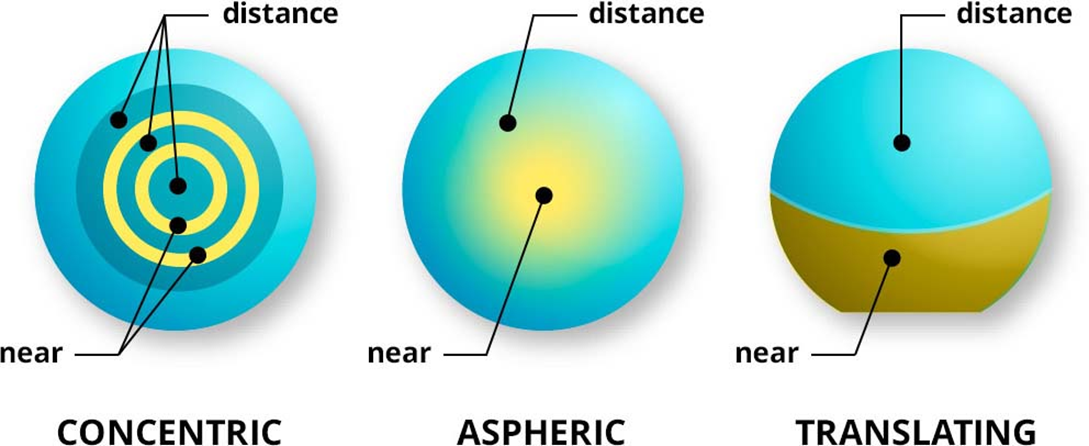
Multifocal – aspheric in design – blended powers
show how there is a variety of designs of multifocal lenses relating to where the power lies
describe what the base curve is and how we calculate it - also state the average BC value (4)
is the fit of the lens of the eye - base line curvature of the eye - OZ radii how it fits onto eye
take the readings from keratometer or topographer - k readings
(K1 + K2) / 2 + 0.9mm
Normal base curve – 8.4-9.2mm – as fitting slightly flatter than eye – dependent on k readings but not based on it
describe how we calculate the total diameter (2)
Soft lenses must cover the cornea and drape onto the conjunctiva
related to HVID - HVID + 2mm - as we want it to drape
describe how we calculate the optic zone (3)
Where the power is on the lens - what makes the person see - centre of the lens - determines power of the lens
related to pupil size
OZ needs to be bigger than the scotopic pupil - usually 6-7mm - or a little bigger depending on px
describe how we calculate the power (3)
Based on the refraction
May be spherical or toric of a MF or a toric MF
Vertex correction applies >4D in any meridian
explain the term vertex distance and how the vertex distance affects the power chosen for the contact lens (5)
The distance between the front surface of the cornea and the back lens surface is called vertex distance
Vertex distance affects how light bends, which impacts vision clarity and lens power.
Because the CL rests ON the eye - the vertex distance d is is essentially 0 - so effective power of the lens is impacted
for example - for a power of +6 - would need to prescribe +6.50 and for -6 would need to prescribe -5.62
Vertex distance changes mostly affect prescriptions over ±4.00 dioptres.
how do we prescribe/work out the rx if the px has a low astigmatic rx (up to 1.00DC) in addition to hyperopia/myopia (4)
in this case a soft spherical lens may be prescribed
Best Sphere = Sphere + ½ Cyl
Can only use this when the CYL component is less than a 1/3 of the total prescription - eg: if the rx was plano / -1.00 DC we would NOT use it - but if it was: -6.00 Ds / -1.00 Dc then we CAN use it - have to look carefully at the px prescription
Best Sphere is fitted in cases of 1.00DC or lower
what should be considered if the prescription has a cyl exceeding 0.75DC
toric CL is to be considered and fitted for best visual acuity.
how do we work out the prescription if it is ± 4.00 D and give an example
then the vertex distance should be calculated to determine its effective power:
Fcl/BVPcl = FSP / 1-dFSP
FSP = lens power / d = vertex distance (in m?)
eg:
+6.00 spectacle power and vertex distance of 12mm
FCL=1−(0.012×6.00)6.00
FCL=6.00/0.928=+6.47D
therefore CL power is = +6.50D
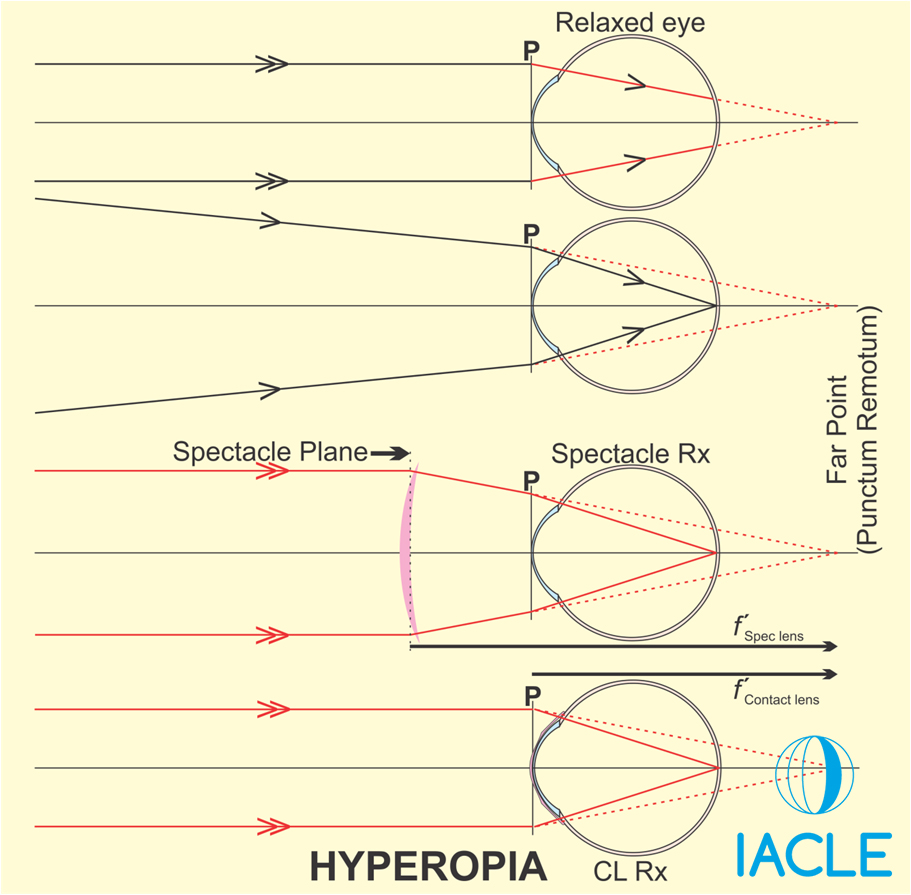
describe the difference between spectacles and CLs in correcting hyperopia (3)
focal length of spectacles is longer than the focal length of CLs
therefore CLs have a SHORTER distance over which to bring light to a focus than do spectacle lenses, i.e.
fC Lens < fSpec Lens
Therefore, the BVP/BVD of a CL must be GREATER than the equivalent CL to correct HYPEROPIA - example +6 rx needs to be +6.50 as the BVP has to be GREATER than the equivalent CL
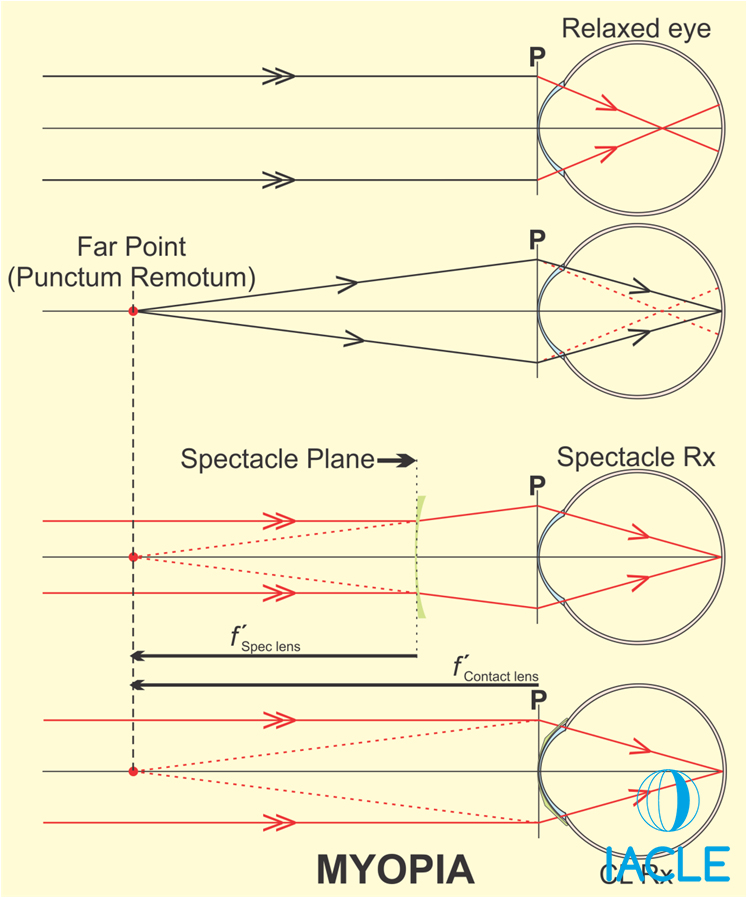
describe the difference between spectacles and CLs in correcting myopia (3)
focal length of spectacles is SHORTER than focal length of CLs
therefore CLs have a LONGER distance over which to bring light to a focus than do spectacle lenses, i.e.
fC Lens > fSpec Lens
Therefore, the BVP of a CL must be LOWER than the equivalent CL to correct MYOPIA - example -6 rx would need to be -5.62 as the BVP needs to be LOWER than the equivalent CL
explain why 2 lenses with the same sagittal height do not behave the same (3)
It is inappropriate to use sagittal heights in isolation without reference to the back surface design (at least) since assumptions of behaviour based only on a sagittal height value can be misleading
Sometimes the term sagittal depth is used rather than sagittal height. There is no difference and usage is a matter of personal preference.
Lenses don’t have same peripheral design – may have same sagittal height and diameter – but will move differently on the eye
explain the effects of sagittal height and diameter on lens fit (5)
•The diameter can be left unaltered and the sag changed by altering the BOZR.
•The diameter can be altered and the BOZR changed in such a manner that the sag is left unchanged.
•Both the diameter and sag can be changed.
•By increasing the sag height independent of diameter, the fit of the lens becomes effectively steeper and, predictably, tighter
•By decreasing the sag height independent of diameter, the fit of the lens becomes effectively flatter and, predictably, looser