unit 4: BIO 311D
 Call Kai
 Learn
Learn Practice Test
 Spaced Repetition
 Match
Match Flashcards
 Knowt Play
1/73

There's no tags or description
Looks like no tags are added yet.
Name | Mastery | Learn | Test | Matching | Spaced | Call with Kai |
|---|
No analytics yet
Send a link to your students to track their progress
74 Terms
ecology
the scientific study of the interactions between organisms and the living/biotic and non-living/abiotic parts of their environment
these interactions determine the distribution of organisms and their abundance
Why Ecology?
studying ecology helps us undertand the relationships between organisms and their environment, including how ecosystems function and how they are affected by human activities
humans are part of the global ecosystem and our everyday decisions can positively or negatively, directly or indirectly, impact all the other levels of life
can implement practices and policies to conserve and restore ecosystems for future generations
tolerance for abiotic conditions
species have a range of tolerance for abiotic conditions; sunlight, water, pH. nutrient availablity, this limits where they can live
abiotic factors
influences species distribution
ecological factors
red kangaroos are adapted to arid areas
cannot tolerate cold or wet areas
drink less water than most other kangaroos, urine is more concentrated to conserve water
history and dispersal
geographic isolation- only in Australia
land bound, cannot disperse due to continential drift
biotic factor
influence species distribution
giant kelp normally thrive in the waters along California’s coast
long-spined sea urchin eats the kelp
when sea-urchin removed, kelp growth occurs
sea otters are keystone species that eat the urchins and this helps the kelp thrive
climate change has caused an increase in urchin population, loss of otters, 95% of kelp forests have been destroyed
keystone species
disproportionately big impact relative to their abundance
population
a group of individuals of a single species living in the same general area
three ways to describe populations
number- count the number of individuals
density- estimate the number of individuals in a given area, quadrant sampling, marked
dispersion- spatial arrangement of individuals, clumped, uniformed, random
depends on environmental conditions and biological needs
Three patterns of dispersion
clumped, uniform, random
clumped dispersion
most common pattern of population dispersion
resources are patchy
social behavior (hunting, predator defense, mating/paternal care
uniform dispersion
organisms are fairly evenly spaced over the area they occupy
species with aggressive, territorial interactions
try to avoid contact, compete for a scarce environmental resource
random dispersion
organisms have an unpredictable distribution
species that do not interact strongly
ex. wind-blown dandelion seeds
population size is the result of 2 processes
birth/ immigration- add individuals to the population
death/ emmigration- remove individuals from the population
change in population size =
(birth + immigrants) - (death + emmigrants)
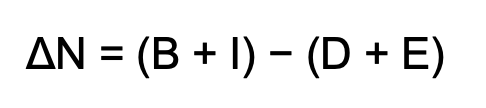
change in population size for a closed population =
births - deaths
population growth rate
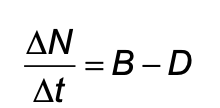
model population growth rate
births = deaths, R = 0
births > deaths, positive growth
births < deaths, negative growth
r
growth per individual and we multiply by N to get total growth R, tells you how fast individuals are reproducing
R
how much the entire population changes, tells you how fast the population is growing
exponential growth
population increase under idealized conditions, resources are unlimited
rare in the living world
when introduced species where they have no natural predators to limit growth
cannot be sustained for long
j-shaped curve
equation of exponential growth

example of exponential growth
elephant population grew exponentially after hunting was banned in Kruger National Park, South Africa
caused damage to food supply
birth control and elephants exported
carrying capacity (K)
the maximum population size the environment can support
varies depending on the resources available at any partiicular time
not a constant number so population growth is dynamic
what limits population growth in real ecosystems?
food, space, disease
logistic population growth model
the growth rate declines as carrying capacity is reached
equation starts with the exponential model and adds an expression that reduces per capitia rate of incease as N approaches K
s- shaped curve in graph
limits growth by including carrying capacity
logistic growth equation
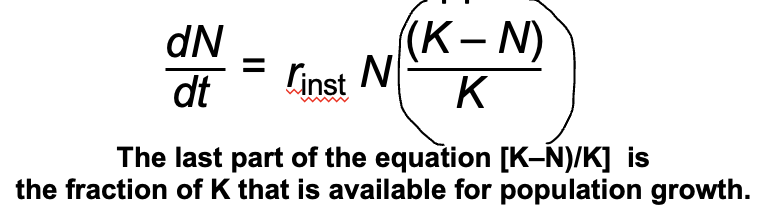
what happens to birth rates and death rates as you approach K?
birth rate decreases and death rate increases
[(K-N)/K]
the fraction of K that is available for population growth
N<<K, similar to exponential growth, close to 1
N~K, close to 0
N = K, population stops growing. = 0
Where is r greatest on the graph, where is the point of maximum growth?
steepest slope
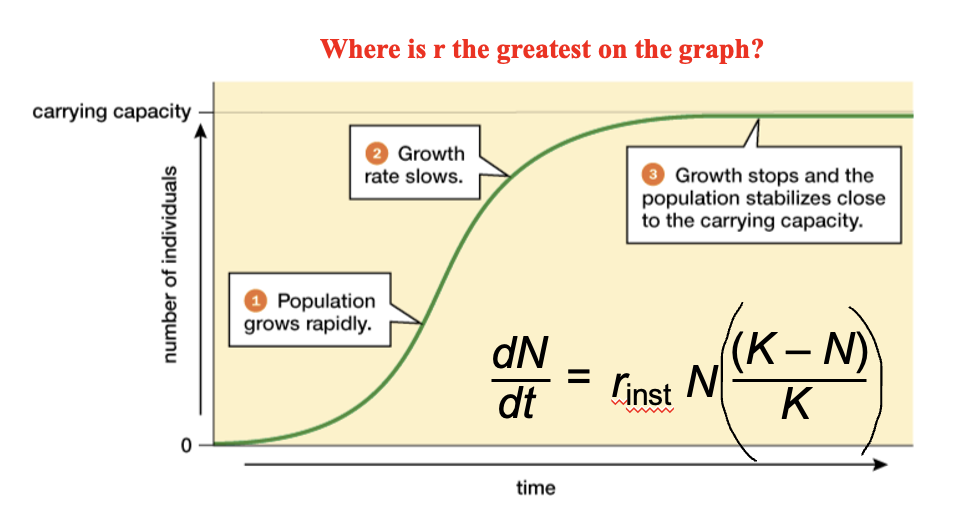
why do some populations overshoot K before settling down to a relatively stable density?
negative feedback, there are time lags for death rates to kick in and reproduction to slow down
density dependent factors
influenced by the relative size of a population
mostly biotic factors
competition for limitied resources
predators
availability for resources
nutrient supply
disease spread
accumulation of wastes
when these factors work the birth rates fall and death rates rise with > population density
keeps the population growth close to K
example of density dependent population regulation
a snowshoe hares chane of dying depends on how many lynx are present
density independent factors
not influenced by the relative size of a population
mostly abiotic parts
abiotic factors- temperature, CO2 levels
natural disasters
weather conditions
the birth rate and death rate do not change with population density
why did the human population increase relatively slowly until 1650 then begna to grow exponentially?
advances in agriculture and the industrial revolution decreased death rates and increased life expectancy
although human population is still growing, why did population growth began to slow during the 1960s?
innovation can increase K, but there are environmental limits, the carrying capacity for humans is unknown
community
a group of populations of different species living together and interacting with each other
trophic structure
a community can be organized by who feeds whom
producers
obtain atoms and energy and convert then into essential carbon-based molecules of life
make their own food
consumers
feed on producers and other consumers to survive
must consume their food
decomposers
feed on dead organisms or waste to renew the raw materials for life
break down decomposing organic matter
key for health of ecosystems
who are decomposers in land based ecosystems?
fungi, earthworms, dung beatles and other recyclers
two main types of interactions
intraspecific and interspecifc
intraspecfic interactions
interactions between organisms within the same species
competition for resources, mates, shelter
interspecfic interactions
interactions between organisms of different species
competition
predation
herbivory
parasitism
mutualism
commensalism
classification of community interactions
can have positive, negative, or nuetral
competition
(-/-) interaction
when individuals of different species compete for a limited resource that limits the survival and reproduction of each species
weeds compete with garden plants
different animals trying to eat the same food source
competitive exclusion
when two species compete for the same limiting resource and use it in the same way, they cannot coexist in the same place
one species will used the resources better and the inferior competitor will be eliminated
competition for limited resources leads to
competitive exclusion
ecological niche
the specifc set of biotic and abiotic resources that an organism uses in its environment
location of habitat
activity patterns of the organism, time active
resources its obtains from the environment
interactions that occur with other species
food, ran
two types of ecological niche
fundamental niche
the niche which could potentially be occupied
realized niche
the niche that is actually occupied, primarily due to competition
how to distinguish both niches
predation
(+/-) predator kills and eats other species
species adapted ways to defend themselves
mechanical- thorns, shells, quills
chemical- toxins
behavorial- herding
coloration
adaptation to defend aganist predators
cryptic coloration- camouflage
aposemetic coloration- bright warning coloration
herbivory
(+/-) herbivore eats parts of a plant or algae
parasitism
(+/-) parasite derives its nourishment from another organism, the host, which is harmed not usually killed in the process
endoparasite- parasite live inside host, tapeworm
ectoparasite- parasite live on their host, mosquitoes
mutualism
(+/+) both species benefit from relationship
symbiosis- cannot live without eachother, only present in some
commensalism
(+/0) one of the species is benefited and the other is neither harmed or helped
food chain
simplistic linear sequence of organisms through which nutrients and energy move from one species to another
each organism occupies a trophic level
quaternary, teritary, secondary, primary, primary producers
apex predator
top level carnivore has no natural predators
food web
a complex web of interdependent feeding relationships within a community
more representative of nature
organisms can have more than one food source and predators
species my play a role at more than one trophic level depending on the food chain
species diversity
increases in two parts
species richness- number of different species in the community
relative abundance- the proportion each species represents of all individuals in the community
biodiversity
extremely important for healthy ecosystem
diverse communities
have higher levels of primary production- energy
are better able to withstand or recover from disturbances
more resistant to invasive species
invasive species
organisms that become established outside their native range
become dominant because they lack natural enemies, can negatively impact the native biodiversity
outcompete natives for food and space, reshaping the ecosystem
foundation species
dominant species that are the most abundant or that collectively have the highest biomass
strong effects on communities as a result of their number or size
loss can allow other species to take over ______
keystone species
presence is key to maintaining biodiversity within an ecosystem and upholding its structure
unrelated to abundance in a community
ecosystem engineers
species that dramatically alter their physical environment
some foundatio species can be ecosystem engineers- trees
ex. beavers create dams- new habitats for organisms
two models of community organization
bottom-up model- a unidirectional influence from lower to higher trophic levels
altering biomass at lower levels will cause changes through the food web
top-down model- a unidirectional influence from higher to lower trophic levels
altering biomass at higher levels will cause changes through to food web
move in alternating +/- effects
disturbance
an event, such as a storm, fire, flood, drought, or human activity, that changes a community by removing organisms from it or altering resource availability
most communities are constantly changing after disturbance
intermediate disturbance hypothesis
moderate levels of disturbance foster greater species diversity than do high or low levels of disturbance
too much disturbance wipes everything out
with too little disturbance, the dominant species take over and outcompetes other species
ecological succession
a disturbed area my be colonized by a variety of species, which are replaced by other species, which are replaced by still other species
primary succession
recovery/colonization in an area that is virtually lifeless- bare rock
soil has not yet formed
prokaryotes, protists, lichens, and mosses- pioneers, colonize first and creat organic matter and soil for species to grow
secondary succesion
occurs when an existing community has been cleared by a disturbance that leaves the soil intact