Grammar theory
 Call Kai
 Learn
Learn Practice Test
 Spaced Repetition
 Match
Match Flashcards
 Knowt Play
1/162

There's no tags or description
Looks like no tags are added yet.
Name | Mastery | Learn | Test | Matching | Spaced | Call with Kai |
|---|
No analytics yet
Send a link to your students to track their progress
163 Terms
what happens when a ‘alif is written with a hamza?
it functions as a consonant أ
can you get a sequence of two sukuuns in any Arabic word?
No
When can shadda’s ّ not appear?
on the first letter of the word
on a letter wiht a sukuun or after a letter with a sukuun
when is a wasla used in the definite article
when the definite article does not introduce the sentence
what happens when the preposition لِ is attached to the definite article?
The ا of the definite article is omitted- لِلْ
What happens when a moon letter follows the definite article
the ل of the definite article is pronounced, and it is vocalised with a sukuun
What are the sun letters?
ل ن ط ظ ص ض س ش ر ز د ذ ت ث
What happens when the definite article is attached to a work that begins with a sun letter?
The ل assimilates to the sun letter in pronunciation, meaning we pronounce the following sun letter as doubled instead of pronouncing the ل
No sukuun is placed over the ل and instead a shadda is written over the sun letter
When such words do not introduce the sentence, the hamza of the definite article is not pronounced either, so all that remains from the pronunciation of the definite article is the doubling of sun letter
What happens when the preposition لِ is attached to a noun with a definite article that begins specifically with the letter ل?
The definite article ال is completely omitted
What are the three ways to make a noun definite in Arabic?
Attaching the definite article ال to the noun
Attaching a possessive pronominal suffix to the noun at the end
In a genitive construct, the first element is considered definite
Proper nouns are also considered definite
Why does attaching a possessive pronominal suffix make a noun definite?
Technically, possessive pronouns are actually the definite second part of a genitive construct
What is the role of the yaa’ of reference?
It is a yaa’ with a shadda يّ which is used to create adjectives from nouns, attached to the end of a noun
Some words ending with the يّ of reference can function both as adjectives and nouns eg. لُبْنانِيّ
How is the letter proceding the يّ of reference vocalised?
Always with a kasra
What happens when the يّ of reference is attached to a noun that ends with the feminine suffix ة ?
The ة is omitted
What happens when the يَ of reference is attached to name of cities and countries that begin with the definite article?
that definite article is dropped
unless using a definite form of the adjective, in which case the definite article is used for that purpose
Give examples of the inner vocalization and / or the form of some nouns changing when the يّ of reference joins them
يَد - يَدَوِيّ manual
قَرْيَة - قَرَوِيّ rural
سَنَة - سَتَوِيّ annual, yearly
مَلِك - مَلَكِيّ royal
أَب - أَبَوِيّ paternal
How is the suffix يَّة ِ -iyya sometimes used?
To create abstract nouns
Give examples of the ya’ of reference being added to plural nouns
عُمَّال - عُمَّالِيّ
دُوَل - دُوَلِيّ
what are the adjective and noun endings with the يّ of reference?
Masculine singular
The feminine singular is formed by adding ة to the يّ of reference
What is the plural form of adjectives ending with the يّ of reference usually?
Usually the sound masc/fem plural
what is the role of the two nouns in a simple genitive construct?
the first =(nucleus) is the thing possessed and the second is the possessor- creating a larger syntactical unit when combined
What can come inbetween the two parts of a genitive construct?
Nothing except a demonstrative pronoun referring to the second element
What are the different uses of a genitive construct?
Partitively (eg. a piece of bread) and to denote the material form from which something is made (a wooden chair = a chair of wood)
What is the definiteness of the first element of an idafah?
It is definite by definition- the fact that a noun is the first element of a genitive construct makes it definite.
This means it does not need a a definite article
What is the definiteness of the second element of an idafah?
it can be definite or indefinite, depending on any other means of definiteness in Arabic
What determines the definiteness of the genitive construct as a whole?
It is determined by the state of definiteness of the second element
How do we express possessive relations where the thing possessed is indefinite?
Can’t use a genitive construct as the first element of a genitive construct is definite by definition
Use the preposition لِ to express belonging eg. صَدِيقٌ لِلْأُسْرَةِ a friend of the family
What do we do when the first and second elements of a genitive construct are modified by an attribute?
We find the preposition لِ used
What are the cases of different elements of a genitive construct?
First element can take any case
The second element of a genitive construct is in the genitive case by definition
What are the two things we know for sure with a genitive construct?
The first element is definite
The second element is in the genitive
How can we differentiate between genitive constructs and noun+adjective phrases
A genitive construct would contain two nouns, not a noun and an adjective
When definite, eg. by ال, the ال would not be attached to the first element of the genitive construct, since it is already definite. Conversely in a noun-adjective nominal phrase, both the noun and adjective would appear definite.
In a noun + adjective nominal phrase we find agreement in gender and number between the noun and the adjective, whereas in a genitive construct there is no such agreement necessarily (if it exists it is only coincidental)
The semantic relationship between a noun and an adjective is not that of possession, like with a genitive construct
What happens when genitive constructs consist of more than two nouns?
An idafah chain is formed in an hierarchical order
the first two nouns form a genitive construct (first unit) then the second joins to create a larger unit, in which the first unit is the second element of the genitive construct
Any single layer of hierarchy consists of two elements only, and each element may in turn be formed by smaller units joining each other
A noun-adjective unit can be one element of an idafah
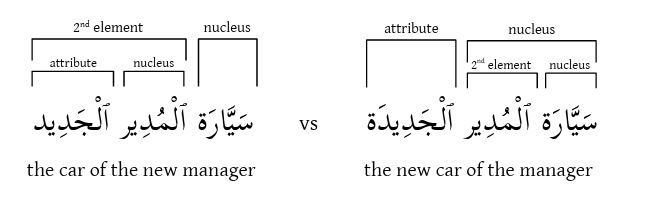
What are the two possible readings of the structures in سَيَّارة الْمُدِيرة الْجَدِيدَة ?
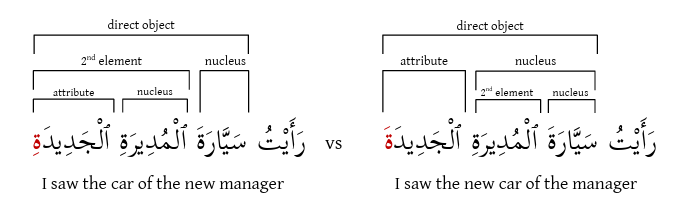
How can the definiteness of an indefinite genitive construct be semantically defined?
somewhere between definite and indefinite- referred to as “specification”- نَخْصِيص
Eg. ‘a school’s principal’- does nto refer to a single entity in the world, therefore not definite, but also does not refer to any “principal” but instead the school’s, which is more specified than ‘principal’ alone
However in arabic grammar there are only two options- definite or indefinite- either with tanwin or not. A diptote in the genitive case takes the case ending of either fatha (if indefinite) or kasra (if definite). In the case of a the 1st element of a genitive construct, the word appears grammatically definite
How do demonstrative pronouns function before a genitive construct?
The demonstrative pronoun functions as the subject, with the genitive construct functioning as the predicate
When are demonstrative pronouns placed after a genitive construct?
To use the demonstrative pronoun as an attribute referring to the genitive construct
When is a demonstrative pronoun placed inbetween the two elements of a genitive construct?
When the demonstrative pronoun is referring to the second element of the idafah
Placed between the two elements without “breaking” the genitive construct
How do masdar forms create genitive constructs?
They create genitive constructs with the performer of the action
How do masdar forms that take a direct object form masdars?
In genitive constructs whose first element is the masdar of a verb that takes the direct object, the second element of the genitive construct can also be the direct object of the action expressed by the masdar
This may lead to ambiguity- eg. فَهِمْ الاولادِ the understanding of / by the children- the children can either be the performers of the actions, ie. the ones who understand, or the direct objects of the action, ie. the ones being understood
How do masdar forms that take an indirect object form genitive constructs?
They can only create genitive constructs with the performer of the action
The masdar in such cases cannot create a genitive construct with its indirect object since it governs its indirect object through a preoposition. When the indirect object is expressed, it appears as the complement of that preposition, which doesn’t allow a genitive construct to be created.
Since masdar forms are definite, the definiteness is created in another way, eg. the definite article ال
What happens when both the subject an object appear with the masdar?
The subject takes the slot of the second element of a definite construct
Once the second element’s slot is taken by the subject, the masdar governs the object like the verb from which it is derived
eg. بَحْثُ المُظَّفِ عَنْ كُتُبٍ the clerk’s looking for the books (the masdar governs an indirect object)
eg. كِتَابَةُ الْمُوَظَّفِ الرَّ!سَالَةَ the clerk’s writing of the letter (the masdar governs a direct object)
A masdar may govern an object like the verb ONLY IF THE SLOT OF THE SECOND ELEMENT IS TAKEN (by the subject)- otherwise the masdar forms a genitive construct with the subject / direct object
What is another way masdar of a verb taking a direct object can govern its direct object?
Using the preposition لِ - very common in MSA and Classical Arabic- more common than to find a masdar governing a direct object directly
What is the circumstantial adverbial phrase / الحال? What does it describe?
lit: the situation / condition
An adverbial describing the state or condition of one of the nouns in the sentence while an action is taking place
It answers the question “in what state or condition is the action taking place”
Usually an indefinite noun in the accusative case, agreeing in number and gender with the noun whose situation it describes
Usually an active or passive participle.
It can also describe the state or condition of a noun other than the subject of the sentence.
In a circumstantial adverbial phrase / حال phrase, do the words ‘while she was/he was/they were’ etc appear?
No- حال clauses do not include these explicitly
When can the حَال be ambiguous?
It can grammatically refer to more than one noun in the sentence, eg.
تَكلَّمْنا مَعَ الرِّجَالِ وَاقِفِين means either “we talked with the men while they were standing” or “we talked with the men while we were standing”
What is the circumstantial clause الجُمْلة الحَالِيَّة ?
A subordinate sentence that describes the stage or condition of one of the nouns in the main sentence while an action is taking place
What is the structure of a circumstantial clause الجُمْلة الحَالِيَّة?
May be a verbal or nominal clause
Often introduced by a وَ waw vocalised with a َ fatha
The و called وَاو الحَال , and should be understood as denoting ‘while’, not ‘and’ as usual
What is commonly the tense of verbs featured in a verbal circumstantial clause?
imperfect
Often also feature وَ + قَدْ + فَعَلَ to describe a situation (shortly) after another action as occurred- the situation when another action has already occurred

How can a الجملة الحالية be ambiguous?
The circumstantial clause can sometimes grammatically refer to more than one noun in a sentence, and in these cases the sentence is ambiguous.
What are the three main ways to express the state or condition of a noun in the sentence?
An indefinite noun (usually a participle) in the accusative case
A verb in the imperfect form
A nominal sentence that begins with وَاوُ الحال
What do أَنَّ and أِنَّ denote?
They denote “that” as in “he said that” or “I know that”
“أِنَّ is used to denote “that” only with the verb قَالَ, and أَنَّ is used to complement other verbs, prepositions and nouns
what type of sentences do أِنَّ and its sisters introduce?
Nominal sentences, not tolerating verbal sentences
The subject of the nominal sentence introduced by أِنَّ and its “sisters” gets the accusative case
What is the case of the subject of a nominal sentence introduced by أِنَّ and its sisters?
the subject gets the accusative case
What happens if the subject of a nominal sentence introduced by أِنَّ or its sisters is a pronoun?
the pronoun is attached to أِنَّ / it sisters eg.
قَالَ أِنَّهَا مَشْغُولةٌ He said that she is busy
Decline the attached pronouns after أِنَّ or its sisters.
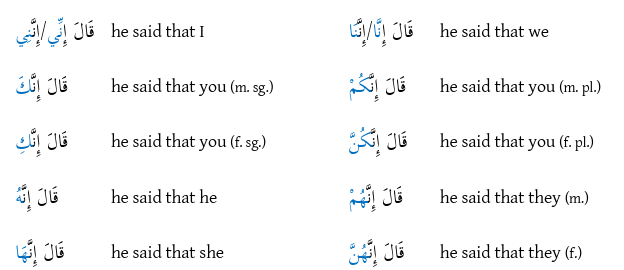
What happens when a nominal sentence can’t be used after أِنَّ or its sisters?
A verbal sentence has to be used, the pronoun -hu هُ is attached to أِنَّ and its sisters
This pronoun is devoid of meaning and not translated. It does not change gender or number and always remains -hu هُ
It serves as a solution for the need to use a verbal sentence after أِنَّ and its sisters, which otherwise only introduce nominal sentences
When the هُ is attached, the subject of the following verbal sentence gets the nominative case, as expected in verbal sentences
In MSA it is common to find this هُ when the subject of the verbal sentence is definite. However, there may be other considerations to prefer using a verbal sentence even after أِنَّ and its sisters eg. sometimes authors prefer to keep new information at the end of the sentence even if it is definite.
What are the sisters of أِنَّ?
أِنَّ used at the beginning of sentences- formally expressed emphasis eg. indeed, now for stylistic purposes and is not translated
أَنَّ “that” after prepositions, nouns and verbs other than قال
مع أَنَّ “although”
رَغْمَ أَنَّ “although”
عَلى أَنَّ “On the condition that” / “although”
أِلا أَنَّ \ غَيْرَ أَنَّ “except that, but”
لِأَنَّ “because”
لكِنَّ, وَلكِنَّ “But”
كَأَنَّ “Like, as if”
لَعَلَّ “maybe”
لَيْتَ “If only, I wish”
What are أِنَّ \ أَنَّ clauses equivalent to?
Nouns- their syntactical function can be more easily determined by replacing them with a noun, as their function would be identical to that of the noun replacing them
What happens when a nominal sentence follows أِنَّ and its sisters?
It follows normally, but with the subject in the accusative
If the subject of the nominal sentence is a pronoun, the pronoun is attached to أِنَّ and its sisters
What happens if a verbal sentence follows أِنَّ and its sisters?
We should try to convert it into a nominal sentence- the subject of the nominal sentence formed is then accusative.
If it is a verbal sentence and we cannot convert it to the nominal sentence, then we use the dummy pronoun هُ where the subject is in the nominative as usual
What are adverbials?
Complements of the verb in the sentence- they take the accusative case
Unlike objects, adverbials are unnecessary for the grammatical completeness of the sentence.
Their meaning of often determined by semantic value but they usually have typical grammatical characteristics
What do adverbial accusatives of time do?
They denote the time of an action and sometimes its duration
What is the definiteness of adverbial accusatives of time?
Some are indefinite, eg. صَباحًا some are definite eg. اليَومَ
Some appear as (mostly definite) prepositional phrases, eg. في الصباحِ in the morning
Not all adverbials may appear in all forms
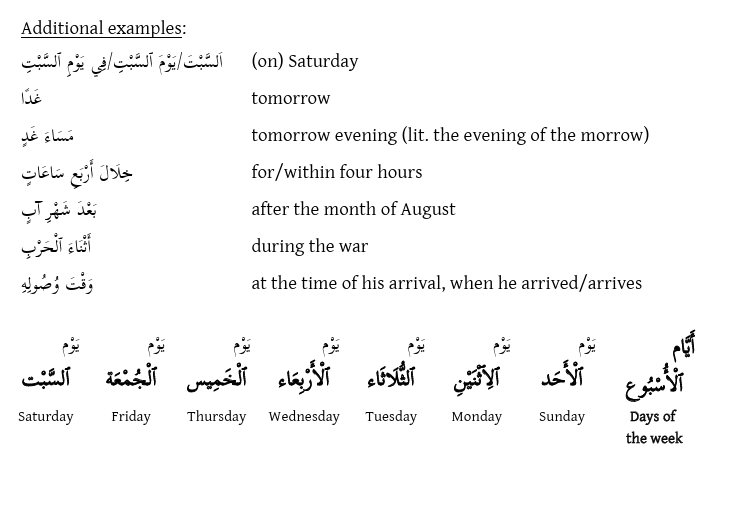
what do adverbial accusatives of place denote?
The place of the action and its direction
May express a general direction, if so indefinite
May appear as a genitive construct whose first element denotes the direction, sometimes with the addition of يَّ
Adverbials may also express a specific place / location, and if so appear definite-
What is the adverbial accusative of cause or purpose?
The thing because of which, or for which, the action is carried out. Covers the cause and purpose of the action, the context determines which one is meant.
The adverbial accusative is expressed by a verbal noun, usually indefinite, in the accusative.
What follows a verbal noun of a transitive verb that requires a direct object?
The preposition لِ will come before the following pronoun
How can relative clauses often be introduced?
Using مَا “what” for non-human referents, or مَن “the (person) that” (for human referents). May be used for any human or non-human referent, respectively, regardless of gender or number.
What is usually the gender and number of the returning pronoun in relative clauses introduced by ما and مَن ?
Usually in the masculine singular
Does the returning pronoun always appear in relative clauses introduced by ما and مَن ?
No, it is occasionally omitted
What are ma/man clauses the equivalent of?
Equivalent of a noun, their syntactical function can be more easily determined by replacing them with a noun, as their function would be identical to that of the noun replacing them.
What links a relative clause to its main sentence?
A common item, eg. The student is diligent. He went to university.
What is the function of a relative clause?
It modifies a nominal phrase that precedes it. This nominal phrase is called the antecedent.
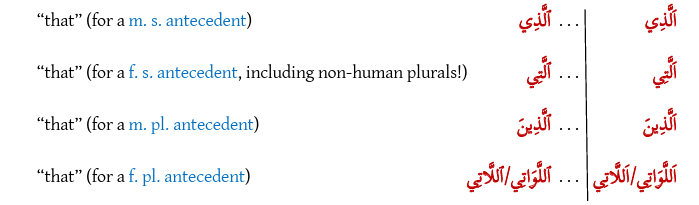
What do relative pronouns depend on in Arabic?
The gender and number of the antecedent
List the relative pronouns in Arabic
What is the function of relative clauses in a sentence?
Function as an attribute, like adjectives- relative clauses can function as attributive clauses
What happens when the antecedent to a relative clause is indefinite?
The relative clause is NOT introduced by a relative pronouns
What is the returning pronoun?
Used in all relative clauses to refer back to the antecedent
Can be either:
the subject of the verb included in the relative clause
A pronoun usually attached to a verb, preposition or noun
What are the two main questions to ask when translating a relative clause into Arabic?
Do we need a relative pronoun (=is the antecedent definite?) If so, which one?
Where is the returning pronoun (=is it the subject of the verb, thus hidden in it, or should it be added)
What are unreal genitive constructs?
They look like genitive constructs but actually differ from them significantly
In a real genitive construct, both elements are nouns. In unreal genitive constructs, the first element is not a noun, but an adjective
A real genitive construct is a unit that can be swapped with a noun. An unreal genitive construct, however, can be swapped with an adjective. Like adjectives, it usually functions as an attribute.
How do unreal genitive constructs agree with the noun they modify?
Like any other attribute, unreal genitive constructs (or their nucleus) agree with the noun they modify in gender, number, case and definiteness
What is the definiteness of an unreal genitive construct and how does it differ from a real genitive construct?
In a real genitive construct, the state of definiteness of the second element determines the state of definiteness of the entire phrase- The first element is always considered definite, so it never takes for example the definite article
HOWEVER for unreal genitive constructs, the second element is always definite by the article, regardless of whether the entire phrase is definite or not.
The state of definiteness of the first element determines the definiteness of the entire phrase.

What is the semantic relationship between the two elements of an unreal genitive construct?
The relationship is that of predicate and subject, NOT of possession between the two elements
The second element is usually a part, feature or characteristic of the modified noun.
What are the demonstrative pronouns in Arabic?
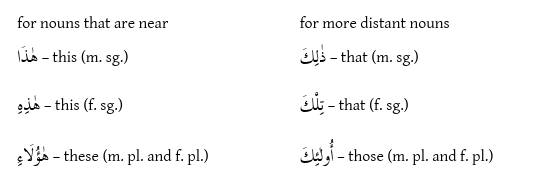
Do demonstrative pronouns in Arabic exhibit or change case?
No, they do not change their case nor do they effect the case of the noun they modify
What are the possible functions of a demonstrative pronoun in a sentence in Arabic?
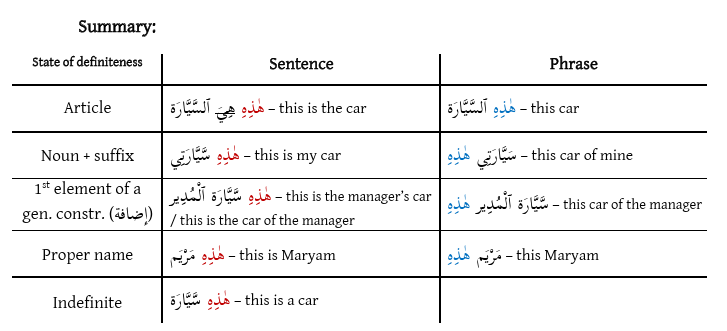
As a subject: they precede the predicate. If the predicate is indefinite or definite by anything but the article, it is understood that the demonstrative pronoun is separate from the predicate. eg. هذِهِ مريم
As an attribute: Qualifying a noun with the definite article, precedes the noun it qualifies, eg. This week هذَأ الأسبوع
When may a demonstrative pronoun appear between the first and second element of a genitive construct?
When functioning as the attribute of a 2nd element that is definite by the article
What happens when demonstrative pronouns function as attributes of nouns definite not by the article (= the first element of a genitive construct, a noun definite by a possessive pronoun or proper name)?
The demonstrative pronouns follow the nouns / nominal phrases they qualify.
Can the pronoun ذلِكَ function as an indefinite pronoun?
Yes, similar to “that” in English, not refering to a particular person eg. I didn’t hear that
Summarise the placement of demonstrative pronouns for different states od definiteness in Arabic
Where can possessive pronouns be found in a sentence in Arabic?
Attached to singular and plural nouns as a suffix
List the possessive suffix pronouns in Arabic using كاتب
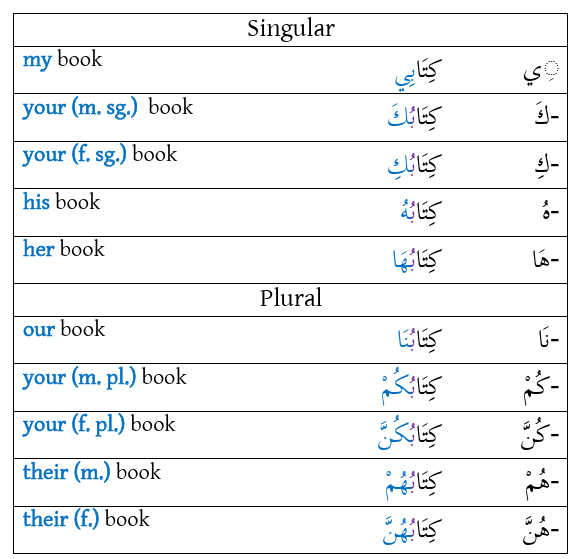
How is the last letter of the noun (before a possessive suffix) vocalised?
In the 1st person sg, the last letter of the noun is always vocalised with a kasra.
In all other persons, the last letter is vocalised according to the noun’s grammatical function in the sentence
What happens when a possessive pronoun is added to a word that ends with a ة?
The ة is written and pronounced as تَ
When are auxiliary vowels used?
When a word ends with a sukuun and precedes a word starting with the definite article with a wasla, a sequence of two sukuuns is formed, which is not allowed in Arabic.
To avoid this, the first sukuun is replaced by a vowel, called a ‘helping’ or ‘auxiliary’ vowel
A helping vowel is also necessary when a word ending with a sukuun is followed by a word beginning with the definite article + a sun letter, since a shadda is a combination of a sukuun and a vowel.
When are different auxiliary vowels used?
The helping fatha is used only when the sequence of مِن + الْ are formed
The helping vowel damma is used with the endings تُمْ, كُمْ, هُمْ are followed by the sequence ْا
In other cases, the helping vowel is a kasra, which is the most common helping vowel
When two sukuuns follow each other, the combination is resolved in order from right to left
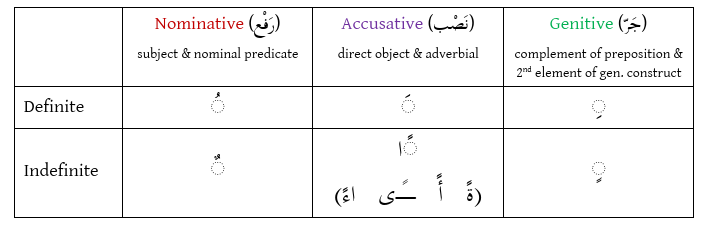
What is the accusative indefinite case ending and how does it vary?
ا ً…
The alif is not added if the word ends with أ , ة, َاء
Instead of a tall alif, we may find an alif maqsura ى ً
When is the nominative case used?
It is the case of the subject and the predicate (if the predicate is not a verb)
When is the accusative case used?
It is the case of direct objects and adverbials
When is the genitive case used?
It is the case of the second element of a genitive construct, as well as any nominal phrase that complements a preposition in a prepositional phrase
Summarise the endings for each case, definite and indefinite.