YEAR 10 HEPE SEM 1
 Call Kai
 Learn
Learn Practice Test
 Spaced Repetition
 Match
Match Flashcards
 Knowt Play
1/45

Earn XP
Description and Tags
light blue = circulatory system, dark blue = musuclar system, pink = fitness components, teal = training methods
Name | Mastery | Learn | Test | Matching | Spaced | Call with Kai |
|---|
No analytics yet
Send a link to your students to track their progress
46 Terms
COMPONENTS OF CIRCULATORY SYSTEM
heart
blood vessles (veins, arteries & capillaries)
blood (RBC, WBC, platelets & plasma)
FUNCTIONS
to move nutrients, oxygen, hormones & other gases to the body organs (tissues & muscles)
remove waste products
temperature regulation
FUNCTION OF ARTERIES
to carry oxygen rich blood from the heart to the body
(except pulmonary artery)
FUNCTION OF VEINS
to carry de-oxygenated blood from the body back to the heart
(except for pulmonary vein)
FUNCTION OF CAPPILARIES
exchange material between blood and tissue cells
remove waste & provide nutrients
gaseous exchange between lungs and muscles
oxygen & carbon dioxide
PULMONARY ARTERY
The only artery that transports de-oxygenated blood from the heart to the body (lungs)
PULMONARY VEIN
The only vein that transports oxygenated blood from the body(lungs) back to the heart
COMPONENTS OF BLOOD
red blood cells (45%)
RBC, leukocytes
white blood cells (>1%)
WBC, erythrocytes
plasma (>1%)
platelets
thrombocytes (55%)
RED BLOOD CELLS
Other name: erythrocytes
Produced: in the bone marrow
Function: Deliver oxygen around the body (hemoglobin protein)
Makes up 45% of blood
WHITE BLOOD CELLS
Other name: Lymphocytes
Produced: in the bone marrow
Function: Immune system function - fight infection
Makes up less
than 1% of blood.
PLATELETS
Other name: Thrombocytes
Produced: in the bone marrow
Function: Clots the blood to slow down bleeding (scab)
Makes up less than 1% of blood.
PLASMA
Liquid component of the blood that carries the other blood cells, nutrients, gases, etc
Produced by drinking water
Function:
Transports nutrients, blood, hormones, etc around the body
Maintains body temperature (homeostasis)
HEART RATE?
amount of times heart beats per min
Measured in bmp (beats per minute)
max heart rate = 220 - your age
Represented by HR symbol
STROKE VOLUME?
The volume of blood pumped out of your left ventricle per beat
OR
The amount of blood pumped out of the heart per beat.
Measured in milliLitres (mL)
Represented by SV symbol
CARDIAC OUTPUT?
The amount of blood pumped out of your left ventricle per minute.
OR
The amount of blood pumped out of the heart per minute.
Measured in litres per minute (L/min)
Calculated by HR x SV
Represented by Q symbol
HR (60bpm) x SV (0.075L) = Q (4.5 L/min)
BRIEF FUNCTIONS
movement of the body
organ function
maintains posture
circulates blood
creates heat
TYPES OF MUSCLE
skeletal muscle
smooth muscle
cardiac muscle
SKELETAL MUSCLE
fibers: striated, tubular and multi nucleated
voluntary
usually attached to skeleton
SMOOTH MUSCLE
fibers: non-striated, spindle shaped & uninucleated
involuntary
usually covering wall of internal organs
CARDIAC MUSCLE
fibers: striated, tubular and branched and uninucleated
involuntary
only covering walls of the heart
mobility
stability
posture
circulation
organ protection
respiration
digestion
temperature regulation
SLOW TWITCH MUSCLES
Type 1 muscle fibres used for long lasting, endurance activities such as distance running. They are red/darker in colour due to a higher amount of oxygen present.
FAST TWITCH MUSCLE FIBRES
Type 2 muscle fibres used for sudden, explosive bursts of energy such as sprinting or jumping. Fast twitch fibres fatigue quickly. They are paler in comparison to Type 1 fibres due to a lack of oxygen.
AGONIST VS ANTAGONIST
Muscle that is contracting is called the agonist and the muscle that is relaxing or lengthening is called the antagonist.
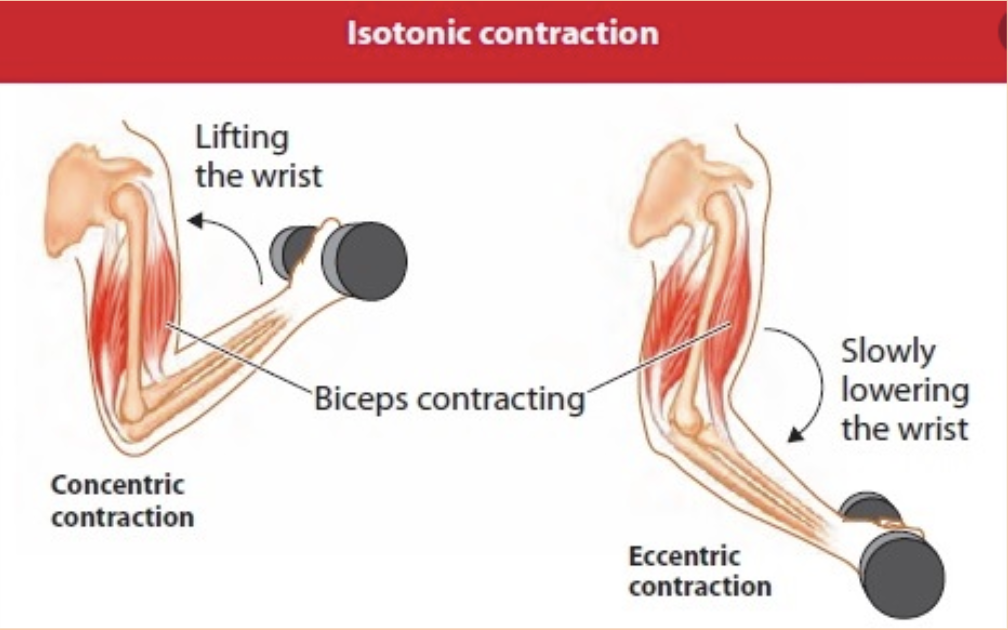
ISOTONIC
Occurs when muscles contract and produce movement. During this, the muscle length changes while tension is developed.
eg, when a shot putter lifts the shot put to their neck, the muscle shortens and the tension varies throughout the movement.
ISOMETRIC
When a muscle contracts but does not produce movement. The muscle develops tension but does not change length.
Eg, holding your hand out while someone places a weight in it — your muscles create tension to hold the position, but the muscle length stays the same.
ISOKENETIC
Occurs when a muscle contracts and changes length at a constant speed. This usually requires special equipment, like an isokinetic dynamometer.
eg, during a leg extension on this machine, the limb moves at a steady speed no matter how much force is applied.
SPEED
The rate of movement from one point to another over time. This can refer to a body part or the whole body.
ANEROBIC CAPACITY
The total amount (yield) of ATP from the anaerobic (w/o O2) energy pathways combined.
AEROBIC POWER
The rate/speed that the aerobic (w/ O2) system can produce ATP over time.
REACTION TIME
The time it takes to respond to the presence of a cue (sign or signal). A cue could be a ball, an opponent’s movement or the start g*n.
COORDINATION
The ability to perform a series of movements in a controlled manner.
AGILITY
The ability to change direction quickly and accurately without losing balance. It can be reactive (game situation) or planned (dance).
MUSCULAR POWER
The ability to produce explosive (quick and great) force.
Power = speed x strength
MUSCULAR ENDURANCE
The ability of the muscle to perform repeated contractions or one contraction for an extended period of time (>60sec).
MUSCULAR STRENGTH
?
BALANCE
The ability to maintain equilibrium (not fall) while in a fixed position (static) or while moving (dynamic).
FLEXIBILITY
The ability to smoothly move a joint through its full range of motion, either statically or dynamically.
TRAINING METHODS
Fitness components is “what you train” where as training methods is “how you train”
The method of training that you choose may depend upon different factors (aims, fitness etc)
Training methods are the different types of training undertaken to achieve desired results.
PLYOMETRICS
It is a power-based training method that focuses on explosive movements (muscular power = strength + speed).
It is best for sports that need quick acceleration, frequent jumping, and fast recovery between explosive movements.
The aim is to increase muscle power by quickly stretching a muscle and then contracting it as fast as possible.
RESISTANCE / WEIGHT TRAINING
Aims to build strength, power, or muscular endurance by working muscles against a resistance.
It involves reps (one movement), sets (a group of reps), and resistance/load (the weight used), with short rests between sets (under 2 minutes). The load, sets, and reps depend on the goal:
strength uses high weight and low reps
power uses moderate weight and reps
endurance uses low weight and high reps.
FLEXIBILITY
Essential component of fitness in all active sports
For gains, an athlete need to undertake a stretching program 3-4 times a week
If they stop training their flexibility will reverse
INTERVAL
Consists of intervals of work followed by intervals of rest or recovery
Useful for team sports
Ratio between work and rest periods usually determines the overload
FARTLEK
Also known as Speed play
Involves continuous training with bursts of speed, changing the activity’s intensity level.
Useful training for team sports as it stimulates the nature of team sports
CONTINUOUS TRAINING
Involves exercising for at least 20 minutes at a steady intensity of 60–85% of maximum heart rate. It is often used in pre-season training to build an aerobic base for team sports and helps reduce the risk of heart disease, diabetes, obesity, and high blood pressure.
Eg. cycling, running, swimming, and aerobic classes.
CIRCUT TRAINING
Used to develop multiple fitness components by completing a series of activity stations in sequence. It usually involves around 10 stations, where you perform as many reps as possible in about 1 min at each station, and it can be designed to suit a specific sport or activity.