blood and circulation
 Call Kai
 Learn
Learn Practice Test
 Spaced Repetition
 Match
Match Flashcards
 Knowt Play
1/19

There's no tags or description
Looks like no tags are added yet.
Name | Mastery | Learn | Test | Matching | Spaced | Call with Kai |
|---|
No analytics yet
Send a link to your students to track their progress
20 Terms
what are the 4 components of blood?
plasma (the liquid part of the blood mainly composed of water)
red blood cells (biconcave, disk-like cell with no nucleus; millions in each mm cubed of blood)
platelets (the smallest cell)
white blood cells (two different types of wbm: lymphocytes and phagocytes. lymphocytes are about the same size as a red blood cell with a large spherical nucleus, phagocytes are much larger with a spherical or lobed nucleus)
what is the role of plasma?
plasma transports:
carbon dioxide from the body cells to the lungs to be exhaled
digested food from the gut to the body cells to absorb nutrients into the bloodstream
urea from the liver to the kidneys where it is excreted in urine
hormones from the endocrine glands to their target organs
heat energy
how are red blood cells adapted to make them suitable for transporting oxygen?
being small and having a biconcave shape - to increase the surface area to volume ratio so that oxygen can diffuse in and out of the cell quicker, enabling more efficient gas exchange
containing haemoglobin - when there is a high concentration of oxygen in its surroundings the haemoglobin binds with oxygen to form oxyhaemoglobin, and when the concentration of oxygen is low it turns back into haemoglobin and the red blood cell unloads its oxygen, to transport oxygen from the lungs to the tissues efficiently
not having a nucleus - so there is more space for haemoglobin so the cell can carry more oxygen
what do phagocytes do in response to diseases?
they can ingest the microorganisms such as bacteria and pathogens. They do this by producing extensions of their cytoplasm (pseudopodia). The pseudopodia surrounds and encloses the microorganism in a vacuole, and once the microorganism is inside it, it secretes enzymes into the vacuole to break down the microorganism.
what do lymphocytes do in response to disease?
lymphocytes make antibodies, which are soluble proteins that pass into the plasma. Pathogens have antigens on their surface, which the antibodies recognise. The antibodies stick to the surface antigens and destroy the pathogen. The antibodies produced are specific to that type of antigen, so they won’t lock onto any others.
how do vaccines result in the manufacture of memory cells?
vaccinations usually involve injecting dead or inactive pathogens into the body. These carry antigens, so lymphocytes produce antibodies to attack them. Memory cells will then be produced and will remain in the blood, so if live pathogens of the same type appear, antibodies to kill them will be produced much sooner, faster and in greater quantities.
what is the structure of the heart?
the heart has four chambers: two atria (top) and two ventricles (bottom)
the right side pumps blood to the lungs, the left side pumps blood to the body
valves prevent backflow of blood
the vena cava brings blood to the right atrium, the pulmonary artery carries blood to the lungs, the pulmonary vein brings blood from the lungs, and the aorta carries blood to the body
how does the heart function?
blood enters the atria, but it can’t pass into the ventricles because the valves are closed
The walls of the atria contract, raising the pressure of blood in the atria which forces open the valves. blood passes through the valves into the ventricles
when they are full, the ventricles contract, which increases the pressure of blood in the ventricles which closed the valves again.
the valves continue to contract and the pressure continues to increase, forcing the valves at the base of the aorta and the pulmonary artery to open. Blood is ejected into these two arteries - the pulmonary artery carries blood to the lungs, and the aorta has branches that carry blood to the other parts of the body.
as the ventricles empty, higher pressure in the aorta and pulmonary artery closes the valves in these blood vessels. The cycle then begins again as the atria starts to fill with blood.
why does heart rate change during exercise?
→ when you exercise, your muscles need more energy, so they need an increased supply of oxygen for aerobic respiration
for this to happen, the blood has to flow faster, so your heart rate increases
when you start to exercise, muscles produce more carbon dioxide in aerobic respiration
receptors in the aorta and the carotid artery detect the increase and send nerve impulses to the medulla
the medulla then sends nerve impulses along the accelerator nerve, which increases the heart rate
when carbon dioxide production returns to normal, the medulla receives fewer impulses so sends nerve impulses along the decelerator nerve, which decreases the heart rate
why does heart rate change under the influence of adrenaline?
when an organism is threatened, the adrenal glands release adrenaline. Adrenaline binds to specific receptors in the heart, causing the cardiac muscle to contract more frequently and with more force so heart rate increases and the heart pumps more blood. This increases oxygen supply to the tissues.
why does coronary heart disease happen?
coronary heart disease happens when the coronary arteries that supply blood to the muscles of the heart get blocked by the build up of fatty materials. This restricts blood flow and there’s a lack of oxygen to the heart muscle, which can lead to a heart attack.
what are some risk factors of coronary heart disease?
having a diet high in saturated fat: this can lead to fatty deposits forming inside arteries, which can cause them to become narrower
smoking: increases blood pressure, which can cause damage to the inside of the coronary arteries
lack of exercise: can lead to high blood pressure, which can damage the lining of the arteries, making it more likely that fatty deposits will form
stress
genetics
high blood pressure
how does the structure of arteries relate to their function?
Function: to carry blood from the heart to the organs in the body
they have elastic tissue in the walls of the arteries allowing them to stretch and recoil
they have a thick muscular wall that helps control blood flow by dilating or constricting the vessels
how does the structure of veins relate to their function?
Function: to carry blood from organs back towards the heart
they have semilunar valves to prevent the backflow of blood
they have much thinner walls than arteries because they carry blood at a much lower pressure, so they don’t need to withstand force
they contain less elastic tissue and muscles than arteries because of their lower blood pressure
how does the structure of capillaries relate to their function?
function: to carry blood through organs to bring blood close to every cell in that organ
they are very small so they can fit between cells
their walls are only one cell thick to provide a shorter distance for diffusion of materials into and out of the blood
what is the structure of the circulation system?
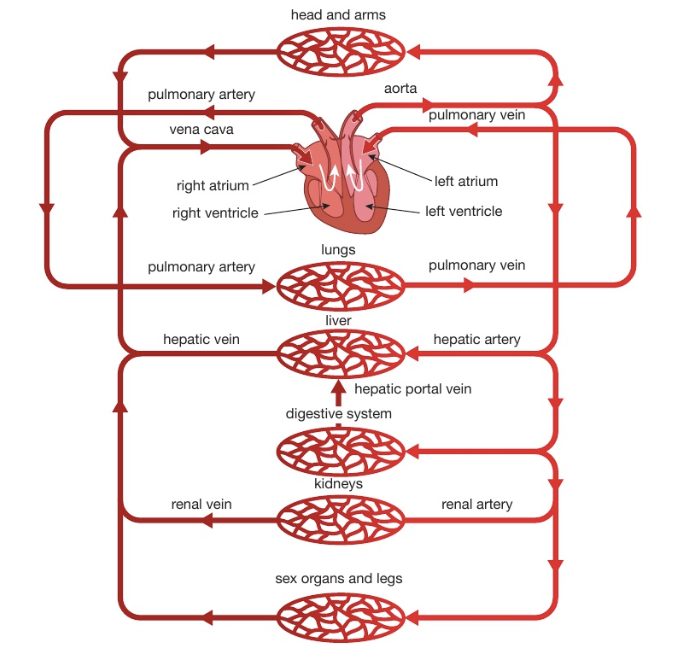
what is diffusion?
the net movement of particles from an area of high concentration to an area of low concentration
how can single celled organisms rely on diffusion for the movement of substances in and out of the cell?
simple, single celled organisms don’t need a transport system because diffusion is enough
unicellular organisms:
are very small
have a large surface area to volume ration
so their cell surface membrane has a large enough area to supply all the oxygen that their volume demands
why do multicellular organisms need a transport system?
multicellular organisms:
have a low surface area to volume ratio
have long distances from the surface to cells
therefore, diffusion would be too slow to meet demands
Instead, multicellular organisms have evolved gas exchange organs and circulatory systems, which carry oxygen, nutrients, and waste products quickly and efficiently around the body
how do platelets prevent blood loss and the entry of microorganisms?
When the skin is cut, exposure to the air stimulates the platelets to produce a chemical, which causes fibrinogen to change into fibrin. The fibrin forms a network across the wound in which red blood cells become trapped. This forms a clot, which prevents further blood loss and entry of microorganisms that may be pathogens. The clot develops into a scab, which protects the damaged tissue whilst new skin grows.