Anatomy Chapter 5 Saladin
 Call Kai
 Learn
Learn Practice Test
 Spaced Repetition
 Match
Match Flashcards
 Knowt Play
1/94

There's no tags or description
Looks like no tags are added yet.
Name | Mastery | Learn | Test | Matching | Spaced | Call with Kai |
|---|
No analytics yet
Send a link to your students to track their progress
95 Terms
Histology or microscopic anatomy
The study of tissues and how they are arranged into organs
The four tissue classes
The variations within each class; how to recognize tissue types microscopically and relate their microscopic anatomy to their function; how tissues are arranged to form an organ; how tissues change as they grow, Shrink, or change from one tissue type to another over the life of the individual; and modes of tissue degeneration and death
Tissue
Is a group of similar cells and cell products that arise from the same region of the embryo and work together to perform a specific structural or physiological role in an organ.
Matrix
extracellular material that surrounds the cell. composed of fibers, proteins, ground substance, tissue fluid, or interstitial fluid
Ground substance
Contains water, gases, minerals, nutrients, wastes, hormones, and other chemicals
Summary of matrix and tissue
A tissue is composed of cells and matrix and the matrix is composed of fibers and ground substance
The four primary tissue
Epithelial, connective, nervous, and muscular
Epithelial Tissue or Epithelium
CLOSELY spaced cells that cover organ surfaces, form glands, and serve for protection, secretion, and absorption. (Epidermis, Digestive tract, Liver, gall bladder
Connective Tissue
Has MORE matrix than cell volume, often specialized to support, bind, and protect organs. (Blood, Cartilage and Bone, Tendons and Ligaments)
Nervous Tissue
Contains EXCITABLE cells specialized for rapid transmission of coded information to other cells. (Brain, Spinal Cord, Nerves)
Muscular Tissue
ELONGATED excitable muscle cells specialized for contraction. (Skeletal muscles, Heart, Viscera walls)
3 primary germ layers
Ectoderm, Endoderm, and Mesoderm
ectoderm
outer layer that gives rise to the epidermis and nervous system
endoderm
inner layer that gives rise to the mucous membranes of the digestive and respiratory tract.
mesoderm
middle layer of more loosely organized cells
mesenchyme
protein fibers created from mesoderm. Give rise to muscle, bone, and blood among other tissues
histological sections
tissue preparations mounted on microscope slides
longitudinal section
A tissue cut on its long, vertical axis
Cross section or Transverse Section
a tissue cut horizontally
oblique section
a tissue cut diagonally
smear
tissue rubbed across the slide
spread
tissue is laid on the slide
basement membrane
a layer of tissue between an epithelium and connective tissue
basal surface
the surface of an epithelial that faces down toward the basement membrane
apical surface
the surface of an epithelial that faces up toward the internal cavity
difference between simple and stratified epithelium
simple epithelia cells touch the basement membrane , whereas in stratified epithelium some cells rest on top of other cells and don't contact the basement membrane
Simple Epithelia
has only one layer of cells (Simple squamous, simple cuboidal, simple columnar, pseudo stratified columnar)
goblet cells
produce protective mucous coatings over the mucous membranes
Stratified Epithelia
range from 2 to 20 or more layers of cells (Stratified Squamous, Stratified Cuboidal, Stratified columnar, transitional)
pseudostratified columnar epithelium
shorter cells are covered by taller ones
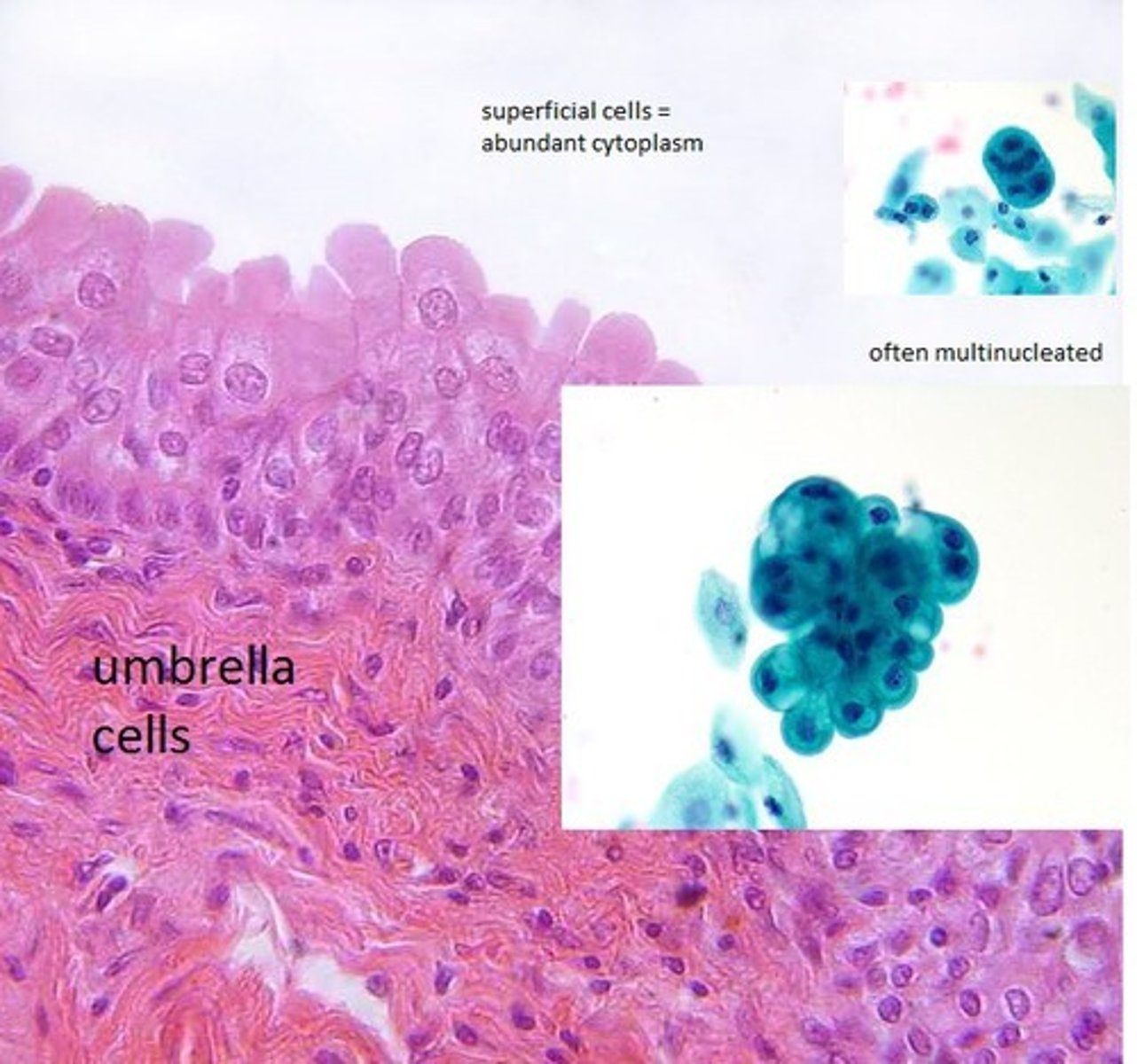
transitional epithelium
Contain umbrella cells
Stratified Squamous Epithelium
The most widespread epithelium in the body.
Exfoliation
When stratified squamous cells daughter cells push toward the surface and become flatter and push farther upward, until they finally die and flake off.
Keratinized epithelia
cells found in the epidermis covered with a layer of dead compressed cells (The Skin)
Non-keratinized epithelia
lack the surface layer of dead cells. Abrasion resistant, moist, and slippery (Tongue, Esophagus, and Vagina)
Umbrella cells
A term for a multinucleated superficial cell of the bladder's transitional
Simple squamous epithelium
located in external surface of small intestine, air sacs of lungs, kidneys, inner lining of heart and blood vessels, and serous membranes of stomach. Allows rapid diffusion or transport of substances through membrane. secrets lubricating serous fluid
Simple cuboidal epithelium
centrally placed nuclei located in the liver, thyroid, mammary, salivary, kidney tubules, and bronchioles. with a brush border of microvilli in some kidney tubles; ciliated in bronchioles of lung
Simple columnar epithelium
located on the inner lining of stomach, intestines, gallbladder, uterus, and uterine tubes; some kidney tubles. absorbs and secrets mucus and moves egg and embryo in uterine tube.
pseudostratified columnar epithelium
located in the respiratory tract from nasal cavity to bronchi; portions of male urethra
stratified cuboidal epithelium
*Two or more cell layers; surface cells square
*Secretes sweat; produces sperm and hormones
*Sweat gland ducts; ovarian follicles and seminiferous tubules
Keratinized Stratified Squamous
*Multilayered epithelium covered with dead squamous cells, packed with keratin
-epidermal layer of skin
*Retards water loss and barrier to organisms
Nonkeratinized Stratified Squamous
*Multilayered surface epithelium forming moist, slippery layer
*Tongue, oral mucosa, esophagus and vagina
Transitional Epithelium
*Multilayered epithelium surface cells that change from round to flat when stretched
-allows for filling of urinary tract
-ureter and bladder
Exocrine Glands
-Secrete substance onto body surface or into body cavity
-Have ducts
-E.G., salivary, mammary, pancreas, liver
Endocrine Glands
-Secrete product into blood stream
-Either stored in secretory cells or in follicle surrounded by secretory cells
-Hormones travel to target organ to increase response
-No ducts
Connective Tissue
*Widely spaced cells separated by fibers and ground substance
*Most abundant and variable tissue type
*Functions
-connects organs
-gives support and protection (physical and immune)
-stores energy and produces heat
-movement and transport of materials
Cells of Connective Tissue
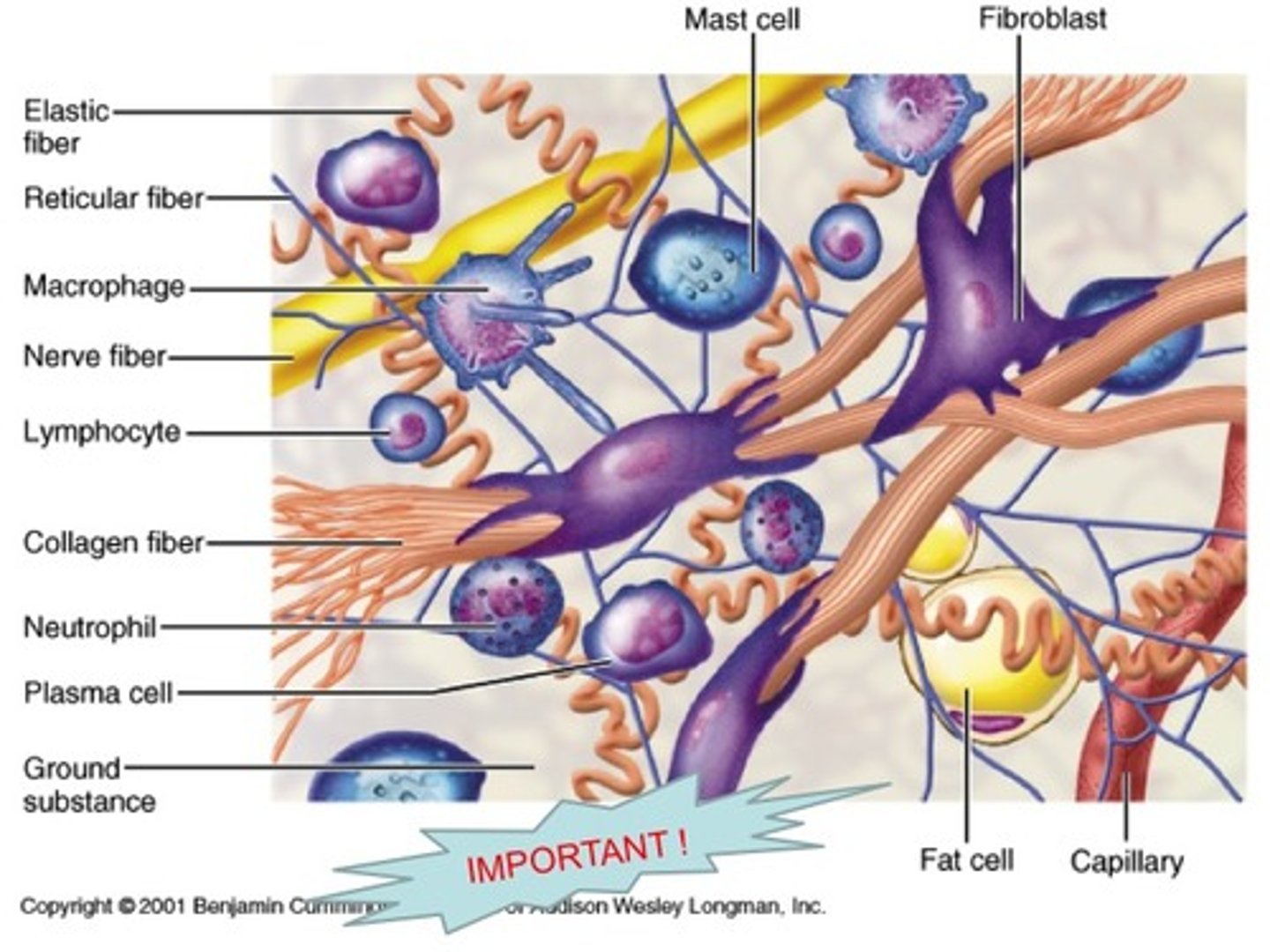
*Fibroblasts produce fibers and ground substance
*Macrophages phagocytize foreign material and activate immune system
-arise from monocytes (WBCs)
-Neutrophils wander in search of bacteria
-Plasma cells synthesize antibodies
arise from WBCs
*Mast cells secrete
-heparin inhibits clotting
-histamine that dilates blood vessels
*Adipocytes store triglycerides
Most Important
Muscle Tissue
*Elongated cells stimulated to contract
*Exert physical force on other tissues
-move limbs
-push blood through a vessel
-expel urine
*Source of body heat
3 histological types of muscle
skeletal, cardiac and smooth
Skeletal Muscle
Many nuclei in muscle cells, only seen in this muscle. Striated, long threadlike cells, multinucleated
Cardiac Muscle
Only found in the heart, single nucleus, one specialized fiber intercalated discs. Branch cells, striated, uninucleated
Smooth Muscle
fusiform shape, single nucleus place in center, found in internal organs, nerves suppling it to turn food
Intercellular Junctions
All cells (except blood) anchored to each other or their matrix
Membrane Types
*Cutaneous
*Synovial
*Serous
Cutaneous membrane = Skin
stratified squamous epithelium over connective tissue
Synovial membrane= lines joint cavities
connective tissue layer only, secretes synovial fluid
Serous membrane(Serosa)- Internal membrane
-simple squamous epithelium over areolar tissue, produces serous fluid
-covers organs and lines walls of body cavities
Tissue Growth
-Hyperplasia
-Hypertrophy
-Neoplasia
Hyperplasia
tissue growth through cell multiplication
Hypertrophy
*enlargement of preexisting cells
-muscle grow through exercise
Neoplasia
growth of a tumor (benign or malignant) through growth of abnormal tissue
Changes in Tissue Types
*Tissues can change types
*Differentiation
*Metaplasia
Differentiation
*unspecialized tissues of embryo become specialized mature types
-mesenchyme to muscle
Metaplasia
*changing from one type of mature tissue to another
-simple cuboidal tissue before puberty changes to stratified squamous after puberty
Stem Cells
Undifferentiated cells with developmental plasticity
Embryonic stem cells
*totipotent (any cell type possible)
*Pluripotent (tissue types only possible)
Adult stem cells
(undifferentiated cells in tissues of adults)
totipotent- embryonic stem cells
-(any cell type possible)
-source = cells of very early embryo
unipotent- Adult stem cells
(only epidermal cells produced)
Pluripotent - embryonic stem cells
-(tissue types only possible)
-source = cells of inner cell mass of embryo
multipotent- Adult stem cells
(bone marrow producing several blood cell types)
Tissue Shrinkage and Death
*Atrophy
*Necrosis
*Apoptosis
Periosteum
A bone as whole is covered with tough fibrous layer
Portion of blood
Blood plasma is best defined as the liquid
Blood
The fluid connective tissue that travels through vessels
Names of the formed elements of blood
-platelets
-erythrocytes
-leukocytes
Location where adipose is found
- Within the orbits
-Within the breast
-Deep to dermis of the skin
Plasma
Liquid portion of the blood
Cartilage
relatively stiff connective tissue with a rubbery matrix
Where would you find spongy bone?
-In head of long bones
-Within the interior of flat and irregular bones
Lacuna
A small cavity in a tissue such as a bone or cartilage
Chondroblast
Within cartilage, cells secrete cartilage matrix
Two types of bone tissues
spongy and compact
Formed elements
The cells and cell fragments of blood or lymph
Erythrocyte
Another name for red blood cell and most abundant type of formed element
Chondrocyte
A cartilage cell that has become enclosed in a lacuna in the cartilage matrix
Mucus
Wineglass-shapped goblet cells, found within some nonsecretory epithelia
Mesenchyme
Give rise to muscle, bone, and blood
Macrophages
- Destroy dead or dying self cells
-Engulf foreign particles
- Activate the immune system when they encounter antigens
Cell Types found in fibrous connective tissue
- Mast cells
- Fibroblasts
- Macrophages
Extracellular Fluid
any body fluid that is not contained in the cells
Osseous (Bone) Tissue
Spongy & Compact
Mitosis
The cells of the basal layers of stratified epithelium undergo, allowing more epithelial cells to be produced