FBLA - Project Management
 Call Kai
 Learn
Learn Practice Test
 Spaced Repetition
 Match
Match Flashcards
 Knowt Play
1/53

Earn XP
Name | Mastery | Learn | Test | Matching | Spaced | Call with Kai |
|---|
No analytics yet
Send a link to your students to track their progress
54 Terms
What is Project Management?
Project management is all of the coordination across personnel, finances, technology, and intellectual property to make things happen.
It involves planning, executing, and closing projects efficiently and effectively to meet specific goals and objectives.
Project management oversees larger deliverables (though it often breaks that larger project into shorter-term tasks).
It is the planning, execution, and monitoring of a series of tasks that have an end goal.
What are deliverables?
Deliverables are the specific outputs or results produced as part of a project, typically defined in project management to meet agreed-upon standards and objectives.
They can include reports, products, services, or any other measurable outcomes that must be completed to fulfill project requirements.
What are the stages of project management?
Planning, initiation, execution, monitoring, and closing.
What is the job of a project manager?
To help define the goals and objectives of the project and determine when the various project components are to be completed and by whom.
They also create quality control checks to ensure completed components meet a certain standard.
The general role of a project manager is to define a project’s goals, create an actionable project plan, allocate the essential resources, and manage the project team as a whole.
In addition, project managers are responsible for ensuring that projects are completed on time, within budget, and to the satisfaction of the necessary stakeholders.
What is Triage?
Triage refers to the practice of dividing incoming work or customers by priority level so the highest priorities are handled first.
Explain Waterfall Project Management.
In Waterfall Project Management, each task needs to be completed before the next one starts. Steps are linear, and progress flows in one direction—like a waterfall.
Describe Agile Project Management.
Agile project management is an iterative process focused on the continuous monitoring and improvement of deliverables.
Agile project management does not follow a sequential stage-by-stage approach. Instead, phases of the project are completed in parallel to each other by various team members in an organization. These phases/steps of the project are typically referred to as “sprints”
This approach can find and rectify errors without having to restart the entire procedure.
What is an iterative process?
An iterative process is a step-by-step method where a project, product, or initiative is designed, tested, and refined in repeated, small cycles based on feedback.
What is Lean Project Management?
Lean Project Management is all about avoiding the waste of time and resources. The main idea is to create more value for customers with fewer resources.
The goal of this approach is that the only resources that will be used on the project are those that directly contribute to its successful completion.
What is Kanban Project Management?
Kanban is a highly visual and intuitive project management method designed to optimize workflow and enhance productivity.
Kanban relies on a Kanban board, a visual representation of the project's tasks and their status.
Tasks are depicted as cards that move through different stages of the workflow, typically represented as columns on the board, such as "to do," "in progress," and "done."
As work progresses, team members move cards across the board, providing real-time visibility into the status of each task and the overall project.
By visualizing work in this way, Kanban promotes transparency, collaboration, and efficiency, allowing teams to identify bottlenecks, prioritize tasks, and maintain a steady flow of work.
What is Six Sigma Project Management?
Six Sigma is a rigorous and data-driven approach to process improvement that aims to minimize defects and variability within organizational processes.
Six Sigma utilizes a structured method known as DMAIC: Define, Measure, Analyze, Improve, and Control.
What does DMAIC stand for? What type of project management utilizes it?
DMAIC stands for: Define, Measure, Analyze, Improve, and Control.
This method is used in Six Sigma Project Management.
What is each phase of DMAIC responsible for?
Define: project goals and objectives are clarified, and key metrics are established to measure process performance
Measure: involves collecting relevant data and analyzing process performance against established metrics to identify areas for improvement.
Analyze: root causes of defects or variations are identified through statistical analysis and data-driven techniques.
Improve: Once root causes are understood, the Improve phase focuses on implementing targeted solutions to address identified issues and optimize process performance.
Control: involves establishing controls and monitoring systems to sustain improvements over time, ensuring that processes remain stable and continue to meet desired performance levels.
What is Scrum Project Management?
Scrum is a popular agile framework designed to enhance team collaboration and deliver value iteratively.
Scrum breaks down project work into manageable units called sprints, usually lasting between one and four weeks.
Each sprint begins with a planning session where the team selects a set of tasks from the product backlog to complete during the sprint.
Once the sprint starts, the team works collaboratively to achieve the sprint goal, holding daily stand-up meetings to discuss progress, address challenges, and adapt as needed.
Throughout the sprint, Scrum teams focus on delivering incremental value, often producing a potentially shippable product increment by the end of each sprint.
After the sprint, the team conducts a sprint review to demonstrate the completed work to stakeholders and gather feedback.
What is a “stand-up meeting”?
A short (5-15 minute), daily, in-person or virtual gathering where team members share progress, align on tasks, and identify blockers
What occurs during the Initiation step of project management?
The initiation phase involves brainstorming, feasibility studies, and refining the project concept to align with organizational goals and stakeholder needs.
In the initiation stage, project objectives are defined, along with the scope of work and the desired outcomes.
What occurs during the planning step of project management?
Planning involves breaking down the project into manageable tasks, sequencing them logically, estimating resources, and developing a comprehensive project plan.
Planning usually entails some sort of resource allocation tasks. Planning is where the blueprint is formed.
What are “feasibility studies”?
A feasibility study is a preliminary assessment that determines the viability, practicality, and potential success of a proposed project or business venture.
What occurs during the execution step of project management?
The execution phase is where the project plan comes to life, and the project team swings into action.
Tasks are assigned, and the project team members collaborate to bring the project deliverables to fruition.
Quality assurance processes are implemented to verify that project deliverables meet the specified quality standards.
The execution phase is the period of intense activity as the project potentially visibly progresses toward its goals.
What occurs during the monitoring and control step of project management?
The monitoring phase involves tracking project performance against the plan, identifying any deviations or issues, and taking corrective action to bring the project back on course.
Change management processes are implemented to address any changes to the project scope, schedule, or resources. Project managers use this phase to tackle any obstacles that come up (i.e., late deliveries, personnel being unavailable, etc.).
What occurs during the closing step of project management?
Loose ends are tied, and hopefully, accomplishments are celebrated.
In the closing phase, the final deliverables are handed over to the customer or end user, and any remaining administrative tasks, such as contract closure or financial reconciliations, are completed.
It's usually a good idea to debrief on "lessons learned" to implement better processes or project management techniques for future similar projects.
What is the “scope” of a project?
The project scope outlines all necessary work
Scope in project management defines the objectives and requirements necessary to complete a project, allowing for accurate cost and time estimations.
Project scope involves all the work needed to deliver a product or service
What is “scope creep”?
Scope creep refers to uncontrollable changes that extend project deadlines.
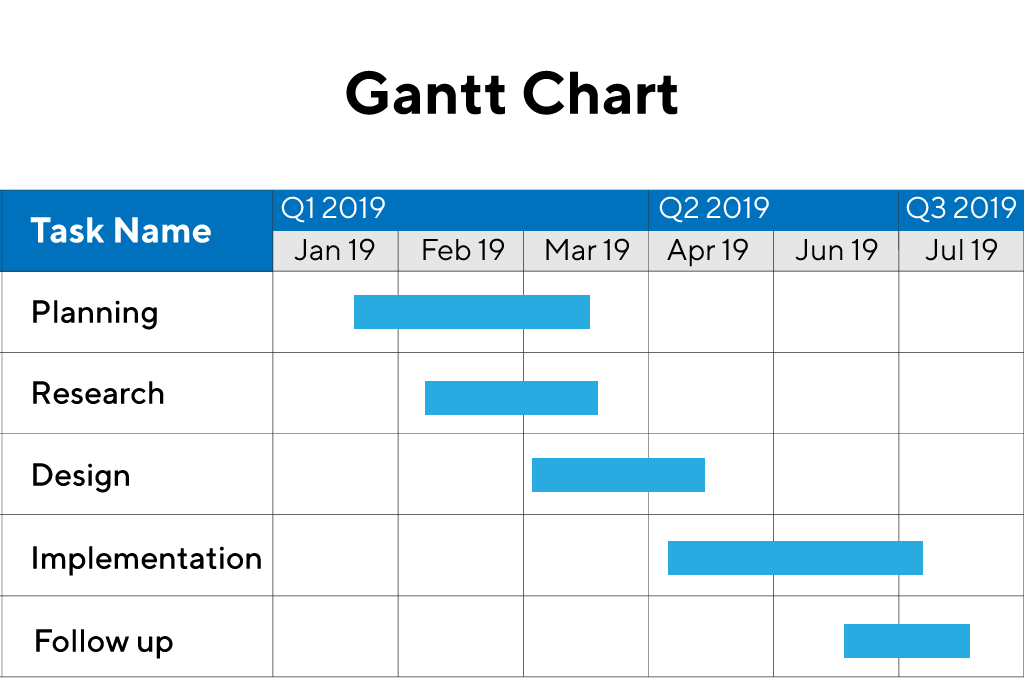
What is a Gantt Chart?
A Gantt chart is a commonly used graphical depiction of a project schedule.
It’s a type of bar chart showing the start and finish dates of a project’s elements, such as resources, planning, and dependencies. It is the most widely used chart in project management.
What is a PERT Chart?
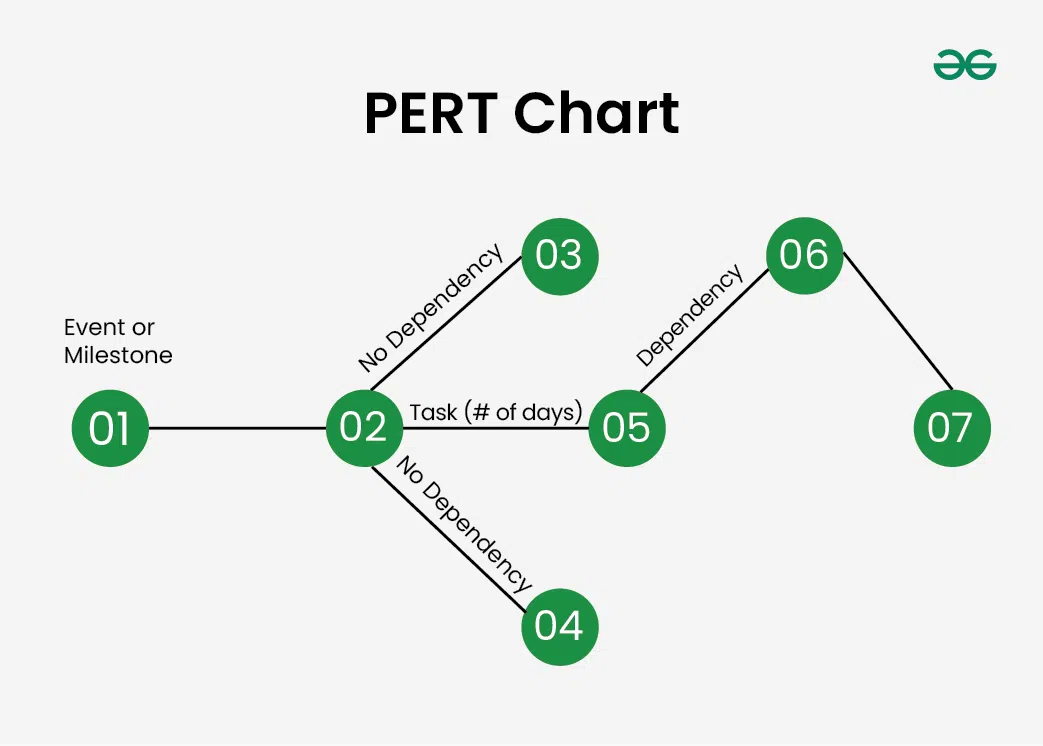
A program evaluation review technique (PERT) chart is a project management tool that allows users to map out a project's timeline and itemize individual tasks.
A PERT chart uses circles or rectangles (called nodes) to represent project events or milestones. These nodes are linked by vectors, or lines, that represent various tasks and their dependencies.
What does PERT stand for in PERT Chart?
Program Evaluation Review Technique.
Define the following project management tool: Project management software
Provides a digital platform for organizing, planning, and tracking project activities.
Examples include: Microsoft Project, Asana, Trello, or Jira.
Define the following project management tool: Communication tools
Facilitate real-time collaboration and communication among project teams, stakeholders, and project managers.
Examples include: Slack, Microsoft Teams or Zoom.
Define the following project management tool: Document management systems
Document management systems are used to store, organize, and share project documents.
Examples include: SharePoint, Google Drive, or Dropbox
Define the following project management tool: Time-tracking software
Time-tracking software allows team members to record what they've been up to.
Platforms like Harvest offer time tracking, expense tracking, and invoicing features, helping project managers monitor project progress. Another example is Toggl.
Define the following project management tool: Risk management tools
Risk management tools can help identify potential risks, their likelihood, and their potential impact on project objectives.
Internal model simulations like Monte Carlo can analyze probability distributions.
What is the a Monte Carlo simulation?
A Monte Carlo simulation is a way to model the probability of different outcomes in a process that cannot easily be predicted due to the intervention of random variables.
It is a technique used to understand the impact of risk and uncertainty. It is a risk management tool.
What are the four primary components of project management?
Time
Scope
Cost
Quality
What does KPI stand for?
Key Performance Indicators.
What is the Critical Path Method (CPM)?
The Critical Path Method is a project management technique that involves identifying the sequence of crucial tasks that directly affect the project duration.
It involves a detailed analysis of tasks, durations, dependencies, and deadlines, to calculate the longest path of planned activities to the end of the project.
What is PRINCE2 project management?
PRINCE2 - Projects in Controlled Environments, version 2
Is a structured project management method that divides projects into manageable stages.
It emphasizes starting, controlling, and closing projects in a consistent, standardized way, with a focus on product-based planning and business justification.
What is “Outcome Mapping” in project management?
Outcome Mapping focuses on the changes that occur in the behaviors, relationships, activities, or actions of people and organizations with whom a project interacts directly.
Rather than focusing solely on deliverables, it emphasizes the journey (behavioral change) and the role of partnerships and contributions in achieving outcomes.
What are the key aspects of project management?
Defining project scope
Identifying deliverables
Managing risks
Effective communication across teams
Describe “Predictive Project Management”
Best for when project and product requirements are well-defined and stable at the beginning.
Emphasizes detailed planning and execution based on initial requirements.
Follows a traditional model where each phase is completed before the next one begins.
Describe “Adaptive project management”
Ideal for projects where requirements are subject to high level of uncertainty and volatility and are likely to change throughout a project.
Uses an iterative and incremental approach, allowing more flexibility and adaptation.
Encourages continuous collaboration and embraces change as a natural part of the process.
Describe “Hybrid project management”
Combines aspects of both predictive and adaptive approaches.
Ideal for projects with varying degrees of certainty and flexibility.
Allows for some project elements to be well-defined and constant while others are subject to change.
What does it mean to determine stakeholder expectations?
Determining stakeholder expectations means actively identifying, understanding, and documenting what key individuals or groups need from a project to consider it successful.
What is SWOT analysis?
Strengths
Weaknesses
Opportunities
Threats
What is an RACI chart?
A RACI chart is a project management matrix used to map roles and responsibilities to tasks, ensuring clarity on who is doing the work, who is accountable, and who needs to be consulted or informed
RACI- Responsible, Accountable, Consulted, Informed
what is a work breakdown structure?
A Work Breakdown Structure (WBS) is a hierarchical, deliverable-oriented decomposition of a project into smaller, manageable components.
It breaks down the total project scope into work packages, allowing teams to visualize, structure, and control all project work.
What is resource leveling?
Resource leveling is a project management technique that adjusts project schedules—specifically start and finish dates—to balance the demand for resources (people, equipment) with limited availability
What is “backward pass scheduling”?
Backward pass scheduling is a Critical Path Method (CPM) technique used to determine the latest possible start and finish times for project activities without delaying the project, calculated by moving backward from the project end date.
What is bottom-up estimating in project management?
Bottom-up estimating is a highly accurate project management technique that calculates total project cost and duration by breaking work into small, manageable tasks (work packages), estimating each, and aggregating them upward
What is “parametric estimating” in project management?
Parametric estimating is a project management technique that uses algorithmic, statistical relationships between historical data and variables (parameters) to calculate cost or duration
What is “analogous estimating” in project management?
Analogous estimating is a project management technique that uses historical data, costs, and durations from previous, similar projects to estimate the current project's parameters
What is “three-point estimating” in project management?
Three-point estimating is a technique used to improve accuracy in activity duration or cost estimation by calculating a weighted average based on three scenarios
Optimistic, Most Likely, and Pessimistic
What is Earned Value Measurement (EVM)?
Earned Value Management (EVM) is a project management technique that objectively measures project performance by combining scope, schedule, and cost metrics. It calculates the value of work actually completed (Earned Value) against the planned budget (Planned Value) and actual costs (Actual Cost) to forecast final project outcomes, such as budget overruns or schedule delays.
What does crashing a project mean?
Project crashing is when you shorten the duration of a project by reducing the time of one or more tasks.
Crashing is done by increasing the resources to the project
What is a change control board (CCB) in project management?
A Change Control Board (CCB) in IT project management is a formal committee of stakeholders, technical experts, and managers that reviews, evaluates, and approves or rejects proposed changes to project baselines (scope, cost, schedule)