Chem Final
 Call Kai
 Learn
Learn Practice Test
 Spaced Repetition
 Match
Match Flashcards
 Knowt Play
1/625

There's no tags or description
Looks like no tags are added yet.
Name | Mastery | Learn | Test | Matching | Spaced | Call with Kai |
|---|
No analytics yet
Send a link to your students to track their progress
626 Terms
intramolecular
bonding within the molecule
ionic and covalent
solids, liquids, and gases do not
ionize
aqueous solutions, strong acids, and strong bases do
ionize
when formula writing make sure to write
states of matter
ionic and covalent are ____ than IMF
stronger
ionic
nm/m
transferred
covalent
nm/nm
shared
intermolecular forces
what relationship two molecules have with one another
types of intermolecular forces
london dispersion, dipole/dipole, hydrogen bonding
hydrogen bonding
nitrogen, oxygen and fluorine + hydrogen
boil/melt
cutting attraction
strongest
dipole/dipole
polar/polar
london dispersion
every molecule has london
depends on mass
mass> property
stronger the IFs, higher the
bp, mp, and viscosity
law of conservation of matter
mass cannot be created or destroyed
who came up with balancing equaltions
antoine lavoisier
Synthesis
N2 +3H2→ 2NH3
nitrogen reacts with hydrogen to produce ammonia
Decomposition
2H20→ 2H2 +O2
Water decomposes to produce hydrogen and oxygen
Single replacement
Zn + 2HCl → H2 + ZnCl2
Double replacement
Pb(NO3)2 +KI → PbI2 + KNO3
Complete Combustion
2HC + O2 → H20 +CO2
four states of matter
solid, liquid, gas, aqueous
pure liquid
H2O and Hg
diatomics
cannot exist by themselves
H, N, O, F, Cl, Br, and I
aq + aq → s + aq
occurs
aq + aq → aq + aq
does not occur
catalysts
speeds up reactions
not consumed
no power to start a reaction
activity series
determines if SR occurs
activity series rule
element that is by itself must be higher than what it is kicking out for reaction to occur
solubility table
to see if DR occurs
ioninc compounds
soluble
aq
insoluble
s
basic acid base neutralization
acid (ph=1) + base (pH=14)→ H20 (neutral, pH=7) + Ionic compound
step to balance ABNs
balance ionic compound
h
o
1 mol
molar mass
1 mole
6.022×10²³ molecules/atoms
Formula unit
ionic
stoich steps
write and balance equations
Label knowns and unknowns
use mass/mole conversions and mole-to-mole ratio
Look to see what units answer needs to be in
Limiting reagent steps
write/balance equation
label knowns and unknowns
take each reactant and calculate how much product will form. The reactant that yields less product is the limiting factor.
Do stoich to calculate what you need to do reaction
make sure you use lr lab value to calculate any product
percent yield equation
actual/theoretical x100
actual is the value
given
theoretical is the value found from
stoich
percent yields less than 100 means
you have lost product
percent yields over 100 could mean
product is wet or you have unreacted reactant
two components of a solution
solute and solvent
solute
gets dissolved (ionic)
solvent
dissolves solute
universal solvent
water
If the solute diappears, then you have a
homogeneous mixture
If some of the solute remains, then you have a
heterogeneous mixture (not a solution)
Equaltion for molarity
M= mol of solute/L of solution
The larger the molarity, the more
concentrated the solution (has a large amount of solute)
the smaller the molarity, the more
dilute the solution (has a smaller amount of solute
more dangerous to spill solutions with
higher molarity
If you have a concentrate solution then diluting the mixture will
reduce the molarity
dilution
add water to a solution to make it less concentrsated
purpose of dilution
save solute, make it safer for students
add acid
to water bc it will spit if you do it the other way
equation for dilution
m1v1=m2v2
When it asks what happens in a dilution say
pipette v1 value of m1 value in v2 flask, add water to mark
for soluble species we write an
(aq) meaning that we cannot see the solute
for insoluble species we write a
(s) meaning we can see the solute
what is a precipitate
chunking solid falls out of solution
precipitate reaction
aq + aq → s + aq
Electrolytes
compounds that are soluble in water and will conduct electricity as ions
water is
not a good conductor of electricity
strong electrolytes
soluble ionic compounds, strong acids, strong bases
bright light
HCl, NaHCO3
weak electrolytes
weak acids, weak bases, slightly soluble ionics and very few covalents
dim light
NH3
Nonelectrolytes
organic compounds and most covalents
h20 (deionized) and alcohol
dissociation=
pop=electrocute
what does it mean if an electrolyte is a s, l, or gas
no pop and double headed arrow
cannot pop
weak and non electrolytes
net ionics
write/balance equations and determine what is soluble and insoluble
split aq species into ions and keep isnoluble solids, gases, and liquids
cancel out spectator ions and reqrite equations
valence electrons
highest energy level
determine by looking at Roman numeral
Assymetrical things tend to be
polar
what doesnt hybridize
halogens and terminal atoms
have a hybridization of p
h hybridization
s
Symmetrical things tend to be
nonpolar
arrow on geometry
element comes forward
triple bonds
1 sigma, 2 pi
train tracks on geomtry
element goes behind
arrow for dipoles goes towards the
most electronegative element
+delta→ -delta
no pull/dipoles for
ionic and nonpolar covalent
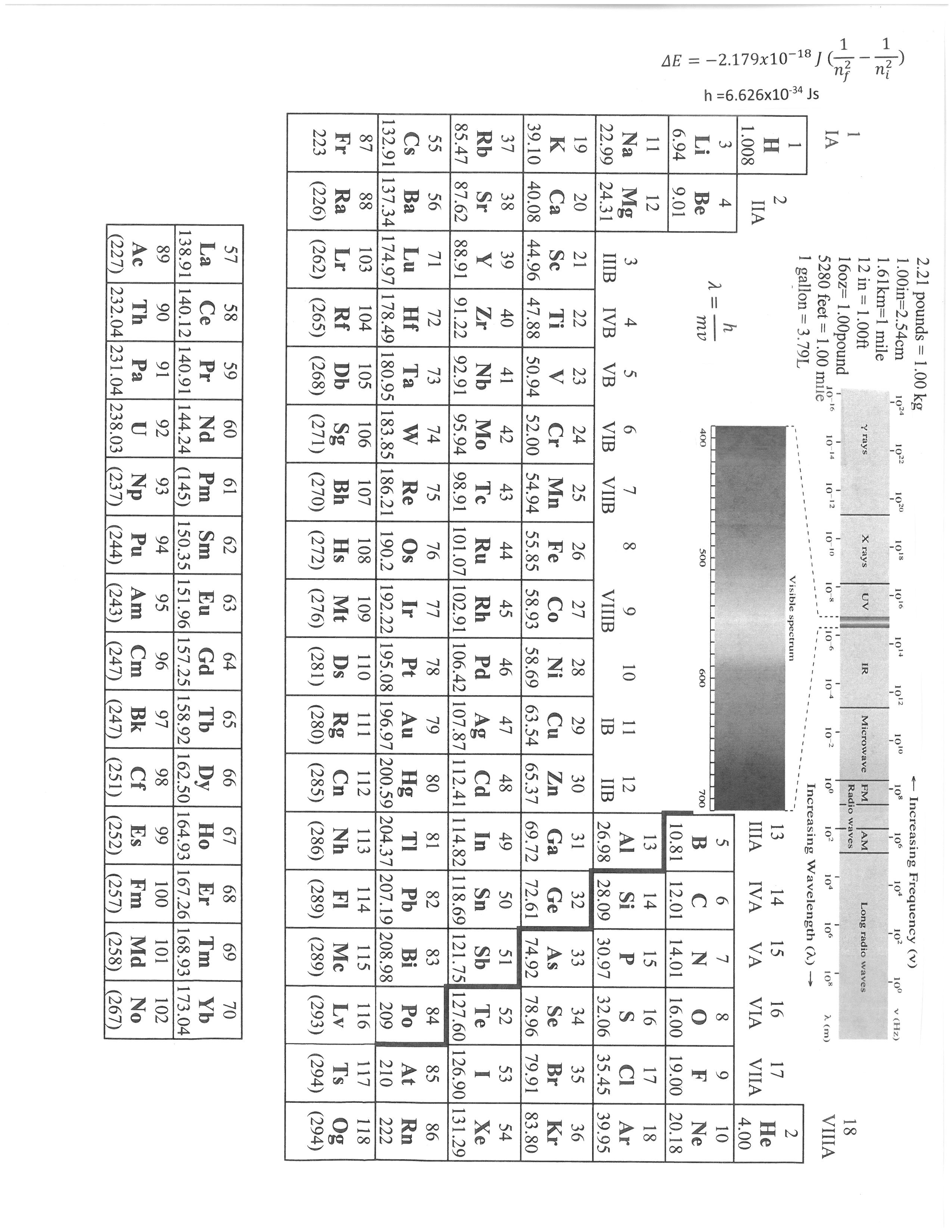
label this
f orbitals are 4 and 5
what do you do if you have a d4 or d9
make them d5/d10 by moving an electron from s sublevel
how many boxes do s orbitals have
1
2e
how many boxes do p orbitals have
3
6e
how many boxes do d orbitals have
5
10e
how many boxes do f orbitals have
7
14e
stable sublevels
full spdf
half full pdf
empty spdf
para
at least one or more unpaired e
effects magnet
dia
all e are paired up
does not effect magnet
cation
loses electrons (+)
metals
anion
gains electrons (-)
nometals
group 1 charge
+1
group 2 charge
+2
group 13 charge
+3
Ag charge
+1
Zinc and Cd charge
+2
group 15 charge
-3
group 16
-2