Endo 12 - Internal Tooth Bleaching/ Management of Discolored Teeth (Dr. Monteiro)
 Call Kai
 Learn
Learn Practice Test
 Spaced Repetition
 Match
Match Flashcards
 Knowt Play
1/111

There's no tags or description
Looks like no tags are added yet.
Name | Mastery | Learn | Test | Matching | Spaced | Call with Kai |
|---|
No analytics yet
Send a link to your students to track their progress
112 Terms
Of the following, which is the least invasive?
A) Prophy/Abrasives
B) External Bleaching
C) Internal Bleaching
D) Combination "Inside/Outside"
E) Prosthetic Rehabilitation
A) Prophy/Abrasives
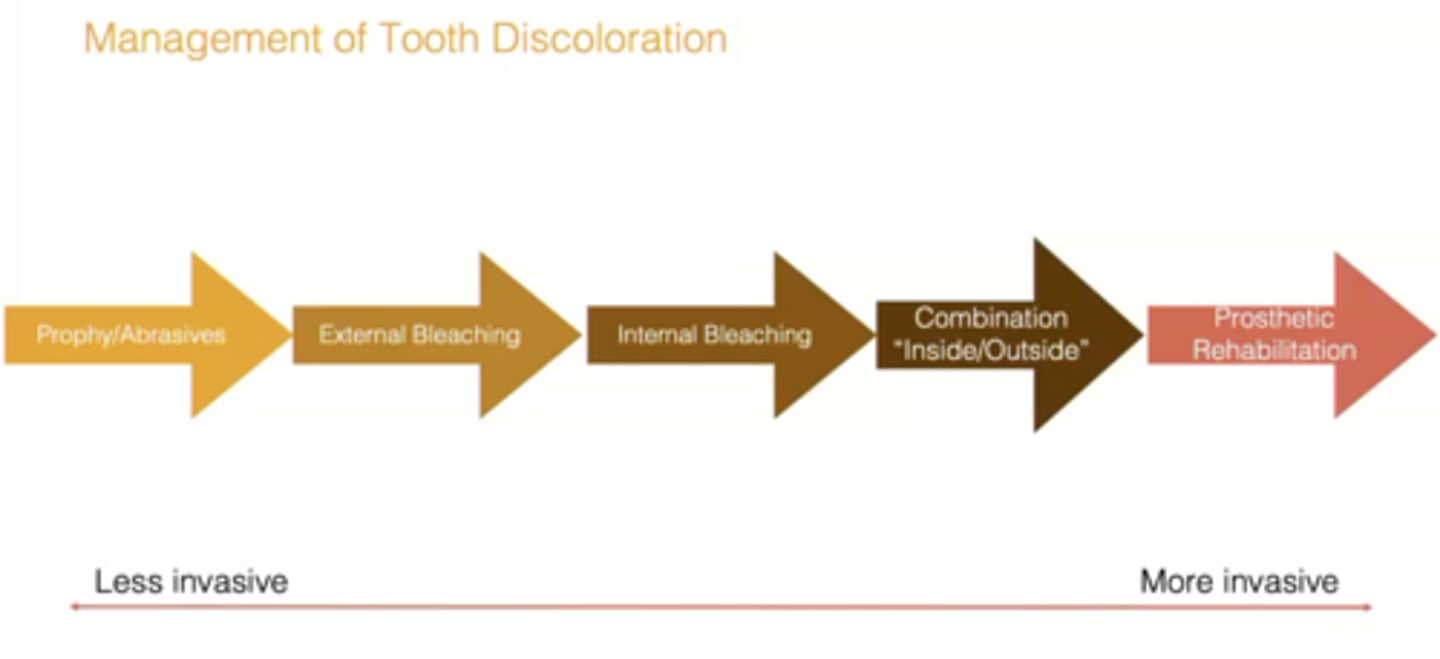
Of the following, which is the most invasive?
A) External Bleaching
B) Prophy/Abrasives
C) Prosthetic Rehabilitation
D) Combination "Inside/Outside"
E) Internal Bleaching
C) Prosthetic Rehabilitation
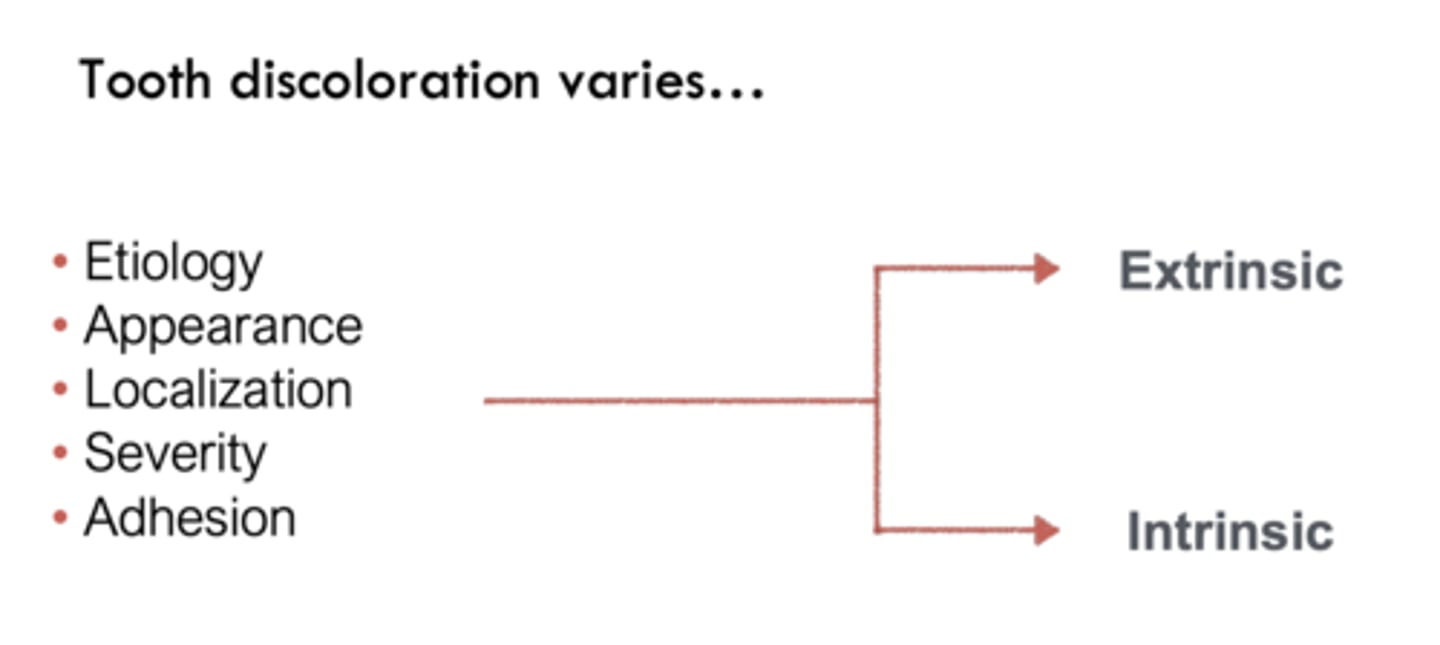
What are two types of causes for tooth discoloration?
- Intrinsic
- Extrinsic
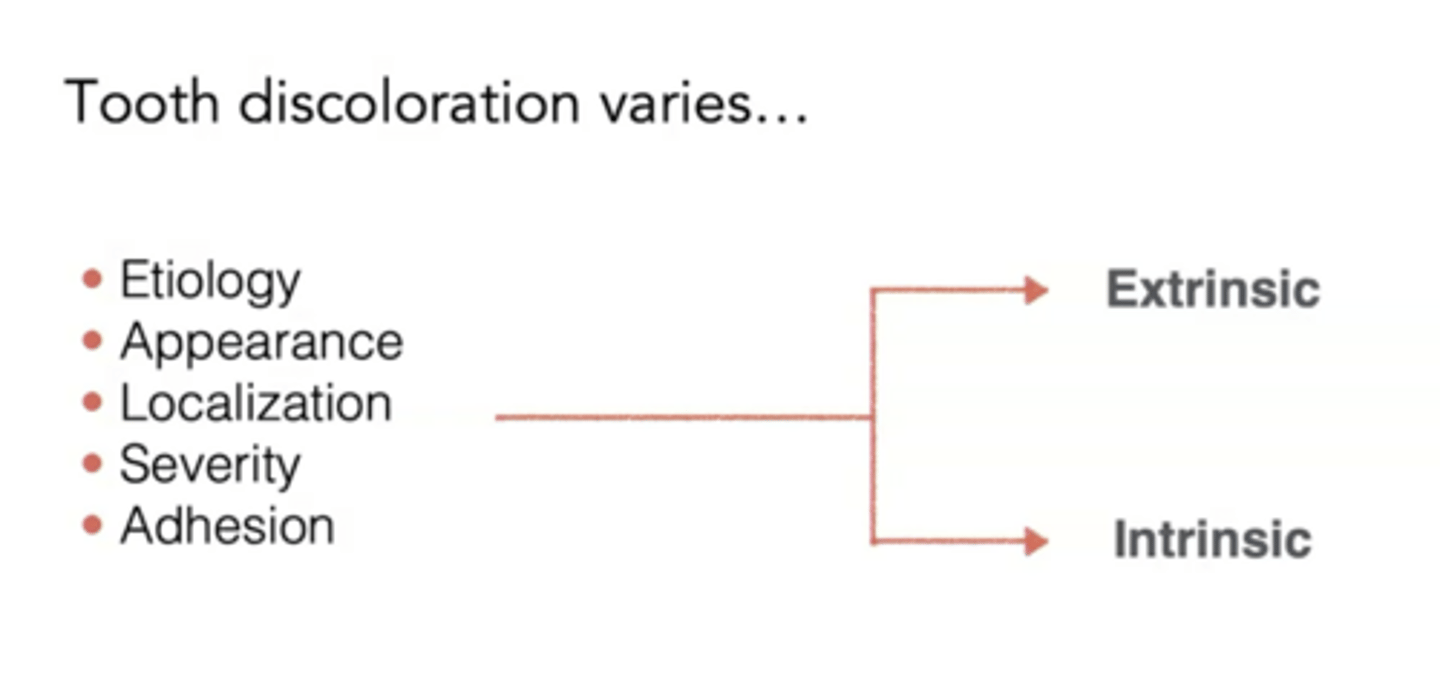
What are the five main factors for causing tooth discoloration?
- Etiology
- Appearance
- Localization
- Severity
- Adhesion
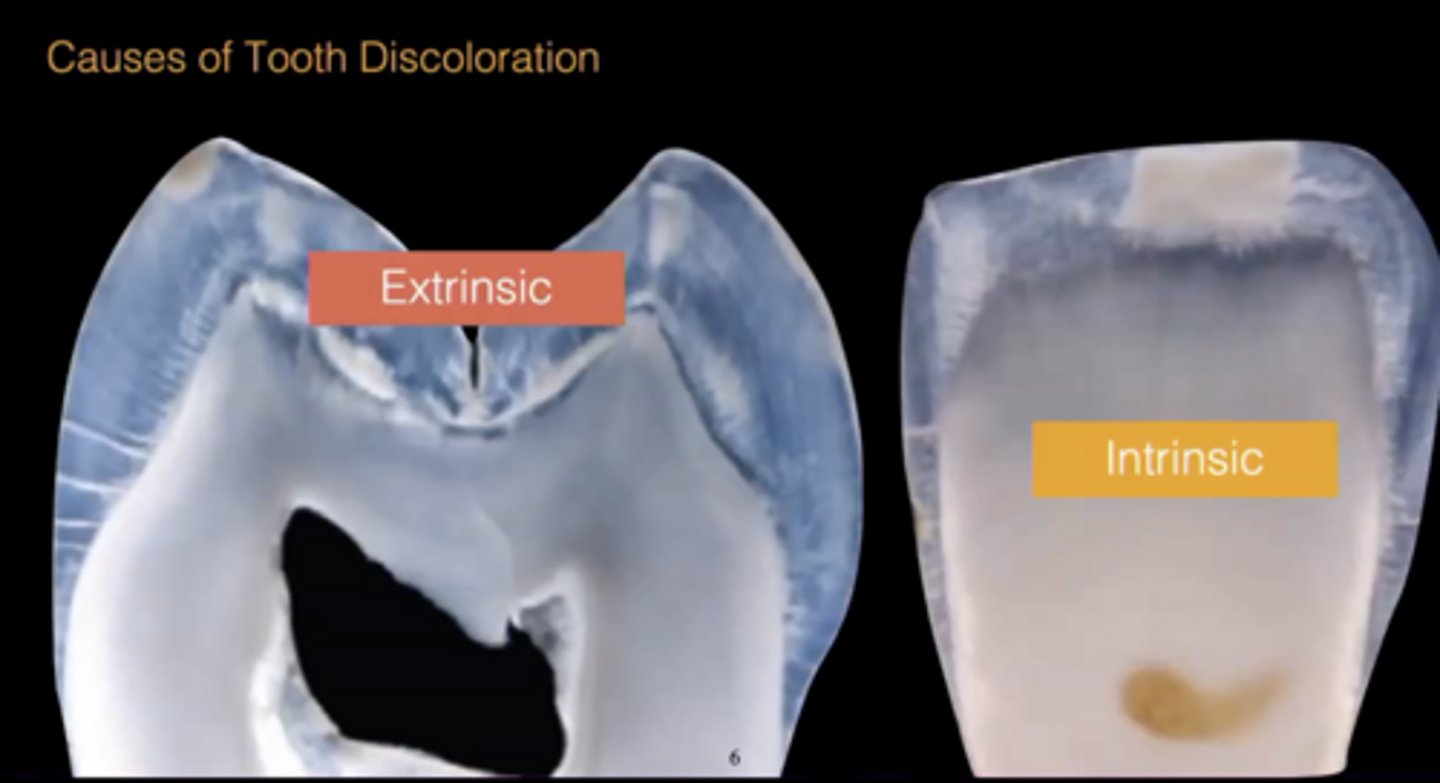
What part of the tooth gives it it's color?
Dentin
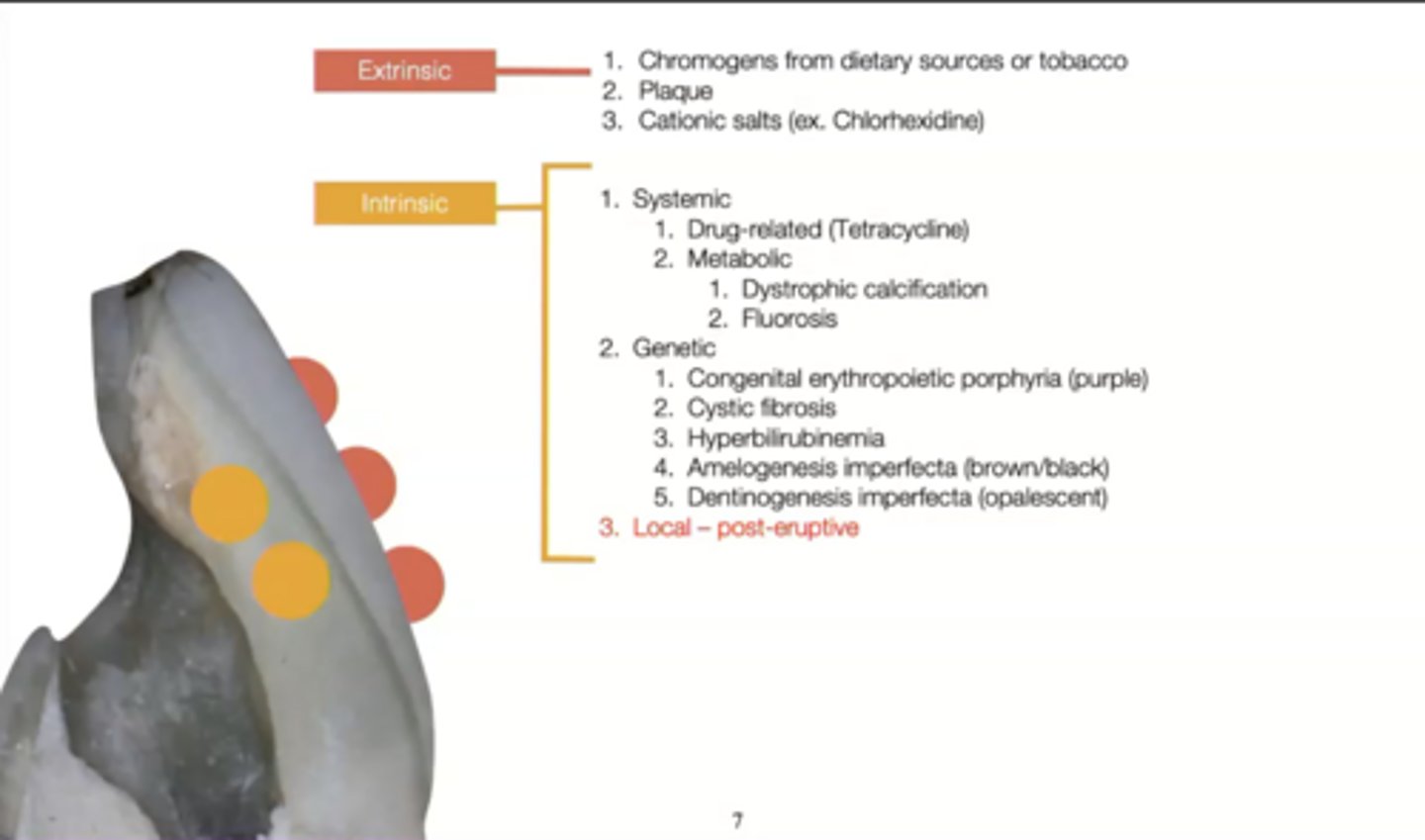
What type of tooth discoloration occurs from...
- Chromogens derived from habitual intake (dietary sources)/tobacco
- Plaque
- Cationic salts (chlorohexidine)
Extrinisic causes
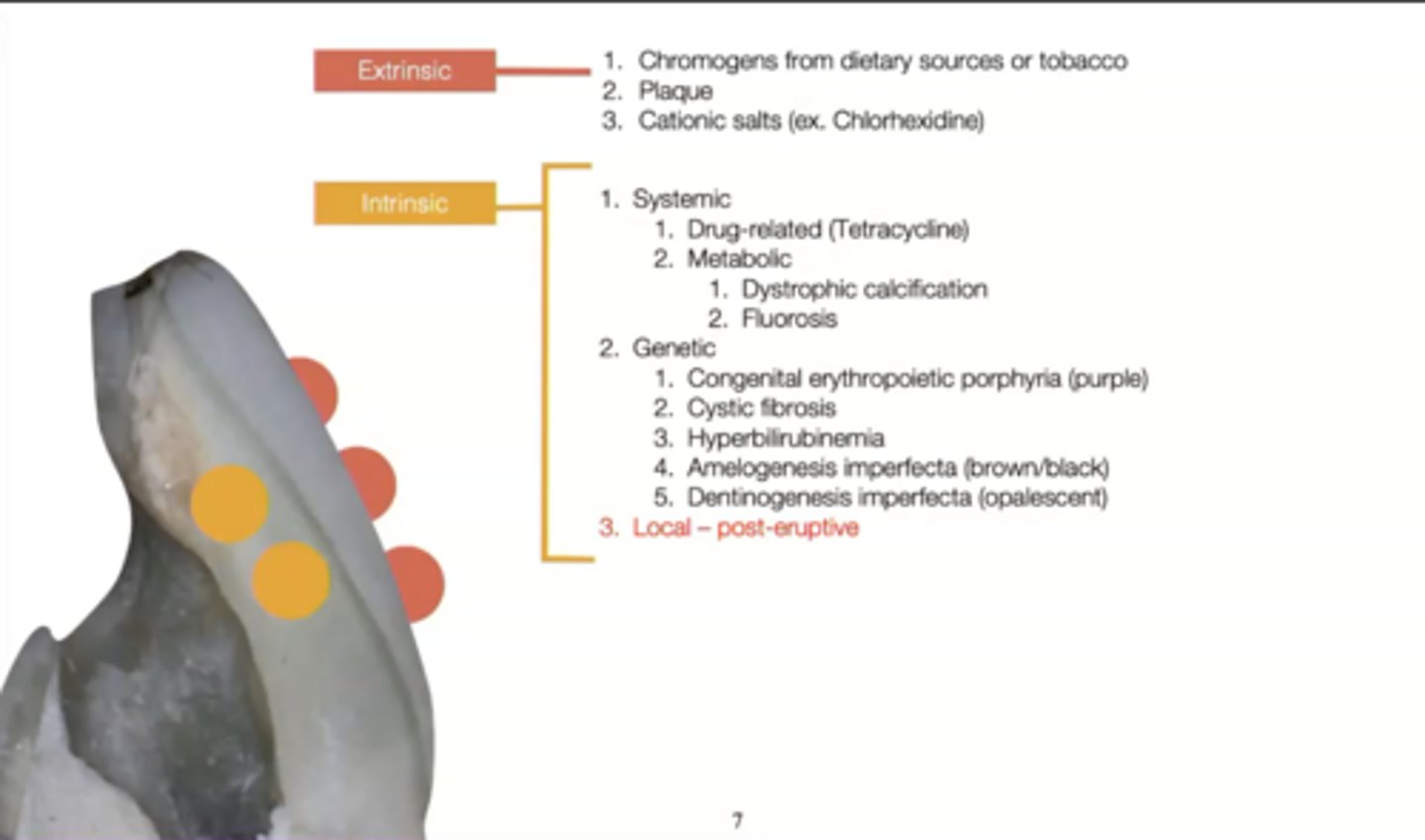
What type of tooth discoloration occurs from systemic causes like...
- Drug-related (Tetracycline)
- Metabolic
- Dystrophic calcification
- Fluorosis
Intrinsic causes
What type of tooth discoloration occurs from genetic causes like...
- Congenital erythropoietic porphyria (purple)
- Cystic fibrosis
- Hyperbilirubinemia
- Amelogenesis imperfecta (brown/black)
- Dentinogenesis imperfecta (opalescent)
Intrinsic causes
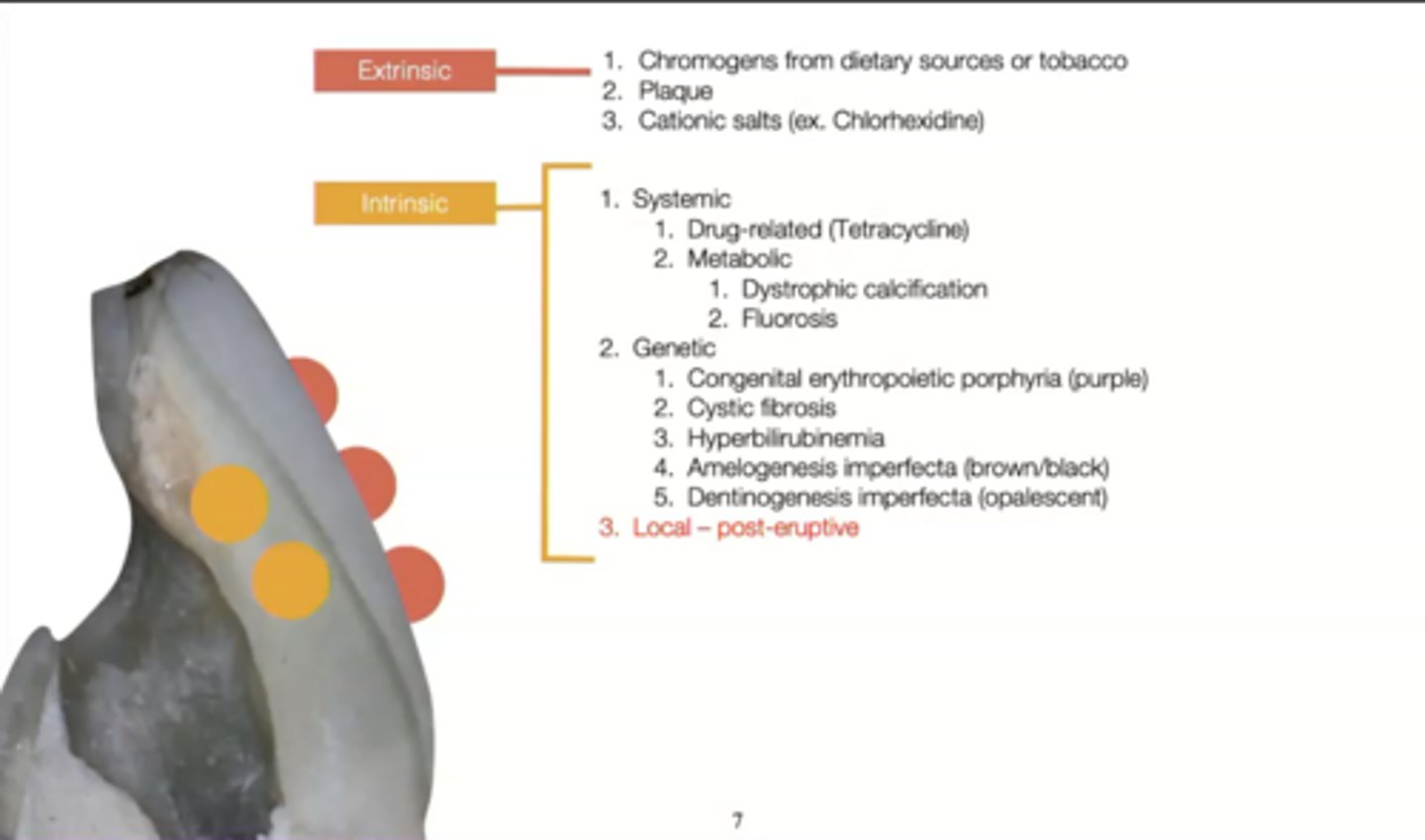
What type of tooth discoloration occurs from local causes like post-eruptive?
Intrinsic causes
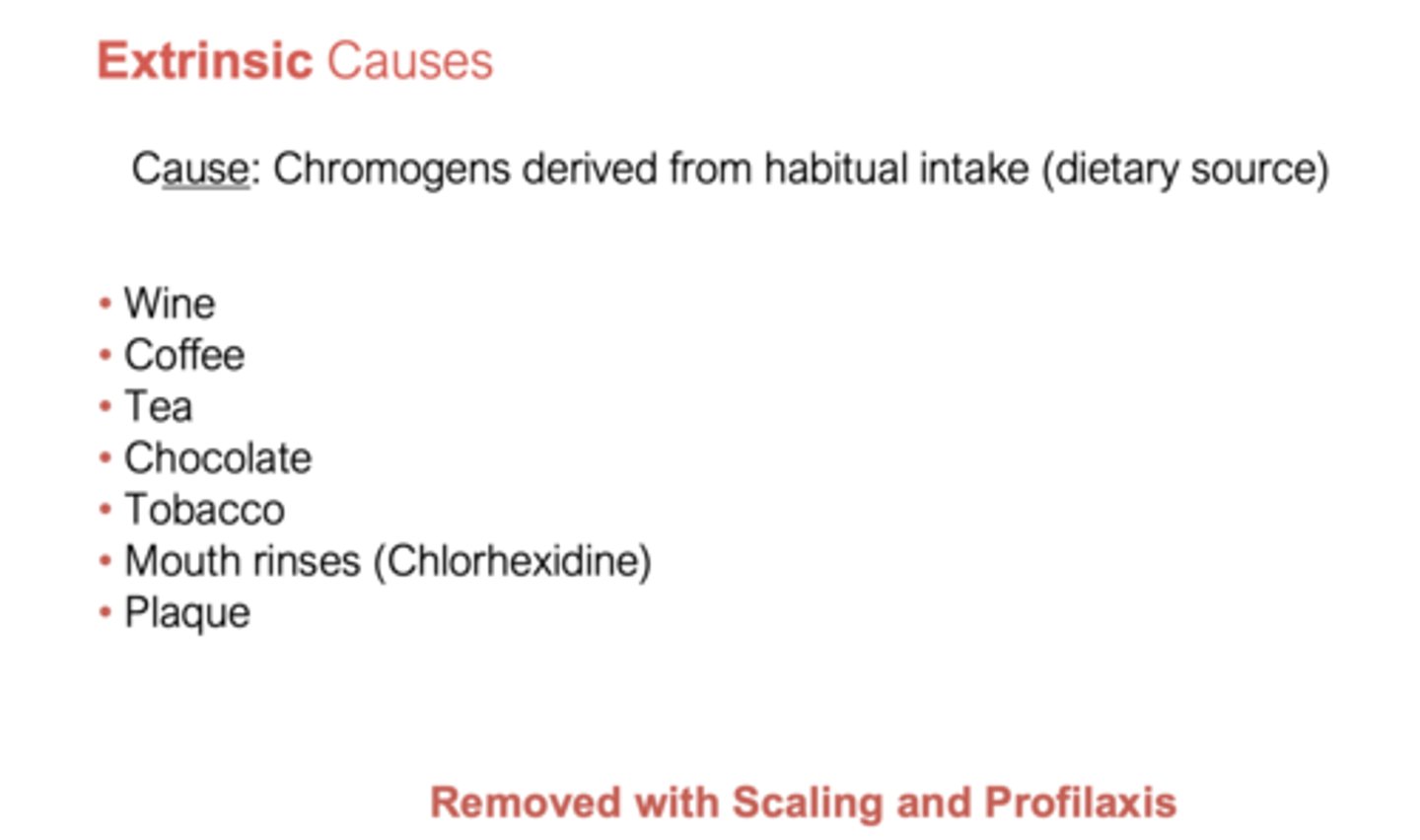
how are external tooth discoloring agents removed, like wine, coffee, and tobacco?
- Scaling
- Prophylaxis
What is the bleaching effectiveness on Amelogenesis Imperfecta with a brown/yellow stain?
temporary
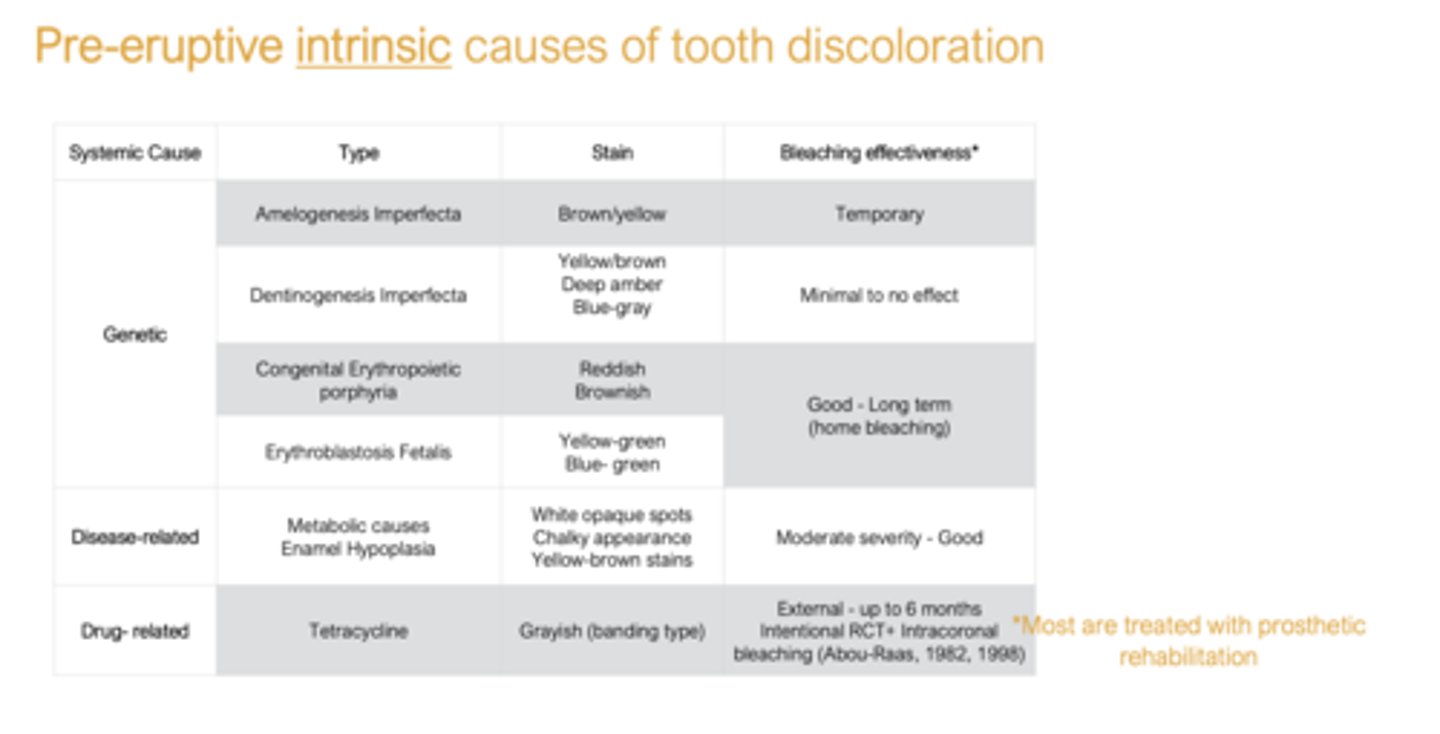
What is the bleaching effectiveness on Dentinogenesis Imperfecta with any of the following colored stains:
- Yellow/brown
- Deep amber
- Blue-gray
minimal to no effect
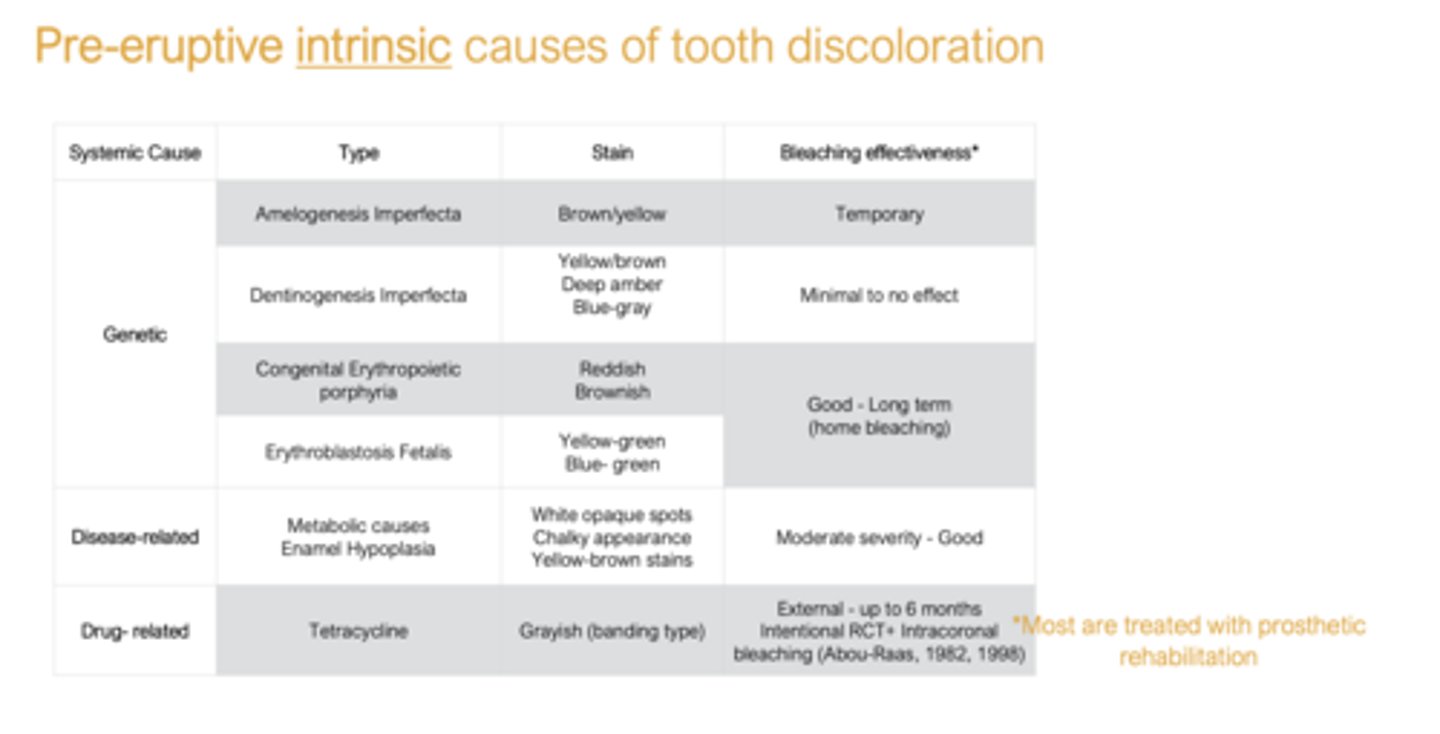
What is the bleaching effectiveness on Congenital Erythropoietic porphyria with a reddish or brownish stain?
Good - Long term (home bleaching)
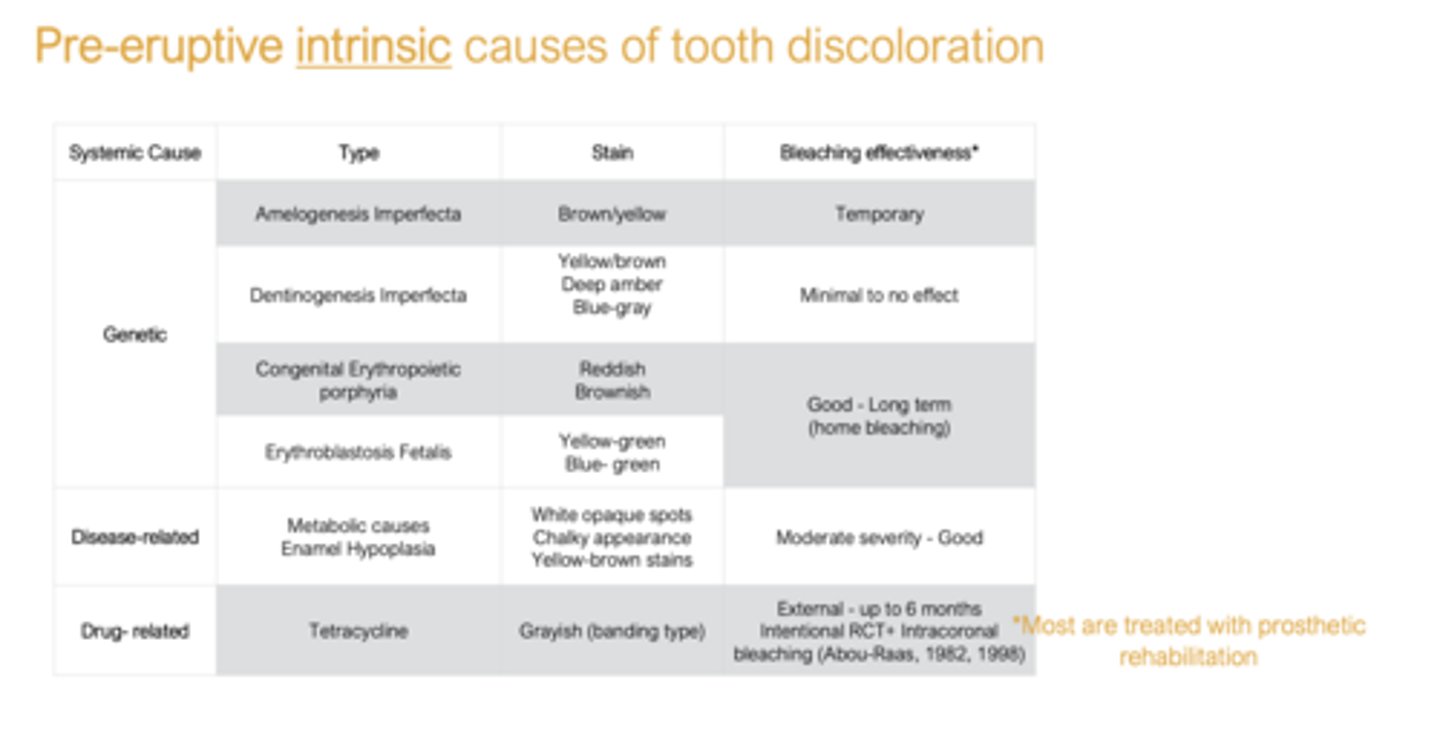
What is the bleaching effectiveness on Erythroblastosis Fetalis with a yellow-green or blue-green stain?
Good - Long term (home bleaching)
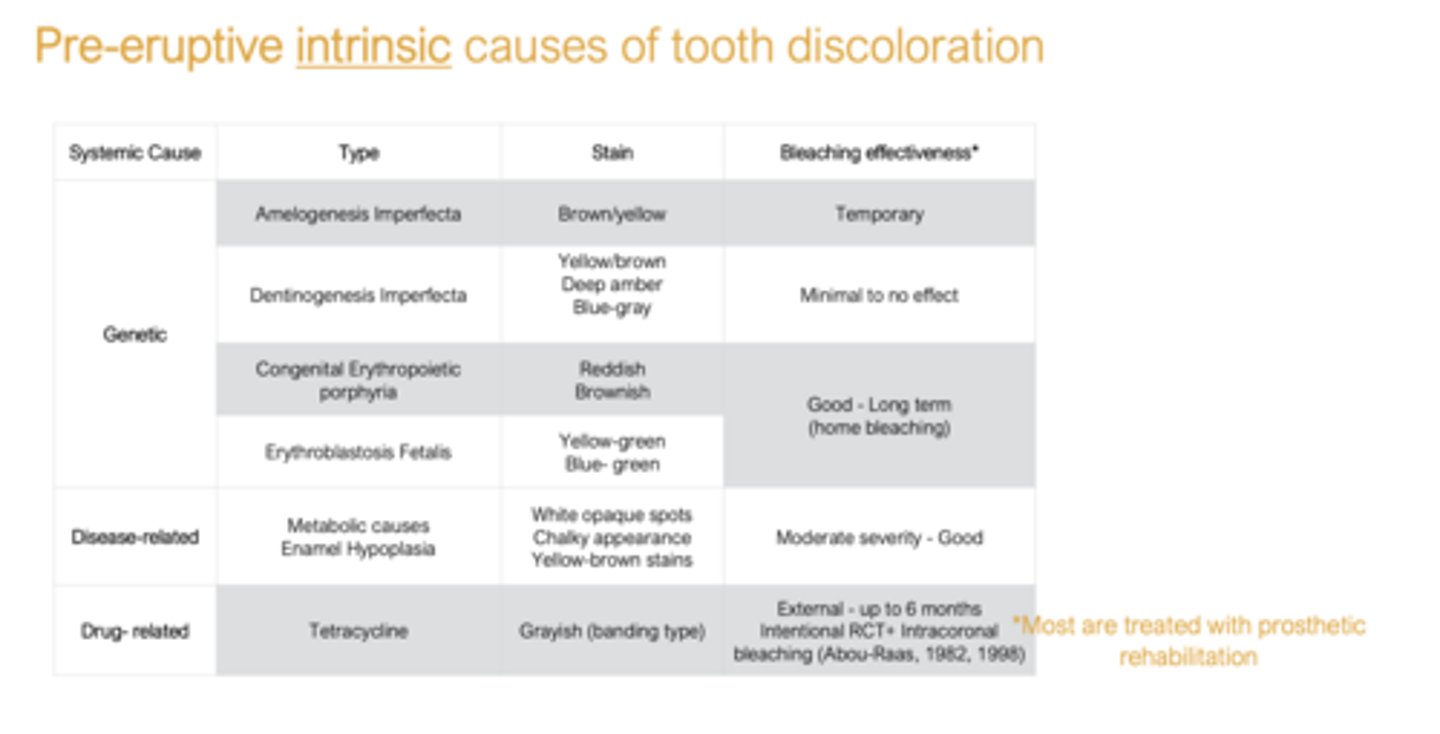
What is the bleaching effectiveness on Metabolic caused Enamel Hypoplasia with any of the following colored stains:
- White opaque spots
- Chalky appearance
- Yellow-brown stains
Moderate severity - Good
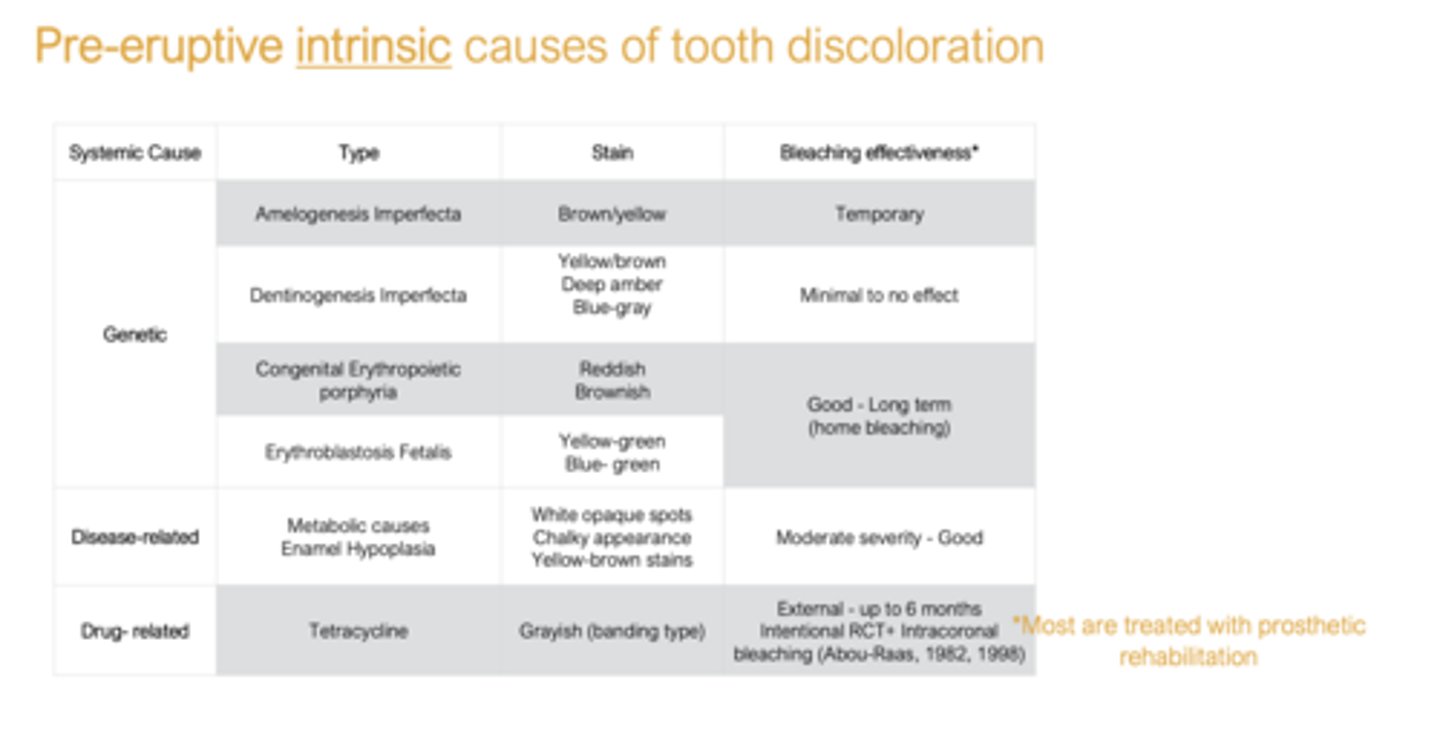
What is the bleaching effectiveness on Tetracycline stains with a grayish color?
- External - up to 6 months
- Intentional RCT + Intracoronal bleaching
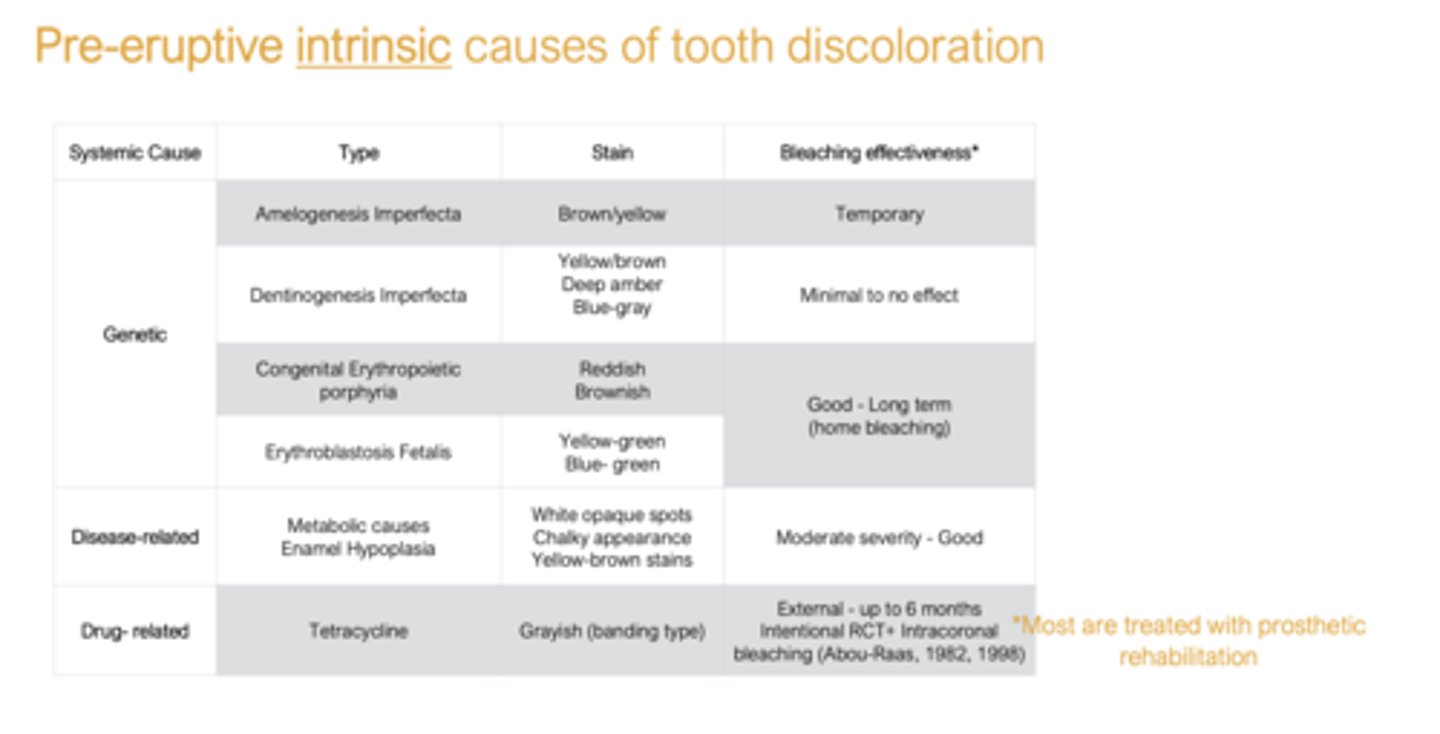
How are most pre-eruptive intrinsic causes of tooth discoloration stains treated?
Prosthetic rehabilition
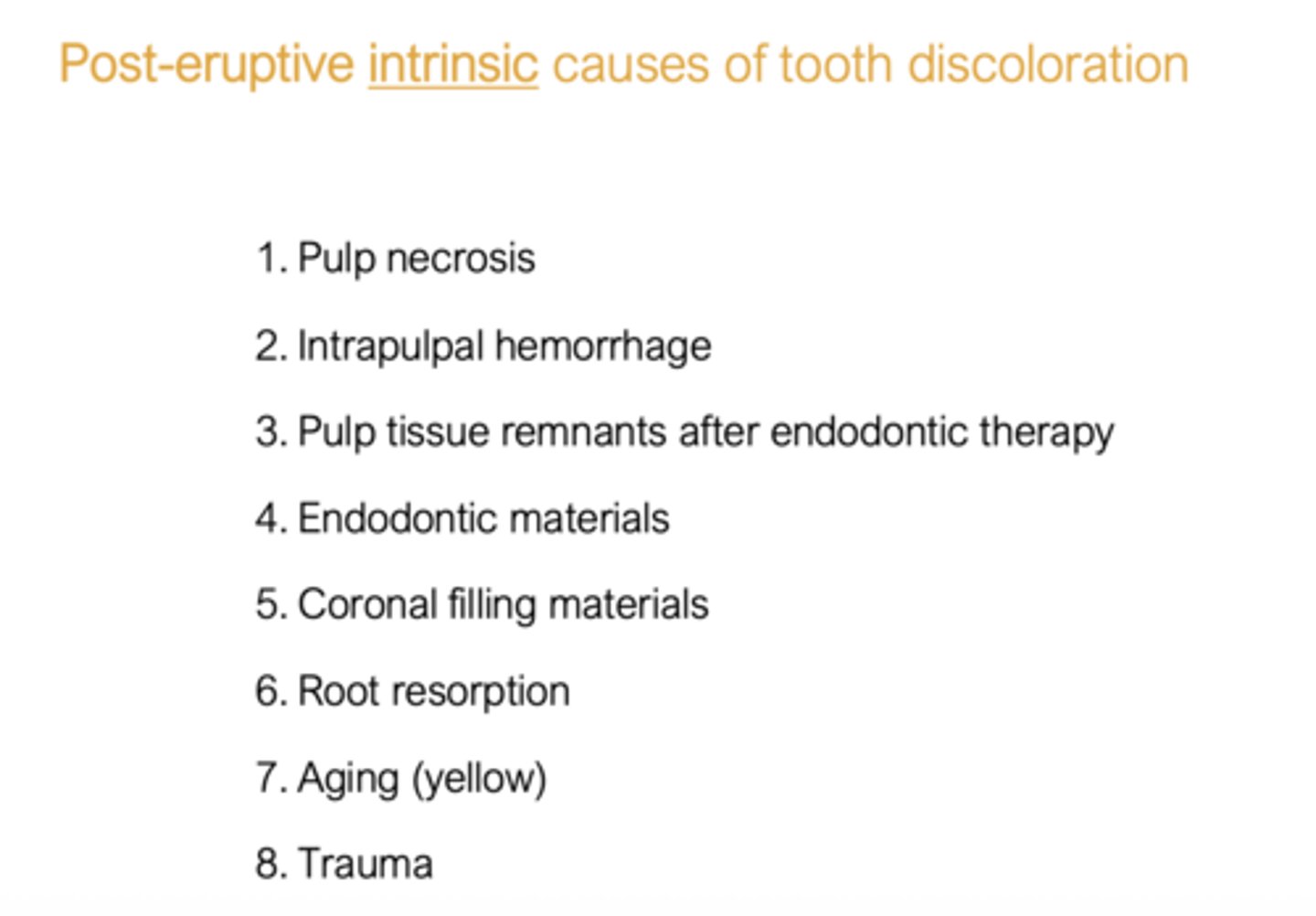
All of the following are _________ causes of tooth discoloration
- Pulp necrosis
- Intrapulpal hemorrhage
- Pulp tissue remnants after endodontic therapy
- Endodontic materials
- Coronal filling materials
- Root resorption
- Aging (yellow)
- Trauma
post-eruptive intrinsic causes
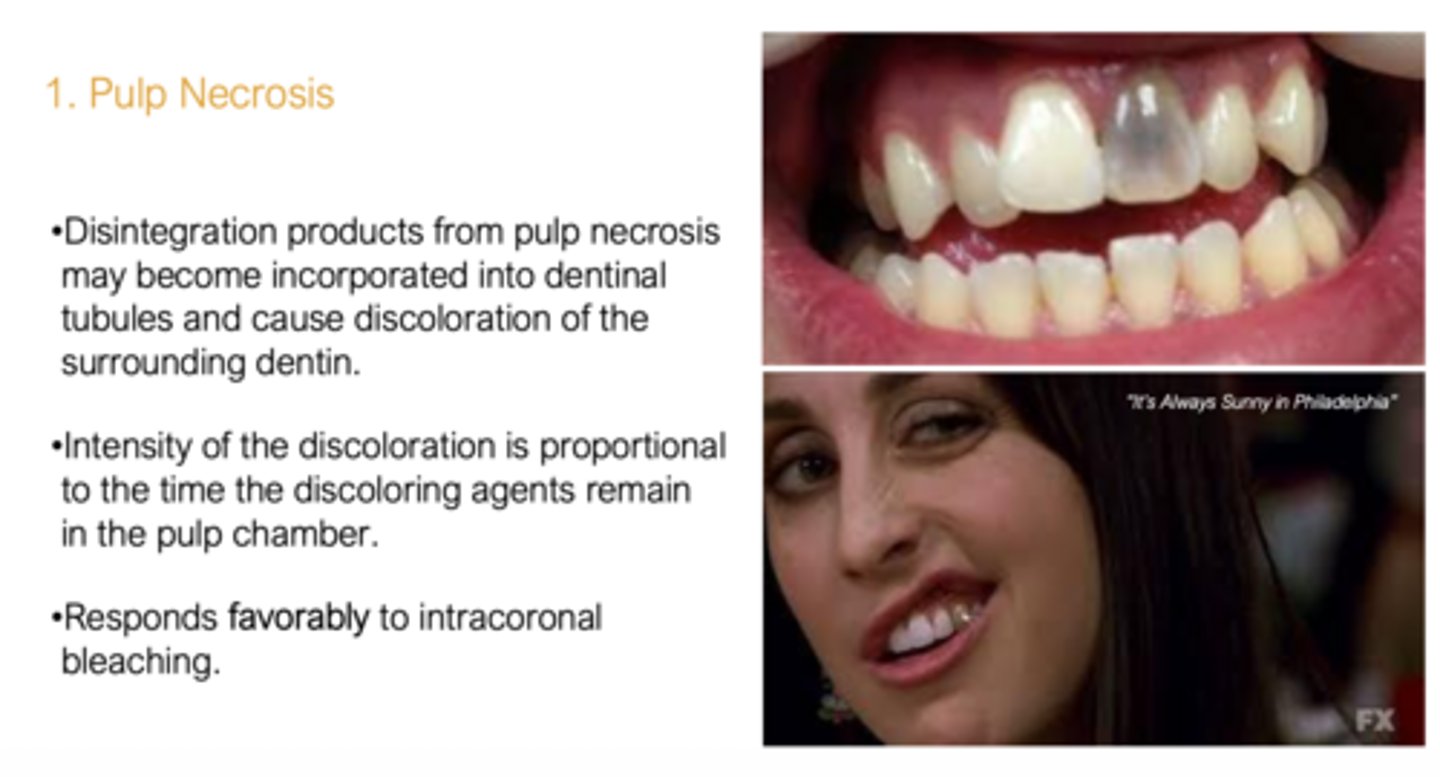
Disintegration products from ________ may become incorporated into dentinal tubules and cause discoloration of the surrounding dentin
pulpal necrosis
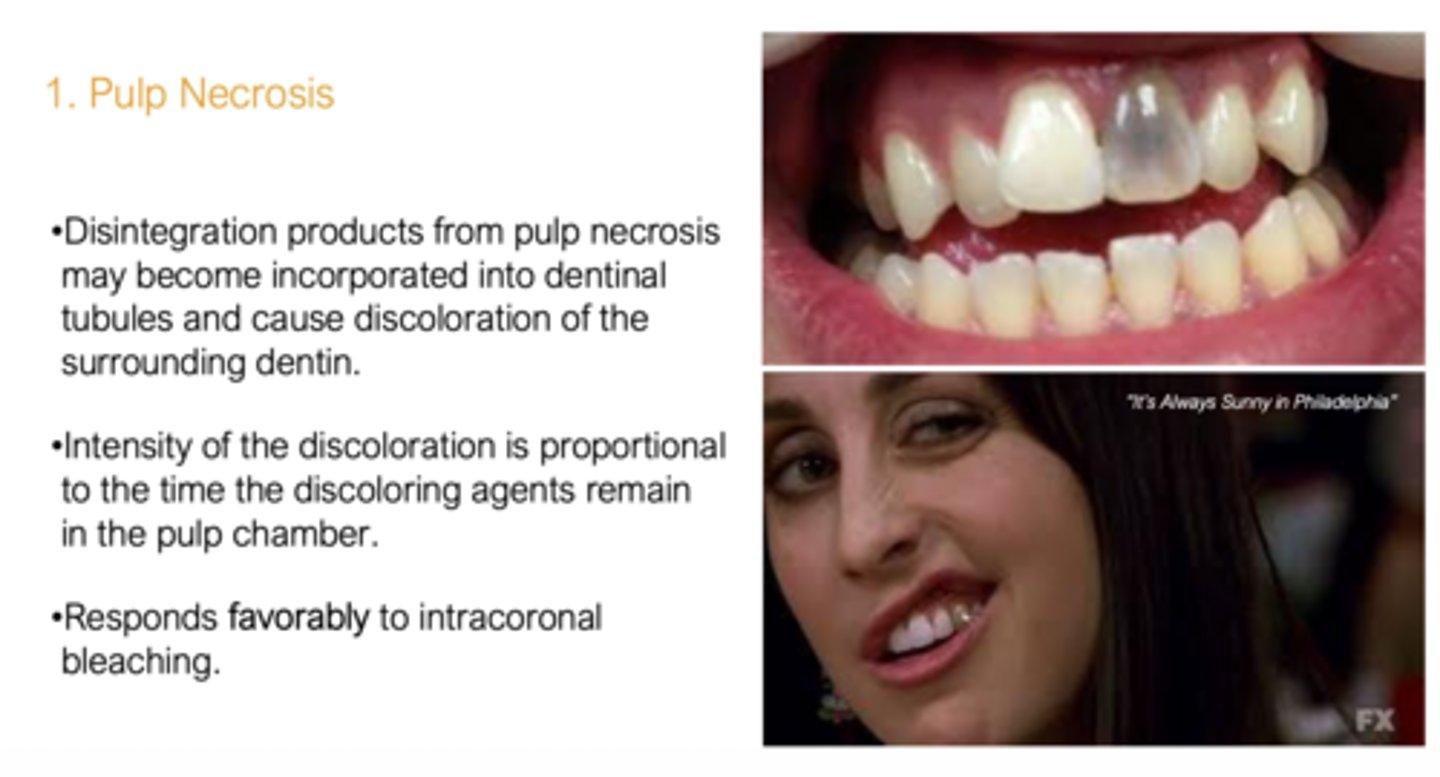
For teeth with pulp necrosis, the intensity of the discoloration is _______ to the time the discoloring agents remain in the pulp chamber.
proportional
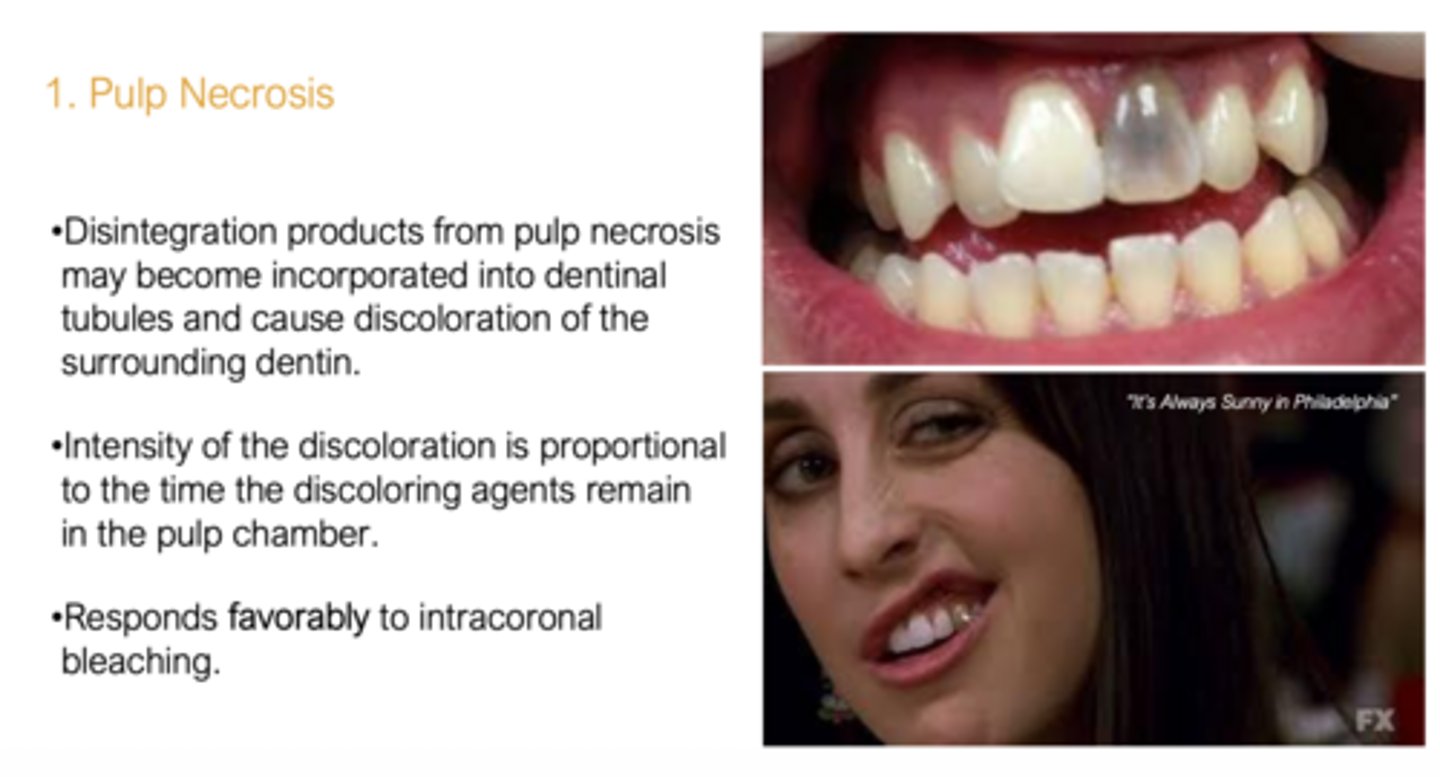
How does pulp necrosis respond to intracoronal bleaching?
favorably
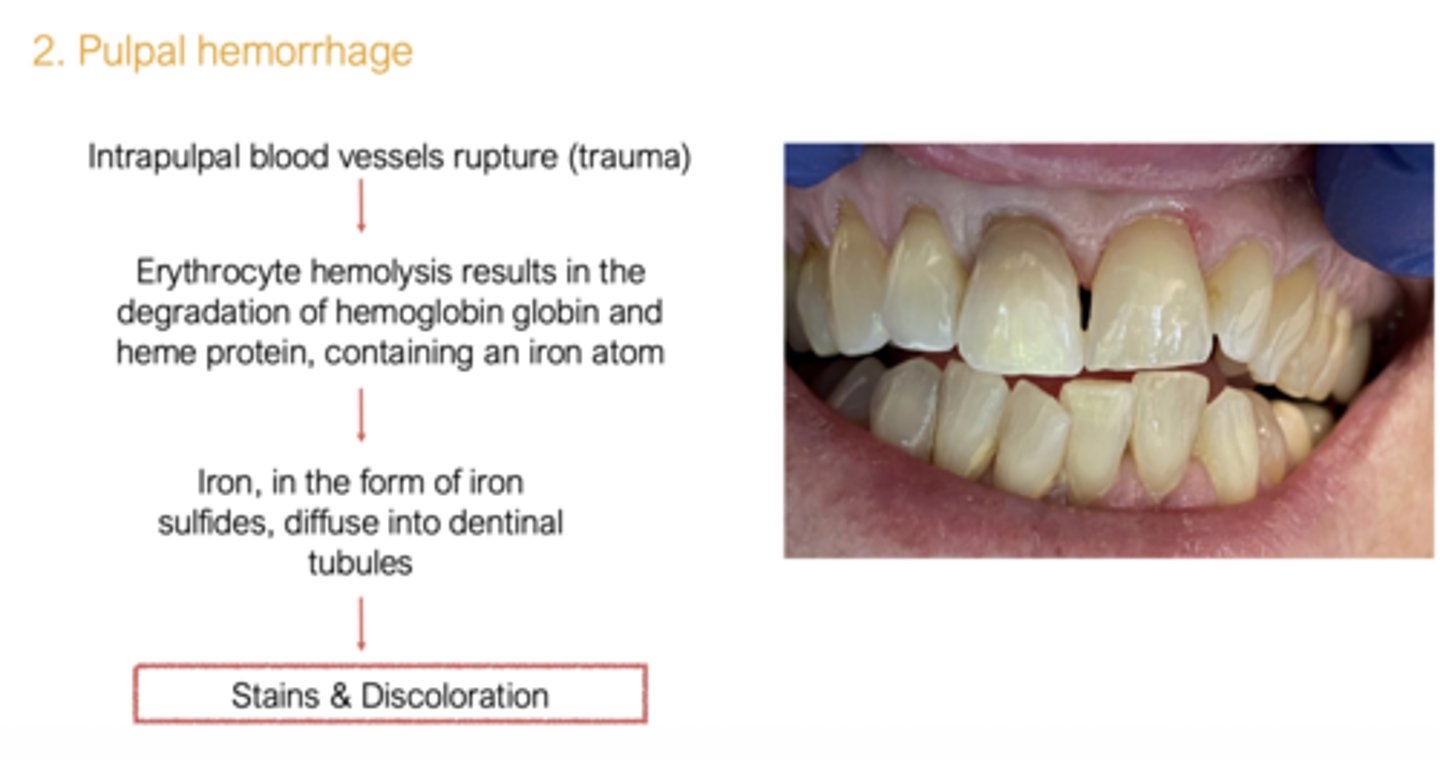
ID the type of extrinsic tooth discoloration cause:
Intrapulpal blood vessels rupture (trauma) and erythrocyte hemolysis results in the degradation of hemoglobin globin and heme protein, containing an iron atom. Iron, in the for form of iron sulfides, diffuse to reach dentinal tubules, which causes stains and discoloration
Pulpal hemorrhage
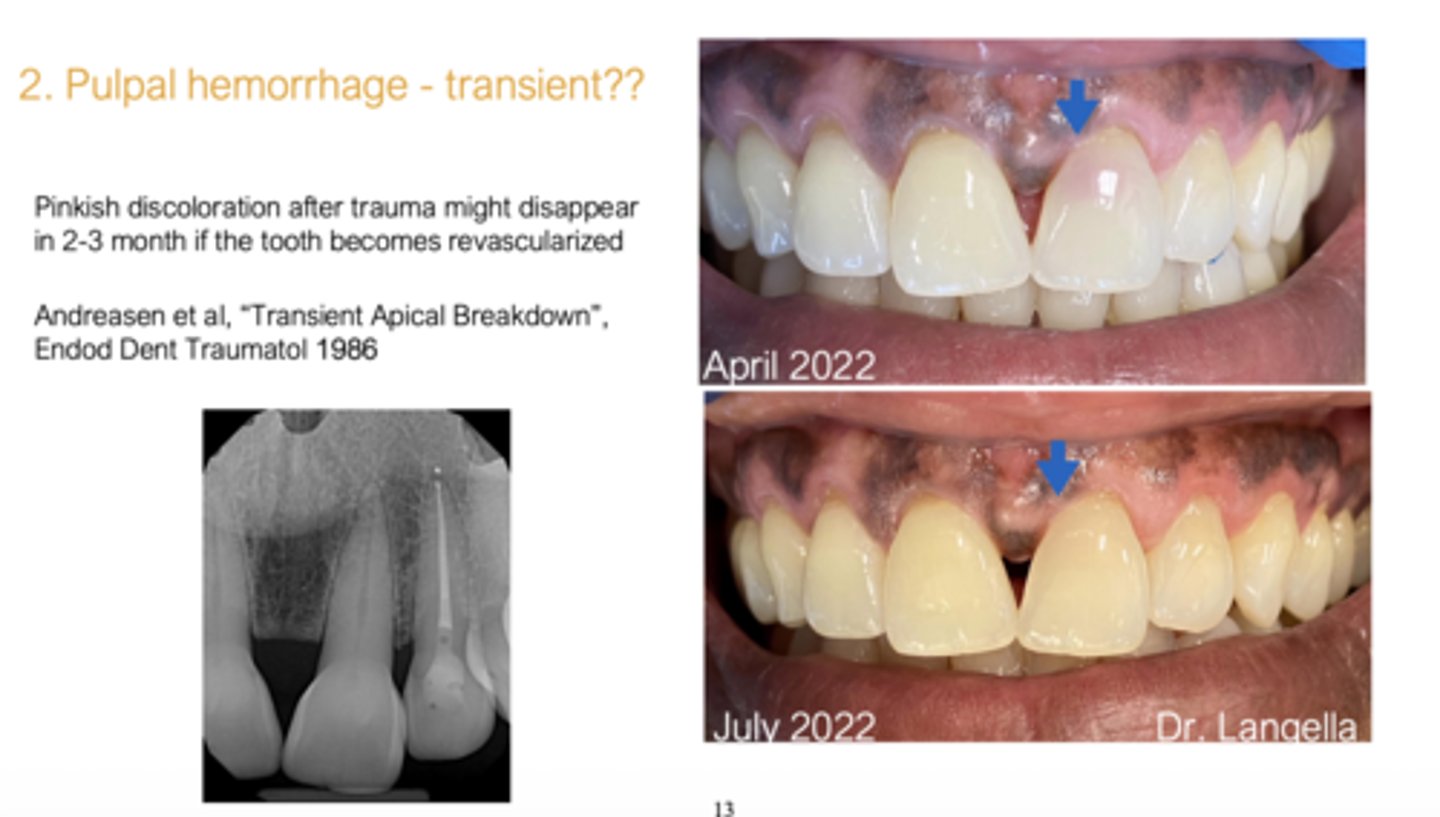
Pinkish discoloration after trauma might disappear in 2-3 months if the tooth becomes revascularized occurs in a tooth with __________
pulpal hemorrhage
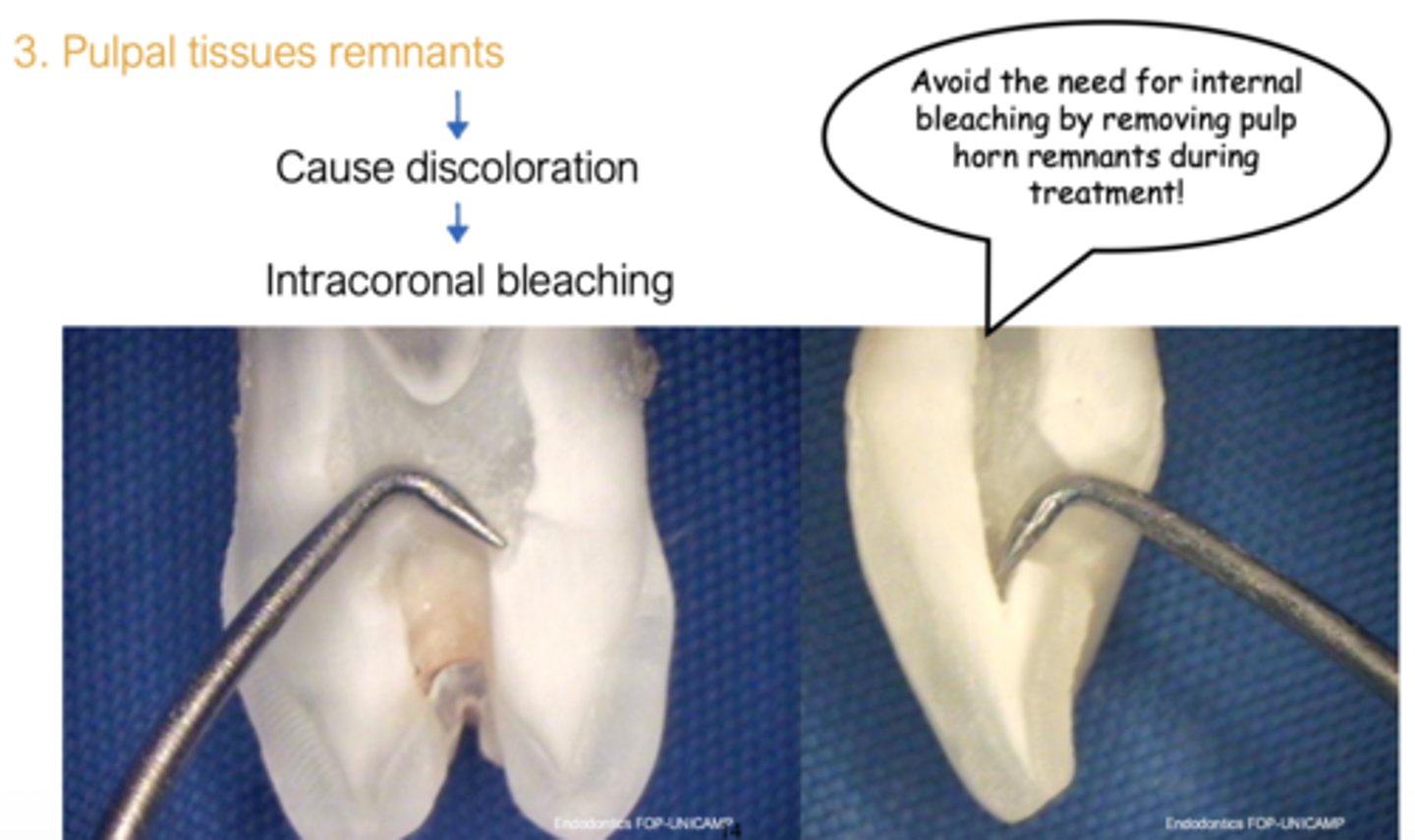
Pulpal tissues remnants can cause discoloration and intracoronal bleaching. How can you avoid the need for internal bleaching?
By removing pulp horn remnants during treatment!
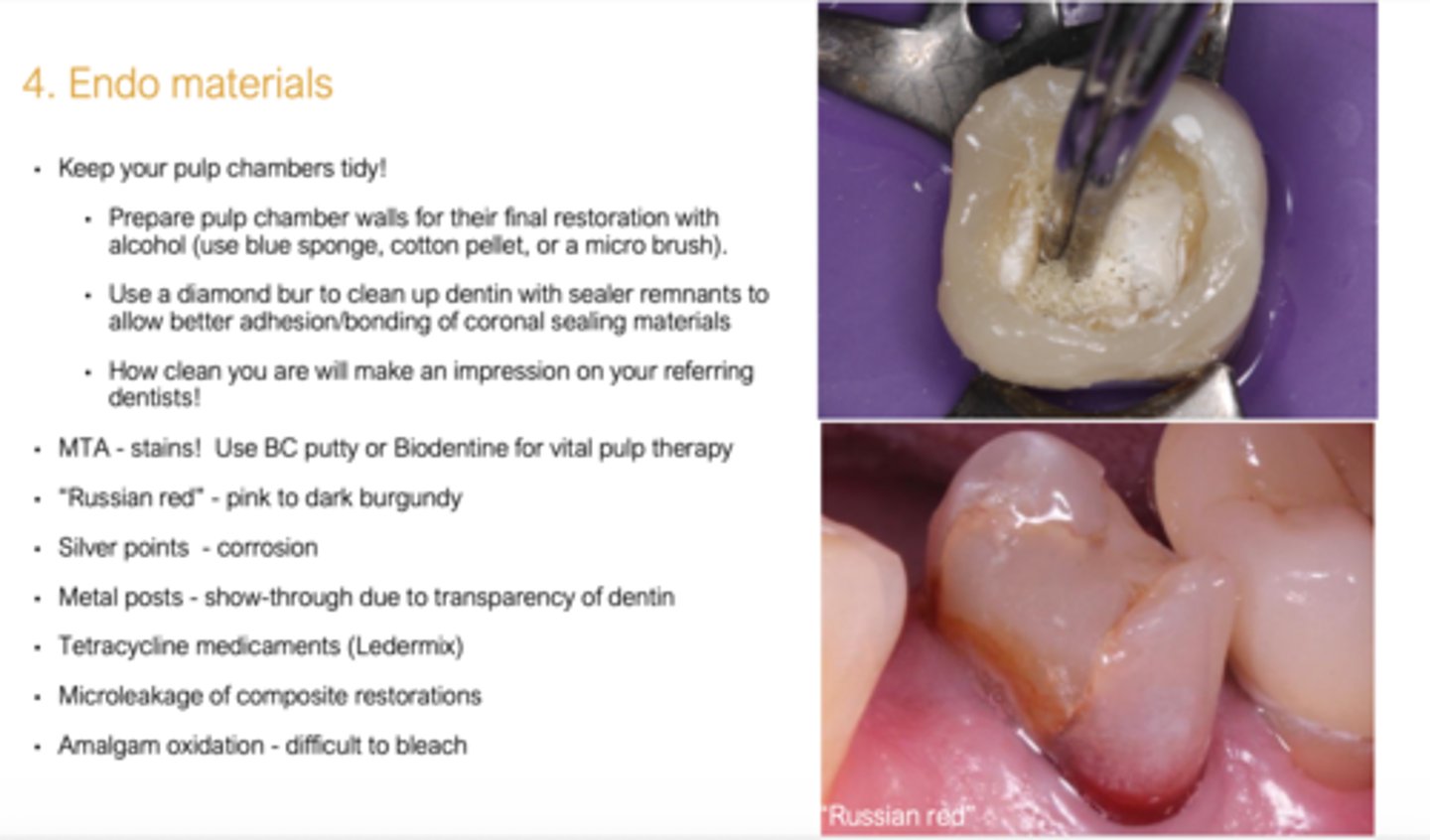
How can you keep pulp chambers tidy?
- Prepare pulp chamber walls for their final restoration with alcohol (use blue sponge, cotton pellet, or a micro brush).
- Use a diamond bur to clean up dentin with sealer remnants to allow better adhesion/bonding of coronal sealing materials
(How clean you are will make an impression on your referring dentists!)
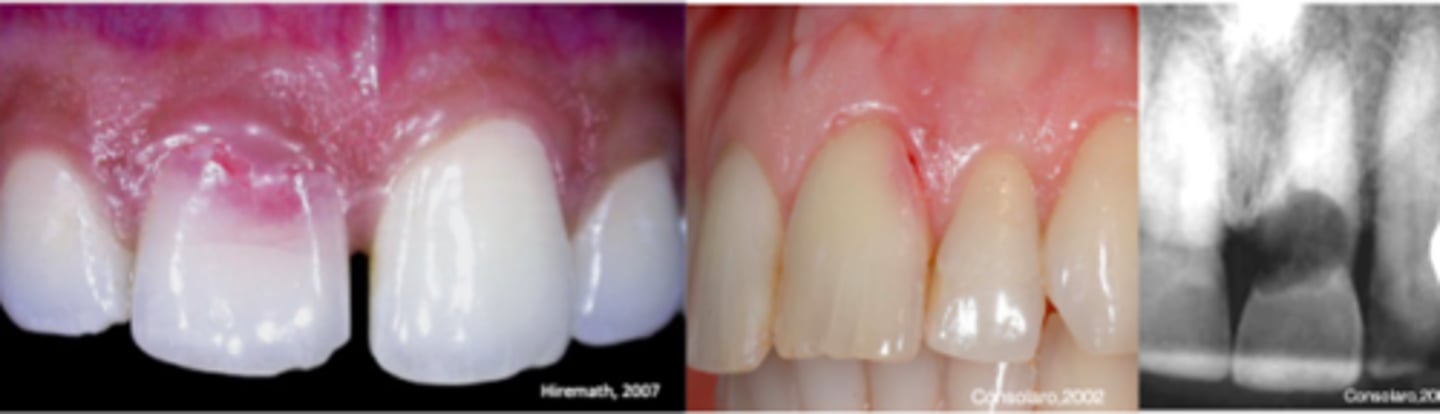
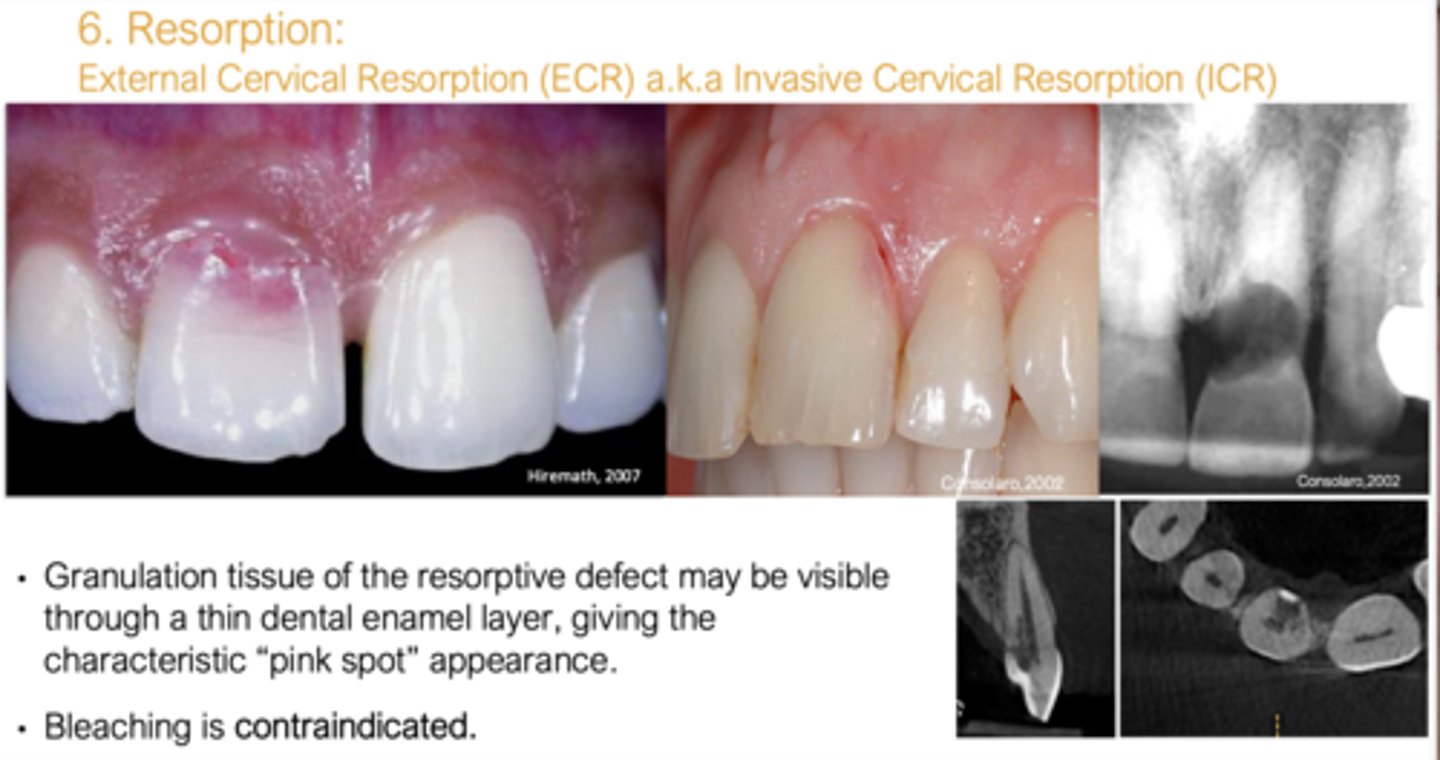
ID the type of extrinsic tooth discoloration cause:
- Granulation tissue of resorptive defect may be visible through a thin dental enamel layer
- Characteristic "pink spot" appearance
- Bleaching is contraindication
Resorption (external cervical/invasive cervical resorption)
Can you bleach teeth with External cervical/invasive cervical resorption?
No - contraindicated
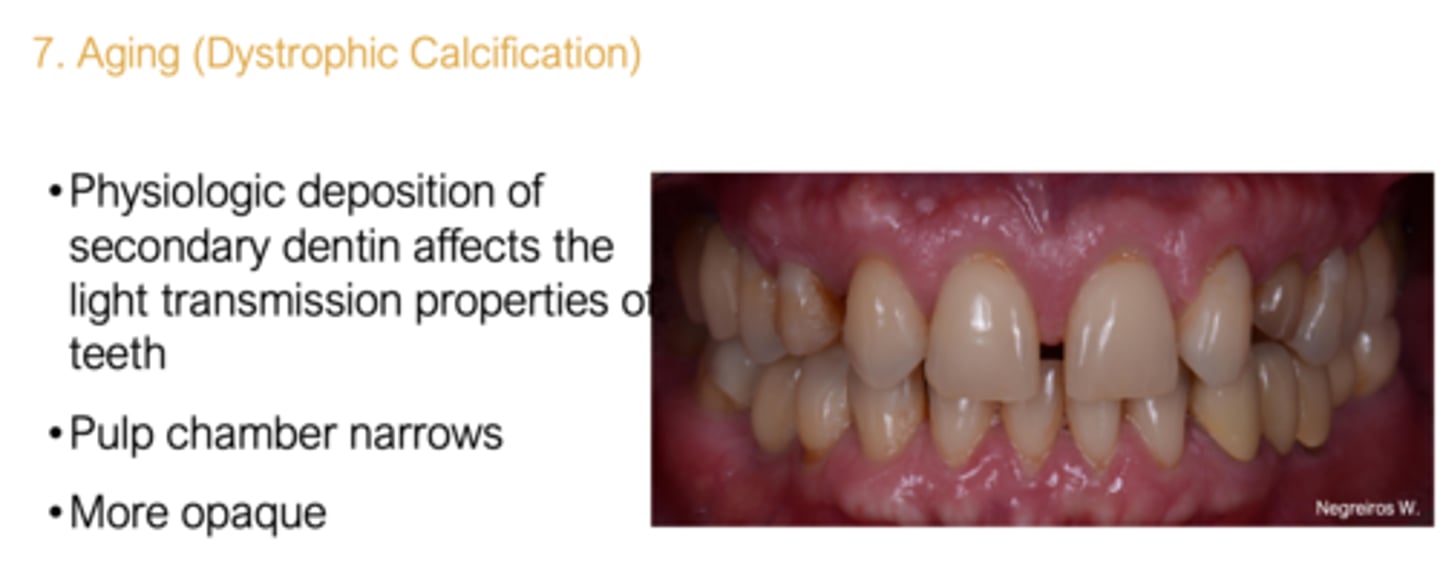
ID the type of intrinsic tooth discoloration cause:
- Physiologic deposition of secondary dentin affecting light transmission properties of teeth
- Pulp chamber narrows
- More opaque
Aging (dystropic calcification)
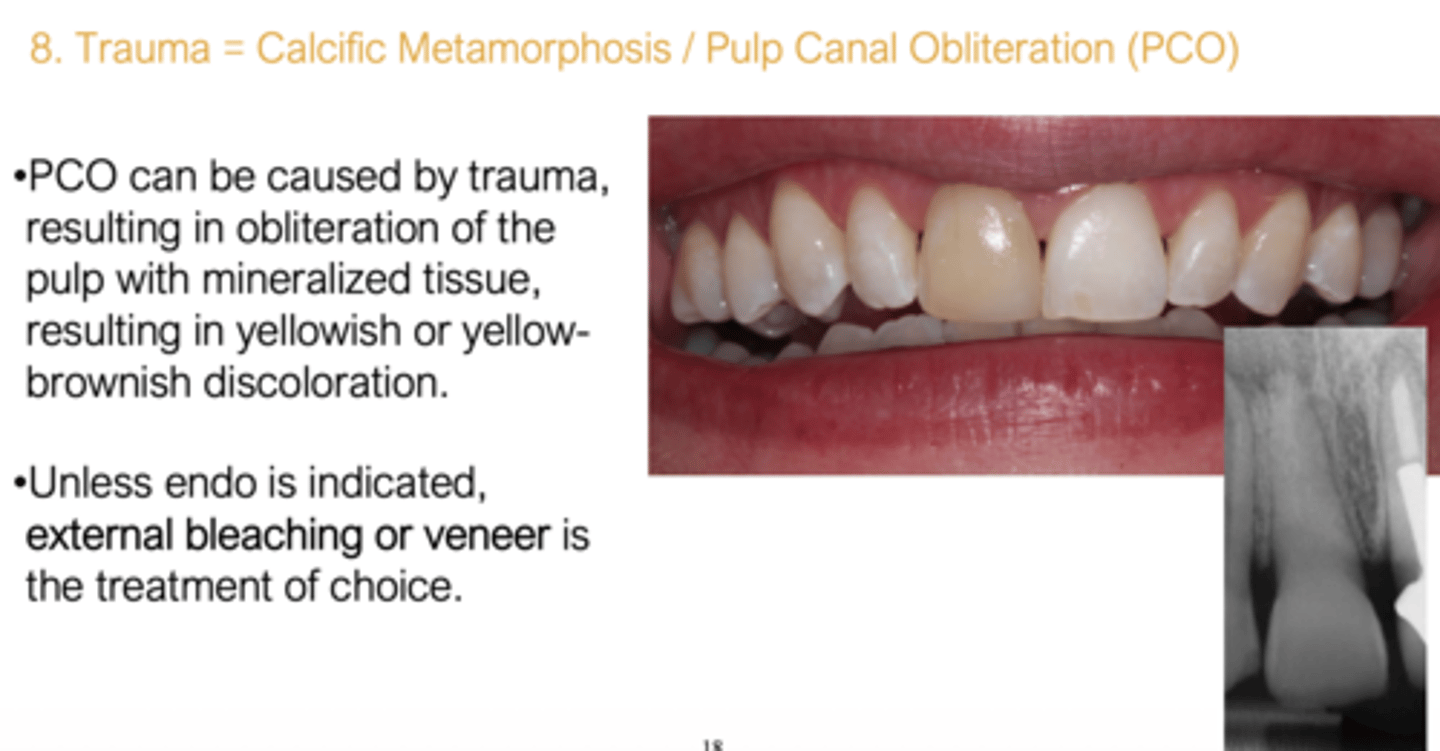
What can be caused by trauma, resulting in obliteration of the pulp with mineralized tissue, resulting in yellowish or yellow- brownish discoloration?
Calcific Metamorphosis/ Pulpal Canal Obliteration PCO/Trauma
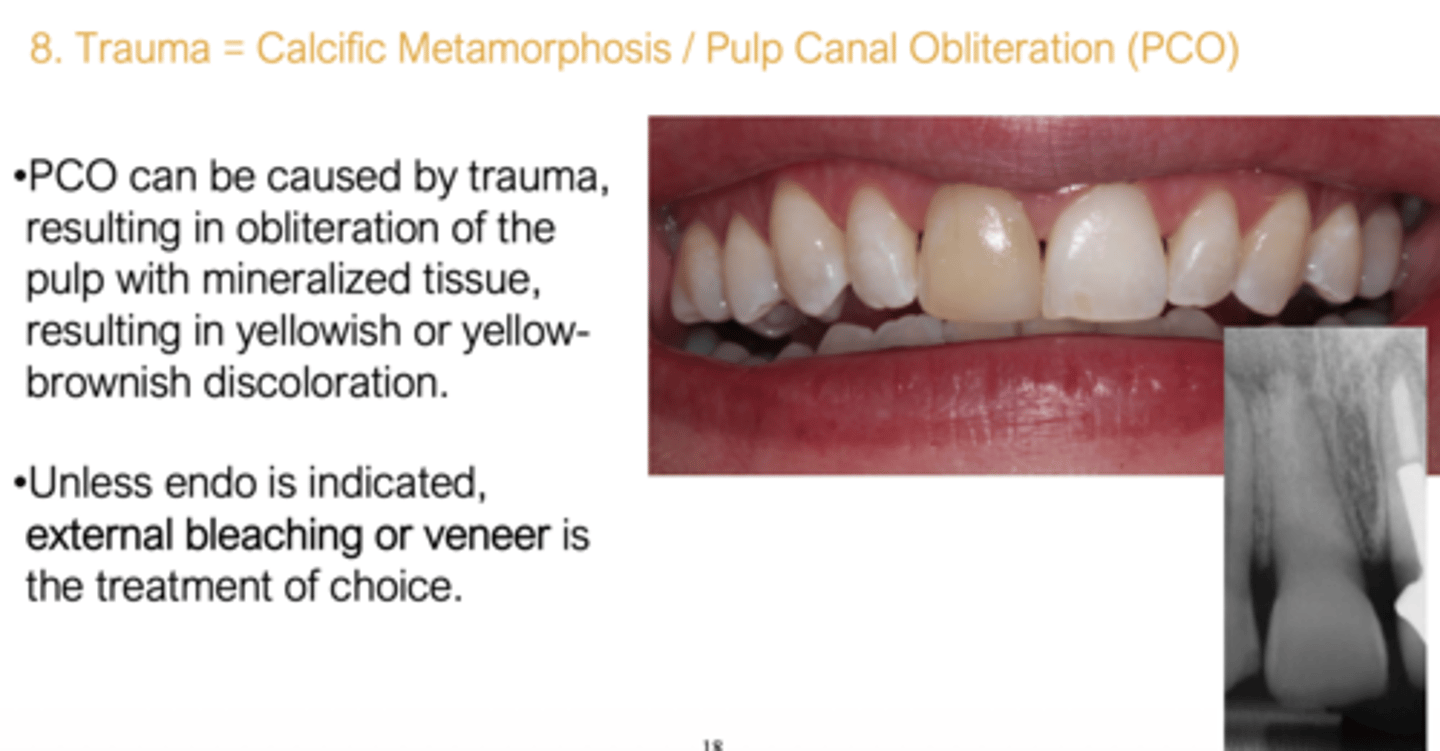
What is the treatment of choice for Calcific Metamorphosis/ Pulpal Canal Obliteration PCO caused by trauma?
external bleaching/veneer
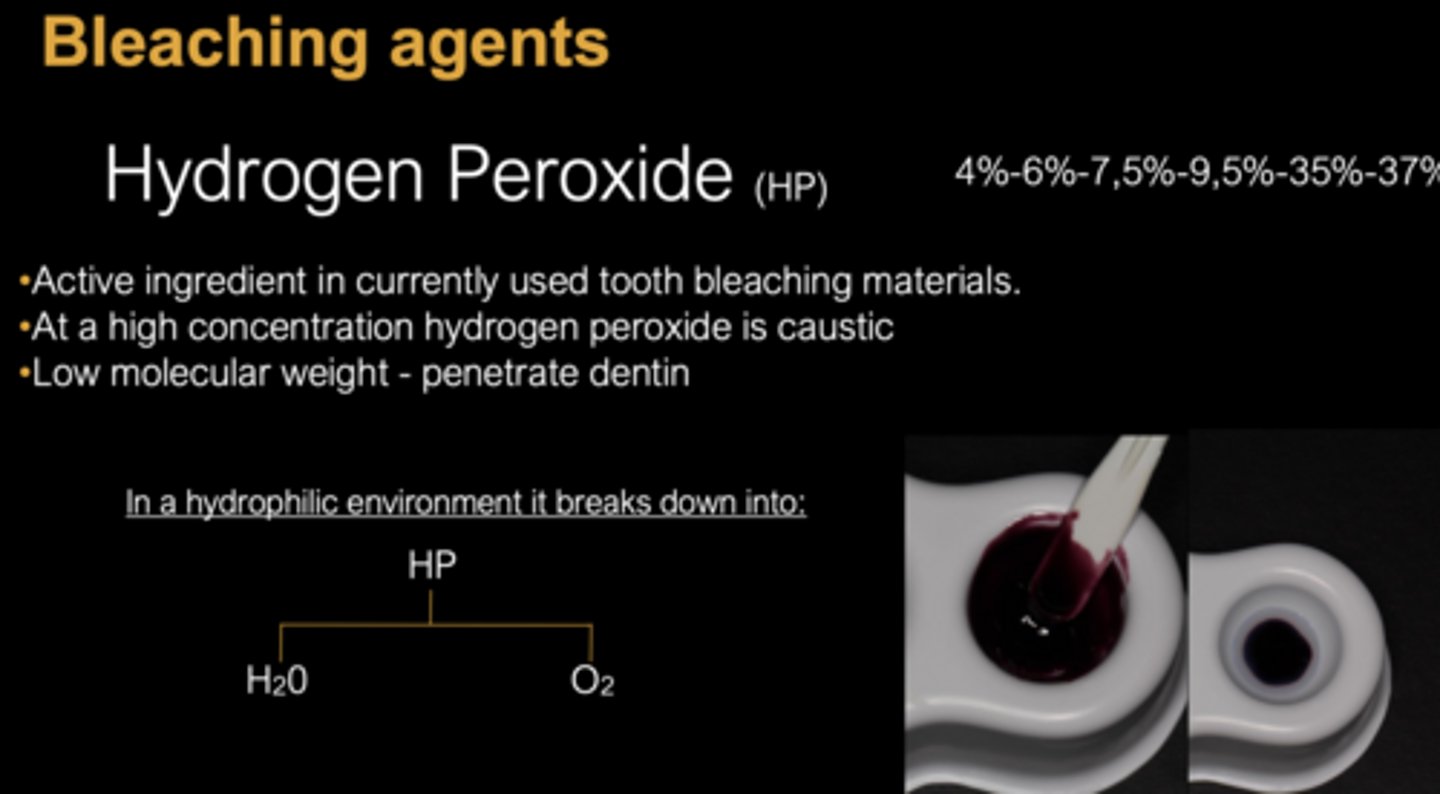
What bleaching agent is the active ingredient in currently used tooth bleaching materials?
hydrogen peroxide
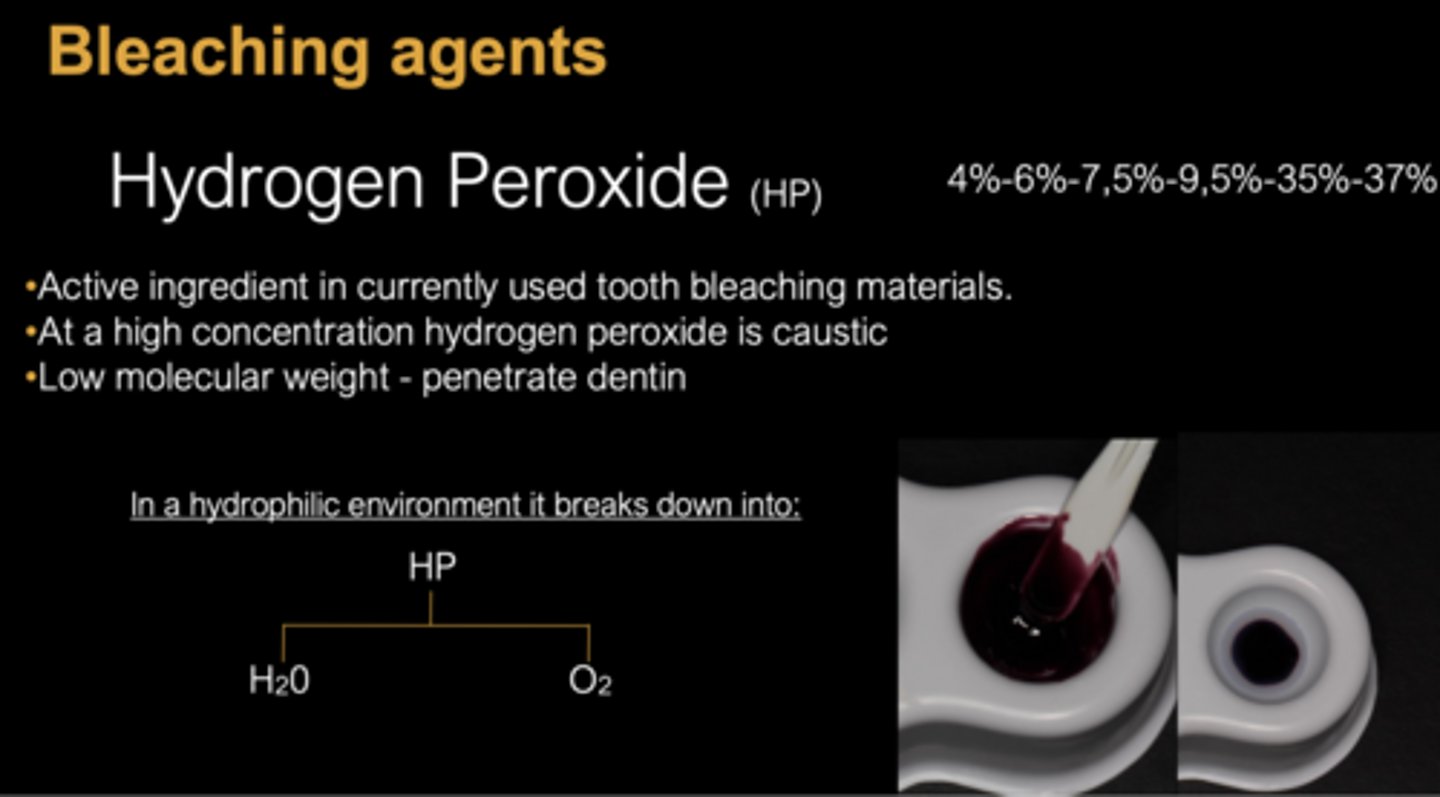
At high concentration, hydrogen peroxide is ________
Caustic
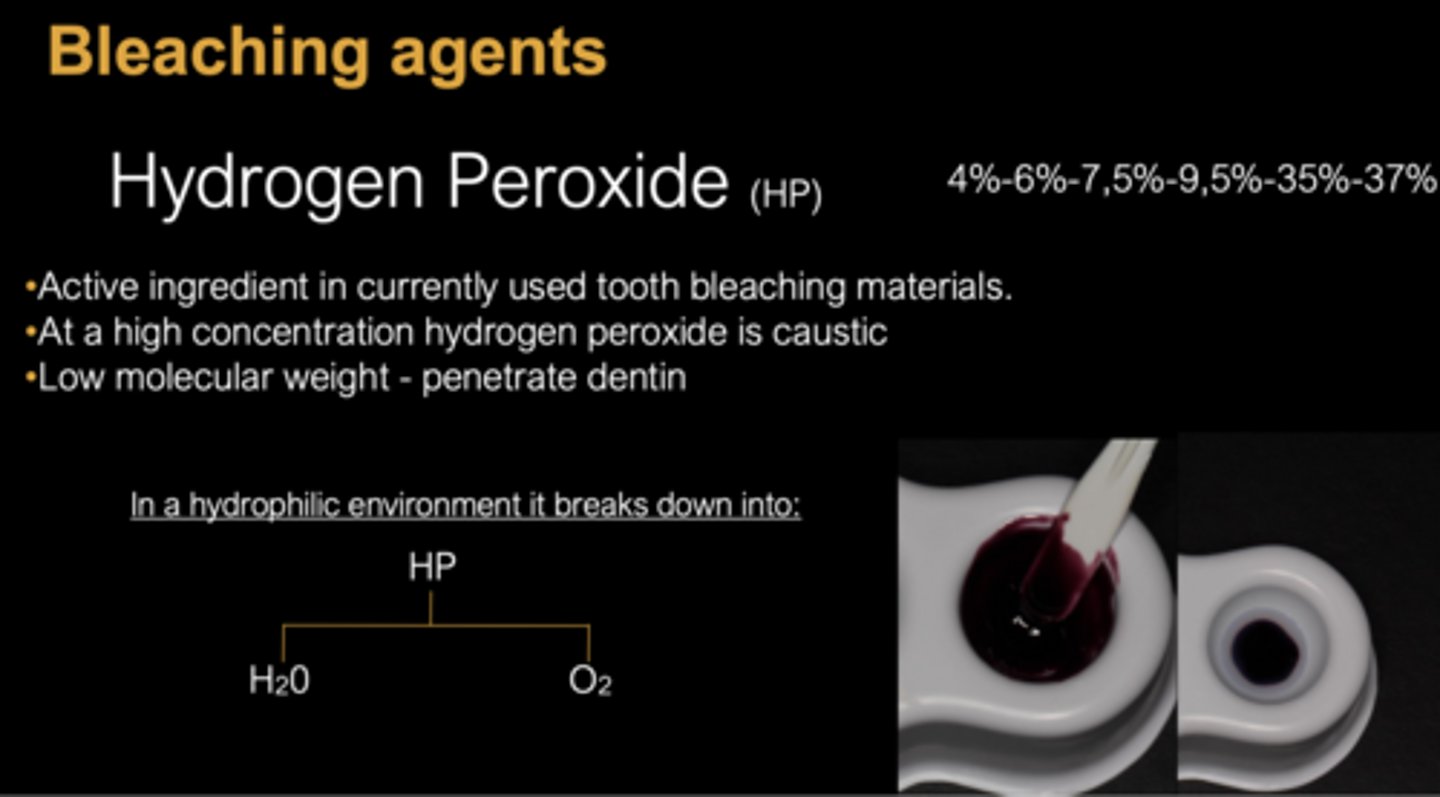
Hydrogen Peroxide (HP) has a _____ molecular weight, allowing it to penetrate dentin
low
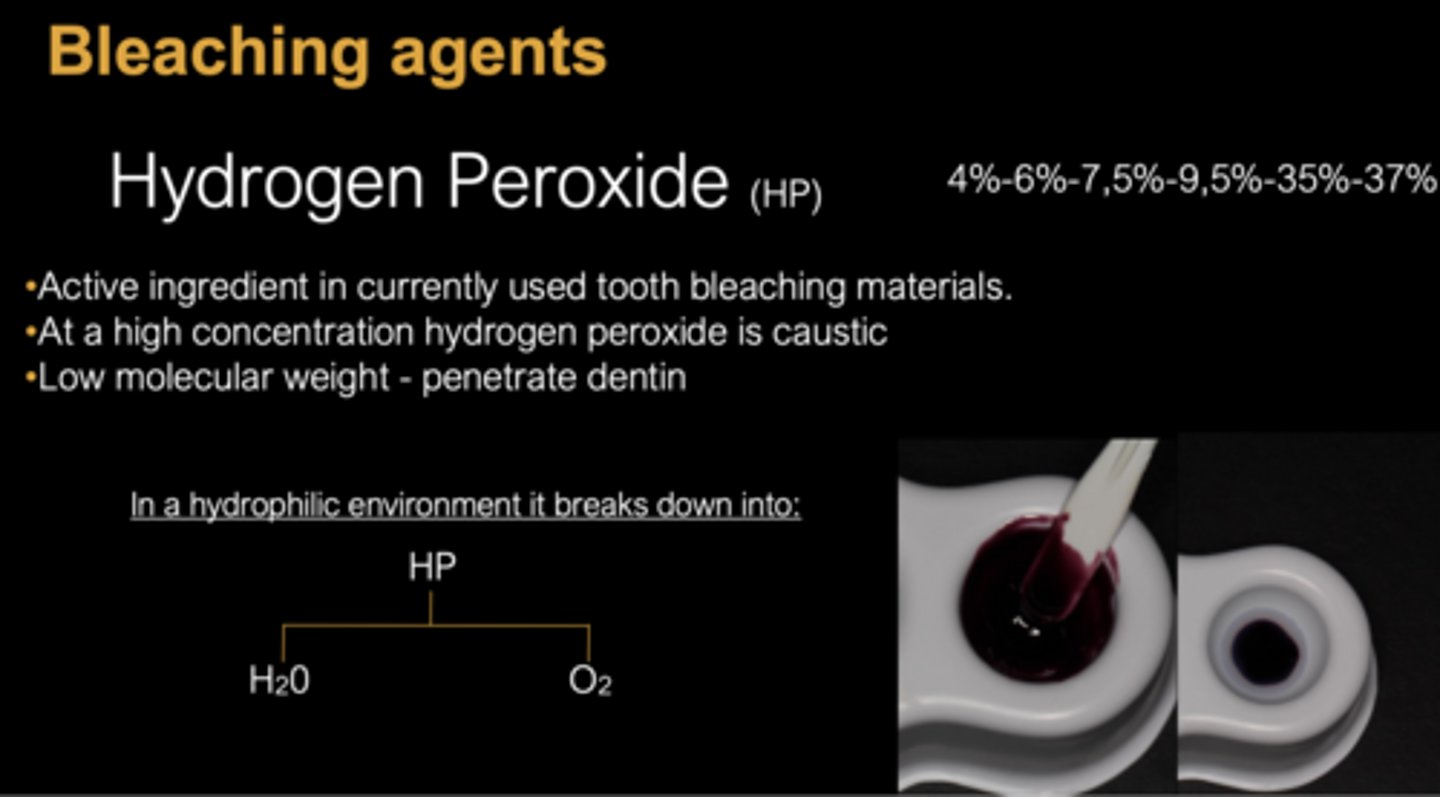
In a hydrophilic environment, hydrogen peroxide breaks down into:
- Water
- Oxygen
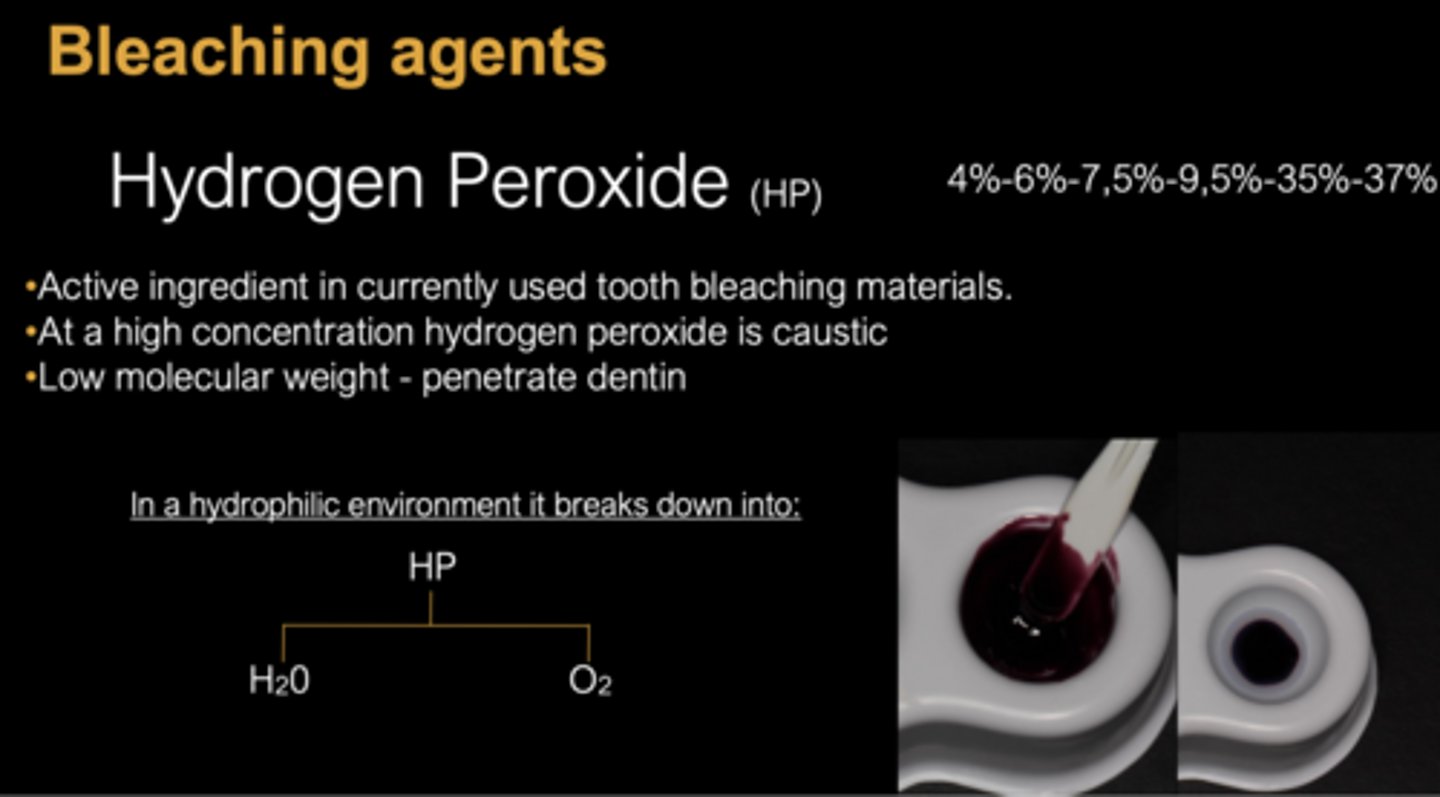
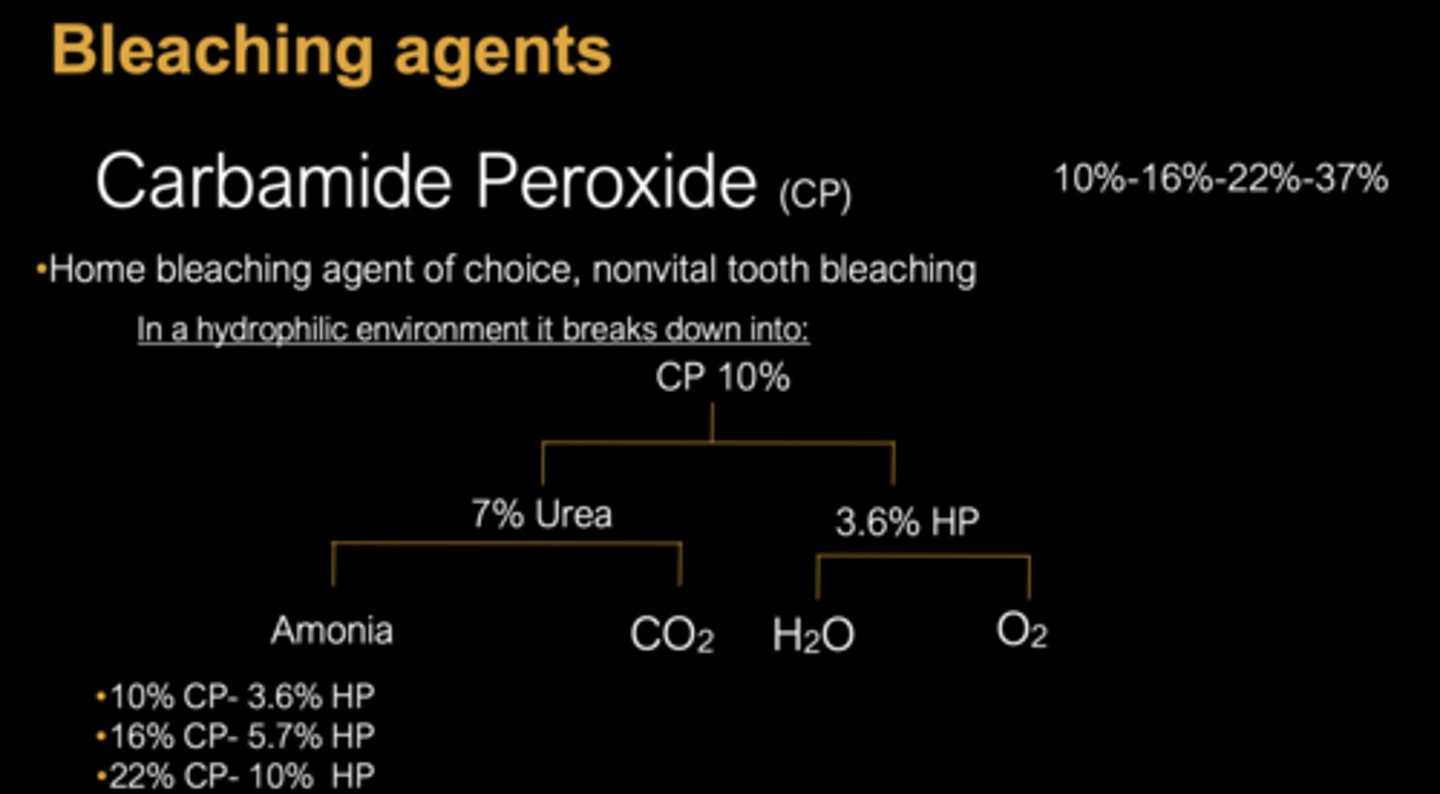
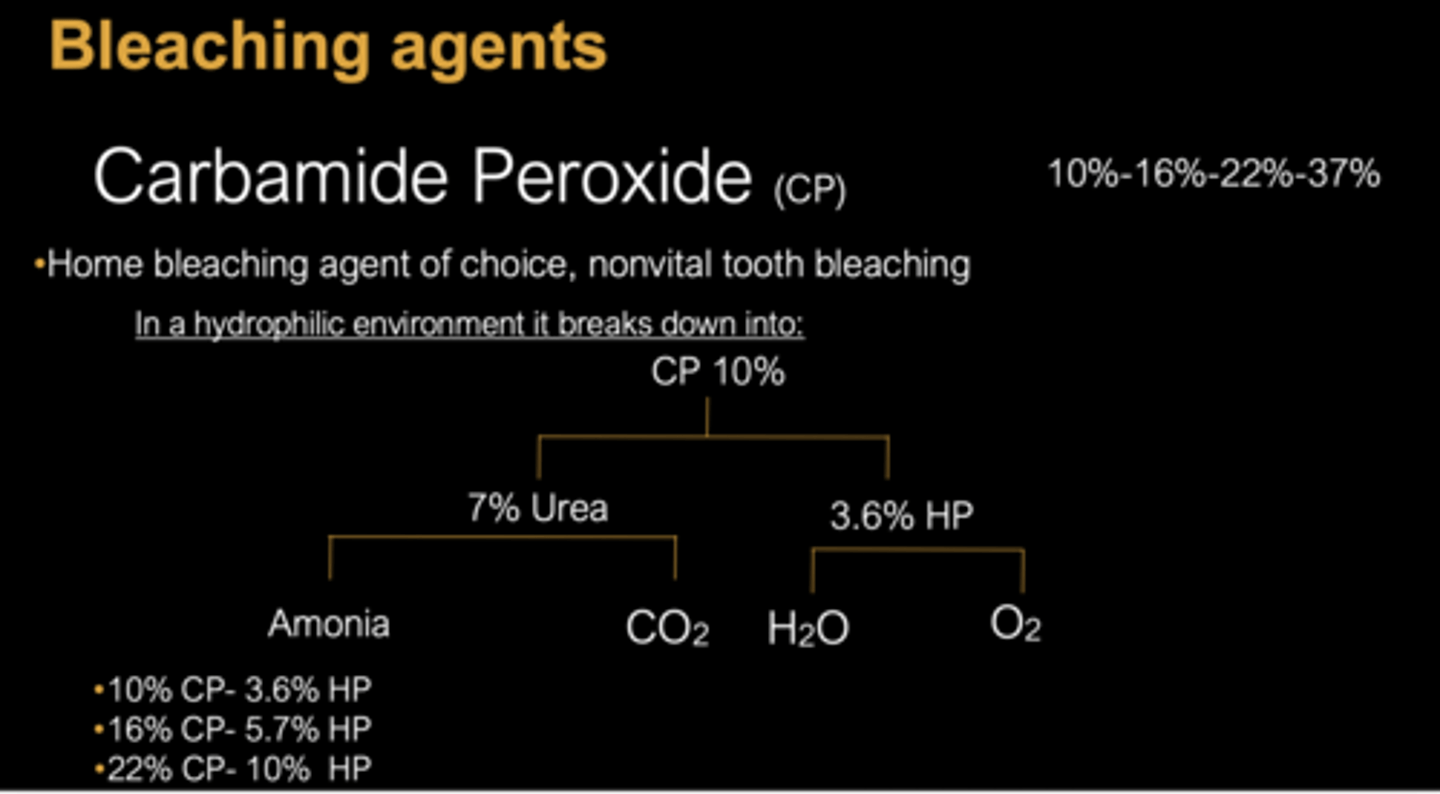
What bleaching agent is the home bleaching agent of choice, nonvital tooth bleaching?
carbamide peroxide
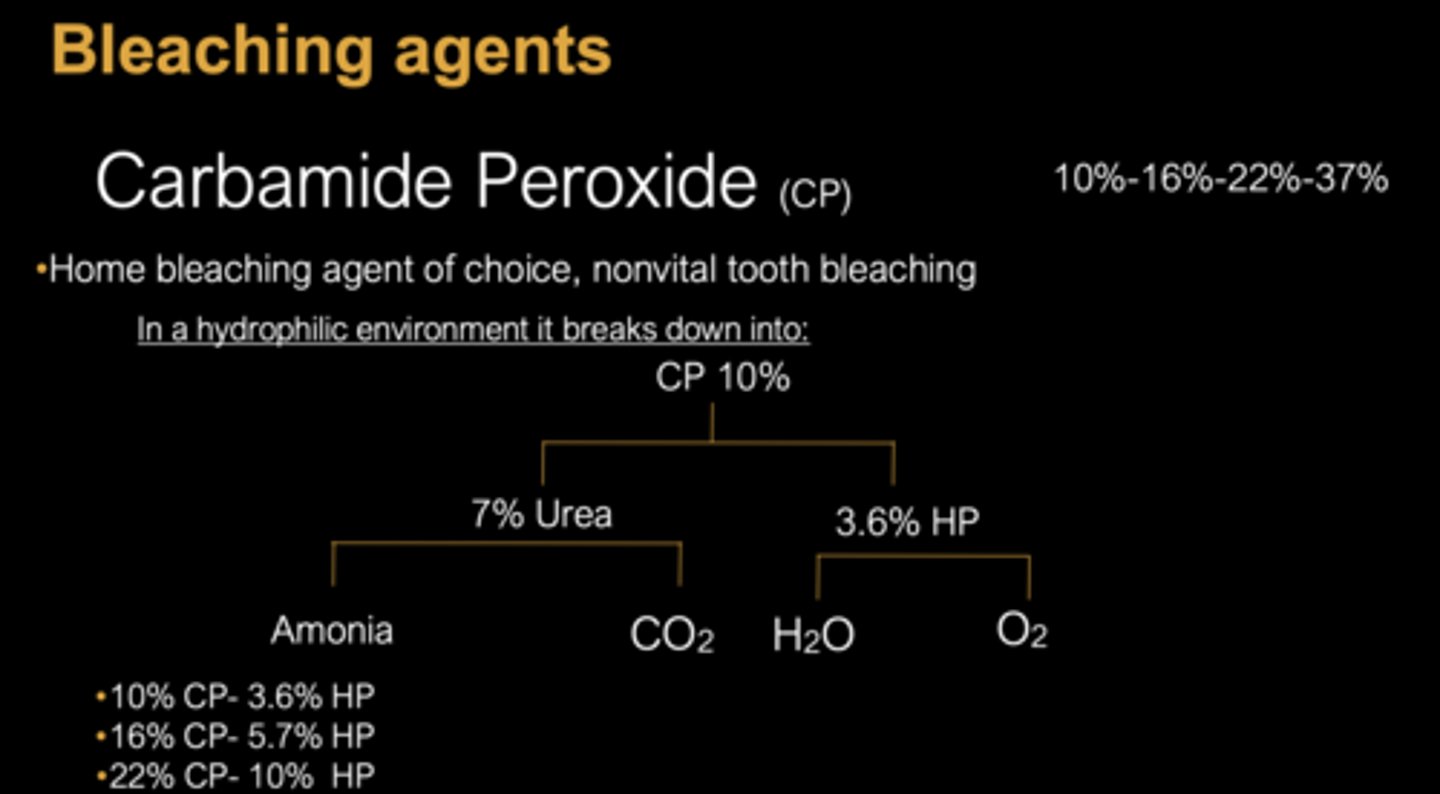
In a hydrophilic environment, carbamide peroxide breaks down into:
- Urea --> Ammonia, Carbon dioxide
- HP --> Water, Oxygen
What bleaching agent is the nonvital tooth bleaching agent of choice?
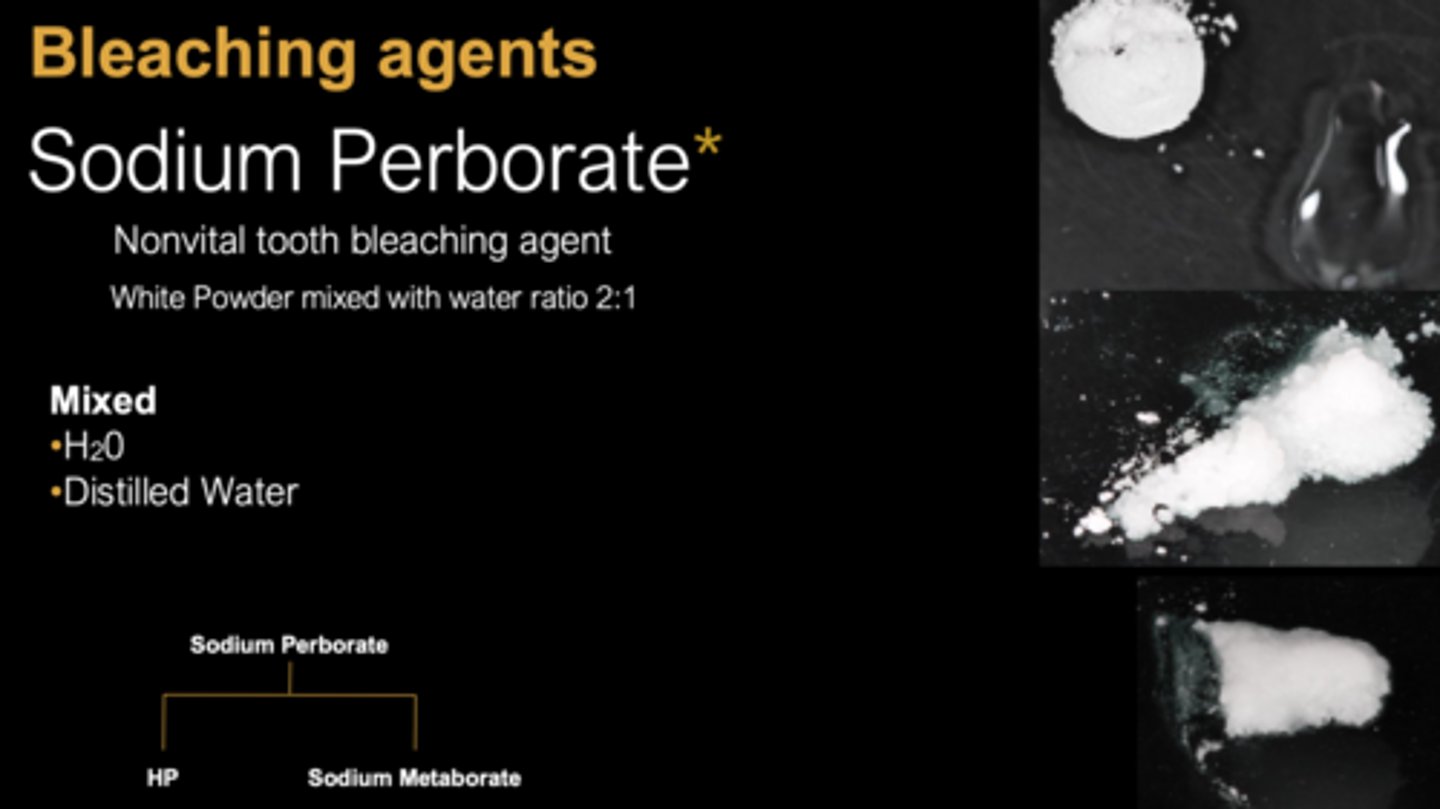
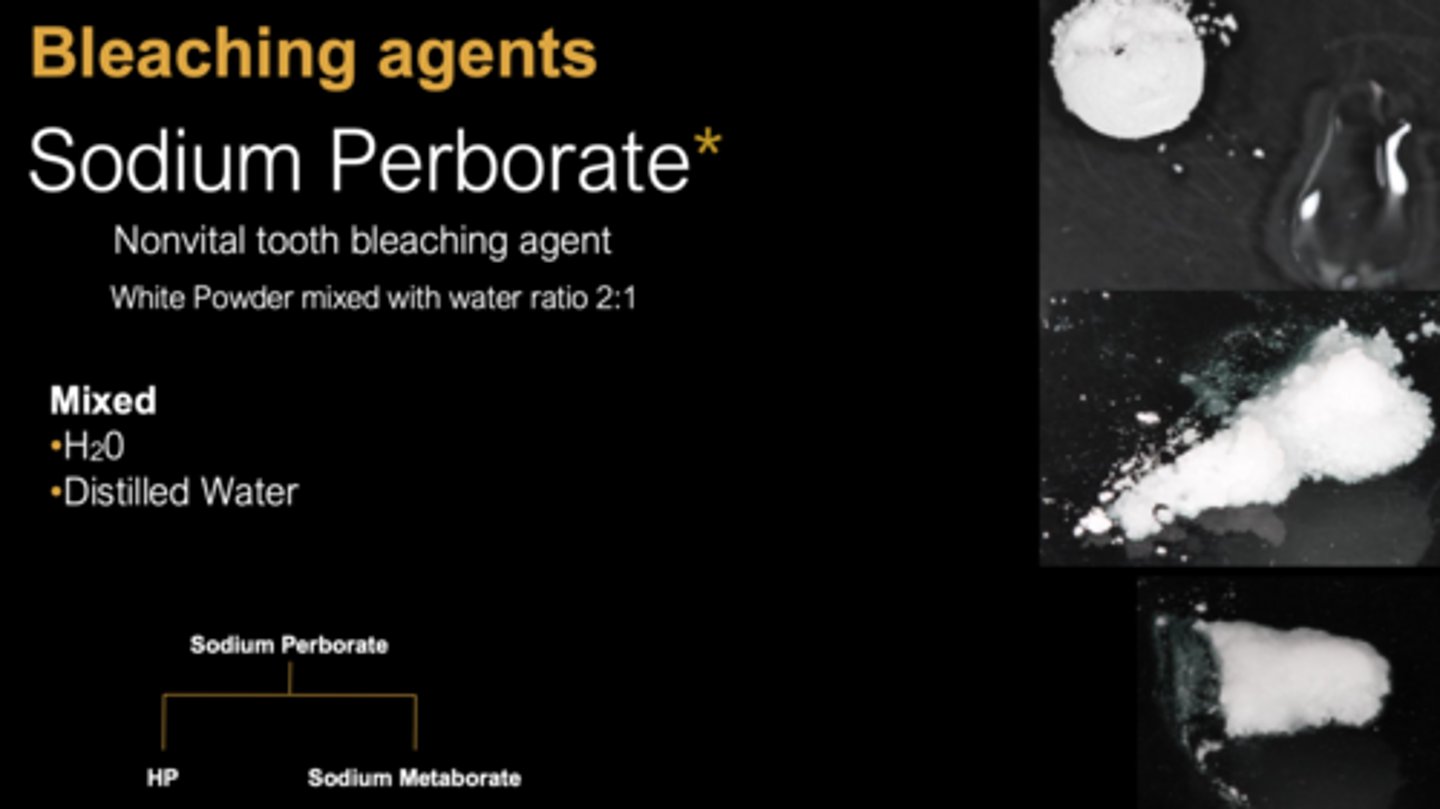
sodium perborate
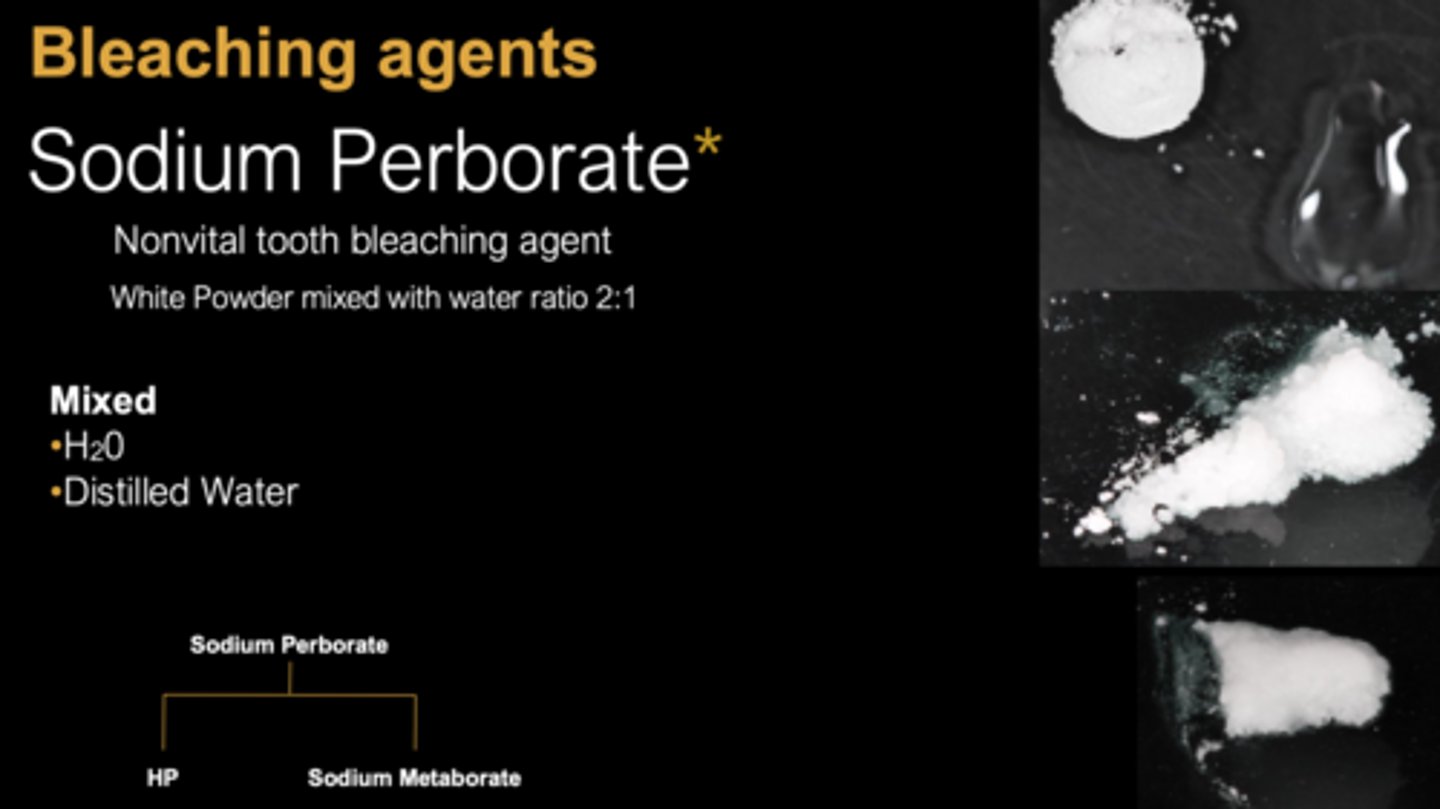
In a hydrophilic environment, sodium perborate breaks down into what?
- Sodium metaborate
- Hydrogen peroxide
What bleaching agent is used for in office bleaching?
hydrogen peroxide
What bleaching agent is used for inside and outside of the crown of a non-vital tooth?
carbamide peroxide
What bleaching agent is used in the walking bleaching technique?
sodium perborate
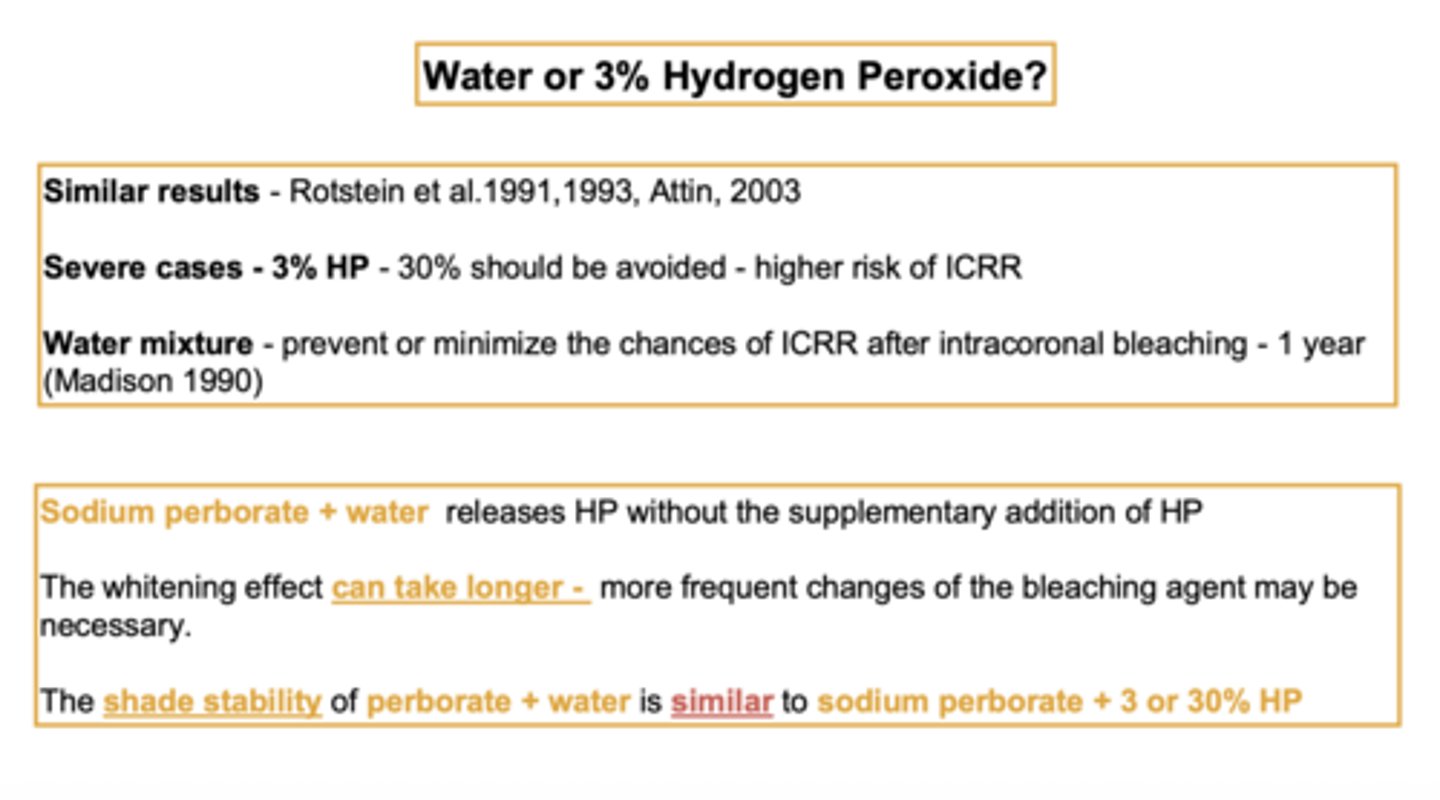
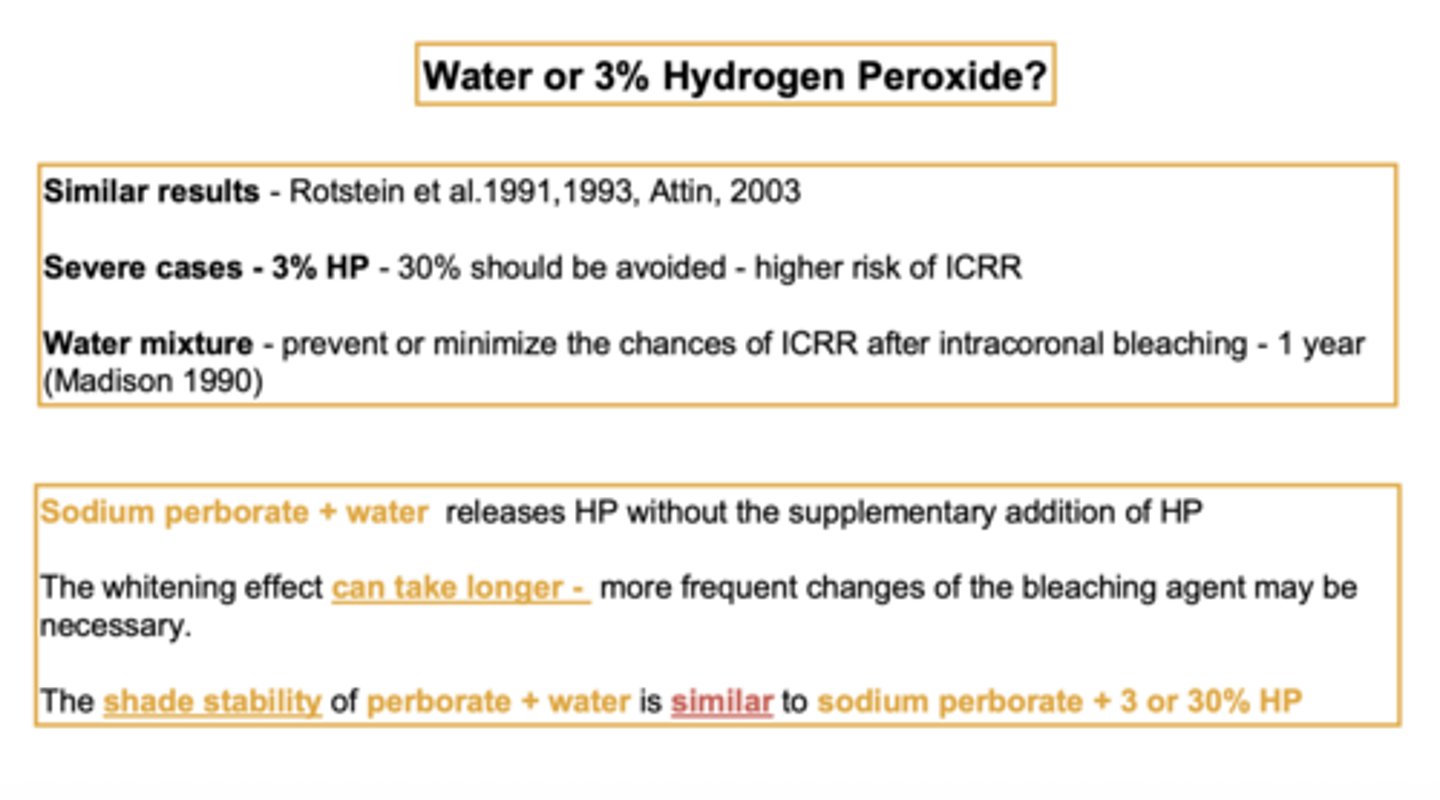
When choosing a solvent to mix with sodium perborate, choosing __________ prevents or minimizes chances of ECR after intracoronal bleaching
Water
When choosing a solvent to mix with sodium perborate, what allows for the following...
- Releases HP without supplementary addition of HP
- The whitening effect can take longer, more frequent changes of the bleaching agent may be necessary.
Water
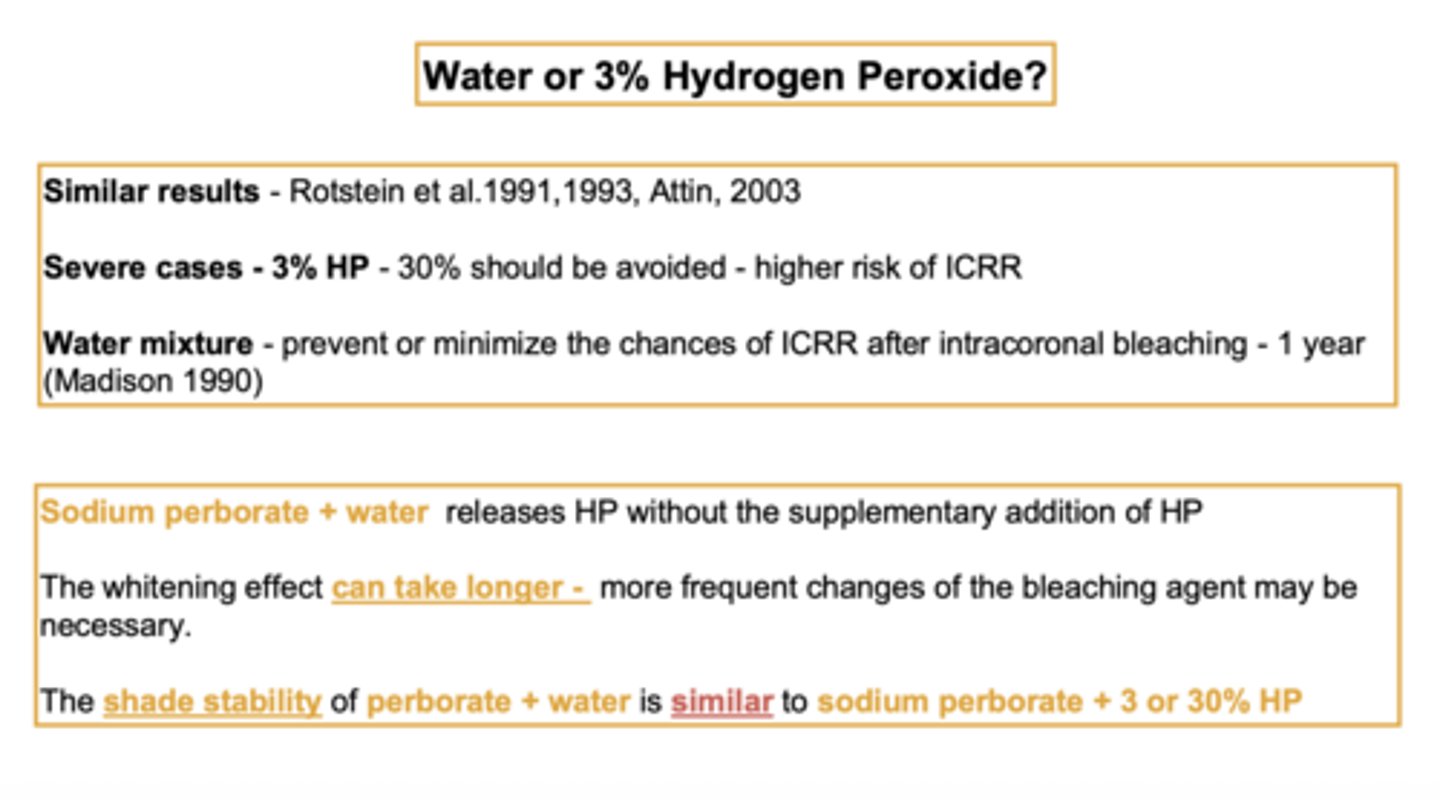
Choosing to mix with sodium perborate with what is associated with risks of External/Invasive Cervical Root Resorption?
hydrogen peroxide
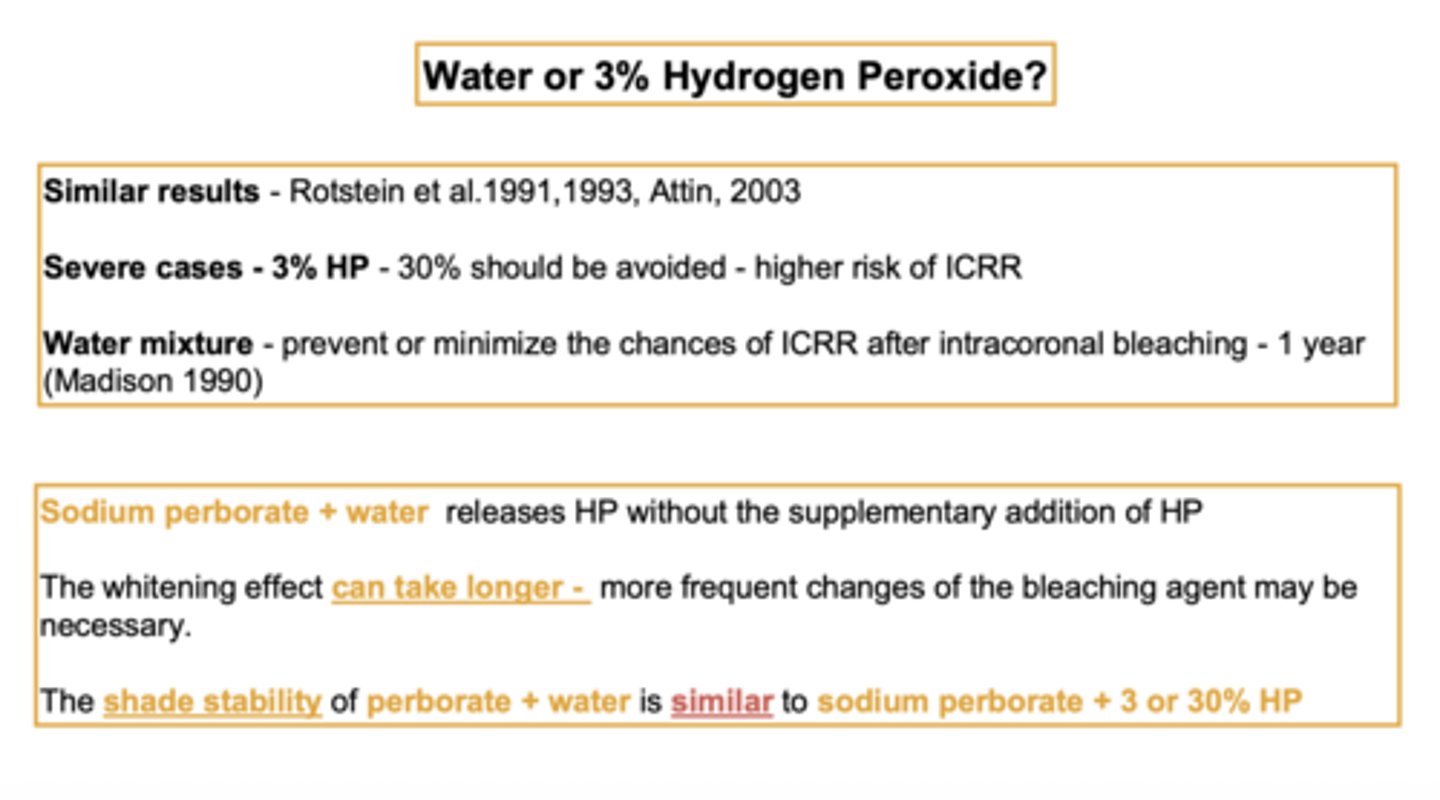
The shade stability of perborate + water is ______ to sodium perborate + 3 or 30% HP
Similar
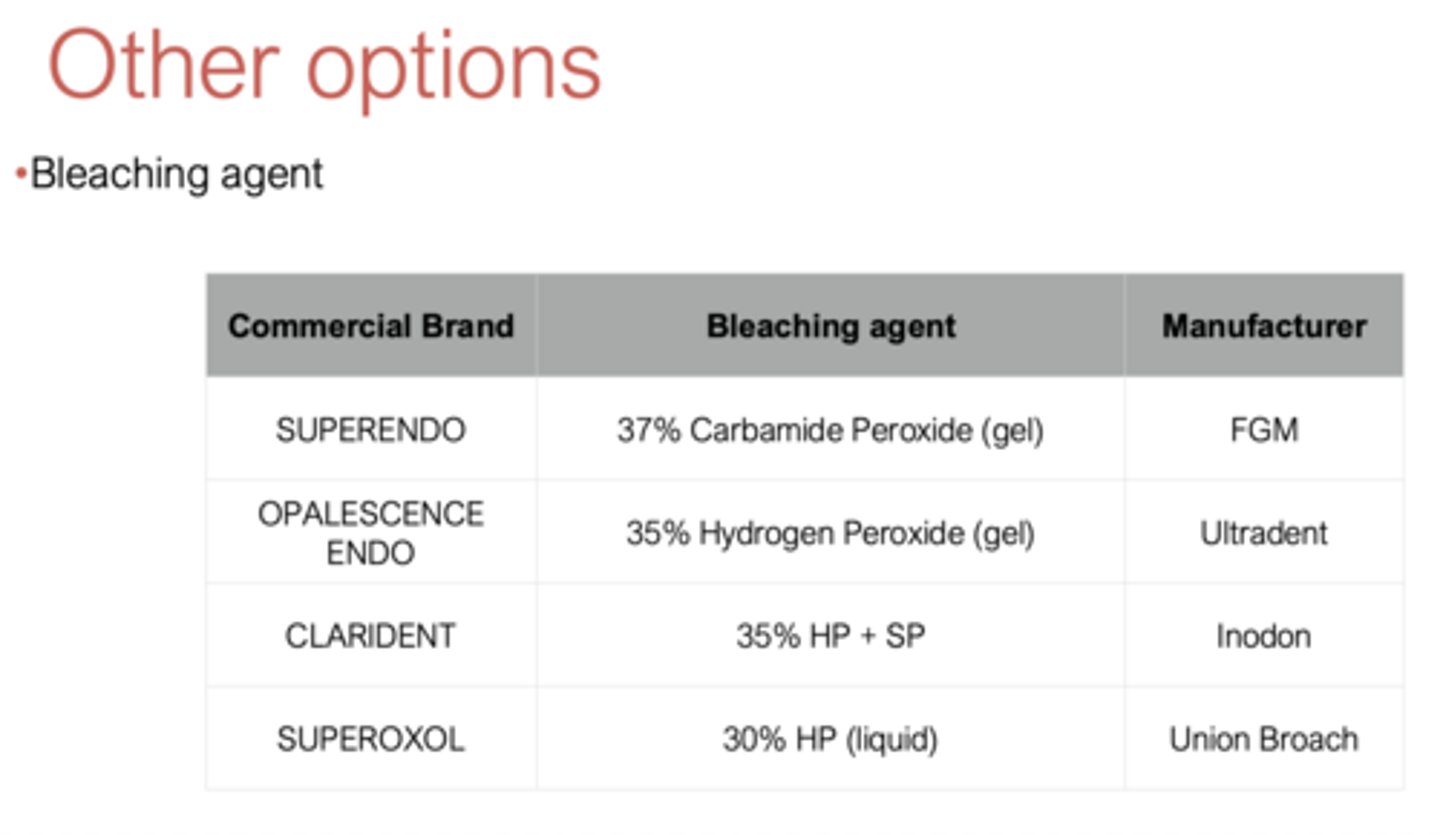
What is the commercial brand name for 37% Carbamide Peroxide (gel) made by FGM?
Superendo
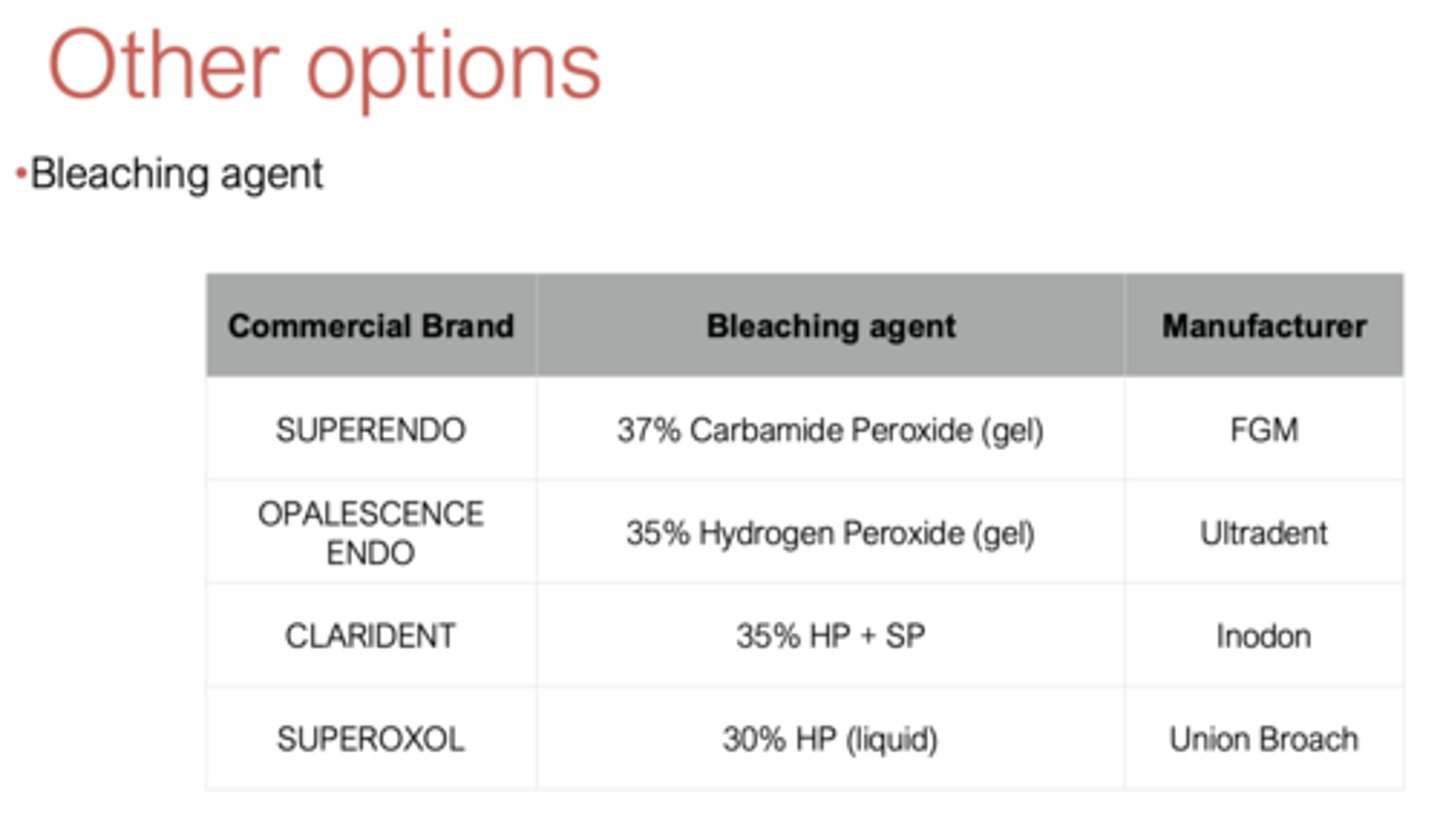
What is the commercial brand name for 35% Hydrogen Peroxide (gel) made by Ultradent?
Opalescence endo
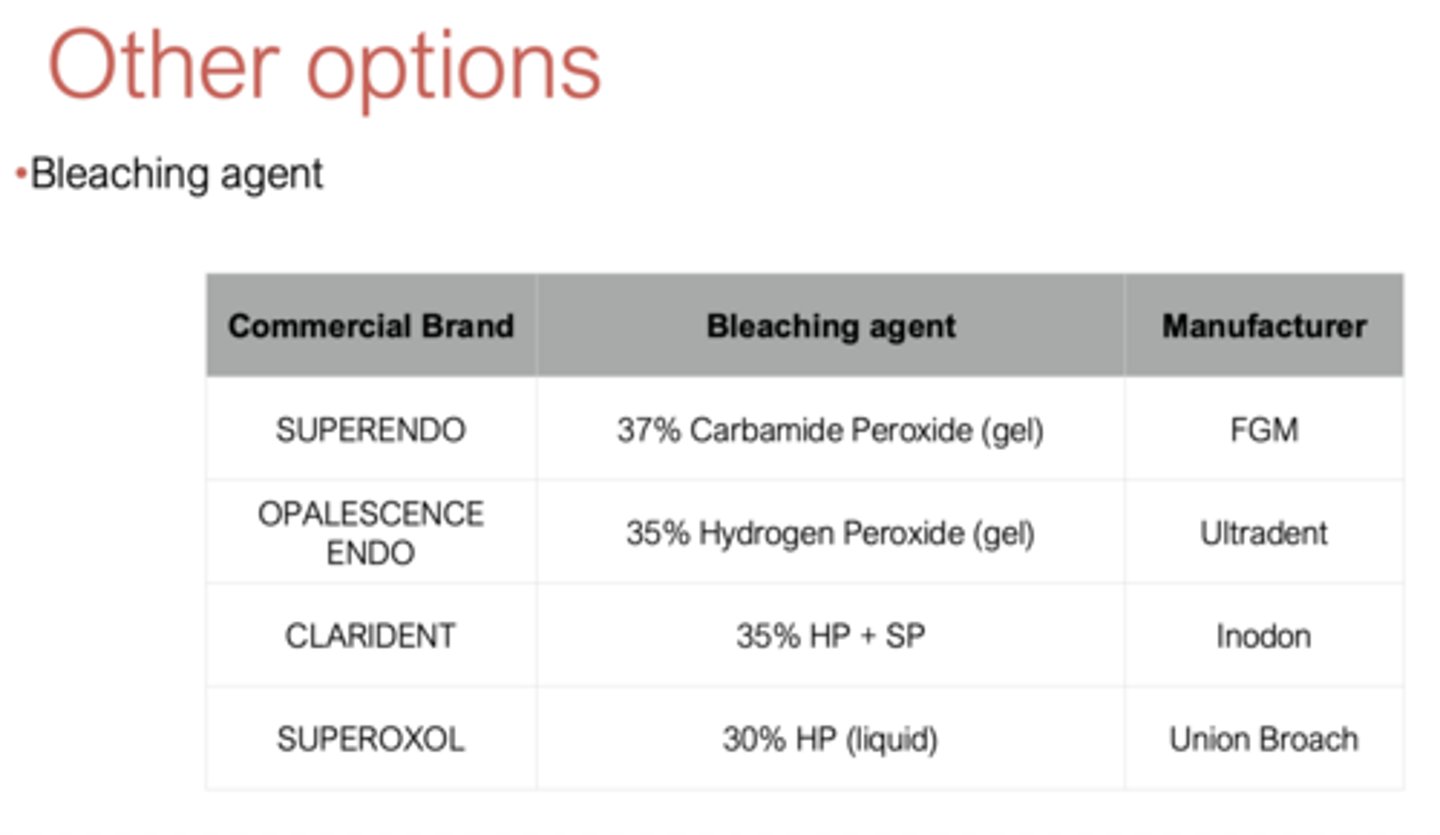
What is the commercial brand name for 35% HP + SP made by Inodon?
Clarident
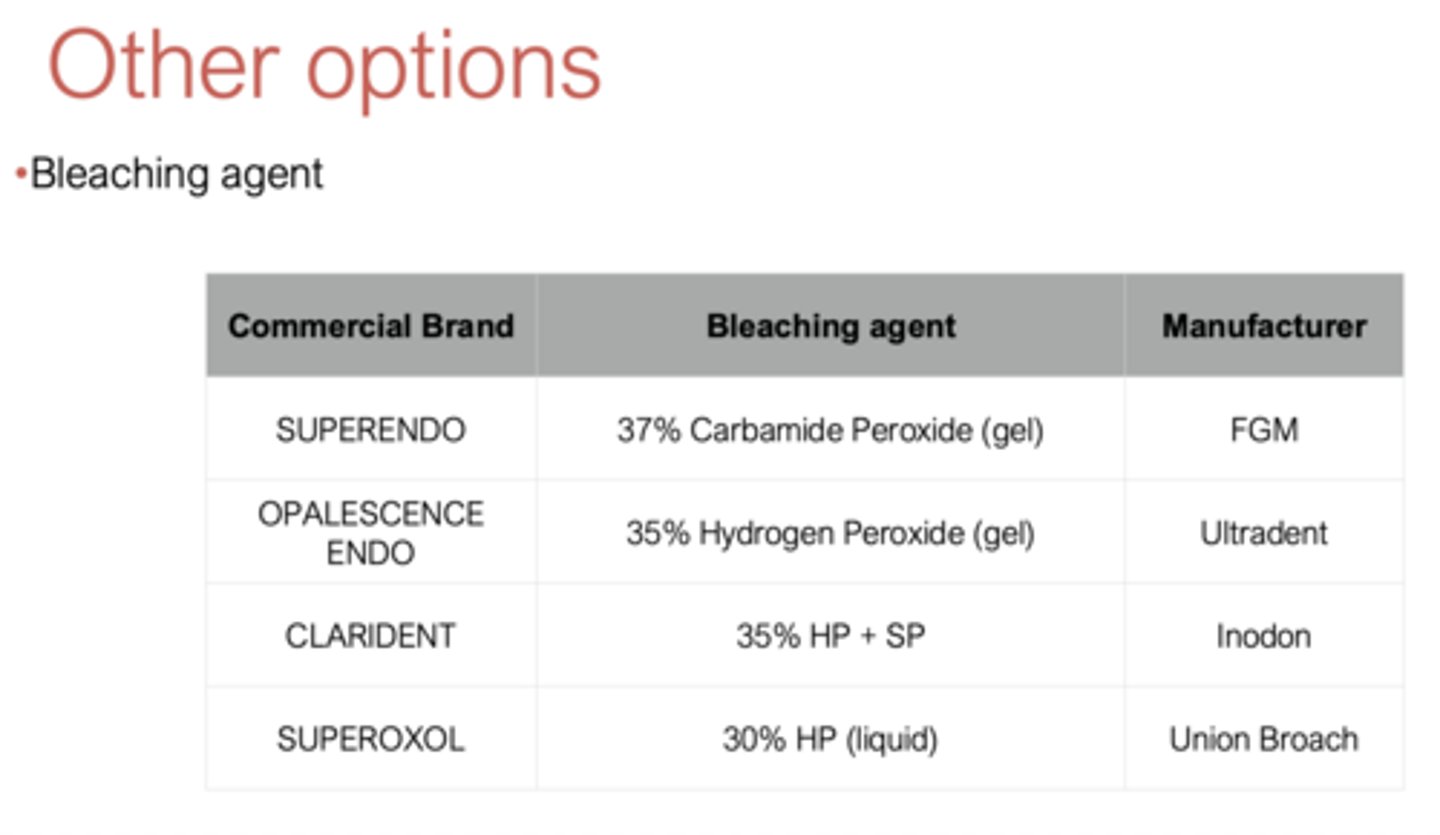
What is the commercial brand name for 30% HP (liquid) made by Union Broach?
Superoxol
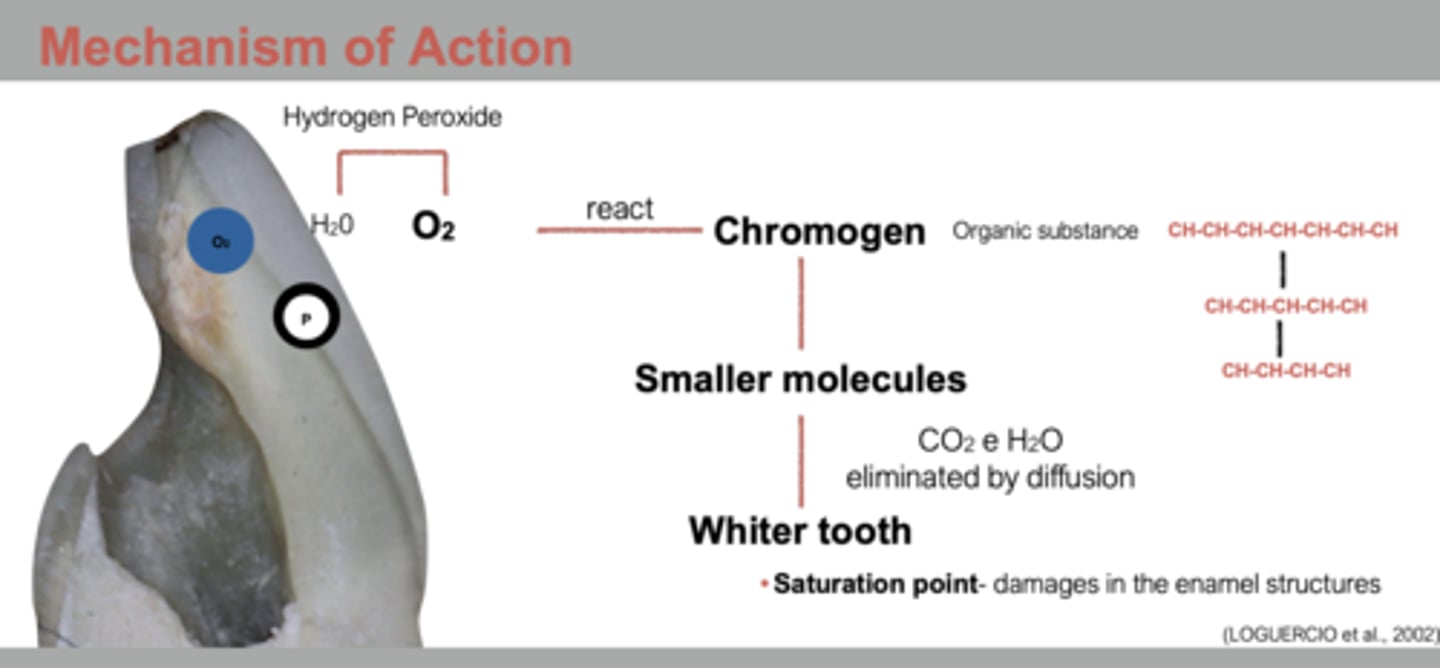
What is the mechanism of action of tooth bleaching?
- Hydrogen peroxide breaks down into water and oxygen
- Oxygen reacts w/ chromogen --> creates smaller carbon chains that reflect light better = lighter tooth
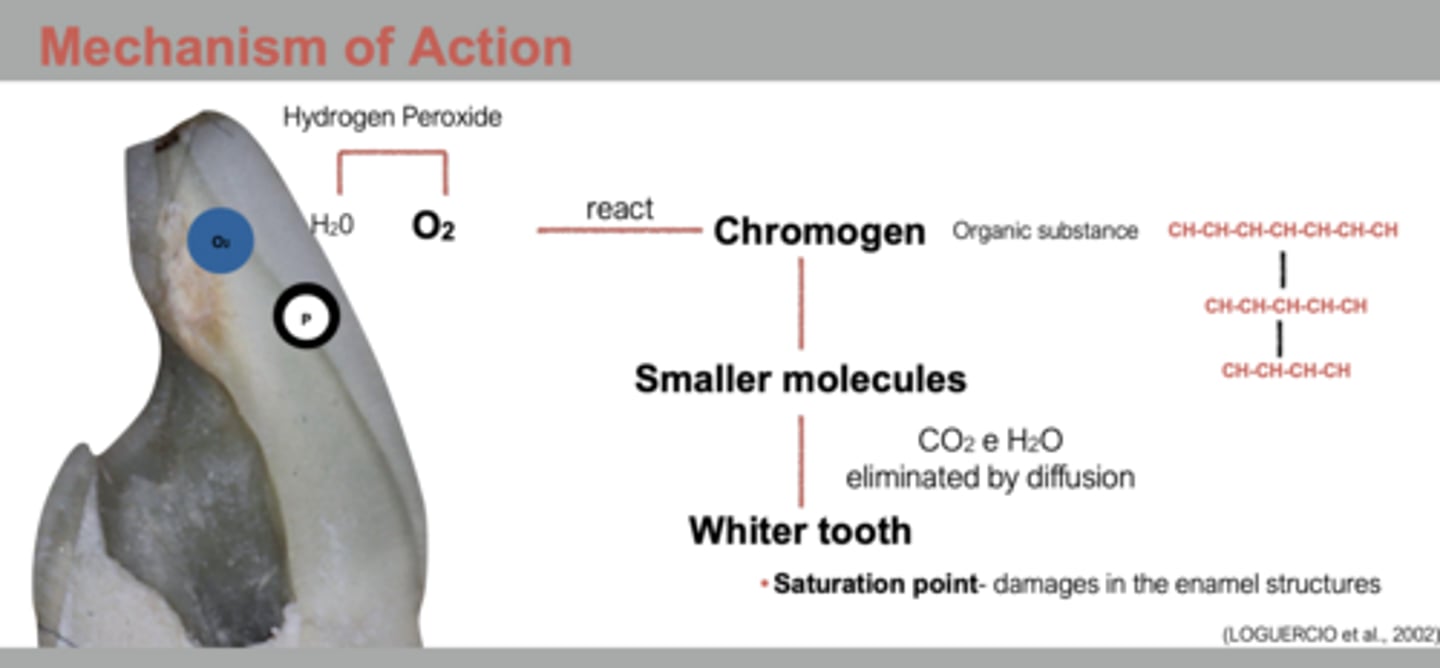
Once a tooth has undergone whitening treatment and a lighter color cannot be achieved, you are approaching the __________ where damages in the enamel surface may occur
Saturation point
All are complications of internal bleaching EXCEPT?
a. short-term reduction in dentin bond strength
b. temporary irritation to the oral mucosa
c. reduction of enamel/dentin micro hardness
d. external cervical resorption
e. color relapse
f. increase in tooth sensitivity
f. increase in tooth sensitivity
If a patient is getting resin restorations done but also wants tooth bleaching, the restorations should be done _______ the bleaching procedure
after
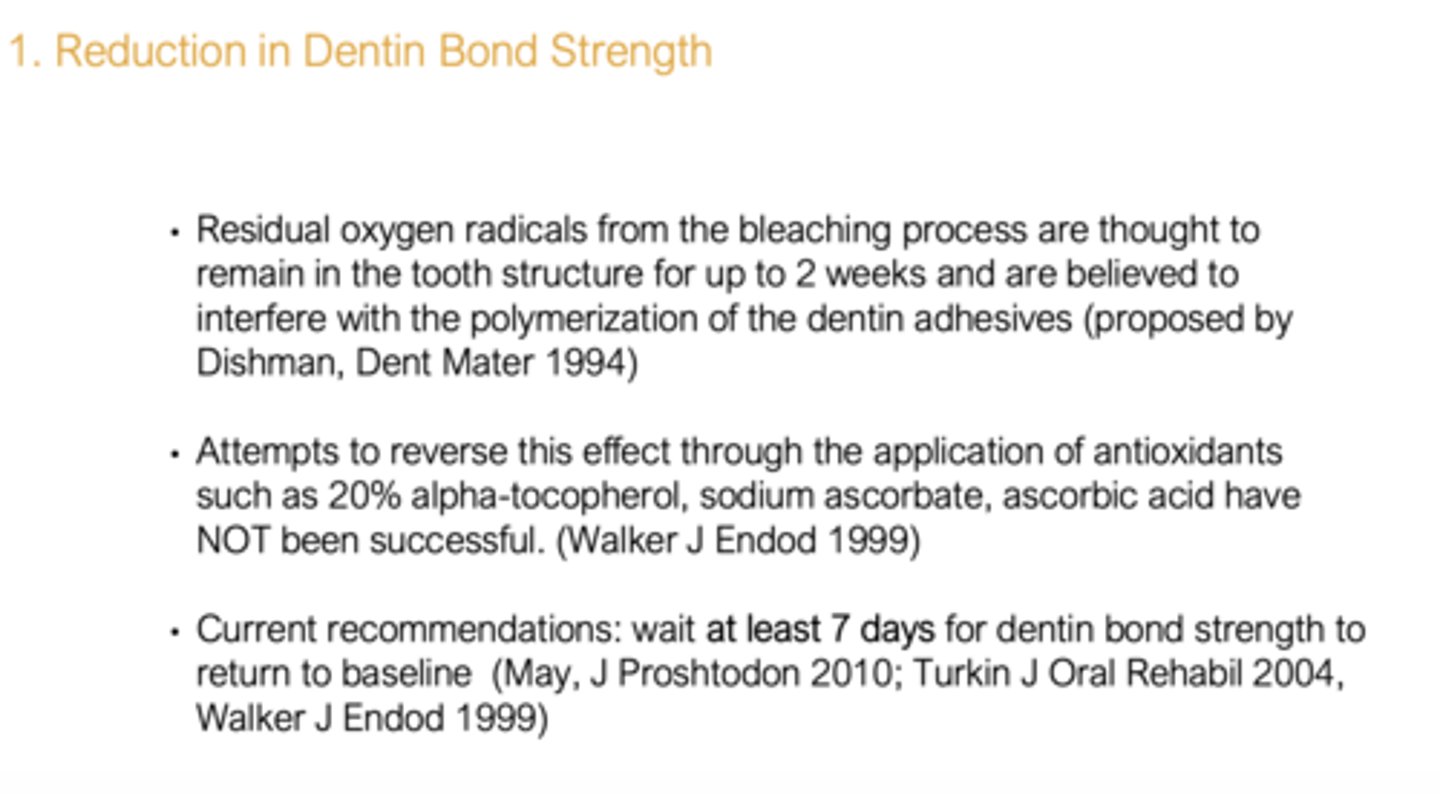
Residual oxygen radicals from the bleaching process are thought to remain in the tooth structure for up to____ weeks and are believed to interfere with the polymerization of the dentin adhesives
2 weeks
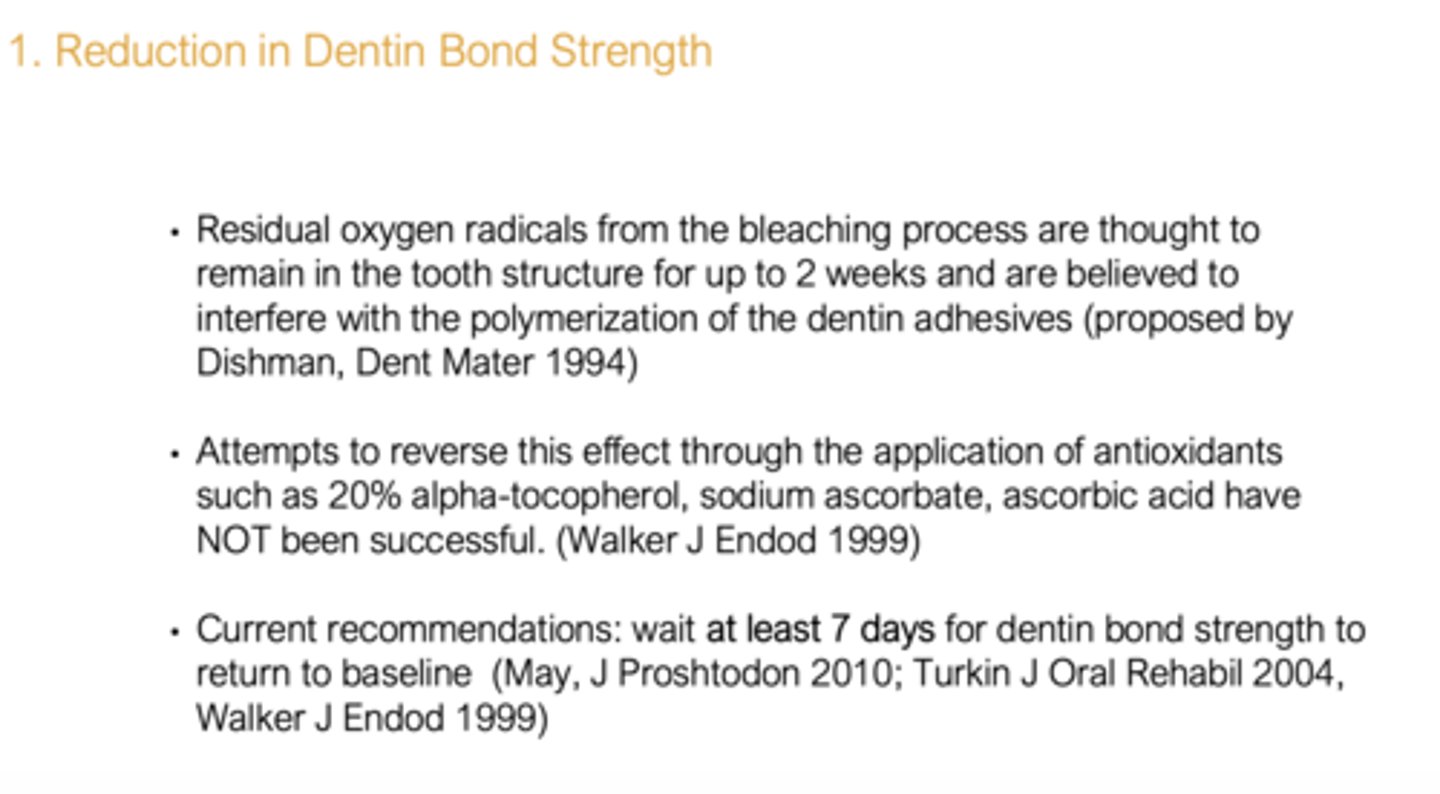
T/F: Residual oxygen radicals from the bleaching process are thought to remain in the tooth structure for up to 2 weeks and are believed to interfere with the polymerization of the dentin adhesives. Attempts to reverse this effect through the application of antioxidants such as 20% alpha-tocopherol, sodium ascorbate, ascorbic acid have NOT been successful
True
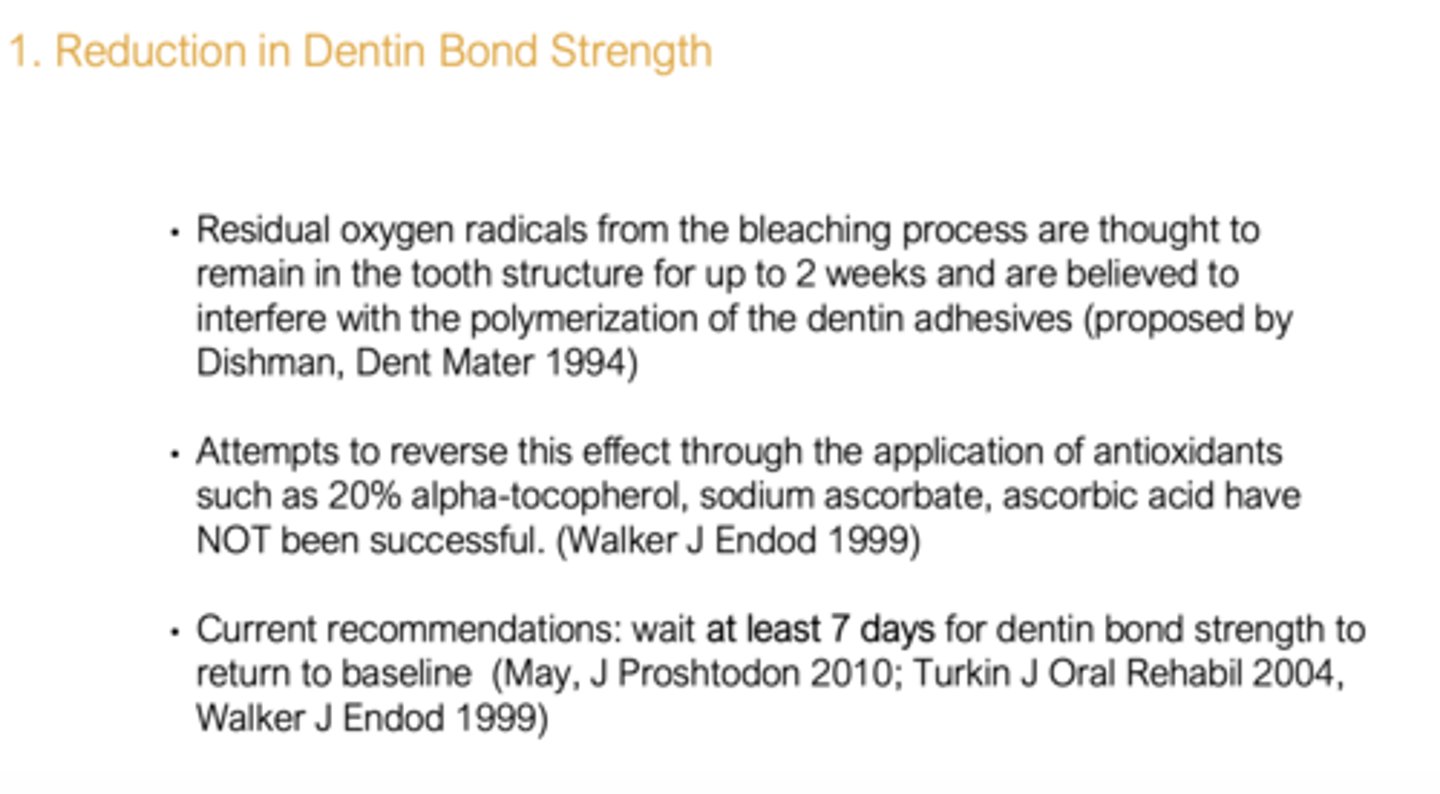
After how long should you do the final restoration on a tooth that has had internal bleaching finished due to issues with adhesion of bond and composite materials?
after 2 weeks
Current recommendations state that you should wait at least 7 days for dentin bond strength to return to baseline before what?
Placing a bonded restoration
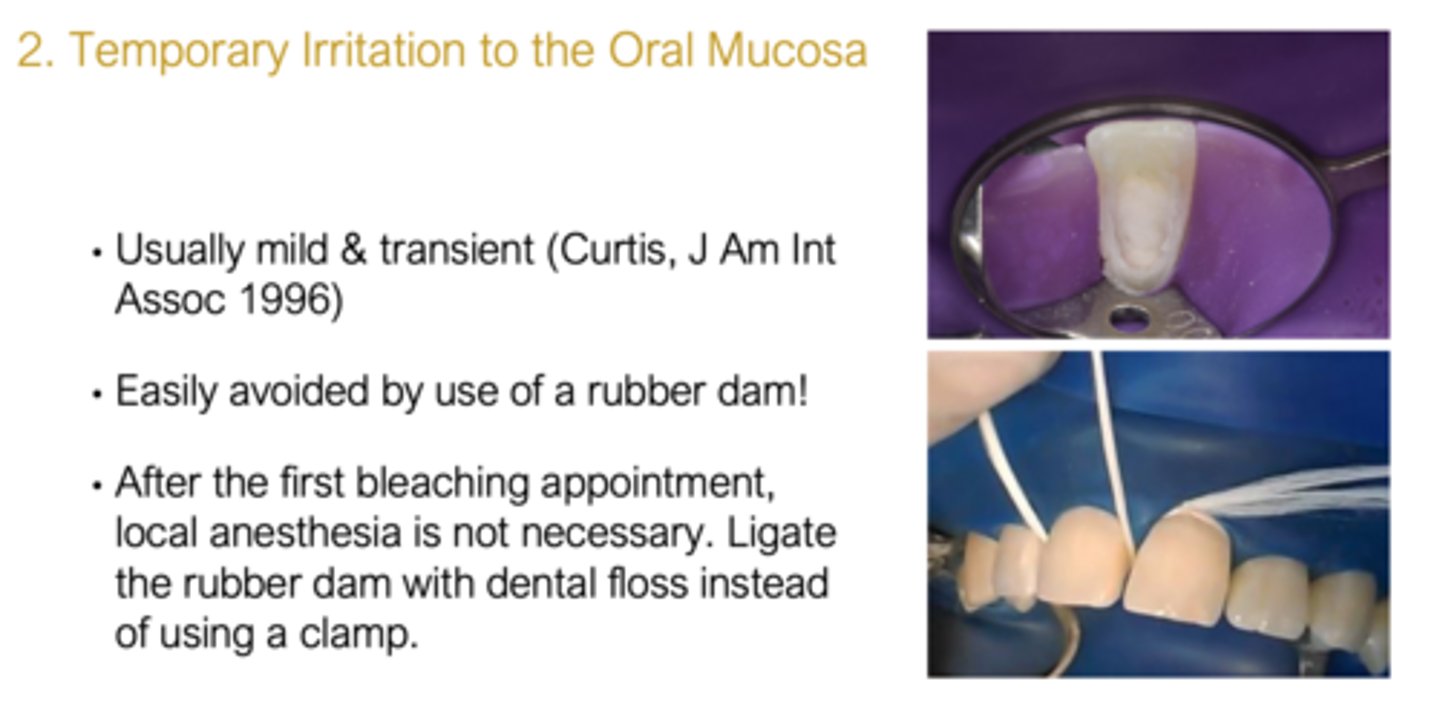
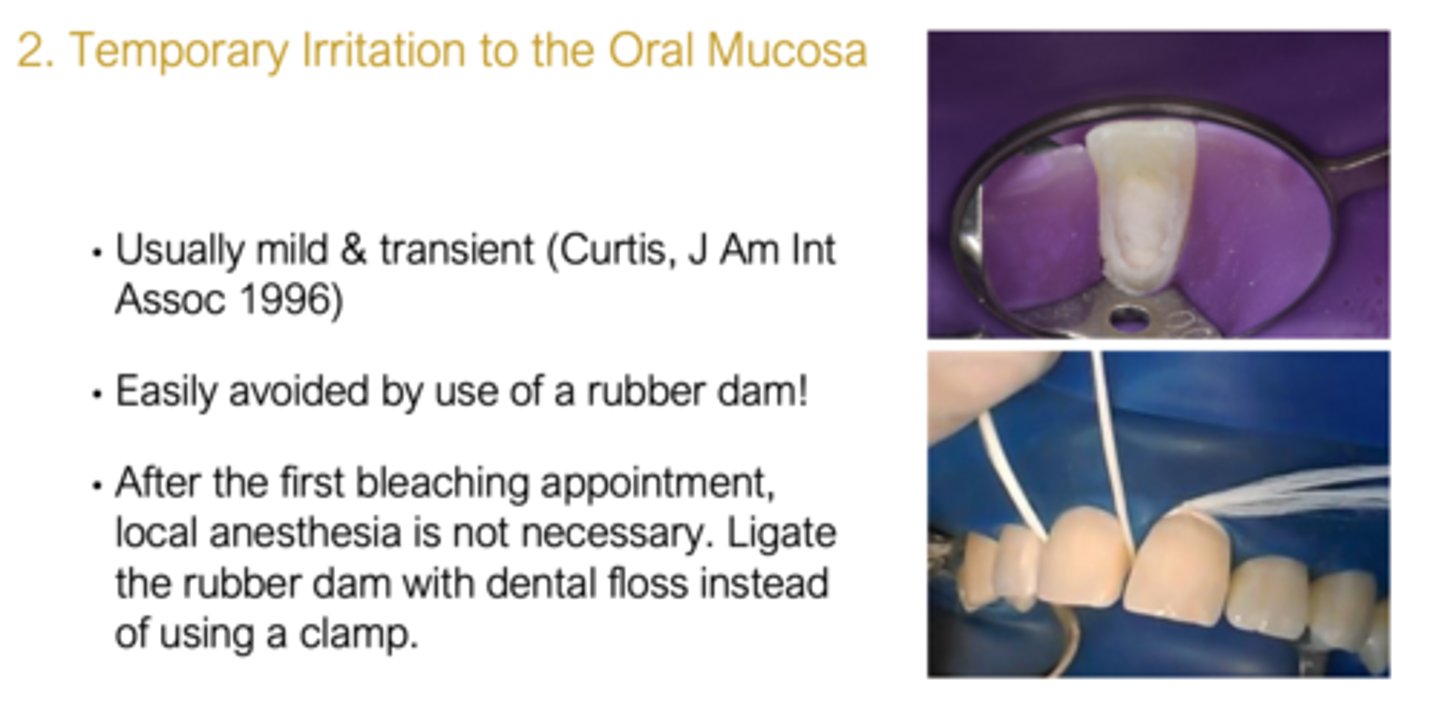
Mild temporary irritation to the oral mucosa can happen after bleaching. How can this easily be avoided?
Use rubber dam!
(Ligate the rubber dam with dental floss instead of using a clamp)
Is local anesthesia necessary after the first bleaching appointment?
No
It has been suggested that peroxides modify the biomechanics properties of dental hard tissues, resulting in ________ enamel micro hardness. These modifications do not appear to be permanent and can be reversed with fluoride remineralization
Reduced
T/F: Reduction of enamel micro hardness appears to be associated with 30% H2O2 and is NOT associated with sodium perborate
True
Have any studies demonstrated increased fracture risk after internal bleaching?
No
According to Heithersay (1999), the most common predisposing factor for external cervical resorption is what?
Ortho
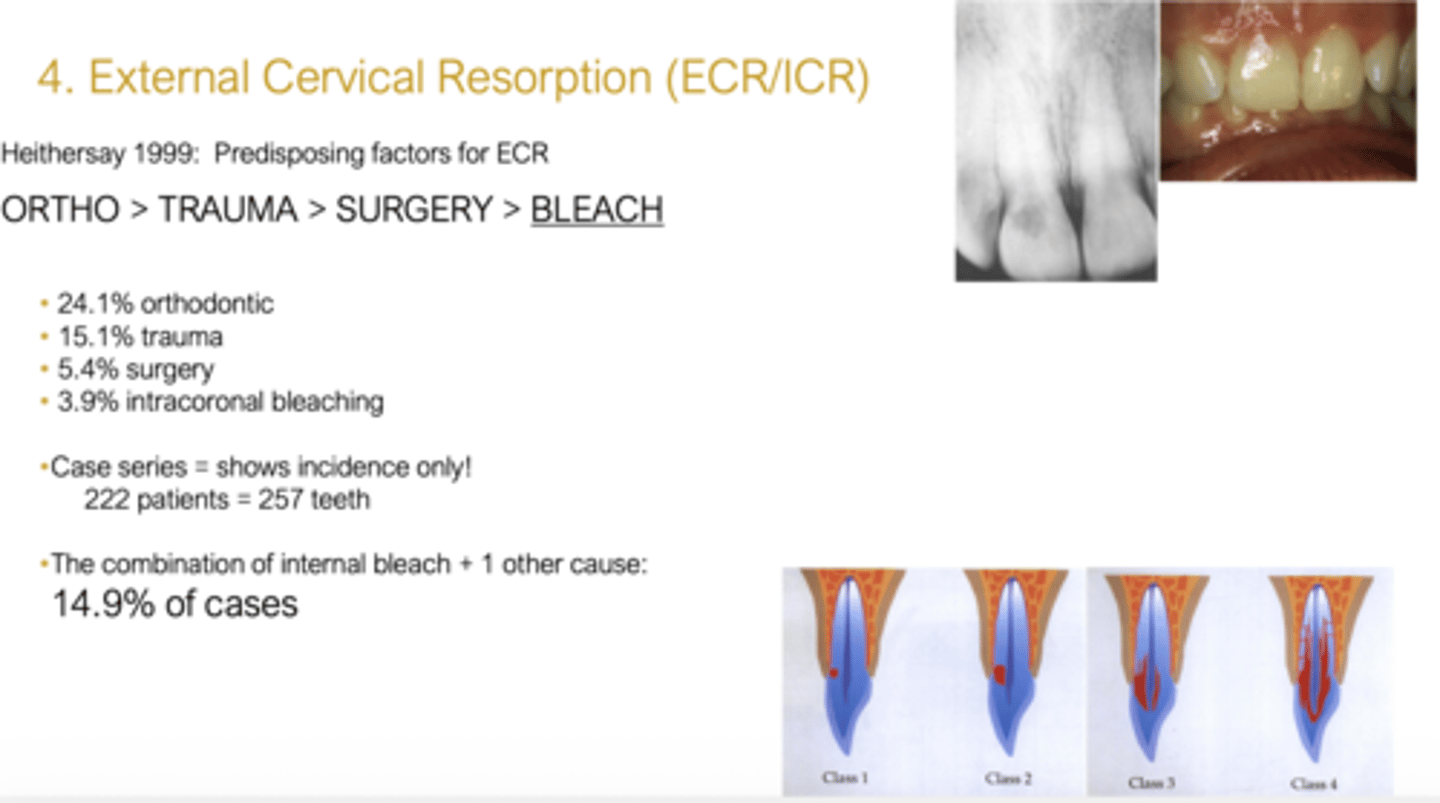
Which factor has the lowest reported association with ECR?
A. Orthodontics
B. Trauma
C. Surgery
D. Intracoronal bleaching
D. Intracoronal bleaching
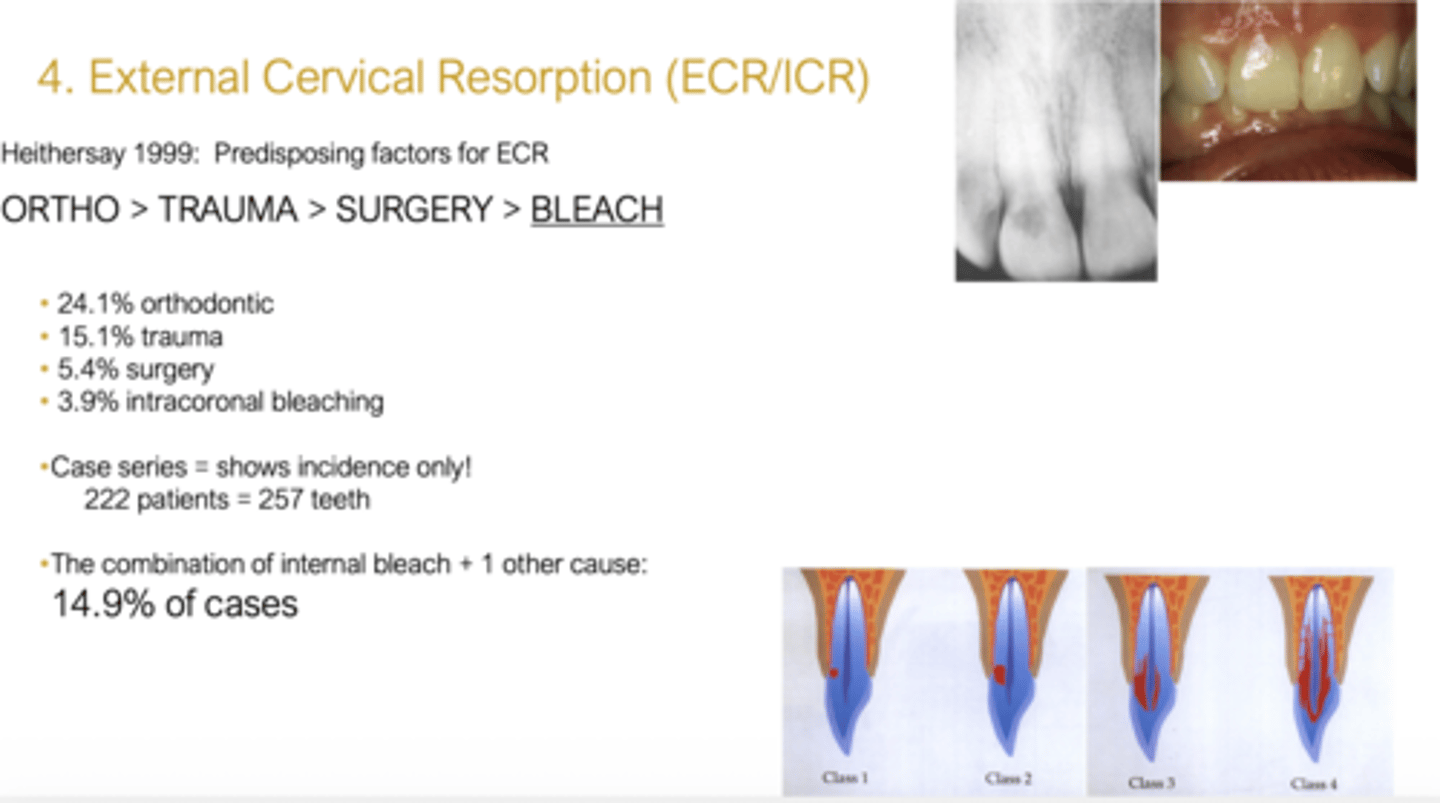
The combination of internal bleaching plus one other factor accounts for what percent of External Cervical Resorption (ECR/ICR) cases?
14.9%
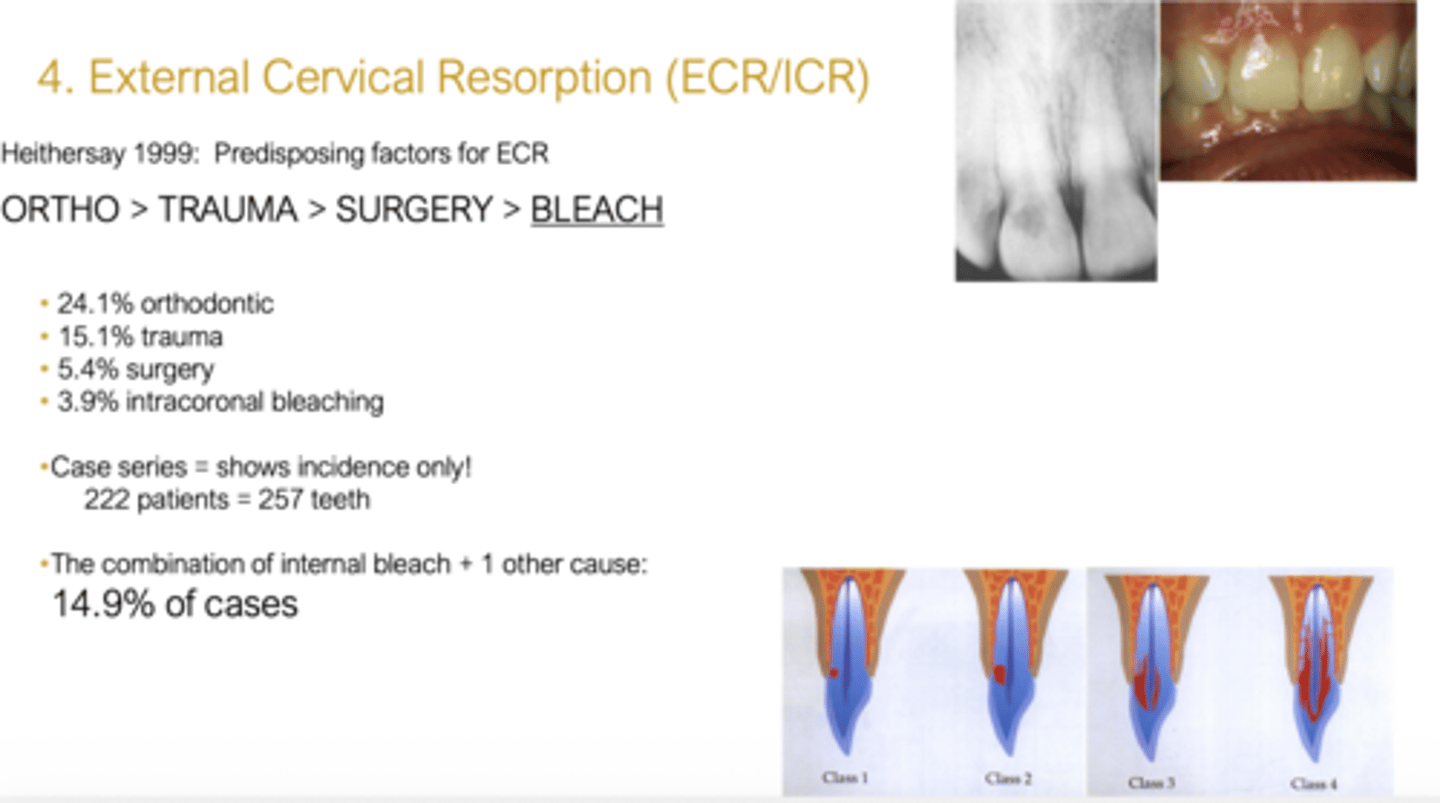
What risk factor OR combination of risk factors presents the highest risk for Invasive Cervical Resorption?
bleaching and trauma
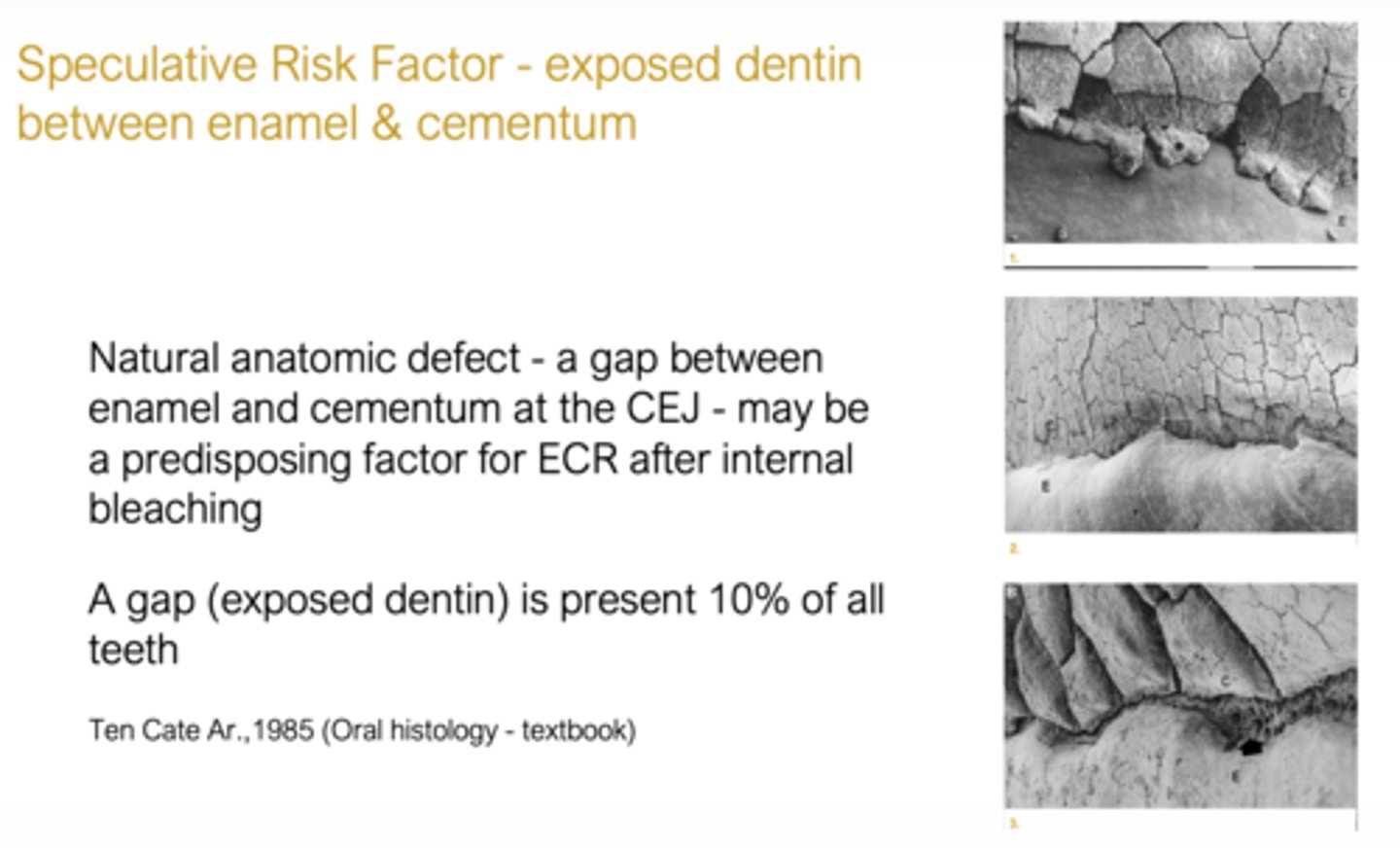
What is an example of a natural anatomic defect that may be a predisposing factor for ECR after internal bleaching?
A gap between enamel and cementum at the CEJ
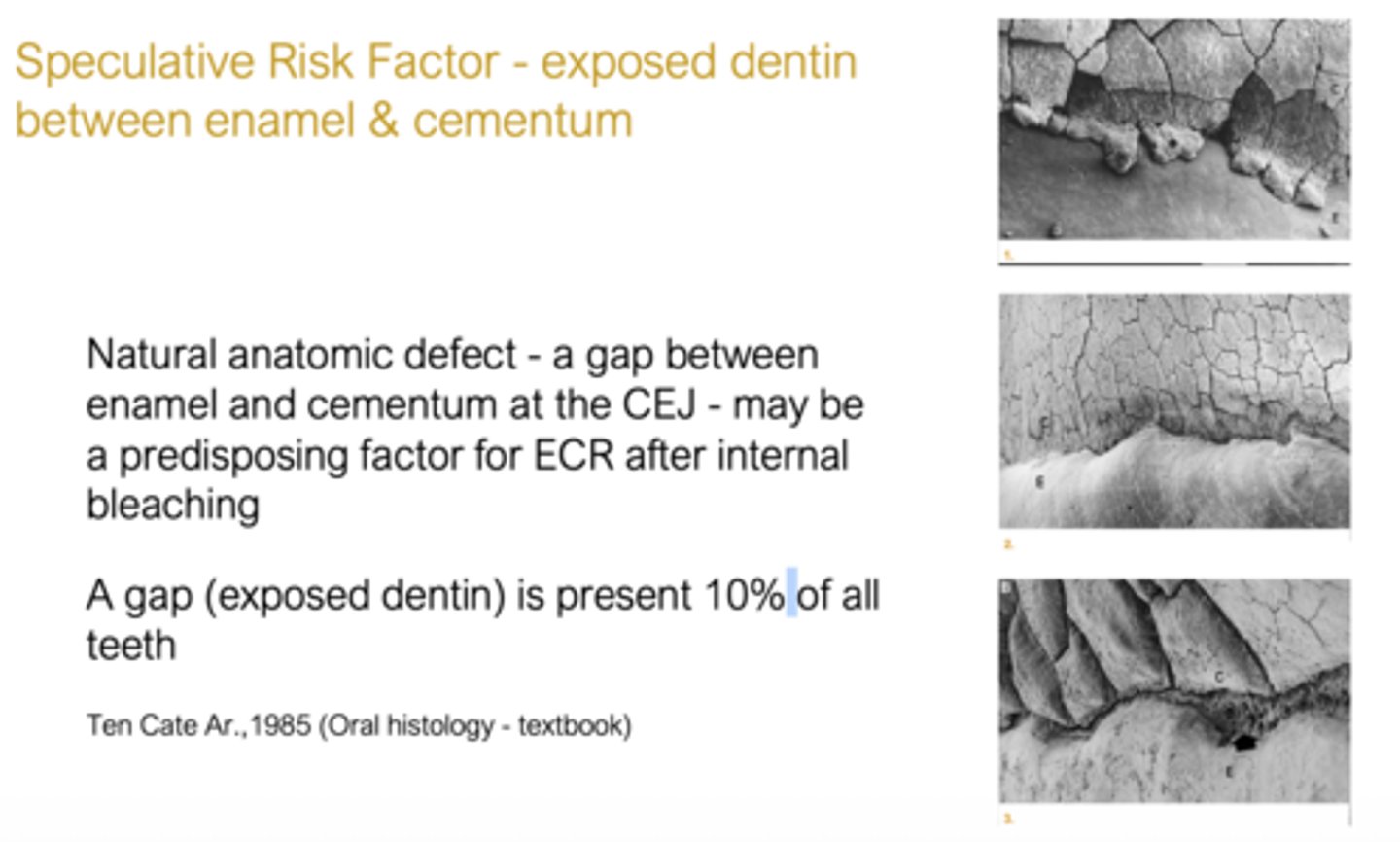
What percent of all teeth have a gap (exposed dentin)?
10%
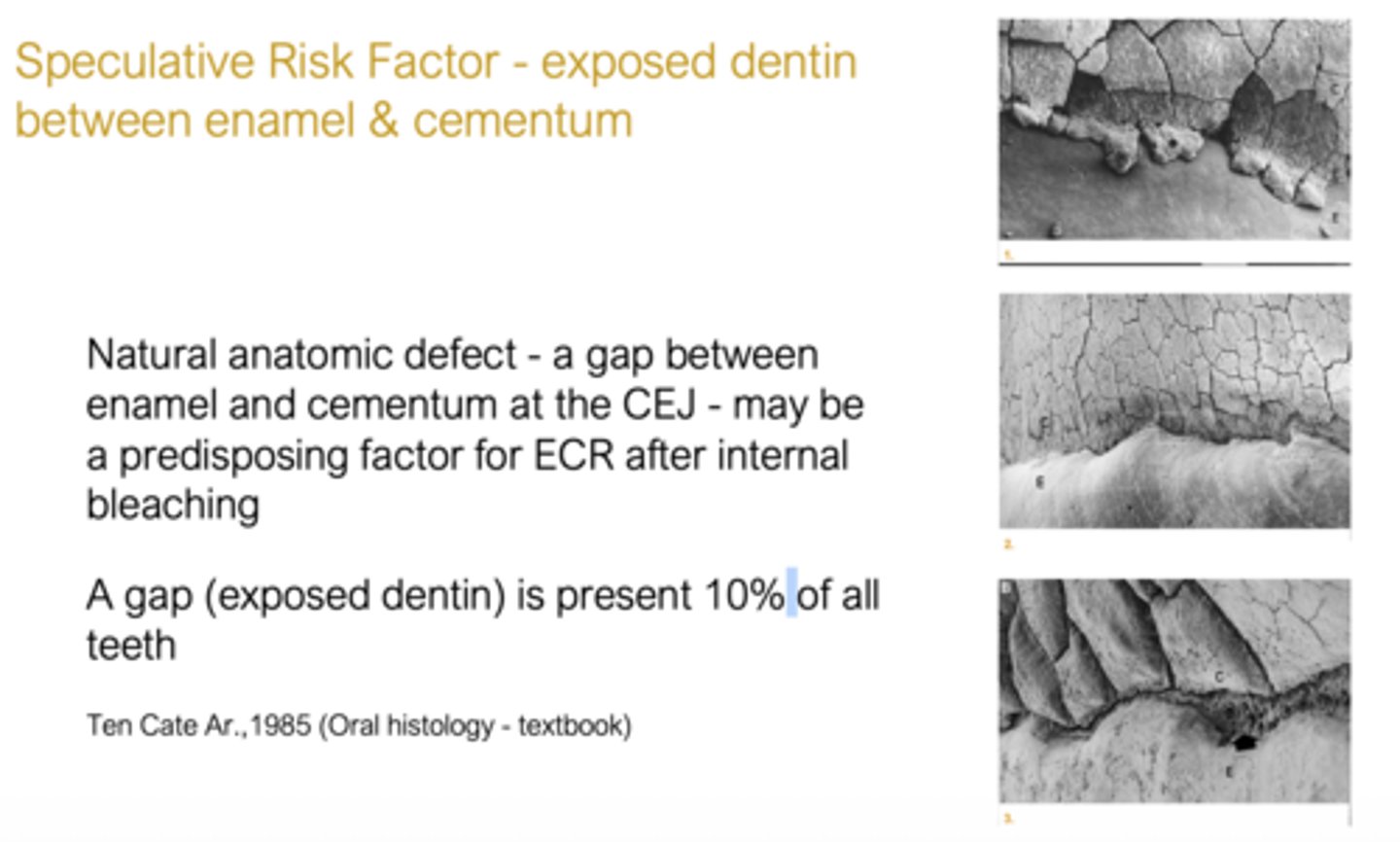
What is the most common CEJ pattern presentation?
overlapped
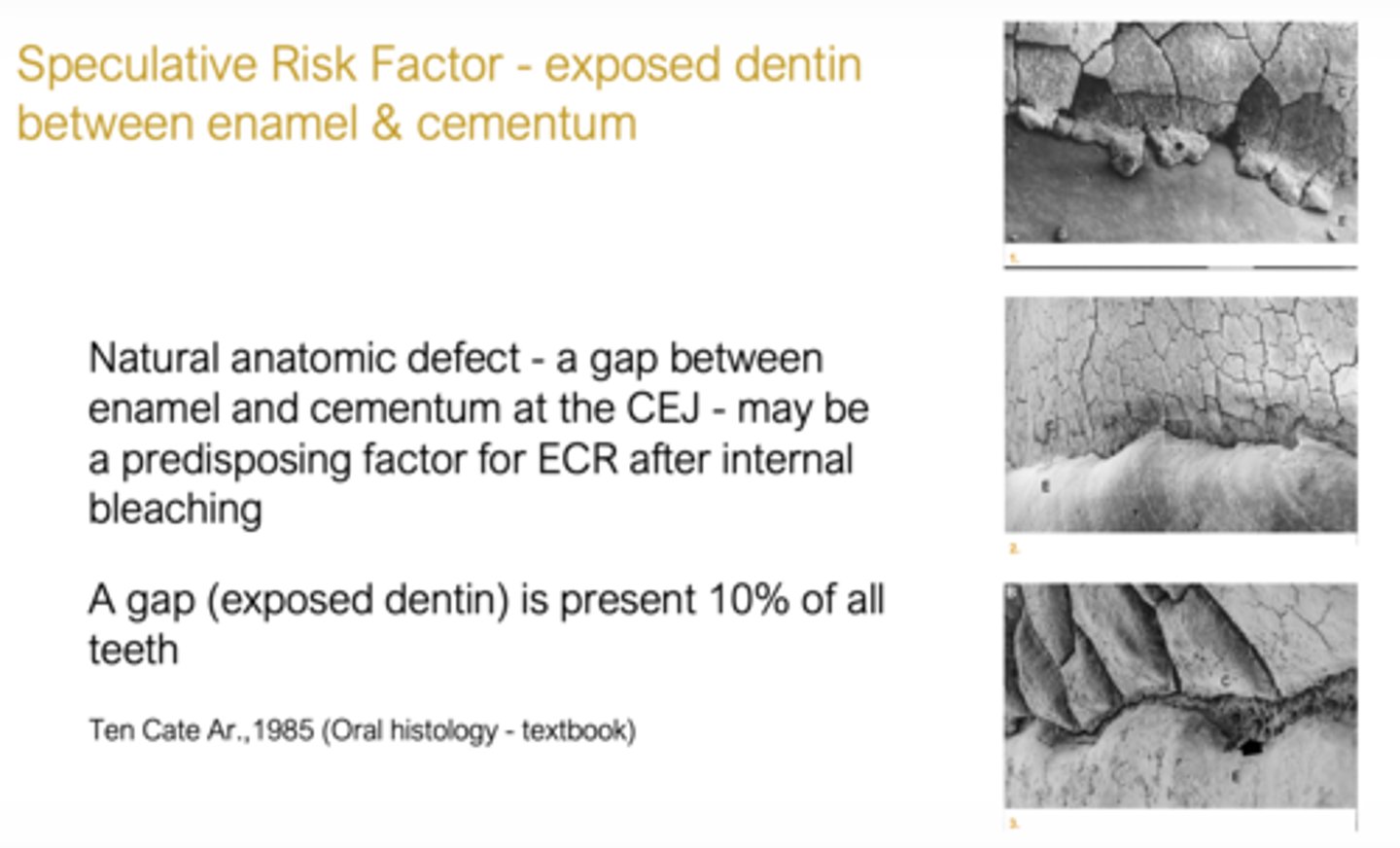
What CEJ pattern presents the highest risk for Invasive Cervical Resorption?
gap between enamel and cementum
T/F: Most studies showing ECR after internal bleaching used a barrier and/or used a thermocatalytic technique
False - Most studies showing ECR after internal bleaching did not use a barrier and/or used a thermocatalytic technique
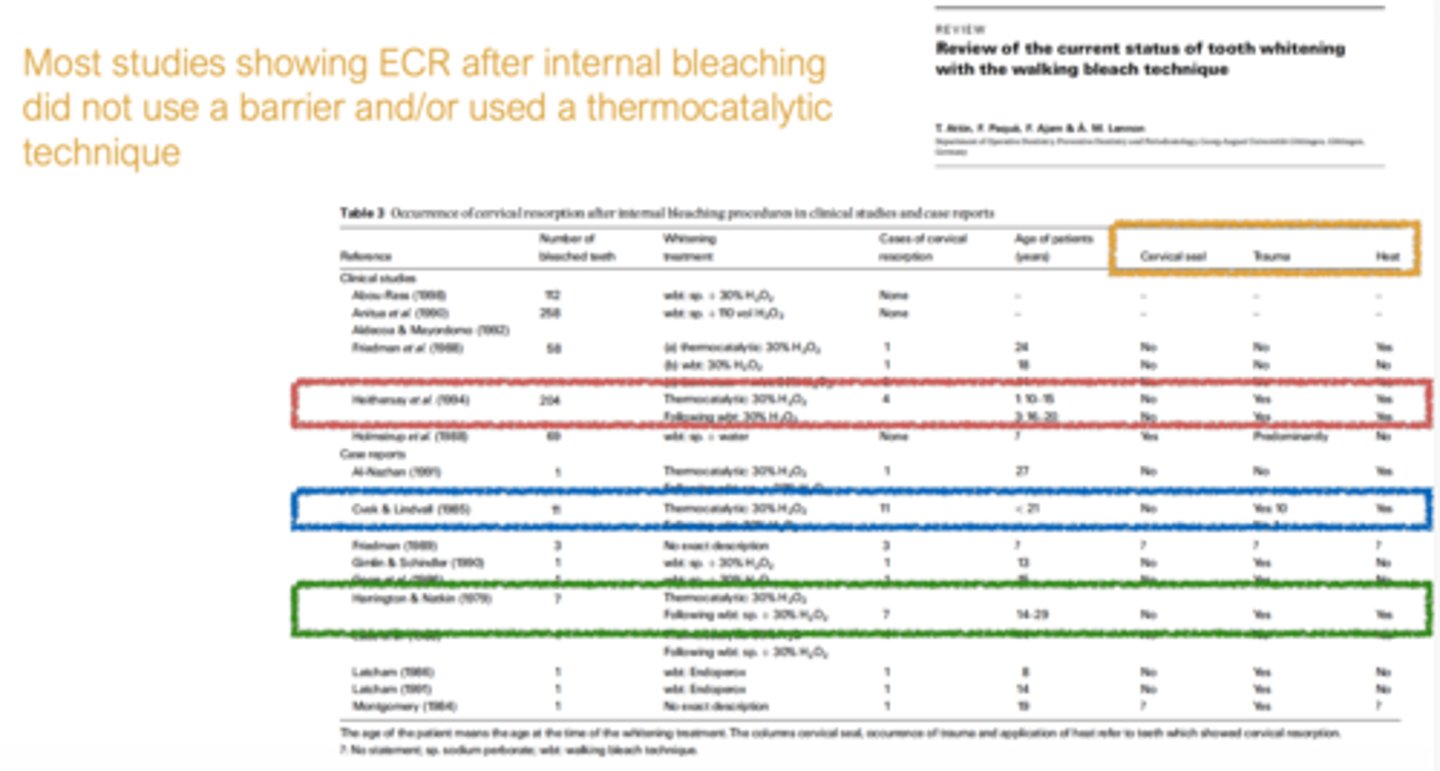
What are the three highest risk factors associated with external cervical root resorption after internal bleaching?
- Cervical seal not used
- Trauma
- Heat/thermocatalytic
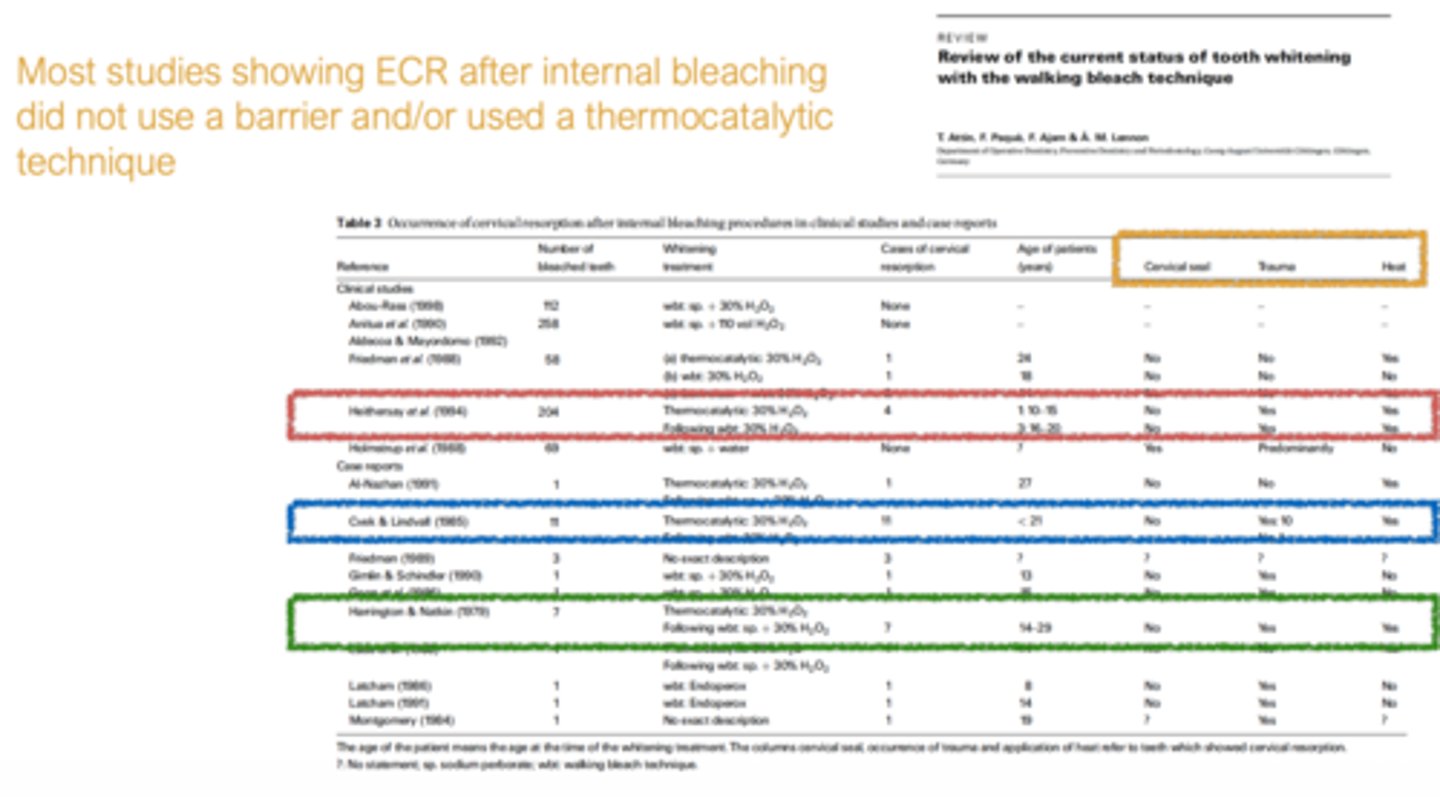
What is the advantage of the Thermocatalytic technique?
Accelerates bleaching
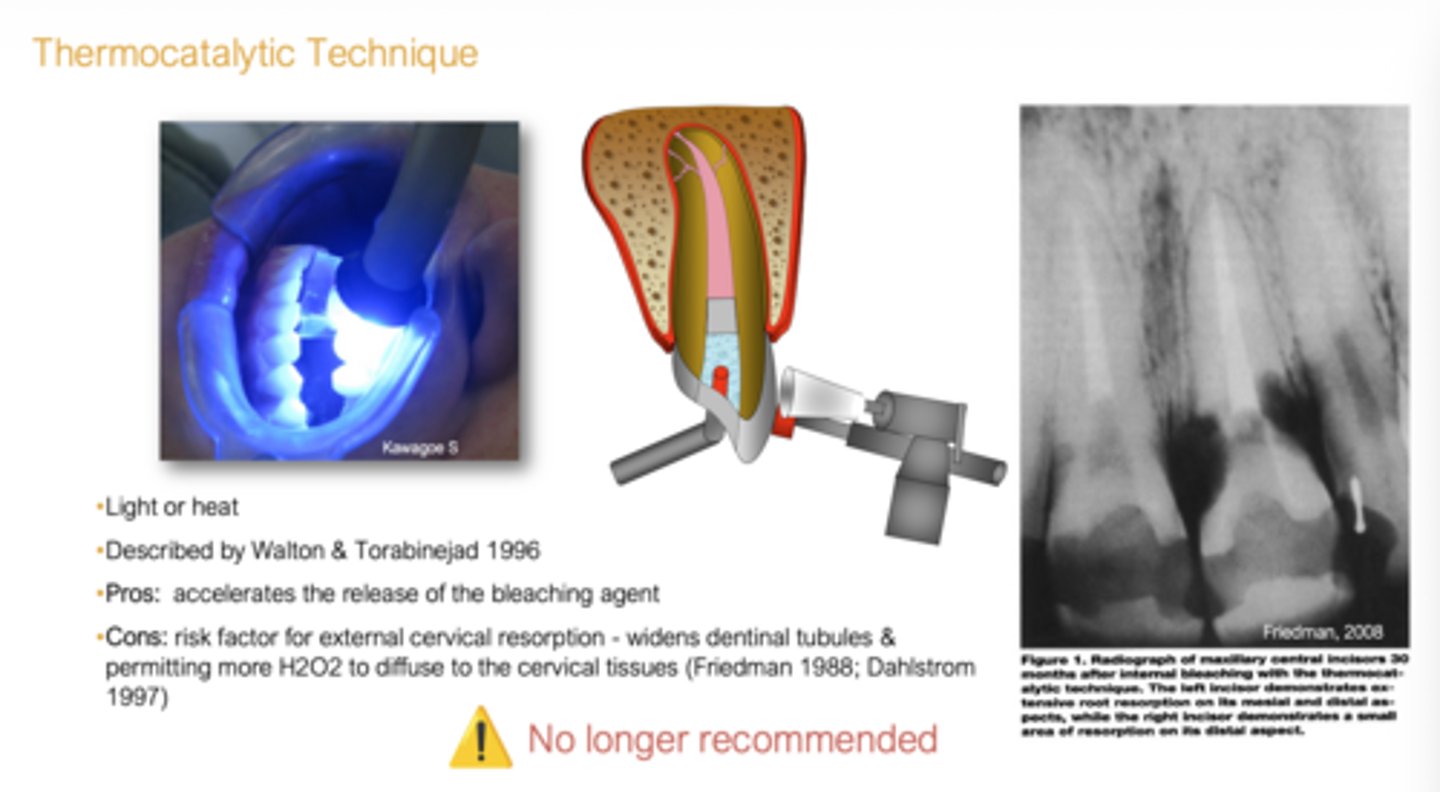
Which is FALSE regarding the thermocatalytic technique?
A) Uses light or heat
B) Pros: accelerates release of bleaching agent
C) Cons: risk for external cervical resorption, widens dentinal tubules and permits more H2O2 to diffuse to cervical tissues
D) Recommended by dentists
D - No longer recommended
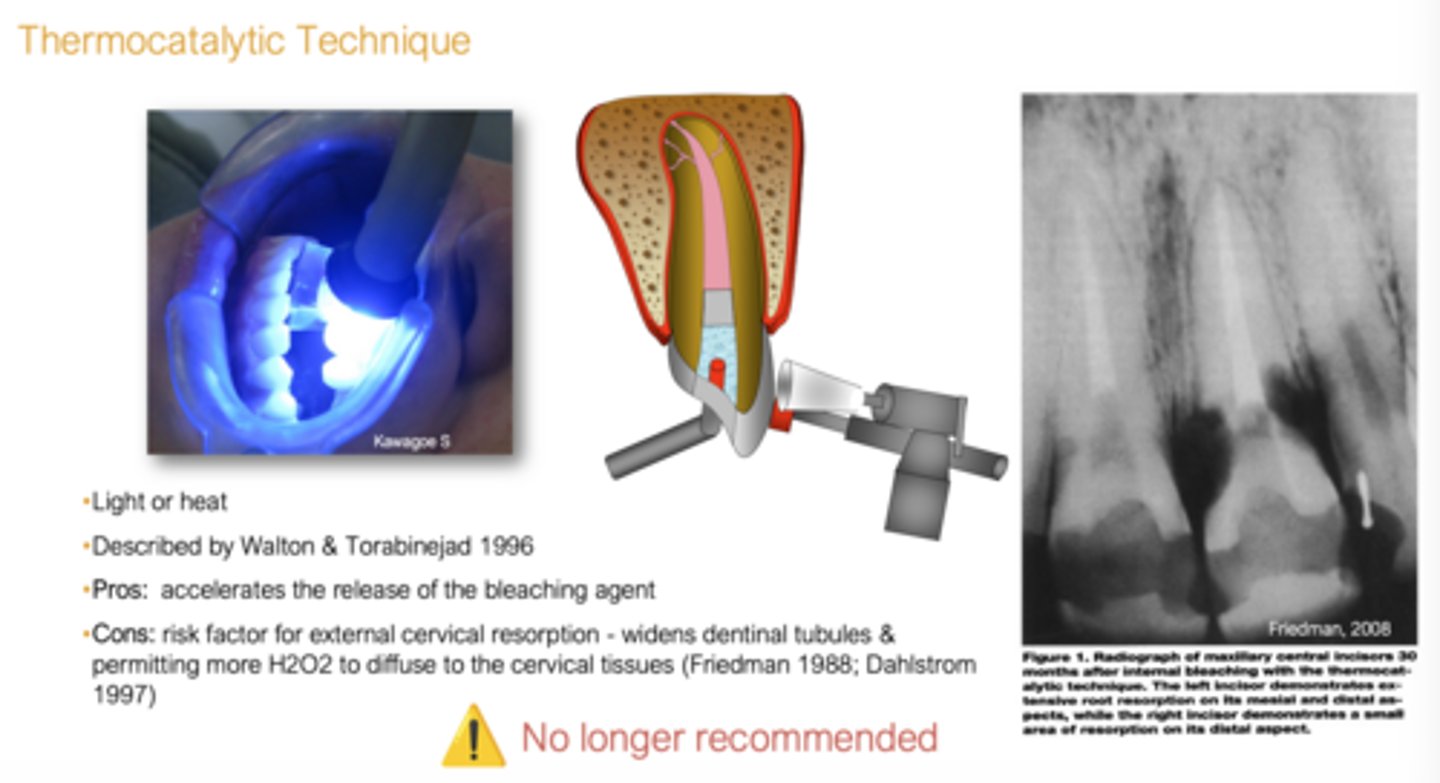
What is the disadvantage of the Thermocatalytic technique?
increase risk for external cervical resorption
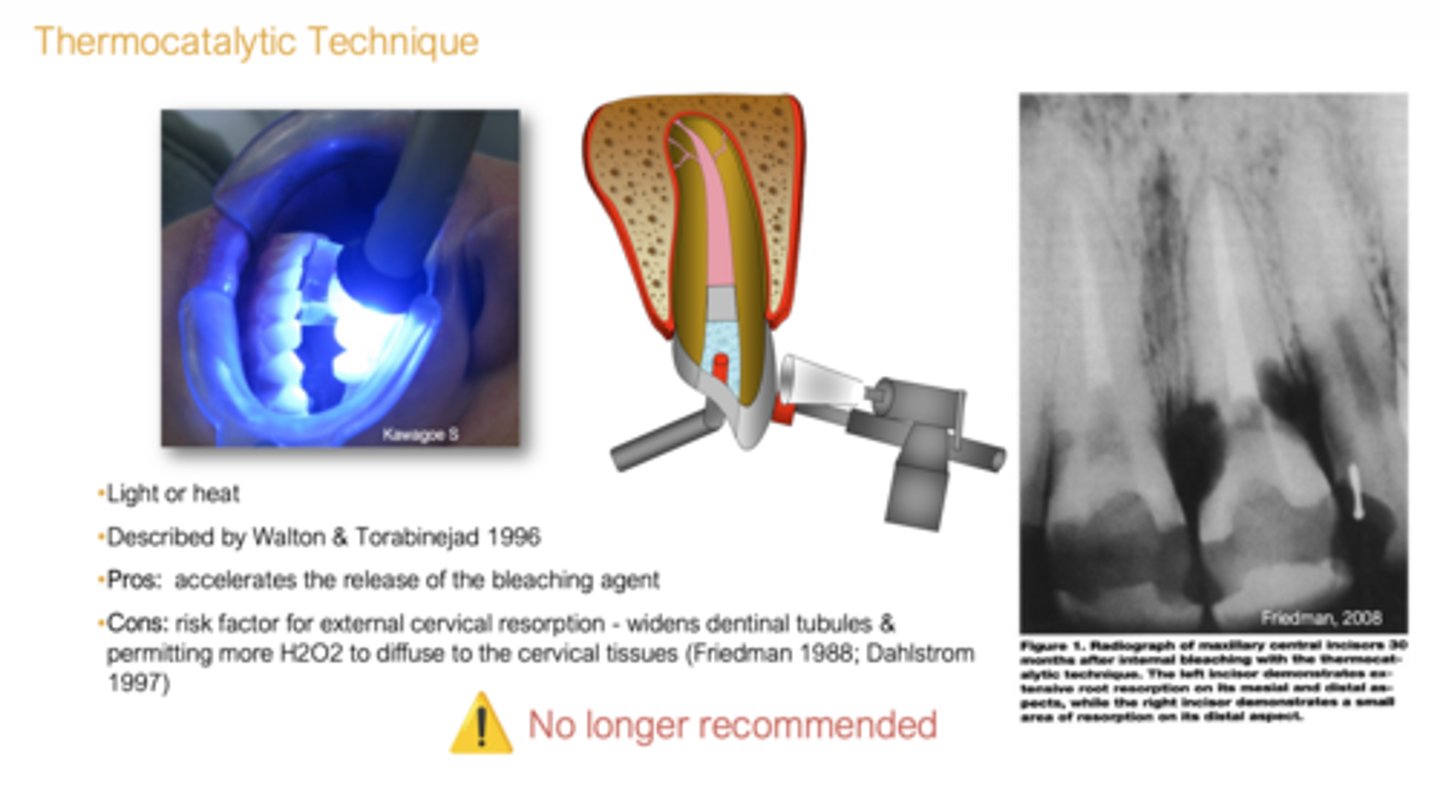
What has the following characteristics?
- Prevents bleaching agents from diffusing into the periodontium
- Should reach level of epithelial attachment/CEJ
- Shape should reproduce the CEJ position and interproximal bone level
- Temporary materials (Cavit/IRM) must be removed before final restoration
cervical seal
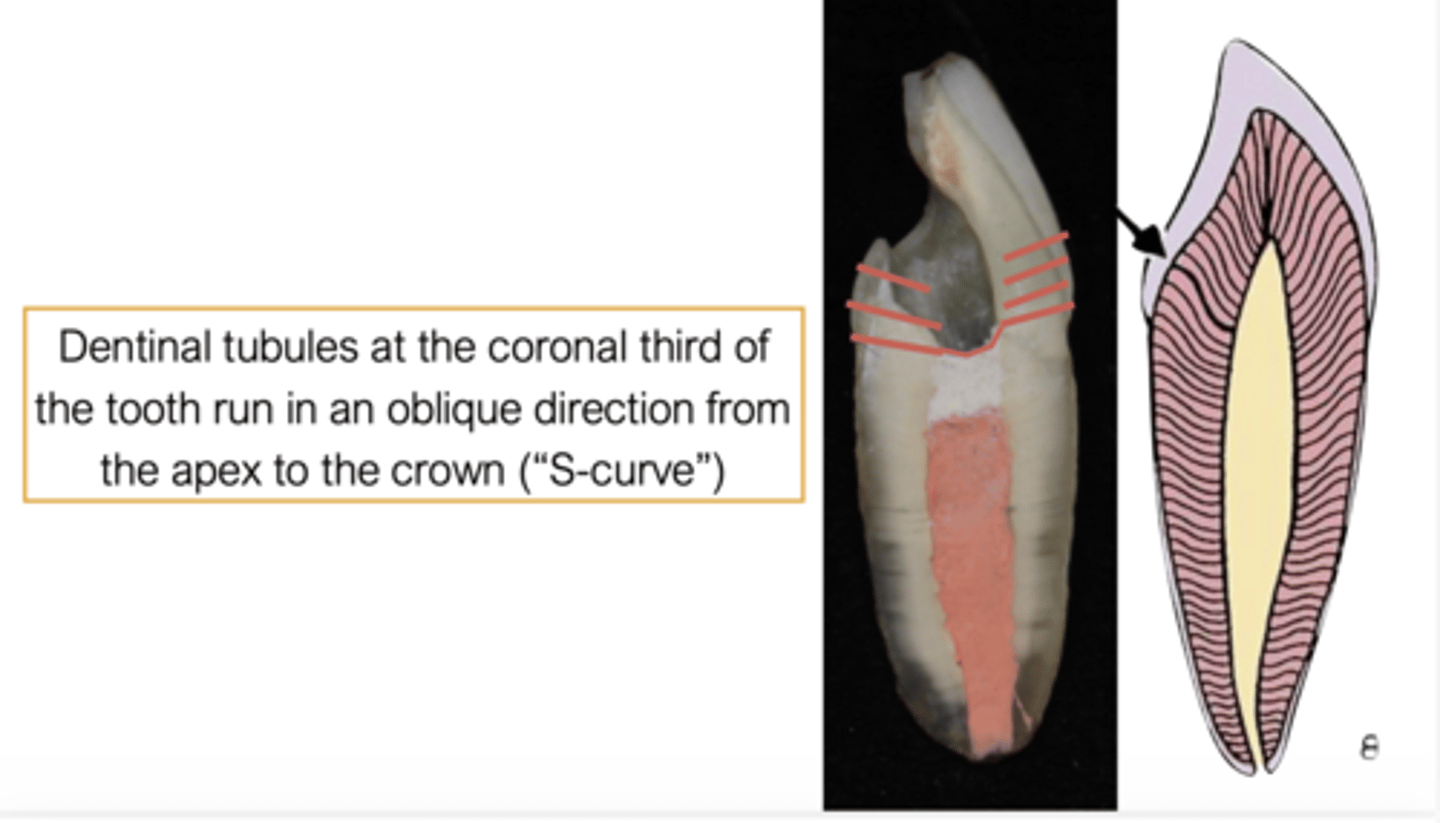
Dentinal tubules at the coronal third of the tooth run in an ______ direction from the apex to the crown ("S-curve")
oblique
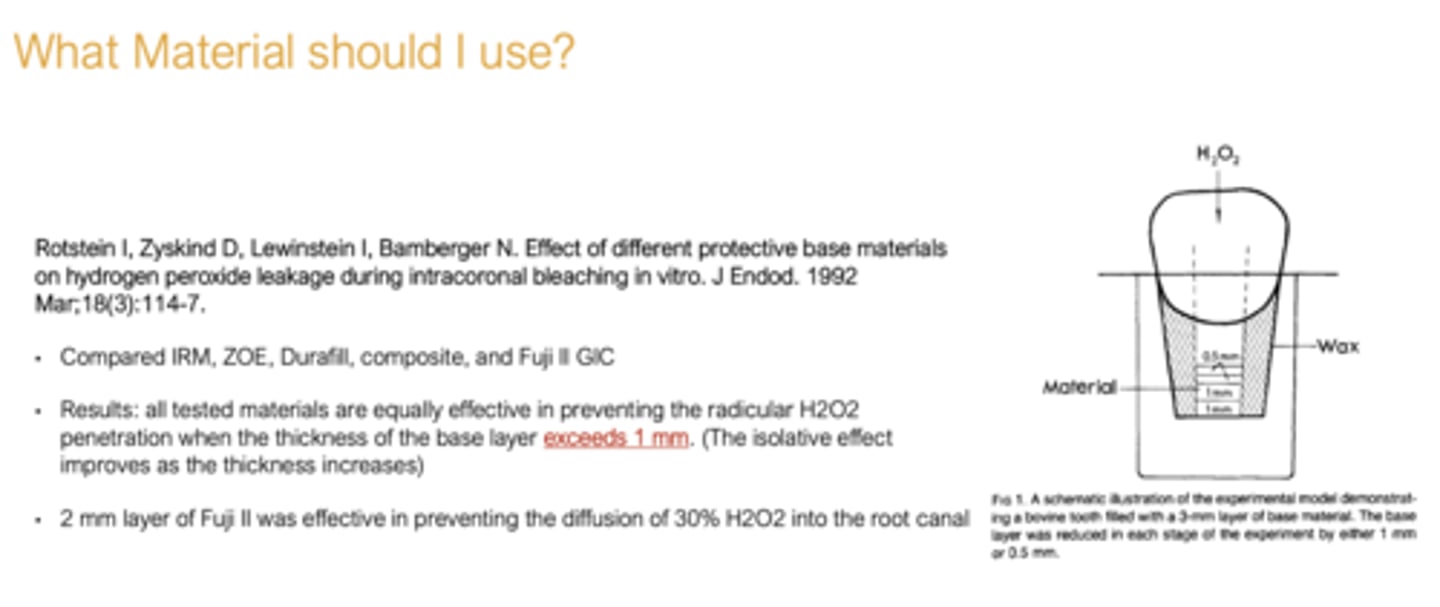
One research study showed that all tested materials were equally effective in preventing the radicular hydrogen peroxide penetration when the thickness of the base layer exceeds ___ mm
1 mm
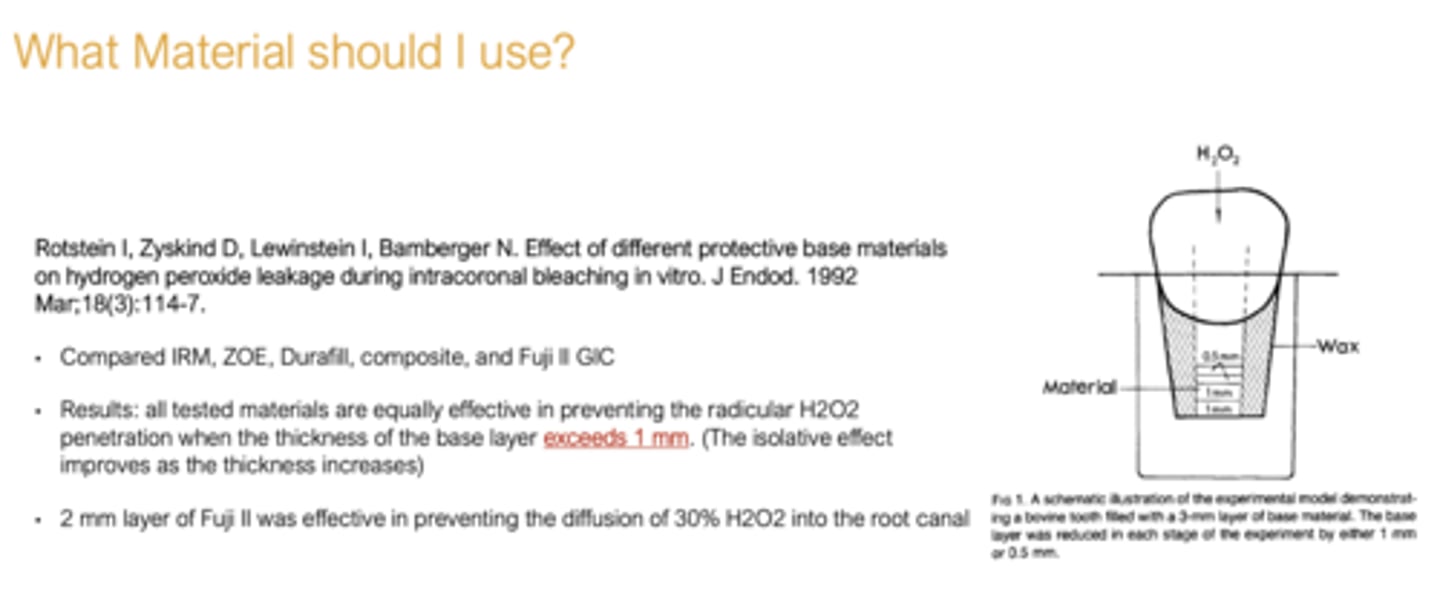
One research study showed that all tested materials were equally effective in preventing the radicular hydrogen peroxide penetration when the thickness of the base layer exceeds 1mm. The isolative affect of all the materials ________ as the base layer thickness increases
Improves
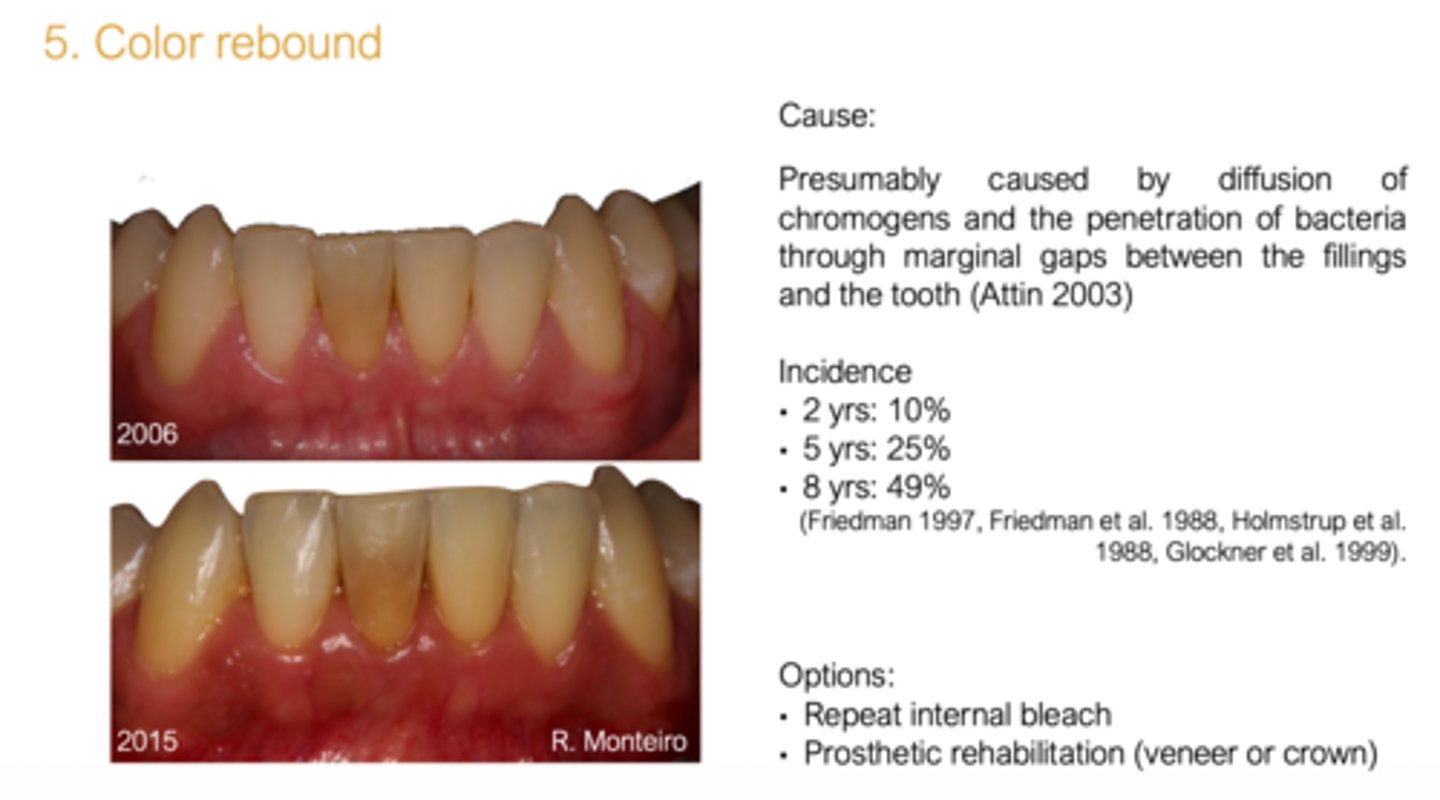
What has the following characteristics?
- Presumably caused by diffusion of chromogens and the penetration of bacteria through marginal gaps between the fillings and the tooth
- Options are to repeat internal bleach OR prosthetic rehab (crown/veneer)
color rebound
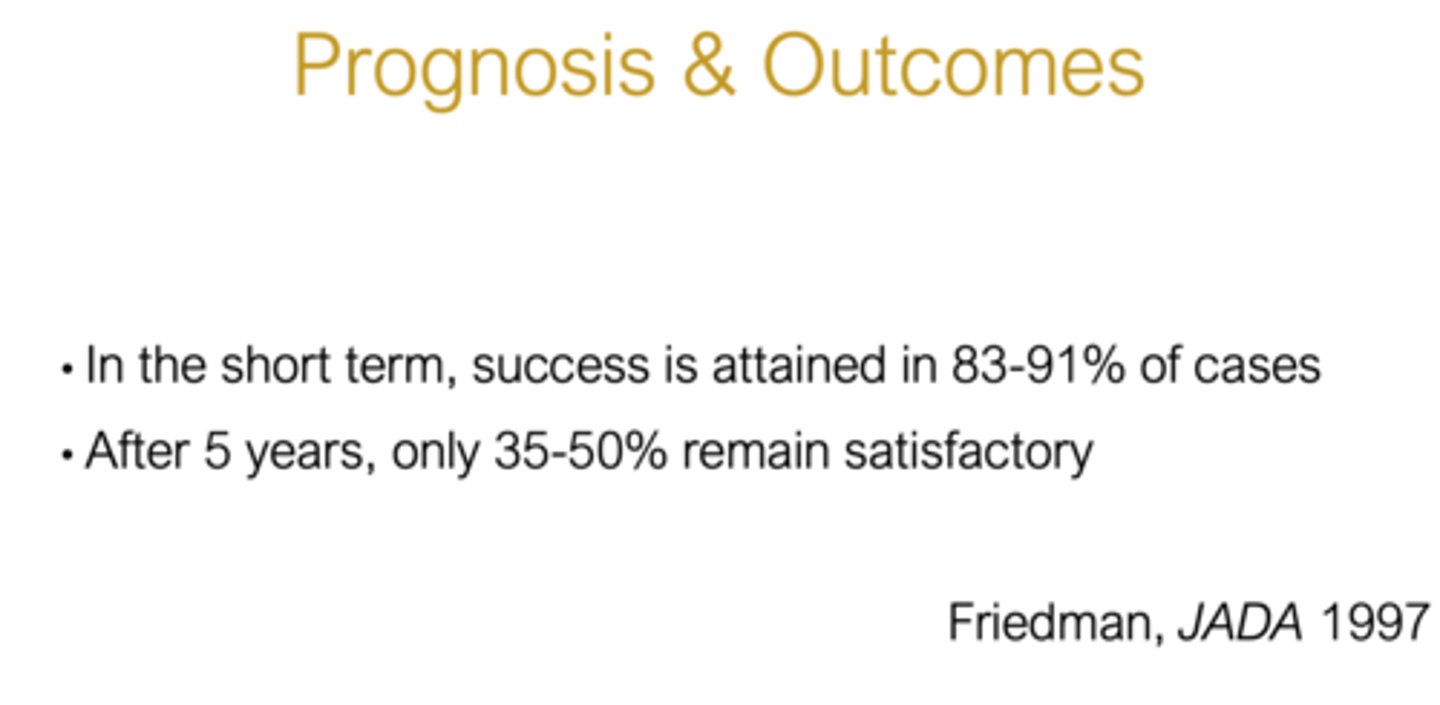
In the short term, what is the success attained for internal bleaching?
83-91%
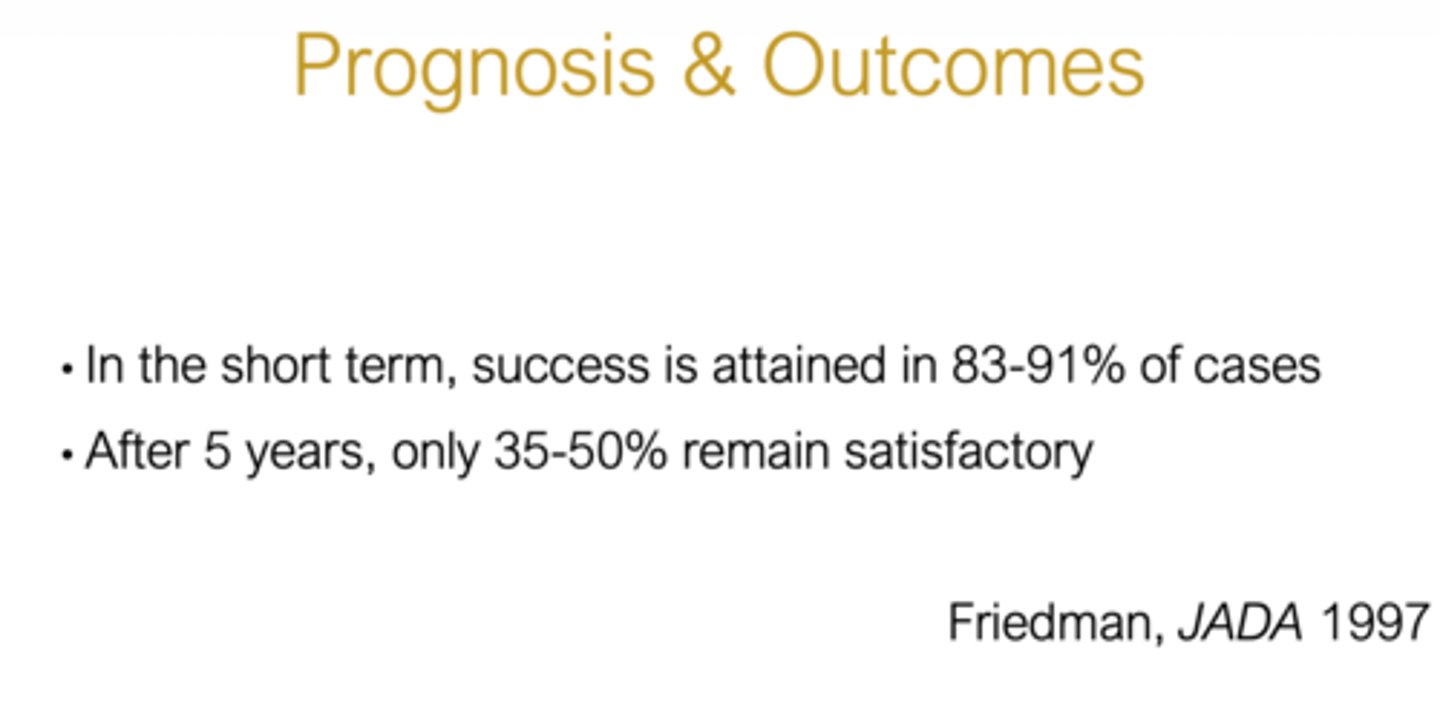
Five years after internal bleaching, what percent of cases remain satisfactory?
35-50%
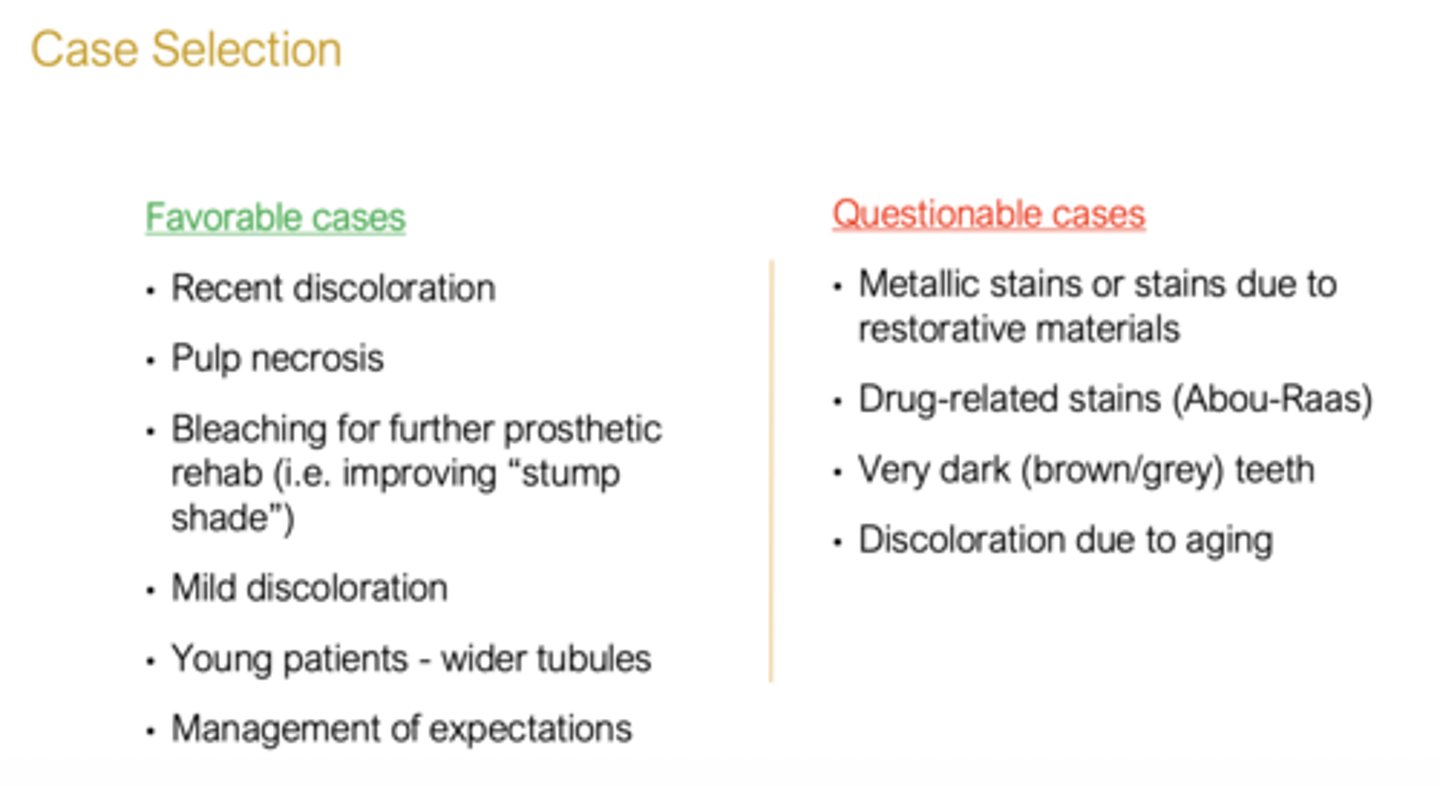
What kind of cases are these for bleaching?
- Recent discoloration
- Pulp necrosis
- Bleaching for further prosthetic rehab (i.e. improving "stump shade")
- Mild discoloration
- Young patients, wider tubules
- Management of expectations
favorable cases
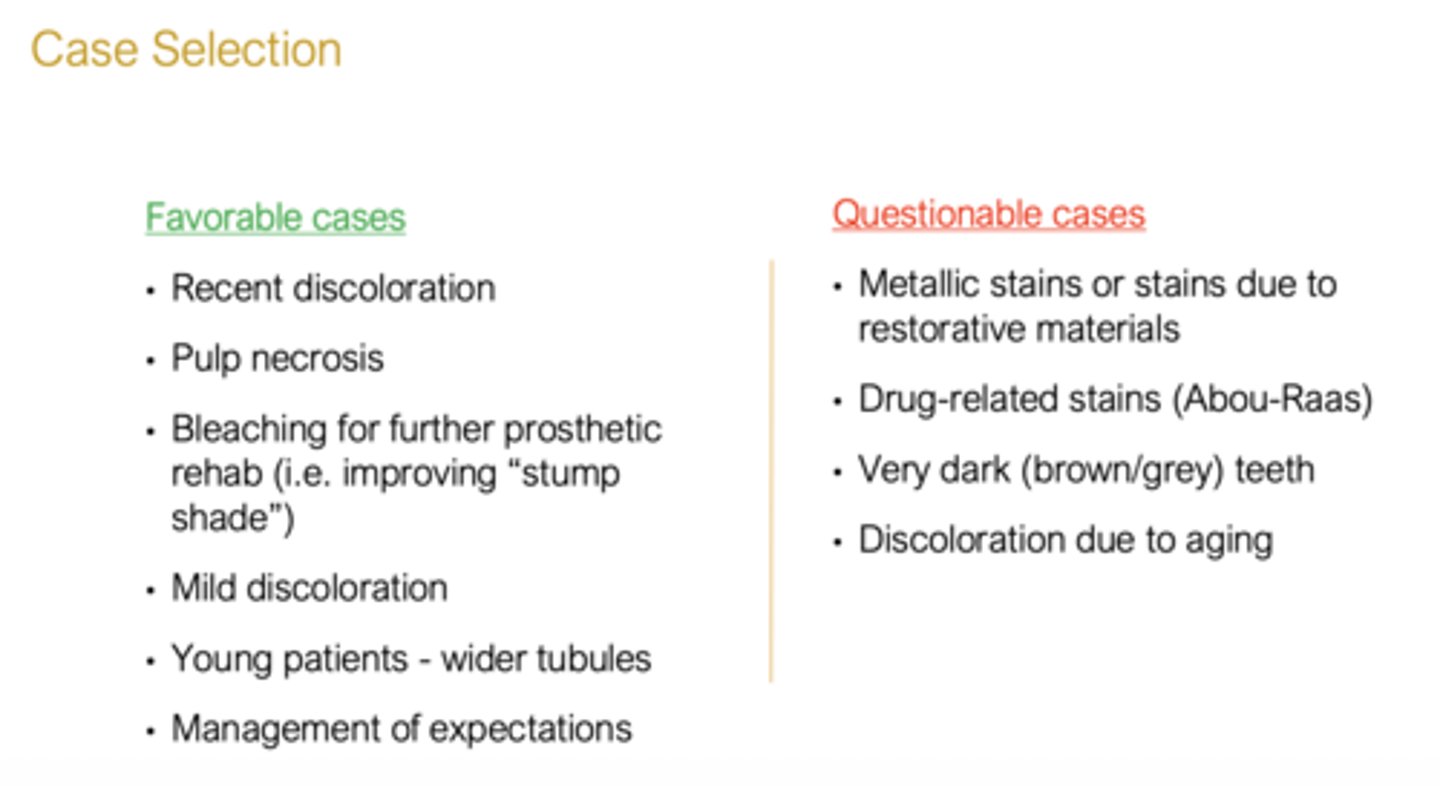
What kind of cases are these for bleaching?
- Metallic stains or stains due to restorative materials
- Drug-related stains (Abou-Raas)
- Very dark (brown/grey) teeth
- Discoloration due to aging
Questionable cases
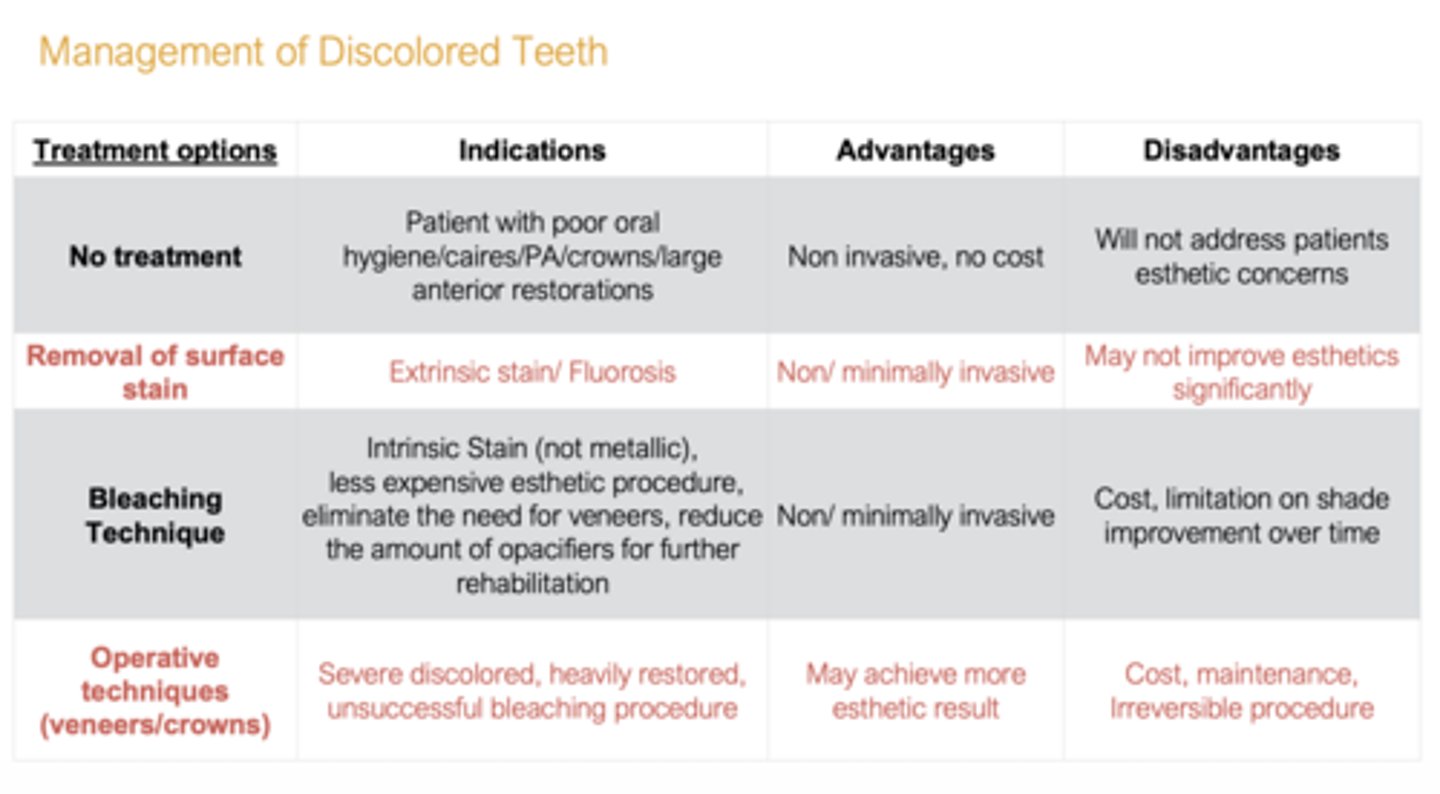
ID the tx option:
- Indication: Extrinsic stain/fluorosis
- Advantage: Non/minimally invasive
- Disadvantage: May not improve esthetics significantly
Removal of surface stain
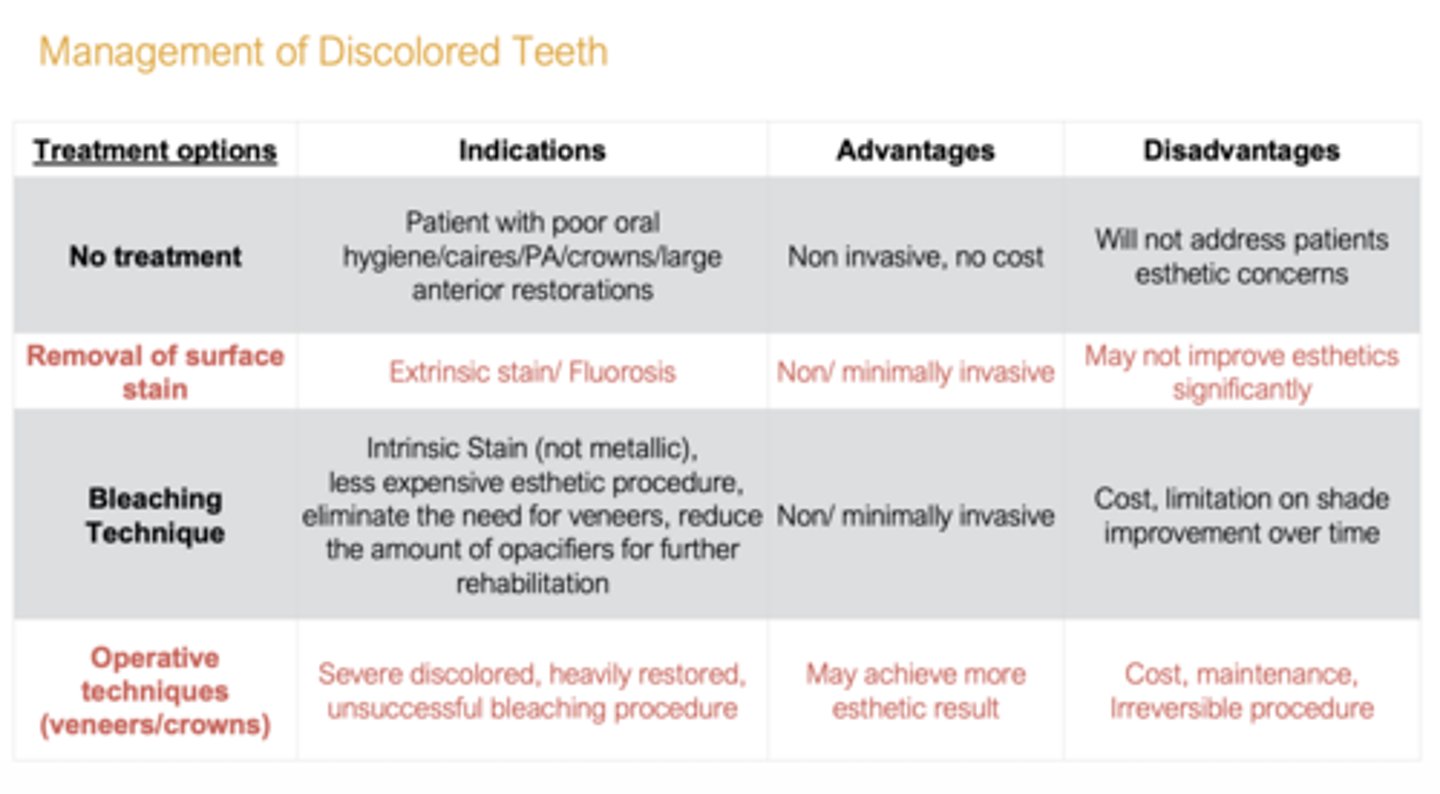
ID the tx option:
- Indication: Intrinsic Stain (not metallic), less expensive esthetic procedure, eliminate the need for veneers, reduce the amount of opacifiers for further rehabilitation
- Advantage: non/minimally invasive
- Disadvantage: Cost, limitation on shade improvement over time
Bleaching technique
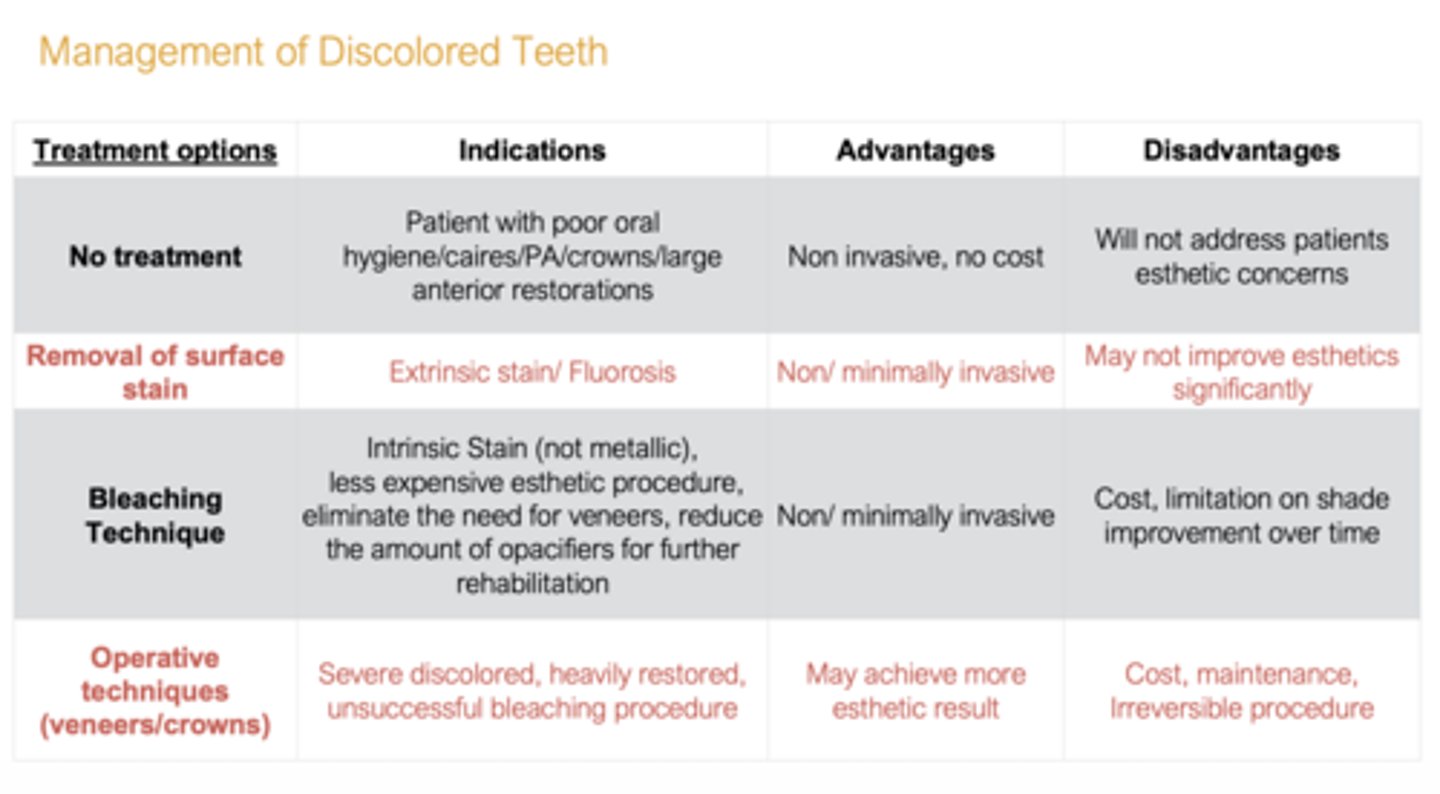
ID the treatment option:
- Indication: Severe discolored, heavily restored, unsuccessful bleaching procedure
- Advantage: May achieve more esthetic result
- Disadvantage: Cost, maintenance, irreversible procedure
Operative technique (veneers, crowns)
ID the technique:
- A mixture of sodium perborate & water is left in the pulp chamber for a few days, and the access cavity is sealed with a permanent cement. This process is repeated until the desired color is achieved.
- Is considered a less-invasive alternative to prosthetic rehabilitation such as veneers or crowns
Walking bleach technique
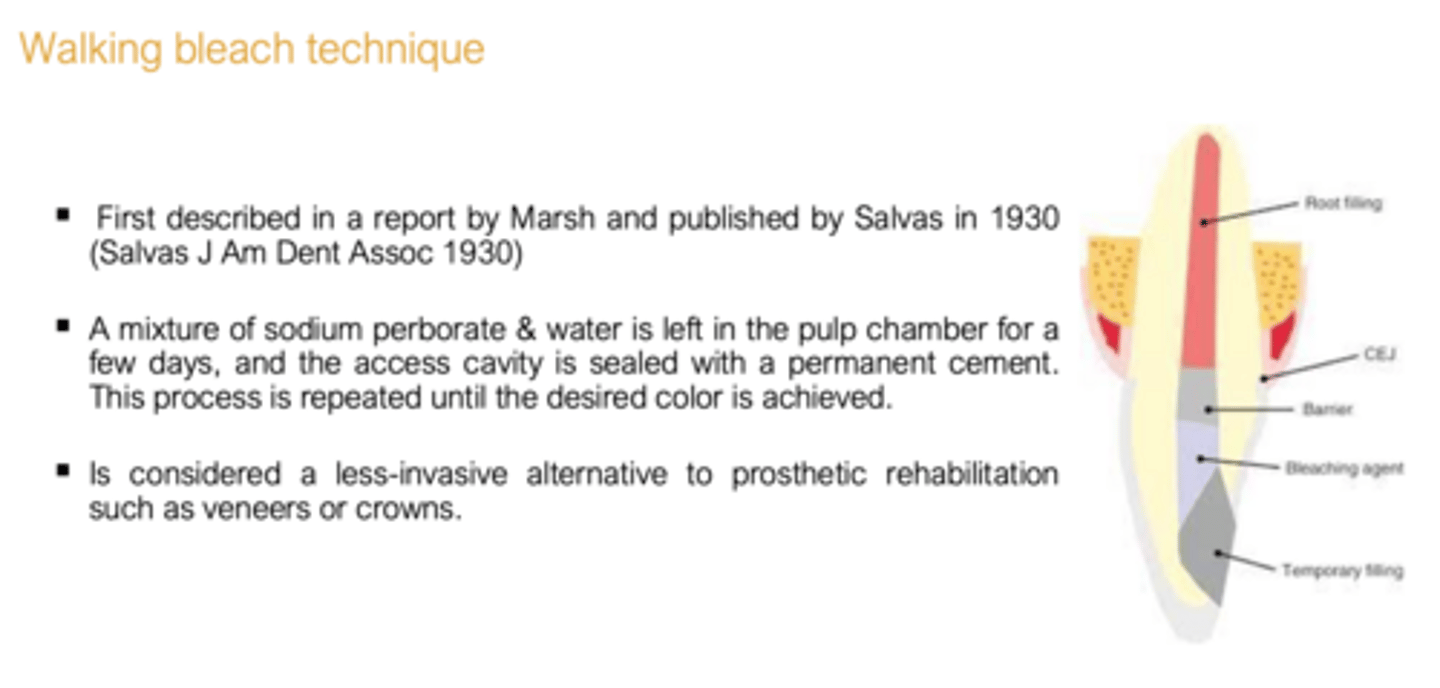
Who first described the walking bleach technique?
Marsh and published by Salvas in 1930
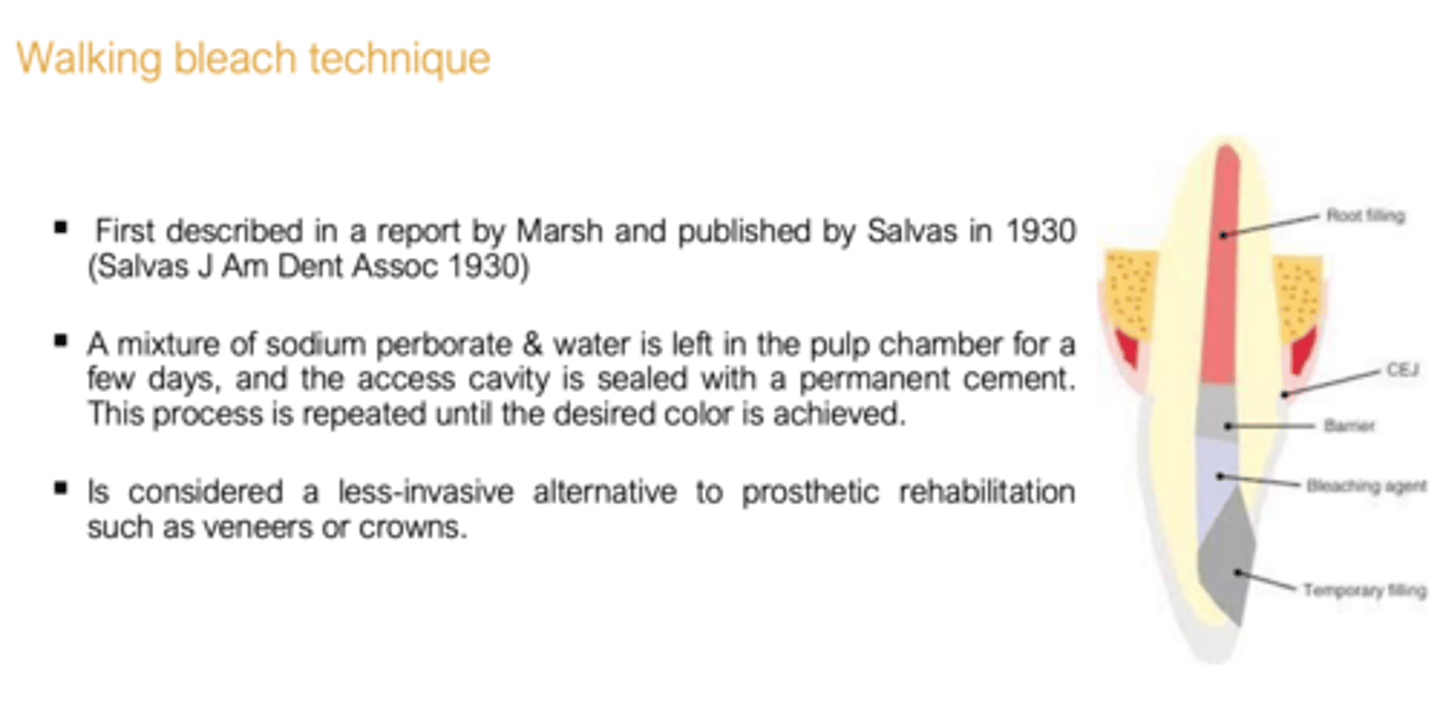
What stage of internal bleaching?
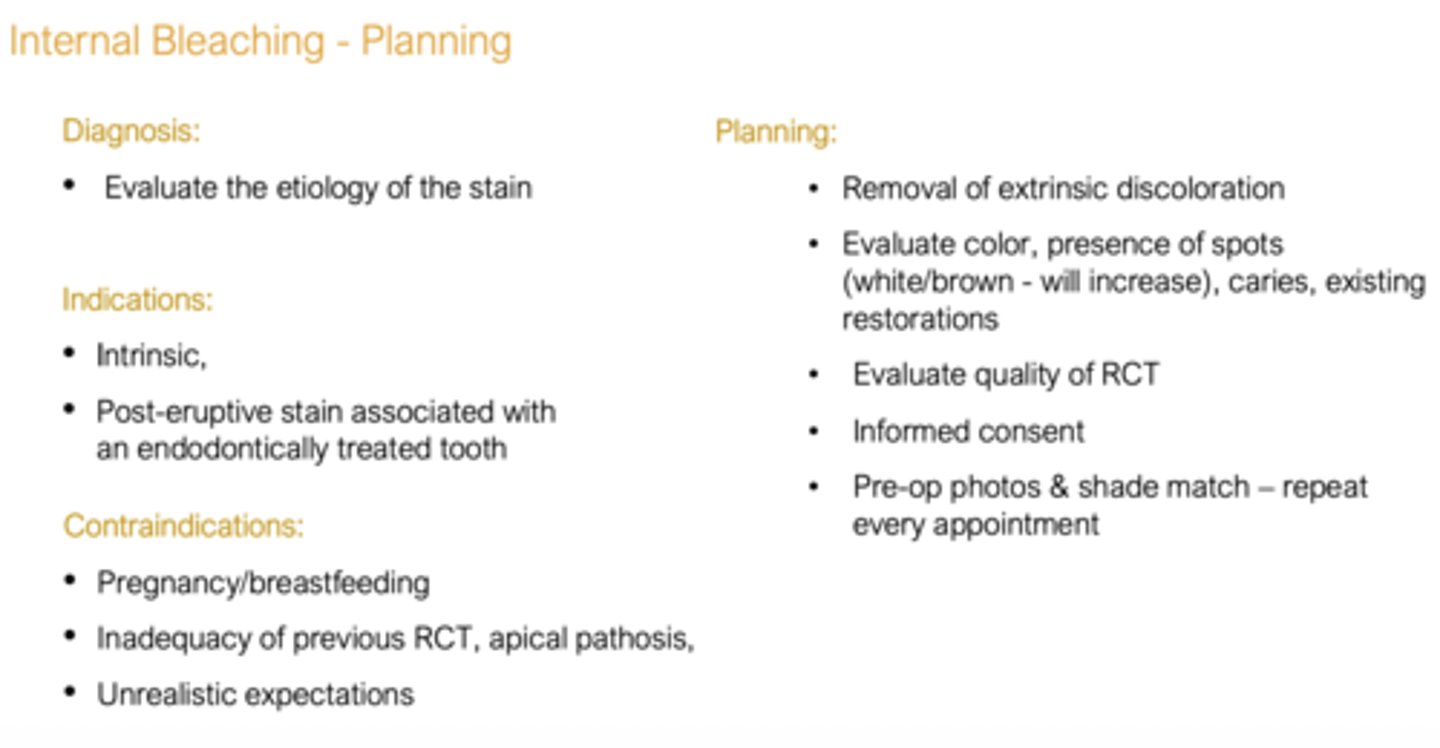
- Evaluate the etiology of the stain
Diagnosis
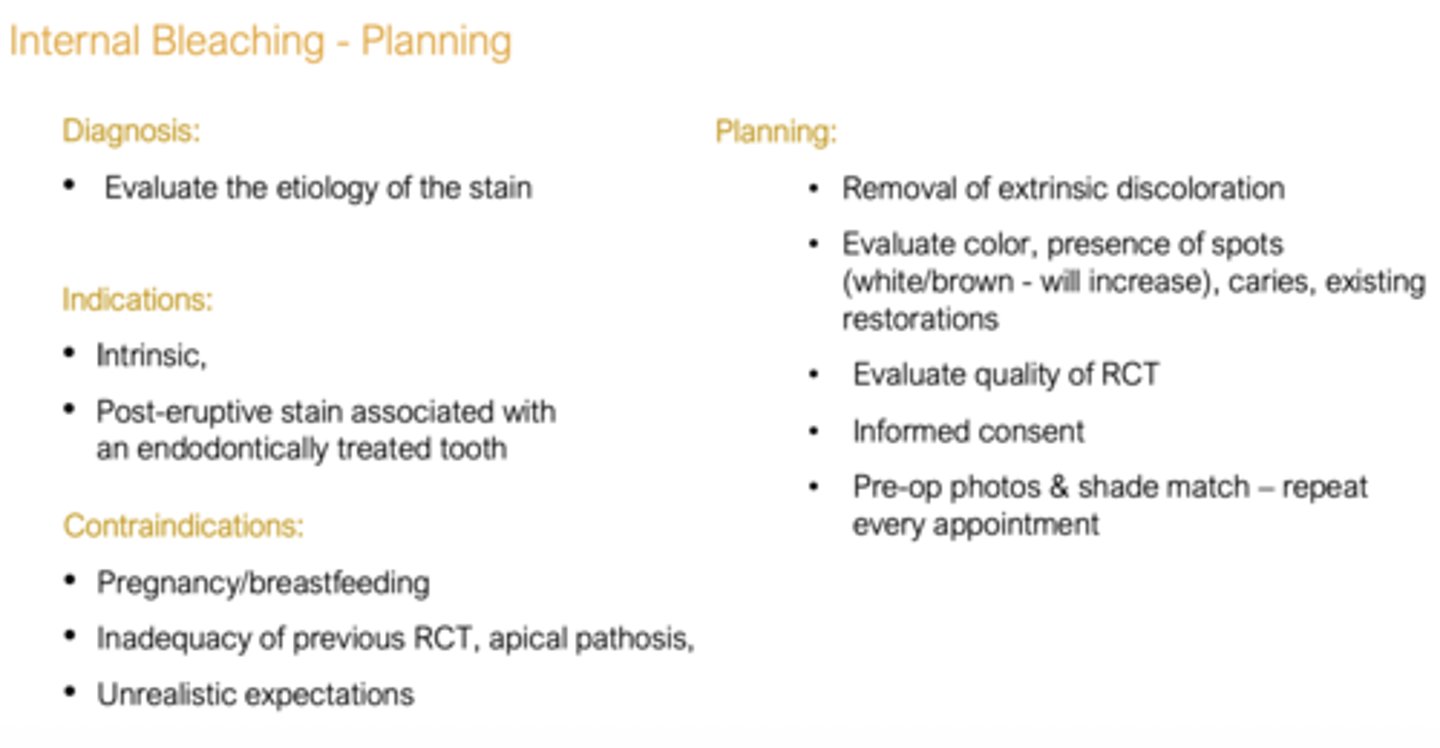
These are _______ for tooth bleaching
- Intrinsic
- Post-eruptive stain associated with an endodontically treated tooth
Indications
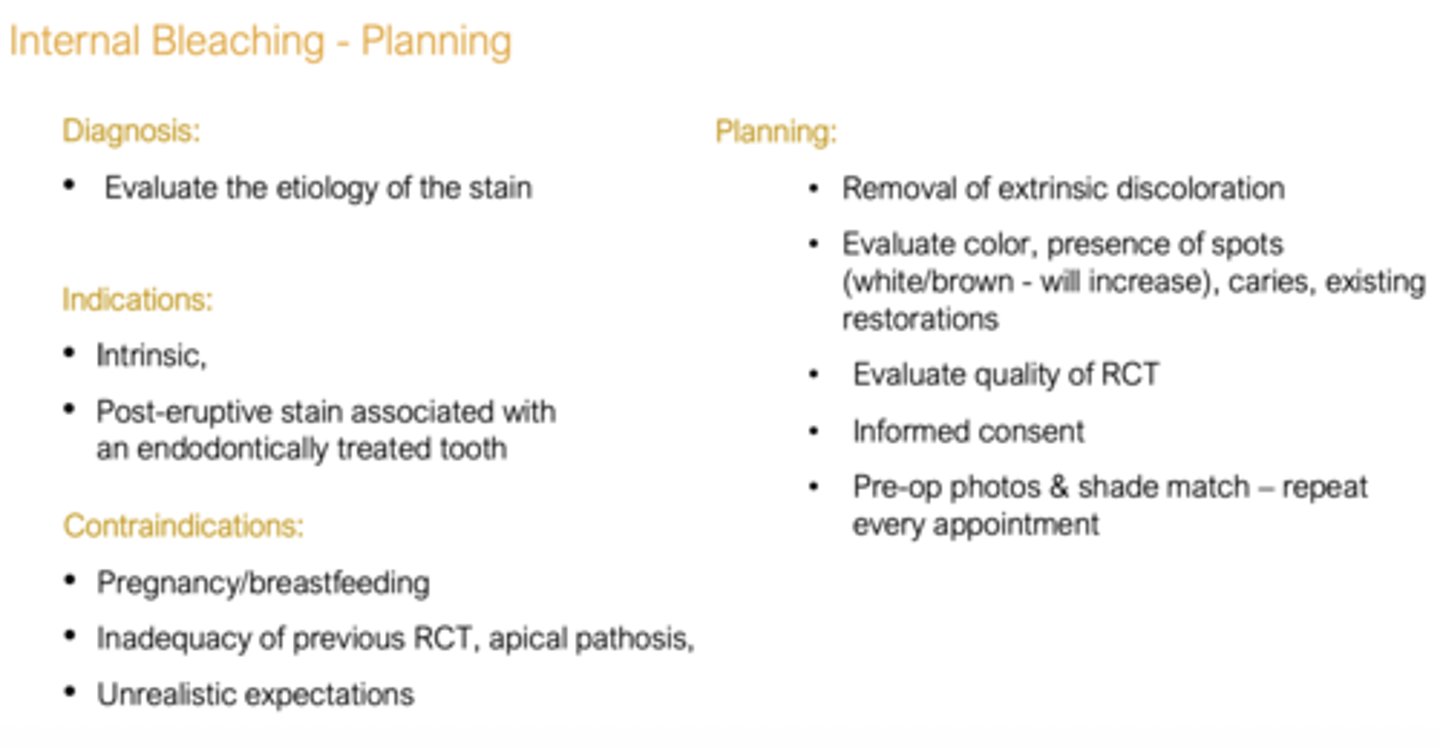
These are _______ for tooth bleaching
- Patients with high/unrealistic expectations
- Decay and active periapical pathosis (must be resolved first)
- Pregnancy/Breastfeeding
- If patients cannot afford changing existing restorations post-bleaching
- Inadequate RCT - do this first
- Teeth that were bleached without results
Contraindications
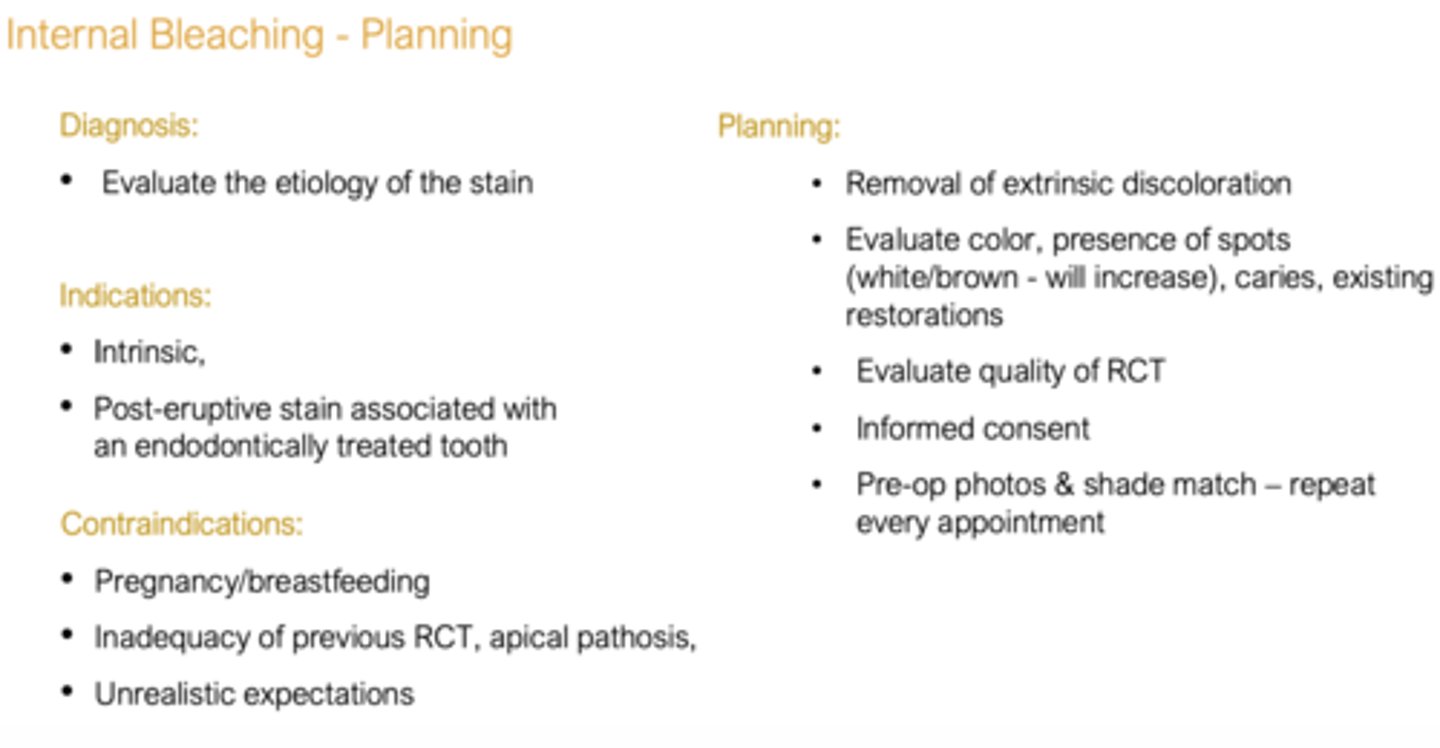
What stage of internal bleaching?
- Removal of extrinsic discoloration
- Evaluate color, presence of spots (white/brown - will increase), caries, existing restorations
- Evaluate quality of RCT
- Informed consent
- Pre-op photos & shade match - repeat every appointment
Planning
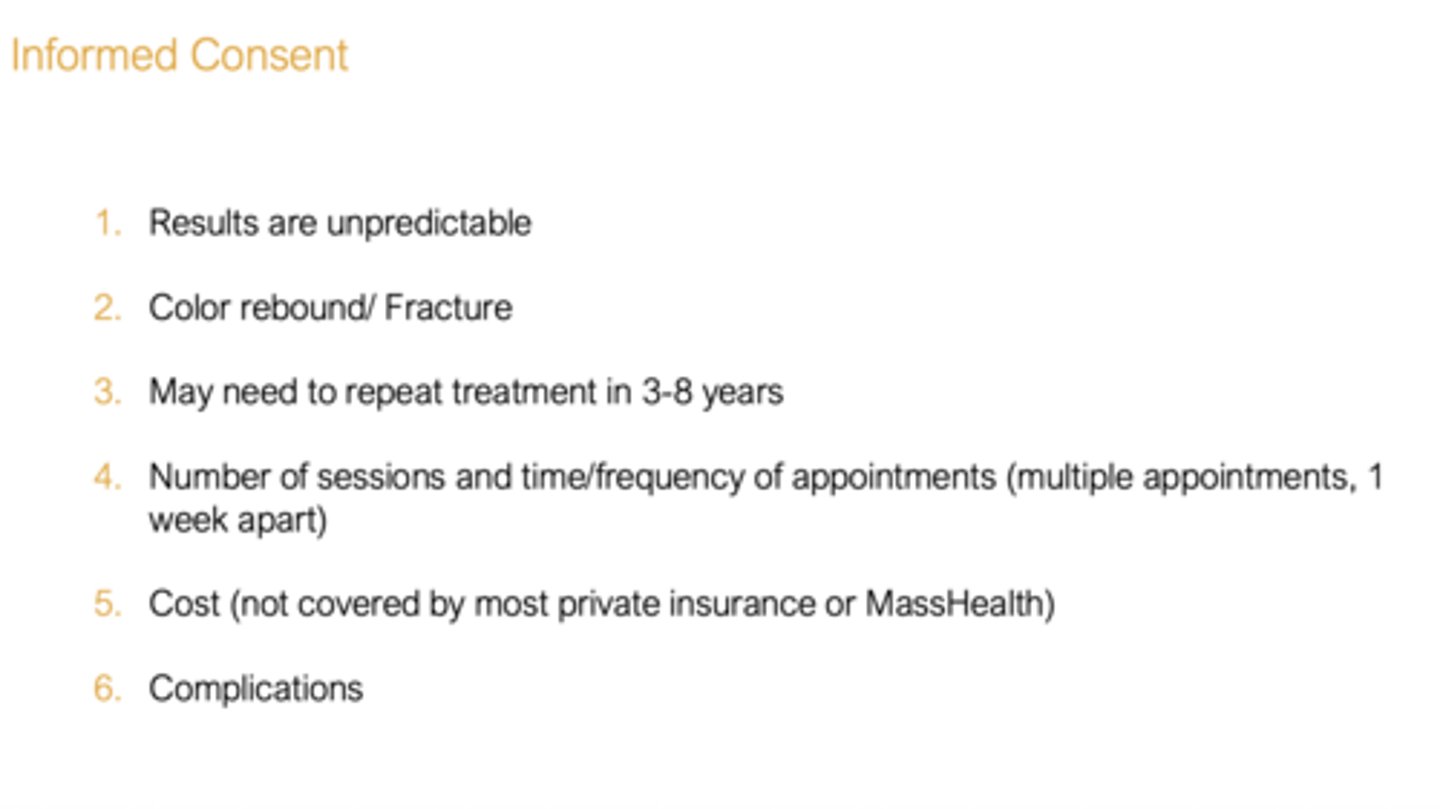
All of the following are included when discussing what?
- Results are unpredictable
- Color rebound/ Fracture
- May need to repeat treatment in 3-8 years
- Number of sessions and time/frequency of appointments (multiple appointments, 1 week apart)
- Cost (not covered by most private insurance or MassHealth)
- Complications
Informed consent
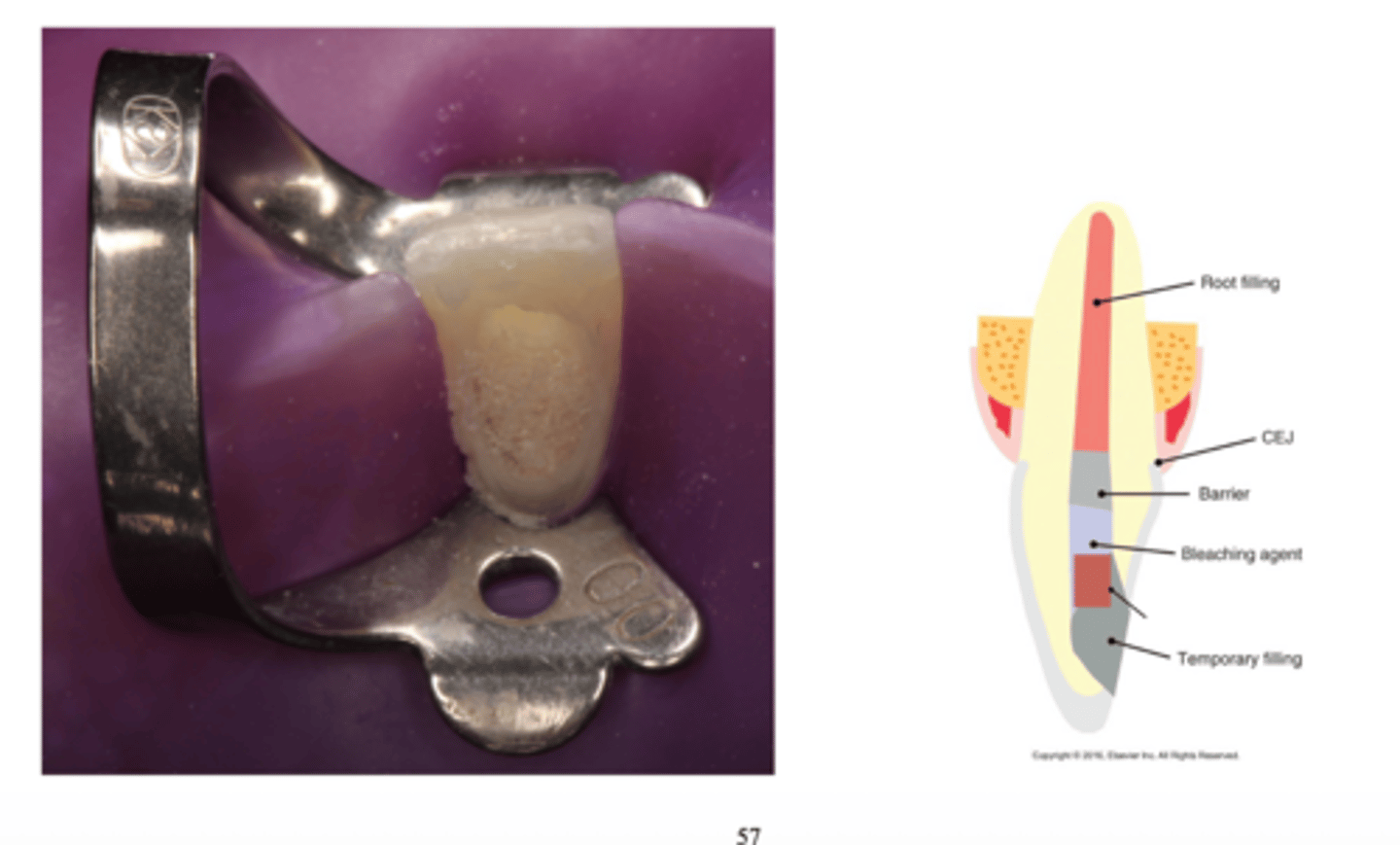
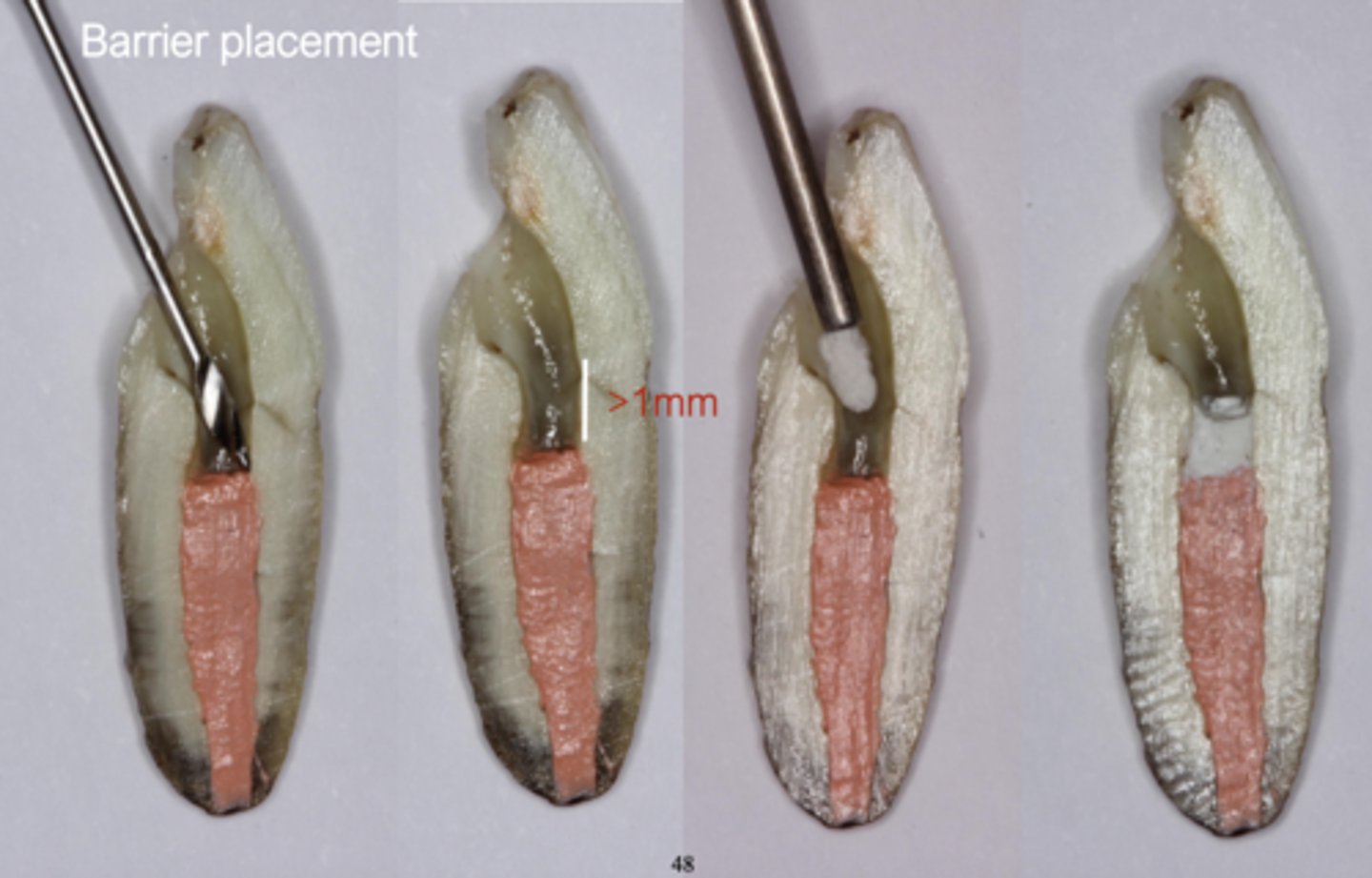
If there is gutta percha up to the CEJ, how much should you reduce it before placing the barrier placement?
>1mm
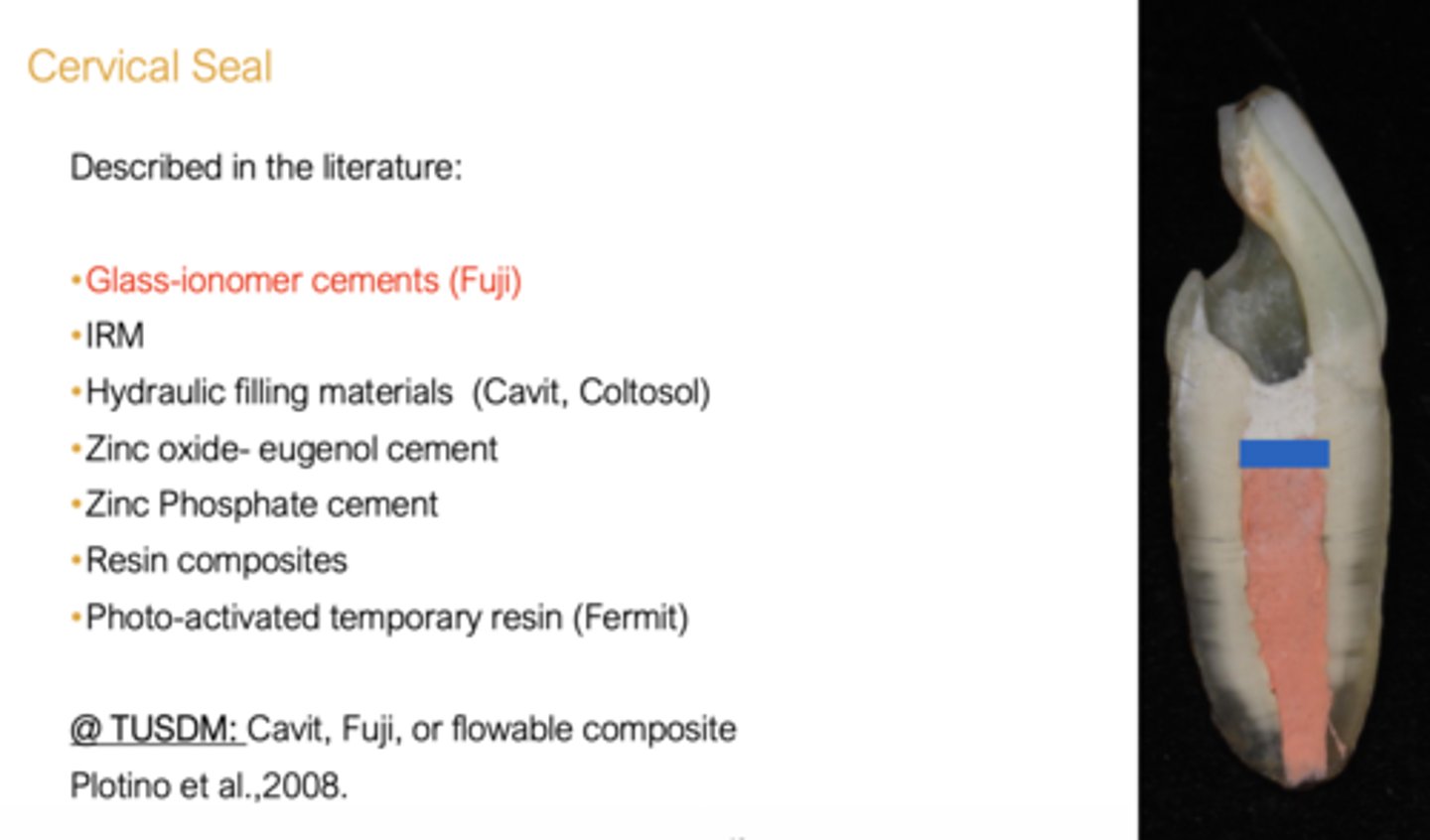
What are the 3 materials we use at TUSDM to achieve a cervical seal?
- Cavit
- Fuji
- Flowable composite
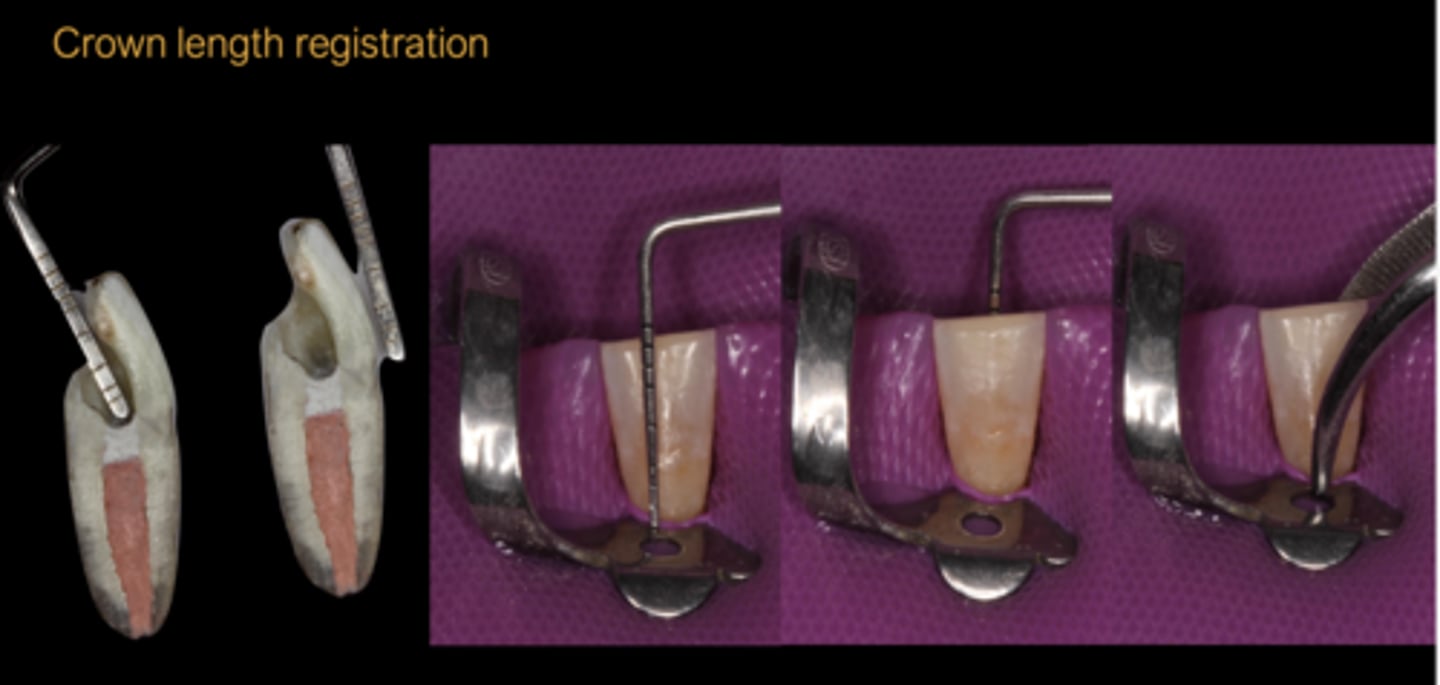
How can you check the measurement of the Gutta Percha height relative to the CEJ?
Measure rubber dam clamp placed at CEJ on the outside and compare to inside
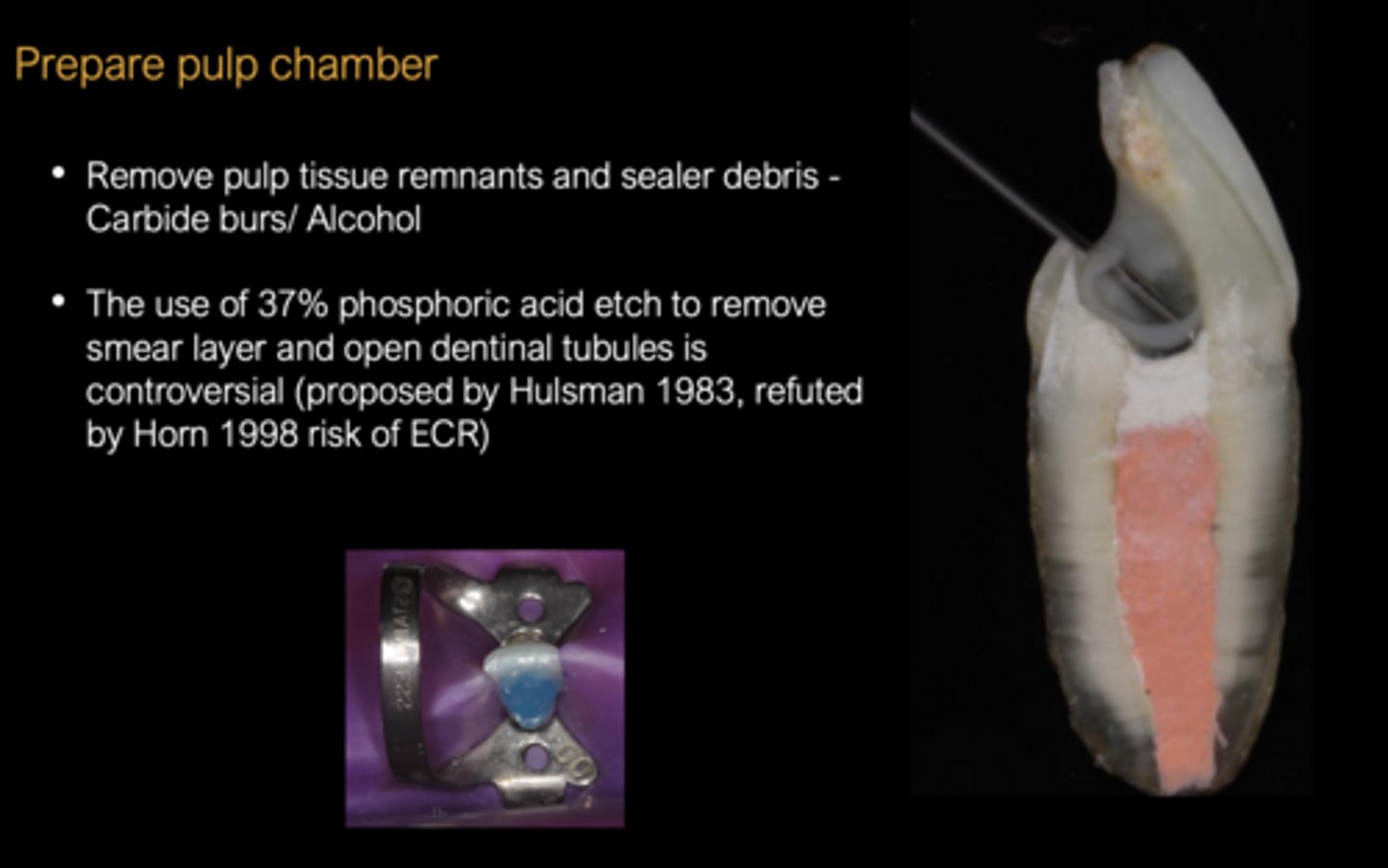
T/F: To prepare the pulp chamber, remove pulp tissue remnants and sealer debris with carbide burs/ alcohol. The use of 37% phosphoric acid etch to remove smear layer and open dentinal tubules is controversial
True
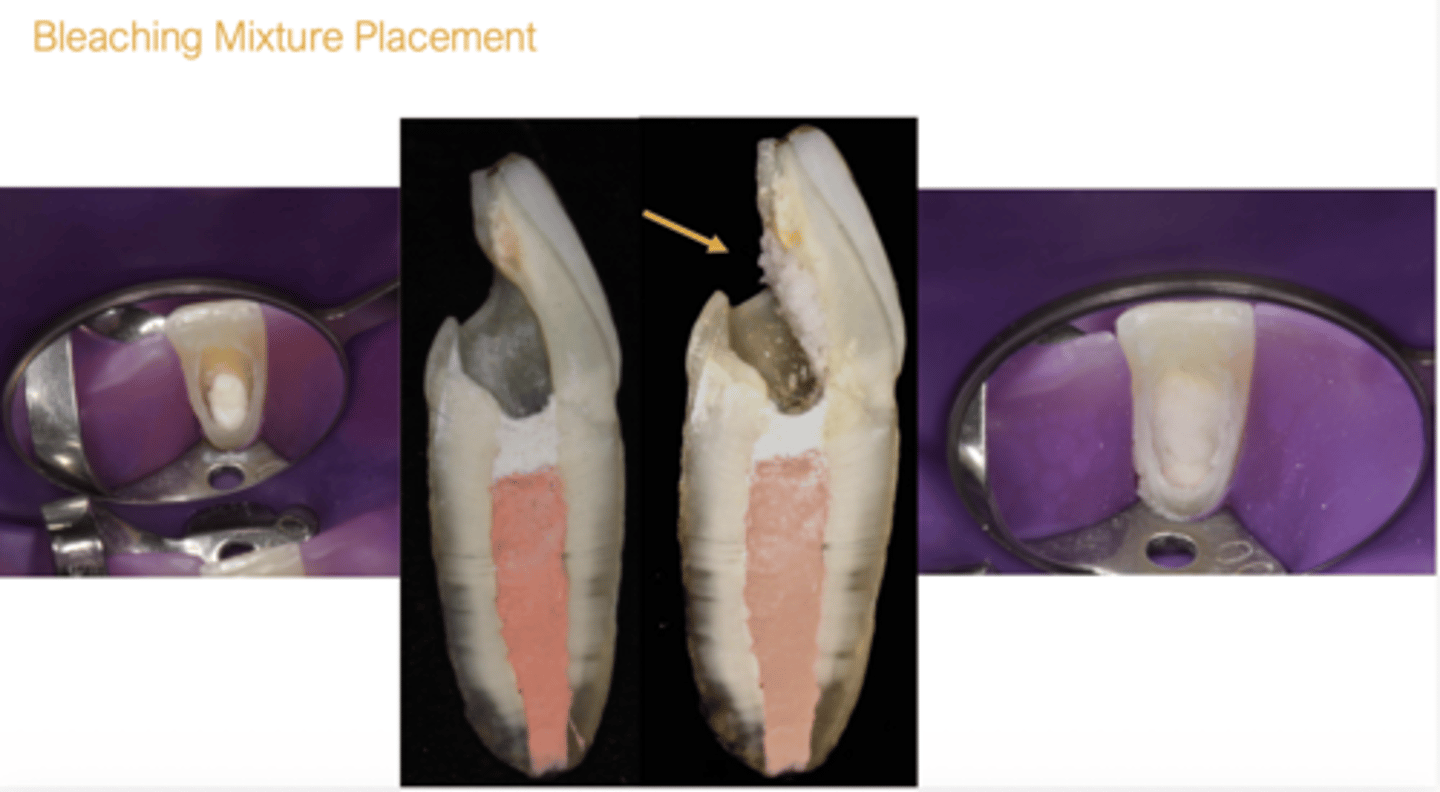
Where is the bleaching mixture placed on the tooth?
Facial wall (not at incisal edge though)
When placing a coronal seal, what is the optimal thickness of the seal to prevent leakage during intracoronal bleaching?
2-3mm