The World Ocean Ch. 9
 Call Kai
 Learn
Learn Practice Test
 Spaced Repetition
 Match
Match Flashcards
 Knowt Play
1/56

There's no tags or description
Looks like no tags are added yet.
Name | Mastery | Learn | Test | Matching | Spaced | Call with Kai |
|---|
No analytics yet
Send a link to your students to track their progress
57 Terms
All ecosystems are composed of producers, consumers, and ______.
Decomposers
The role of the ____ is to be the first organism to create organic matter from pure energy and inorganic nutrients.
Producer
The role of the _____ is to remineralize organic matter to replenish the supply of inorganic (i.e., mineral) plant nutrients to the ecosystem
Decomposer
An herbivore consumes only _____ while am omnivore consumes ______.
Plants/plants + animals
Food webs can be defined as networks of interconnected ______.
food chains
What one chemical compound or element below is produced by photosynthesis?
Oxygen, O2
The most common type of primary production in the ocean is ______.
photosynthesis
Choose the answer that shows two biological processes that are opposite reactions of one another.
Photosynthesis/respiration
Organisms that obtain food by filtering bits of organic detritus out of the water are called:
Filter feeders
A feather-duster worm feeds by ______.
filter-feeding
Animals that obtain their food nonselectively by ingesting sediment and extracting food particles that are mixed into the mud, are called _______.
deposit feeders
Energy in ecosystems is ultimately lost as _________.
heat
The amount of living matter per unit volume of seawater or unit area of ocean surface or seabed, is known as what?
biomass
What one compound below is consumed by respiration?
oxygen
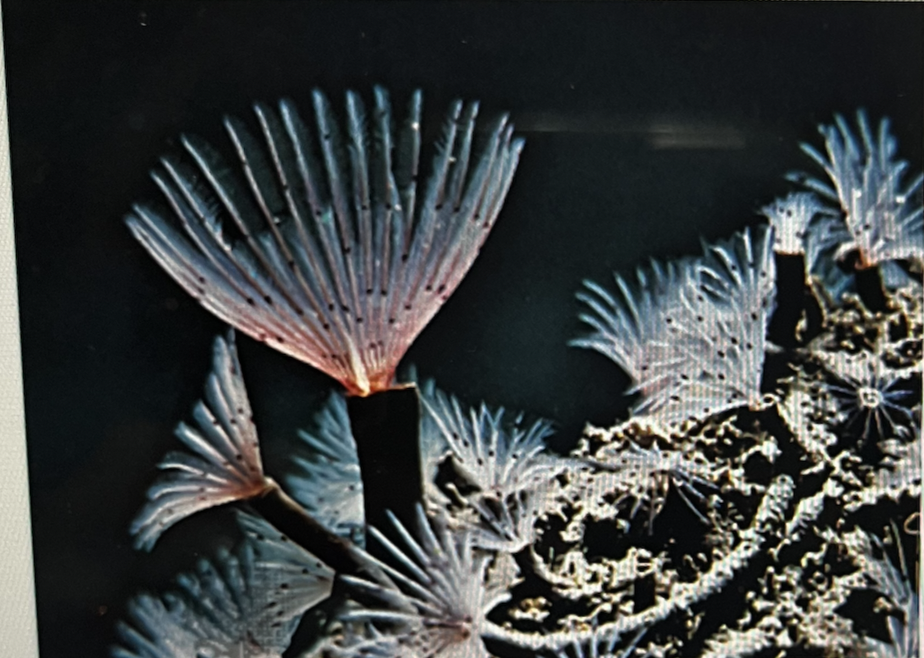
The animals shown in this picture is a feather duster worm. What type of feeding strategy does it employ?
filter feeding
All ecosystems are composed of producers, consumers, and _____.
decomposers
An infaunal worm feeds by _______.
deposit feeding
What group of marine organisms are responsible for 90% of the primary production in the ocean?
phytoplankton
The lower trophic levels of an ocean food pyramid are drawn much wider than the upper trophic levels of the pyramid. What does this signify?
That there is greater biomass at the lower trophic levels compared to the upper trophic levels
Active capture and consumption of one animal by another is called _______.
predation
The role of the decomposers is to:
decompose dead organic matter and remineralize the materials into nutrients to be used by the primary producers
What is the general term used for the class of inorganic chemicals such as nitrate or phosphate that are required by phytoplankton to manufacture food through the process of photosynthesis?
nutrients
The euphotic zone in most of the ocean has very low nitrogen concentrations and high primary productivity only is possible when nitrogen enters the surface ocean how?
deep, nutrient-rich water mixing to thosurface.
What is the 'dilemma' which slows the growth of oceanic phytoplankton?
Photic zone is high light, but low nutrients
Which ocean region has the lowest annual levels of primary production?
Open ocean
In the mid-latitude (i.e., temperate) ocean regions, when does the largest phytoplankton bloom typically occur?
Spring
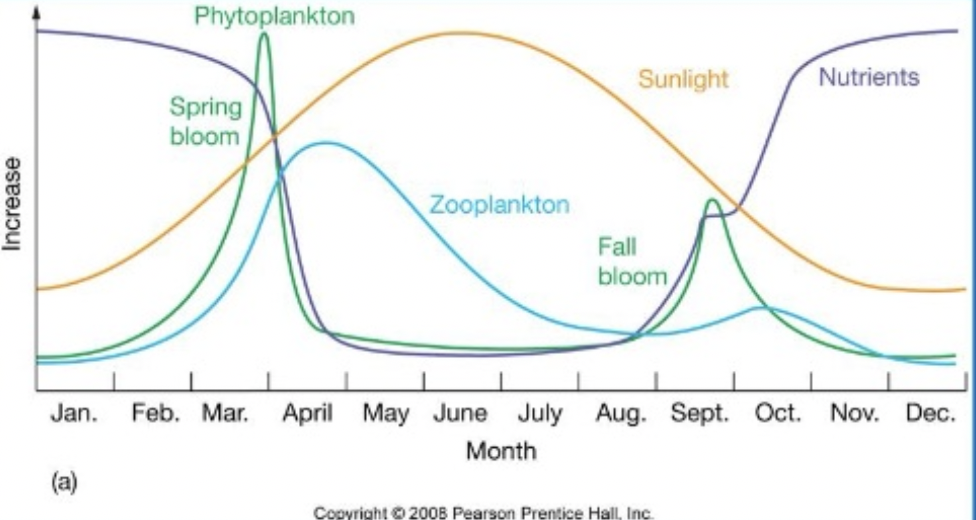
In the mid-latitude (i.e., temperate) ocean regions, a large phytoplankton bloom typically occur in the spring because ________.
This is when there is the right combination of sunlight and nutrients
Given what you know about surface productivity, where do you think that sunlight penetrates deepest into the ocean?
Subtropical gyres
Ocean regions with high primary productivity also have high productivity of benthos, because ______.
benthos are part of the food web that has at its base the primary producers
Water that has recently upwelled to the surface is typically _______ and ________.
Cold/ nutrient-rich
Which one is an example of a primary factor that controls levels of primary productivity in the ocean?
Nutrients
Which one is an example of a secondary factor that controls levels of primary productivity in the ocean?
upwelling
Why is upwelling such an important factor in creating areas of high biologic productivity
Upwelling brings nutrient-rich deep water to the surface where productivity is limited by lack of nutrients
What two properties are typical for an upwelling region?
cold surface water and high biomass
ENSO is an acronym that means:
El Niño Southern Oscillation
During the El Niño phase of ENSO, which conditions persist?
Weakened or no upwelling in eastern tropical Pacific
What is the wind belt that is most intimately involved in ENSO?
Trade Winds
Which one below describes typical conditions in the eastern tropical Pacific during the La Niña phase of ENSO?
Strengthened upwelling
During so-called “normal” ENSO conditions, the eastern tropical Pacific surface waters are:
Cold due to upwelling
Why is the Anchoveta fishery off of Peru dramatically reduced during El Nino phase?
Upwelling is shut down, reducing nutrients delivery to photic zone and lowering primary productivity, the food for the anchovies
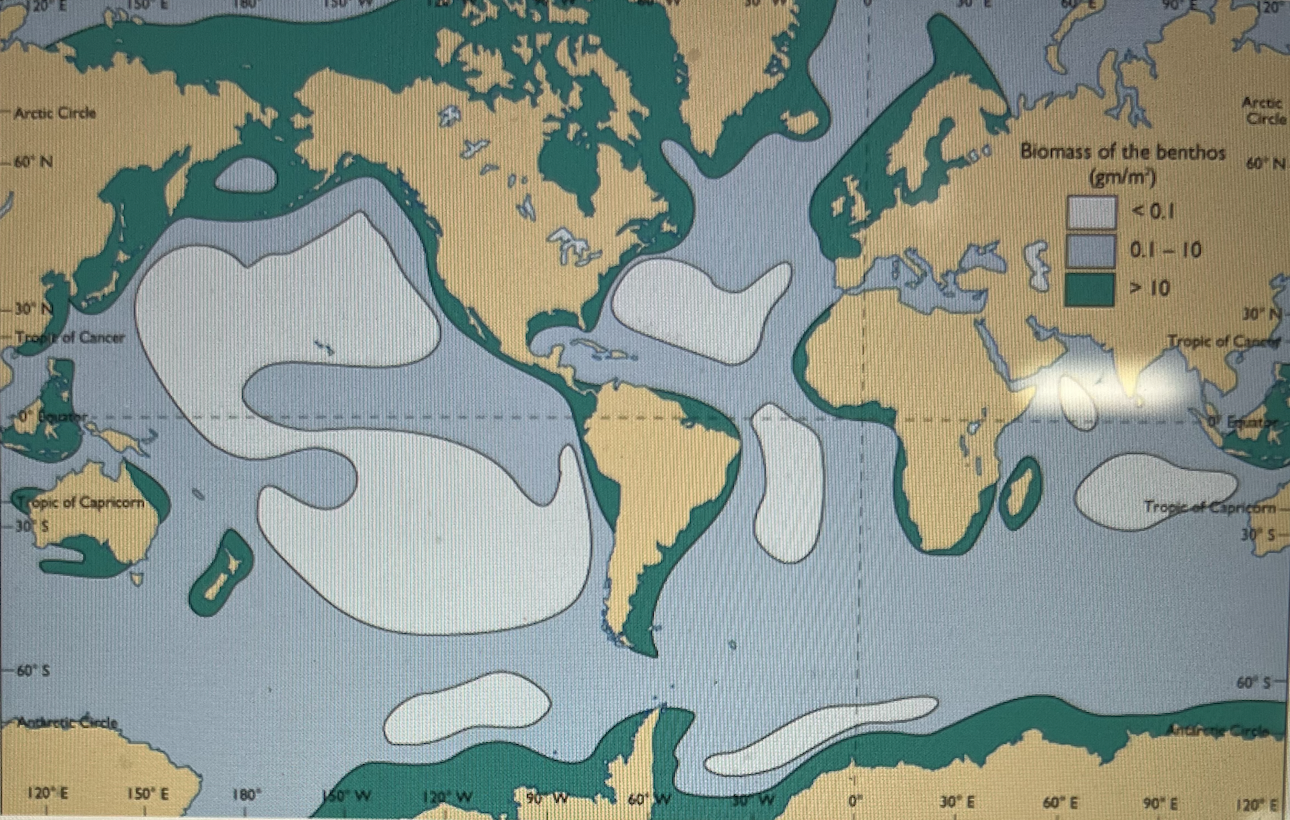
Referring to this map, where is the greatest amount of benthic animal biomass found, and why?
Along margins of continents, because this is where the greatest amount of primary production occurs, which can then support a large biomass of higher trophic level organisms.
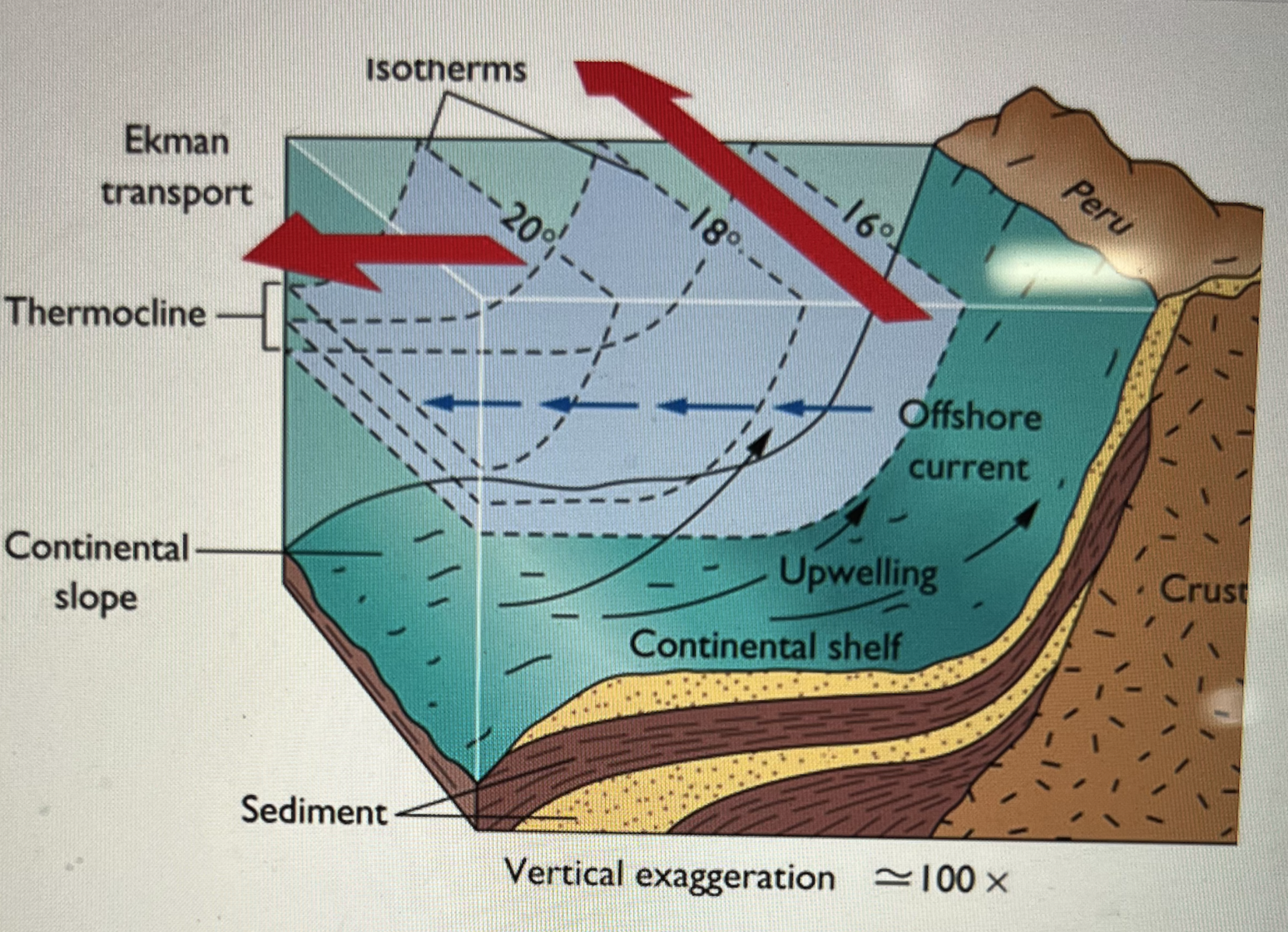
What is the correct order of events that characterizes a highly productive coastal upwelling regions such as shown here for Peru?
(1) Strong coastal winds blow parallel to coast, (2) Ekman transport moves surface water away from coastline, (3) deep water upwells along coastline, (4) deep water nutrients stimulate phytoplankton growth
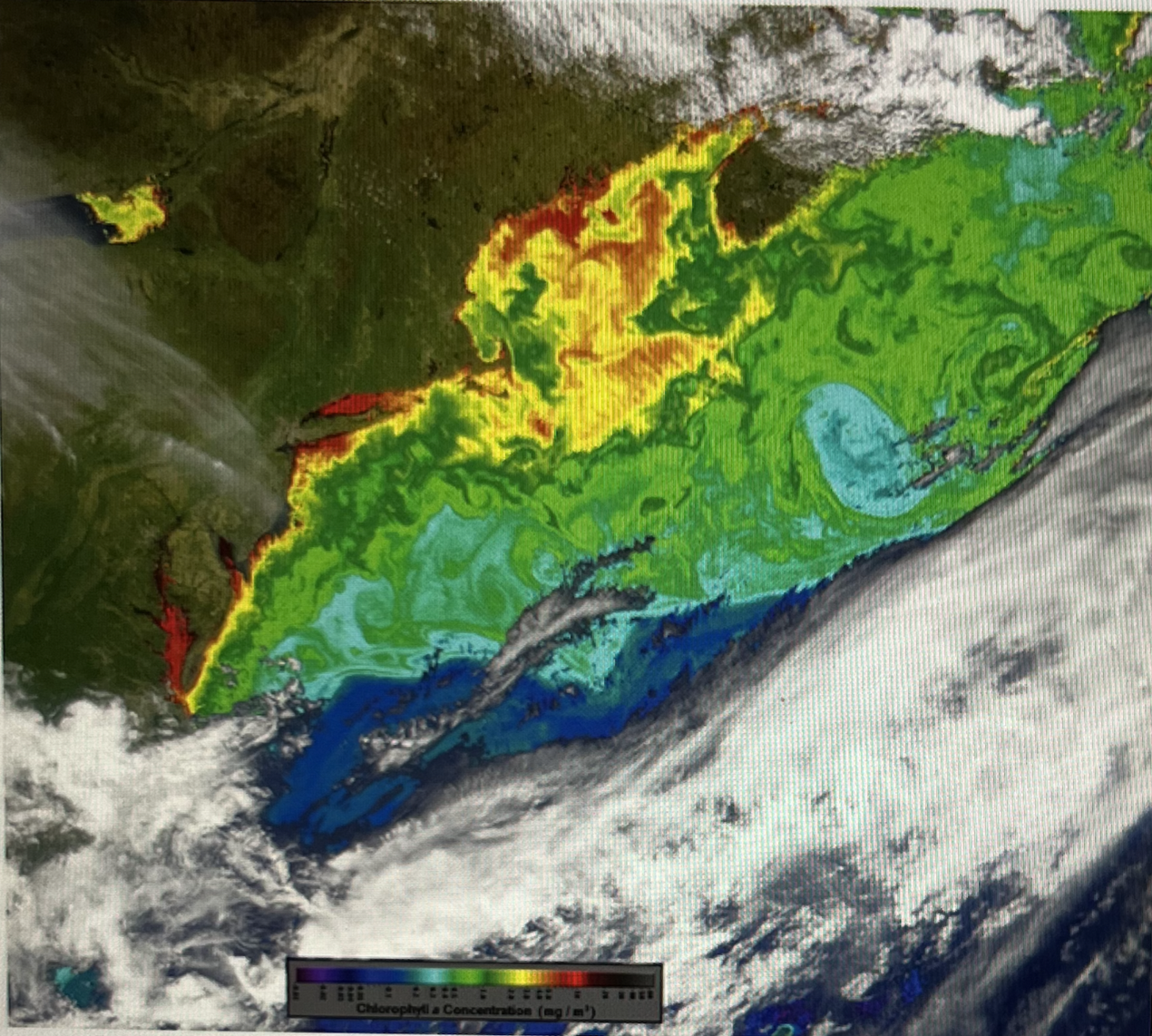
This satellite image shows a sudden increase in primary productivity (phytoplankton as chlorophyll a) in May, a seasonal phenomenon known as the:
spring phytoplankton bloom
The anchovy catch off the coast of Peru suddenly decrease during an El Nino because:
coastal upwelling is diminished, thus cutting of nutrients to the diatoms
In the temperate mid latitude regions, a spring phytoplankton bloom occurs primarily as a result of:
increase in sunlight
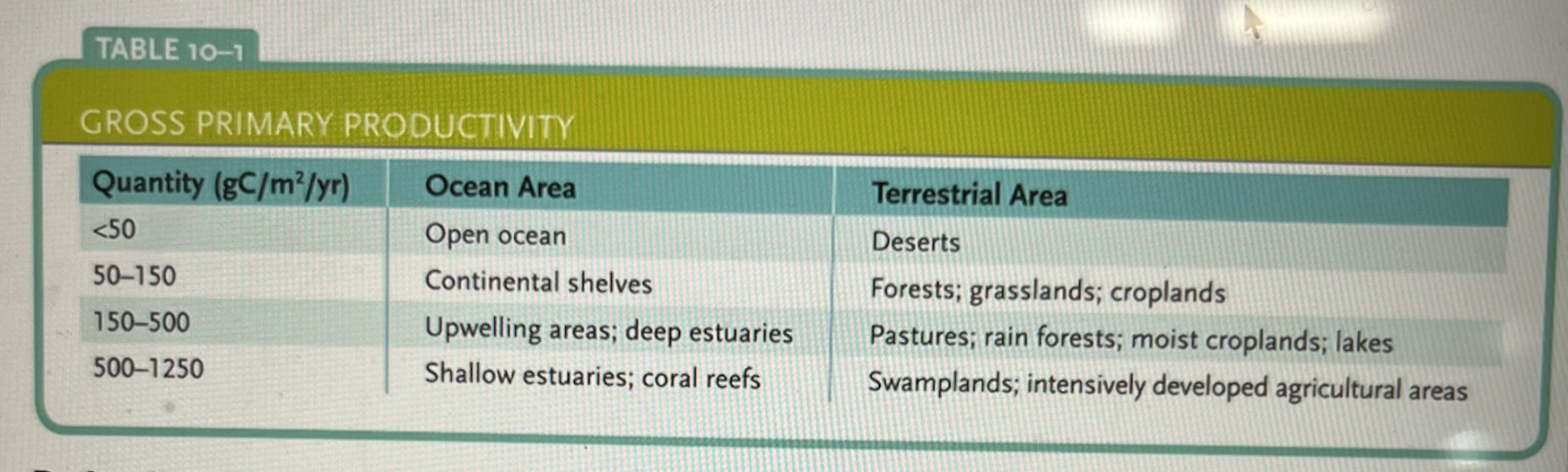
Referring to this table, order these 4 regions in order of decreasing amount of annual gross primary production.
coral reef, deep estuaries, shelves, open ocean
There are primary factors and secondary factors that control primary production in the ocean. Which one selection below is NOT an example of a secondary factor?
sunlight
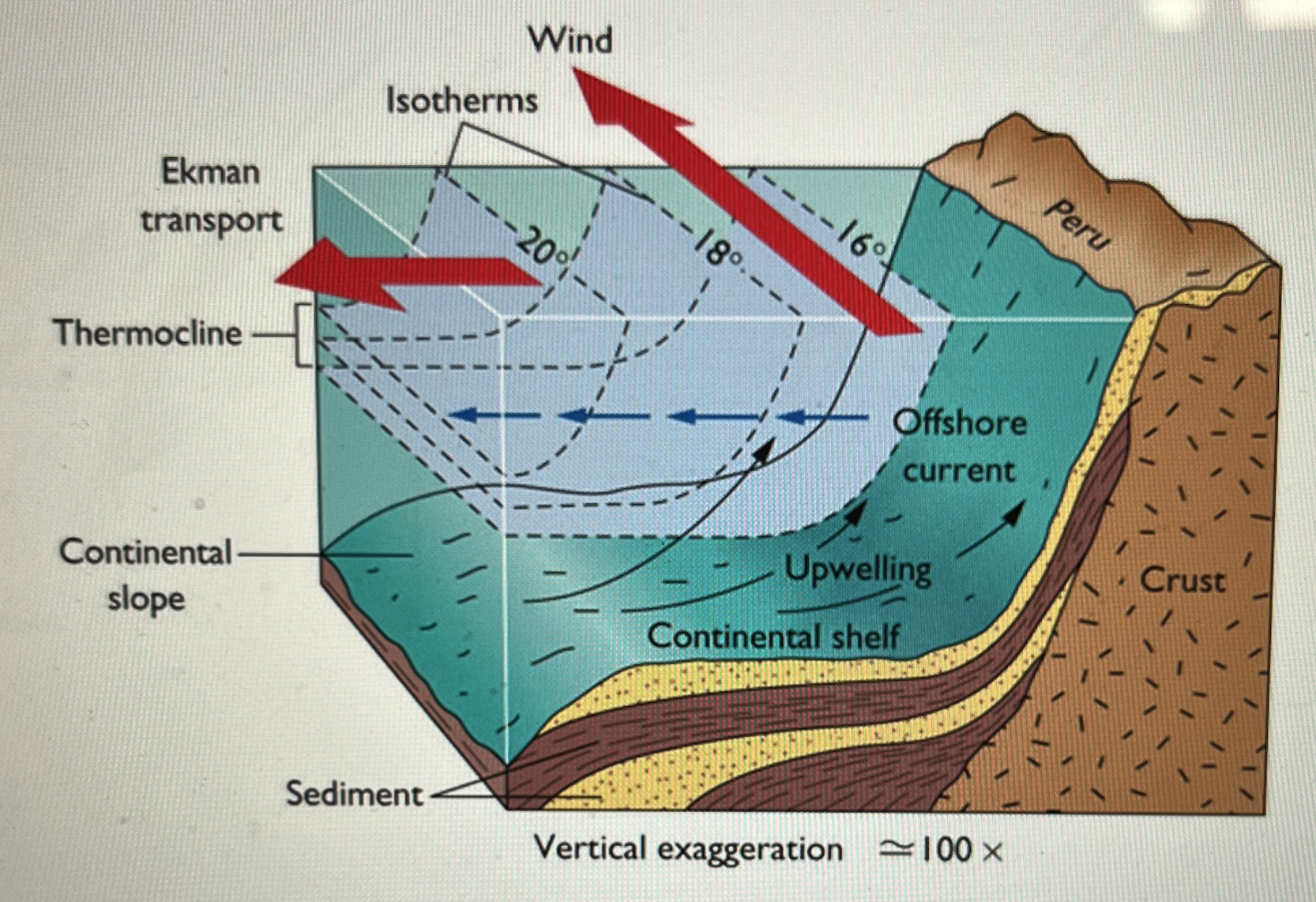
What would NOT result from a reversing of the direction of the wind at the surface?
Cold water along the shoreline
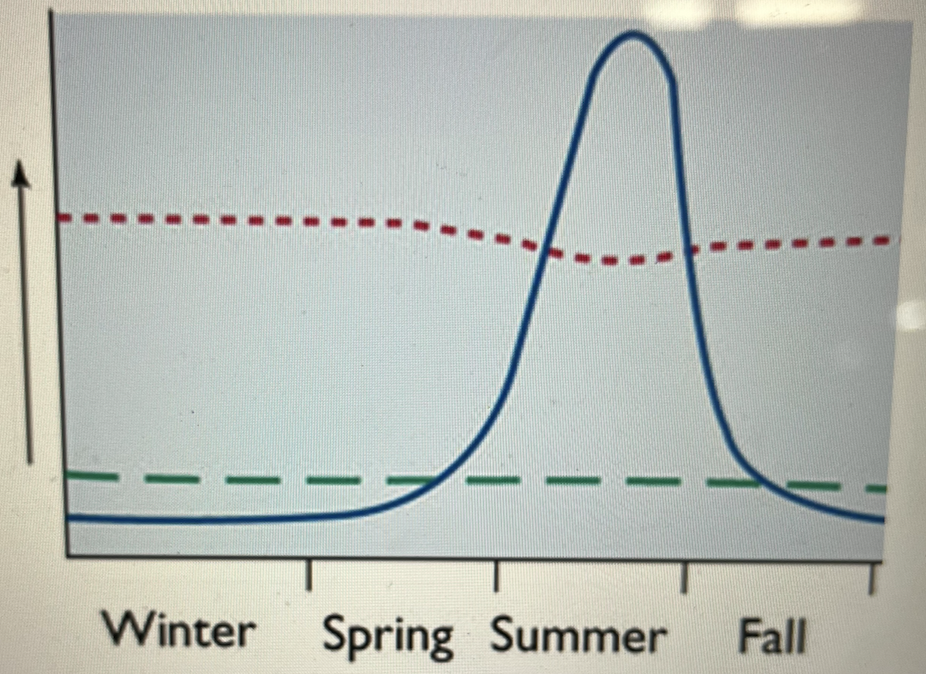
This figure shows the seasonal changes in primary production (blue line), nutrients (red line), and water temperature (green line) in what ocean region?
Arctic
The temperate regions of the middle latitudes have distinct seasons and thus show strong seasonal variations in:
primary production
The rapid attenuation of sunlight in the ocean is caused by:
absorption and scattering of photons by seawater and the suspended and dissolved material in seawater
Referring to this map, where does the highest annual primary productivity occur generally, and why?
Along the margins of continents because of the abundance of nutrients found there.
Which simple food chain below is common in the ocean?
diatom --> copepod--> sardine
An herbivorous copepod grazes on______________.
diatoms
In the chemical reaction for respiration, six molecules of carbohydrate are oxidized to produce six molecules of carbon dioxide, six molecules of water, and a release of ___________.
energy
In the chemical reaction of photosynthesis, six carbon dioxide molecules are consumed and six______________ molecules are produced.
oxygen
Primary productivity is defined as the _______________________.
formation of organic matter from inorganic nutrients and radiant energy from the sun