The Global Economy
 Call Kai
 Learn
Learn Practice Test
 Spaced Repetition
 Match
Match Flashcards
 Knowt Play
1/76

There's no tags or description
Looks like no tags are added yet.
Name | Mastery | Learn | Test | Matching | Spaced | Call with Kai |
|---|
No analytics yet
Send a link to your students to track their progress
77 Terms
what is sustainable development
development that allows the present generation to meet its needs without compromising the ability of future generations to meet their own needs
UN Sustainable Development Goals
End poverty in all its forms everywhere
End hunger, achieve food security, and improved nutrition and promote sustainable agriculture
Ensure healthy lives and promote well-being for all at all ages
Ensure inclusive and equitable quality education and promote lifelong learning opportunities for all
Achieve gender equality and empower all women and girls
Ensure availability and sustainable management of water and sanitation for all
Ensure access to affordable, reliable, sustainable, and modern energy for all
Promote sustained, inclusive, and sustainable economic growth, full and productive employment, and decent work for all
Build resilient infrastructure, promote inclusive and sustainable industrialisation and foster innovation
Reduce inequality within and among countries
Make cities and human settlements inclusive, safe, resilient, and sustainable
Ensure sustainable consumption and production patterns
Take urgent action to combat climate change and its impacts
Conserve and sustainably use the oceans, seas, and marine resources for sustainable development
Protect, restore, and promote sustainable use of terrestrial ecosystems, sustainably manage forests, combat desertification, and halt and reverse land degradation and halt biodiversity loss
Promote peaceful and inclusive societies for sustainable development, provide access to justice for all and build effective, accountable, and inclusive institutions at all levels
Strengthen the means of implementation and revitalise the global partnership for sustainable development
poverty and sustainability
Poverty is the inability to satisfy minimum consumption needs
This results in pollution of poverty, which is environmental pollution caused by poor people for survival needs
Mainly due to over-reliance on natural resources by the poor for survival, who deplete natural resources without replenishment due to lack of income
The rapid depletion of common pool resources threaten sustainability
Measuring economic development
Single Indicators
GDP/GNI per capita at PPP
Health and education indicators
Economic and social inequality indicators
Energy indicators
Environmental indicators
Composite indicators
Human Development Index
Gender Inequality Index
Inequality adjusted Human Development Index
Happy Planet Index
Components of human development index
GNI per capita (PPP rates) - decent standard of living
Life expectancy at birth - long and healthy life
Expected years of schooling and mean years of schooling - knowledge
strengths and limitations of single indicators of measuring economic development
Strengths
Generally less complex than composite variables - more straightforward to calculate
More widely available, which facilitates comparison
Limitations
Insufficient if used individually
Difficult to assess overall effect on economic development if information is inconsistent
what is economic development
Economic development refers to sustained improvements in overall living standards/economic well-being,
which in turn implies higher per capita income, reduced poverty, lower inequality in income and wealth, better accessibility and quality of education and health services, etc.
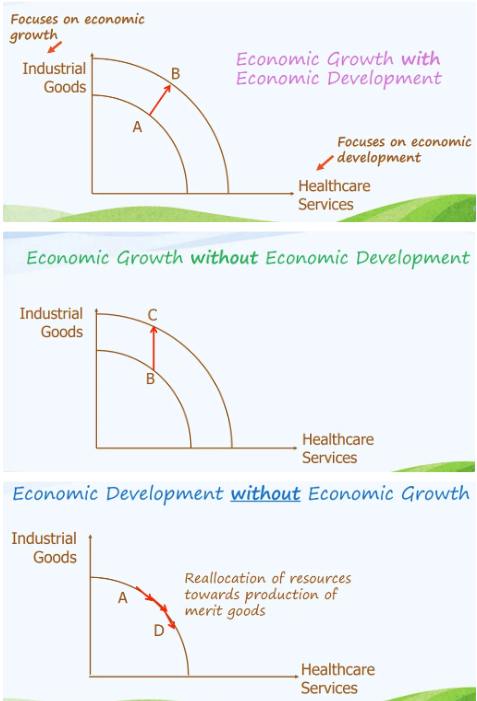
PPC to show relationship between economic growth and development
Diagram must include a merit good, e.g. healthcare, with industrial or luxury (non-merit) goods
By labelling the relevant points (ref. points B and C), you can show how economic growth does or does not lead to the increased production of merit goods, which will aid in economic development
Similarly, you can show economic development without economic growth, by showing a shift along the PPC to favour the increased production of merit goods
draw and explain diagram of poverty cycle
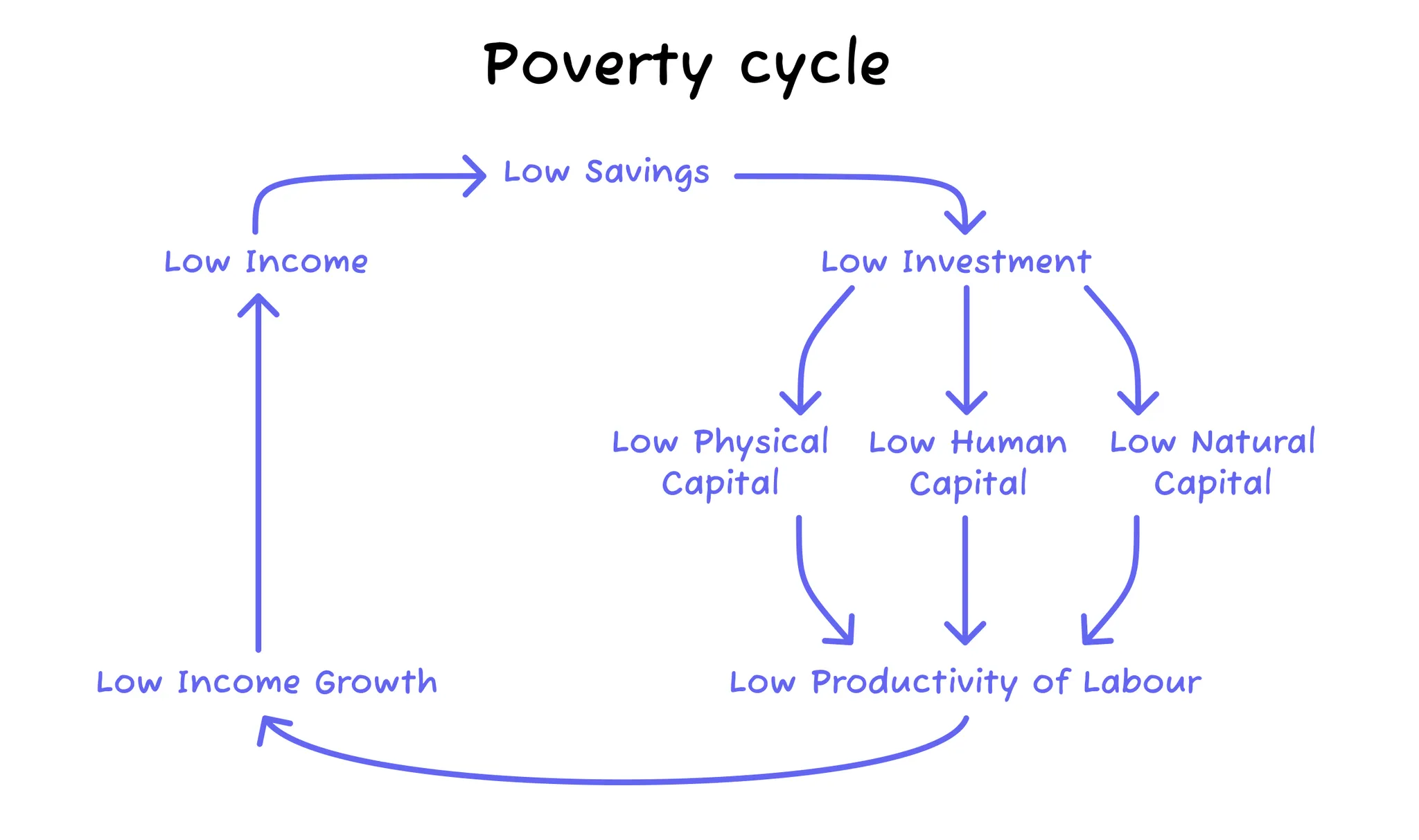
This results in the perpetuation of poverty across generations, where individuals are unable to break out on their own
e.g. children in poverty cannot afford to go to school
e.g. inability to afford healthcare/food → malnourished and physically disadvantaged children
e.g. large families, where children are a source of income
any of these examples penalise the children for life, resulting in a demographic trap
To break out of the poverty cycle, external help (usually governmental) is needed
to provide human capital (health and education services, nutrition)
to provide physical capital (sanitation, water supplies, roads, power supplies, etc.)
increase participation in private sector activities through access to credit
If the entire nation is trapped in poverty, external help is needed.
economic barriers to development
Rising economic inequality
Lack of access to infrastructure
due to problems of:
financing (e.g. insufficient revenue)
inadequate maintenance and poor quality
limited access by the poor (due to lack of revenue, which limits the quantity of infrastructure)
misallocation of resources (e.g. due to corruption → infrastructure is inappropriate given the needs of the population)
neglect of the environment
Limited access to appropriate technology
appropriate → technology that is well-suited to particular economic, geographical, ecological, and climate conditions
e.g. labour intensive technologies (use more labour in relation to capital) is more suited for developing countries as it increases local employment → increase in income → poverty alleviation + saves scarce foreign exchange, as compared to capital intensive technologies (use more capital in relation to labour), which displaces workers → increased unemployment → reduced incomes → increased poverty + requires highly skilled labour (which may not exist locally) and foreign exchange for imports
e.g. usage of ploughs (labour intensive technology) is more appropriate for developing countries as compared to heavy agricultural machinery (capital intensive technology), such as tractors
improves the quality of physical capital (infrastructure)
Low levels of human capital
Lack of access to healthcare and education
Geography (e.g. landlocked countries)
Dependence on primary products
Volatile prices of primary products (as PED and PES are both usually <1) → unstable income → inability to plan for future spending, especially spending on human capital, which inherently has longer timelines
Overspecialisation of the economy on that one primary product increases the risk
Lack of access to international markets
difficulties encountered by developing countries in their exports to developed countries
e.g. tariff barriers, administrative barriers (e.g. technical regulations, testing, and certification), agricultural subsidies by rich countries (e.g. EU’s Common Agricultural Policy)
Informal economy
Tax revenue from these workers is less stable
As these industries are not regulated, the government is unable to ensure the basic welfare of these workers
Indebtedness → lower economic growth
Debt servicing costs → government has fewer resources for social services, infrastructure, etc.
Poor credit ratings → harder to borrow
To reduce debt, taxes may increase, govt. spending may decrease (contractionary f.p.)
Lower private investment due to uncertainty
Possibility of a debt trap → the government keeps borrowing more to pay back old debts
Tropical climates and endemic diseases
Some preventable diseases are made more serious due to climate conditions
Heat and humidity affect productivity
Soil quality and its impacts on human and animal health
Capital flight
Money does not return to the home country, resulting in a loss of financial capital that could have been invested domestically
Could result in the depreciation of the currency, increasing foreign debt and potentially causing financial crises
political and social barriers to development
Weak institutional framework
Legal framework and access to justice, or lack thereof
affects tax collection and property rights
This affects the functioning of the economy
Ineffective taxation structures
Developing country tax systems typically are:
highly dependent on indirect taxation, e.g. VAT or tariffs (easier to collect)
inefficient and highly bureaucratic
weak, with significant corruption
minimizing of tax burden on the wealthy due to their influence on the government
This results in:
Low levels of revenue (corruption, inefficiencies, tax exemptions on wealthy, etc.)
Inequities in tax systems (regressive)
Negative impacts on resource allocation (increased barriers to entry for new firms that lack connections with the government, or favouring of political allies)
Banking system
Banks provide:
incentive to save
credit to open/run businesses or make investments in physical/human capital
important to low income earners, who are least able to save and therefore need to borrow to invest in physical/human capital
However, banking systems in developing countries are underdeveloped, and overseas branches of large multinational banks are more interested in loaning to large domestic firms/multinational corporations
small scale producers and consumers who need small loans and lack the collateral to secure their loans cannot get credit, and are forced to rely on illegal sources of credit
Property rights and land rights
can be used as collateral, which improves access to credit
Gender inequality
Corruption/lack of good governance
governance - process which state and nonstate actors interact to design and implement policies within a set of formal and informal rules that shape and are shaped by power
corruption → abuse of public office for private gains → makes economic activity more expensive, leads to low per capita income and low investment
Bribes in place of tax evasion
Misallocation of resources
Damages trust of state, encourages contempt for rule of law
Unequal political power and statuses
e.g. caste system in India, apartheid in South Africa
Political instability
Political stability is positively correlated to economic growth and development
continuity facilitates the implementation of effective policies
encourages investment
prevents outflows of financial capital due to uncertainty
prevents hunger and famine
name strategies to promote economic development
dont explain
international trade strategies
import substitution
export promotion
diversification
social enterprise
market-based strategies
deregulation
privatisation
interventionist policies
redistribution policies
provision of merit goods
Foreign direct investment
Multinational corporations
Foreign aid
humanitarian aid
development aid
Multilateral Development Assistance
World Bank, IMF
Institutional change
microfinance
Women’s empowerment
Reducing corruption
Property and land rights
what is import substitution
A growth and trade strategy where a country begins to manufacture simple consumer goods for the domestic market to promote its domestic industry (e.g. shoes, textiles)
Depends on protective measures such as tariffs or quotas to limit the entry of imports that compete with domestic producers
theoretical justification - infant industry argument
advantages and consequences of import substitution
Advantages of import substitution
assuming that imports fall and exports remain the same, the increase in net exports (due to a reduction in imports) will:
drive economic growth and development
promote employment in domestic industries
reduce the trade deficit as net exports increases
however, this assumes ceteris paribus
Consequences of import substitution policies:
high levels of protection of domestic firms, inefficiency, resource misallocation → high prices for consumer goods
overvalued exchange rates to reduce price of imports and increase price of exports (allow firms to import more cheaply)
cheap capital imports → capital intensive production methods (inappropriate technology for labour-abundant and capital-scarce developing countries) → unemployment, growth of informal economy
Made exports more expensive → worsen poverty
encouragement of capital-intensive production methods → negative impacts on employment and income distribution, as these methods result in income being distributed amongst a small group of landowners, with significant unemployment for the rest of the population
too much government intervention → inefficiencies, resource misallocation
most import substitution policies rely on industrial policies with protective trade barriers, overvalued exchange rates, subsidised credit, etc.
deterioration in the balance of payments
retaliation from trade partners
limited possibilities for growth over the long term (domestic producers continue to produce for the domestic market even though they are inefficient, and may be complacent in reducing costs as they know the government will protect them)
what is export promotion
a country attempts to achieve economic growth by expanding exports
adopted by China, Indonesia, Japan, Singapore, South Korea
similar to import substitution, this also requires extensive government intervention, including:
financial assistance to targeted key industries
strong government intervention (subsidised credit and large public investments in key areas)
requirements on MNCs
maximise benefits of FDI, such as the promotion of r&d, transfer of desired and targeted technologies to the domestic economy, training of domestic workers, and use of local inputs where possible
undervaluing currencies (! opposite of import substitution) to encourage exports while making imports more expensive
economic integration → trade liberalisation, e.g. through bilateral FTAs
strengths and disadvantages of export promotion
increased net exports → economic growth and development
investments in human capital → greater levels of education and economic development
investments in physical capital → aid in breaking the poverty cycle
diversify goods produced in the economy
export promotion can gradually change the promoted industries to suit the skill and technological levels of the population
reap economies of scale from domestic firms expanding into foreign markets
encourages them to become more efficient by competing in foreign markets
Disadvantages of export promotion
exporting countries may become overly dependent on exports → if major trading partners have a recession, the fall in exports → fall in AD → they also get a recession
issues in the maintenance of low wages to keep labour costs low and exports competitive
strong exports over a long period of time lead to trade surpluses with trading partners which can lead to trade protection by trading partners who feel threatened
is export promotion better than import substitution
expansion into foreign markets → benefits of economies of scale
emphasis on diversification
major investments in human capital and appropriate technologies under export substitution facilitate the diversification of the economy from simple, labour intensive goods to more advanced goods based on increasing skill and technology levels
increased employment → use of labour intensive tech rather than capital intensive tech to start developing the economy
no balance of payments issues due to increase in exports and export earnings
what is diversification
Diversification involves a reallocation of resources into new activities that broaden the range of goods or services produced (usually with the intent that production is diversified into higher value-added products, like manufacturing or services)
strengths and limitations of diversification
Strengths
exports can increase over time, especially into higher value-added markets that can experience a sustained increase in global demand
Reduced vulnerability to short-term price volatility.
Diversification also incentivizes greater investment into physical and human capital in new industries, which helps with economic growth and development.
Limitations
In the short term, developing countries would likely lack the technology or the resources (be it in terms of skills or infrastructure needed) to diversify their exports and compete in foreign markets.
Trade barriers can make it more difficult for developing countries to break into new export markets.
Diversification may result in lower efficiency as countries are not as specialised in their comparative advantage.
what is social enterprise
Social enterprises are a type of commercial organisation that aims to achieve particular social goals to improve people’s well-being and promote social change. May be either for-profit or non-profit organisations.
*even if the social enterprise is for profit, the primary goal is still to achieve their social goals. it just means that they try to be commercially viable, and the profits made are put back into the enterprise rather than received as profit income by the owners
e.g. microfinance (Gramean Bank)
strengths and limitations of social enterprise
Strengths
does not take up government budget to achieve social goals (applies to for profit social enterprises)
can operate in a wide variety of areas across various social goals (e.g. education, health, social care, clean technology, etc.)
Limitations
more limited financial resources → hard to scale up business to reap economies of scale
hard to raise funds from investors due to lack of profit
harder to compete on cost due to their social missions → tend to be small → makes their impact more limited and localised
examples of market based strategies
strengths and limitations of market based strategies
Trade liberalisation
Removal of tariffs and other trade barriers
Strengths
greater exports → economic growth → economic development
increased competition, productivity, efficiency
countries in trading blocs get more FDI as they can be bases in which to expand and export into other countries they are in a trading bloc with
Limitations:
Domestic industries may not be able to compete with foreign imports and close down → job losses
greater income inequality → certain export industries benefit while other domestic industries that cannot compete with imports lose out
Only beneficial if trading partners also remove their trade barriers (e.g. NAFTA, where US subsidies on corn remained, flooding the Mexican market)
Deregulation
market-based supply side policies for labour, removing barriers to enter product markets
Strengths
It can limit the inefficiencies created by excessive government control and regulations.
This can reduce cost of production for firms, especially if it comes to deregulating the labour market (reducing minimum wages or making it easier to hire and fire workers) or reducing the cost of compliance to rules and regulations.
Firms become more competitive as a result and increase in efficiency.
Limitations
However, limitations are that there might be greater harmful activities taken by businesses, such as exploitation of workers, corporate abuse, damage to environment or other illegal activities that might be hard to detect with reduced regulations.
This can be a particularly big problem for ELDCs where the political institutions and rule of law are weaker, and further deregulation will make it even harder for the government to protect economic wellbeing of citizens.
Privatisation
privatising state enterprises, e.g. transport
Strengths
Increased efficiency, competition, and productivity as firms have a profit motive to reduce costs
Generates revenue for the government from the sale of the company
Limitations
Companies may raise prices due to profit motive → harms consumers
If privatised companies have a monopoly/large market power, could be detrimental to consumers due to lack of competition
examples of interventionist policies
factors affecting interventionist policies
Interventionist policies that results in inclusive economic actual growth with reduction in income inequality can be achieved through
redistribution policies
the provision of merit goods (enables economic long-term growth)
Redistribution policies
Effective at achieving economic development in both material and non-material aspects
Includes transfer payments, minimum wages
Transfer payments and minimum wages allows broad-based spending (↑C) across the economy as low-income households experienced higher income
↑ C → ↑ AD → ↑ actual growth
Assuming ↑ actual growth > ↑ population growth → ↑ real GDP per capita → ↑ material welfare
Redistribution policies → reduction of income inequality → ↑ non-material welfare
↑ equity (fairness) as more can afford basic necessities such as healthcare, education & better accommodation → ↑ non-material welfare
Transfer payments or cash transfers have emerged as effective policy tools to fight poverty, reduced child labor, ↑ schooling and improved childhood nutrition → ↑ non-material welfare
Factors affecting the effectiveness of redistribution policies
Ineffective taxation system → low budget to spend on redistribution policies limiting economic development
Risk of over-reliant & misuse of transfer payments limiting economic development
Minimum wage unemployment → ↓non-material welfare & material welfare → adversely affecting economic development
Provision of merit goods
Merit goods (e.g. healthcare, education, infrastructure) to be subsidized or directly provided by the governments, making them broadly available across the economy
Education programmes → increase in labour productivity → more, better & higher paid employment opportunities
Better health → more active & productive participation in the community → greater health improves education, greater education improves health
Vital drivers of growth (↑material welfare) and development (↑ both material & non-material welfare)
Infrastructure includes schools, health-care centres, energy, transport, telecommunications, better sanitation and clean water supplies.
Will result in an increase in human capital, which will increase the income earning capacity of the poor leading to higher incomes, growth and development.
Increases productivity and lowers the costs of production.
Factors affecting the effectiveness of infrastructure, healthcare, and education programmes
Lack of financial resources
Poor governance and prevalent corruption
define FDI
When a firm establishes a productive facility in a foreign country or acquires controlling interest (at least 10% of the ordinary shares) in an existing foreign firm
characteristics of developing countries that attract FDI
Sound macroeconomic, political stability & security
Well-defined & enforced property laws
Low cost factor input
Well-educated, but at the same time low-cost labour force
Weak regulatory systems (such as labour safety & environmental standards)
Govt concessions to MNCs such as favourable tax rules & ease of profit repatriation (ie. transfer of profits back to the MNC’s home country
Proximity to a major & growing market areas with high & or growing levels of income
Membership in wider free trade areas or trading blocs; avoidance of tariffs
Natural resources including climate
Cultural similarities
Infrastructure
effectiveness and limitations of FDI
Effectiveness of FDI in achieving economic development
Non-material welfare
Increased employment opportunities
Training of the local workforce, leading to improved human capital
Transfer of organizational and managerial know-how and new production technologies
Providing a source of foreign exchange
Both material and non-material welfare
Higher tax revenues that can be used to fund spending in other areas
Helps to fill saving and investment gap
Limitations of FDI
Lack of training if the local workforce is employed only in low skill positions
Capital-intensive technology that does not create employment
Tax contribution that is not significant
Forced relaxation of labour and environmental protection laws
Repatriation of profit
Environmental damage
Define foreign aid
Foreign aid refers to the transfer of funds, goods and services, grants or loans from EMDCs to ELDCs on a non-commercial basis to promote an improvement in economic, social or political conditions, usually on concessionary terms.
what must transfers be to be considered foreign aid
concessional - the transfers involve more favourable conditions than could be achieved in the market. e.g. loans would have lower interest rates and longer repayment periods
non-commercial - must not involve buying or selling or other activities concerned with making a profit
types of foreign aid
Humanitarian aid
usually temporary assistance meant to alleviate poverty and other forms of suffering caused by a humanitarian crisis due to conflicts or natural disasters
Development aid
Development aid is long-term in nature, focused on the economic development of the recipient country.
May be official or unofficial (NGOs).
May be bilateral (between two countries) or multilateral (eg: World Bank, International Monetary Fund, Asian Development Bank, Asian Infrastructure Investment Bank).
In multilateral aid, donor countries donate to the organisation, which then donates to the recipient country
Sources of foreign aid
Official Development Assistance (ODA)
Comes from government funds
Consists of bilateral aid (most important way), multilateral aid, and through non-governmental organisations (ODA → NGO → ELDC)
Non-governmental organisations
Independent of the government, non-profit driven
Promotes economic development, humanitarian ideals, sustainable development by publishing studies, forming pressure groups, and providing aid
Usually only gives grants, unlike ODA which has grants and loans
advantages and limitations of official development assistance
advantages
Helps countries whose governments have insufficient funds to break out of the poverty cycle
Makes resources available for investments in health, education, infrastructure
Focus on disadvantaged groups helps to improve their relative income positions and improve income distribution
Increased investment, increased consumption → AD increases → actual economic growth
Enables ELDCs to achieve the UN SDGs
Prevents countries from falling into the debt trap by reducing their debt burden and releasing resources that can be used for poverty reduction and economic growth and development
limitations
Tied aid
donors make recipients spend all/a portion of borrowed funds to buy g&s from them
recipients cannot seek lower price alternatives and are forced to buy from the donor country → higher import costs
Having to buy specific g&s → inappropriate capital intensive technologies
Beneficiaries are usually large firms whose g&s the recipient countries are forced to buy
Conditional aid
Donors do not pay sufficient attention to the preferences of the government or the population groups the project is intended to benefit
Policy prescriptions may not fit with the government’s development strategy and priorities, weakening the recipient government’s authority and accountability to its citizens
Volatility and unpredictability of aid
Flow of aid funds is volatile due to changing volumes of aid in donor budgets and changing donor priorities
Makes implementation of policies dependent on aid funds difficult as governments cannot be sure if and when such funds will be available to undertake necessary investments and activities
Uncoordinated donors
Uncoordinated bilateral/multilateral donors results in numerous inefficiencies in use of aid resources
e.g. overlapping and duplication of some projects, inconsistencies with other projects, and an overall lack of coherence
Aid becomes a substitute for domestic resources
Governments overly depend on aid and make insufficient efforts to increase domestic revenues
Corruption
advantages and limitations of NGOs
Advantages of NGOs
Anti-poverty orientation
Close cooperation with project beneficiaries
Expertise and advice
Innovative solutions
Trust
Limitations of NGOs
Size and impact
Level of independence
Competition for talent with ELDCs
Challenge to state authority
what is multilateral development assistance
Involves lending to developing countries on non concessional terms
rates of interest and repayment periods dependent on the market
e.g. World Bank, International Monetary Fund
what is the washington consensus
A set of 10 economic policy prescriptions considered to constitute the ‘standard’ reform package promoted for countries in crisis by institutions like the IMF and World Bank
Fiscal discipline
Tax reform (lower marginal rates, broadened tax base)
Interest rate liberalisation
A competitive exchange rate
Trade liberalisation
Liberalisation of inflows of FDI
Privatisation
Deregulation (both entry and exit barriers)
Secure property rights
criticism of world bank and IMF
Voting power is dominated by richer nations
Excessive interference in countries’ domestic affairs
Conditional lending - restricts economic activity
Damaging effects on ELDCs
Conditions often lack attention on poverty alleviation and overly focus on market-based ss policies
Conditions also often create recessions in the recipient countries
Historical trends show that IMF recipients suffer increasing poverty and low/negative rates of growth and are stuck in their BOP difficulties and external debt problems
what is microfinance
controversy
Microfinance
Refers to credit in small amounts to people who normally do not have access to credit
Delivered through microfinance institutions which include a wide variety of organisations, such as credit unions, NGOs, etc.
Controversies of microfinance
Microfinance may become a substitute for urgently needed government anti-poverty policies, e.g. affordable education, sanitation, clean water, etc.
Contributes to the growth of the informal economy → workers have no protection and exploitative conditions often prevail
Poor and highly unskilled people may be harmed, as they lack the skills for micro-enterprise → microfinance may be a burden with payments on loans that cannot produce income
Interest rates are too high as the costs of providing many small loans are higher than providing a few large loans
evaluate benefits of reducing corruption
Increased tax revenue (less loss to corruption)
More actual spending by the government
More redistribution of wealth to lower income groups
Lower costs of doing business (less bribes needed)
Incentives for FDI
importance of property and land rights
Important pillar for agriculture
Essential for urban development
Helps protect the environment
Crucial for private sector development
Important for empowering women
Vital for keeping peace
strengths and limitations of govt intervention versus market based approaches to achieving economic growth and economic development
Market oriented strategies
Need for good supporting institutions such as:
legal system
banking sector
Strengths
More efficient allocation of resources
Max free operation of demand & supply
Automatic clearance of markets → max society’s welfare
Reduce inefficiency
Econ Growth
Increases incentive to work and invest
Attracts FDI into the country
SR: Actual econ growth & lower UnN+
LR: Potential growth
Competition among firms
More innovation
More competitive exports
Greater growth
Reduce Budget deficits
Less govt spending needed due to investment from private firms
Free floating exchange system
trade deficit = automatically eliminated through market forces of DD & SS of currency.
allows a country to implement dd-side policies to tackle internal problems like high inflation and unemployment w/o worrying about trade deficits
Weaknesses
Market failure
Externalities
Missing market (public goods)
Market power
Asymmetric info
Income inequality & Dual Economy
Income distribution depends on skills, assets and opportunity => income disparity
Trade liberalization => Closure of domestic firms
Dual economy
Rural VS Urban
Urban: formal VS informal
Informal sector: displaced workers have to engage in informal sector in order to survive
increases the divide between rich & poor
Growth of monopolies & oligopolies
high prices for essential goods & services
Interventionist strategies
Strengths
Provision of infrastructure/merit goods
Infrastructure - large scale, provided by government, needed for economic activity
A school is not infrastructure as it is too small scale. Transport networks and ports can be considered infrastructure.
Invest in human capital
Stabilize the economy
increase growth, lower inflation etc + good institutional environment
Provision of social safety
Redistribution of income
e.g. transfer payments, price and income policies such as the imposition of minimum wage (removal of minimum wage is labour market reforms)
Weaknesses
Inefficiencies due to absence of profit motive/protectionism/price floors
Poor planning due to imperfect info and time lags
Corruption
Large public debts
should a government pursue market oriented, interventionist, or both?
Depends on the
stage of economic development
type-[ of economy
government budget
development of existing institutions and rule of law
For lower levels of economic development, interventionist is better
Government should gradually withdraw with increasing development
At higher levels of econ development, there should be more market-based ss policies
what is free trade
Free trade refers to international trade that takes place without any trade barriers
benefits of free trade
To consumers
Increased specialisation of scarce resources → increased output and consumption
Increase in competition (due to international competition) → increase in efficiency → lower prices → lower cost of living
Increase in choices of goods and services
To producers
Benefits of internal and external economies of scale
due to larger international market
Access to much needed capital goods and raw materials
Enables spread of technology and innovation to improve productivity and profitability
For economic growth
Vent for surplus (dumping basically)
Engine of growth
export revenues, advancement of technology, spurring competition
Structural change allowing diversification from manufacturing to services industry
facilitates economic growth and possible economic development
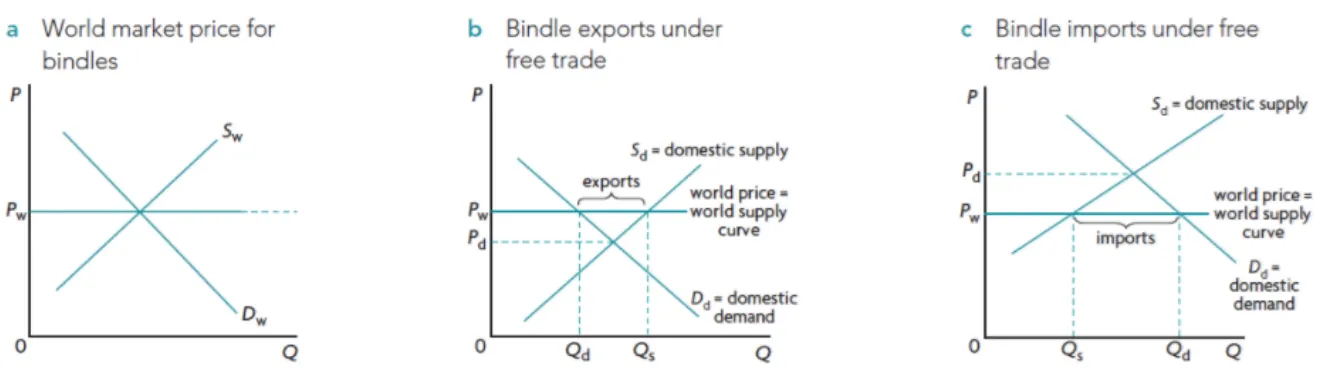
draw world market, market of exporting country, market of importing country
what is protectionism
Protectionism is the partial or complete protection of domestic industries from foreign competition within domestic markets.
define tariffs
Tariffs are taxes levied on products when they cross national boundaries. Taxes can be applied either to imports or exports.
types of tariffs
purpose of tariffs
Types of tariffs
Specific tariffs
Expressed in terms of a fixed amount of money per physical unit of the imported product ($ a ton, 10 cents per litre).
It is independent of the initial price
Ad valorem tariffs
Expressed as a percentage of the value of the commodity e.g. 35% of the value of the product
Purpose of tariffs
Raise revenue
Important source of revenue in ELDCs
Protectionism purpose
Dumping
These 2 aims are conflicting since a tariff will not yield much revenue is it is effective in reducing imports
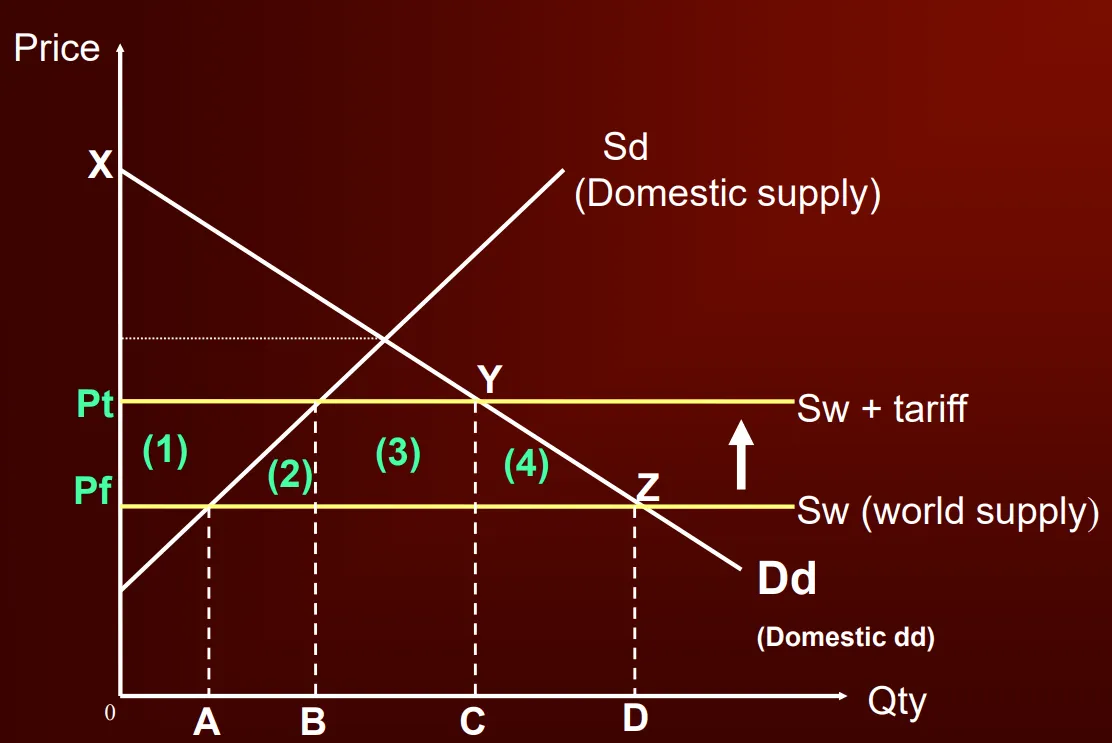
draw and explain tariff diagram
Before tariffs:
consumer surplus: PfXZ
domestic output: 0A
domestic revenue: 0PfA
domestic output: 0B
domestic producer surplus: the small triangle below segment PfA
imports: AD
foreign producer revenue: APfD
After tariffs
consumer surplus: PtXY (lost area 1+2+ 3+4)
domestic revenue: 0PtB
domestic producer surplus: add area (1)
government revenue: area (3)
imports: BC
foreign producer revenue: BPfC
Welfare loss: areas 2+4
Welfare loss comes from increased reliance on less efficient domestic producers as well as loss of consumer surplus from making consumers pay more for the same good
Beneficiaries of tariffs
Domestic producers
Workers in protected industries
Government (tariff revenue)
Losers from tariffs
Domestic consumers
Foreign firms
Increased inefficiency of production
Misallocation of resources
define import quotas
Import quotas are legal limits on the amount of a good that may be imported (import quotas) during a given period of time.
why may import quotas be preferred over tariffs?
Import quotas do not create any revenue for the government and less likely to attract retaliation from other countries
Thus, the effect is only protectionist (there are no conflicting aims)
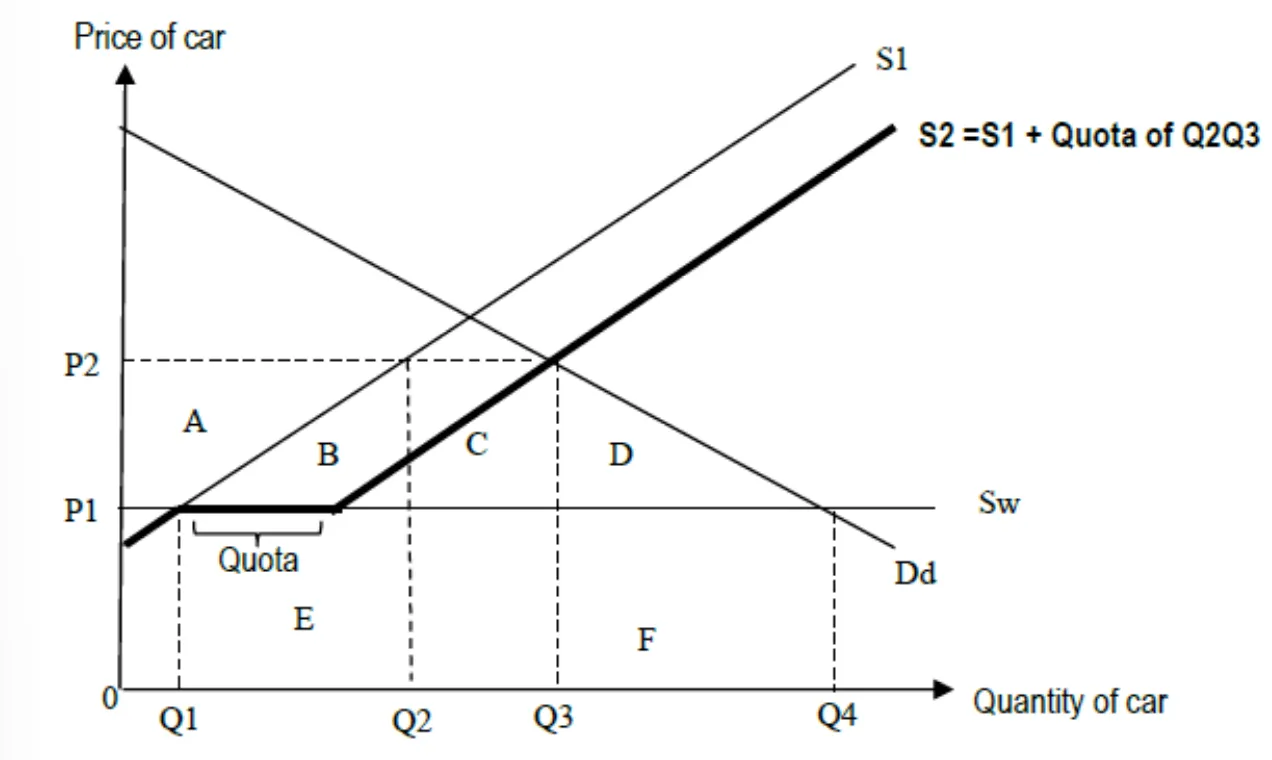
draw and explain import quota diagram
Before import quota
Price before import quota = P1
Qty demanded = Q4
Qty supplied by domestic producers = Q1
Qty imported = Q1Q4
After import quota
Quota - Q2Q3
if the government approves Q2Q3 of imports into the country, this shifts the supply curve from S1 to S2
Price after quota = P2
Qty demanded = Q3
Qty supplied by domestic producers = Q2
Qty imported = Q2Q3 (quota amount)
Quota revenue: Area C
Imports are sold at a higher price than the world price
Why C? it is because the distance between the two parallel supply curves is the same as the qty of the quota.
Quota revenue is earned by foreign producers and counts as welfare loss for the home country
Welfare loss for the domestic country: Areas B+C+D
Beneficiaries of import quotas
Domestic producers
Workers in protected industries
Exporting firms (in rare cases)
Losers of import quotas
Domestic consumers
increased price
worsens income inequality
Increased inefficiency of production
Global misallocation of resources
Foreign producers affected by quota
in most cases, the limit on supply by the quota outweighs the increase in revenue from each unit of good, resulting in a net loss
define production subsidies
A production subsidy is a grant provided by the government to firms aiming at lowering production costs for domestic firms competing against foreign imports
Production subsidies aim to enable less efficient domestic producers to be more competitive against more efficient foreign producers
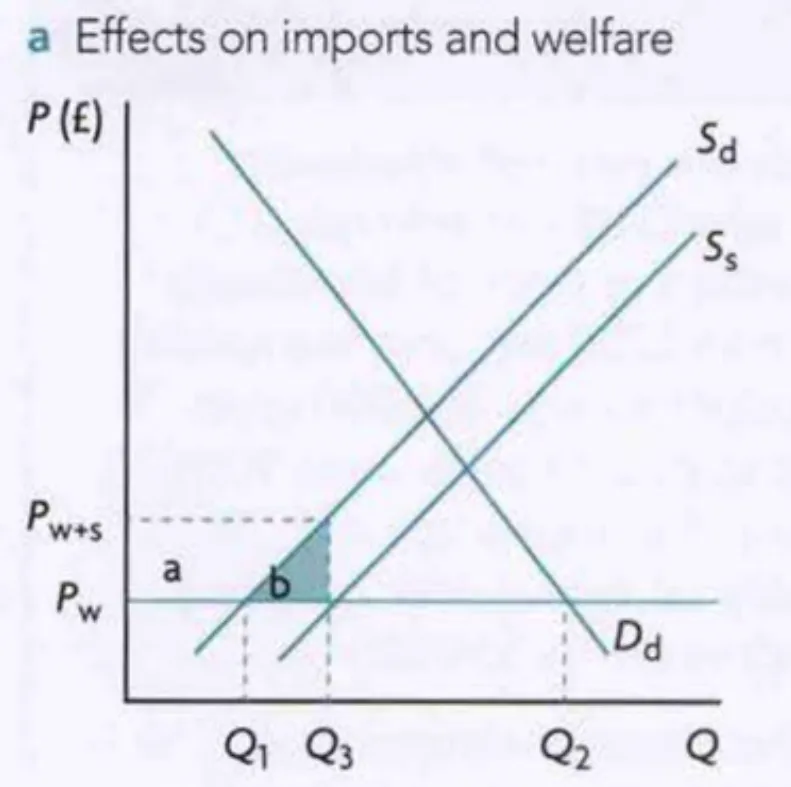
draw and explain production subsidy diagram
Consumer surplus is not affected since both price paid and quantity bought by consumers have not changed
initially, domestic producers produce Q1, quantity demanded is Q2, excess demand of Q2-Q1 is satisfied by imports
the subsidy shifts the supply curve, but the good continues to be sold at Pw, though the price received by producers is now Pw+s
Since consumers still consume Q2 of goods at price Pw, consumer surplus remains unchanged
Producer surplus increases by area A due to the higher price they receive (subsidy money) and the larger quantity they sell
Government spends area A and B to provide the subsidy
Welfare loss is area B
Beneficiaries of production subsidies
Domestic firms
Workers in domestic industries
Losers from production subsidies
Government budget
Taxpayers
Inefficiency in domestic production
Exporting countries competing with the domestic country
Misallocation of resources globally
define export subsidies
Export subsidies involves payments by the government per unit of the subsidised good that is exported
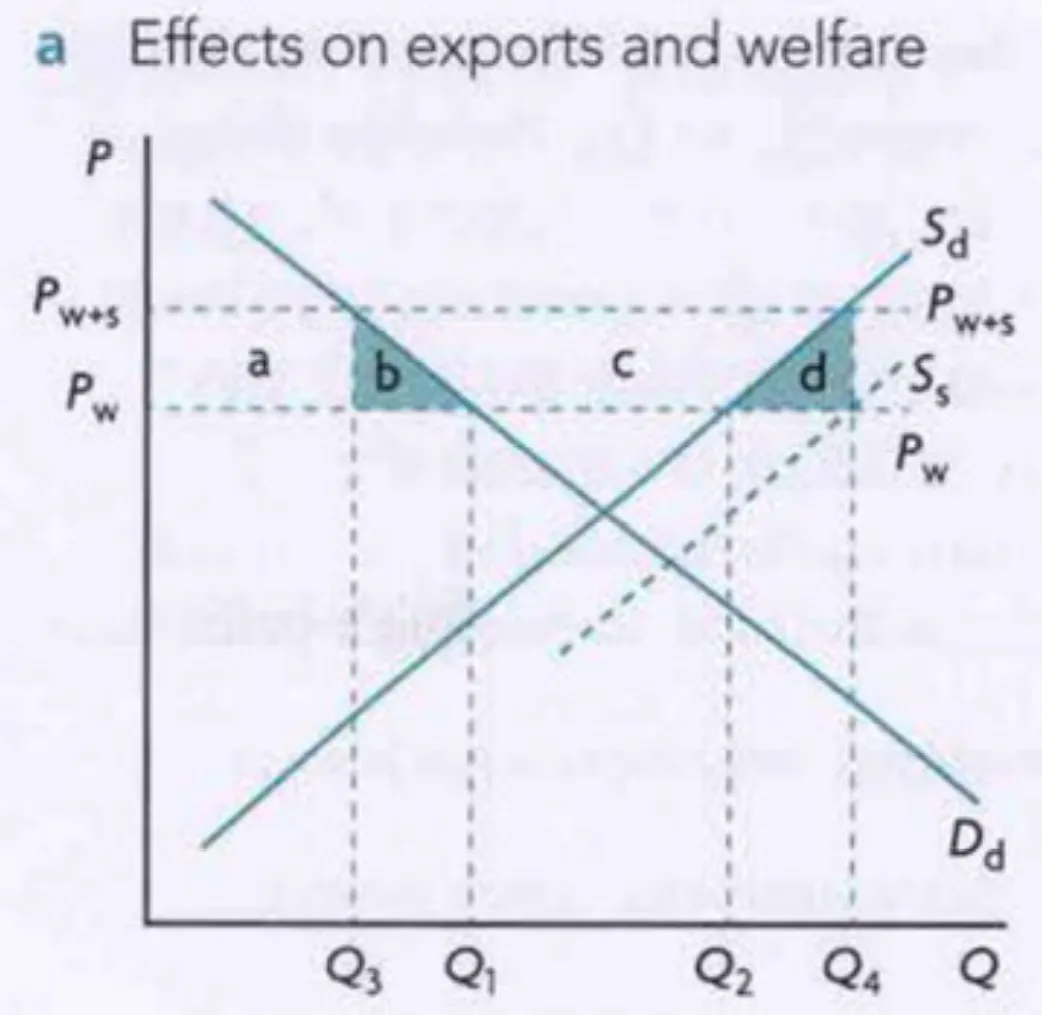
draw and explain export subsidy diagram
Before export subsidy
Before opening up to trade, the world price Pw is higher that domestic price, given by intersection between Dd and Sd
thus the country becomes an exporter if it trades
When trading, at the world price Pw,
the domestic quantity demanded is Q1
the domestic quantity supplied is Q2
the exports is given by Q1Q2
After export subsidy
The supply shifts down by the amount of subsidy per unit to Ss
Producers increase the quantity they supply to Q4 (intersection between Ss and Pw)
This results in a new higher domestic price, Pw+s, which is determined by drawing a vertical line up from the intersection of Ss and Pw to the line Sd (basically the world price plus the subsidy per unit)
Unlike production subsidies, the price paid by domestic consumers increase, instead of remaining unchanged at Pw
This is because the export subsidy reduces the qty of goods available in the domestic market from Q1 to Q3 → increase in price
Cus basically the foreigners are also paying Pw+s, but the government pays s for them so it remains at Pw
Domestic consumers decrease the quantity demanded to Q3 (intersection between Dd and Pw+s)
Exports is quantity Q3Q4
The price paid by foreigners remains at Pw
Loss in consumer surplus of areas a+b due to higher price paid and lower qty bought
Increase in producer surplus of areas a+b+c due to higher price and larger qty
Government loses areas b+c+d which is what they pay for the subsidy (subsidy per unit x quantity of exports)
Welfare loss = (a+b+c)-(a+b)-(b+c+d)=-(b+d)
welfare loss is areas b and d
welfare loss from export subsidies are always greater than those of production subsidies, as export subsidies make both the government and consumers worse off
what are administrative barriers
Administrative barriers are trade barriers in the form of regulations that aim to limit imports into a country. These barriers may take the form of product safety standards, sanitary standards or pollution standards but may also include more stringent than necessary application of customs procedures.
arguments for protectionism
To develop infant industries
- Industries in their infancy are too small to have gained economies of scale
- Without protection, these infant industries will not survive competition from abroad
- Protection will increase their competitiveness
- E.g. Airbus’ early subsidies that allowed it to develop to compete with Boeing
Issues
- Complacency
- Once given, hard to remove
- Failure to identify the right industries to protect
National security
- Protect industries essential to national defence
- So that the country can produce them itself and does not need to depend on imports that may be controlled by unfriendly nations
- E.g. steel and weapons production
Health, safety and environmental reasons
- Governments are justifiably concerned of imported goods that may fall short of health/safety/environmental standards
- Lower income countries accused of polluting/destroying the environment due to their environmental activities
- Trade protectionism could help tackle the problem of over production
To retaliate against ‘dumping’ and other anti-competitive actions
- Prevents domestic producers from being wiped out by ‘unfair foreign competition’, which can take the form of:
- production/export subsidies to artificially achieve lower CoPs
- administrative barriers
- undervalued currencies → makes exports more competitive
- violation of intellectual property
- Issues
- hard to prove that prices are artificially lowered
- excuse to protect inefficient industries
- causes a permanent reduction of trade and welfare
Correcting a balance of payments deficit
- deficit means that there is a net outflow of money from a country
- Decreased imports would affect the exports of the affected countries → retaliation
- Issues
- does not solve underlying long term problems
- e.g. poor quality of products or lack of comparative advantage
- retaliation
- Self defeating → fall in output and income of trading partners → fall in their demand for exports from home country → fall in output and income of home country
To protect employment during recession
- Limits imports to stimulate domestic production and generate employment
- Issues:
- does not solve underlying cause of a lack of competitive advantage
- Hard to remove
- Self defeating → fall in output and income of trading partners → fall in their demand for exports from home country → fall in output and income of home country
Source of government revenue
- Important source of revenue for govts in ELDCs
- poorer countries use tariffs because they rely more on goods, while richer countries rely more on services
- additionally, due to the greater prevalence of tax evasion in ELDCs, tariffs are a better source of revenue than taxes
- Tariffs are easier to collect compared to income taxes
- Issues:
- May impeded the transition towards other sources of tax
- Tariffs applied to imported goods are regressive in nature
Enable and industry to decline gradually
- Provides time for labour to be retrained and rechanneled to other growing industries
- Helps to reduce the incidence of structural unemployment
- Issue
- may instead unnecessarily slowdown the process, depriving other industries of resources
To achieve political objectives
- e.g. sanctions on russia or syria
arguments against trade protection
Allocative inefficiency and welfare losses
Danger of retaliation
Higher costs of production and reduced effciency
Higher prices and loss of consumer surplus
Impact on export competitiveness
Domestic firms have less incentives to be efficient
Trade protection may have negative effects on real GDP
protected goods may be used as inputs in the production of other goods
protection using means like tariffs would increase the COP for these goods → SRAS shift left
types of economic integration
Trading Blocs
Preferential trade agreements
Free trade area
a group of countries that have abolished all tariff barriers among themselves but maintain their individual tariffs against the outside world
Customs unions
common external tariff that applies to the imports by any member country from the outside world
Common markets
Allows for the free movement of products like the free trade area and customs union
Also allows for the free movement of labour and capital, common taxes, and common trade laws
Monetary union
Requires a common market
Adoption of a common currency, central bank, and monetary policy
Advantages of trading blocs
Trade creation
expansion into larger markets
Lower prices and increased choices for consumers
Increased competition and efficiency
Increased FDI
Benefits from movement of labour and mobility of entrepreneurship (common market)
increased bargaining power as a bloc
disadvantages of trading blocs
Trade diversion
Challenges the multilateral trading agreements pursued in the WTO
Unequal distribution of gains and losses
Economic integration and loss of sovereignty
what do exchange rates show
The price of a currency in terms of another currency
Measures the external value of a currency
May be quoted either:
in the amt of foreign currency needed to buy a unit or domestic currency
or the amt of domestic currency needed to buy a unit or foreign currency
Why is the DD for currency downward sloping and the SS upward sloping?
As the currency appreciates, exports and assets denominated in that currency becomes dearer → less demand for the currency
As the currency appreciates, foreign goods become cheaper
consumers will sell off the currency to buy foreign currencies to pay for more imports and invest overseas
causes of shifts in demand and supply of a currency
Changes in long term capital movements (foreign direct investment)
more long term profit opportunities in the country and expected long term appreciation of its currency → inflow of long term capital and increase in demand for its currency
Changes in relative growth rates
increase in domestic income due to economic growth → higher demand for imports → increased supply of home currency
increase in foreign income → higher export demand → increased demand for home currency
Changes in taste for exports and imports
Change in favour of exports → increased demand for currency
Change in favour of imports → increased supply for currency
Changes in interest rates
increase in interest rates attracts short term capital inflows and increases demand for its currency
decrease in interest rates attracts short term capital outflows and increases supply of the currency
Expectations of future exchange rates
If speculators expect a currency to appreciate, they will buy more of the currency, causing it to actually appreciate
Change in relative prices (domestic vs foreign inflation)
higher rate of domestic inflation → exports are more expensive, imports are cheaper
leads to a depreciation of the currency
Note: Although the central banks of countries with free floating currencies do actually intervene when necessary, such passages will not appear in paper 2.
what is a free float exchange rate
Exchange rate is determined by market demand and supply of a currency
Demand for a currency is affected by exports and capital flow into the country
Increase in exports increases demand for the domestic currency → more USD is needed to pay for these goods
Capital flow into the country (both short and long term) increases demand for the currency
Supply for a currency is affected by imports and capital outflow from the country
Imports cause an increase in supply of the domestic currency
Capital outflow from the country increases supply of the currency
Rise in exchange rate → appreciation
Decrease in exchange rate → depreciation
foreign exchange market scenarios (change in USD)
investors from us invests in indonesian stock market
french importers buy machinery from US
us residents come to singapore for holidays (from US perspective, it is an import since the income is accruing to the trading partner)
european companies seek to increase investments in US
increase in supply of usd, depreciation of usd
demand of usd increases, appreciation of usd
increase in supply of usd, depreciation of usd
increase in demand of usd, depreciation of usd
what is a managed float
Managed by demand and supply, but the central bank intervenes to prevent excessive fluctuations
Allows central bank to eliminate wild fluctuations and speculations under a free float yet not need to defend a fixed exchange rate
e.g. Singapore
what is fixed exchange rates
Maintained at a fixed rate and not permitted to change freely
e.g. hong kong
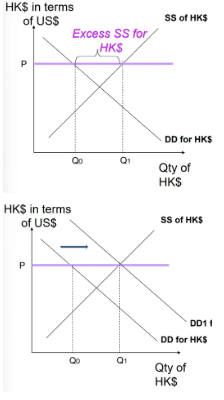
what happens when market rate above the fixed exchange rate
Market rate above the fixed exchange rate
this increases their reserve of foreign currencies
to maintain the fixed rate, the central bank has to sell HK$ and buy foreign currencies to prevent the HK$ from rising in value
alternatively, they can also lower interest rates to help increase the supply of HK$ in the market or revalue the currency
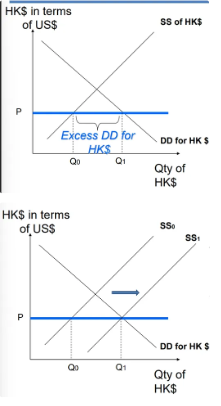
what happens when market rate is below fixed exchange rate
to maintain the fixed rate, the central bank has to buy HK$ and sell foreign currencies
this results in a decrease in the central bank’s reserves of foreign currencies
they can also raise interest rates to increase demand for HK$
Additionally, they can:
borrow from abroad
use protectionism to limit imports
contractionary dd-side policies to lower national incomes and in turn imports
devalue the currency
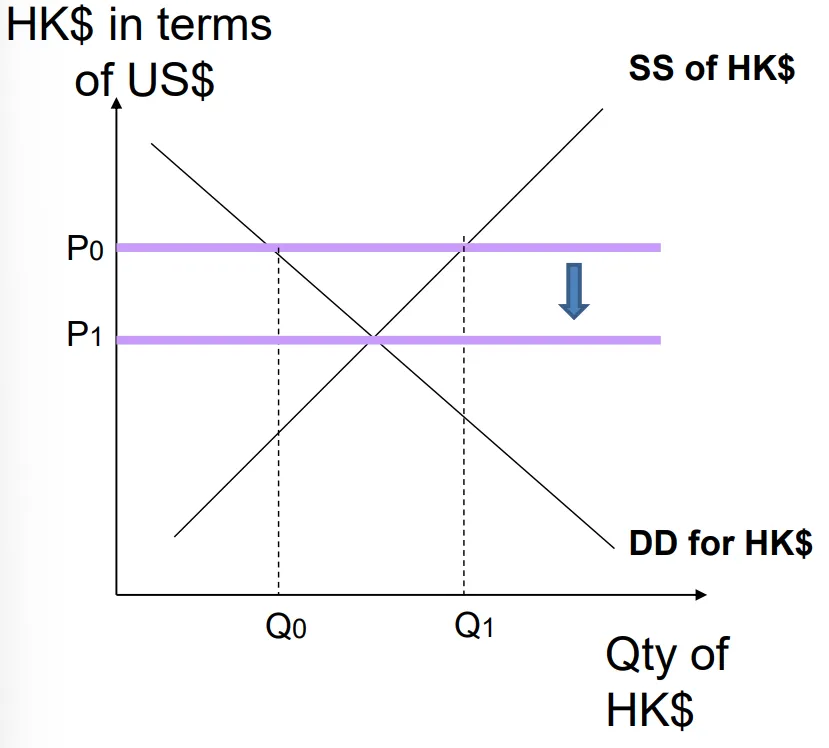
what is devaluation
central bank devalues the currency
fixed exchange rate is lowered
does not require the central bank to increase the demand for the currency in the foreign exchange market
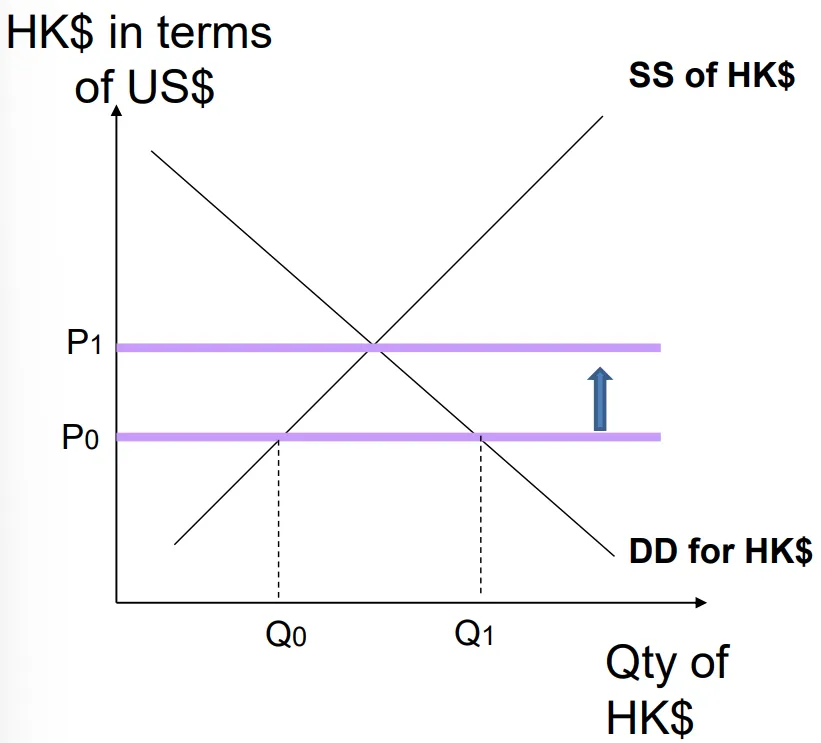
what is revaluation
does not require the central bank to increase supply in the foreign exchange market
fixed exchange rate is raised
what is balance of payments
Balance of payments refers to the monetary value of all economic transactions that have taken place over a period of time, usually one year, between a country and the rest of the world.
only external transactions are recorded - i.e. the total payments made by the country to other countries and its receipts from them.
what are credit and debit items
Credit item
An international transaction that leads to an inflow of money from abroad
e.g. exports → foreigners have to convert their currencies to the domestic currency to pay domestic exporters, resulting in an inflow
Debit item
An international transaction that leads to an outflow of money overseas
e.g. imports
what are the components of BOP
Current account → exports/imports of g&s
Covers all earnings and expenditures of a country arising from the current purchases and sales of goods and services during a year
This includes
visible trade - exports/imports of physical goods
invisible trade - exports/imports of services, income, current transfers (transactions where goods/services/financial items are transferred without something of economic value being received in return, which is basically unilateral transfers)
The current account balance is therefore calculated by the sum of the balance of trade in goods and the invisible balance, which is simply the value of visible/invisible exports - value of visible/invisible imports
Capital account → capital transfers
Capital transfers - transfer of ownership of assets without a specific exchange of goods or services
Debt forgiveness
Investment grants (gifts by other governments for financing physical capital)
Transactions in non-produced, non-financial assets
e.g. international sales and purchases of rights to natural resources (fishery, minerals, air space)
Financial account
Direct investment
all long term inflows minus outflows of physical capital undertaken by MNCs
Portfolio investment
All inflows minus outflows of investments in stocks, bonds and other financial instruments
Reserve assets
All foreign currency reserves held by the central bank
A positive value for reserve assets means that there is an inflow of domestic currency, and an outflow of foreign currency
Reserve assets must be denominated in domestic currency!
what should the BOP be equal to
The sum of the current account, capital account, financial account, and the errors and omissions should be zero (0)
how to determine BOP deficit or surplus
To determine if the BOP has a deficit or surplus, simply exclude the use of reserve assets from the calculation.
BOP deficit
A balance of payment deficit means that there is a deficit in the combined current, capital and financial accounts (plus errors and omissions), excluding use of the reserve assets (buying and selling of currencies).
This means that the export revenue is less than the import expenditure
Overall, this leads to a supply of the domestic currency, causing the domestic currency to depreciate
BOP surplus
A balance of payment surplus means that there is a surplus in the combined current, capital and financial accounts (plus errors and omissions), excluding use of the reserve assets (buying and selling of currencies).
This means that the export revenue is more than the import expenditure
This leads to a rise in demand of the domestic currency, causing the domestic currency to appreciate
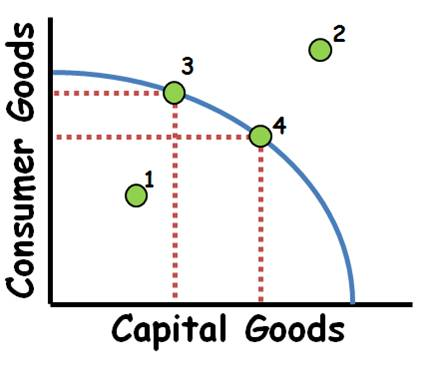
how to show trade surpluses on a PPC
how to show trade deficit on PPC
why are surpluses considered waste in current account balance
Trade surplus
point within a PPC
The economy is consuming less than it is producing
Trade deficit
point outside of PPC, since you are consuming more than you are producing
current account balance → any surplus is considered a waste cause its for the future, not for the current