Metabolism Integration
 Call Kai
 Learn
Learn Practice Test
 Spaced Repetition
 Match
Match Flashcards
 Knowt Play
1/3

There's no tags or description
Looks like no tags are added yet.
Name | Mastery | Learn | Test | Matching | Spaced | Call with Kai |
|---|
No analytics yet
Send a link to your students to track their progress
4 Terms
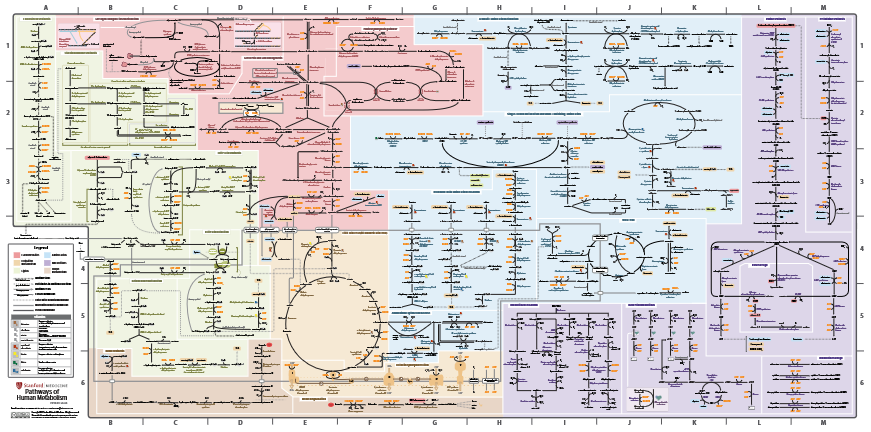
Stanford Metabolic Map
Role of the Liver
Central processing facility and metabolic hub
Determines what dietary nutrients and metabolic fuels are sent to peripheral tissues
Glucose regulator that:
Removes excess glucose from blood when carbohydrate levels are high. Stored as glycogen.
Releases glucose when glucose levels are low.
Controlled by insulin and glucagon signaling
Portal vein directly delivers nutrients from small intestine and inactivates toxins from the diet. - “first pass effect” for food and IV medication
Glucose-6-P fates
Monosaccharides from food are converted to Glucose-6-P by hexokinase & glucokinase
Fate of Glucose-6-P depends on metabolic needs of the liver balanced with other organs
Most Glucose-6-P is used to generate glycogen.
But if other tissues (the brain) need glucose, Glucose-6-P can be dephosphorylated and released to the bloodstream.
If the liver needs NADPH, the Glucose-6-P is used by pentose phosphate pathway
Can also by used in glycolysis to generate Acetyl-CoA, for a variety of purposes
Pancreas
produces insulin and glucagon
also secretes digestive proteases for digestion in small intestine: Trypsin, Chymotrypsin, Elastase