apes unit 4 population
0.0(0)
Studied by 1 person Call Kai
 Learn
Learn Practice Test
 Spaced Repetition
 Match
Match Flashcards
 Knowt Play
Card Sorting
1/28

Earn XP
Description and Tags
Last updated 8:02 PM on 5/1/26
Name | Mastery | Learn | Test | Matching | Spaced | Call with Kai |
|---|
No analytics yet
Send a link to your students to track their progress
29 Terms
1
New cards
k-selected species
Possess relatively stable populations fluctuating near the carrying capacity of the environment. These species are characterized by having only a few offspring but investing high amounts of parental care. Elephants, humans, and bison
2
New cards
rule of 70
Used to determine the doubling time of a population by using
the equation DT=70/CBR where DT is doubling time and CBR
is crude birth rate.
the equation DT=70/CBR where DT is doubling time and CBR
is crude birth rate.
3
New cards
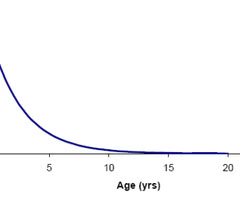
type 3 survivorship curve
curve depicts species where few individuals will live to
adulthood and die as they get older because the greatest
mortality for these individuals is experienced early in life.
adulthood and die as they get older because the greatest
mortality for these individuals is experienced early in life.
4
New cards
carrying capacity
maximum number of individuals an ecosystem can support
5
New cards
cultural carrying capacity
The maximum number of people who could live in reasonable
freedom and comfort indefinitely without decreasing the
ability of the earth to sustain future generations
freedom and comfort indefinitely without decreasing the
ability of the earth to sustain future generations
6
New cards
demographic transition
Movement of a nation from high population growth to low
population as it develops economically (from subsistence
economy to affluence
7
New cards
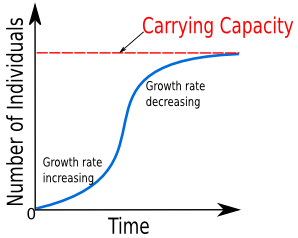
logistic growth model
Population increase that happens in a manner that starts
slowly, as there are few individuals, then increases in speed
as numbers increase, but then decreases to a halt as numbers
get high enough that resources are depleted and cannot
support further growth. is represented in
graph form as an S-shaped curve (S curve
slowly, as there are few individuals, then increases in speed
as numbers increase, but then decreases to a halt as numbers
get high enough that resources are depleted and cannot
support further growth. is represented in
graph form as an S-shaped curve (S curve
8
New cards
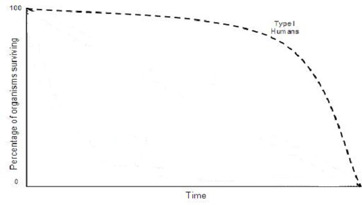
type 1 survivorship curve
individuals have a high probability of surviving through early
and middle life but have a rapid decline in the number of
individuals surviving into late life
and middle life but have a rapid decline in the number of
individuals surviving into late life
9
New cards
r-selected species
A species puts only a small investment of resources into each
offspring, but produces many such low effort babies. Such
species are also generally not very invested in protecting or
raising these young
offspring, but produces many such low effort babies. Such
species are also generally not very invested in protecting or
raising these young
10
New cards
population momentum
Is a consequence of the demographic transition and is the
ratio of the size of the population at that new equilibrium
level to the size of the initial population.
ratio of the size of the population at that new equilibrium
level to the size of the initial population.
11
New cards
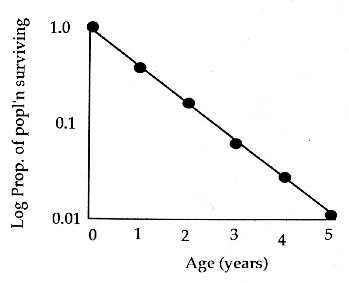
type 2 survivorship curve
shows a roughly constant mortality rate for the species
through its entire life. This means that the individual's chance
of dying is independent of their age.
through its entire life. This means that the individual's chance
of dying is independent of their age.
12
New cards
density dependent factors
factors that influence population growth based on size (size affects survival )
13
New cards
density independent factors
A factor that limits the size of a population whose effect is
not dependent on the number of individuals in the
population.(survival not affected by size )
not dependent on the number of individuals in the
population.(survival not affected by size )
14
New cards
survivorship curves
A line that displays the relative survival rates of a cohort - a
group of individuals of the same age- in a population, from birth
to the maximum age reached by any one cohort member. Type
1,2,3 curves
group of individuals of the same age- in a population, from birth
to the maximum age reached by any one cohort member. Type
1,2,3 curves
15
New cards
population density
A measure of the number of organisms that make up a
population in a defined area
population in a defined area
16
New cards
biotic potential
The maximum capacity of an organism for reproduction
under optimum environmental conditions.
under optimum environmental conditions.
17
New cards
boom and bust cycle
Regular increase and decrease of a population. One usually
lags behind the other
lags behind the other
18
New cards
Crude birth rate
The number of births per 1,000 individuals per year.
19
New cards
crude death rate
The number of deaths per 1,000 individuals per year.
20
New cards
emigration
Act of leaving a place. Usually happens more in developing
countries.
countries.
21
New cards
immigration
Act of going into a place. Usually happens more in developed
countries.
countries.
22
New cards
pre industrial - 1st stage of society
Death and birth rates are high, but roughly in balance. Population growth is slow.
23
New cards
industrial 3rd stage of society
Marked by declining fertility, fairly low mortality rates, and
moderate to slow population growth rates.
moderate to slow population growth rates.
24
New cards
transitional 2nd stage of society
Rapid increase of human population due to improvements in
health care and the supply of food
health care and the supply of food
25
New cards
post industrial 4th stage in society
Emphasizes on services, which depend on intelligent
designers and users of technology.
designers and users of technology.
26
New cards
environmental resistance
Sum of environmental factors that tend to restrict the basic
potential of organisms and impose a limit on numerical
increase
potential of organisms and impose a limit on numerical
increase
27
New cards
fecundity
is a biological potential of the physiological capacity to
participate in reproduction (able to be fertile)
participate in reproduction (able to be fertile)
28
New cards
dead zone
a region of the ecosystem that can’t support any living
creatures.
creatures.
29
New cards