7.3 Biodiversity & The Effect of Human Interaction on Ecosystems
 Call Kai
 Learn
Learn Practice Test
 Spaced Repetition
 Match
Match Flashcards
 Knowt Play
1/30

There's no tags or description
Looks like no tags are added yet.
Name | Mastery | Learn | Test | Matching | Spaced | Call with Kai | Chat |
|---|
No analytics yet
Send a link to your students to track their progress
31 Terms
What is the definition of biodiversity?
The variety of all the different species on earth, or within an ecosystem.
How does a great biodiversity ensure the stability of ecosystems?
Reducing the dependence of one species on another for:
Food
Shelter
Maintenance of the physical environment
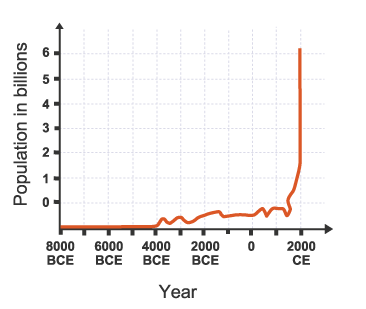
Rapid growth in the ________ ___________ and an increase in the __________ of ________ mean that increasingly more ____________ are used and more ________ is produced.
Unless ________ and _________ _________ are properly handled, more ___________ will be caused.
human population
standard
living
resources
waste
waste
chemical materials
pollution
What are the three ways pollution can occur?
Water — sewage, fertiliser, or toxic chemicals
Air — smoke and acidic gases
Land — landfill and toxic chemicals
Pollution kills _________ and __________ which can reduce _____________.
plants
animals
biodiversity
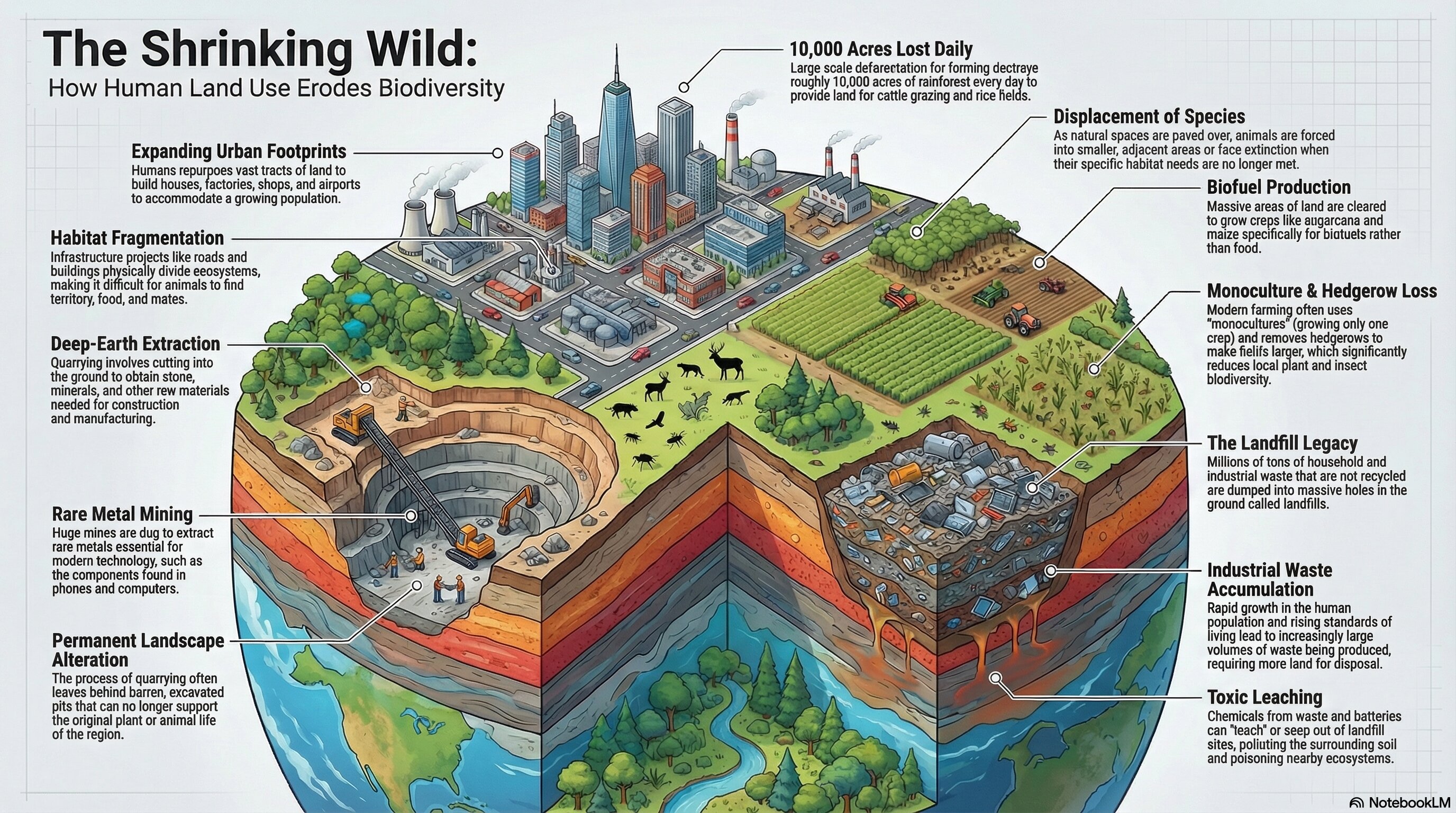
How do humans reduce the amount of land available for other animals and plants? (4)
Building
Quarrying
Farming
Dumping waste
Why are peat bogs being destroyed?
Produce garden compost
Dried to use as fuel — contains carbon
Drained to create space for farming
What is peat?
A material that forms when plant material has not fully decayed — not enough oxygen.
What does the decay or burning of peat do?
Release carbon dioxide into the atmosphere
The ______________ of peat bogs, and other areas of peat to produce garden __________, reduces the area of this ____________ and thus the variety of different _______, _________, and _______________ species that live there (____________).
destruction
compost
habitat
plant
animal
microorganism
biodiversity
What has large-scale deforestation in tropical areas occurred? (2)
Provide land for cattle and rice fields
Grown crops for biofuels
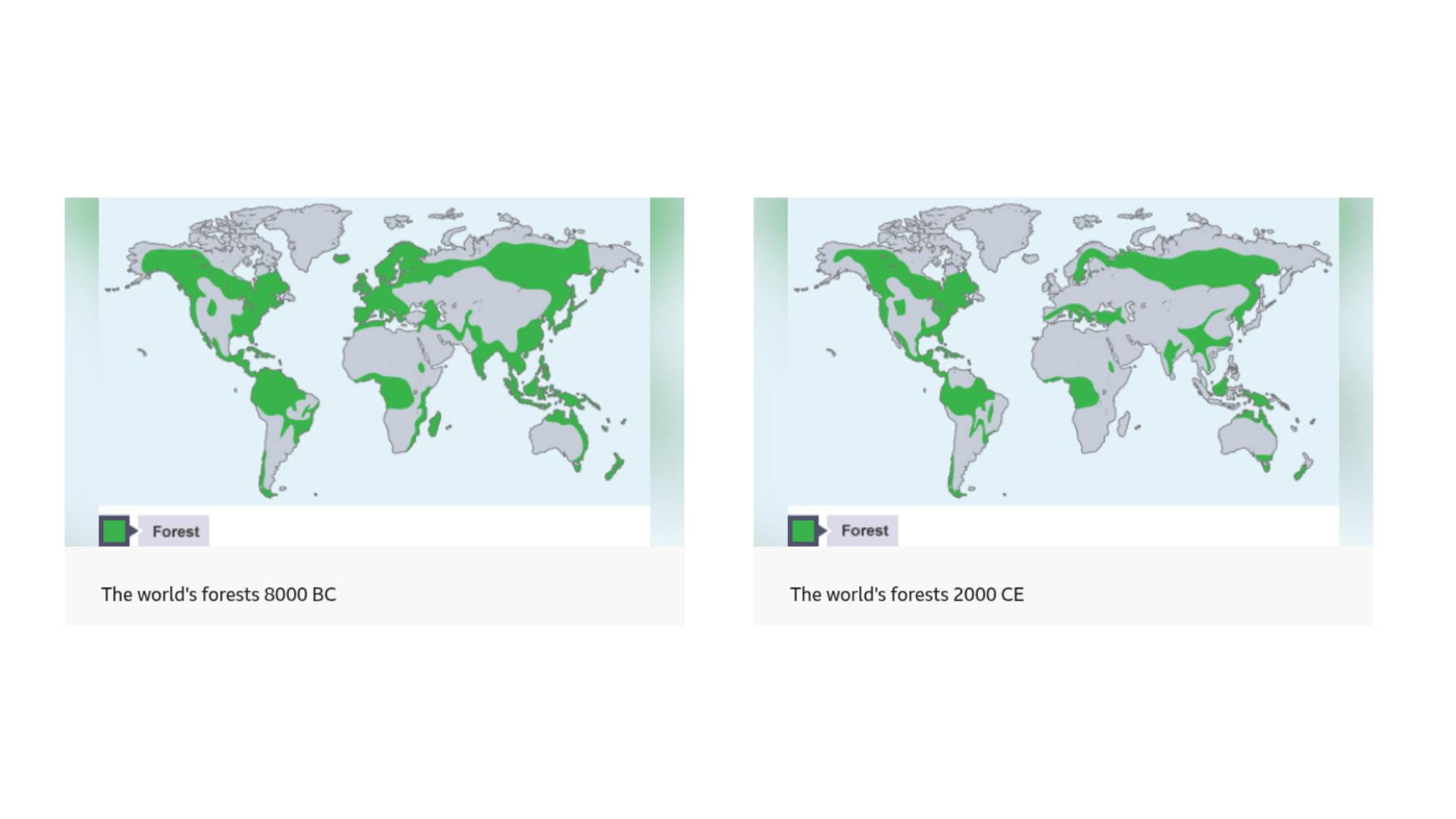
What is deforestation?
The large-scale removal of trees to provide land for other uses.
What are the problems caused by deforestation? (4)
Burning trees releases CO2 → global warming
After deforestation, microorganisms decompose dead plant material → produces CO2 as they respire
Trees take in CO2 when they photosynthesise — less trees = less CO2 taken in
Deforestation destroys habitats → decreasing biodiversity
Levels of _________ __________ and __________ in the atmosphere are increasing, and contribute to ‘_________ ___________’.
carbon dioxide
methane
global warming
What are the consequences of global warming? (4)
Melting ice caps → reduces habitats
Rising sea levels → reduces habitats — low lying areas are flooded with salty water
Temperature and rainfall levels → affect migration → distribution of different species — may not be able to survive where they live
Habitats lost → organisms go extinct → reduces biodiversity
What are some programmes that have been put in place to reduce the negative effects of humans on ecosystems and biodiversity? (5)
Breeding programmes for endangered species
Protection and regeneration of rare habitats
Reintroduction of field margins and hedgerows in agricultural areas where farmers only grown one type of crop
Reduction of deforestation and carbon dioxide emissions
Recycling resources — rather than dumping waste in landfill
What are some positive human interactions with ecosystems? (4)
Maintaining rainforests
Reducing water pollution
Preserving areas of scientific interest — stopping humans from going there
Replanting hedgerows and woodlands — restores habitats
What are some negative human interactions with ecosystems? (4)
Production of greenhouse gases → global warming
Producing sulfur dioxide → acid rain → affects habitats
Chemicals using in farming — leaking into environment
Clearing land for building — reduces habitats
Many scientists think that an increase in carbon dioxide concentration in the atmosphere causes an increase in air temperature.
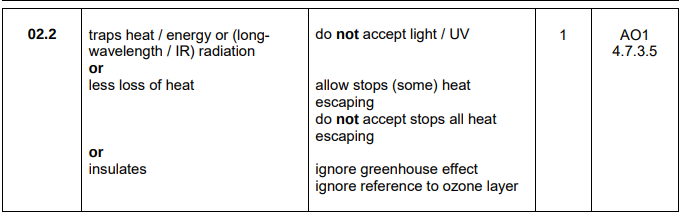
How would an increase in the concentration of carbon dioxide in the atmosphere cause an increase in air temperature? [1 mark]
Less loss of heat
![<ul><li><p>Many scientists think that global air temperature is related to the concentration of carbon dioxide in the atmosphere.</p></li><li><p><strong>Figure 3</strong> shows changes in global air temperature and changes in the concentration of carbon dioxide in the atmosphere.</p></li></ul><p>Evaluate evidence for and against the theory that an increase in the concentration of carbon dioxide in the atmosphere causes an increase in air temperature. [4 marks]</p><p>Use data from <strong>Figure 3</strong> and your own knowledge.</p>](https://assets.knowt.com/user-attachments/de18b61c-2a08-4cfa-913e-c58b73a38590.png)
Many scientists think that global air temperature is related to the concentration of carbon dioxide in the atmosphere.
Figure 3 shows changes in global air temperature and changes in the concentration of carbon dioxide in the atmosphere.
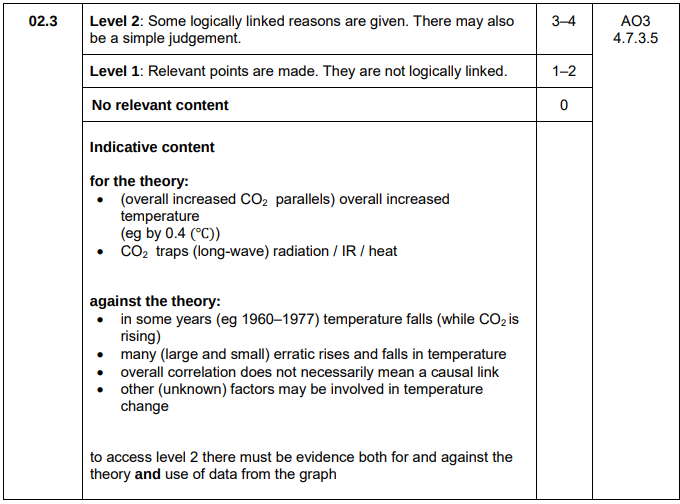
Evaluate evidence for and against the theory that an increase in the concentration of carbon dioxide in the atmosphere causes an increase in air temperature. [4 marks]
Use data from Figure 3 and your own knowledge.
Overall increased CO₂ parallels overall increased temperature by 0.4 °C
CO₂ traps radiation
In some years (1960 — 1977) temperature falls while CO₂ is rising
Many large and small rises and falls in temperature
Other factors could be involved in temperature change
![<ul><li><p>Many scientists think that global air temperature is related to the concentration of carbon dioxide in the atmosphere.</p></li><li><p><strong>Figure 3</strong> shows changes in global air temperature and changes in the concentration of carbon dioxide in the atmosphere.</p></li><li><p>In each year, the concentration of carbon dioxide in the atmosphere is higher in the winter than in the summer.</p></li></ul><p>Give one human activity that could cause the higher concentration of carbon dioxide in the winter. [1 mark]</p>](https://assets.knowt.com/user-attachments/4f9bb090-1b7d-4dd0-89c5-0c5994fcacac.png)
Many scientists think that global air temperature is related to the concentration of carbon dioxide in the atmosphere.
Figure 3 shows changes in global air temperature and changes in the concentration of carbon dioxide in the atmosphere.
In each year, the concentration of carbon dioxide in the atmosphere is higher in the winter than in the summer.
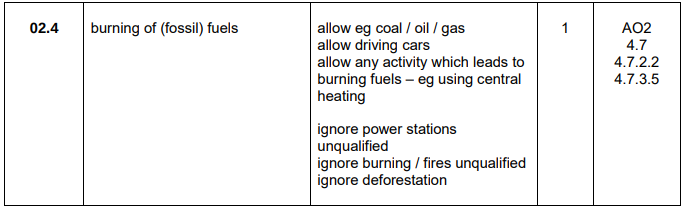
Give one human activity that could cause the higher concentration of carbon dioxide in the winter. [1 mark]
Burning fossil fuels
![<ul><li><p>Many scientists think that global air temperature is related to the concentration of carbon dioxide in the atmosphere.</p></li><li><p><strong>Figure 3</strong> shows changes in global air temperature and changes in the concentration of carbon dioxide in the atmosphere.</p></li><li><p>In each year, the concentration of carbon dioxide in the atmosphere is higher in the winter than in the summer.</p></li></ul><p>Give one biological process that could cause the lower concentration of carbon dioxide in the summer. [1 mark]</p>](https://assets.knowt.com/user-attachments/be087819-cbfa-4c5c-816d-9c3a7a9ef54b.png)
Many scientists think that global air temperature is related to the concentration of carbon dioxide in the atmosphere.
Figure 3 shows changes in global air temperature and changes in the concentration of carbon dioxide in the atmosphere.
In each year, the concentration of carbon dioxide in the atmosphere is higher in the winter than in the summer.
Give one biological process that could cause the lower concentration of carbon dioxide in the summer. [1 mark]
Photosynthesis

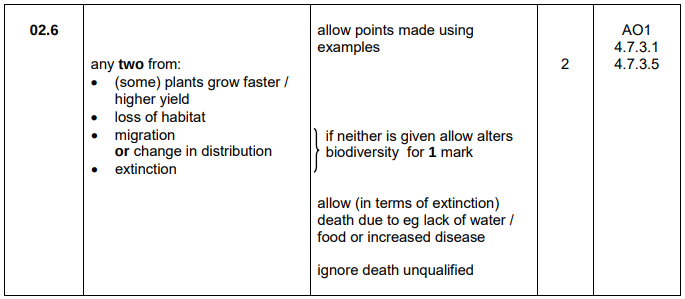
Give two possible effects of an increase in global air temperature on living organisms. [2 marks]
Migration
Loss of habitat
The rapid growth in human population means that more waste substances are box released into the environment.
The release of substances into the environment can cause pollution.
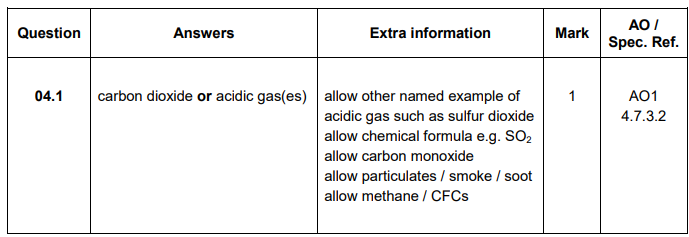
Name one harmful substance that could cause air pollution. [1 mark]
Carbon dioxide
The rapid growth in human population means that more waste substances are box released into the environment.
The release of substances into the environment can cause pollution.
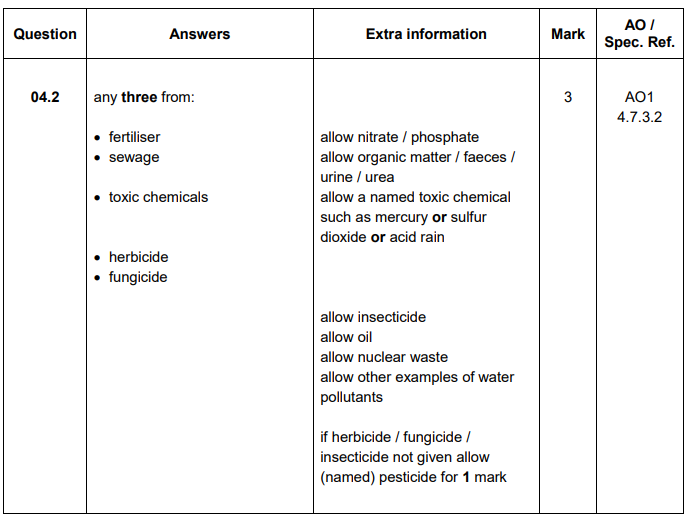
Name three harmful substances that could cause water pollution. [3 marks}
Do not refer to plastic or to litter in your answer.
Sewage
Fertiliser
Toxic chemicals
The rapid growth in human population means that more waste substances are box released into the environment.
The release of substances into the environment can cause pollution.
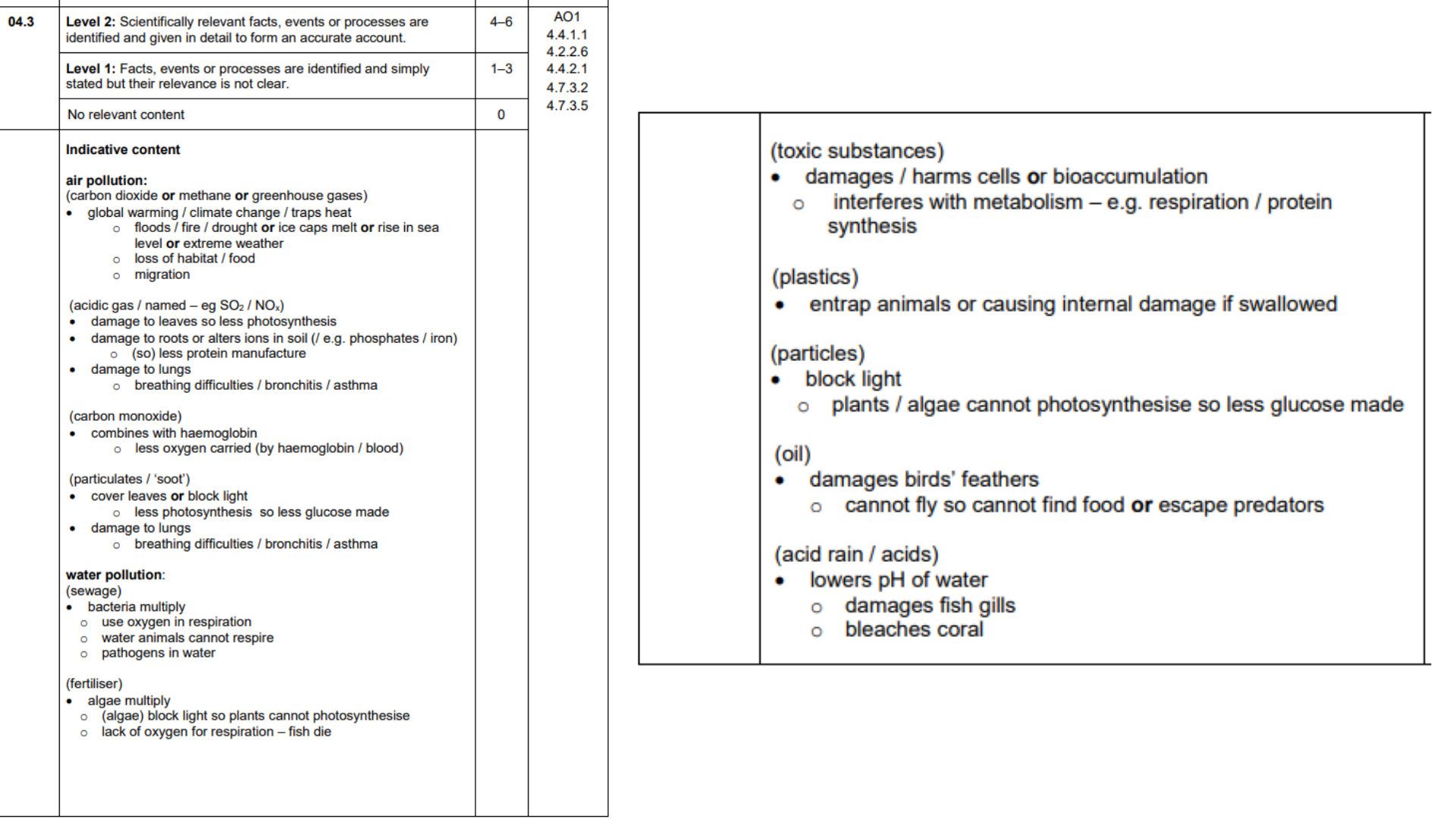
Describe how substances that pollute air and water could be harmful to humans and other living organisms. [6 marks]
Air pollution:
Greenhouse gases — causes global warming and extreme weather can lead to loss of habitat and migration
Carbon monoxide — combines with haemoglobin so less oxygen is carried by the blood
Acidic gases:
damages leaves so less photosynthesis
damages roots so less protein manufacture
can damage lungs can lead to breathing difficulties
Water pollution:
Sewage — bacteria multiply and use oxygen for respiration so water animals cannot respire
Fertiliser:
algae multiply and block light so plants cannot photosynthesis
algae also use oxygen to respire so there is less oxygen in the water for fish to respire so they die
Acid rain — lowers the pH of the water which damages fish gills and bleaches coral
Farming techniques have changed in recent years.
Describe:
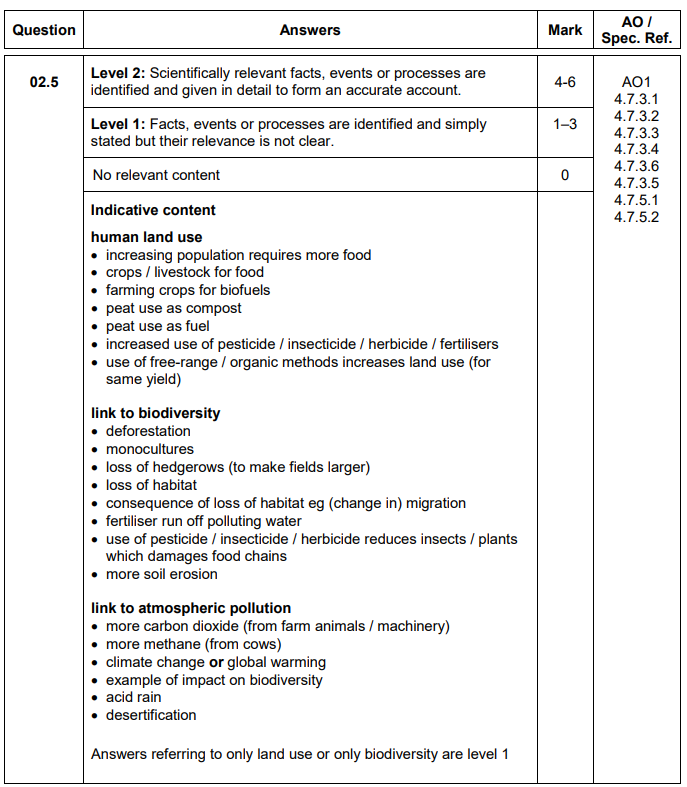
why more land is being used for farming
how increased farming has decreased biodiversity
[6 marks]
Increasing population requires more food
Crops and livestock are used for food
Crops are used for biofuels
Deforestation is done to make more space for land — but it can lead to:
loss of habitat
migration
Increased use of pesticides can lead to bioaccumulation which damages food chains
More methane is released from cattle and carbon dioxide is released from farm animals which contributes to global warming
![<ul><li><p>Peat bogs are estimated to contain twice as much carbon as all the world’s forests.</p></li><li><p><strong>Figure 2</strong> shows a section through part of a peat bog.</p></li><li><p>Layer A contains a lot of air.</p></li><li><p>Layer B: </p><ul><li><p>contains the dead remains of plants</p></li><li><p>has a low pH</p></li><li><p>contains very little oxygen</p></li><li><p>contains carbon dioxide and methane</p></li></ul></li></ul><p>Explain why most of the dead remains of plants in layer B do not decay. [3 marks]</p>](https://assets.knowt.com/user-attachments/7108bb13-2585-4a47-a55f-1ba498d9114b.png)
Peat bogs are estimated to contain twice as much carbon as all the world’s forests.
Figure 2 shows a section through part of a peat bog.
Layer A contains a lot of air.
Layer B:
contains the dead remains of plants
has a low pH
contains very little oxygen
contains carbon dioxide and methane
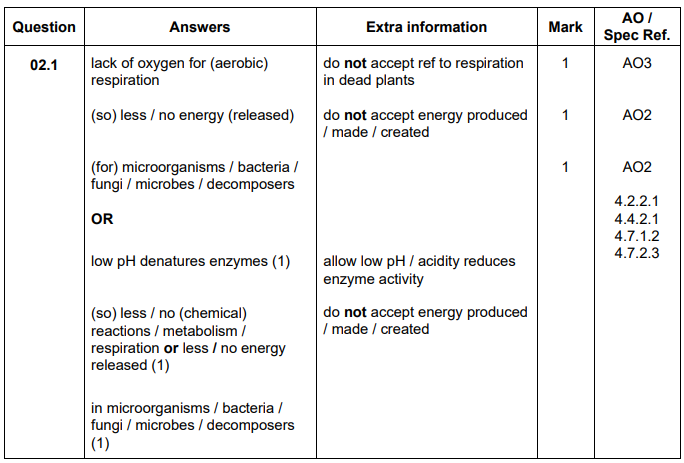
Explain why most of the dead remains of plants in layer B do not decay. [3 marks]
Lack of oxygen for aerobic respiration
so less energy released
for microorganisms
![<ul><li><p>The sundew plant shown in <strong>Figure 2</strong> has leaves with sticky hairs that box trap and digest insects. </p></li><li><p>Digestion of the insects releases phosphates and simple compounds of nitrogen that are used by the sundew plant.</p></li></ul><p>What substance can the sundew plant make using the phosphates? [1 mark]</p>](https://assets.knowt.com/user-attachments/ebeef39c-6a6a-420a-a425-5e73af0d1394.png)
The sundew plant shown in Figure 2 has leaves with sticky hairs that box trap and digest insects.
Digestion of the insects releases phosphates and simple compounds of nitrogen that are used by the sundew plant.
What substance can the sundew plant make using the phosphates? [1 mark]
DNA
![<ul><li><p>The sundew plant shown in <strong>Figure 2</strong> has leaves with sticky hairs that box trap and digest insects. </p></li><li><p>Digestion of the insects releases phosphates and simple compounds of nitrogen that are used by the sundew plant.</p></li></ul><p>What substance can the sundew plant make using the nitrogen? [1 mark]</p>](https://assets.knowt.com/user-attachments/c7d9e820-7d86-4f73-9f08-911e737a7a28.png)
The sundew plant shown in Figure 2 has leaves with sticky hairs that box trap and digest insects.
Digestion of the insects releases phosphates and simple compounds of nitrogen that are used by the sundew plant.
What substance can the sundew plant make using the nitrogen? [1 mark]
Protein
![<ul><li><p>Humans have destroyed large areas of peat bog to collect peat.</p></li><li><p>The peat provides fuel and provides compost for gardeners to use.</p></li><li><p>The peat comes from layer B in <strong>Figure 2</strong>.</p></li></ul><ul><li><p>Layer B:</p><ul><li><p>contains the dead remains of plants</p></li><li><p>has a low pH</p></li><li><p>contains very little oxygen</p></li><li><p>contains carbon dioxide and methane</p></li></ul></li><li><p><strong>Figure 3</strong> shows the removal of peat from a peat bog.</p></li></ul><p>Explain how the destruction of peat bogs and the use of peat affects the temperature of the Earth’s atmosphere. [4 marks]</p>](https://assets.knowt.com/user-attachments/c771d882-899f-416f-9609-5312db2227c9.png)
Humans have destroyed large areas of peat bog to collect peat.
The peat provides fuel and provides compost for gardeners to use.
The peat comes from layer B in Figure 2.
Layer B:
contains the dead remains of plants
has a low pH
contains very little oxygen
contains carbon dioxide and methane
Figure 3 shows the removal of peat from a peat bog.
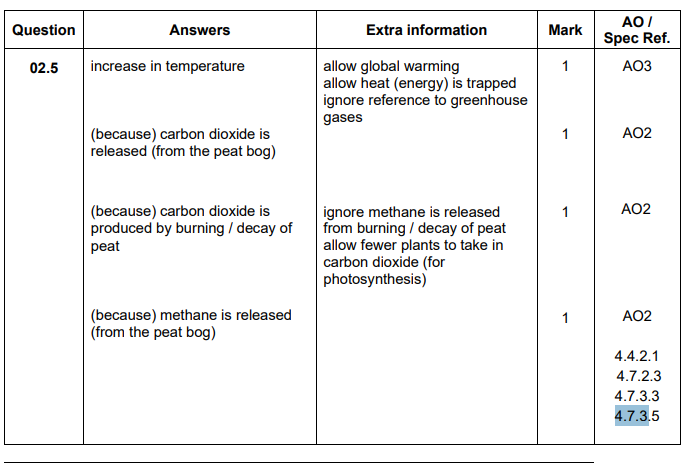
Explain how the destruction of peat bogs and the use of peat affects the temperature of the Earth’s atmosphere. [4 marks]
Increase in temperature because:
carbon dioxide is released form peat bog
carbon dioxide is produced by the decay of peat
methane is released from the peat bog