Production in the short run
 Call Kai
 Learn
Learn Practice Test
 Spaced Repetition
 Match
Match Flashcards
 Knowt Play
1/8

There's no tags or description
Looks like no tags are added yet.
Name | Mastery | Learn | Test | Matching | Spaced | Call with Kai |
|---|
No analytics yet
Send a link to your students to track their progress
9 Terms
Production defn
any activity that creates present or future utility (can be tangible/intangible)
The Production function bg (defn , input + output defn)
the rlstionship combining inputs to make outputs
inputs → FOP
outputs → the resulting objects that give us utility
The production function
Q (output) = F(a constant) (K (capital), L(labour))
raw materials (intermediate products) needed to make output as well but not incl in our model
Fixed / Variable inputs as it pertains to SR and LR
SR → At least 1 input (usually K) cant change
LR → All inputs variable
What does production look like in the SR (3 gen properties)
assumption : capital fixed → K fixed @ K0
Use this to simplify fnction
Law of diminishing marg
3 gen properties of sr production fncts
Pass thru origin
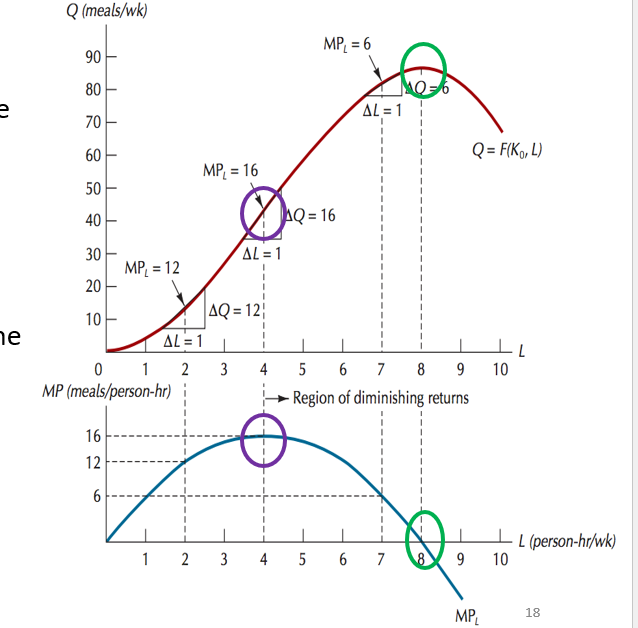
At the start → + additional units variable input increase output @ increasing rate
After a pt of inflexion → Law of Diminishing marginal returns (to wtv var input) - xtra units var input increase output @ decreasing rate
Thomas Malthus views on technology + why he was wrong
His 1978 argument : pop growth would lead to mass starvation
why hes wrong : tech advancement shift production fnc up so @ same lvl var input more can be produced
TP , MP , AP
TP → Production function - TP = Q
tot output as fnct of amount of var input
AP → TP/L (in gen : variable unit used in production)
= m of a ray from origin to any pt on TP
AP inc @ inc rate then stops - more labour added to fixed cap ; productivity falls at a pt
MP → delta TP due to 1 unit delta in var input ( delta Q/ delta L)
= slope of TP
max @ point of inflexion on TP
cuts x axis @ TP peak
continous MP when delta L rlly small : dQ/dL
AP + MP relationship
MP > AP → AP rising
MP < AP → AP falling
MP = AP → turning pt of AP
How resources allocated
keep doing the allocation (production process) yielding the highest MP → go until MP equal for all processes