APES Unit 8
 Call Kai
 Learn
Learn Practice Test
 Spaced Repetition
 Match
Match Flashcards
 Knowt Play
1/36

There's no tags or description
Looks like no tags are added yet.
Name | Mastery | Learn | Test | Matching | Spaced | Call with Kai |
|---|
No analytics yet
Send a link to your students to track their progress
37 Terms
Point Source Pollutant
Pollutant that enters the environment from an easily identified and confined place. You can “point” to it. Example: You can say this pollutant came from a farm. Animal waste runoff from a CAFO. Emissions from a coal power plant (CO2, NOx, SO2, PM) , and oil spill.
Nonpoint Source
These are pollutants entering the environment from many places at once. Difficult to point to one individual source. Example: Estuary polluted by sediments (bc coming from multiple sources and come from large regions). Urban runoff, pesticides sprayed on agricultural field = runoff of into bodies of water.
Pollutants
Specific chemicals or groups of chemicals that come from specific sources with specific env. and human health effects. More likely to earn you FRQ credit. Pollution-related FRQ: Specific pollutant names: Their sources, env and human impact, and mitigation strategies.
Pollution
Vague, non descript term for any substance that is harmful to the environment. Never acceptable on an APES FRQ. Exceptions: Specific categories of pollution: Thermal, noise, and sediment pollution
Range of Tolerance
Organisms have a range of tolerance for pollutants and abiotic conditions. Example: pH, temp., salinity. Pollutants cause physiological stress such as: limited growth and reproductive growth, difficulty respiring and suffocation, hormonal disruption, death (if pollutant iis high).
pH Tolerance
As pH decrease (more acidic) outside optimal range for a species = pop. declines. Can’t survive due to: aluminum toxicity and disrupted blood osmolarity.
Indicator species
Species that can be used to determine conditions of an ecosystem. Ex: white moss/filamentous algae pop. = pH < 6/ High crustacean pop. = pH > 6
Coral reef
Most biodiverse ecosystem. This is a mutualistic relationship between coral and algae called zooxanthelle. Algae = energy and coral supplies CO2. Algae have narrow temp. tolerance and leave if temp. rises or if pollutants = coral bleach. Humans = green house gas emissions (warming ocean temp + bleaching coral). Also, overfishing destroys fish populations.
Bottom Trawling
Can break reef structure and stir up sediment = enters into their gills. Example: Heavy nets are dragged along seafloor to capture species at the bottom.
Sediment pollution
Soil particles are transported into waterway = increase in turbidity = not clear. Also, limit the amount of sunlight coming through = affect the ability for algae to photosynthesize. Disrupt coral reefs.
Oil Spills
Hydrocarbons in oil = toxic to many marine organisms = can kill they if they eat the oil or absorb it through gills/ skin. Negative effects: decreased photosynthesis, oil sinking to bottom and killing bottom species, and decreased visibility. Can also wash ashore = decrease in tourism, hurt fishing industry, and hurt restaurants serving fish. Methods to Clean: Using booms on surface to contain spread with vacuum tubes, or physical removal, and chemical dispersants sprayed on oil to break up and sink to the bottom.
Endocrine Disruptors
Chemicals that interfere with endocrine (hormonal systems) of animals. This works by mimicking hormones and binding to receptor = disrupt the normal function of endocrine system. Medications can pass through urine and sewage = if not probably treated can also disrupt animals. Example: Atrazine (herbicide) bends to male frogs = feminize males and masculine female frogs. DDT - Insecticide that was phased out, but still persists in env. Phthalates - Compounds used in plastic and cosmetic manufacturing. Lead, arsenic, mercury. Medications.
Mercury
Naturally in coal. Released by coal combustion = enters the atmosphere and can be spread through precipitation (rain and snow). Endocrine Disruptor = inhibits estrogen and insulin (menstrual cycle and ovulation). Can affect pregnant women. Not toxic in elemental form, but bacteria in water convert it into methylmercury which is toxic to animals.
Arsenic
Naturally occurring element in rocks underground = can dissolve in drinking water. Naturally released into groundwater and can be worsened by mining. Formerly use as pesticide in ag. but still used to prevent wood from rotting. It is a carcinogenic and endocrine disruption. Water filter can remove this.
Lead
Found in old paint, old water pipes, and soils contaminated by PM from vehicle exhaust before lead was phased out of gas in 70s. Also released through coal combustion. Neurotoxicant and an endocrine disruptor. Can be removed through water filter.
Coal ash
Can be a source of mercury, lead and arsenic. Can be attached to fly ash (released by combustion and carried by wind) = deposited in ecosystems far away. Fly and bottom ash stored on site in ponds = store coal ash, but can overflow and comminate nearby waterways and can leach into groundwater = contaminates it.
Wetland
This is an area with soil submerged in water for at least part of the year, but shallow enough for emergent plants. Plants here have adapted to living with roots submerged in water. Ecosystem Services of Wetland: Provisioning - Habitat for animal and plant foods. Regulating - Groundwater recharge, absorb floodwater and CO@. Supporting: H2O filtration, pollinator habitats, nutrient cycling, pest control. Cultural: tourism revenue, fishing license, camping fees. Threats to this and Mangroves: Pollutants - Nutrient (N/P), sediment, motor oil, pesticide, and endocrine disruptors. Development - filled or drained to be developed into homes. Wetland diversion + dam construction reduces water + sediment flow into wetlands. Overfishing - Disrupts ecosystem by killing fish.
Eutrophication
Too much N and P lead to this b/c of excess nutrients that feel algae growth. Algae = covers surface water = blocks sunlight + killing plants below surface = eventually die off = bacteria break down dead algae use up )2 in water = lower levels of oxygen in water kills aquatic animals = bacteria uses more oxygen to decompose dead aq. animals = loop (less oxygen = more dead organisms = more bacterial decomposition = less oxygen).
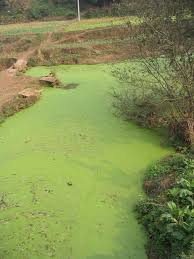
Major N/P sources
Discharge from sewage treatment plants, animal waste from CAFOS, synthetic fertilizer from ag. fields and lawns.
Oligotrophic Waterways
Waterways with low nutrient (N/P) levels, stable algae pop, and high dissolved oxygen. Can be due to lack of nutrient pollution or age of the body of water. Aquatic ecosystems naturally undergo succession (oligotrophic to mesotrophic to eutrophic)
Hypoxia
This is a decrease in dissolved oxygen. This causes a dead zone. Waterways with this condition are called hypoxic waterways. This is bad bc all aq. requires dissolved oxygen for respiration and as dissolved oxygen decreases, fewer species can be supported (most require at least 3 ppm to survive + 6 to reproduce).
Solubility
The ability of a solid/liquid/gas to dissolve into a liquid. Example oxygen dissolving into water.
Dissolved oxygen relationshiip
Water temperature and dissolved oxygen has an inverse relationship. Increased in water temp = decrease in dissolved oxygen. Decrease in water temp = increase in dissolved oxygen.
Thermal Pollution
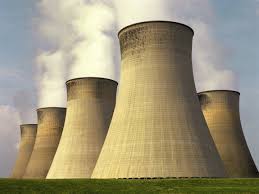
When heat released into the water has negative effects on organisms living in the water. Example: Heat increases respiration rate of aquatic organisms to pull in breaths more frequently to extract more oxygen as possible = physiological tress. Hot water can lead to less oxygen = suffocation. Sources: power plants use cool water from surface/ground water sources to cool steam used to turn a turbine back into water to reuse. Steel and paper mills also use this. Urban stormwater runoff can also cause this. Nuclear power plants require LARGE amounts of cool water to cool steam back into water and cool the reactor core.
Cooling towers
These are used to cool steam back into water and to hold warmed water before returning to local surface water. Already in nuclear power plants, but can hold warm water for a longer time to get it close to water temp.
POPS
Persistent (long-lasting) Organic (carbon-based) Pollutants. Don’t easily break down in environment = stays for a long time and can build up in organism’s fat tissue instead of passing through the body because they are fat soluble. Can be slowly released from fatty tissue and enter bloodstream and brain. Example: DDT (outdated insecticide), PCBs (plastic), PBDEs (fire proofing), BPA (plastic additive), dioxins (fertilizer prod. and combustion of waste), phthalates (plastics), and perchlorates (rocket/missile fuel, fireworks). Travel long distances, through wind and water. Can also be passed by eating animals.
DDT
This is part of POPs. Was a widely used insecticide before phaseout. Still persists in soils + sediments in aquatic ecosystems and build up in food webs.
Dioxins
Byproduct of fertilizer production and burning medical waste, FFs, and biomass. 90% of human dioxin exposure come from animal fats since dioxins buildup in fat tissue.
Medications
This is part of POPs. Steroids can pass through human bodies into sewage release from treatment plants. Persist in streams/rivers = disrupts aquatic organisms’ endocrine function.
PCBs
This is part of POPs. Additives in paint and plastics released into aquatic ecosystems by wastewater. Toxic to fish = endocrine disruption. Reproductive failure and cancer in humans.
Perchlorates
This is part of POPs. Given off by rockets, missiles, and fireworks. Especially common near military testing sites or rocket launch pads. Remain in soil = can get into groundwater or runoff into surface waters.
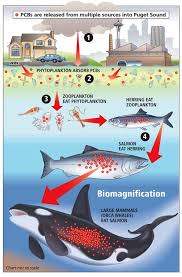
Bioaccumulation
Absorption and concentration of compounds (especially fat-soluble ones like POPs that build up in fat tissue) in the cells and fat tissues of organisms.
Biomagnification
Concentration of fat soluble compounds like methylmercury and POPs increase as they go up in the food chain. Begins in plants by entering sediments in soil. Because organisms in higher trophic levels have to eat more b/c of the 10% rule = more of this fat soluble compounds. DDT (causes thinning in eggshells of eagles and lead to massive eagle decline) is banned in many nation, but still persists in sediments of many bodies of water. Mercury → methylmercury is also taken into the food web. We can get these chemicals by eating large predatory fish.
MSW
A.K.A municipal solid waste. Waste from cities (households, business, schools, e.t.c.) Waste stream is the flow of waste to recycling centers, landfills, or trash incineration.
E Waste
Old computers, TVs, phones, tablets. Though 2% of MSW, they are hazardous waste b/c of metals and can release endocrine disruptors in landfills.
Sanitary Landfills
A.k.a. landfills. This is where develop nations dispose of trash. Types: Clay/plastic bottom liner: layer of clay/plastic on the bottom of hole in the ground = prevents pollutants from leaking out. They have low rates of decomposition due to low oxygen, moisture, and organic material. Negative effects: They can cause groundwater contamination and release GHGs (CO2 and methane), ppl don’t want landfill in their background, and usually placed in low income communities.
Waste Incineration
Waste is burned = reduces waste volume but releases air pollutants (carbon dioxide, particulate matter, SOx, NOx). Can also be used to generate electricity, and illegal ocean dumping can happen.