Chapter 9: Crags, Cracks, and Crumples: Geologic Structures and Mountain Building
 Call Kai
 Learn
Learn Practice Test
 Spaced Repetition
 Match
Match Flashcards
 Knowt Play
1/59

There's no tags or description
Looks like no tags are added yet.
Name | Mastery | Learn | Test | Matching | Spaced | Call with Kai |
|---|
No analytics yet
Send a link to your students to track their progress
60 Terms
An episode of mountain building is termed a(n) ________.
Orogeny
The majority of the Earth’s mountains occur ________.
In belts called orogens
A body of rock affected by tensile stress will likely undergo ________.
Stretching
A body of rock affected by compressive stress will likely undergo ________.
Shortening
The term for a change in shape induced by stress is ________.
Strain
Which of these is NOT one of the components of deformation?
Dissolution
How is stress different from force?
Stress is the force applied per unit area.
How is stress different from strain?
Strain is the change in shape of a rock due to applied stress.
Under which condition would a body of rock be most likely to exhibit brittle behavior?
Low temperature
Under which of these conditions would a body of rock be more likely to exhibit plastic behavior?
High temperature
Why are earthquakes on continents most likely to occur above the brittle-plastic transition depth?
Below the transition, the rocks respond to stress by changing shape without breaking
If compressive stresses acting on a rock are greatest in a north-south direction, the rock will likely deform by shortening in a _________ direction.
North-south
We can describe the orientation of planar features such as faults and joints using measurement of the _______.
Strike and dip
A geologist’s compass differs from the more widely known orienteering compass in that the geologist’s compass ________.
Can measure strike, dip and dip direction
A mineral-filled crack in a rock is termed a _______.
Vein
The distinction between joints and faults is that ________.
Faults are fractures along which displacement has occurred; displacement does not occur along joints
Movement along faults often produces a rock formed from sharply angled rock fragments termed ________.
Fault breccia
A polished surface produced by scraping of rock along a fault is termed a(n) ________.
Slickenside
In a ________ fault, the fault plane is non-vertical and the hanging wall block moves downward relative to the footwall block.
Normal
Which type of a fault is the result of deformation to accommodate tensile stresses such as those that occur during rifting?
Normal
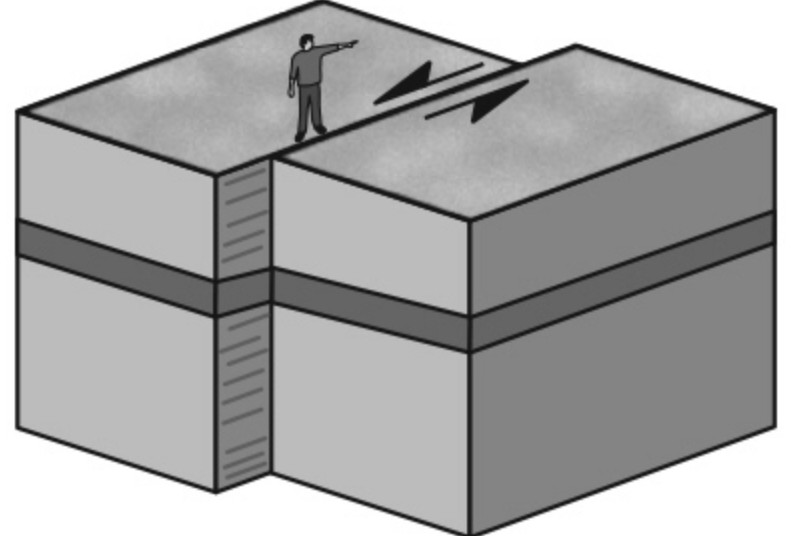
If you stand on one side of a strike-slip fault and the block on the other side of the fault has moved to your left, this is known as a(n) ________.
Left lateral fault
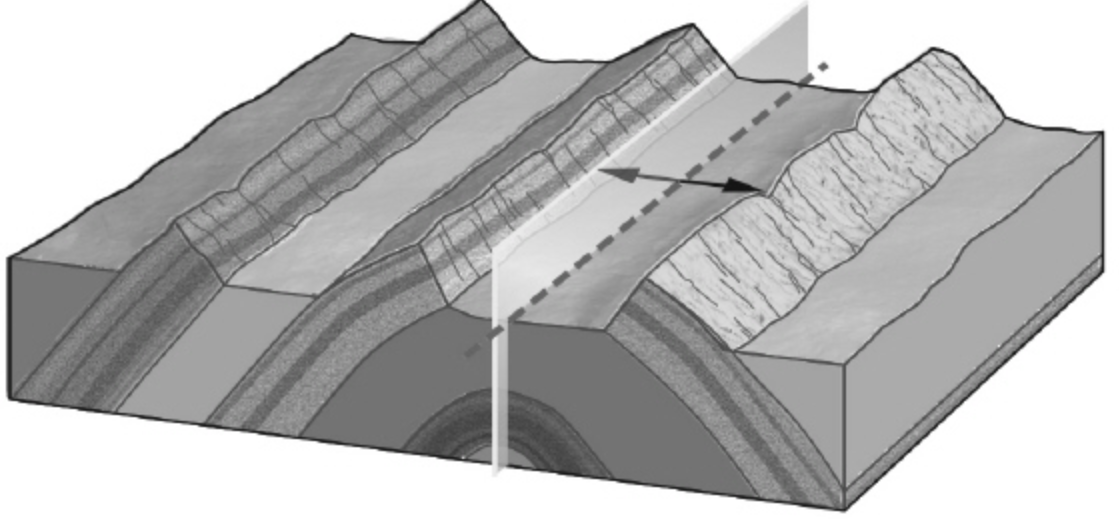
In the image, the rocks have been bent into an elongate arch. This is an example of a(n) ________.
Anticline
The portion along a fold where curvature is the greatest is termed the fold ________.
Hinge
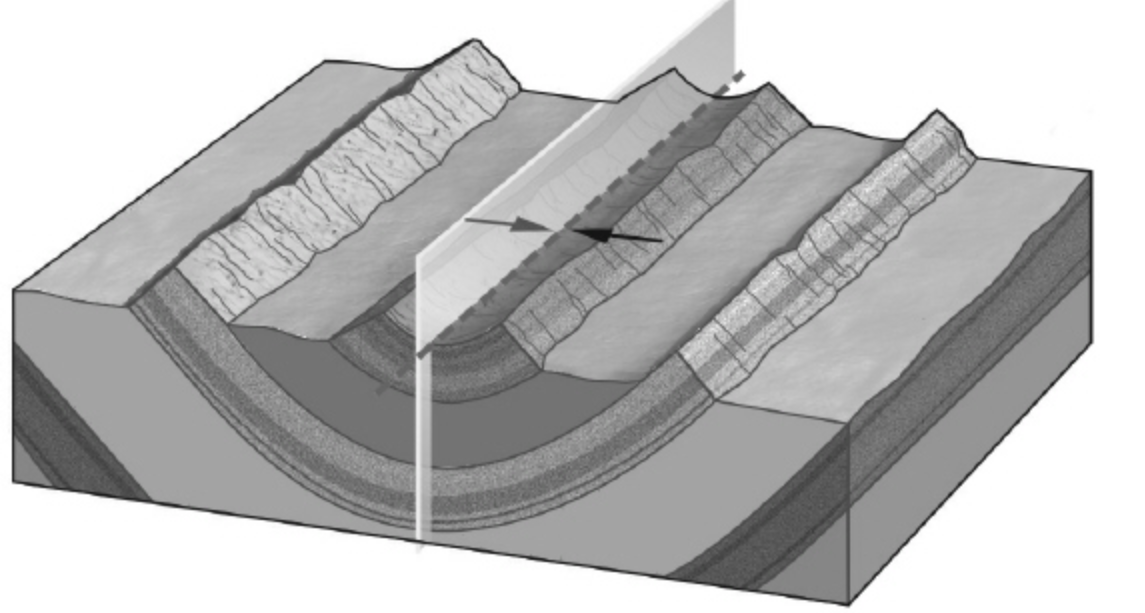
In the image, the rocks have been bent into an elongate trough. This is a(n) ________.
Syncline
On a geologic map, the beds of an eroded anticline will be _________ near the fold hinge compared to further from the hinge.
Older
On a geologic map, if the contacts between sedimentary rock units form a bull’s-eye pattern of concentric circles, with the youngest unit in the center, the underlying structure is a(n) ________.
Basin
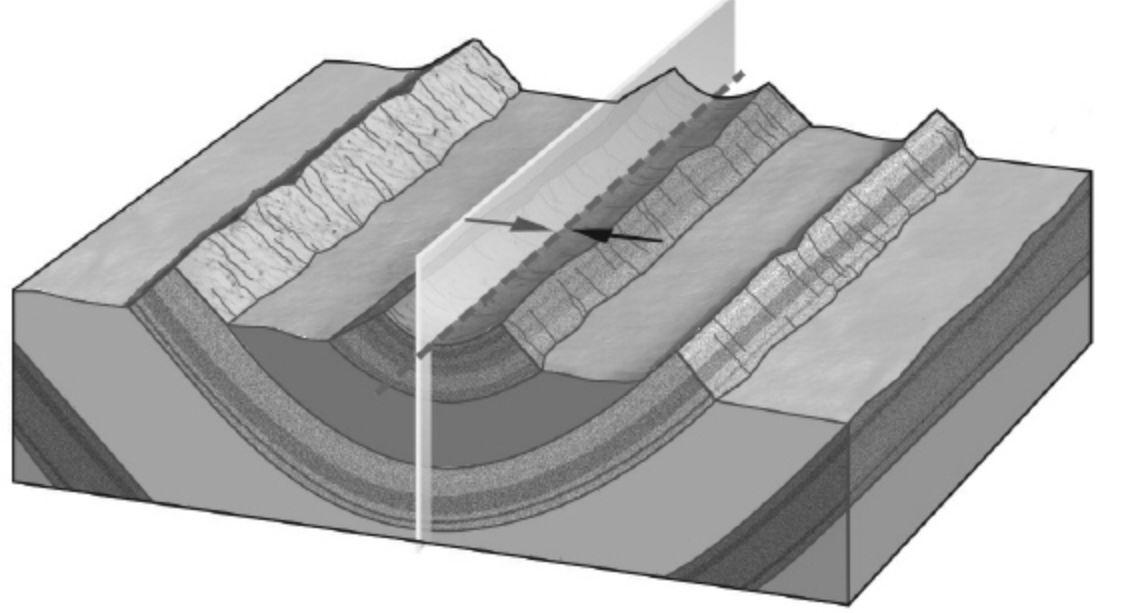
The sides of a fold, where curvature is at a minimum, are termed ________.
Limbs
Mountain ranges formed along subduction zones are formed, in part, by ___________ in the crust.
Compression
Normal faulting is most often associated with mountain building along ___________ boundaries, whereas reverse faulting is generally observed at ___________ boundaries.
Divergent; Convergent
The formation of the Basin and Range Province, a fault-blocked mountain range in Utah, Nevada, and Arizona, is associated with which of the following processes?
Continental rifting
Which of these properly illustrates the principle of isostasy?
Mountains stand high because they are gravitationally balanced by their deep crustal roots.
What is the primary reason why mountains substantially taller than Mt. Everest are unlikely to arise on the Earth?
The high geothermal gradient in the crust causes mountains to collapse under their own weight.
What can be said about a mountain range that is being uplifted at 2 cm/year but is not growing any taller?
The rate of erosion is the same as the rate of uplift.
Regions of continents that have NOT been subjected to orogeny during the past 1 billion years are termed ________.
Cratons
Regions where Precambrian metamorphic rocks are exposed at the surface are termed ________.
Shields
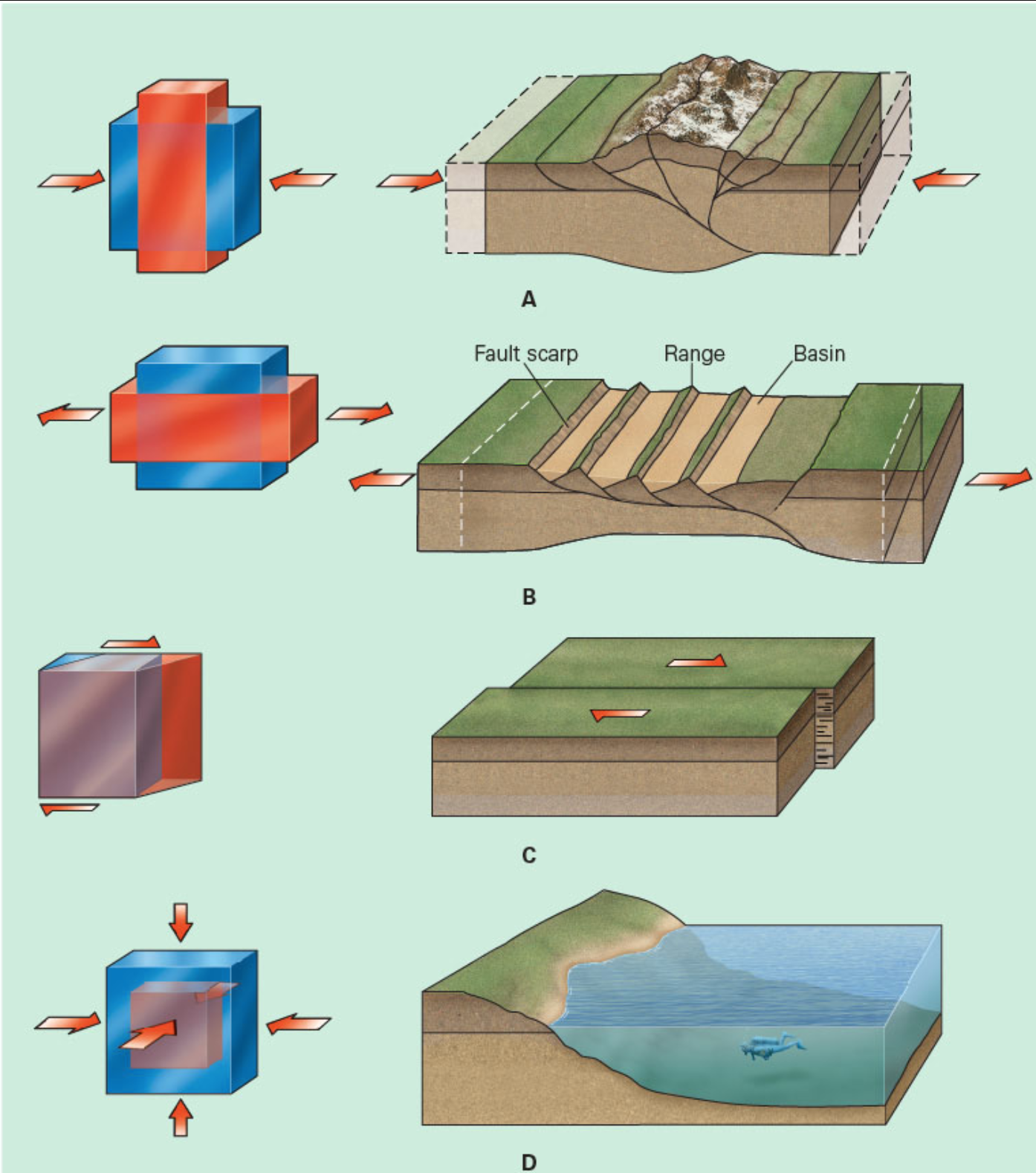
The four images below show geologic settings created by different regional stress regimes. Which of the following geologic settings would you find at a convergent-plate boundary?
A
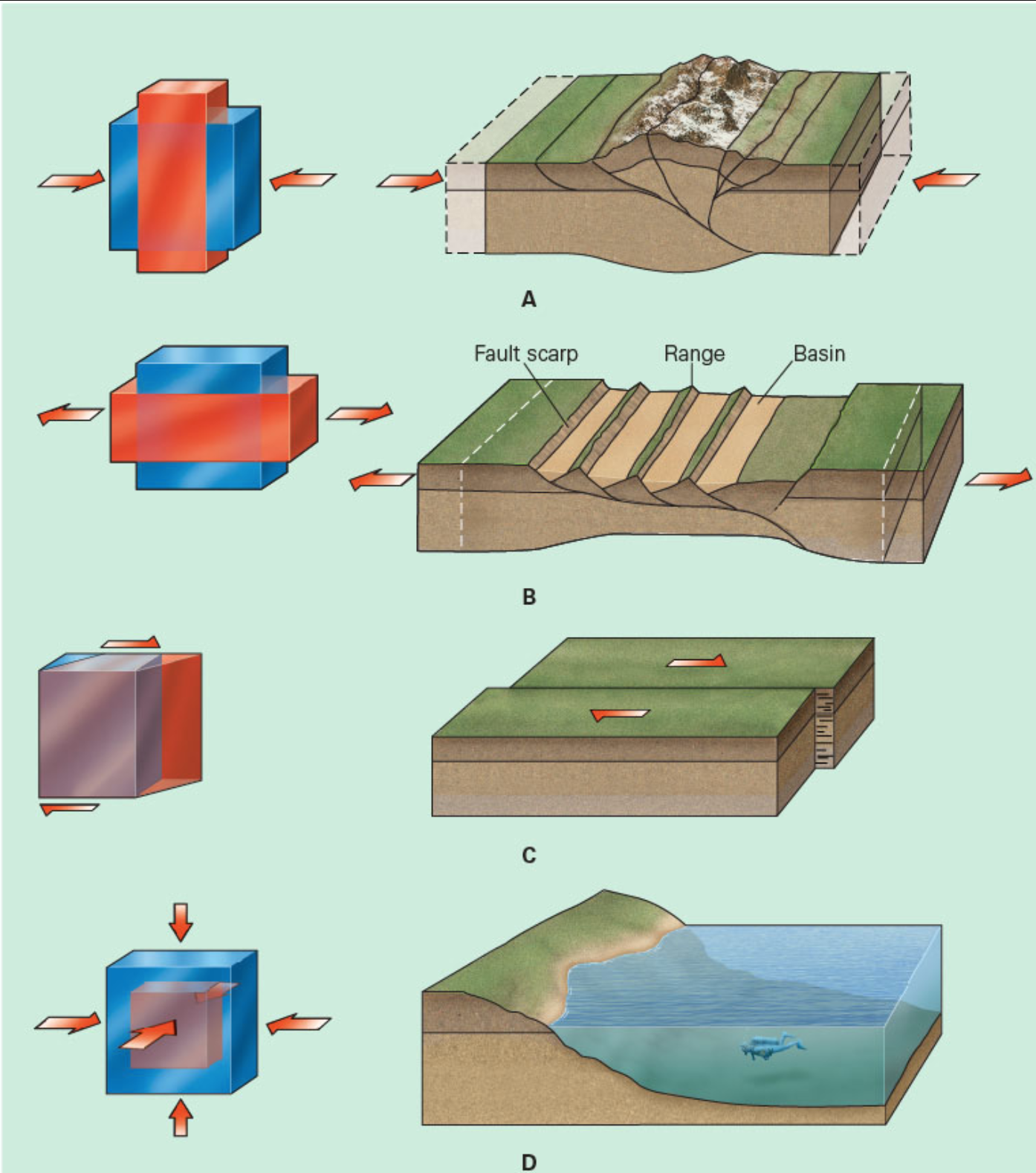
Depending on the orientation of force vectors, stress is categorized as compression, tension, shear, or pressure. Which of the following diagrams shows tension (also known as tensile) stress?
B
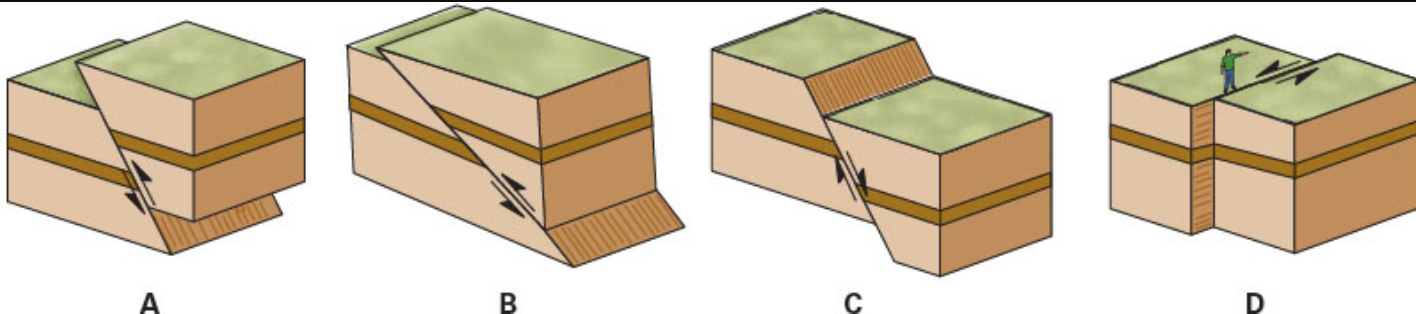
Faults are generally classified as either dip-slip, where motion occurs parallel to the dip line, or strike-slip, where motion occurs parallel to the line of strike. Which of the images shows a strike-slip fault?
D
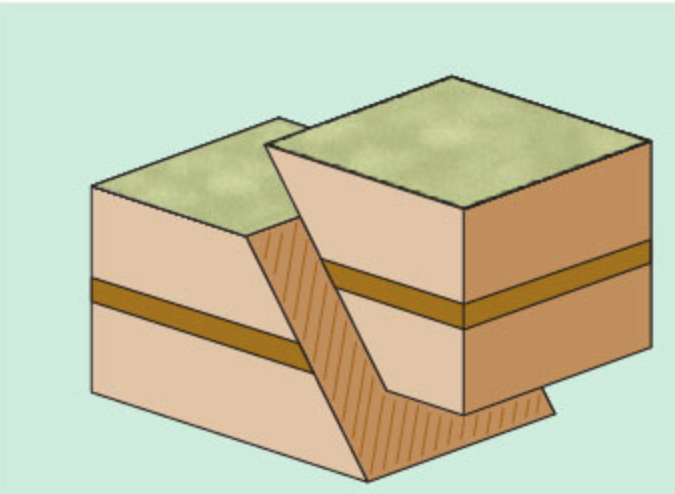
In the real world, faults rarely show exclusively strike-slip or dip-slip motion. Often, a combination of motions are experienced. What combination of motion is seen in the image?
Reverse and left lateral displacement
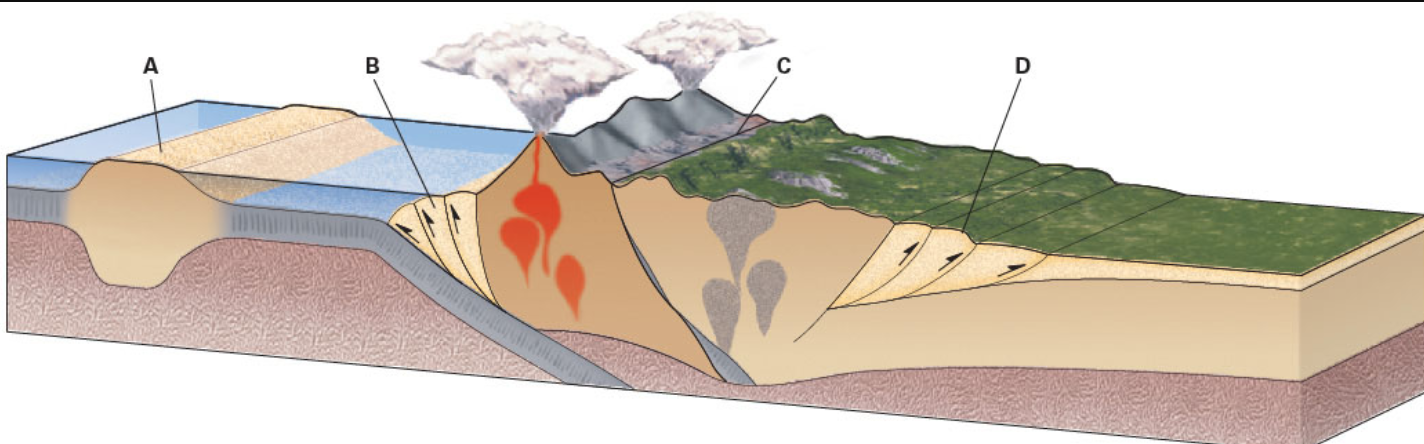
Mountain building at convergent margins produces several distinct geologic settings. The following image is a sketch of an orogeny. Where on the image is the fold-thrust belt located?
D
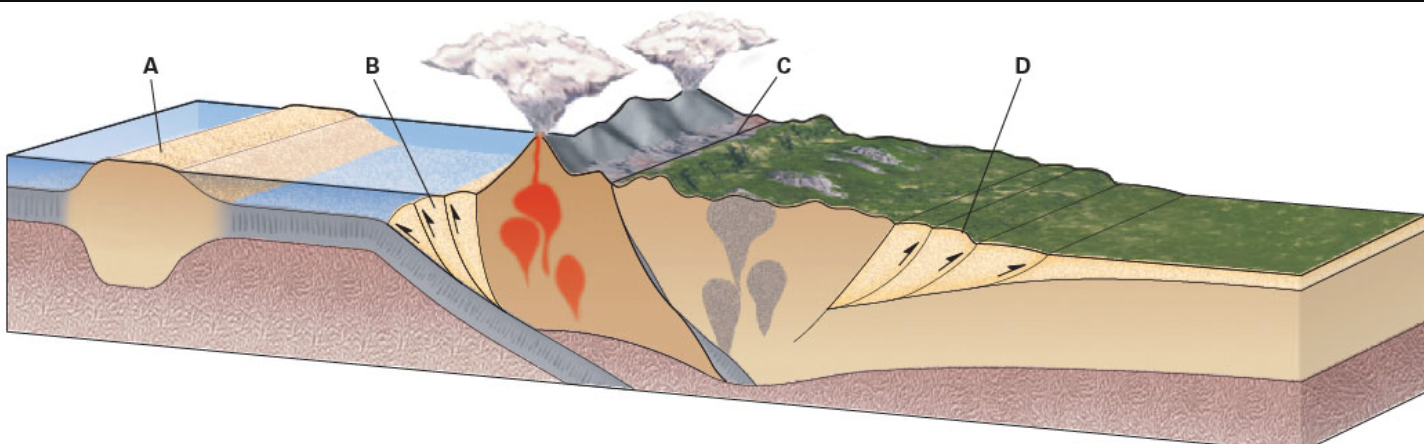
Mountain building at convergent margins produces several distinct geologic settings. The following image is a sketch of an orogeny in which one island arc has already collided with the continent. Where on the image is the suture located?
C
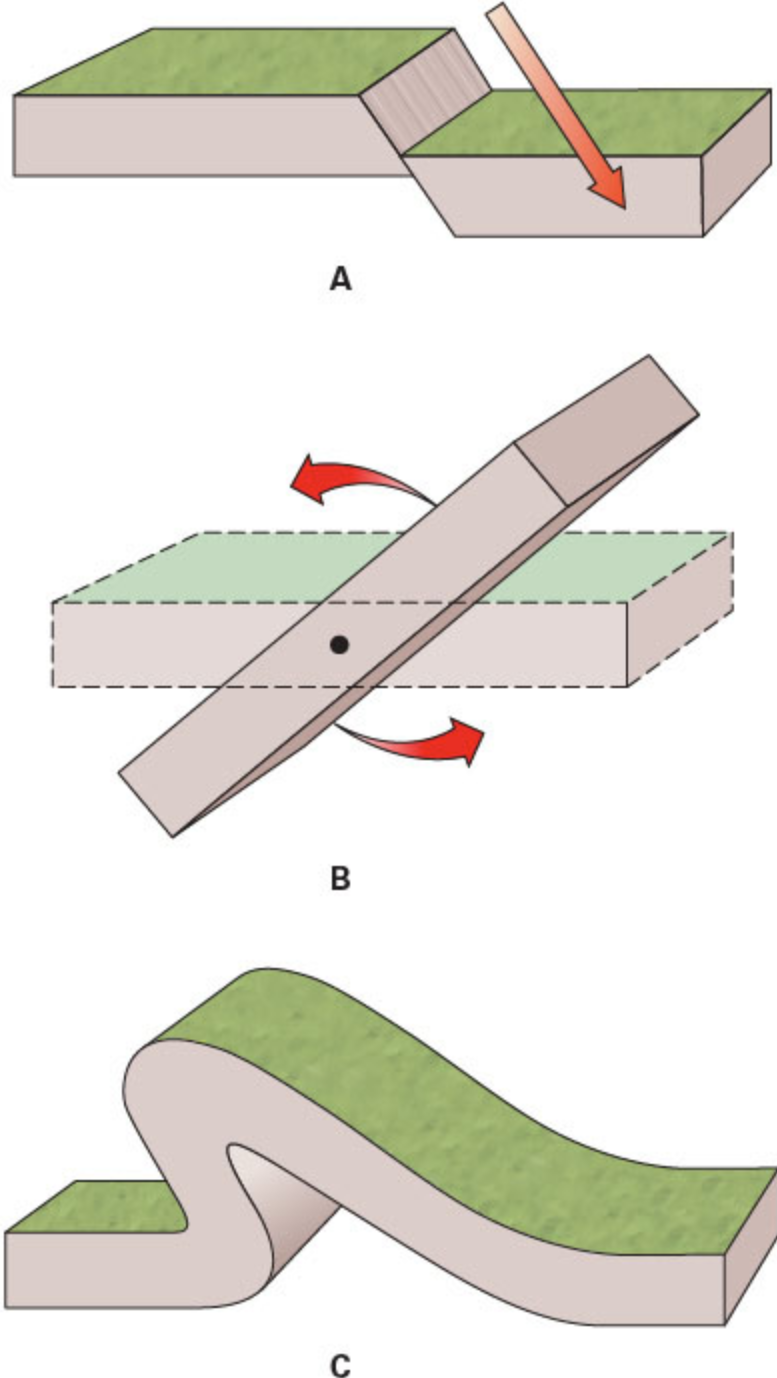
The components of deformation include displacement, distortion, and rotation. Match the component with the correct image.
A - Displacement, B - Rotation, C - Distortion
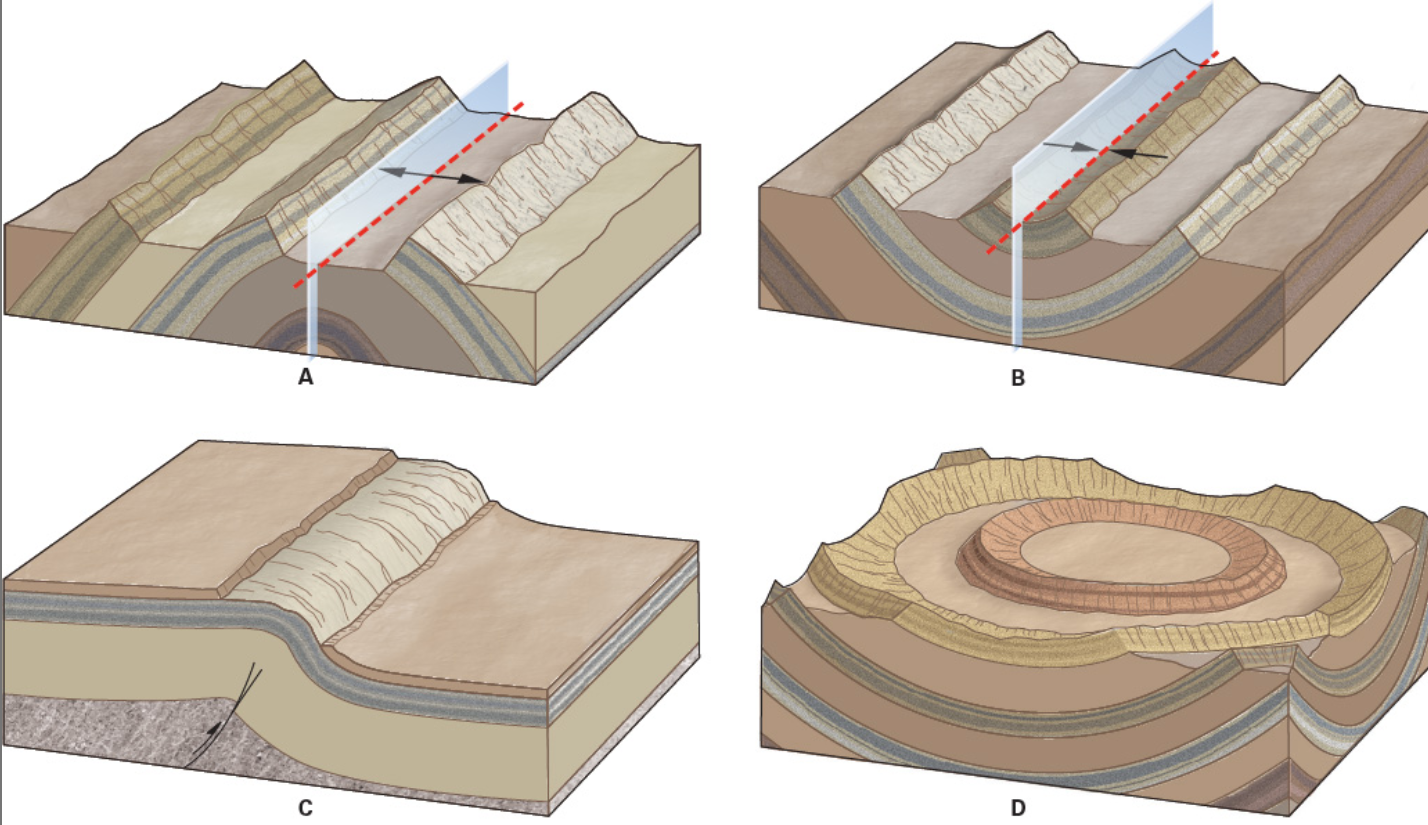
The following block diagrams all show different kinds of folds, evidence of ductile deformation. Which of the following figures shows an anticline?
A
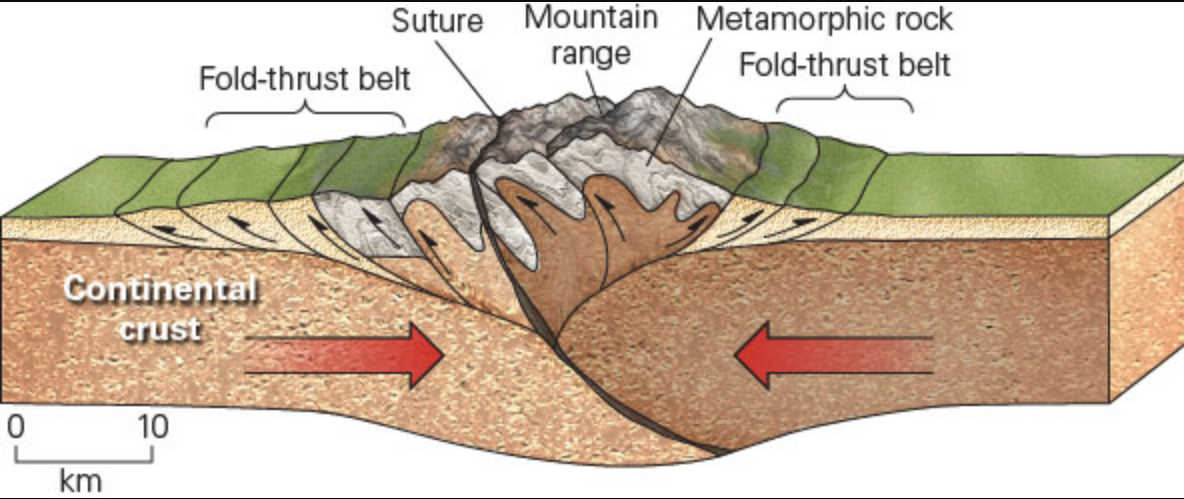
The figure shows an orogeny. Which of the following statements BEST describes the geologic setting of this orogeny?
Continental plates are colliding due to convergence, producing reverse faults and uplift.
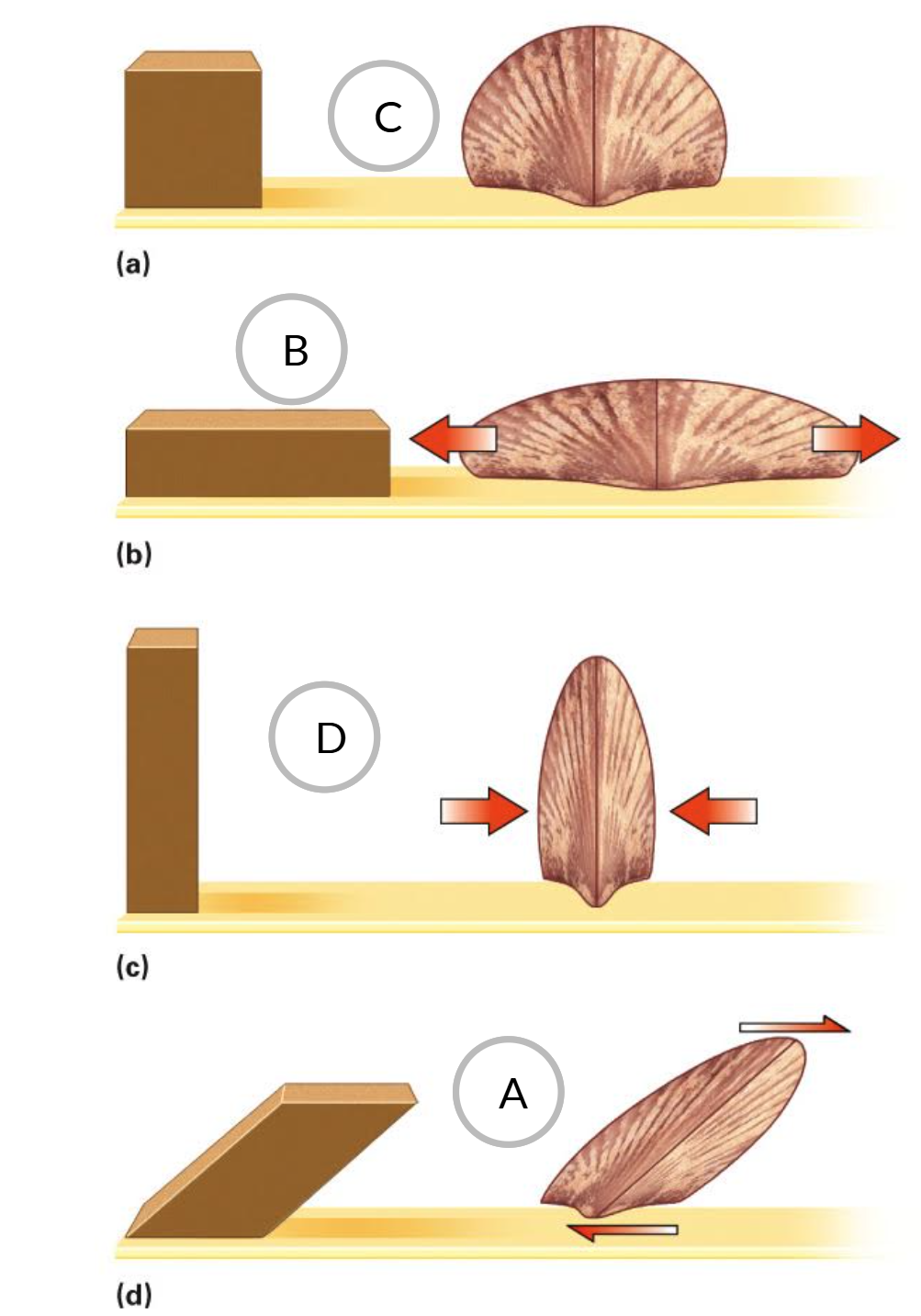
What type of strain is happening with each letter in the photo
A: Shear strain
B: Stretching
C: Unstrained
D: Shortening
What is true about brittle deformation
Brittle deformation can be preceded by small amounts of elastic deformation
During brittle deformation, rocks can break or crack into pieces.
What is true about ductile deformation
During ductile deformation, rocks can fold or bend.
Ductile deformation usually occurs at great depths and high temperatures.
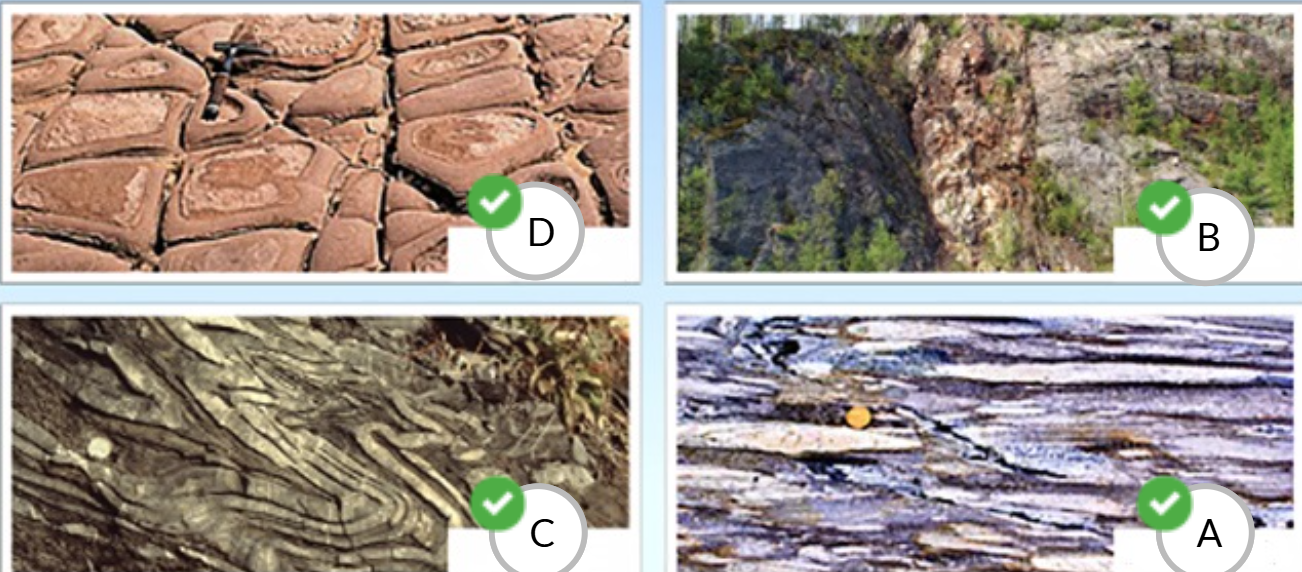
What type of rock deformation does each letter represent in the photo
A: Foliation
B: Fault
C: Fold
D: Joint
Faults are examples of what kind of rock deformation?
Brittle
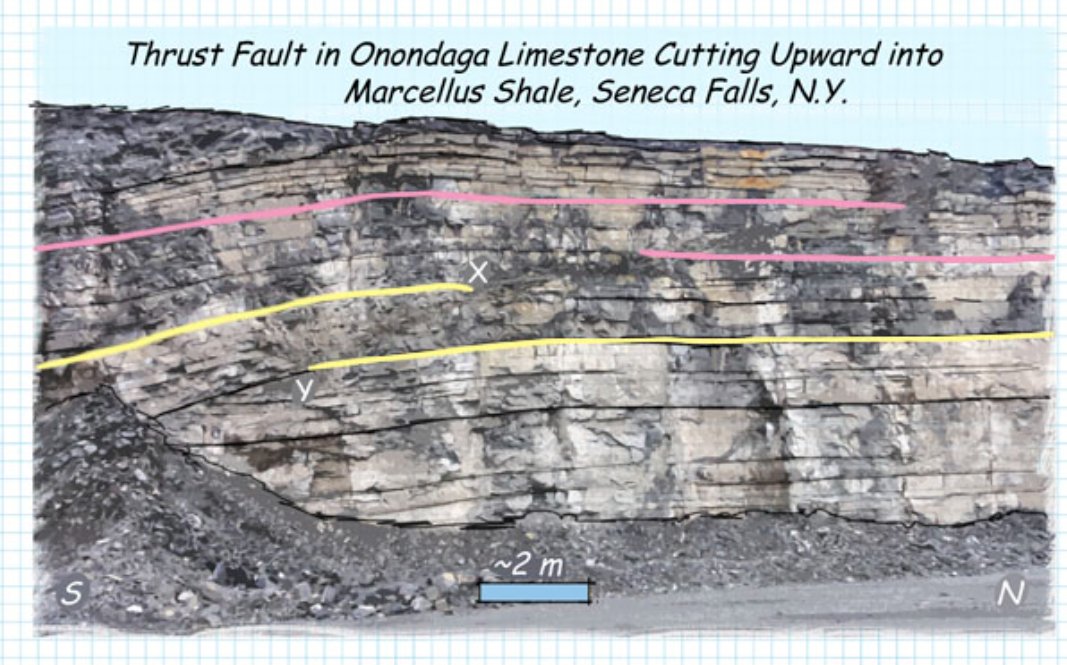
Based on looking at the offset of the beds, which type of fault is this?
Thrust fault
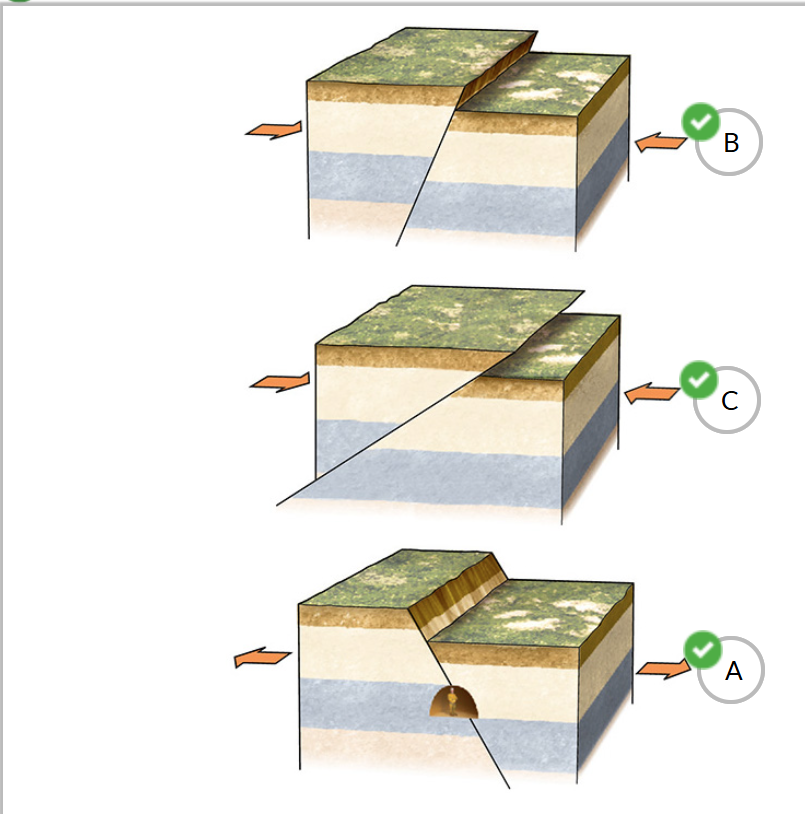
Match the three faults with their respective names.
A: Normal fault
B: Reverse fault
C: Thrust fault
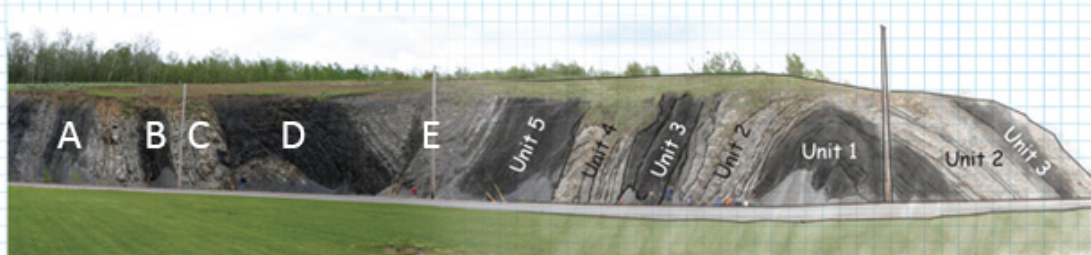
This image shows folded layers of sandstone and shale in an outcrop of the Stellarton Formation (Pennsylvanian) near New Glasgow, Nova Scotia. None of the layers is overturned. Which of the following portions of the diagram corresponds to Unit 4?
Bed C
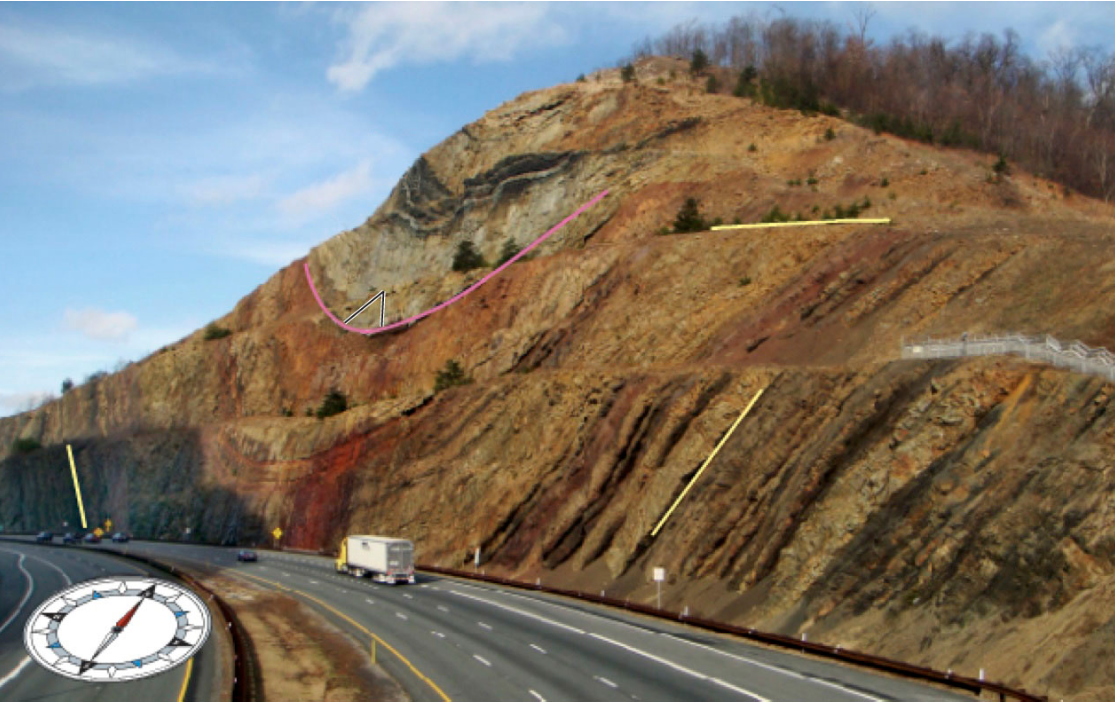
Sideling Hill, in western Maryland, is a northeast-southwest-trending ridge underlain by Paleozoic sandstone, shale, and coal. This fold formed due to the collision of Africa with North America. Note that the compass shown over the highway points approximately north. What kind of fold is this?
Syncline
Which statements are true about synclines?
They are the result of ductile deformation.
They form from compressional stress.
The limbs dip toward the hinge.
What mountains were formed by continental collision
Alps
Appalachian Mountains
Himalayas
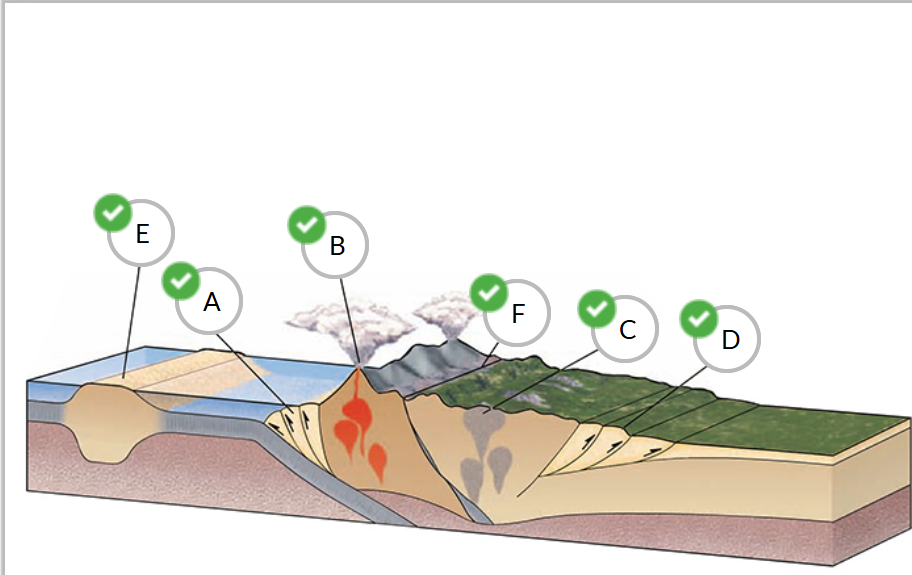
Label the diagram of a convergent-margin orogen.
A: Active accretionary
B: Active arc
C: Pluton
D: Fold-thrust belt
E: Incoming exotic terrane
F: Suture
What outcomes increase mountain building
Continental crust thickens.
Asthenosphere is compressed.
Lithospheric mantle sinks lower.
What outcomes increase in erosion
Continental crust thins.
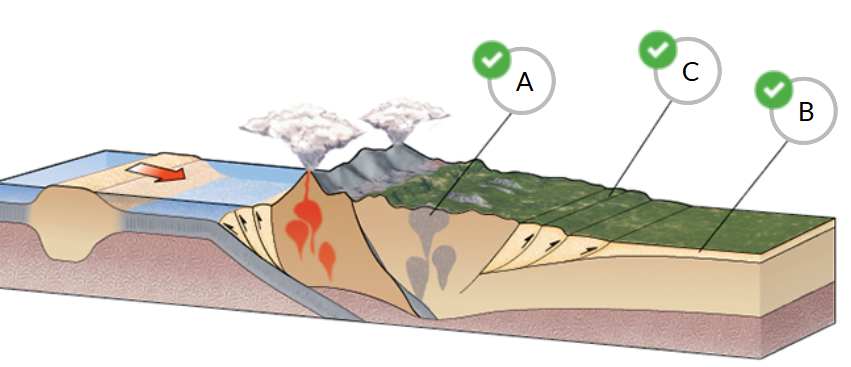
Identify where igneous, metamorphic, and sedimentary rocks would be found on the image of a mountain.
A: Igneous rocks
B: Sedimentary rocks
C: Metamorphic rocks
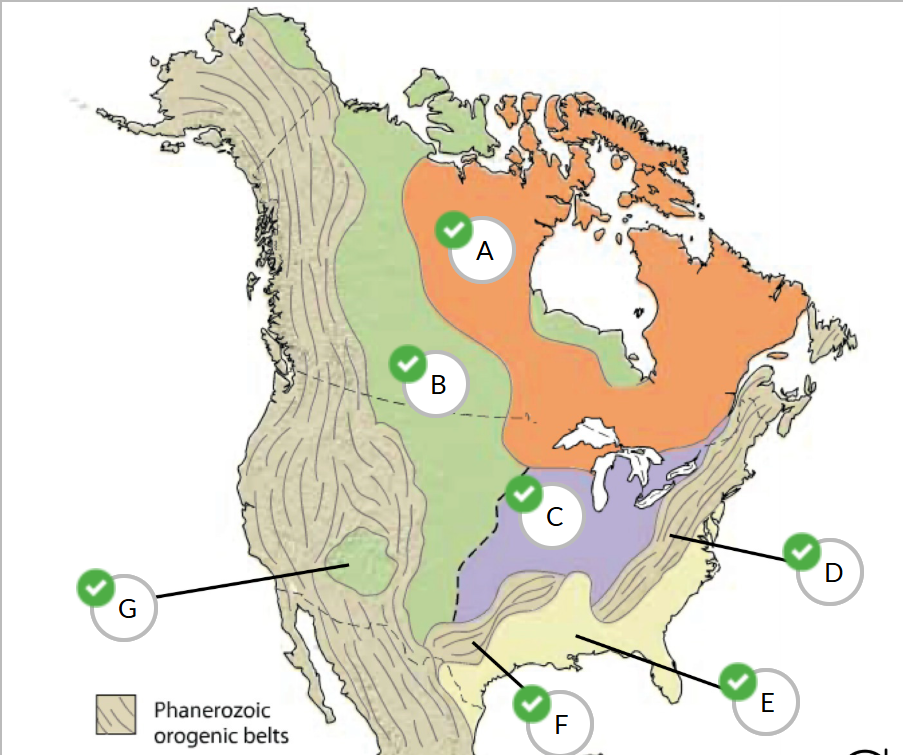
Identify North America's geologic provinces by dragging the labels to the indicated regions.
A: Shield
B: Western Platform
C: Eastern Platform
D: Appalachian
E: Coastal Plain
F: Ouachitas